
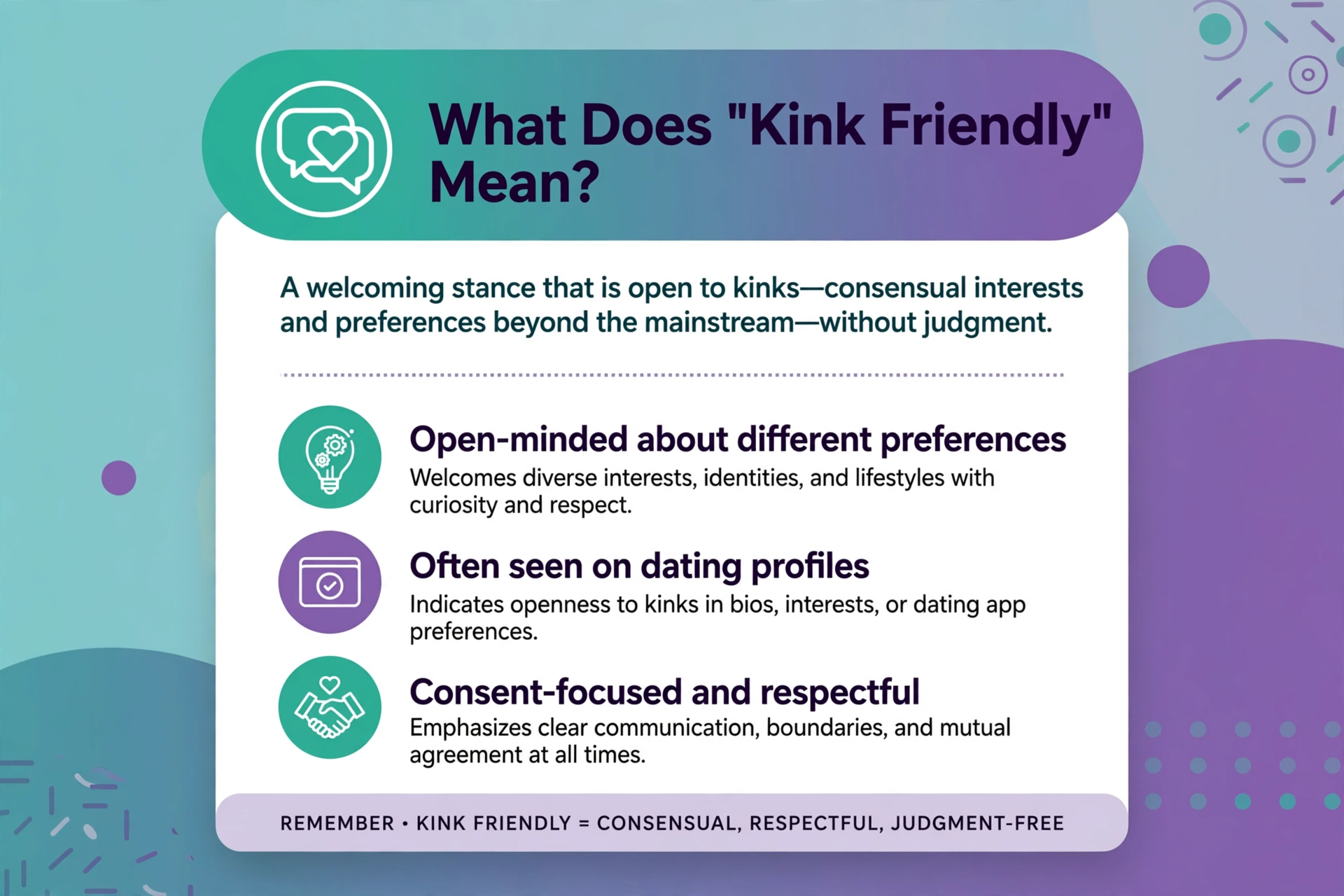
Quick definition: “Kink friendly” means open-minded and non-judgmental about kinks and unconventional sexual preferences. It is dating-profile shorthand — most common on apps like Tinder, Hinge, Bumble, and Feeld — that signals a person is comfortable talking about kinks without shame or mockery. It does not mean “up for anything”; it means “safe to talk to about this.”
Kink Friendly Meaning & Definition
If you have ever swiped through a dating profile and spotted the phrase “kink friendly” tucked into a bio, you have probably paused and wondered exactly what the person is trying to say. Here is the simple answer: kink friendly describes someone who is accepting, curious, or unbothered when it comes to kinks — the broad umbrella term for sexual interests and preferences that fall outside the conventional mainstream.
The word “kink” itself comes from the idea of a bend in an otherwise straight line: a deviation from the “norm,” not a defect. Adding “friendly” softens it into a social signal. Just as a “dog-friendly” café does not require you to own a dog — it simply means dogs are welcome — a kink-friendly person does not demand anything of you. It means the topic is welcome: no judgment, no awkwardness, no shaming.
Here is the word-by-word breakdown:
| Word | Meaning in the Phrase | What It Signals |
|---|---|---|
| Kink | Any sexual interest outside the conventional mainstream | The topic area — broad, personal, and varied |
| Friendly | Welcoming, open, non-judgmental | The attitude — acceptance, not pressure |
At a glance, here is how the term is classified:
| Attribute | Detail |
|---|---|
| Full phrase | Kink friendly (sometimes hyphenated: kink-friendly) |
| Type | Dating-profile descriptor / social slang |
| Core meaning | Open-minded and non-judgmental about kinks |
| Tone | Casual, honest, sex-positive |
| Typical users | Dating-app users (20s–40s), especially on Feeld, Tinder, Hinge, Bumble |
| Common platforms | Dating app bios, Reddit personals, FetLife profiles, Twitter/X bios |
| Formality level | Informal — dating and social contexts only, never professional |
The single most important thing to understand is the difference between openness and expectation. “Kink friendly” is a green flag about attitude, not a menu of activities. A kink-friendly person is saying: “If kinks come up in conversation, I will handle it like an adult.” They are not saying: “I expect kinks to happen.” That distinction is the entire key to reading — and using — the term correctly.
Introduction
Picture this: you are scrolling through dating profiles on a quiet evening, and one bio catches your eye. Decent photos, funny prompt answers, and then, right at the end: “kink friendly 🙂”. You stare at it for a second. Is that a proposition? A warning? A joke? You do what everyone does — you open a new tab and search “kink friendly meaning” while hoping nobody looks over your shoulder.
Welcome — you are in exactly the right place, and there is nothing to be embarrassed about. Dating slang evolves fast, and “kink friendly” is one of those phrases that migrated from niche communities into mainstream dating apps so smoothly that millions of people now see it weekly without a clear definition. It shows up in Hinge bios, Tinder profiles, Feeld listings, and Reddit personals — usually written casually, as if everyone already knows what it means.
The good news is that the meaning is refreshingly wholesome at its core: it is about openness, not explicitness. A kink-friendly person is signaling that conversations about desires, boundaries, and preferences will be met with curiosity instead of judgment. In this complete guide, we will break down the kink friendly meaning in plain English, trace where the phrase came from, show you real (tasteful) examples of how it appears in profiles, compare it with similar terms like “sex-positive” and “kink-aware,” and give you practical dos and don’ts for using it yourself.
If you enjoy decoding modern dating and texting language, you will also like our guides to SMH meaning in text and NGL meaning in text — two more phrases that show up constantly in the same chats and dating conversations where “kink friendly” appears.
Origin
“Kink friendly” did not start as dating slang — it started as professional shorthand. Long before it appeared in Tinder bios, the phrase was used to describe therapists, doctors, and lawyers who were accepting of clients with unconventional sexual lifestyles. Directories of “kink-friendly professionals” (and the more specialized “kink-aware professionals”) have existed for years, helping people find counselors who would not pathologize or judge their private lives. In that world, “kink-friendly” was a badge of non-judgment — and that original sense of safe to talk to is exactly what survives in the dating usage today.
The jump from professional directories to dating profiles happened gradually through the 2010s. As dating apps normalized blunt, filter-style bios — height, star sign, “420 friendly,” “no hookups” — users needed compact ways to signal sexual compatibility without writing an essay. Communities on FetLife, Reddit’s personals subreddits, and early sex-positive blogs had already been using “kink-friendly” casually for years, and the phrase was short, clear, and PG enough to survive app moderation. It slid naturally into the bio vocabulary alongside its cousins.
The sex-positive movement gave it cultural tailwind. As public conversation around consent, communication, and sexual openness grew — through podcasts, TikTok educators, and mainstream dating advice — being “kink friendly” stopped sounding edgy and started sounding emotionally mature. On apps like Feeld, which explicitly cater to open-minded dating, it became near-standard bio language. On mainstream apps like Hinge and Bumble, it functions as a quiet filter: people who share the value recognize it instantly, while everyone else scrolls past without a second thought.
That dual quality — visible to those who know, invisible to those who don’t — is a big part of why the phrase stuck. It lets people signal compatibility discreetly, without turning their public profile into something explicit. In that sense, “kink friendly” is less a confession than a communication style: it says as much about how someone talks about intimacy (openly, respectfully, without shame) as about what they enjoy.
Popularity
Let us be honest about where “kink friendly” sits in the dating-vocabulary hierarchy: it is widely recognized among app daters under 40, but it is not universal slang like “ghosting” or “situationship.” Think of it as fluent-dater vocabulary — if someone has spent real time on dating apps, they have seen it; if they have not, it may need a one-line explanation. That middle ground is actually ideal for a profile term: specific enough to filter, common enough to be understood.
Here is a realistic look at how its popularity breaks down:
| Context | How Common Is It? | Notes |
|---|---|---|
| Feeld & alternative dating apps | Very common | Almost expected bio language in open-minded dating spaces |
| Tinder / Hinge / Bumble bios | Common | Appears regularly, especially in big-city profiles |
| Reddit personals & dating subs | Common | Standard shorthand alongside age, location, and intentions |
| FetLife & kink communities | Very common | Used more literally — openness to community norms |
| TikTok / Instagram dating discourse | Growing | Shows up in “green flag bio” and dating-advice content |
| Professional settings | Never appropriate | Keep it strictly in dating/social contexts |
| Among older / offline daters | Rare | Many have never encountered the phrase |
Search interest in the kink friendly meaning has been steady rather than spiky — people look it up because they keep encountering it in real profiles, not because of one viral moment. That is the signature of durable slang: it earns its place one conversation at a time. As dating culture keeps rewarding honesty about compatibility — and as app bios keep getting more direct about what people actually want — compact, judgment-free signals like “kink friendly” are only becoming more useful.
How It Is Used
“Kink friendly” is a profile descriptor first and a conversation term second. You will almost always see it written rather than spoken — sitting in a bio, an “about me” section, or a personals post. Its job is to do quiet filtering work before a conversation even starts: it tells compatible people “you are safe here” and tells incompatible people nothing at all.
Here are the most common ways people use the phrase in real dating life:
- In dating app bios: The classic placement. Usually appears near the end of the bio as a one- or two-word tag: “Adventurous, sarcastic, kink friendly.” Sometimes paired with related signals like “sex-positive” or “ENM friendly.”
- As a compatibility filter: People include it the way they include “dog person” or “420 friendly” — a quick compatibility checkpoint. Readers who share the value feel invited; readers who don’t simply move on.
- In personals posts: On Reddit personals or Craigslist-style listings (where they still exist), “kink friendly” in the headline sets expectations for the kind of conversation the poster welcomes.
- As a conversation opener: Seeing it in someone’s bio gives matches a natural, low-pressure way to raise the topic: “I saw you’re kink friendly — I’m still figuring out what that means for me, is that okay?”
- In community spaces: On FetLife or at munches and meetups, “kink friendly” can describe venues, events, or groups — meaning newcomers and questions are welcome without judgment.
- As reassurance: In early dating chats, someone might say “just so you know, I’m kink friendly” to signal that a partner can share preferences honestly without fear of a disgusted reaction.
Tone matters. On a profile, “kink friendly” reads as confident and emotionally mature — it suggests someone who communicates well about intimacy. Dropped into a first message to a stranger (“hey, are you kink friendly?”), it can read as pushy or presumptuous, because it skips the rapport the phrase assumes. As a bio line, it is a green flag; as an opener, it can be a red one. Context is everything.
Capitalization and punctuation are flexible — “kink friendly,” “kink-friendly,” and “Kink Friendly” all mean the same thing. It is sometimes abbreviated in very casual spaces, but unlike acronyms such as LOL, it has no standard short form; people write it out because the full phrase is already compact.
Examples
Nothing clarifies a dating term faster than seeing it in the wild. Below are realistic, tasteful examples of “kink friendly” across different tones and contexts.
Friendly Examples
These are the everyday, warm uses — the way the phrase actually appears in profiles and kind conversations.
| Profile / Chat Snippet | What Is Happening |
|---|---|
| Hinge bio: “Fluent in sarcasm, terrible at bowling, kink friendly 🙂” | Classic bio placement — casual, confident, one tag among many |
| Feeld profile: “Curious, communicative, kink friendly. Let’s talk about what we like.” | Emphasis on communication — the phrase doing its filtering job |
| Early chat: “Just putting it out there — I’m kink friendly, so no need to be shy about what you’re into.” | Reassurance offered freely, with zero pressure attached |
| Reddit personal: “[32M] looking for something real — adventurous, kink friendly, great communicator” | Personals shorthand bundling values together |
Professional Examples
Let us be clear: “kink friendly” is not workplace language, and it should never appear on a LinkedIn profile or in a work chat. But “professional” here means the polished, careful end of the spectrum — therapists, dating coaches, and advice columnists who use the term in its original, clinical sense.
| Snippet | What Is Happening |
|---|---|
| Therapist directory: “Kink-friendly practice welcoming diverse relationship styles” | The term’s original professional use — signaling non-judgment to clients |
| Dating coach: “Being kink friendly mostly means being a good listener without flinching.” | Reframing the phrase as a communication skill, not a lifestyle claim |
| Advice column: “If a date says they’re kink friendly, take it as an invitation to honesty, not a request.” | Professional guidance on reading the term correctly |
The takeaway: in professional and clinical contexts, “kink friendly” keeps its oldest meaning — you will not be judged here. That is worth remembering, because it is the exact same promise the dating-bio version makes.
Funny Examples
Like all dating slang, “kink friendly” gets memed. These are the lighthearted takes you’ll see in dating humor content — still PG, still about the phrase rather than anything explicit.
| Snippet | What Is Happening |
|---|---|
| Meme caption: “His bio said ‘kink friendly’ but he panicked when I ordered pineapple on pizza” | Playfully testing how “adventurous” someone really is |
| TikTok comment: “‘Kink friendly’ is just ‘I won’t judge your Spotify Wrapped’ for dating” | Exaggerating the non-judgment angle for comedy |
| Group chat: “She put ‘kink friendly’ in her bio and all I can think is… same, I also enjoy flavored coffee” | Deliberately misunderstanding it in the most wholesome way possible |
| Dating joke: “Kink friendly: will not shame you. Will absolutely roast your fantasy football team.” | Contrasting the open-mindedness with normal playful teasing |

Comparison with Similar Terms
“Kink friendly” lives in a neighborhood full of lookalike terms, and mixing them up is the most common source of confusion. Here is how it stacks up against its closest relatives:
| Term | What It Means | How It Differs from “Kink Friendly” |
|---|---|---|
| Kink friendly | Open-minded and non-judgmental about kinks | The baseline: welcoming attitude, no specific claims |
| Sex-positive | Believes consensual sexuality is healthy and nothing to be ashamed of | Broader philosophy — covers all sexuality, not just kink; more of a worldview |
| Kink-aware | Has actual knowledge of kink practices, culture, and safety | Stronger claim — implies education and experience, not just openness (originally a professional standard) |
| Open-minded | Willing to consider new ideas generally | Much vaguer — could mean anything from food to politics; “kink friendly” is specific |
| Adventurous | Likes trying new things, often sexually | Implies active enthusiasm; “kink friendly” only promises acceptance |
| Vanilla | Prefers conventional, mainstream intimacy | The opposite end — a vanilla person is simply not into kink, which is equally valid |
| Freaky | Playful slang for sexually bold or uninhibited | More boastful and vague; “kink friendly” sounds more mature and intentional |
So when should you use “kink friendly” over the alternatives? Choose it when:
- You want to signal acceptance without pressure — it is the warmest, lowest-stakes option on the list.
- You value honest communication about desires more than any specific activity.
- You want a term that reads as mature and intentional rather than boastful.
- You are curious but still exploring — “kink friendly” welcomes beginners, while “kink-aware” implies expertise.
And when should you pick something else? If you hold a considered philosophy about sexuality, “sex-positive” says more. If you genuinely have deep knowledge of kink culture and safety practices, “kink-aware” is the more accurate — and more respected — claim. Honesty beats ambition: claim the term that matches your reality, and the right people will find you. If you want to decode more dating-profile language, our FRFR meaning in text guide covers another phrase that thrives in honest, high-energy chats.

Alternate Meanings
Outside dating, “kink friendly” (and especially “kink-friendly”) has a few established professional uses. If you ever see the phrase in a context with nothing to do with dating profiles, one of these is almost certainly what it means:
| Alternate Meaning | Field | Example Context |
|---|---|---|
| Kink-friendly therapist / doctor / lawyer | Professional services | “Find a kink-friendly therapist near you” — a practitioner who won’t judge unconventional lifestyles |
| Kink-friendly business or venue | Hospitality / events | “A kink-friendly resort” — a venue welcoming to open-minded adult guests |
| Kink-friendly (dating profile) | Dating / social slang | “kink friendly 🙂” in a Hinge bio — the meaning this guide covers |
Notice the common thread: in every usage, the phrase means “you are safe and welcome here.” Whether it is a therapist’s directory listing or a dating bio, “kink friendly” is fundamentally a promise of non-judgment. That consistency is rare in slang — and it is why the term earned trust across such different worlds.
Professional or Polite Alternatives
Sometimes you want to signal the same openness in softer, more universally understood language — for example, on a mainstream app where “kink friendly” might feel too direct, or in a conversation where you want to ease the topic in gently. Here are polished alternatives:
| Instead of “Kink Friendly,” Try… | Best For | Example |
|---|---|---|
| “Open-minded” | Mainstream apps, early chats | “I’m pretty open-minded — happy to talk about anything” |
| “Sex-positive” | Bios with a values-forward tone | “Sex-positive and a great communicator” |
| “Judgment-free” | Reassuring a nervous match | “This is a judgment-free zone, promise 🙂” |
| “Curious and communicative” | Signaling exploration + honesty | “Curious, communicative, and up for honest conversations” |
| “Adventurous” | Playful, light bios | “Adventurous in every sense of the word” |
| “Let’s talk about what we like” | Direct but classy invitation | Ends a bio with an open door, no labels needed |
A useful rule of thumb: match the room. On Feeld or in kink-positive spaces, “kink friendly” is perfectly calibrated — direct and understood. On a mainstream app where you are unsure of your audience, “open-minded” or “judgment-free” delivers 90% of the signal with zero risk of misunderstanding. The underlying message is identical; only the packaging changes.
Common Mistakes
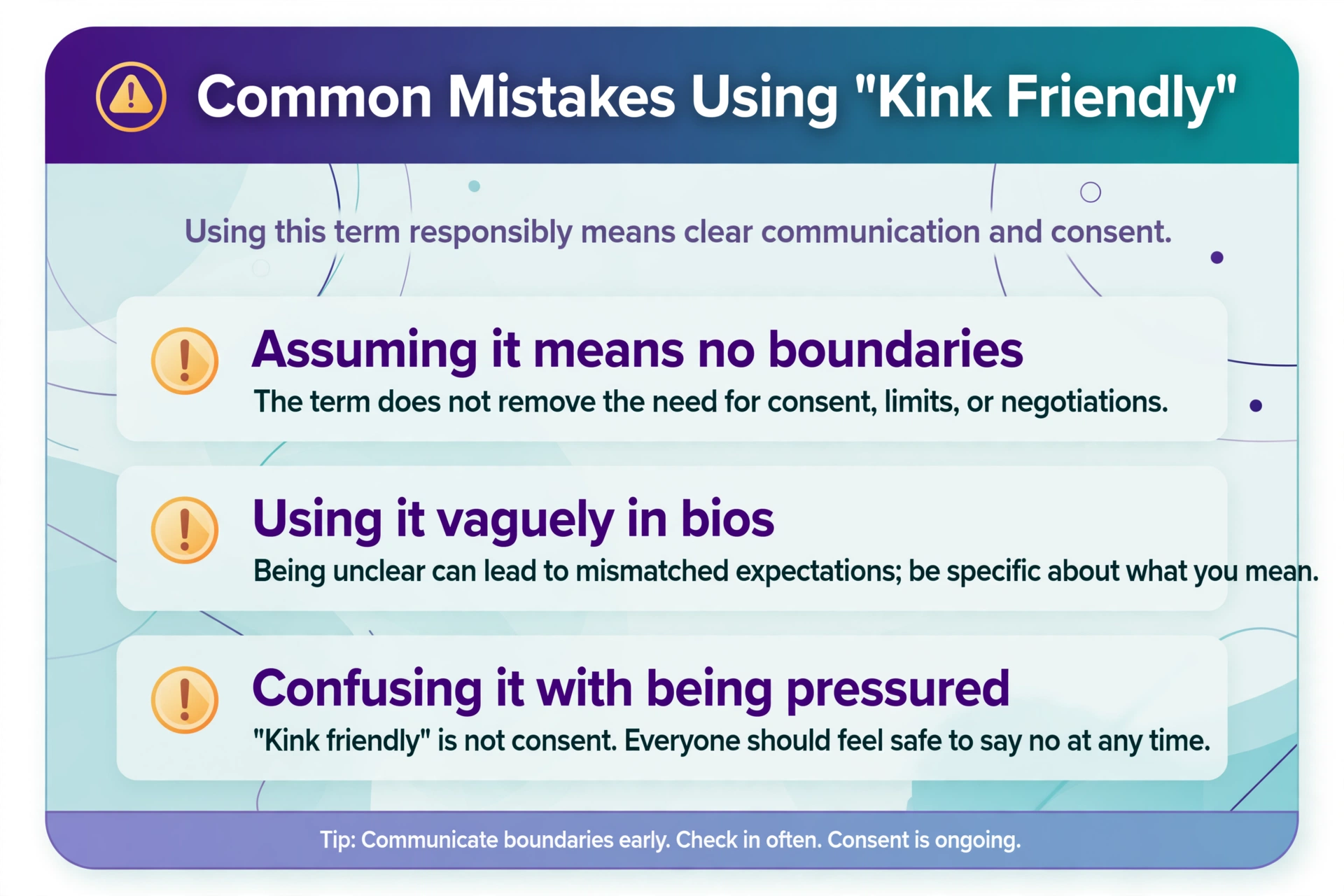
The phrase is simple, but people misread it constantly. Here are the mistakes to avoid:
- Assuming it means “up for anything.” The biggest and most important mistake. “Kink friendly” signals openness to conversation, not consent to activities. Treating it as a green light for explicit demands is the fastest way to prove you misunderstood it.
- Using it as a first-message opener. “Hey, are you kink friendly?” to a stranger skips every step of rapport. As a bio line it is confident; as a cold opener it reads as presumptuous.
- Demanding details immediately. If someone’s bio says “kink friendly,” that is not an invitation to ask “so what are you into?” in your second message. Let the topic surface naturally, the way any personal topic should.
- Putting it somewhere professional. Worth stating plainly: this phrase belongs in dating contexts only. It should never appear on a résumé, LinkedIn, work Slack, or any professional profile.
- Confusing it with “kink-aware.” “Friendly” promises attitude; “aware” promises knowledge. Claiming awareness you don’t have — especially around safety — can genuinely mislead people. Stay in your lane.
- Assuming everyone knows it. Plenty of lovely, open-minded people have simply never seen the phrase. If a match seems confused, a one-line explanation (“it just means I’m open-minded and non-judgmental about that stuff”) clears it up instantly.
- Using it performatively. Adding “kink friendly” to seem edgy while actually being judgmental about unconventional preferences will backfire the moment a real conversation starts. Only claim it if you mean it.
Quick Tips
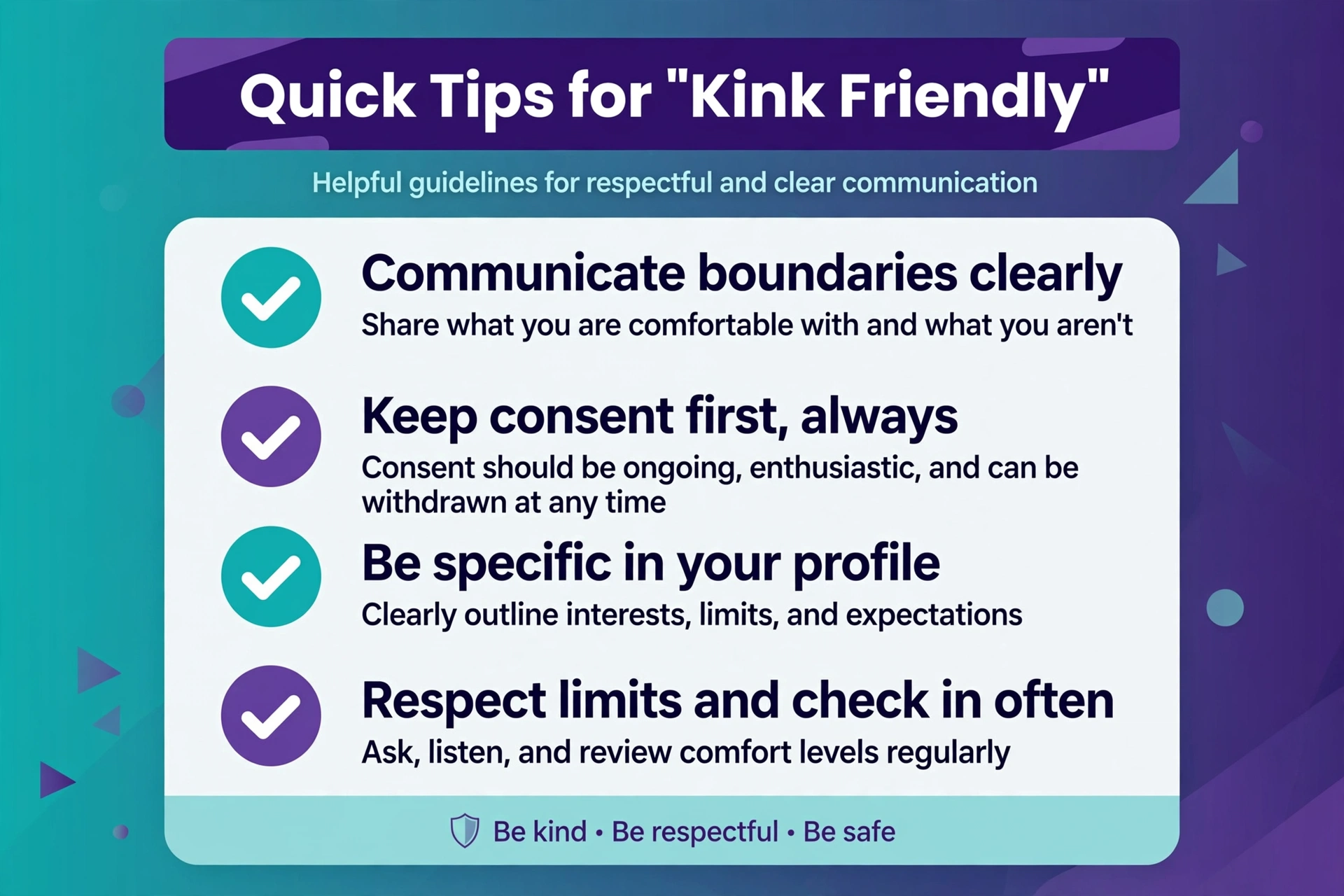
Want to use or interpret “kink friendly” like someone who truly gets it? These quick tips will get you there:
- ✅ Do read it as “safe to talk to” — a promise of non-judgment, not a proposition.
- ✅ Do use it in your bio if you genuinely are open-minded — it filters for compatibility.
- ✅ Do pair it with communication signals (“great communicator,” “let’s talk”) to show what you actually value.
- ✅ Do explain it simply if a match asks — one honest sentence beats a defensive paragraph.
- ✅ Do remember consent and conversation come before everything — friendliness is the starting line, not the finish.
- ❌ Don’t treat it as consent or an invitation to get explicit — openness ≠ obligation.
- ❌ Don’t open with it in a first message to a stranger.
- ❌ Don’t use it in any professional or work context, ever.
- ❌ Don’t claim “kink-aware” unless you actually have the knowledge — “friendly” is the honest beginner-friendly term.
- 💡 Pro tip: If a match’s bio says “kink friendly” and you’re curious, the classiest response is honesty about yourself: “I’m still figuring that stuff out, but I like that you’re open about it.” Vulnerability is more attractive than bravado.
FAQ
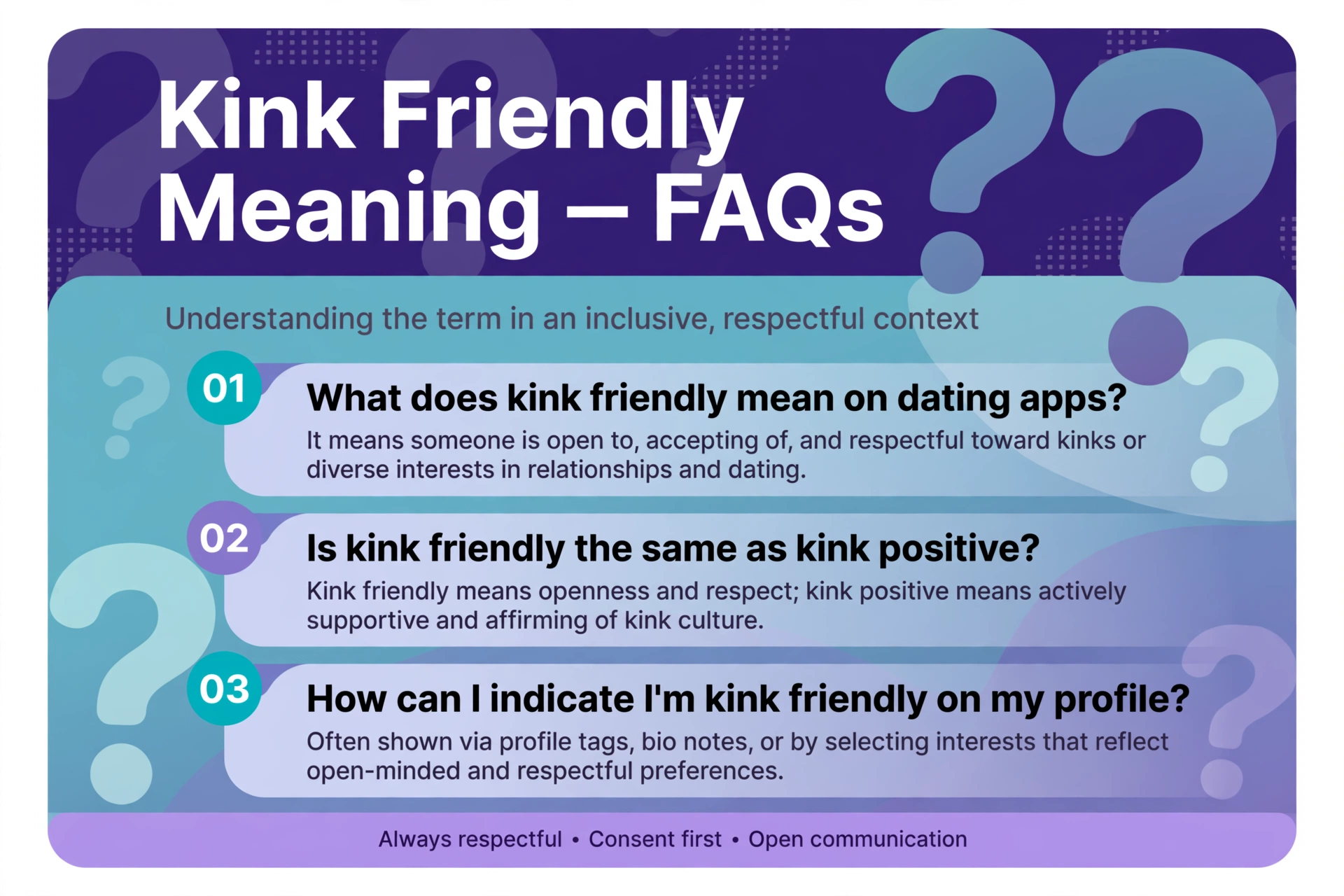
1. What does “kink friendly” mean?
“Kink friendly” means open-minded and non-judgmental about kinks — unconventional sexual preferences. It is most commonly seen in dating app bios, where it signals that the person is comfortable discussing desires honestly, without shame or mockery. It is a statement about attitude, not a list of activities.
2. Does “kink friendly” mean someone is into BDSM?
Not necessarily. It means they are open to the topic, not that they practice anything specific. A kink-friendly person might be deeply experienced, casually curious, or simply unbothered — the phrase covers all of those. Never assume specifics from the label alone.
3. Where do people write “kink friendly”?
Mostly in dating app bios (Tinder, Hinge, Bumble, Feeld), Reddit personals, FetLife profiles, and occasionally Twitter/X bios. It is written language — a profile tag — rather than something people say out loud in everyday conversation.
4. Is “kink friendly” the same as “sex-positive”?
They overlap but are not identical. Sex-positive is a broader philosophy that consensual sexuality is healthy and nothing to be ashamed of. Kink friendly is narrower — it specifically signals openness about kink. Many sex-positive people are kink friendly, but you can be one without emphasizing the other.
5. Is “kink friendly” rude or offensive?
No — it is not offensive. It is a neutral, descriptive dating term, and many people read it as a sign of emotional maturity and good communication. The only “risk” is context: it belongs in dating and social settings, never in professional ones.
6. What’s the difference between “kink friendly” and “kink-aware”?
“Kink friendly” promises attitude — openness and non-judgment. “Kink-aware” promises knowledge — real understanding of kink practices, culture, and safety. “Aware” is the stronger claim (it originated as a professional standard for therapists), so use “friendly” unless you genuinely have the expertise.
7. How should I respond if someone’s profile says “kink friendly”?
Treat it as an invitation to honesty, not explicitness. A great response is simple and self-aware: “I like that you’re open about that — I’m still figuring out my own stuff.” Don’t demand details, don’t get graphic, and don’t assume anything. Curiosity with manners wins.
8. Should I put “kink friendly” on my dating profile?
If it is true, yes — it is an excellent filter. It attracts compatible, communicative people and quietly screens out those who would judge you. Just make sure you mean it: the phrase promises non-judgment, so be ready to live up to that when conversations get honest. If you are unsure, softer alternatives like “open-minded” or “judgment-free” work too.
Conclusion
So, what does “kink friendly” mean? It means open-minded and non-judgmental about kinks — a short, confident way of saying “you can talk to me about this honestly.” In a dating world full of vague bios and mixed signals, it stands out as refreshingly direct: not a proposition, not a boast, just a promise of a judgment-free conversation.
Here are the key takeaways to remember:
- Kink friendly = open-minded about kinks — it signals attitude, not activities.
- It lives in dating bios and personals (Tinder, Hinge, Feeld, Reddit), where it quietly filters for compatibility.
- Read it as “safe to talk to,” never as consent or an invitation to get explicit.
- It differs from sex-positive (broader philosophy) and kink-aware (claims real knowledge).
- Keep it in dating contexts only — never professional ones — and only claim it if you mean it.
The next time you spot “kink friendly” in a bio, you will know exactly what it is: a green flag for communication, wrapped in three syllables. And if you are decoding more of the internet’s ever-growing vocabulary, check out our guides to WYA meaning in text and FRFR meaning in text — because the group chat and the dating app never stop inventing new words, and now you will never be the one asking what they mean.

1 thought on “Kink Friendly Meaning: The Complete 2026 Guide to This Dating Profile Term”