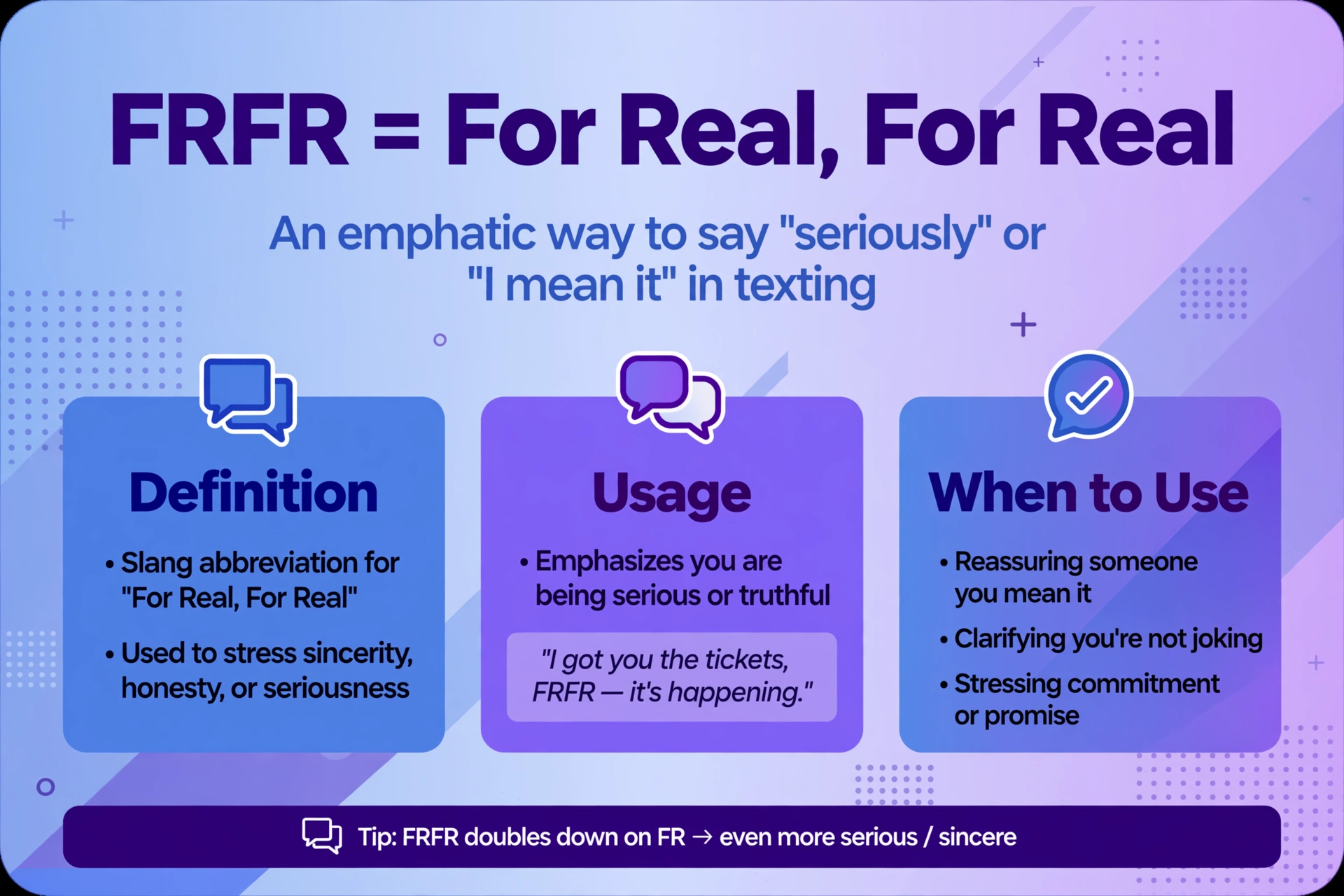
Quick definition: If you are looking up the frfr meaning in text, here it is: FRFR means “for real, for real” in texting and online slang. It is an emphatic way to say “seriously,” “I genuinely mean it,” or “I am not joking” — doubling down on honesty or strong agreement in a conversation.
FRFR Meaning & Definition
FRFR is an acronym that stands for “for real, for real.” It is used in texts, DMs, and social media comments to emphasize sincerity. When someone writes “frfr,” they are telling you they mean what they just said — no joke, no exaggeration, no sarcasm. Think of it as the digital equivalent of looking someone in the eye and saying “I swear, I really mean this.” In short, that is the frfr meaning in text.
The repetition is the whole point. “For real” already means “truly” or “seriously,” and saying it twice — for real, for real — cranks the intensity up a notch. It is emphasis stacked on emphasis, the way you might say “really, really” out loud when you want someone to believe you.
| Abbreviation | Stands For | Core Meaning | Tone |
|---|---|---|---|
| FRFR | For real, for real | I genuinely mean it | Emphatic, sincere |
| FR | For real | Seriously / truly | Casual |
| ISTG | I swear to God | I promise this is true | Intense |
Introduction
You are scrolling through your messages and a friend drops a hot take: “this is the best song of the year frfr.” Or someone confesses something wild and adds “frfr, I was terrified.” You have probably seen FRFR meaning in text conversations dozens of times, but if you have ever paused to wonder what exactly it adds to the sentence, you are not alone.
Texting slang evolves fast, and FRFR has quietly become one of the most common emphasis markers in casual digital conversation — especially among Gen Z and younger millennials. Unlike slang that names a thing or an action, FRFR is pure intensity: it upgrades whatever it touches. This guide breaks down exactly what FRFR means, where it came from, how to use it correctly, how it compares to similar slang like IMK and IDT, and the mistakes that make people look out of place when they try it.
Origin
The roots of FRFR go back to African American Vernacular English (AAVE), where “for real” has long been a staple phrase meaning “truly” or “seriously.” Saying “for real, for real” — doubling the phrase for emphasis — follows a well-established pattern in Black speech of repeating words for intensification (think “real real,” “big big,” or “long long time”).
The phrase jumped from spoken conversation into digital slang as texting culture exploded in the 2010s. The written doubling felt natural in messages because people already typed “for real for real” to sound more convincing. Hip-hop lyrics played a major role too — artists using “for real, for real” in verses helped cement the doubled form in youth culture, and by the late 2010s and early 2020s, the acronym FRFR was everywhere on Twitter, TikTok, Instagram, and Snapchat. It is a textbook example of internet slang spreading through online culture.
Like much slang that travels from AAVE into mainstream internet culture, FRFR’s exact “first use” date is hard to pin down — it emerged organically across platforms rather than from one viral moment. What is clear is that by the mid-2020s, FRFR had become a standard part of the texting toolkit, right alongside its close cousins. Knowing this background makes the frfr meaning in text even clearer.
Popularity
FRFR is now one of the most-used emphasis acronyms in casual online English, particularly in the United States. A few reasons explain its staying power:
- It fills a real gap. Text strips away tone of voice, so writers need explicit markers of sincerity. FRFR does that job in four letters.
- It is flexible. It works as a reaction (“frfr 😭”), an opener (“frfr tho, hear me out”), and a closer (“that’s just how it is frfr”).
- It pairs well with other slang. You will constantly see it combined with IMK (“imk, frfr he’s the best player on the team”) or paired with IDT for contrast.
- It survived TikTok. Countless slang terms die with a single trend cycle; FRFR kept spreading because it is useful rather than just funny.
Google search interest for “frfr meaning” has climbed steadily, and the term now appears in mainstream entertainment writing, reality TV captions, and even brand social media accounts trying to sound casual (with mixed success). It has crossed from niche slang into general internet vocabulary.
How It Is Used
FRFR functions as an emphasis adverb — it modifies whatever statement it attaches to, making it stronger and more sincere. There are three main placements:
- At the end (most common): “This pizza is elite frfr.” — stamps the opinion as genuinely felt.
- At the start: “Frfr, you need to hear this story.” — signals “I am being serious right now.”
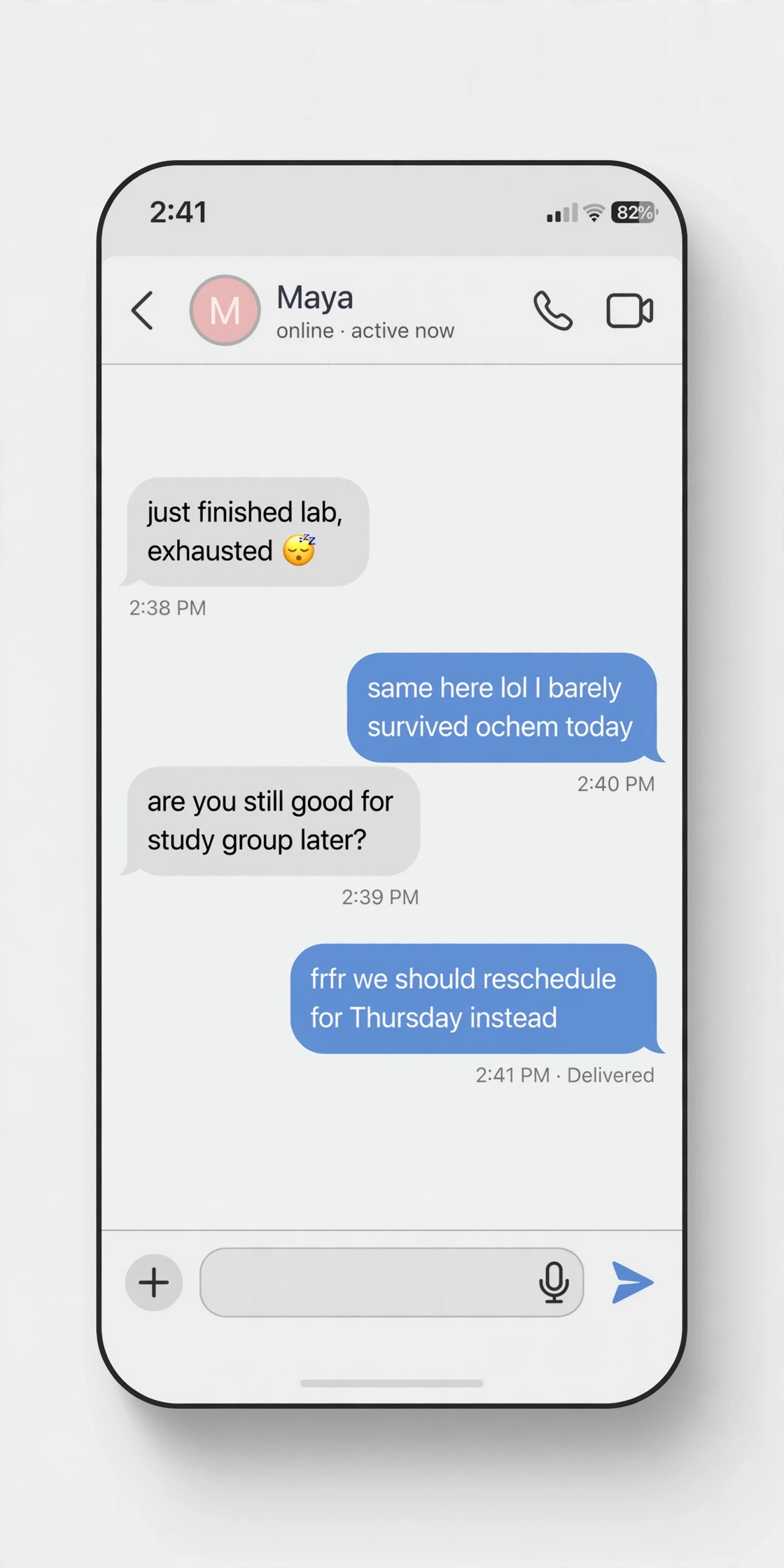
- Standalone: “Frfr.” — as a reply, it means strong agreement (“for real” as in “you’re right, seriously”).
The register is strictly casual. You would use FRFR with friends, siblings, group chats, and followers — never with a boss, a professor, or in anything formal. It also carries a slightly youthful, internet-native flavor, so in mixed-age conversations it can read as playful.
One subtlety: FRFR can emphasize both agreement and sincerity, and context decides which. “The line was so long frfr” = sincerity about the experience. Replying “frfr” to someone’s rant = agreement with their take. Same four letters, two related jobs.
Examples
Friendly Examples
- “You killed that presentation today frfr, everyone was talking about it.”
- “Frfr we need to plan the trip soon, I’m getting serious FOMO watching everyone else go.”
- Friend 1: “That plot twist broke my brain.”
Friend 2: “Frfr, I sat there staring at the screen for ten minutes.” - “I missed you frfr, this place isn’t the same without you.”
Professional Examples
FRFR has no real professional use — it is too casual for work communication. The closest you get is ultra-casual startup or creative-team chats where slang is the norm, and even there it is risky:
- Risky but seen: “Frfr this deadline is going to crush us” (Slack, close team, casual culture).
- Better alternative: “Seriously, this deadline is going to be tight.” — same emphasis, professional register.
Rule of thumb: if you would not say “for real, for real” out loud in a meeting, do not type “frfr” in a work message.
Funny Examples
- “My bank account said ‘we’re done here’ frfr 💀”
- “Frfr my dog understands me better than my group project team.”
- “This exam really said ‘surprise!’ and by surprise I mean trauma frfr.”
- Roommate: “Who ate my leftovers?”
You: “Frfr it wasn’t me” (narrator: it was them).
Comparison with Similar Terms
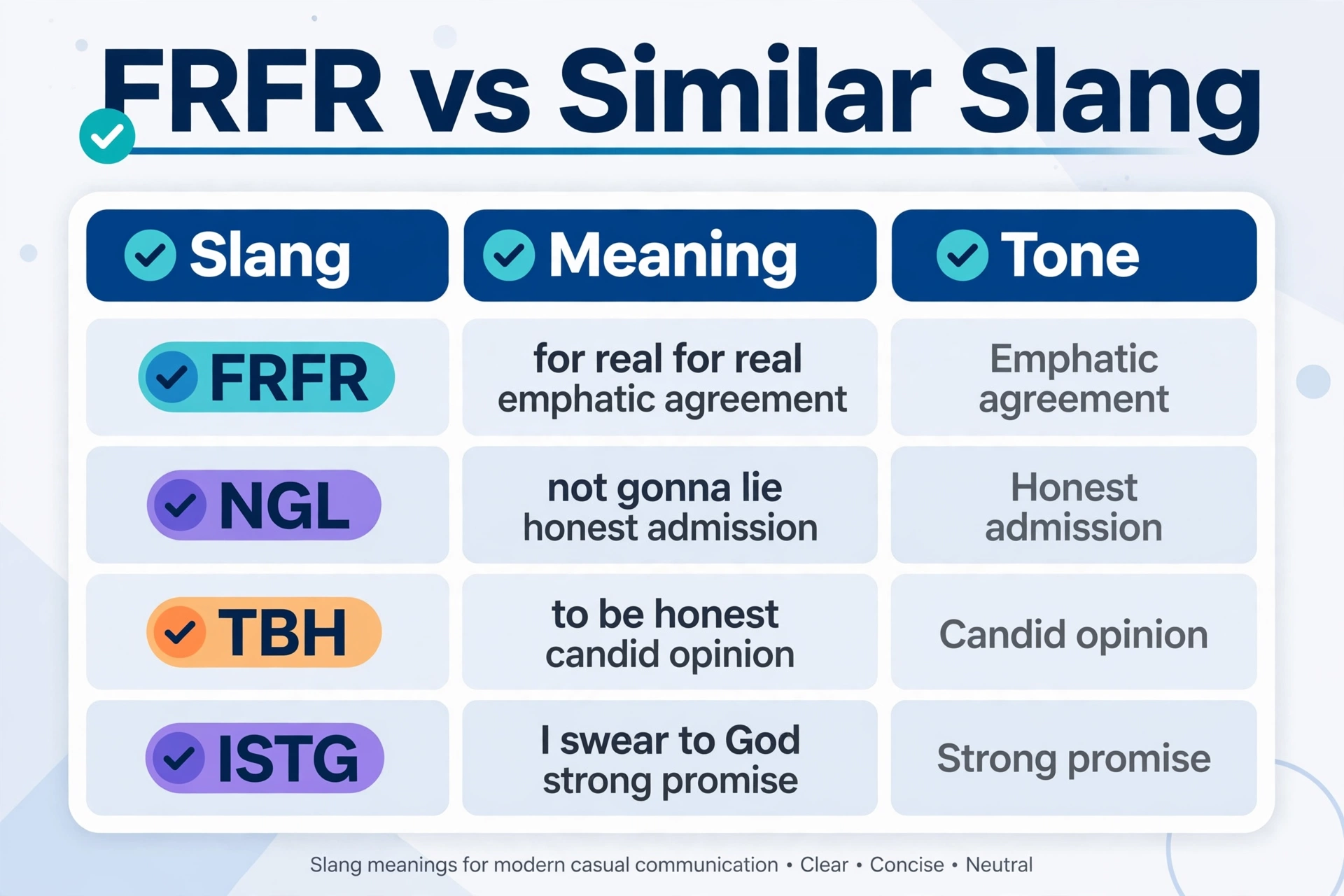
FRFR lives in a crowded neighborhood of emphasis and honesty slang. Here is how it stacks up:
| Slang | Stands For | What It Emphasizes | Example | Intensity |
|---|---|---|---|---|
| FRFR | For real, for real | Sincerity / strong agreement | “This is the best day ever frfr” | High |
| FR | For real | Seriousness (single dose) | “That was wild fr” | Medium |
| NGL | Not gonna lie | Honest admission, often blunt | “Ngl, I didn’t like it” | Medium |
| TBH | To be honest | Candid opinion | “Tbh, it was just okay” | Low–Medium |
| ISTG | I swear to God | Solemn promise, often dramatic | “Istg if he texts me again—” | Very high |
| ONG / ON GOD | On God | Swearing truthfulness | “On God, I saw it happen” | High |
The key distinction: NGL and TBH introduce honesty (usually before an opinion that might sting), while FRFR intensifies sincerity (usually after a statement to prove you mean it). ISTG is FRFR’s more dramatic sibling — use ISTG when you are borderline outraged, FRFR when you are just really, really sure.
Alternate Meanings
In texting and internet slang, FRFR almost always means “for real, for real.” But the letters can show up elsewhere with different meanings:
- French financial contexts: FR-FR is the country code for France, and you may see “fr-FR” as a language/region tag in software (French as used in France). The hyphen and context make this one obvious.
- Frequency abbreviations: In some technical writing, FR can stand for “frame rate” — but “FRFR” as a doubled form is not a standard technical term.
- Typo or stutter: Very occasionally, “frfr” is just someone accidentally doubling “fr” while typing fast. Context (and whether the sentence needs emphasis) usually reveals this.
If you see FRFR in a text, DM, tweet, or TikTok comment, “for real, for real” is the safe interpretation roughly 99% of the time.
Professional or Polite Alternatives
When the situation calls for sincerity without the slang, reach for one of these instead:
| Instead of FRFR… | Say… | Best For |
|---|---|---|
| “This is amazing frfr” | “This is genuinely amazing” | Work praise, emails |
| “Frfr, we need to talk” | “Seriously, we need to talk” | Important conversations |
| “I agree frfr” | “I completely agree” | Meetings, professional chats |
| “He’s the best frfr” | “He’s honestly the best” | References, introductions |
| “Frfr I’m so sorry” | “I truly am so sorry” | Apologies |
The pattern is simple: replace the acronym with an adverb of sincerity — genuinely, seriously, truly, honestly, completely — and you keep 100% of the emphasis with 0% of the informality.
Common Mistakes
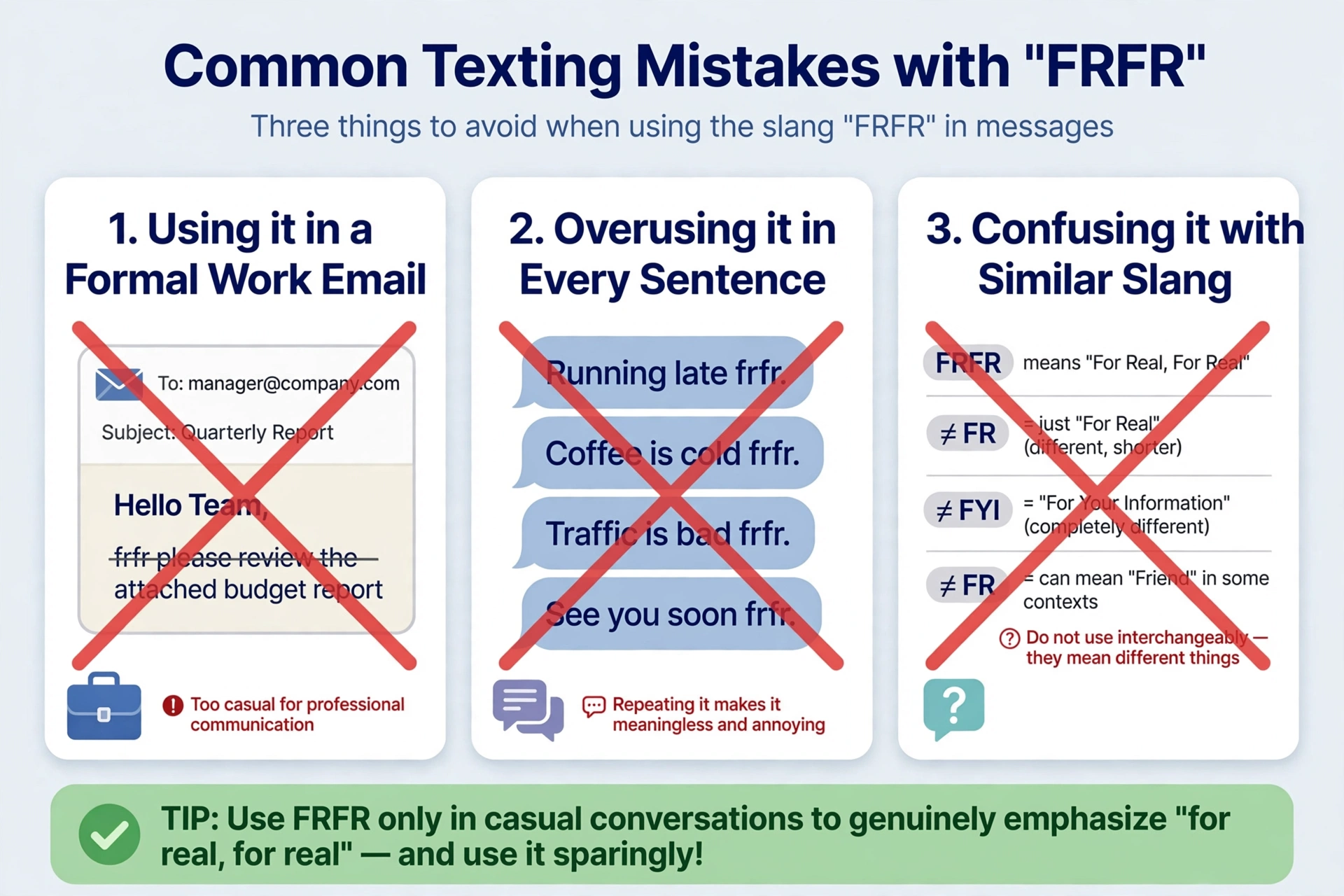
- Using it at work or school. The #1 FRFR mistake. It reads as unprofessional in emails, assignments, and formal chats — even when your tone is friendly.
- Overusing it. Drop “frfr” into every other sentence and it loses all power. Emphasis only works when it is rare. One frfr per conversation is plenty.
- Stacking it with too much other slang. “Ngl tbh istg frfr ong” is not emphasis — it is noise. Pick one intensifier per sentence.
- Using it sarcastically without a signal. FRFR means sincerity, so a sarcastic “frfr 🙄” confuses people unless your tone is unmistakable. If you must, add the emoji — but know the risk.
- Misreading a standalone “frfr.” When someone replies with just “frfr,” they are agreeing with you — not asking a question or changing the subject. Reply to the agreement, not the acronym.
- Forgetting your audience. With grandparents, older relatives, or anyone not steeped in texting slang, “frfr” is just four confusing letters. Spell it out: “for real!”
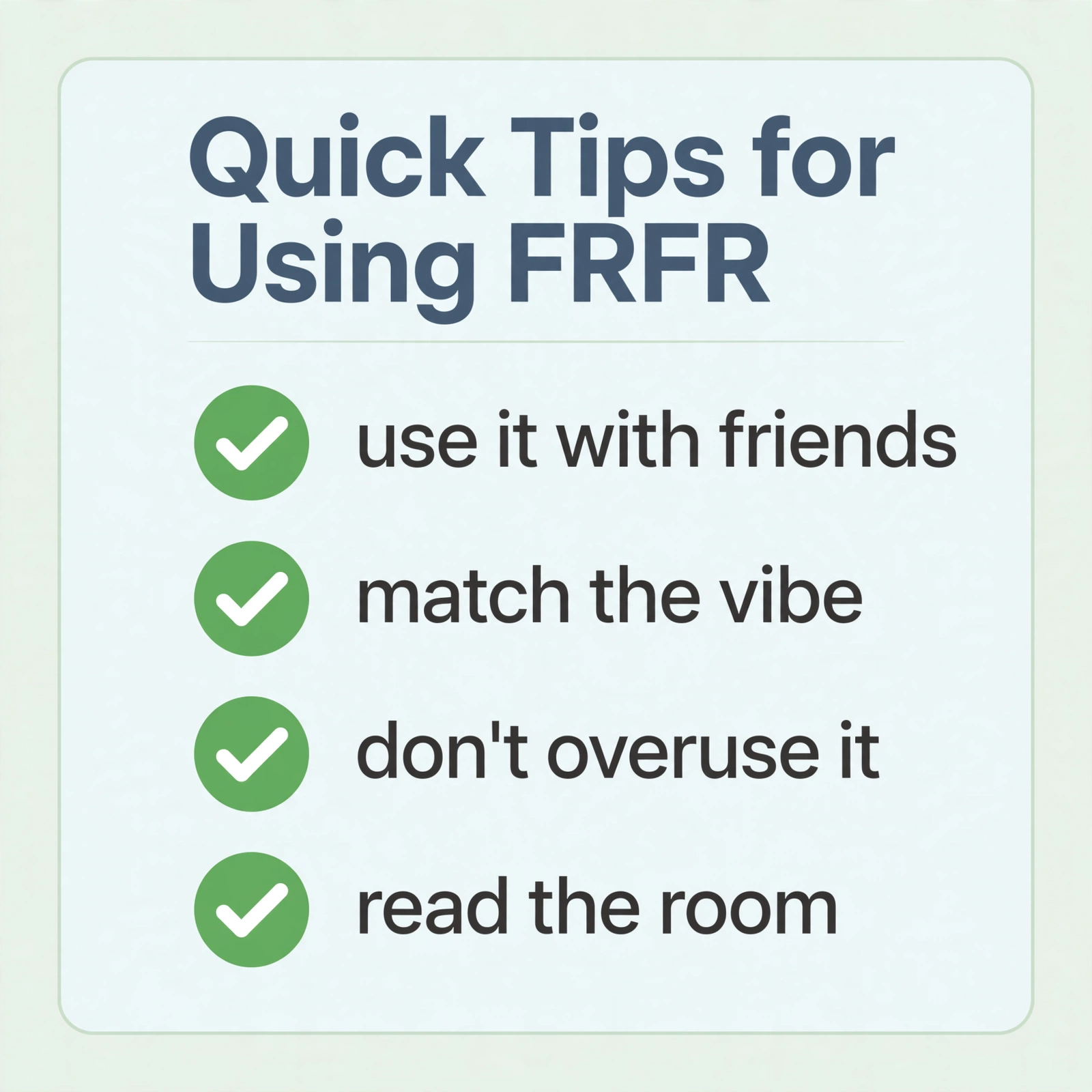
Quick Tips
- Place it at the end of the sentence for the most natural emphasis: “That movie was incredible frfr.”
- Use it to rescue sincerity when a compliment might sound sarcastic over text — “frfr” is the anti-sarcasm stamp.
- Pair it with a period for extra deadpan weight: “Frfr.” hits harder than “frfr!!!”
- Match the room: group chats and close friends = green light; mixed company = read the vibe first.
- Don’t translate it literally for non-native speakers — explain it as “I really, really mean it” instead.
- Let the sentence do the work. FRFR is seasoning, not the meal — the statement itself should be worth emphasizing.
FAQ
What does FRFR mean in texting?
FRFR stands for “for real, for real.” It is slang for emphasizing that you genuinely mean what you said — like saying “seriously” or “I really mean it” in a text message.
Is FRFR the same as FR?
Almost — FR means “for real” and FRFR means “for real, for real.” The doubled version is stronger and more emphatic. Think of FR as “seriously” and FRFR as “seriously seriously.”
How do you respond when someone says “frfr”?
If it is attached to their statement (“this show is elite frfr”), just react to the statement normally. If they reply with a standalone “frfr,” they are agreeing with you — a simple acknowledgment or a matching “frfr” back works.
Is FRFR rude or disrespectful?
No — FRFR is not rude at all. It is casual and friendly. It only becomes inappropriate in formal settings (work, school, official communication) because of its informality, not because it is offensive.
Can you use FRFR in a professional setting?
You should not. Use “genuinely,” “seriously,” or “truly” instead. FRFR belongs in texts with friends, social media, and casual group chats.
Where did FRFR come from?
It comes from the phrase “for real, for real,” rooted in African American Vernacular English, where doubling words adds emphasis. It moved into mainstream texting and social media slang in the late 2010s and early 2020s.
What is the difference between FRFR and IDT?
FRFR emphasizes sincerity or strong agreement (“I really mean this”), while IDT (“I doubt that”) expresses skepticism — they are near opposites. One says “believe me,” the other says “I don’t buy it.”
Is FRFR still popular or is it outdated?
It is still very much in use. Unlike trend-based slang that fades in months, FRFR stuck around because it serves a real function — marking sincerity in text — and it remains common on TikTok, Twitter/X, Instagram, and in everyday texting.
Conclusion
FRFR meaning in text comes down to two doubled words with one clear job: proving you mean it. Whether you are hyping up a friend’s achievement, confessing something real, or just stamping your strong agreement on a group chat take, “for real, for real” turns an ordinary sentence into one nobody can mistake for a joke.
The rules are simple: keep it casual, keep it rare enough to matter, and keep it away from your boss’s inbox. Do that, and FRFR will do what it has always done — make your sincerity impossible to miss. And if texting slang still has you curious, keep exploring: from IMK to IDT to IKTR, every abbreviation is just another shortcut for something people have always wanted to say — for real.

4 thoughts on “FRFR Meaning in Text: For Real, For Real — The Ultimate Guide”