
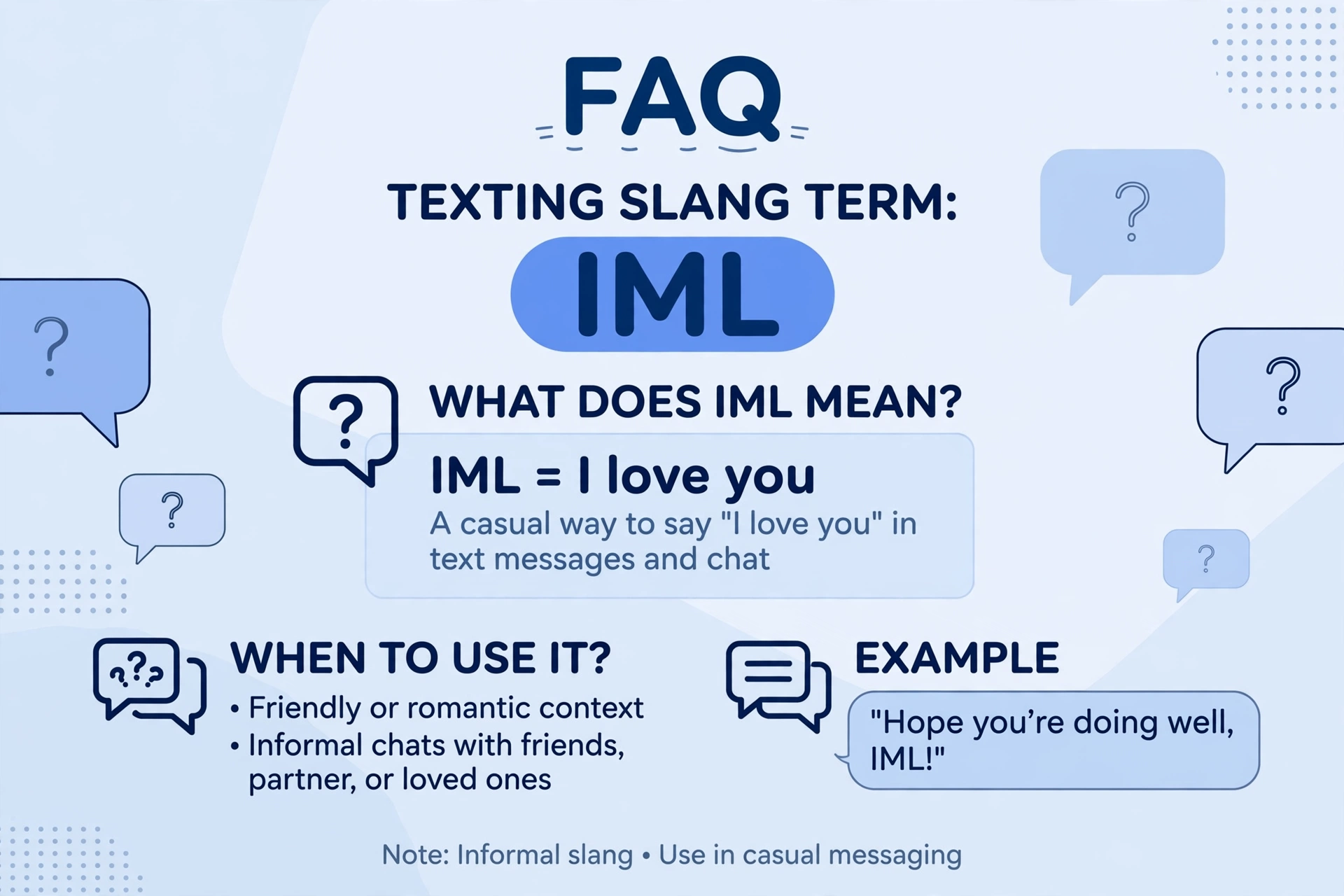
Quick Definition: In texting, IML (usually typed as ImL) means “I love you.” It is a visual pun: when typed in Arial font, the letters I, m, and L resemble the hand shape of the American Sign Language (ASL) sign for “I love you.” People send it as a sweet, playful shorthand in texts, chats, and social media messages.
Introduction
Imagine opening your phone to a message from your partner, your best friend, or even your mom, and all it says is “ImL.” No context, no explanation, just three letters staring back at you. If you have ever found yourself squinting at those three characters and wondering what on earth they mean, you are not alone. The iml meaning text question pops up again and again in search engines, parenting forums, and relationship advice threads — just like iktr meaning in text and fn meaning in text do — because this little abbreviation hides a surprisingly clever idea behind it.
Unlike most texting slang, which is usually just the first letters of a phrase, IML works differently. It is not exactly an acronym in the traditional sense. Instead, it is a visual trick, a small piece of typography that borrows from American Sign Language to say something heartfelt without spelling it out. That is what makes it special, and that is also what makes it confusing for anyone seeing it for the first time.
In this complete guide, we will break down everything about IML: what it means, where it came from, how people actually use it in real conversations, how it compares to similar terms like ILY and 143, what mistakes to avoid, and the polite alternatives you can use when the situation calls for something more straightforward. By the end, you will never have to guess at those three letters again.

IML Meaning in Text: Definition and Explanation
At its core, the iml meaning in text definition is simple: IML stands for “I love you.” But the story of how three ordinary letters came to carry that meaning is what makes this slang term worth understanding.
The trick behind the iml meaning in text lies in the font. Type the letters “ImL” (capital I, lowercase m, capital L) in Arial, one of the most common fonts on phones and computers, and look at the result closely.
The combination visually echoes the hand shape of the ASL sign for “I love you.” In American Sign Language, the “I love you” sign is made by raising the pinky finger (the letter I), the index finger and thumb (the letter L), while the middle and ring fingers stay folded down, which also forms the letter Y. When you look at “ImL” in Arial, the shapes of the characters suggest that same hand gesture, with the tall I and L framing the rounded m in the middle.
This is why texting abbreviation guides specifically note that IML only works in Arial font. In other fonts, the letters may look too thin, too curly, or too stylized, and the visual pun falls apart. Arial’s clean, blocky letterforms are what make the illusion work, which is why the original abbreviation lists from the early days of texting always included that little parenthetical note: “in Arial font.”
So when someone texts you “ImL,” they are essentially drawing you a tiny picture of the ASL “I love you” hand sign using nothing but keyboard characters. It is part abbreviation, part ASCII-style art, and part love note, all packed into three keystrokes.
Breaking Down Each Letter
- I (capital i): Represents the raised pinky finger of the ASL sign, which stands for the letter “I” in “I love you.”
- m (lowercase m): Sits in the middle and suggests the folded-down middle and ring fingers of the hand sign.
- L (capital L): Represents the extended index finger and thumb, forming the “L” of “love” in the ASL gesture.
Put together in Arial, these three characters become a miniature love note that you can only fully appreciate if you know the secret. That hidden quality is part of its charm: sending IML feels a little like sharing an inside joke or a secret code with someone you care about.
Origin of IML
The exact birth date of IML is hard to pin down, which is true of most internet slang, but its footprints lead back to the early 2000s, the golden age of instant messaging. During the era of AIM, MSN Messenger, and early SMS texting, when every character counted and creativity was currency, users invented countless clever shorthands. IML earned its place in the great texting abbreviation dictionaries of that time, appearing in widely circulated lists alongside classics like LOL, BRB, and TTYL.
One of the earliest well-known references comes from Webopedia’s famous text abbreviations guide, which listed “ImL” with the explanation: “in Arial font, means I love you, a way of using the American sign language in text.” That single line, copied and reposted across hundreds of abbreviation websites over the years, is how most of the internet first learned about IML. The phrasing stuck so firmly that even today, nearly every abbreviation list on the web repeats the same Arial-font note word for word.
The connection to American Sign Language also tells us something about the era. The ASL “I love you” hand sign had become a widely recognized cultural symbol by the late 1990s and early 2000s, popularized by celebrities, athletes, and public figures flashing it at cameras. Texting culture, always hungry for new ways to express emotion with limited characters, naturally borrowed the symbol and translated it into type.
As texting moved from flip phones to smartphones and then to social media platforms like Instagram, Snapchat, and TikTok, IML survived the transition. It never became as mainstream as ILY or the heart emoji, but it carved out a lasting niche as the “clever” way to say I love you, the version you send when you want to show a little extra thoughtfulness.
IML Meaning in Text: Popularity in Texting Today
The iml meaning in text occupies an interesting middle ground in the world of texting slang. It is not one of the abbreviations you will see in every other message, like LOL or OMG, but it has never faded away either. Search data shows a steady stream of people looking up the iml meaning text definition year after year, which suggests a constant cycle of discovery: someone receives it, gets curious, looks it up, and then starts using it themselves.
Several factors keep the iml meaning in text alive. First, it skews romantic and affectionate, which gives it a timeless quality. Slang tied to humor or trends can feel dated quickly, but new ways to say “I love you” never really go out of style. Second, the ASL connection gives it a layer of meaning that feels thoughtful rather than lazy. Typing IML signals that you know something, that you are in on a piece of texting culture, which makes it popular among teens and young adults who value that kind of insider knowledge.
On platforms like TikTok and Instagram, IML shows up in captions, comments, and bios, often paired with the actual ASL hand sign emoji or photos of the gesture. On Snapchat, where quick, casual communication rules, it appears in streaks and late-night conversations between close friends and couples. Parents, meanwhile, tend to encounter it when scrolling through their kids’ messages, which is why “what does IML mean” is such a common search among concerned moms and dads trying to decode their teenagers’ chats.
It is worth noting that IML remains far less common than heavyweights like ILY (I love you), ILU (I love you), or ILYSM (I love you so much). Think of IML as the boutique option: less widely used, but more distinctive and memorable when it appears.
IML Meaning in Text Messages: How It Is Used in Chats
Understanding the iml meaning in text definition is only half the battle. The other half is knowing how IML actually behaves in real conversations, because context changes everything with slang like this.
As a standalone message. The most common use of IML is as a message all by itself. Someone sends “ImL” and nothing else, usually at the end of a conversation, as a goodnight text, or as a random midday surprise. The brevity is the point: it is a tiny burst of affection that does not need any decoration.
As a sign-off. Many people use IML the way others use “love you” or “xoxo” at the end of a longer message. For example: “Good luck on your exam tomorrow, ImL!” It softens the message and adds warmth without requiring a whole sentence.
In social media captions and comments. On Instagram and TikTok, IML appears in comments on a partner’s or friend’s post, in photo captions from weddings and anniversaries, and in bios, where space is tight and every character has to earn its place.
Playfully and flirtatiously. Because it is less direct than typing out “I love you,” IML can carry a light, flirty tone. It is a way of expressing affection while keeping things casual, which makes it popular in the early stages of dating when “I love you” might feel too heavy but you still want to show you care.
Between family members. Parents and kids, siblings, and grandparents use IML too, especially once someone in the family explains the trick. It has a wholesome, almost wholesome-secret-code quality that works well in family group chats.
One important note: IML is almost never used in professional or formal communication. You would not put it in a work email, a message to your boss, or a formal announcement. It belongs firmly in the world of personal, casual, affectionate messaging.
IML Meaning in Text Examples: Real Conversations
Seeing IML in action is the fastest way to grasp the iml meaning in text. Here are realistic examples of how it shows up across different types of conversations.
Friendly Examples
- Text between partners:
Alex: “Just got home safe.”
Jordan: “Good. Get some rest, ImL.” - Goodnight message:
“Long day. Heading to bed now. ImL, talk tomorrow.” - Family group chat:
Mom: “Dinner’s ready, everyone come downstairs!”
Daughter: “Coming! ImL mom.” - Between best friends:
“Thanks for listening to me vent for an hour. You’re the best. ImL.”
Professional Examples
Here is the honest truth: there really are no good professional examples of IML, because it does not belong in professional settings. Texting your manager “ImL” after a performance review would be confusing at best and inappropriate at worst. The closest professional-adjacent use might be a warm message to a longtime colleague who is also a close friend, and even then, plain language is safer. If you want to express appreciation at work, skip the slang entirely and say “Thanks so much, I really appreciate you” instead. Keeping IML out of the workplace is one of the simplest rules for using it well.
Funny Examples
- After sending a meme:
“This reminded me of you. ImL, you absolute gremlin.” - Food-related affection:
“Saved you the last slice of pizza. ImL, and don’t you forget it.” - Playful exaggeration:
“You did the dishes without being asked?? ImL, marry me again.” - Pet messages:
“The dog just did the cutest thing. ImL, both of you.”
Notice how in the funny examples, IML adds a layer of mock-seriousness. Pairing a grand gesture like “I love you” (even in code) with something silly like pizza or dish duty is exactly the kind of playful contrast that makes texting fun.

IML vs Similar Terms: A Comparison
IML is far from the only way to say “I love you” in shorthand. The texting world is crowded with affectionate abbreviations, and choosing the right one depends on your relationship, the tone you want, and how much effort you want to signal. Here is how IML stacks up against its closest cousins.
| Term | Meaning | Tone | Best Used |
|---|---|---|---|
| IML / ImL | I love you (ASL visual pun in Arial) | Sweet, clever, playful | When you want a creative, insider-feeling love note |
| ILY | I love you | Warm, standard, versatile | Everyday affection between partners, friends, family |
| ILU | I love you | Casual, relaxed | Quick casual texts where ILY feels too formal |
| ILYSM | I love you so much | Intense, heartfelt | Deep emotional moments, anniversaries, apologies |
| LY | Love you | Brief, breezy | Sign-offs and rapid-fire chats |
| 143 | I love you (1-4-3 letters) | Retro, nostalgic | Pager-era nostalgia, playful old-school vibe |
| XOXO | Hugs and kisses | Affectionate, classic | Sign-offs, cards, friendly warmth |
The key difference is effort and cleverness. ILY is the reliable workhorse: everyone understands it instantly. IML, on the other hand, is a conversation piece. It takes a second to decode, and that moment of decoding is part of the gift. If ILY is a hug, IML is a hug combined with a wink.
That said, clarity matters. If you are texting someone who might not know the slang, ILY will always be the safer choice. IML shines brightest with people who are already in on the joke, or in moments when you enjoy the little spark of curiosity it creates.

Alternate Meanings of IML
Like many three-letter combinations, IML does not have just one meaning. Context is everything, and while “I love you” is the dominant meaning in texting, you may run into IML in other settings where it stands for something entirely different.
It’s My Life
The most common alternate meaning is “It’s My Life.” This usage shows up as a statement of independence or attitude, similar to YOLO. Someone might post “IML” on social media alongside a bold decision, meaning they are living life on their own terms. The association is strengthened by the famous Bon Jovi song of the same name, which turned the phrase into a full-blown anthem of self-determination.
In My Life
IML can also stand for “In My Life,” often used when reflecting on experiences or relationships. For example, “The best thing IML right now is my morning coffee ritual.” This usage is less common than “It’s My Life,” but it appears in captions and casual posts.
Technical and Industry Meanings
Outside of texting entirely, IML has several technical definitions, including In-Mold Labeling (a packaging manufacturing process), Interactive Machine Learning (a field of artificial intelligence research), and Initial Microcode Load (a computing term). You will essentially never encounter these in a text message, but they are worth knowing so you are not confused if you see IML in a work document or news article.
How to Tell Which Meaning Applies
- Romantic or friendly text from someone close: Almost certainly “I love you” (the Arial/ASL pun).
- Bold social media post about independence: Likely “It’s My Life.”
- Technical document or industry article: One of the technical definitions.
- When in doubt: Look at who sent it and what the rest of the conversation is about. Context resolves the ambiguity nearly every time.
Professional or Polite Alternatives to IML
IML is charming, but it is not always appropriate. In professional settings, formal messages, or conversations with people who may not know texting slang, plain language wins every time. Here are polished alternatives organized by situation.
For Work and Formal Settings
- “Thank you so much, I really appreciate your help.”
- “I’m grateful for everything you do.”
- “It was wonderful working with you.”
- “Warm regards” or “Best wishes” as a sign-off.
For Expressing Affection Clearly
- “I love you.” (Simple, direct, never misunderstood.)
- “Love you lots.”
- “Sending you so much love.”
- “You mean the world to me.”
- “Thinking of you and sending love your way.”
For Friendly Warmth Without Romance
- “You’re the best!”
- “So thankful for you.”
- “Appreciate you!”
- “Take care!”
The rule of thumb is simple: if there is any chance the other person will not understand IML, or any chance the setting calls for professionalism, choose clear words instead. Slang is a spice, not the whole meal.
Common Mistakes When Using IML
IML is easy to use, but a few common missteps can turn a sweet gesture into an awkward moment. Here is what to watch out for.
- Using it with the wrong audience. The number one mistake is sending IML to someone who has no idea what it means. Your boss, a new acquaintance, or a formal contact will likely be confused. Reserve it for people who share your texting vocabulary.
- Typing it in all caps as “IML.” The visual pun depends on the specific letterforms “ImL” in Arial. In full capitals, the lowercase m becomes an uppercase M, and the illusion weakens. If you want the ASL effect, the mixed case matters.
- Assuming the font will render correctly. Not every phone, app, or platform uses Arial. Some messaging apps use custom fonts where the letters look different and the visual trick disappears. The meaning usually survives because people learn the abbreviation itself, but the clever visual layer may be lost.
- Overusing it until it loses meaning. Like any term of affection, IML hits hardest when it is used with intention. Sprinkling it into every single message dilutes its impact. Save it for moments when you genuinely want to send love.
- Confusing it with “It’s My Life.” If someone posts “IML” after quitting their job to travel the world, replying “aww, love you too” might miss the mark. Always read the context before assuming the romantic meaning.
- Using it too early in dating. Because IML secretly means “I love you,” dropping it casually in the first week of dating can send a stronger signal than you intended. Make sure the level of affection matches the stage of the relationship.
- Explaining the joke every time. Part of IML’s charm is its subtlety. If you have to attach a paragraph explaining the Arial font trick each time you use it, the magic fades. Use it naturally and let curious people ask.

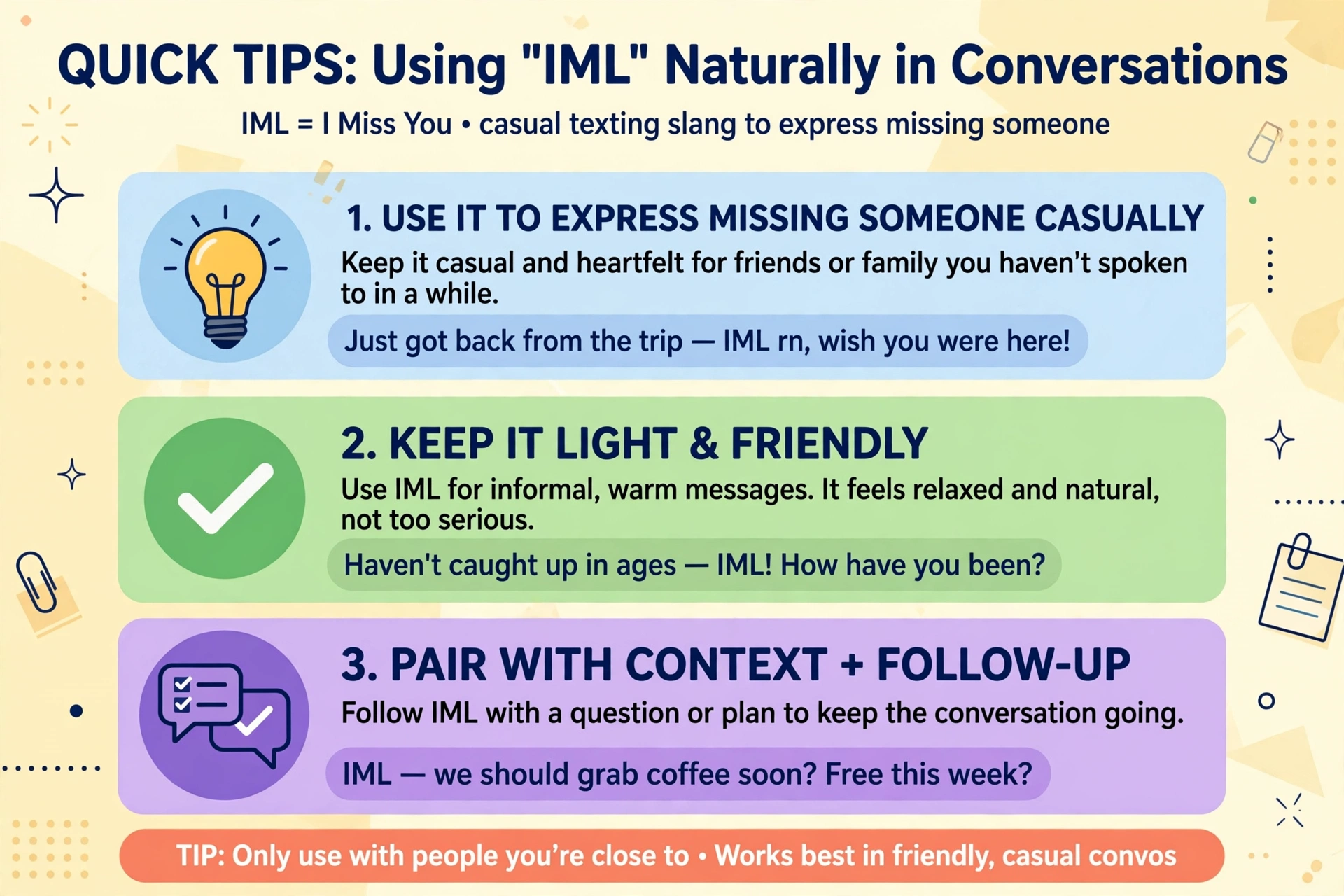
Quick Tips for Using IML Naturally
Want to use IML like someone who has been texting with it for years? These practical tips will help you get it right.
- Match the casing: Type “ImL” with a capital I, lowercase m, and capital L to preserve the classic Arial visual pun.
- Keep it personal: IML works best one-on-one or in small groups of close friends and family, not in large group chats with strangers.
- Pair it with timing: Send it as a goodnight text, after good news, or out of the blue on a random Tuesday. Unexpected affection lands hardest.
- Do not force it: If “I love you” or “ILY” feels more natural in the moment, use those. IML should feel playful, not performative.
- Read the room: In emotional or serious conversations, plain language (“I love you, I’m here for you”) carries more weight than clever slang.
- Teach it once: If someone asks what it means, explain the Arial/ASL trick once with enthusiasm, then use it freely with them afterward.
- Know when to upgrade: For anniversaries, apologies, or big emotional moments, spell it out fully. “I love you” in complete words will always beat any abbreviation when it truly counts.
Frequently Asked Questions About IML
1. What does IML mean in text messages?
In text messages, IML means “I love you.” It is typically typed as “ImL” because, in Arial font, those letterforms visually resemble the American Sign Language hand sign for “I love you.” It is a playful, affectionate shorthand used between partners, friends, and family members.
2. Why does IML have to be in Arial font?
The whole concept is a visual pun: the letters I, m, and L in Arial look like the ASL “I love you” hand gesture, with the tall letters framing the rounded middle letter the way extended fingers frame folded ones. In other fonts with very different letter shapes, the resemblance disappears, which is why classic abbreviation guides always specify Arial.
3. Is IML the same as ILY?
They carry the same basic message, “I love you,” but they feel different. ILY is the straightforward, universally understood abbreviation, while IML is the clever insider version with a hidden visual trick. ILY is safer with people who may not know slang; IML is more fun with people who do.
4. Can I use IML in professional or work messages?
No, IML is not appropriate for professional communication. It is casual slang with a romantic or affectionate meaning, and many recipients will not recognize it. In work settings, express appreciation with clear language like “Thank you, I really appreciate your help” instead.
5. What does IML mean on Snapchat and TikTok?
On Snapchat and TikTok, IML almost always means “I love you” in the Arial/ASL sense. You will see it in comments, captions, streak messages, and bios. Occasionally, in a bold or rebellious post, it can mean “It’s My Life,” so check the context of the post to be sure.
6. How do you type IML correctly?
Type a capital I, a lowercase m, and a capital L: “ImL.” This mixed casing in Arial font creates the visual resemblance to the ASL sign. Typing it in all caps (“IML”) still communicates the abbreviation to people who know it, but it loses the visual pun that makes it special.
7. What are good alternatives to IML?
Popular alternatives include ILY (I love you), ILU (I love you, casual), ILYSM (I love you so much), LY (love you), 143 (pager-era code for I love you), and XOXO (hugs and kisses). For formal situations, skip slang entirely and write “I love you” or “Sending you love” in full words.
8. Is sending IML flirty?
It can be. Because IML is less direct than spelling out “I love you,” people often use it in a light, flirty way, especially in early dating. But it is just as commonly used platonically between friends and family. The tone depends entirely on your relationship with the person and the context of the conversation.
Conclusion
IML is one of those rare pieces of internet slang that rewards a closer look. On the surface, it is just three letters, but underneath it hides a clever visual tribute to American Sign Language, a bit of early-2000s texting history, and a genuinely sweet way to tell someone you love them without typing the whole phrase. That combination of creativity and affection is exactly why it has survived for two decades while countless other abbreviations faded into obscurity.
The next time “ImL” lights up your screen, you will know exactly what it means, and maybe you will even appreciate the tiny typographic magic trick behind it. Use it thoughtfully, save it for people who matter, and remember the golden rule of all slang: clarity first, cleverness second. Want to keep decoding the group chat? Check out our guides to whf meaning in text and csl meaning in text next. When the moment truly calls for it, nothing beats spelling it out: I love you.
