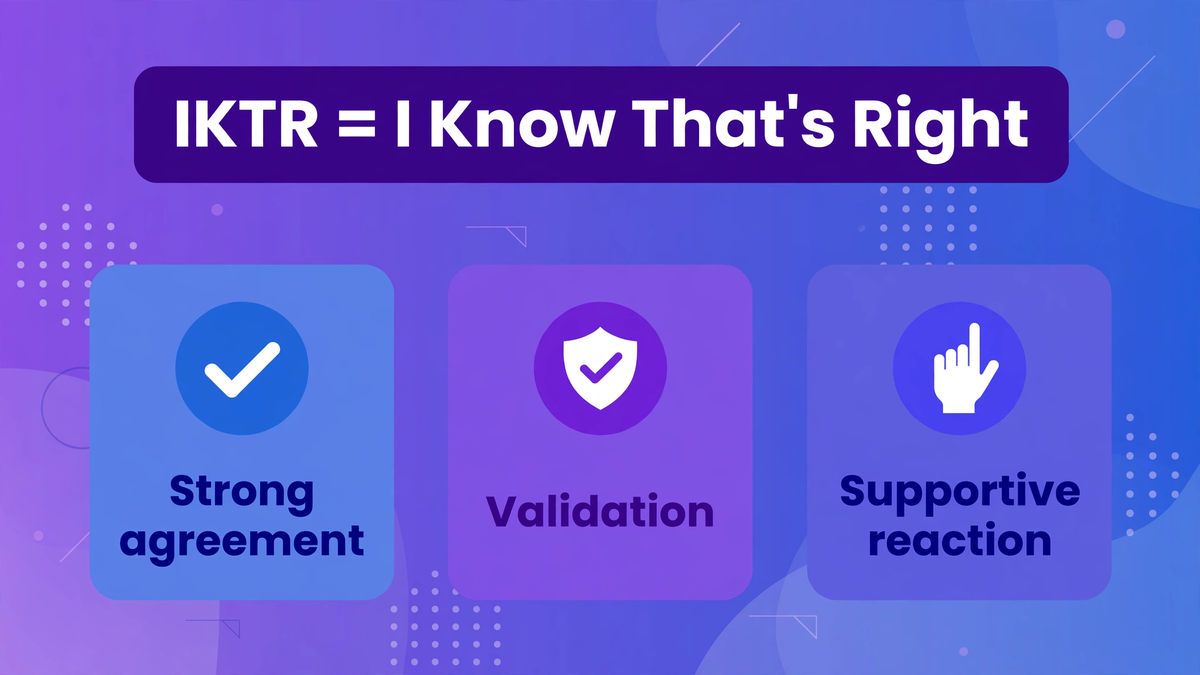
Quick definition: IKTR stands for “I Know That’s Right.” It’s an expressive texting and social media abbreviation used to show strong agreement, validation, or enthusiastic support for something someone just said. Think of it as a confident digital nod — shorter and punchier than “I completely agree.”
IKTR Meaning in Text & Definition
You’ve probably seen it in a TikTok comment section or a fast-moving group chat: someone drops a bold, confident statement, and a reply simply says “IKTR.” Four letters, no punctuation, maximum energy. If you’ve been scratching your head over it, you’re not alone — IKTR is one of those slang terms that carries a lot more feeling than its letter count suggests.
So, what does IKTR mean in text? IKTR is an initialism for “I Know That’s Right.” People use it as a reaction phrase to express strong agreement, validation, or hype. It’s not a neutral “yes” or a casual “ok” — it’s an emphatic, confident response that says, “That statement was so true, it didn’t even need debating.”
Linguistically, IKTR works as what language experts call a pragmatic discourse marker. That sounds fancy, but the idea is simple: IKTR doesn’t just communicate the literal words “I know that’s right.” It communicates emotional alignment. It tells the other person, “I see your point, I feel the same way, and I’m amplifying it.”
The tone matters enormously with IKTR. Depending on context, capitalization, and platform, it can sound:
- Supportive and warm — hyping up a friend’s good news
- Bold and confident — agreeing with a strong opinion
- Sassy or playful — the classic finger-snap energy of “period, say that”
- Slightly confrontational — when used to shut down an opposing view
That tonal range is exactly why this guide exists. IKTR meaning in text depends heavily on context, and misreading it can turn a friendly exchange awkward fast.
Introduction
Picture this: your friend texts, “I’m not answering work emails after 7 PM anymore. My evenings are mine.” You reply “IKTR” — and instantly, she knows you’re not just agreeing, you’re cheering. Now picture a different scene: someone posts a controversial hot take online, and a stranger comments “IKTR.” Same four letters, completely different energy.
Internet slang moves fast, and IKTR has become one of the most recognizable agreement markers in digital conversation. Born from spoken language and supercharged by TikTok, X (Twitter), and Instagram comment culture, it’s now a staple of how people validate each other online.
This guide breaks down everything about IKTR: its exact meaning, where it came from, how different communities use it, real examples across tones and platforms, how it compares to similar abbreviations, the mistakes people make with it, and answers to the most-searched questions. By the end, you’ll read “IKTR” the way fluent texters do — instantly, and with the tone intact.
If you enjoy decoding texting shortcuts, you’ll also want to check out IMK meaning in text and TTM meaning in text — two more abbreviations that show up in the same fast-moving conversations.
Origin
The phrase “I know that’s right” didn’t start on the internet. It’s been part of everyday spoken English for decades, and it has deep roots in African American Vernacular English (AAVE), where it functions as an emphatic way to agree with or reinforce a statement. In AAVE speech communities, “I know that’s right” carries a distinctive rhythmic, affirming energy — often delivered with a snap, a nod, or a knowing look.
The shortened form IKTR emerged as texting and social media made brevity a virtue. Typing four letters instead of a full sentence fits the pace of group chats, comment sections, and captions. The abbreviation gained serious momentum on Twitter and TikTok, where influencers, creators, and meme pages used it as a quick validation signal under relatable or bold content.
Wiktionary now lists IKTR as internet slang for “I know that’s right,” noting the alternative spelling IKDR (“I know dat’s right”) — a nod to the slang pronunciation of “that” as “dat.” That variant alone tells you how deeply the term is tied to its spoken-language roots.
Timeline-wise, the phrase itself is old; the abbreviation’s rise tracks with the short-form video boom of the early 2020s, when TikTok comment culture turned expressive agreement into an art form. Today, IKTR is globally recognizable even among people who’ve never heard it spoken aloud.
Popularity
IKTR’s popularity comes down to three things: speed, emotion, and community.
Speed: In a comment section moving at hundreds of replies per minute, “IKTR” lands faster than any full sentence. It’s the digital equivalent of a snap or a head nod.
Emotion: A plain “yes” agrees. IKTR validates. It adds hype, warmth, and confidence that flat agreement lacks. That’s why creators love seeing it in their comments — it signals genuine enthusiasm, not passive scrolling.
Community: IKTR thrives in spaces built on shared perspective: fandom communities, beauty and fashion TikTok, self-care and confidence content, meme pages, and group chats among friends. Using it signals belonging — you speak the language of the room.
You’ll spot IKTR most often on:
- TikTok — comments, captions, and reply videos under relatable or empowering content
- X (Twitter) — quote tweets and replies to bold takes
- Instagram — comments on reels, outfit posts, and glow-up content
- Snapchat and iMessage — one-tap agreement in private chats
- Group chats — the universal “say that louder” response
It’s also crossed into captions and even merch-adjacent meme culture, which is usually a sign a slang term has fully arrived. And because it’s clean — no profanity, no vulgarity — it spreads freely across age groups and platforms without moderation issues.
How It Is Used
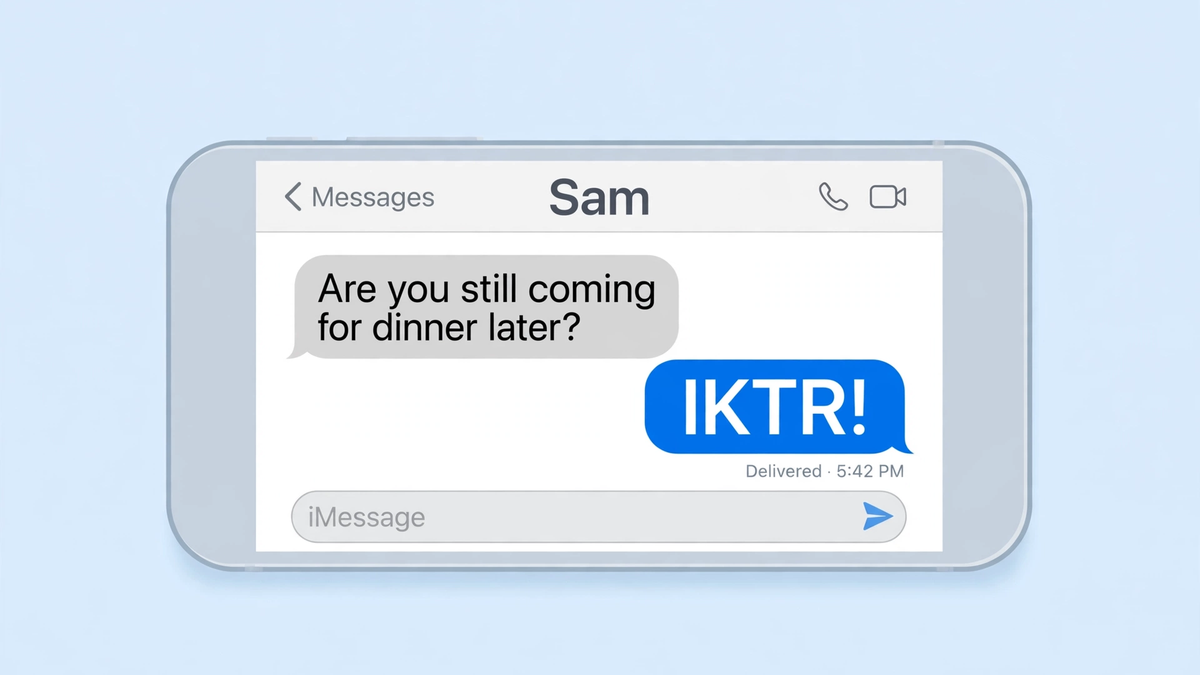
IKTR is almost always a reaction, not an opener. Someone makes a statement; you respond with IKTR. That statement can be an opinion, a personal update, a hot take, or a relatable truth.
As enthusiastic agreement:
- Friend: “This new album is a masterpiece, no skips.”
You: “IKTR!!” - Creator caption: “Protect your peace at all costs.”
Comment: “IKTR”
As validation and hype:
- Friend: “I finally asked for the raise. Wish me luck.”
You: “IKTR! You deserve it!”
As emphasis on your own statement:
- “Nobody is doing it like her right now, IKTR.”
In this last pattern, the speaker tacks IKTR onto the end of their own sentence — like patting themselves on the back and inviting everyone else to agree. It’s confident, a little playful, and very common in captions.
Formatting notes that change the meaning:
- “IKTR” (caps) — standard, confident
- “iktr” (lowercase) — softer, casual, often ironic or deadpan
- “IKTR!!” — maximum hype
- “IKTR.” with a period — dry, can read as sarcastic
- “IKTR 💅” or “IKTR ✨” — playful, sassy energy
Context is everything. “IKTR” under a friend’s promotion announcement is pure love. “IKTR.” under someone’s apology post might be shade. Read the room before you reply — and before you send it yourself.
Examples
Real-world usage is the fastest way to get fluent. Here are IKTR examples across the three main tones you’ll encounter.
Friendly Examples
- Maya: “Homemade pasta night was the best decision I’ve made all month.”
You: “IKTR 😭 that carbonara was elite” - Jordan: “I finally finished all my assignments. Weekend mode: ON.”
You: “IKTR! Go enjoy it, you earned it 🙌” - Group chat: “Road trip playlist is ready and it’s perfect.”
Reply: “iktr, no skips allowed”
In friendly contexts, IKTR functions like a high-five. Pair it with emojis or an exclamation point and it reads as pure warmth.
Professional Examples
Let’s be honest: IKTR is not professional language. You would never put it in a work email or a client presentation. But in casual workplace-adjacent spaces — a friendly Slack channel, a creative team’s group chat, a marketing brainstorm — it can appear.
- Slack #random: “Coffee machine is fixed, by the way.”
Reply: “IKTR 🙏 best news all week” - Team chat: “This new brand direction finally feels like us.”
Reply: “IKTR. The mood boards nailed it.”
Rule of thumb: if your manager or a client can see it, don’t use IKTR. If it’s peers being casual, it reads as friendly — but keep it rare.
Funny Examples
- Friend: “My toxic trait is buying houseplants and naming them.”
You: “IKTR, Gerald the fern sends his regards 🌿” - Meme caption: “Me pretending I understood the group project.”
Comment: “iktr the way I just nodded along 💀” - Friend: “Naps should count as cardio.”
You: “IKTR!! Science just hasn’t caught up yet”
Humor is where lowercase “iktr” shines — it adds a deadpan, self-aware flavor that all-caps can’t match.
Comparison with Similar Terms
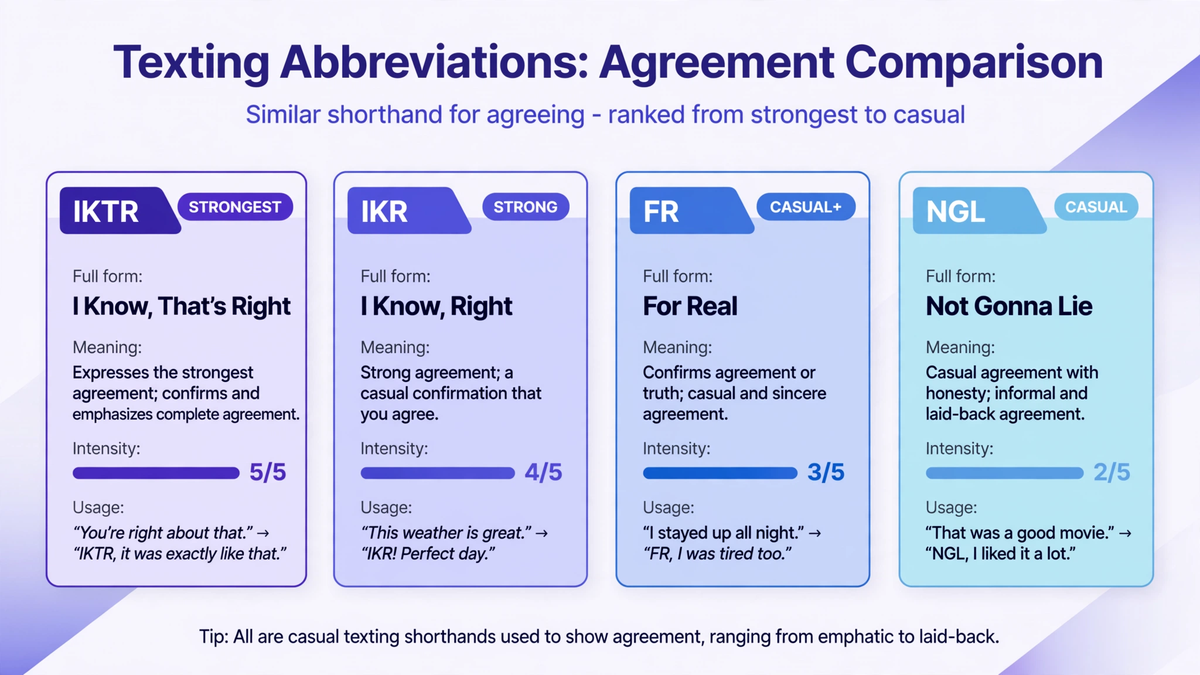
IKTR belongs to a crowded family of agreement abbreviations. They look similar but carry different weights. Here’s how they stack up:
| Term | Stands For | Energy Level | Best Used When |
|---|---|---|---|
| IKTR | I Know That’s Right | 🔥 High — confident, emphatic | Strongly validating a bold or relatable statement |
| IKR | I Know, Right? | 🙂 Medium — agreeable, conversational | Casually agreeing in everyday chat |
| FR | For Real | 🙂 Medium — sincere, understated | Quietly confirming something is true |
| FRFR | For Real, For Real | 🔥 High — intense, earnest | Doubling down on sincerity |
| NGL | Not Gonna Lie | 🤔 Variable — honest, sometimes blunt | Prefacing an honest or unpopular opinion |
| 100 | Keep it 100 / 100% agree | 🔥 High — approving | Giving full endorsement |
| PREACH | (say it louder) | 🔥 High — enthusiastic | Amplifying someone’s statement dramatically |
The key difference: IKR agrees; IKTR validates. “IKR” is what you say when your friend complains about Monday. “IKTR” is what you say when she announces she’s setting boundaries and protecting her peace. One is conversational, the other is a standing ovation.
Compared to FR/FRFR, IKTR is less about sincerity and more about affirmation — it’s outward-facing hype rather than inward-facing honesty. And unlike NGL, which often introduces disagreement or a hard truth, IKTR almost never introduces conflict (unless used sarcastically).
Quick chooser:
- Want to sound supportive and warm? → IKTR
- Want to sound casual and chill? → IKR
- Want to sound dead-serious? → FRFR
- Want to sound honest-to-a-fault? → NGL
Alternate Meanings
IKTR is remarkably consistent — “I Know That’s Right” accounts for the overwhelming majority of uses. Unlike abbreviations such as “SMH” or “ATP,” IKTR doesn’t have a crowded field of competing definitions.
That said, a few rare alternates exist:
- IKDR — not a different meaning, but the phonetic spelling variant (“I Know Dat’s Right”), reflecting AAVE pronunciation. You’ll see both; they mean the same thing.
- Misreadings — some people initially guess “I Know The Rules” or read it as a typo of IKR. If someone seems confused by your IKTR, this is probably why.
- Brand/acronym collisions — in technical or organizational contexts, IKTR could theoretically stand for something else (company names, project codes), but in texting and social media, assume “I Know That’s Right” unless context screams otherwise.
Bottom line: if you see IKTR in a text, comment, or caption, “I Know That’s Right” is the safe bet 99% of the time.
Professional or Polite Alternatives
IKTR is casual by design. In professional, academic, or formal settings, swap it for one of these:
| Instead of IKTR, say | Tone | Example |
|---|---|---|
| “I completely agree.” | Professional, neutral | “I completely agree with the proposed timeline.” |
| “Well said.” | Respectful, concise | “Well said — that captures the issue perfectly.” |
| “Couldn’t agree more.” | Warm, professional | “Couldn’t agree more with your assessment.” |
| “That’s exactly right.” | Confident, formal | “That’s exactly right; the data supports it.” |
| “Absolutely.” | Friendly, versatile | “Absolutely, let’s move forward with that.” |
| “You make an excellent point.” | Diplomatic | “You make an excellent point about the budget.” |
Notice the pattern: formal alternatives keep the validation but drop the slang. “I completely agree” does the same job as IKTR without risking your credibility in a boardroom.
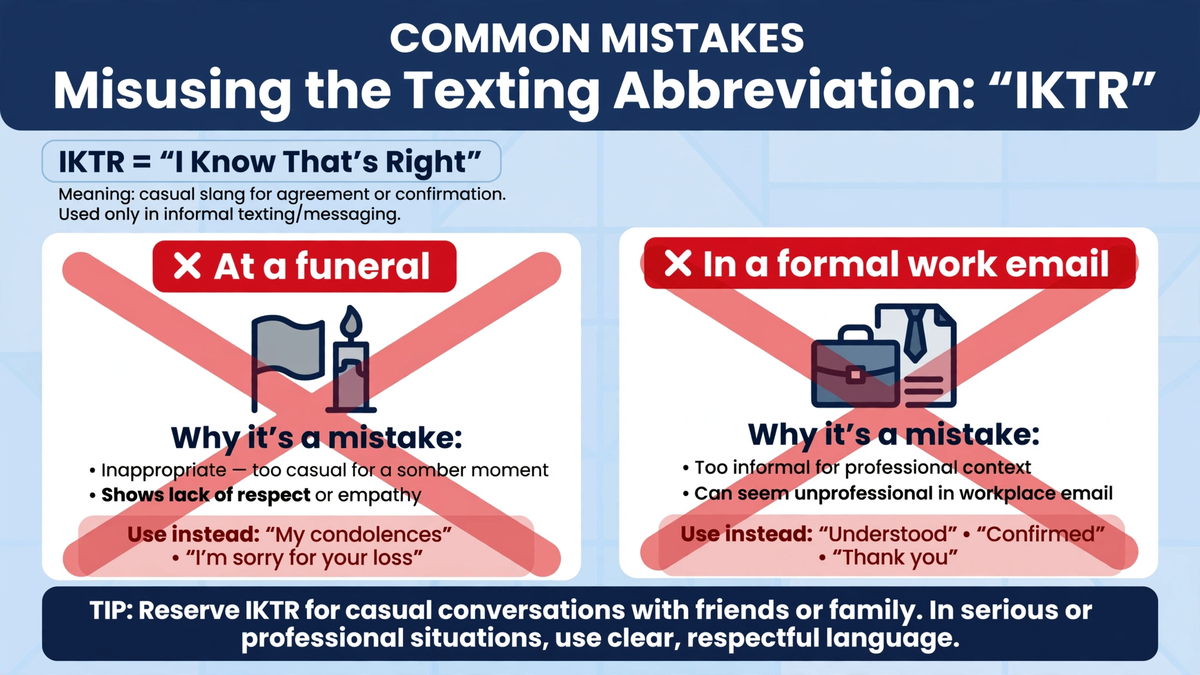
Common Mistakes
IKTR is simple, but people still misuse it. Here are the mistakes to avoid:
1. Using it to disagree. IKTR is agreement-only. Replying “IKTR” to something you actually disagree with — even as a joke — confuses people, because the abbreviation has no built-in irony detector.
2. Dropping it in serious or somber contexts. Someone shares sad news and you reply “IKTR”? Even if you mean “I hear you,” it reads as hype in a moment that needs empathy. Match the energy of the room.
3. Using it professionally. As covered above: work emails, client chats, and formal documents are IKTR-free zones. One slang abbreviation can undo a paragraph of professionalism.
4. Confusing it with IKR. They’re siblings, not twins. Using IKTR when you mean a mild “I know, right?” can come across as oddly intense — like applauding someone for saying the sky is blue.
5. Overusing it. IKTR’s power comes from emphasis. If every reply is “IKTR,” none of them are. Save it for statements that genuinely deserve the hype.
6. Misreading sarcastic IKTR. “IKTR.” with a period, especially from someone annoyed, often means the opposite. If the tone feels off, trust the tone, not the letters.
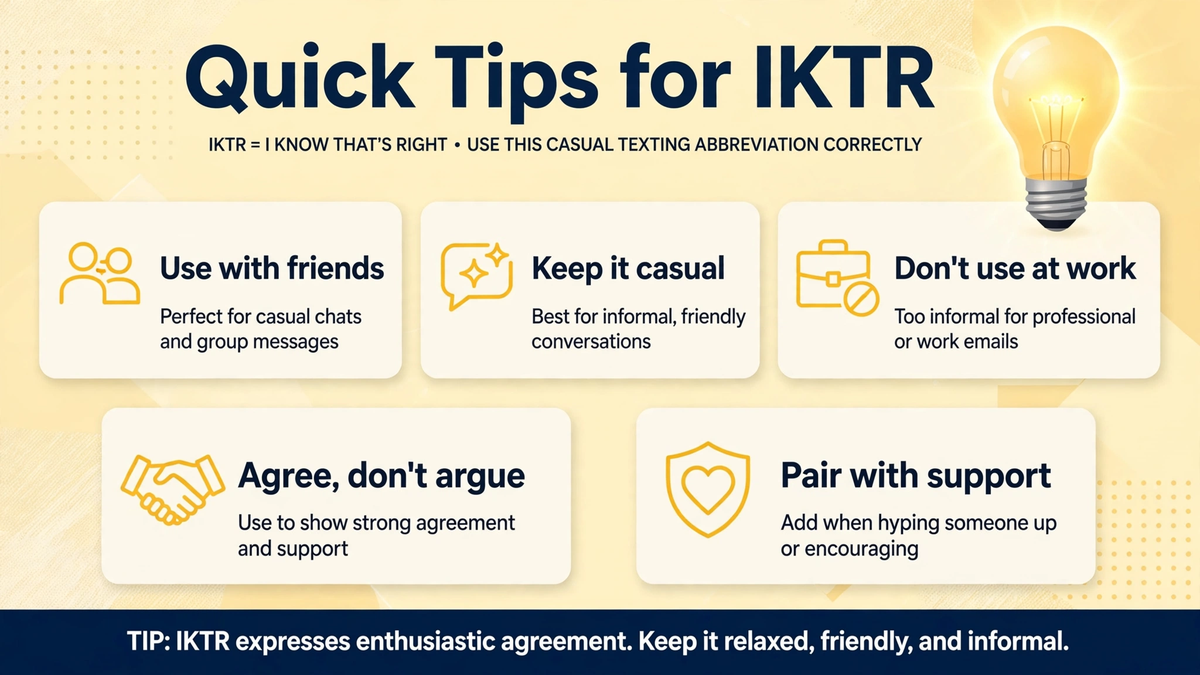
Quick Tips
- Match the energy: big statement → “IKTR!!”; chill chat → “iktr”
- Pair it with specifics: “IKTR, that presentation was flawless” beats a bare “IKTR” every time
- Read before you reply: make sure the statement deserves validation, not just acknowledgment
- Keep it out of work: when in doubt, use “I completely agree” instead
- Watch the punctuation: exclamation = hype, period = potential shade, no punctuation = neutral-positive
- Don’t force it: if “I agree” feels more natural, say that — slang should never feel like a costume
- Know your audience: grandparents, bosses, and formal contacts get the full sentence version
FAQ
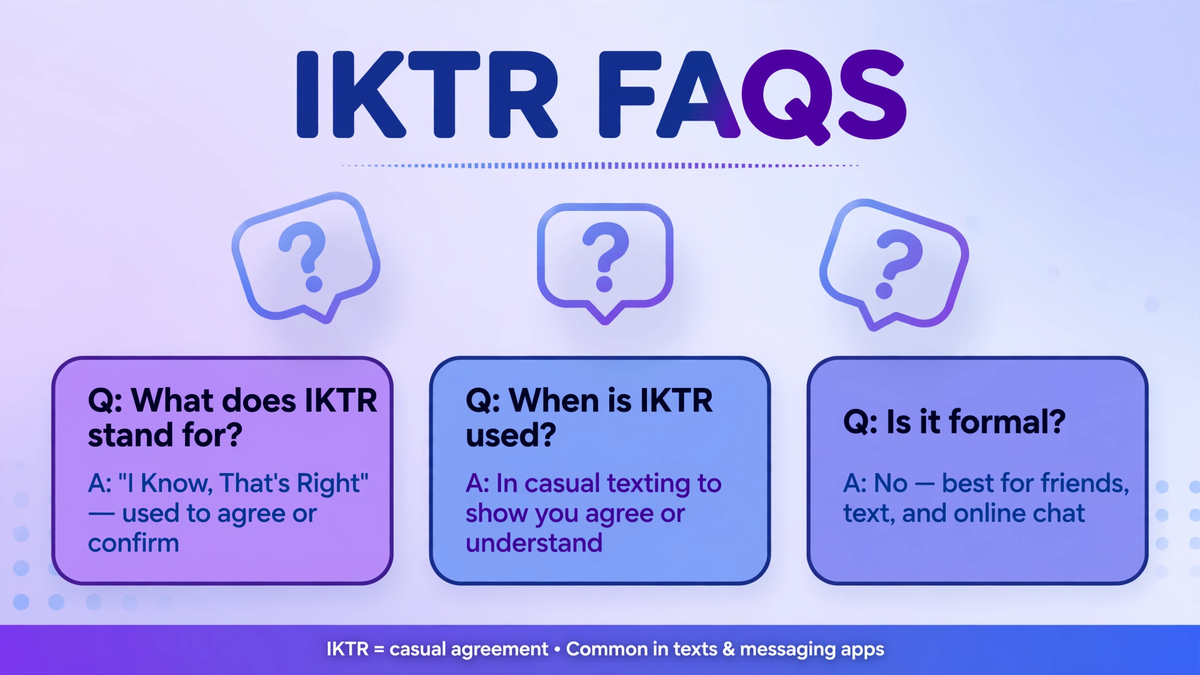
What does IKTR mean in text?
IKTR means “I Know That’s Right.” It’s used in texting and on social media to express strong agreement, validation, or enthusiastic support for something someone said.
What does IKTR mean on TikTok?
On TikTok, IKTR is a popular comment and caption abbreviation meaning “I Know That’s Right.” People use it to hype up creators, agree with relatable videos, and validate bold statements — especially under confidence, glow-up, and lifestyle content.
Is IKTR the same as IKR?
No. IKR (“I Know, Right?”) is casual, everyday agreement, while IKTR (“I Know That’s Right”) is stronger, more emphatic validation. IKTR carries more confidence and hype; IKR is more conversational.
Is IKTR rude or sarcastic?
Usually neither — it’s normally supportive and affirming. But tone and punctuation matter: “IKTR.” with a flat period can read as sarcastic, and in the wrong context it can sound confrontational. Default to reading it as positive unless the tone says otherwise.
Where did IKTR come from?
The phrase “I know that’s right” comes from spoken English with deep roots in African American Vernacular English (AAVE) as an emphatic agreement expression. The four-letter abbreviation spread through texting, Twitter, and TikTok in the early 2020s.
Can I use IKTR at work?
Not in formal communication. Avoid it in emails, meetings, and client messages. In very casual team chats with peers it may be fine, but professional alternatives like “I completely agree” are always safer.
What is the difference between IKTR and IKDR?
They mean the same thing. IKDR (“I Know Dat’s Right”) is a phonetic spelling variant reflecting the slang pronunciation of “that” as “dat.” Both express the same emphatic agreement.
How do you reply to IKTR?
Just accept the hype — a “thank you,” an emoji, or your own agreement (“right??”) all work. If someone IKTRs your statement, they’re validating you, so respond warmly: “Thank you! 🙌” or “Glad you agree!”
Conclusion
IKTR may be only four letters, but it carries a full emotional sentence: I hear you, you’re right, and I’m saying it with my whole chest. From its roots in AAVE spoken culture to its reign in TikTok comment sections, “I Know That’s Right” has become the internet’s favorite way to validate someone with style.
The takeaway is simple: use IKTR when you genuinely want to hype, validate, or emphatically agree — match the energy with your punctuation, keep it out of professional settings, and never waste it on statements that don’t deserve the applause. Master that, and you’ll wield one of texting’s most expressive abbreviations like a native.
Want to decode more texting shortcuts? Check out TTM meaning in text, TMP meaning in text, and WYFD meaning in text — and whenever you want to verify a word’s formal meaning, Merriam-Webster’s dictionary has you covered.

2 thoughts on “IKTR Meaning in Text: What Does IKTR Mean and When to Use It”