
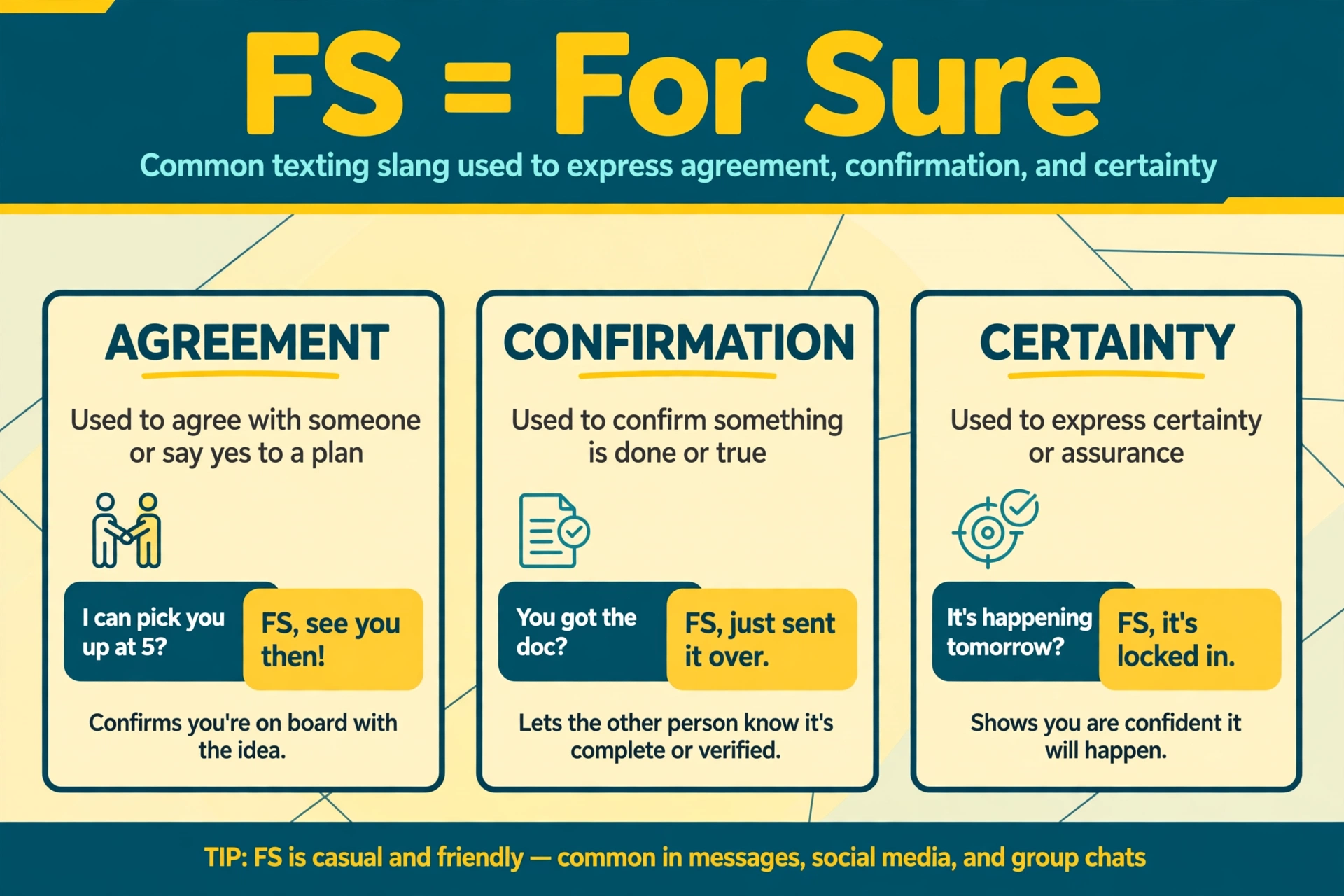
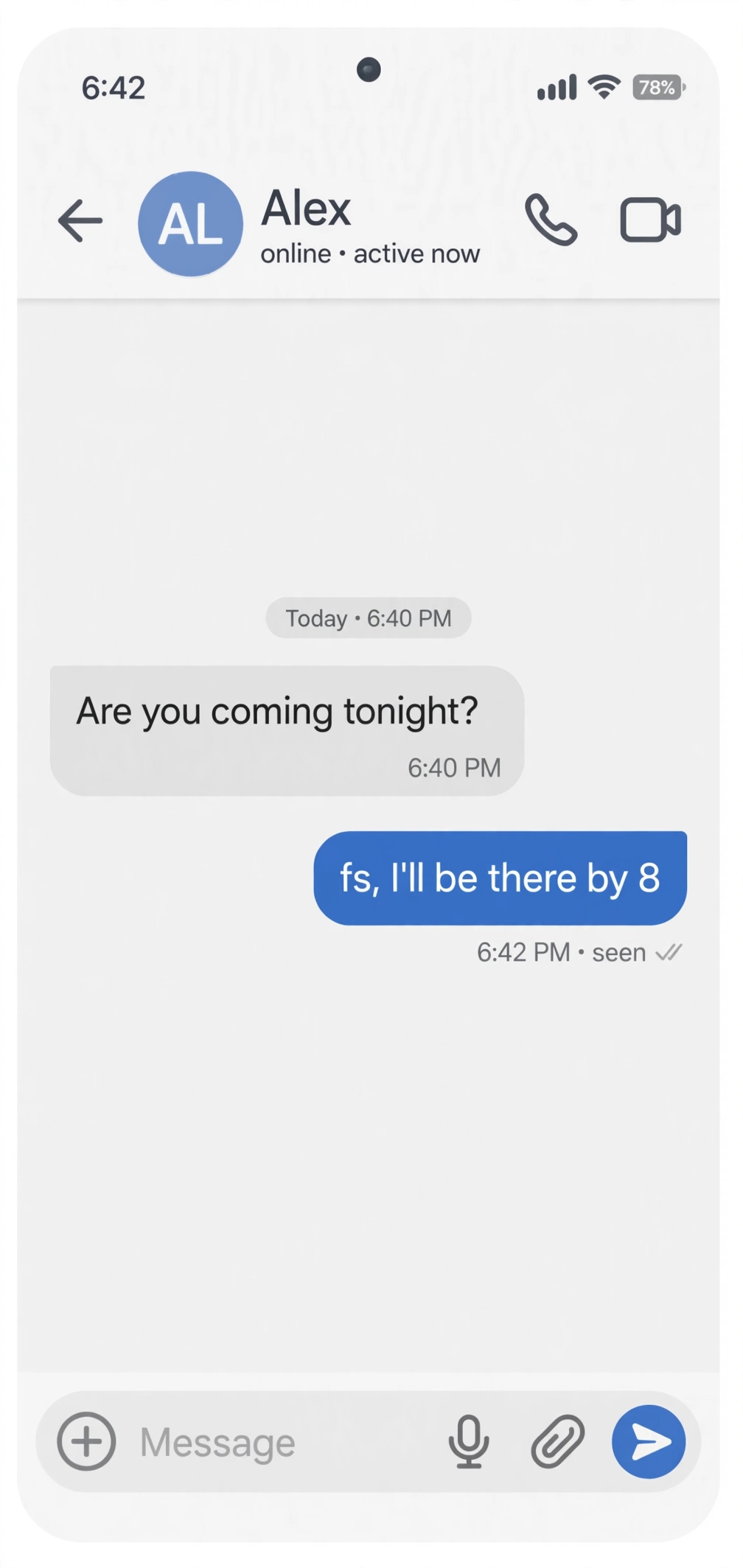
Quick definition: In slang, FS means “for sure.” It is a fast, casual way to say “definitely,” “absolutely,” or “I agree” in texts, DMs, and social media comments. If someone asks “Are you coming tonight?” and you reply “fs,” you just said yes — with confidence.
FS Meaning Slang & Definition
The fs meaning slang definition is simple: FS is short for “for sure.” It works as a quick confirmation, an enthusiastic yes, or a way to add certainty to whatever you just said. Unlike longer replies, it takes two letters to send the whole message — and that is exactly why it caught on.
Here is the fs meaning at a glance:
| Aspect | Details |
|---|---|
| Full form | For sure |
| What it means | Definitely, absolutely, without a doubt, I agree |
| Tone | Positive, casual, confident, relaxed |
| Where you see it | Texting, Snapchat, Instagram DMs, TikTok comments, WhatsApp, Discord |
| Most common form | Lowercase “fs” (uppercase “FS” reads more emphatic) |
| Best for | Friends, group chats, casual conversations |
| Avoid in | Work emails, formal messages, talking to teachers or bosses |
FS does two jobs in a conversation. On its own, it is a complete reply — a standalone “yes, definitely.” At the end of a sentence, it acts like an exclamation point for certainty: “I am so going, fs.” Both uses mean the same thing, but the second one hits harder because it backs up a statement you already made.
The phrase “for sure” itself is old — people have said it in spoken English for centuries to mean “certainly” or “without a doubt.” The two-letter shortcut is the new part. It belongs to the same family of ultra-short agreement slang as TS, FR (for real), and OFC (of course), all built to confirm something without typing a full sentence.
Introduction
Open any group chat and you will find it. Someone suggests plans, and the replies roll in: “fs,” “fs fs,” “fs, I am down.” Two letters, zero confusion — at least for everyone under thirty. For everyone else, FS can look like a typo, a random abbreviation, or a code you were never given.
That is the whole story of modern texting slang in miniature. As messaging moved from keyboards to phone screens, every phrase got squeezed. “For sure” became “FS” for the same reason “laughing out loud” became “LOL” and “be right back” became “BRB”: when you are typing with your thumbs, shorter wins. What makes FS interesting is how much meaning it carries for two letters — agreement, enthusiasm, reassurance, and confidence, all at once.
This guide covers everything about the fs meaning slang trend: what FS stands for, where it came from, how people actually use it on Snapchat, TikTok, and Instagram, how it compares to similar slang like FR and FFS, the alternate meanings that can trip you up, and the mistakes to avoid. By the end, you will read “fs” the way fluent texters do — instantly, without thinking.
Origin
FS as texting shorthand traces back to the mid-2010s, when direct-message culture exploded on Snapchat, WhatsApp, and Instagram. The first Urban Dictionary entry defining FS as “for sure” appeared in 2016, and by 2018 the abbreviation was standard in Snapchat and Instagram DM culture. It arrived alongside a wave of extremely short acronyms — NP, BB, FR — all built on the same idea: strip a common phrase down to its initials and let context do the rest.
The timing was not an accident. Three things came together at once. First, smartphones made texting the default way young people talked, and thumb-typing rewards brevity. Second, Snapchat and Instagram DMs made conversations fast, informal, and constant — the kind of chats where a two-letter reply feels natural and a full sentence feels stiff. Third, Gen Z slang culture began favoring lowercase, low-effort typing as a style in itself: lowercase “fs” reads relaxed and casual, while uppercase “FS” reads louder, almost like shouting.
By 2020, lowercase “fs” had become the Gen Z default. The shorthand spread from private messages into public spaces — TikTok comments, Instagram replies, Twitter threads, and Discord servers — anywhere people agree with each other in public. Today, FS is one of the most common agreement markers in English-language texting, right next to “lol,” “yeah,” and “bet.”
Popularity
FS is popular because it solves a real problem: how do you say “yes, I completely agree and I am definitely in” without sounding formal? A plain “yes” can sound flat. “Yes, definitely, I agree” sounds like a work email. “Fs” lands exactly in the middle — warm, fast, and sure of itself.
Its popularity also comes from its flexibility. FS works as a reply to a question (“You coming?” — “fs”), as a reaction to an opinion (“That movie was elite” — “fs”), and as a booster at the end of your own message (“Best day ever, fs”). Very few slang terms work in all three positions, and that versatility is why it survived while dozens of other abbreviations faded.
The term is most common among teens and people in their twenties, but it has spread well beyond that. Parents see it in their kids’ texts, coworkers see it in casual Slack messages, and brands have even started using it in social media captions to sound relatable. Like mid and YOLO before it, FS has crossed from group-chat slang into mainstream internet English — the kind of word that no longer needs explaining to most people online.
How It Is Used
FS shows up in three main positions, and the position changes the feeling slightly:
- As a standalone reply: “We should hang out this weekend.” — “fs.” This is the most common use. It means “yes, absolutely, I am in.”
- At the start of a message: “fs, I will be there by 8.” Here FS confirms first, then adds the detail. It reads like a confident promise.
- At the end of a message: “That concert was unreal, fs.” Here it strengthens the statement before it, closer to “for real” or “no doubt.”
People also double it for emphasis — “fs fs” — the same way they might say “yes yes” out loud. And they pair it with other slang constantly: “fs, bet,” “fs, no cap,” “ong fs.” Each pairing adds a slightly different flavor, but the core meaning never changes: agreement and certainty.
One more thing worth knowing: FS is almost always positive. It confirms, agrees, and reassures. It is not sarcastic by default, and it is not dismissive. If someone replies “fs” to your idea, they like the idea. That simple reliability is a big part of why people keep using it.
Examples
The easiest way to understand FS is to see it in real conversations. Notice how the same two letters fit completely different tones depending on the context around them.
Friendly Examples
In casual chats between friends, FS is warm and easy. It says “I am with you” without making a big deal of it.
- Friend: “Pizza tonight?” You: “fs, I am starving.”
- Friend: “That new song is so good.” You: “fs, been on repeat all day.”
- Friend: “We should road trip this summer.” You: “fs fs, I am so down.”
- Friend: “You looked amazing in that photo.” You: “aww fs, thank you!”
Professional Examples
FS is informal, so it has no real place in formal work messages — but it does appear in casual workplace chats between coworkers who already talk like friends. Even then, use it carefully.
- Coworker: “Can you send the file by 3?” You: “fs, sending it now.” (Only in a relaxed team chat, never in a client email.)
- Teammate: “Meeting moved to 11, okay?” You: “fs, see you then.”
- Classmate: “Study group at the library at 6?” You: “fs, I will bring my notes.”
The rule is simple: if you would say “definitely” out loud to this person, “fs” works in a chat. If you would say “certainly” or “of course,” type the full words instead.
Funny Examples
FS also shows up in jokes, memes, and playful exaggeration — often paired with other slang for comic effect.
- Friend: “Me: I am going to bed early tonight. Also me at 3 a.m.:” You: “fs, that is literally me.”
- Friend: “Bro thinks he can cook.” You: “fs not, that man burned water once.”
- Friend: “We are so back.” You: “fs, we never left.”
- Friend: “I am definitely not spending money this weekend.” You: “fs… see you at the mall.”
That last example shows something important: FS can carry a joking, ironic tone when the context is funny. The words still mean “for sure,” but the meaning underneath is “yeah, right” — and everyone in the chat knows it.
Comparison with Similar Terms
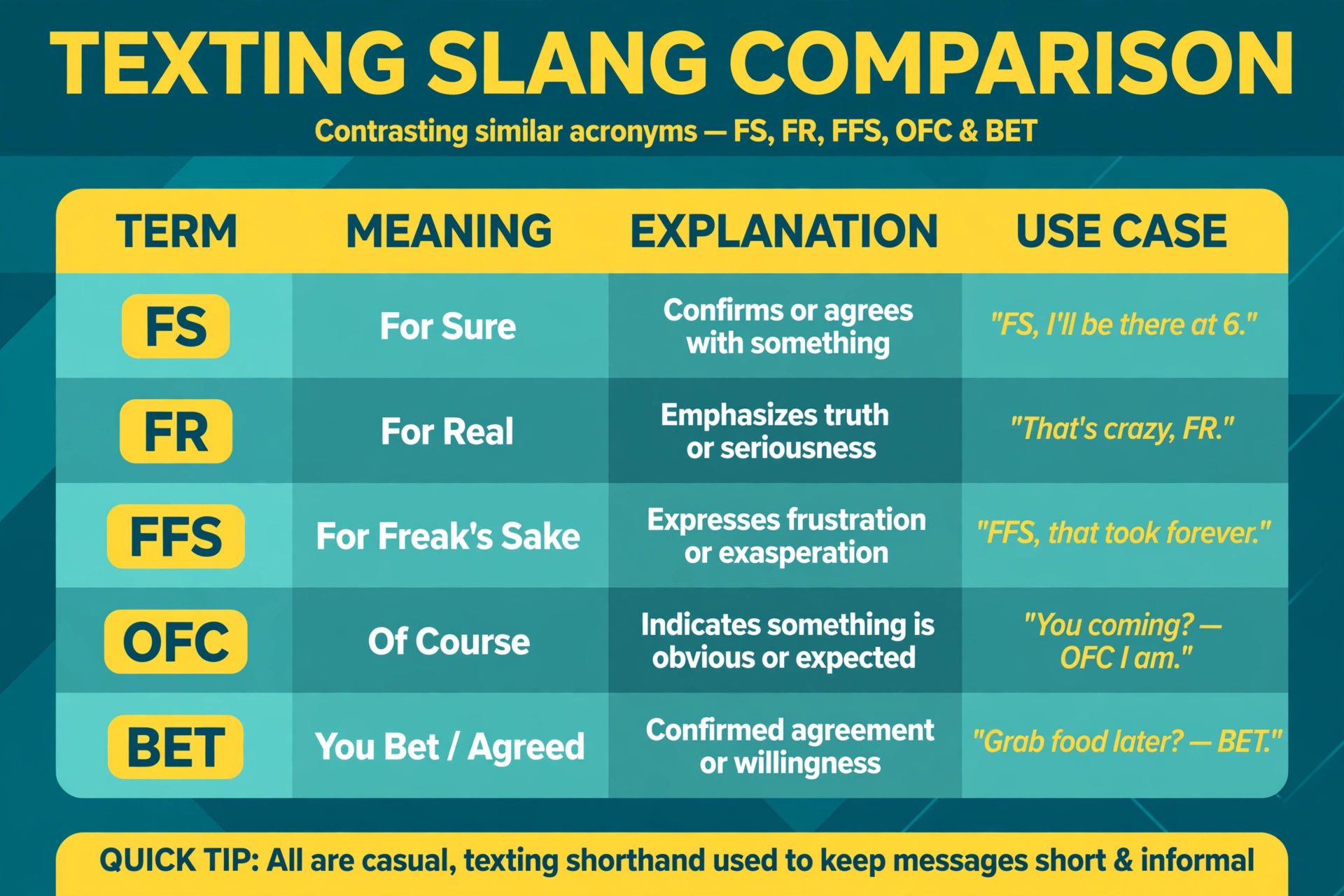
FS looks like several other short acronyms, and mixing them up can change your message completely. Here is how the main ones split:
| Slang | Stands For | Meaning | Tone |
|---|---|---|---|
| FS | For sure | Definitely, I agree | Confident, positive |
| FR | For real | Seriously, truly | Emphatic, honest |
| FFS | For f***’s sake | Frustration, annoyance | Negative, angry |
| OFC | Of course | Obviously, naturally | Casual, obvious |
| DEF | Definitely | Certainly, without doubt | Confident, casual |
| BET | Bet | Okay, agreed, challenge accepted | Confident, playful |
| ONG | On God | I swear, honestly | Sincere, emphatic |
| NGL | Not gonna lie | Honestly speaking | Honest, blunt |
FS vs FR: This is the closest pair, and the difference is small but real. FS confirms something — it says “yes, I agree.” FR states that something is true — it says “seriously, that is real.” If a friend says “That test was impossible,” replying “fs” means “I agree, it was.” Replying “fr” means “seriously, it really was.” In practice, people use them almost interchangeably, but FS leans toward agreement while FR leans toward truth.
FS vs FFS: Do not confuse these. FS is friendly; FFS is frustrated swearing. One extra letter turns a cheerful “definitely” into “for f***’s sake.” If you type FFS by accident, your friend will think you are annoyed. Double-check before you send.
FS vs BET: Both agree, but BET is more playful and sometimes carries a challenge — “bet, I will do it.” FS is a cleaner, calmer yes. When you just want to confirm plans, FS is the safer choice.
Alternate Meanings
FS does not always mean “for sure.” Like most short abbreviations, it picks up different meanings in different worlds. Context is everything — the same two letters mean something completely different on a marketplace listing than they do in a group chat.
| Meaning | Where You Will See It |
|---|---|
| For Sure | Texting, DMs, TikTok, Snapchat, Instagram — the default meaning |
| For Sale | Marketplace posts, classified listings, “FS: PS5, barely used” |
| Full Send | Gaming, sports, extreme sports — committing fully without hesitation |
| Full Screen | Computers, video, gaming settings — “switch to FS mode” |
| Free Safety | American football — a defensive position |
| File System | Computers and tech — how a device organizes data |
| Financial Statement | Business and formal writing |
| First Strike | Gaming — an opening attack or advantage |
How do you tell which one is meant? Look at the sentence around it. “FS, I will pick you up at 7” can only be “for sure.” “FS — iPhone 13, $400” can only be “for sale.” “Going full FS on this jump” is clearly “full send.” In everyday texting, “for sure” is the meaning about 95% of the time, and the other meanings almost never appear in casual chats.
Professional or Polite Alternatives
FS is strictly informal. In any setting where you want to sound professional, respectful, or polished, use the full phrase instead. Here are the best swaps:
| Instead of “FS” | Say This | Best For |
|---|---|---|
| “fs” | “Definitely” | Work chats, emails, general use |
| “fs, I will be there” | “Certainly, I will be there” | Formal replies, clients |
| “fs, sounds good” | “Absolutely, that sounds good” | Meetings, professional messages |
| “fs fs” | “Yes, of course” | Agreeing with a teacher or manager |
| “that is so true, fs” | “I completely agree” | Discussions, group projects |
| “fs, no worries” | “Of course, no problem at all” | Customer service, polite replies |
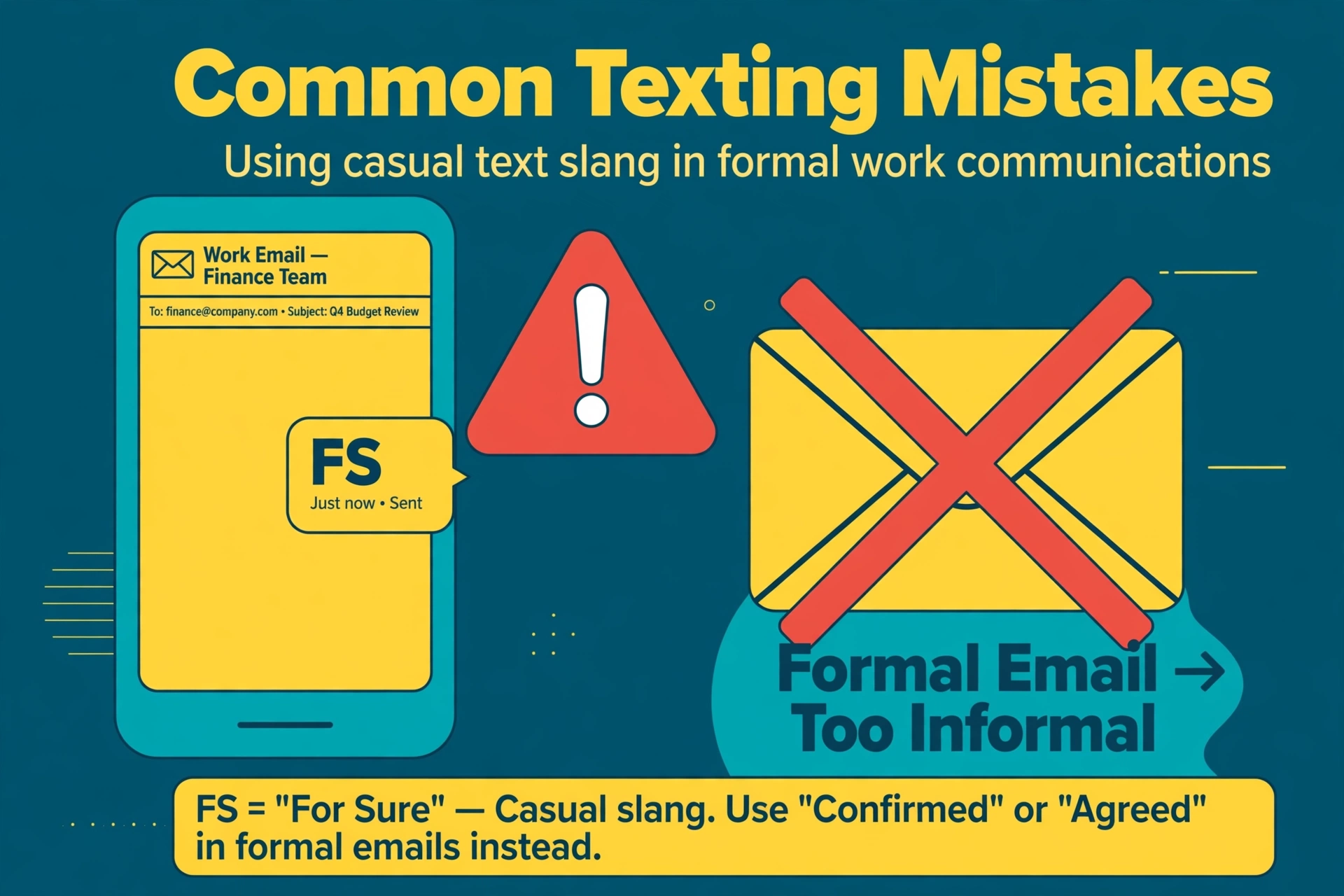
The simplest test: if you are messaging your boss, a teacher, a client, or anyone you address formally, write out the words. “For sure” is perfectly polite in spoken English — it is only the abbreviation that reads as casual. Dropping two letters is the whole difference between a friendly text and a professional one.
Common Mistakes
FS is easy to use, but a few mistakes show up again and again — especially from people who just learned the term.
- Using FS in formal messages: Sending “fs” to a boss, teacher, or client reads as careless. Save it for friends and casual chats, and write “definitely” or “certainly” at work.
- Confusing FS with FFS: One extra F changes a friendly “for sure” into frustrated swearing. Always re-read before sending, especially when you are typing fast.
- Replying “fs” when you mean “maybe”: FS is a confident yes. If you are unsure, say so — “maybe” or “I will let you know” is more honest than a “fs” you do not mean.
- Overusing it in one conversation: Answering every single message with “fs” makes you sound bored or uninterested, even when you are not. Mix in real replies, questions, and reactions.
- Using FS with people who do not know slang: Older relatives, new acquaintances, or anyone outside group-chat culture may not know what FS means. With them, type the full “for sure” — it costs you six extra letters and zero confusion.
- Reading “for sale” as “for sure”: On marketplaces and buy-sell groups, “FS” almost always means “for sale.” Replying “for sure!” to a listing that says “FS: bike” will confuse the seller.
- Using it sarcastically with strangers: Among friends, a sarcastic “fs” is funny. With someone you barely know, it can read as rude or dismissive. Keep the irony for people who know your tone.
Quick Tips
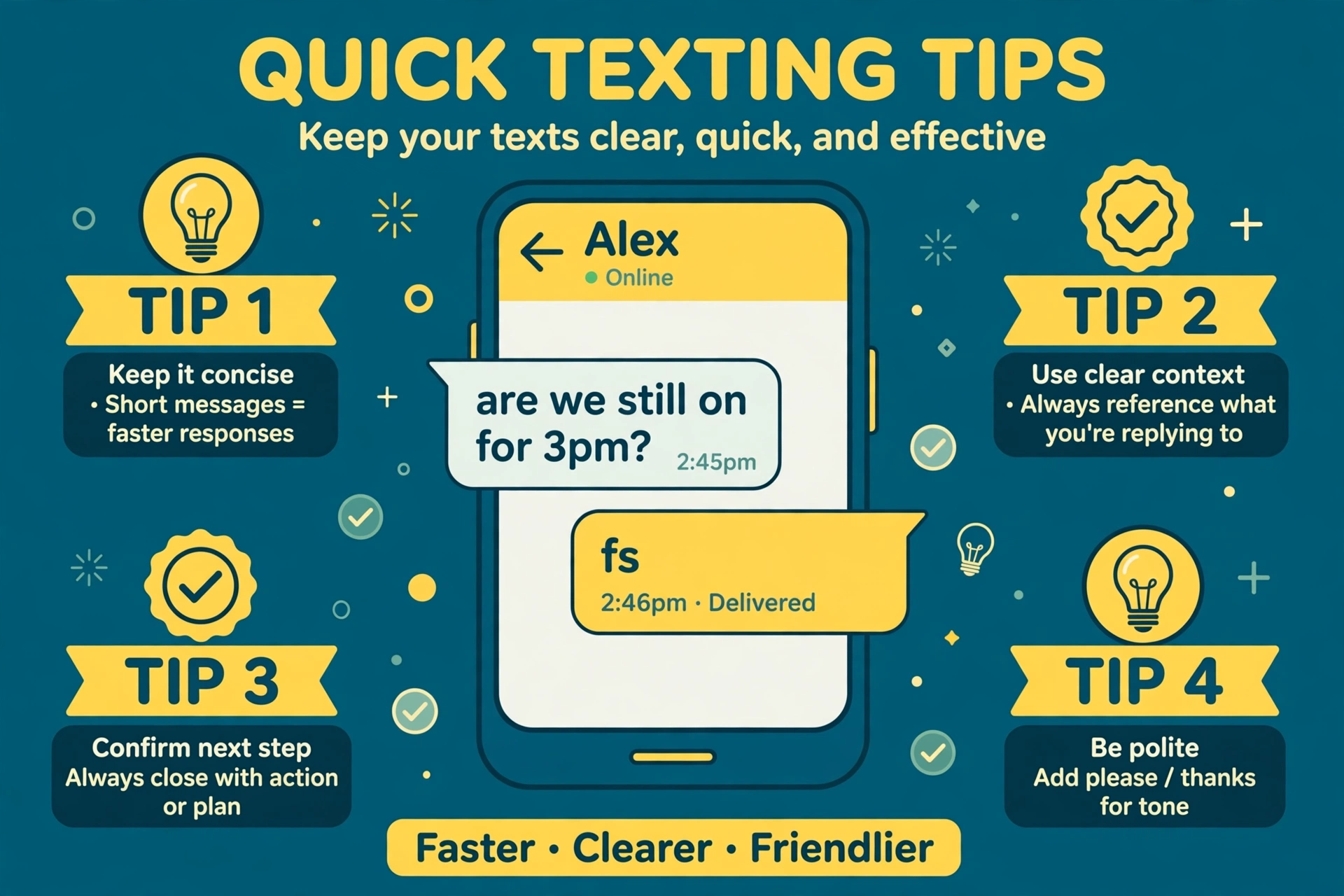
Want to use FS like a native? Keep these tips in mind:
- Default to lowercase: “fs” is the standard form online. Save uppercase “FS” for moments when you really want to emphasize your agreement.
- Pair it with a detail: “fs, I will be there at 8” is warmer and clearer than a bare “fs” — it proves you actually read the message.
- Use it to close plans: FS is perfect for the final confirmation in a plan — the message that turns “maybe” into “locked in.”
- Match the other person’s energy: If they reply with full sentences, answer with full sentences. If they reply “fs,” you can reply “fs” right back.
- Do not use it as your only reply: FS works best mixed with real conversation. A chat full of nothing but “fs” and “lol” dies fast.
- Remember the platform: FS fits Snapchat, TikTok, Instagram, and WhatsApp perfectly. It fits email and LinkedIn not at all.
- When in doubt, spell it out: “For sure” is never wrong. If you are unsure whether the other person knows the slang, the full phrase is always the safe choice.
FAQ
What does FS mean in text?
FS means “for sure” in texting. It is a quick way to say “definitely,” “absolutely,” or “I agree” in a casual conversation.
What does FS mean on Snapchat?
On Snapchat, FS means “for sure.” People use it in chat replies and snap captions to agree with something or confirm plans quickly.
What does FS mean on TikTok?
On TikTok, FS means “for sure” — the same as in texting. It appears in comments, replies, captions, and direct messages when someone wants to agree or emphasize a point.
What does FS mean on Instagram?
On Instagram, FS means “for sure.” You will see it in DM conversations, story replies, and comments, usually as a fast way to agree with a post or a plan.
Is FS rude?
No, FS is not rude. It is friendly and positive — it means you agree or you are confident about something. It only reads as rude if you use it sarcastically with someone who does not know you well, or if you reply “fs” to everything and sound uninterested.
What is the difference between FS and FR?
FS means “for sure” and confirms something — “yes, I agree.” FR means “for real” and states that something is true — “seriously, that is real.” They are very close in meaning, but FS leans toward agreement while FR leans toward truth.
Can FS mean “for sale”?
Yes. On marketplaces, classified ads, and buy-sell groups, FS usually means “for sale” — for example, “FS: PS5, barely used.” In regular texting and social media chats, FS almost always means “for sure,” so check the context before you decide.
Should I use FS at work or school?
Not in formal messages. FS is casual slang, so avoid it in work emails, messages to teachers, and anything professional. In a relaxed team chat with coworkers you know well, a quick “fs” is usually fine — but “definitely” is always the safer choice.
Conclusion
The fs meaning slang story is a small lesson in how language adapts to the way we actually talk. “For sure” is a phrase people have used for centuries, but the two-letter version — FS — only exists because texting demanded something faster. It spread through Snapchat and Instagram DMs in the mid-2010s, became the Gen Z default by 2020, and now works everywhere from TikTok comments to group chats planning Friday night.
What makes FS worth knowing is not just the definition. It is the confidence baked into two letters: FS never means “maybe.” When someone sends it, they are in — on the plan, on the opinion, on the joke. Just remember the two rules that keep it working for you: keep it casual, and keep it honest. Use it with friends, spell it out at work, never confuse it with FFS, and never send it when you actually mean “I am not sure.”
Now the next time a message pops up that just says “fs,” you will not have to guess. You will know exactly what it means — for sure. And if you want to decode more of the shorthand filling up your chats, check out our guides to glizzy, TS, and mid — the rest of the group-chat dictionary, explained one term at a time. For a second opinion on the term, How-To Geek’s guide to FS covers the same “for sure” definition with extra examples.

1 thought on “FS Meaning Slang: What “For Sure” Really Means in Texting”