Quick definition: In slang, “muff” most commonly refers to female pubic hair or the female genital area, used as a playful or cheeky euphemism. As a verb, “to muff” means to bungle something, fumble, or drop a catch in sports. The word’s meaning depends entirely on context, so the same four letters can be crude, funny, or completely innocent.
Muff Slang Meaning & Definition
Muff slang is one of those words that can mean completely different things depending on who is saying it and where you hear it. If you have ever stumbled across “muff” in a text, a meme, a sports broadcast, or an old novel and felt confused, you are not alone. The word has lived several lives across four centuries, and each one left a meaning behind.
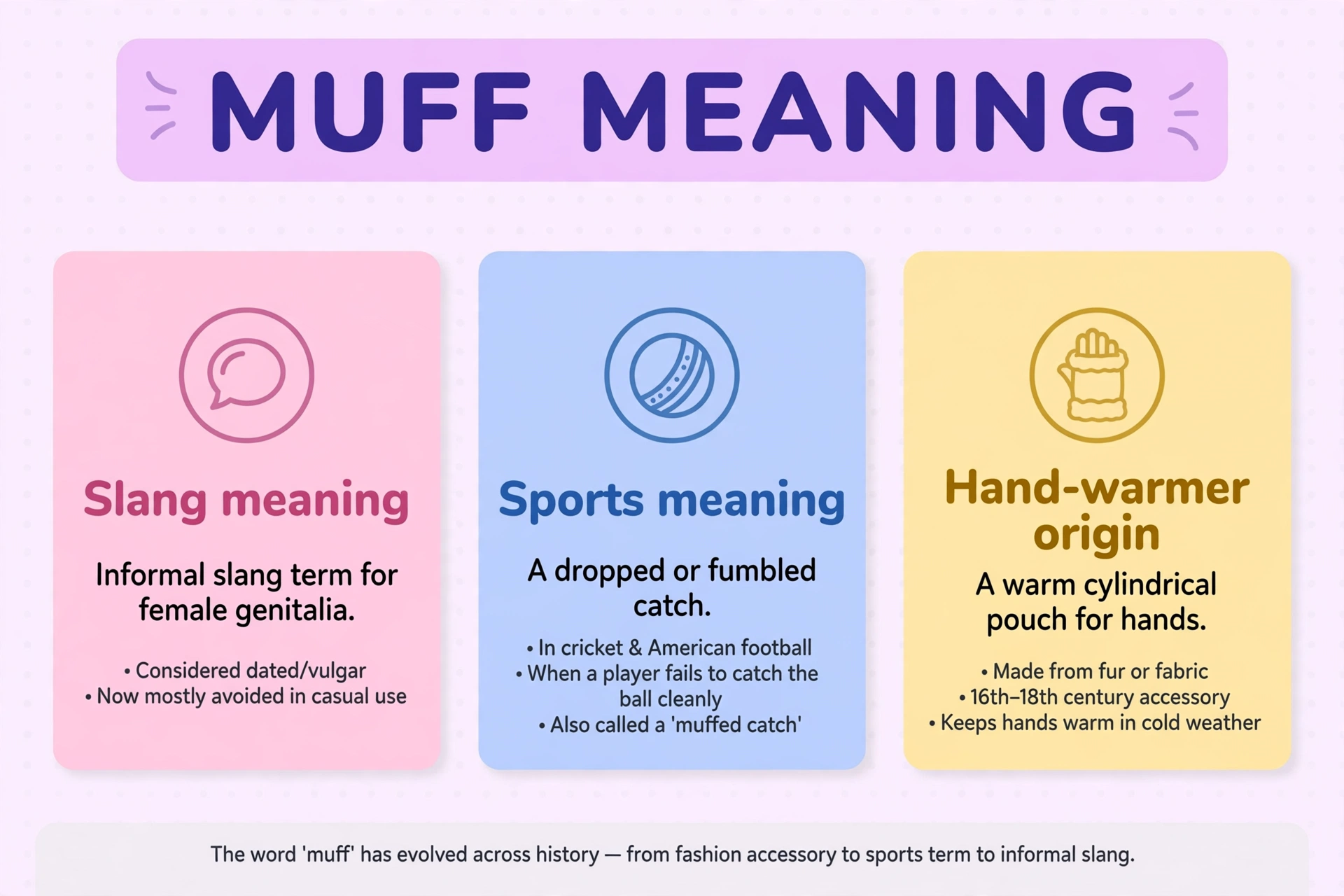
At its core, the slang meaning of “muff” breaks down into three main definitions:
- Vulgar slang (noun): A casual, slightly old-fashioned slang word for female pubic hair or the female genital area. This is the meaning most people encounter online, especially on Urban Dictionary, TikTok comments, and meme pages.
- To bungle or fumble (verb): To mess something up, handle it clumsily, or drop a ball you should have caught. A football player who drops an easy pass has “muffed” the catch.
- A fool or clumsy person (noun, older British use): A 19th-century insult for someone who is awkward, stupid, or poor-spirited, as in “a muff of a curate.”
Understanding which meaning applies is all about context. A sports commentator saying “he muffed it” is talking about a dropped ball, not anatomy. A joke in a group chat is almost certainly using the cheeky slang sense. And a Victorian novel mentioning a lady’s muff is talking about a fur hand-warmer. This guide walks through every meaning of muff slang, where it came from, how people actually use it today, and what to say instead when you need a polite alternative.
Introduction
Few slang words are as confusing as “muff.” It sounds soft, harmless, and almost cozy — and in one of its meanings, it literally is: a muff was once a fashionable fur tube that kept Victorian ladies’ hands warm. But somewhere along the way, the same soft, furry image gave the word a second, much spicier life as slang for female pubic hair. The visual connection is obvious once you see it, and that is exactly why the slang meaning stuck.
Today, “muff” survives in two very different worlds. In internet slang and meme culture, it shows up as a cheeky, slightly retro euphemism, often used for shock value or laughs. In sports, it never left: commentators still say a player “muffed” a punt or a catch, and nobody in the stadium blushes. Meanwhile, words like DSL meaning slang show how body-related slang keeps evolving online, and “muff” is one of the older words in that same family of terms that refuses to disappear.
So what does “muff” actually mean when someone uses it in a text? The honest answer is that you need the sentence around it. This article gives you every definition, real examples of each use, the history behind the word, and a clear guide to using it — or avoiding it — without embarrassing yourself.
Origin
The story of “muff” starts long before the internet, in 16th-century Europe. The word most likely comes from the Dutch mof, meaning a mitten, which itself traces back through the French moufle (a mitten) to the Medieval Latin muffula, meaning a glove. The earliest recorded English use, from around 1590 to 1600, referred to a thick, tubular case of fur or cloth, open at both ends, that women slipped their hands into to keep them warm in winter. It was a practical accessory and a fashion statement, and it stayed popular for centuries — you can spot muffs in Victorian paintings, period dramas, and old photographs.
The slang meaning grew out of that original object. A fur muff is soft, warm, and fuzzy, and the visual resemblance to pubic hair made the jump to vulgar slang almost inevitable. By the 19th century, “muff” was being used as a euphemism for female genitalia, and it was common enough that dictionaries of the era recorded it. The slang sense was never the polite term — it was always a wink, a joke, or a deliberately crude word — but it was softer and more playful than most of its synonyms, which is part of why it survived.
The verb meaning developed on a separate track. Nobody is entirely sure where “to muff” as in “to bungle” came from — it may be a specialized use of the noun, or it may come from the Dutch muffen (to dote) or the German muffen (to sulk). What is clear is that by the 1800s, “muff” also meant a clumsy person, a bungled action, or a dropped catch in sports. The two families of meaning — the cheeky slang noun and the clumsy verb — have coexisted ever since, which is exactly what makes the word so confusing today.
According to Dictionary.com, “muff” covers all of these senses: the hand-warmer, the bungled action, the dropped catch in sports, and the vulgar slang meaning. Few words pack that much range into four letters.
Popularity
“Muff” is not a trending Gen Z word in the way that “rizz” or “skibidi” are, but it has never really gone away either. Its popularity comes in waves. Every few years, a meme, a TikTok joke, or a viral Urban Dictionary screenshot pushes it back into group chats, and a new generation discovers that this innocent-sounding word has a very un-innocent meaning. That cycle is exactly why slang dictionaries and meaning guides keep getting traffic for it.
Several things keep “muff” alive in 2026:
- Urban Dictionary culture: “Muff” has been one of the most looked-up words on slang dictionaries for years, and new entries keep the joke going.
- Its double life: Because the sports meaning is completely clean, the word keeps appearing on television and in newspapers, which keeps it in everyone’s vocabulary — and keeps the joke available.
- The retro factor: Unlike newer, harsher slang, “muff” sounds old-fashioned and almost polite, which makes it a favorite for jokes that want to be cheeky without being outright crude.
- Related slang trends: As interest in body-related slang grows — words like BFE and kink meaning slang keep climbing in searches — curious readers keep landing on older terms like “muff” too.
In the United States, the slang meaning is far more common than the hand-warmer meaning, which most people only know from history books and movies. In the UK, the verb “to muff” (to bungle) is still heard more often, and the noun as an insult for a fool survives in older British writing. Online, though, the vulgar slang sense dominates, and that is the meaning most searchers are trying to understand.
How It Is Used
How “muff” is used depends entirely on the setting. Here is how each meaning shows up in real life:
The slang noun (vulgar, playful)
In casual online conversation, “muff” is used as a joking, slightly old-school word for female pubic hair or the female genital area. It is rarely used in serious conversation — it shows up in jokes, memes, teasing, and Urban Dictionary-style humor. The tone is almost always playful rather than aggressive, which is what separates it from harsher synonyms. Someone might say it to be funny, to shock a friend, or to reference the word itself rather than the anatomy.
The verb “to muff” (to bungle or fumble)
This is the cleanest and most common everyday use. In sports, “he muffed the catch” means a player dropped a ball he should have held on to. Outside sports, “she muffed her lines” means an actor forgot or flubbed a line, and “he muffed his big chance” means someone wasted a golden opportunity through clumsiness or nerves. This usage is informal but not vulgar, and it appears in newspapers, broadcasts, and professional writing without any raised eyebrows.
The noun for a mistake
A “muff” can also be the mistake itself: “That missed penalty was a real muff.” This is the noun form of the verb, and it is most common in sports writing and older British English.
The original meaning (hand-warmer)
In historical or literary contexts, a muff is simply the fur accessory. You will see it in period novels, museum descriptions, and costume discussions. Nobody in 2026 buys a muff to keep their hands warm, but the word survives in that meaning too.
The key skill is reading the room. In a sports broadcast, “muff” is innocent. In a meme comment section, it almost certainly is not. And in a formal setting, it is best avoided altogether, because even the clean meanings can make listeners think of the slang one.
Examples
Real examples make the different meanings click. Here are examples of “muff” used in friendly, professional, and funny contexts.
Friendly Examples
- “Okay, be honest — did you actually know what ‘muff’ meant before today, or did you just pretend?”
- “My grandma had a fur muff in an old photo and I thought it was a tiny pillow. Turns out it was a hand-warmer!”
- “No way, I just learned ‘muff’ has like four different meanings. English is wild.”
- “He muffed the last question on the quiz and we all groaned — it was right there!”
Professional Examples
- “The receiver muffed the punt in the third quarter, and the turnover changed the entire game.”
- “The actor muffed his opening line on the first night, recovered quickly, and the audience never noticed.”
- “The startup muffed its product launch by announcing a feature that was not ready yet.”
- “In the 19th century, a fur muff was both a practical winter accessory and a status symbol.”
Funny Examples
- “I told my mom I learned a new word today and she said, ‘Please tell me it wasn’t muff.'”
- “Me: *uses ‘muff’ in a sentence about football.* My friends: *lose it.* Me: ‘Guys, it’s a sports term!'”
- “Urban Dictionary has ruined so many innocent words. ‘Muff’ was a hand-warmer, people. A HAND-WARMER.”
- “He muffed the catch, muffed the interview, and then muffed the apology. A hat trick of muffs.”
Comparison with Similar Terms
“Muff” sits in a crowded family of slang words, and the differences matter. Here is how it compares with the terms people most often confuse it with:
| Term | Meaning | Tone | How It Differs from “Muff” |
|---|---|---|---|
| Muff | Female pubic hair / genital area; also to bungle | Playful, cheeky, old-fashioned | The original term — softer and more retro than most synonyms |
| Bush | Female pubic hair | Casual, blunt | More direct; lacks the sports and hand-warmer meanings |
| Muffin top | Fat spilling over the waistband of tight clothing | Humorous, teasing | Related by wordplay (“muffin”), but a completely different body reference |
| Fumble | To drop or mishandle something | Neutral, standard | The clean synonym for “to muff” in sports — no slang baggage |
| Blunder | A stupid or careless mistake | Neutral, formal | Means the same as “to muff” but sounds more serious and has no slang sense |
| Pussy | Female genitalia (vulgar slang) | Crude, harsh | Much stronger and more explicit than “muff” |
| Snatch | Female genitalia (vulgar slang) | Crude | Harsher tone; “muff” is the softer, joking alternative |
The comparison shows why “muff” has survived: it is the gentlest word in a rough category. People reach for it when they want the joke without the harshness, and the sports meaning gives it a built-in excuse — you can always claim you were talking about football.
Alternate Meanings
Beyond the three main senses, “muff” has a handful of alternate meanings worth knowing:
- A muffin (short form): In casual slang, “muff” can be a shortening of “muffin,” usually as a term of endearment or a joke — “Hey, muff, what’s up?” This is rare, but it appears in some online communities.
- Muff glass: In glassblowing, a “muff” is a blown cylinder of glass that is flattened into a sheet. This is a technical, historical term.
- Bird feathers: In ornithology, the “muff” is the tuft of feathers on the sides of a bird’s head or legs.
- A pipe fitting: In engineering, a muff is a short hollow cylinder that surrounds or joins a pipe.
- MUF (abbreviation): In technical fields, MUF can stand for “material unaccounted for” (inventory) or “maximum usable frequency” (radio communications). These are unrelated to the slang word but show up in searches.
- A fool (British, 19th century): “Don’t be such a muff” once meant “don’t be such an idiot” — an insult that has mostly faded, though it survives in old books.
None of these alternate meanings is what most people are looking for when they search “muff slang,” but knowing them helps you avoid confusion when the word pops up in an unexpected place, like a textbook or a period drama.
Professional or Polite Alternatives
Because the slang meaning of “muff” is vulgar, there are plenty of situations where you need a different word. Here are polite alternatives for each sense:
- For the slang noun: In any formal or mixed setting, simply avoid the topic or use clinical language such as “pubic area” if the discussion genuinely requires it. In most cases, the best alternative is to not use the word at all.
- For “to muff” (to bungle): Use “fumble,” “blunder,” “flub,” “botch,” or “miss.” For example: “He fumbled the catch” or “She flubbed her lines” — same meaning, zero awkwardness.
- For a mistake (noun): Use “error,” “blunder,” “mishap,” or “fumble.”
- For the hand-warmer: Just say “hand-warmer” or “fur muff” with the historical context made clear.
The general rule is simple: the verb sense is safe anywhere, the slang noun is only safe among close friends who are joking around, and in professional, academic, or family settings, the polite alternatives are always the better choice.
Common Mistakes
People get “muff” wrong in a few predictable ways. Here are the mistakes to avoid:
- Using it in formal settings: The biggest mistake is forgetting that most listeners will hear the slang meaning first. Even if you mean the sports term, saying “he muffed it” in a business meeting can earn you strange looks.
- Assuming it only has one meaning: New learners often assume “muff” is only the vulgar slang word, or only the sports word. It is both, and the context decides.
- Confusing it with “muffin top”: “Muffin top” is a different slang term about waistlines. The shared “muff” root is wordplay, not the same meaning.
- Using it with strangers or older people: The slang sense can come across as crude or disrespectful if the audience is not in on the joke. With strangers, skip it.
- Spelling it “muffe” or “muph”: The correct spelling is M-U-F-F. It is often confused with “muffler” (a car part or a scarf) — a different word entirely.
- Thinking it is a new Gen Z word: “Muff” is centuries old. It is not new slang, even if TikTok keeps rediscovering it.
Quick Tips
- Check the context first: Sports broadcast? It means a fumble. Meme comment? It means the slang noun. Old novel? It is probably a hand-warmer.
- When in doubt, use “fumble”: If you mean “to muff” in the bungle sense, “fumble” or “flub” says the same thing with no risk of misunderstanding.
- Keep the slang sense among friends: The cheeky meaning is a joke word. It works in group chats and memes, not in classrooms or workplaces.
- Remember the history: Knowing the hand-warmer origin makes the slang meaning make sense — and it is a great piece of trivia for winning arguments about words.
- Don’t overuse it: Like any joke word, “muff” is funnier the less often you say it. Once the joke lands, move on.
- Watch for the plural: “Muffs” usually refers to more than one hand-warmer, or to the slang noun in plural. In sports, the verb form “muffed” is far more common than the noun.


FAQ
What does “muff” mean in slang?
In slang, “muff” most commonly refers to female pubic hair or the female genital area. It is a playful, slightly old-fashioned euphemism, softer in tone than most synonyms. The word can also mean to bungle or fumble something, as in “he muffed the catch.”
Is “muff” a bad word?
It depends on the meaning. The slang sense is vulgar, so it is considered a bad word in formal, professional, or family settings. The sports sense (“to muff a catch”) is completely clean and acceptable anywhere. Context decides whether it is offensive.
What does “to muff” mean in sports?
In sports, “to muff” means to drop or mishandle a ball that should reasonably have been caught — for example, a football player muffing a punt. It is a standard piece of sports commentary language.
Where did the slang word “muff” come from?
“Muff” originally meant a fur hand-warmer (from Dutch mof, via French moufle). The slang meaning developed because of the visual resemblance between the soft, furry accessory and pubic hair. The verb sense (to bungle) developed separately in the 19th century.
What is the difference between “muff” and “muffin top”?
They are different terms. “Muff” is slang for female pubic hair or a bungled action. “Muffin top” is slang for fat that spills over the waistband of tight pants. They share a word root, but they describe completely different things.
Can you use “muff” in professional writing?
The verb sense (“muffed the launch”) is fine in professional writing. The slang noun is not — use clinical language or avoid the topic entirely in formal contexts.
Is “muff” still used in 2026?
Yes. The sports meaning never left, and the slang meaning keeps resurfacing through memes, Urban Dictionary, and TikTok jokes. It is an old word with a very long shelf life, and new generations keep rediscovering it.
What are polite alternatives to “muff” slang?
For the slang noun, the polite move is to avoid the word or use clinical terms like “pubic area” if the topic genuinely requires it. For the verb sense, use “fumble,” “flub,” “botch,” or “blunder” — all clean, professional, and clear.
Conclusion
“Muff” is a small word with a surprisingly big history. It started as a fur hand-warmer in the 1600s, became a cheeky slang word for female pubic hair, grew a second life as a sports term for a dropped catch, and even served as a 19th-century insult for a fool. In 2026, all of those meanings are still in circulation, which is why the word confuses so many people — and why it keeps getting searched.
The takeaway is simple: context is everything. In a sports broadcast, “muff” is innocent. In a meme, it is a joke. In a formal setting, it is a word best left unsaid. If you remember the three main meanings — the slang noun, the verb “to muff,” and the original hand-warmer — you will never be caught off guard by it again.
If you enjoyed decoding this one, check out our guides to other slang terms that keep people guessing, like glazing slang and Gen Alpha slang. And the next time someone drops “muff” into a conversation, you will know exactly which meaning they mean — and exactly what to say back.
