Quick definition: In slang, slag is a British insult for a person — usually a woman — judged to be promiscuous or of low character, and as a verb, to slag someone off means to criticize or insult them harshly. It is one of the harshest words in British slang, so context and audience matter a lot before you ever use it.
Slag Slang Meaning & Definition
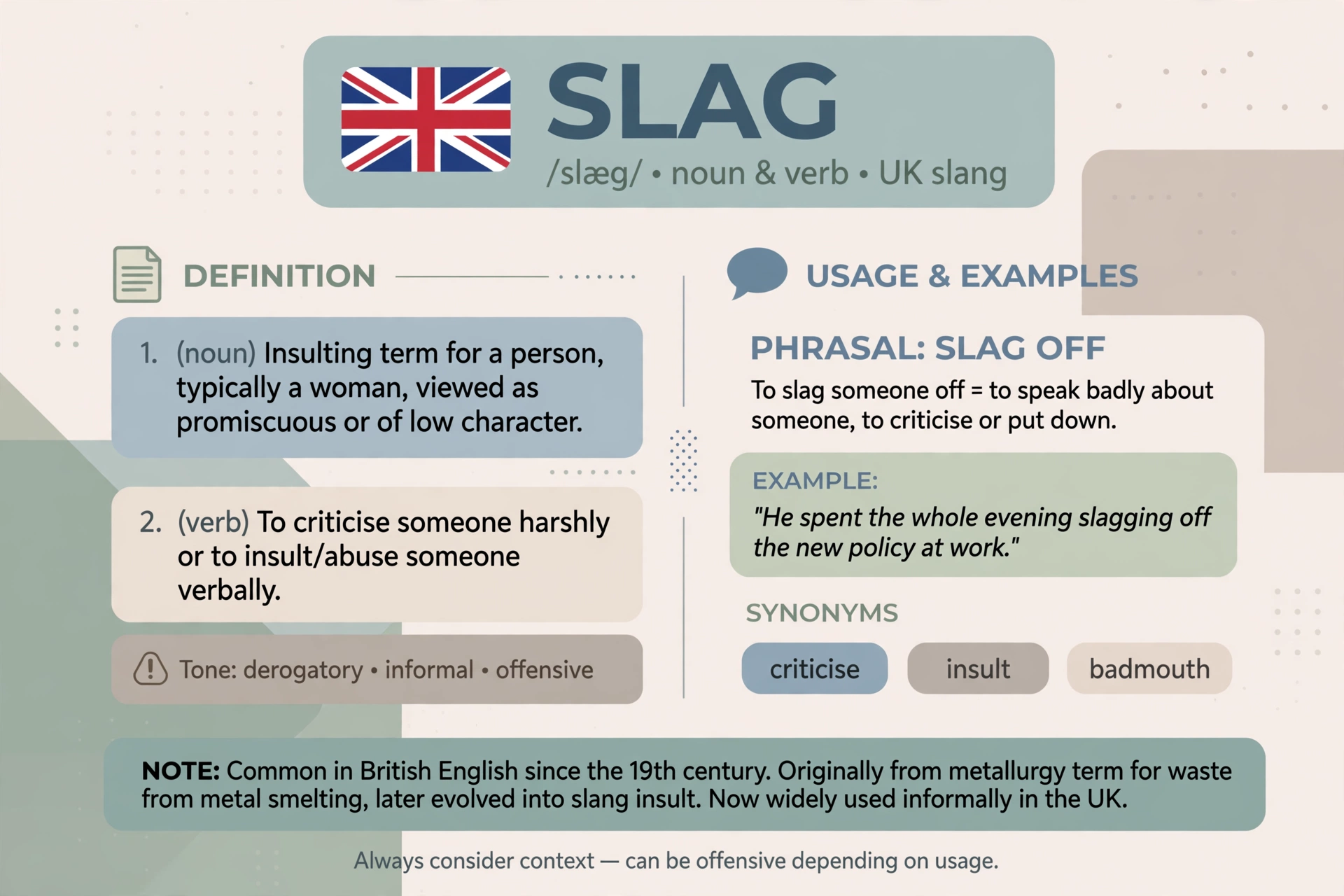
Slag slang carries two main meanings in modern British English. As a noun, a slag is a derogatory term for someone — most often a woman — who is perceived as having many sexual partners or behaving in a way the speaker considers cheap or disreputable. It is roughly the British equivalent of the American insults “slut” or “tramp,” but with a grittier, working-class edge that feels unmistakably British.
As a verb, to slag (usually to slag off) means to talk badly about someone, to criticize them unfairly, or to mock them. “Don’t slag him off, he’s doing his best” has nothing to do with promiscuity — it simply means “don’t badmouth him.” This verb sense is far more common in everyday conversation, and it is the meaning most people actually encounter in texts, group chats, and social media.
There is also a lighter, teasing sense in Irish and some British usage, where slagging means playfully mocking a friend — “We’re just slagging each other” — the way American friends might say they are roasting each other. The tone, the relationship, and the exact wording decide whether it lands as a joke or an insult.
Here is the short version you can remember:
- Slag (noun): a derogatory British insult, usually aimed at a woman, implying promiscuity or low character.
- Slag off (verb): to criticize, insult, or badmouth someone.
- Slagging (verb, friendly): to tease or mock someone in a playful, joking way — mostly in Irish and British friend groups.
- Slag (literal noun): the stony waste left over from smelting metal ore — the original meaning the slang grew out of.
Because the noun form is strongly gendered and offensive, most style guides and most British speakers treat it as a word to understand, not a word to use casually. The verb form “slag off,” on the other hand, is everyday informal English in the UK, Australia, and Ireland.
Introduction
If you have ever watched a British TV show, scrolled through UK Twitter, or chatted with a friend from Manchester or London, you have probably bumped into the word slag — and you may have been unsure whether it was a joke, an insult, or something else entirely. It is one of those slang words that sounds short and simple but carries a surprising amount of history, regional flavor, and social weight.
The confusion is understandable. In one sentence, slag is a vicious insult. In the next, it is just friends messing around. In a text message, it might mean someone is being criticized behind their back. And in a science textbook, it means something completely different — the waste from a furnace. No wonder people search “slag slang meaning” thousands of times a month.
This guide breaks it all down: the exact definition of slag slang, where the word came from, how it is used in texts and real conversations, how it compares to similar insults like “skank” and “slut,” and, most importantly, the polite alternatives you should use instead. By the end, you will know exactly what slag means, when people use it, and why it is usually better left unsaid.
Origin
The story of slag starts in a furnace, not on the street. The literal meaning of slag is the glassy, stony waste material separated from metal during smelting — the dross, the leftovers, the stuff with no value that gets thrown away. The word comes from Middle Low German slagge, related to the German Schlacke (dross) and the verb “to strike,” because slag was the material struck off molten metal.
By the late 18th century, that image of worthless waste had jumped into slang. People began calling a “worthless” or low-life person a slag — and at first, the insult was not gendered at all. A man could be called a slag if he was considered a petty criminal, a layabout, or just a contemptible person. Dictionary records show the insult in use from around 1780–1790, originally as underworld or thieves’ cant for a worthless person; see the full Dictionary.com entry for slag for the dictionary definitions and etymology.
Over the 19th and 20th centuries, the meaning narrowed and sharpened. In British working-class speech, slag became attached specifically to women and to sexual reputation, until the promiscuity sense became the dominant one. The verb sense followed a parallel path: to “slag someone off” grew out of the same idea of treating a person like worthless waste — talking them down, stripping away their reputation.
Pop culture cemented the word. It shows up in the scripts of EastEnders and other British soaps, in the lyrics of bands like the Arctic Monkeys, in tabloid headlines, and in countless British films. Each appearance reinforced the same associations: gritty, street-level, working-class, and deliberately crude. Unlike many slang terms that soften with age, slag has kept its sting — which is exactly why it still gets searched, quoted, and argued about.
Popularity
Slag is not a TikTok-born word, and it is not trending because of a viral meme. Its popularity is steadier and older than that: it is a permanent fixture of British English, recognized by the overwhelming majority of UK speakers. Surveys of British language use have found that around two-thirds of respondents immediately recognize the sexual connotation of the word, and recognition is higher still among younger adults who grew up with British television and social media.
Regionally, the word is strongest in the UK and Ireland, common in Australia, and much weaker in the United States. Say “slag” in a pub in Manchester and everyone knows what you mean. Say it in a coffee shop in Ohio and most people will think you are talking about mining or metallurgy — or they will have no idea what you mean at all. That gap is precisely why American readers keep searching for the definition after hearing it in a British show, a song, or an online argument.
Online, the word spikes whenever British reality TV, football culture, or celebrity gossip is in the news — tabloid stories love the word, and social media arguments recycle it constantly. It also appears in a softer, joking form in group chats and gaming lobbies, where “slagging off” a friend is a normal part of banter. In 2026, the noun form is increasingly seen as dated and sexist, especially by younger speakers, while the verb form “slag off” remains widely used and socially acceptable.
Interestingly, some communities have tried to reclaim the word — notably parts of the UK drag scene and some feminist circles use it ironically among themselves. But reclamation only works inside the group; used by an outsider, it lands as the same old insult it has always been.
How It Is Used
Slag changes meaning with its grammar, so the form of the word is your best clue to what the speaker means. Here is how each form works in real life:
Slag as a noun (insult)
This is the harshest use. “She’s such a slag” is a judgment about a woman’s sexual behavior or reputation. It is almost always meant to wound, and it is usually said behind someone’s back rather than to their face. It can also be used more generally for a contemptible person of any gender — “He’s a right slag” — though this is less common today.
Slag off as a phrasal verb (criticize)
This is the most common everyday use. “He spent the whole lunch slagging off his boss.” “Stop slagging off my team.” It means to criticize harshly, to badmouth, or to run someone down. It does not carry the sexual meaning at all — it is simply a colorful way of saying someone is being verbally attacked.
Slagging as friendly teasing
Among close friends, especially in Ireland and parts of the UK, “slagging” can be affectionate mockery. “We were just slagging each other about our terrible haircuts.” The key ingredients are mutual trust, equal footing, and an obvious joke. If any of those are missing, it stops being banter and starts being bullying.
Slag in texting and social media
In texts, DMs, and comments, you will mostly see two patterns: the insult (“omg she looks like a slag in that outfit” — a nasty comment about someone’s appearance) and the verb (“he’s slagging you off in the group chat”). Tone is hard to read in text, so the friendly teasing sense rarely travels well in writing — without a voice or a facial expression, “I’m only slagging you” can easily read as genuine hostility. That is one reason the word causes so many misunderstandings online.
A quick rule of thumb: if slag is followed by “off,” it means criticizing. If it stands alone as a label for a person, it is the insult. And if friends are laughing together, it might be banter — but you should not assume that unless you know the friendship well.
Examples
Real examples make the different meanings click. Notice how the same four letters do very different jobs depending on the sentence around them.
Friendly Examples
- “Stop slagging me off about my cooking — you ate two plates of it!” (playful complaint between friends)
- “We spent the whole car ride slagging each other’s music taste. It was the best part of the trip.” (affectionate teasing)
- “I’m only slagging you, don’t take it seriously — your presentation was actually great.” (joking, then reassuring)
- “The lads were slagging off the referee for a full hour after the match.” (fans criticizing, but in a lighthearted group-bonding way)
Professional Examples
- “Let’s not slag off the previous supplier in the meeting — just explain why we’re switching.” (workplace advice: criticize the work, not the people)
- “The review didn’t just critique the film, it slagged off the entire cast.” (a harsh, unfair review)
- “If you slag off a colleague in front of a client, it reflects badly on the whole team.” (professional warning)
Funny Examples
- “My brother has been slagging off my haircut since 2019. The haircut changed. He did not.”
- “She slagged off his playlist so hard that he deleted Spotify out of shame.”
- “Don’t slag him off — he’s the only one in this group chat who actually reads the messages.”
Negative Examples (the insult sense)
- “Did you see what she was wearing? She’s such a slag.” (judgmental gossip — the classic insult use)
- “He called her a slag just because she was dancing with someone else.” (an unfair, sexist label)
- “The tabloids love calling any confident woman a slag. It’s lazy and it’s sexist.” (criticism of the word itself)
Notice the pattern: the friendly and professional examples almost always use “slag off” or “slagging,” while the insult examples use “slag” as a standalone noun. That grammatical difference is the fastest way to tell which meaning is in play.

Comparison with Similar Terms
Slag sits in a crowded family of insults, but each word has its own flavor, region, and level of severity. This table lays out the differences:
| Term | Meaning | Region | Severity | Main difference from “slag” |
|---|---|---|---|---|
| Slag | Derogatory label for a promiscuous woman; also “to criticize” | UK, Ireland, Australia | High (noun) / Low (verb) | The baseline — gritty, working-class, very British |
| Slut | Derogatory label for a promiscuous woman | USA, worldwide | High | The American equivalent; no verb form meaning “to criticize” |
| Skank | Derogatory label for a promiscuous or dirty person | USA, UK | High | More about being unclean or trashy than just promiscuity |
| Tramp | Derogatory label for a promiscuous woman | UK, USA | High | Older-fashioned; also means a homeless wanderer |
| Tart | Derogatory label for a sexually provocative woman | UK | Medium–High | Softer and older; can sound almost playful in period dramas |
| Bitch | Derogatory label for a difficult or unpleasant woman | Worldwide | Medium–High | About attitude and behavior, not sexual reputation |
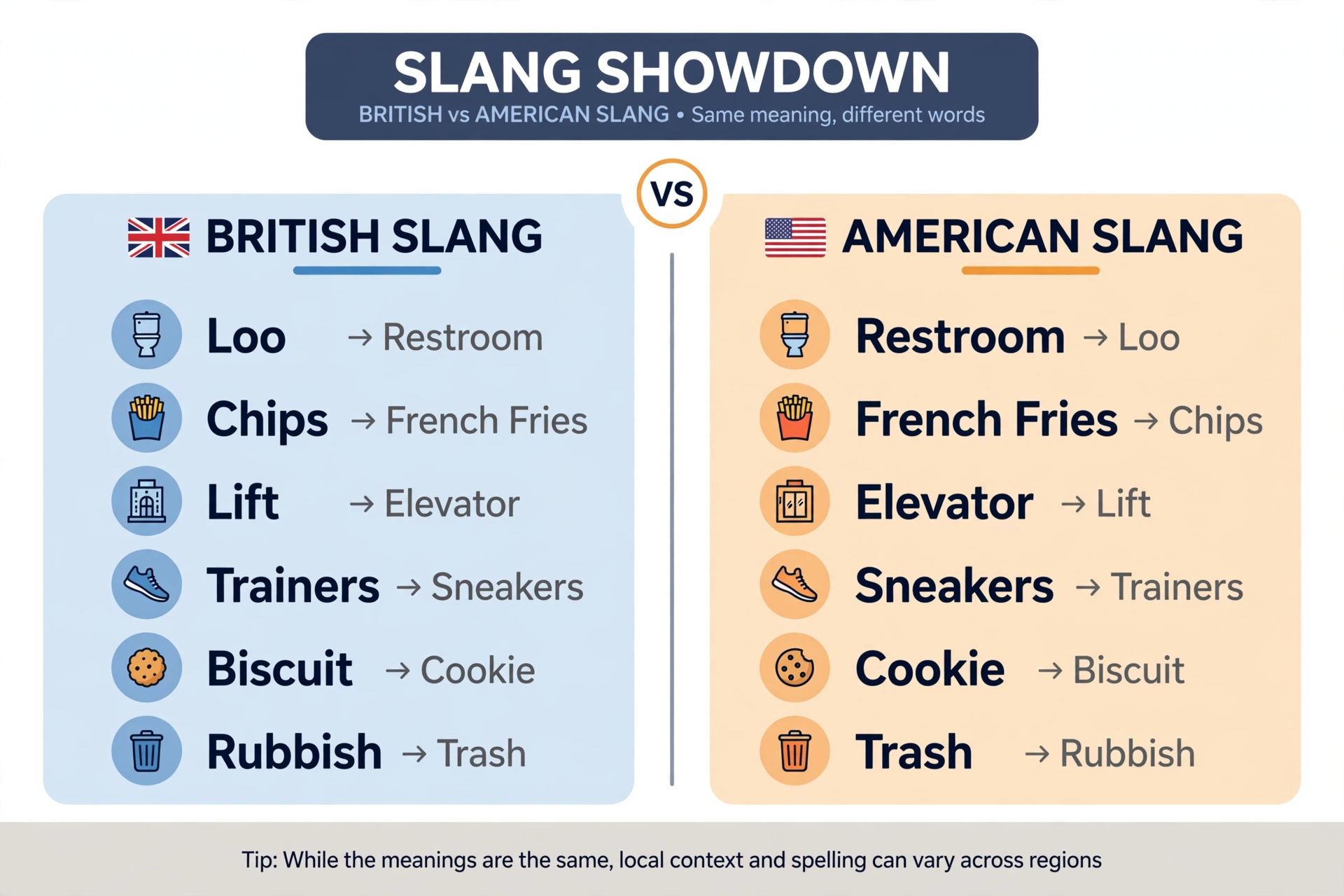
| To diss / to trash-talk | To criticize or insult someone | USA | Low–Medium | The American equivalent of “slag off” — the verb sense only |
| To roast | To mock someone, usually jokingly | USA, worldwide | Low | The friendly equivalent of “slagging” among friends |
The most useful comparison is with slut: the two words mean almost the same thing as insults, but slag is the British version and slut is the American one. If you are writing for an American audience, “slut” is the word they will recognize; if you are writing for a British audience, “slag” is the one that lands. The verb “slag off,” though, has no single-word American twin — “trash-talk” and “diss” are the closest matches, and they carry less venom.
Compared with other British slang, slag is harsher than “chav” (a class-based insult) and more personal than “tosser” or “wanker” (general insults for an annoying person). It is also more gendered than any of them, which is why it draws more criticism in modern discussions about language and sexism. Similar slang explainers on this site cover words that travel between the US and UK in confusing ways — for example, BFE meaning is a very different kind of slang puzzle, but it shows the same pattern: a short phrase that means one thing in one country and something else entirely in another.
Alternate Meanings
Slag has several meanings beyond the slang, and knowing them helps you avoid embarrassing mix-ups:
- Metallurgy (the original meaning): the glassy waste produced when metal is smelted from ore. Slag is used in construction, road building, and cement — it is a real industrial product, not just an insult.
- Mining: a heap of waste rock from a mine, often called a slag heap. Old mining towns in Wales and northern England are still shaped by these dark, artificial hills.
- Volcanic rock: rough fragments of lava and cinders, also called scoria, are sometimes described as slag.
- To slag off (verb): to criticize or badmouth someone — the most common non-insult meaning in everyday speech.
- To slag (verb, Australia): to spit. This is a rare, regional use, mostly heard in Australian slang.
- Slagging (friendly teasing): in Irish English, to mock a friend playfully — the banter sense described above.
- Slag code (computing): a rare term for harmful instructions hidden in a program, unrelated to the slang insult.
In practice, if you see the word in a British conversation, a text message, or a comment section, the slang meanings are almost certainly the ones in play. The industrial meaning only shows up in engineering, geology, and history contexts.
Professional or Polite Alternatives
Because the noun form of slag is a gendered insult, there are many situations — work, school, polite conversation, writing — where you should not use it at all. Here are better options for each situation:
| Instead of saying… | Say this… | When to use it |
|---|---|---|
| “She’s such a slag.” | “I don’t agree with her choices, but that’s her business.” | When you disagree with someone’s behavior without judging their character |
| “He’s slagging me off.” | “He’s criticizing me unfairly.” | Formal or professional settings |
| “Stop slagging him off.” | “Stop badmouthing him behind his back.” | Polite everyday speech |
| “We were just slagging each other.” | “We were just teasing each other.” | Explaining friendly banter to outsiders |
| “Don’t be a slag.” | “Think about how that comes across.” | Advice to a friend, without the insult |
The simplest rule: if you mean “criticize,” say “criticize,” “badmouth,” or “trash-talk.” If you mean the insult, ask yourself whether the judgment is fair or even necessary — in most cases, it is not, and a neutral description of the actual behavior works better. Language that targets a person’s sexual reputation says more about the speaker than about the person being described.
Common Mistakes
People get slag wrong in a handful of predictable ways. Avoid these and you will never be caught out by the word:
- Using the noun form casually: calling someone “a slag” is not casual banter for most listeners — it is a serious insult. Do not use it jokingly with people you do not know well.
- Confusing the verb and noun senses: “slagging off” a bad movie is fine; calling a person “a slag” is not. The two extra letters change everything.
- Assuming it means the same thing in the US: most Americans will not know the slang meaning. If you use it with an American audience, explain it or choose a word they recognize, like “slut” or “trash-talk” depending on your meaning.
- Using it at work or school: even the verb form is informal. In professional settings, “criticize” or “give feedback” is always safer than “slag off.”
- Thinking the friendly sense travels in text: “I’m just slagging you” can read as hostile without tone of voice. In writing, add a clear signal — an emoji, a “haha,” or an explicit “joking” — or use “teasing” instead.
- Repeating it about a real person: sharing gossip that labels someone a slag can damage a real reputation and, in some workplaces, count as harassment. Think twice before repeating it.
- Mixing it up with the industrial meaning: in a technical or scientific context, slag is neutral. Do not giggle at a civil engineering document — the furnace meaning came first.
Quick Tips
- Remember the “off” test: “slag off” = criticize (usually safe). “Slag” alone as a noun = insult (usually not safe).
- Know your audience: fine among close British friends as banter; risky with strangers, Americans, colleagues, or in writing.
- When in doubt, swap it out: “criticize,” “tease,” and “badmouth” cover almost every situation without the baggage.
- Don’t use it to describe real people: labeling someone’s sexual reputation is judgmental and can be genuinely harmful.
- Watch it in media: British soaps, reality shows, and football chants use it constantly — that is exposure, not permission to repeat it.
- Learn the friendly version carefully: if British or Irish friends slag each other, enjoy the humor — but wait until you are genuinely part of the group before joining in.
- Pair it with context in writing: if you must quote the word, explain which meaning you intend so readers do not assume the worst one.

FAQ
What does slag mean in slang?
In British slang, slag is a derogatory term for a person — usually a woman — judged to be promiscuous or of low character. As a verb, to slag someone off means to criticize or insult them harshly. The verb sense is far more common in everyday conversation than the insult.
Is slag a bad word?
Yes, the noun form is considered a bad word — it is vulgar, derogatory, and sexist when used about a woman’s sexual reputation. The verb form “slag off” is milder and is everyday informal British English, roughly equivalent to “trash-talk” or “badmouth.”
What does “slag off” mean?
“Slag off” means to criticize someone harshly or talk badly about them, usually behind their back. For example: “He spent the whole meeting slagging off his old boss.” It has nothing to do with the sexual meaning of the noun.
What does slag mean in texting?
In texts and DMs, slag usually appears as either the insult (“she’s such a slag”) or the verb (“he’s slagging you off in the group chat”). Because tone is hard to read in writing, the friendly teasing sense rarely works well in text — it can easily be misread as genuine hostility.
Is slag British or American slang?
Slag is primarily British, Irish, and Australian slang. Most Americans do not use it and many do not know the slang meaning at all — in the US, the word is more likely to be understood in its literal industrial sense, the waste from smelting metal.
What is the difference between slag and slut?
They mean almost the same thing as insults — a derogatory label for a promiscuous woman — but slag is the British version and slut is the American one. Slag is also more working-class and gritty in tone, and unlike slut, it has a separate verb form (“slag off”) meaning “to criticize.”
Can slag be used in a friendly way?
Yes, among close friends in the UK and Ireland, “slagging” can mean playful teasing — the equivalent of roasting a friend. But it only works when everyone involved understands it is a joke, and it is risky in writing, with strangers, or with people outside that friend group.
What should I say instead of slag?
If you mean “criticize,” say “criticize,” “badmouth,” or “trash-talk.” If you are tempted to use the noun insult, describe the actual behavior neutrally instead of labeling the person — for example, “I don’t agree with her choices” rather than a gendered insult.

Conclusion
Slag slang is a small word with a big footprint: a furnace-waste noun that became one of Britain’s sharpest insults, a verb that means “to criticize,” and — among close friends — a form of playful teasing. The key to understanding it is grammar and context. “Slag off” means someone is being badmouthed. “A slag” means someone is being judged, usually unfairly, for their sexual reputation. And “slagging” among friends usually means everyone is laughing.
For most people, the practical takeaway is simple: understand the word, but use it carefully. The verb form is useful, everyday British English. The noun form is a gendered insult that has aged badly, and the polite alternatives — criticize, tease, badmouth — do the same job without the damage. If you hear it in a British show, a song, or a group chat, you will now know exactly which meaning is in play — and why the people using it chose that word and not another.
Slang is always moving, and words like slag show how a single term can carry history, class, region, and attitude all at once. For more plain-English explainers of confusing slang, check out FN meaning in text and CFS meaning in text — two more short terms that mean something completely different depending on who is typing them.
