Quick definition: In slang, FOH means “fuck outta here” — a blunt, dismissive way to tell someone to leave, or to react with disbelief, like saying “get out of here” or “no way.” It shows up in texts, social media comments, song lyrics, and heated arguments, and its tone can swing from playful teasing between friends to a genuinely angry brush-off.
FOH Meaning Slang & Definition
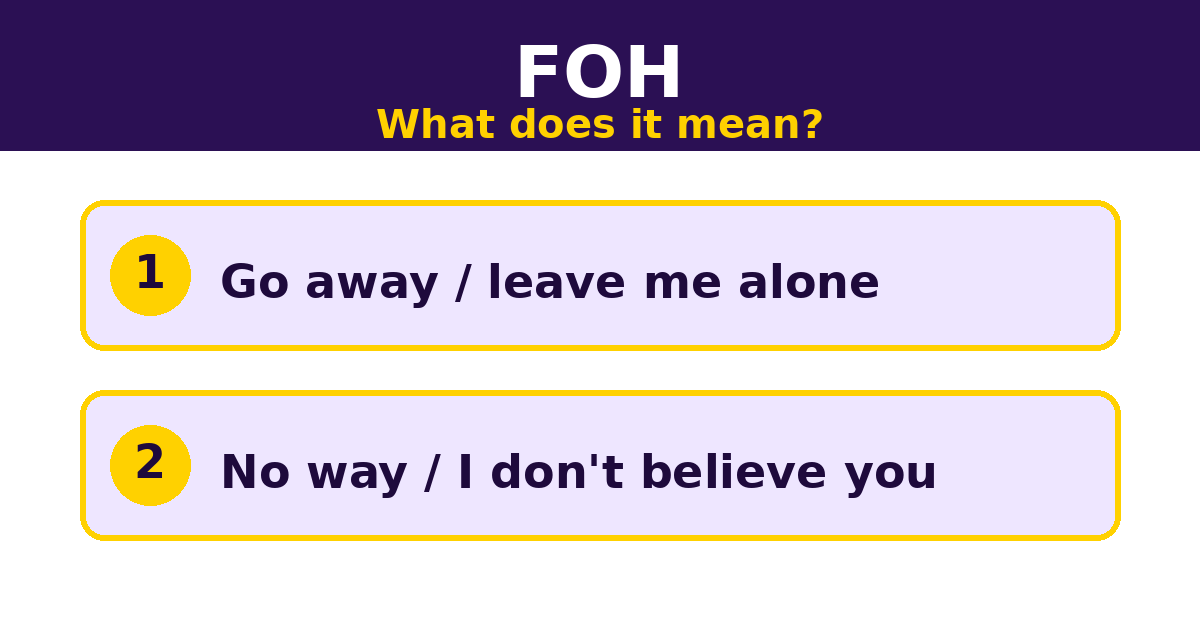
So, what does FOH mean in slang? At its core, FOH is an abbreviation of the phrase “fuck outta here,” where “outta” is the casual spoken form of “out of.” It works in two main ways. First, as a command: “FOH” tells someone to go away, to stop talking, or to leave you alone. Second, as an exclamation of disbelief: “FOH!” means “I don’t believe you,” “that’s ridiculous,” or “you can’t be serious” — the same energy as “get outta here!” said with a laugh or an eye roll.
The meaning almost always depends on context and tone. Between close friends, FOH is often a joke — a dramatic, exaggerated reaction to a wild story or a bad take. In an argument, it is a door slamming shut: the person is done listening and wants the other person gone. Because the full phrase contains a swear word, FOH is considered vulgar slang, so it belongs in casual conversations, not in work messages, school emails, or anything formal.
FOH also carries a distinctly hip-hop and street-culture flavor. It grew up in Black American English and rap lyrics before spreading to group chats, Twitter (now X), TikTok comments, and gaming lobbies. When you see it online today, it usually reads as confident, unbothered, and a little bit confrontational — a three-letter way of saying “I’m not dealing with this.”
Introduction
Imagine this: you open your group chat and someone drops a take so wrong it hurts — “Pineapple belongs on every pizza, and anyone who disagrees is wrong.” The first reply is three letters long: “FOH 😂.” Everybody laughs, because everybody understands. That is FOH in its natural habitat.
Short slang like FOH exists because texting rewards speed and punch. Nobody wants to type out “I respectfully disagree with your opinion and would like you to leave this conversation” when three letters do the job with ten times the attitude. FOH is part of a whole family of blunt, dismissive abbreviations — GTFO, STFU, BYE — but it has its own flavor: less formal than “get the fuck out,” more dismissive than a simple “no,” and instantly recognizable to anyone who spends time online.
This guide breaks down everything about FOH: what it means, where it came from, how it became popular, and how people actually use it in texts, comments, songs, and arguments. You will find real examples for friendly, professional, and funny situations, a comparison with similar slang, alternate meanings you should know about, polite alternatives for when the F-word is off the table, and the common mistakes that make people use it wrong. By the end, you will know exactly when to drop a FOH — and when to keep it in your pocket.
Origin
FOH comes from the spoken phrase “fuck outta here,” a piece of American English that has been around for decades as an angry dismissal. The phrase itself is a compressed, street-level version of “get the fuck out of here,” which has long been used to order someone out of a room, a conversation, or your life. The abbreviation took shape the way most internet slang does: people started typing the first letters of each word to save time and add attitude.
The roots run through Black American English and hip-hop culture, where punchy, confrontational phrases have always been part of the verbal toolkit. In rap lyrics from the 1990s and 2000s, variations like “get the fuck outta here” appear as a way to reject haters, fake friends, and disrespect — a lyrical door slam. As hip-hop became the dominant sound of American pop culture, its vocabulary spread with it, and FOH rode along into mainstream slang.
Social media finished the job. On Twitter, where character limits once forced brevity, abbreviations like FOH thrived. On TikTok and Instagram, creators use it in captions and comments to react to drama, bad takes, and unbelievable stories. In gaming lobbies and Discord servers, it became a quick way to dismiss a trash-talking opponent. Each new platform gave the abbreviation a slightly different flavor, but the core meaning never changed: go away, or I don’t believe you.
It is worth noting that FOH also has a much older, completely unrelated meaning in music and live performance: “front of house,” the area of a venue where the audience sits and where the sound engineer works. That meaning is still alive in theater and concert production, and it is one of the alternate meanings covered later in this article. The slang meaning, though, is the one that dominates search results and group chats today.
Popularity
FOH is not as universally known as LOL or OMG, and that is part of its appeal. It sits in the middle tier of internet slang: instantly understood by anyone under 35 who spends time on social media, but still confusing enough to send older relatives to Google. That in-group quality is exactly what makes slang spread — using it signals that you are fluent in online culture.
Search interest in “FOH meaning” spikes whenever the abbreviation appears in a viral moment. A rapper drops it in a lyric, a TikTok creator uses it as a punchline, a celebrity feud plays out in quote-tweets full of FOH replies — and suddenly thousands of people are looking it up. The term also benefits from its versatility: because it works as both a dismissal and an expression of disbelief, people reach for it in twice as many situations as a single-purpose abbreviation.
On TikTok, FOH shows up in storytime videos, reaction clips, and comment sections where creators roast bad behavior. On X, it is a staple of quote-tweet dunking — someone posts a terrible opinion, and the replies are a wall of “FOH.” In hip-hop, it continues to appear in lyrics as a marker of authenticity and defiance. And in everyday texting, it has become the go-to response when a friend says something so outrageous that a plain “no” would feel too polite.
The abbreviation has also spread beyond the United States. English-speaking internet users in the UK, Canada, Australia, and beyond recognize it, even if they use it less often than Americans do. Like most slang that travels through global platforms, FOH now belongs to the internet as a whole, not just to the culture that created it.
How It Is Used
FOH is used in two main ways, and telling them apart is the key to understanding it.
1. As a dismissal (“leave me alone”). This is the literal use: telling someone to go away. “FOH with that nonsense” means “stop bringing that nonsense to me.” “FOH, I’m busy” means “leave me alone, I’m busy.” In this sense, FOH is a command, and it is almost always rude — the speaker is ending the conversation on purpose. The tone can be playful between friends (“FOH, you know I’m right 😂”) or genuinely hostile in an argument (“FOH, I don’t wanna hear it”).
2. As an exclamation of disbelief (“no way”). This is the figurative use, and it is far more common online. When someone tells you something unbelievable — a wild story, a shocking claim, an absurd opinion — “FOH!” means “get out of here,” as in “I refuse to believe that.” It is the text equivalent of laughing and waving your hand at someone. “You got front-row tickets for $20? FOH!” means “No way, that’s impossible.” This use is usually lighthearted, even affectionate.
FOH also appears as a standalone reply, a hashtag, and a lyric. As a standalone reply, it needs no context — the previous message supplies it. As a hashtag (#FOH), it tags posts about cutting people off or rejecting nonsense. In lyrics, it delivers a punchy, rhythmic dismissal that fits naturally into a rap verse. It is almost never written out in full (“fuck outta here”) in casual text, because the abbreviation is the whole point: short, sharp, and instantly recognizable.
Grammatically, FOH is flexible. It works as an interjection (“FOH!”), a verb phrase (“FOH with that”), and an adjective-like tag (“that whole FOH energy”). It is usually written in all caps for emphasis, though lowercase “foh” appears in fast typing. It pairs naturally with emojis — 😂 for the playful version, 🙄 for the annoyed version, ✌️ for the “I’m done” version — and with other slang, like “FOH, you wild” or “FOH, nobody asked.”
Examples
Seeing FOH in real sentences is the fastest way to learn it. These examples cover the three situations where it shows up most: friendly teasing, professional settings (where it mostly should not appear, but does), and funny moments.
Friendly Examples
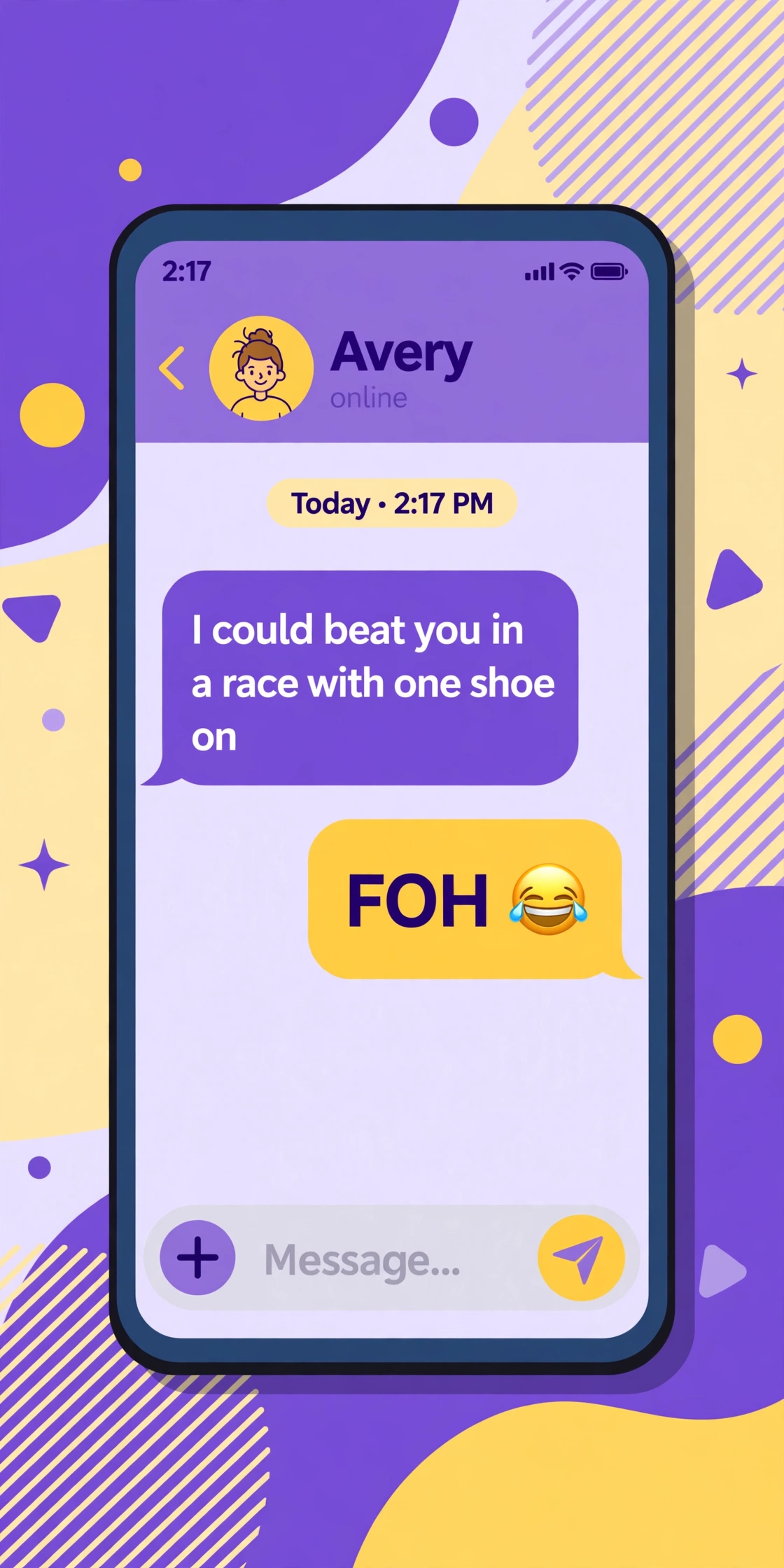
- Friend: “I could beat you in a race with one shoe on.” You: “FOH 😂 you couldn’t beat me on a bike.”
- Friend: “Bro I just won $500 on a scratch card.” You: “FOH! No way, show me the ticket.”
- Friend: “I’m telling you, the earth is flat.” You: “FOH with that. We went over this already.”
- Group chat: “Guys, I think I might actually like Mondays now.” Everyone: “FOH 😭😭”
- Friend: “I met a celebrity at the grocery store today.” You: “FOH, pics or it didn’t happen.”
In friendly examples, FOH is almost always paired with laughing emojis or an obvious joke. The speaker is not angry — they are performing disbelief for comic effect. The key signal is warmth: if everyone is laughing, FOH is a joke. If the room goes quiet, it was not.
Professional Examples
FOH is not professional language, and you should not use it at work, in school, or in any formal message. But it does appear in casual professional-adjacent spaces — a relaxed team group chat, a creative industry Slack, a message to a coworker who is also a close friend. Even there, it carries risk.
- Coworker (casual chat): “The client wants the whole project redone by tomorrow.” You: “FOH 😅 they can’t be serious.” — Only if you know this coworker well and the channel is informal.
- Freelancer to a friend: “A client just offered me exposure instead of payment.” Friend: “FOH, tell them to pay up or walk away.”
- Creative team chat: “New idea: let’s rebrand everything the night before launch.” Teammate: “FOH, we’re not doing that to ourselves.”
The rule is simple: if there is any chance a manager, client, or HR might see it, do not type FOH. Use “No way,” “That’s not happening,” or “Let’s be realistic” instead. The polite alternatives section below has a full list.
Funny Examples
- “My bank account after payday: FOH, I’m already empty.” — FOH as a joke about being broke.
- “Me: I’m going to bed early tonight. Also me at 3 AM watching conspiracy videos: FOH.” — FOH aimed at yourself.
- “My gym membership watching me eat pizza: FOH.” — FOH as a caption for a relatable meme.
- “When someone says ‘we need to talk’ and it’s about the group project: FOH, not today.” — FOH as a dramatic reaction.
- “My alarm clock at 6 AM: FOH, we are NOT doing this.” — FOH as the voice of the snooze button.
Funny uses of FOH work because the abbreviation itself is dramatic. It turns a small complaint into a performance, which is exactly why it thrives in memes and captions.
Comparison with Similar Terms
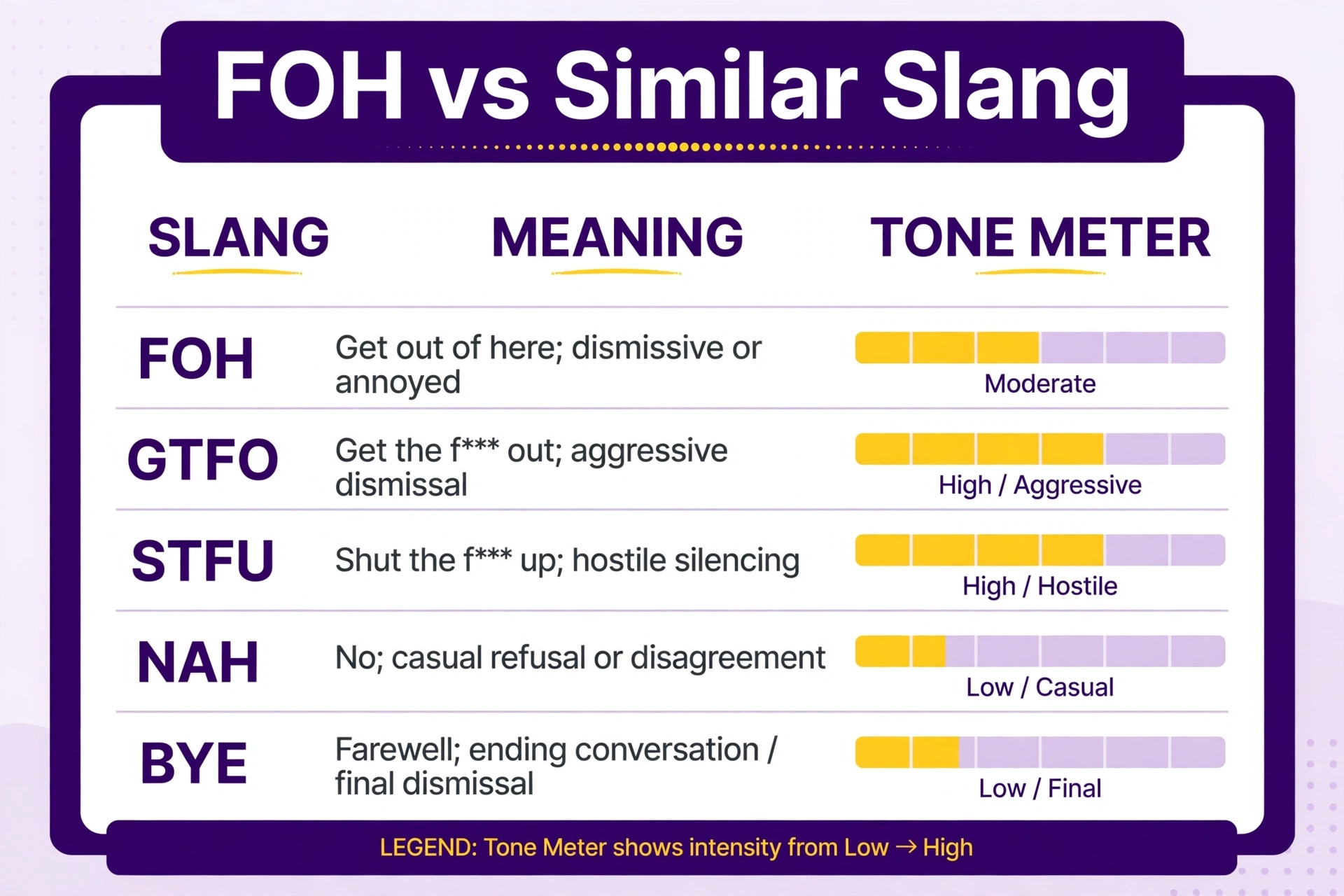
FOH belongs to a family of dismissive slang. Each term in the family does a slightly different job, and picking the right one matters. Here is how FOH stacks up against its closest relatives.
| Term | Full Form | Meaning | Tone | Best Used When |
|---|---|---|---|---|
| FOH | Fuck outta here | Go away / I don’t believe you | Blunt, dismissive | Rejecting nonsense or expressing disbelief |
| GTFO | Get the fuck out | Leave immediately | Angry, aggressive | You are genuinely furious and want someone gone |
| STFU | Shut the fuck up | Stop talking | Hostile, silencing | You want someone to stop talking right now |
| BYE | — | I’m done with this | Cold, final | Ending a conversation with icy dismissal |
| NAH | — | No / I disagree | Casual, mild | A soft, everyday no |
| SMH | Shaking my head | That’s disappointing | Disappointed, judgmental | Reacting to foolish behavior without anger |
| GTFOH | Get the fuck outta here | Stronger version of FOH | Very blunt, emphatic | Maximum disbelief or maximum dismissal |
The biggest practical difference is intensity. NAH is a gentle no. FOH is a firm no with attitude. GTFO is an angry order. STFU is an attack on the person’s right to speak at all. If you want to reject an idea without starting a fight, FOH is usually the sweet spot — strong enough to be clear, but common enough online to read as playful rather than hostile, especially with a laughing emoji attached.
FOH and GTFOH are the closest pair: GTFOH is just FOH with “get the” added for extra emphasis. Think of it as FOH turned up one notch. People use GTFOH when FOH alone does not feel strong enough — usually for the most unbelievable claims or the most unwelcome interruptions. In most situations, though, FOH does the job on its own.
It also helps to know how FOH differs from simple agreement slang. Terms like FS meaning slang (for sure) express certainty and agreement, while FOH expresses rejection and disbelief. They sit on opposite ends of the same spectrum: FS says “yes, definitely,” and FOH says “no, get out of here.” Knowing both keeps your texting vocabulary balanced.
Alternate Meanings
FOH has a few alternate meanings, and one of them is completely unrelated to slang. Knowing them saves you from embarrassing mix-ups.
Front of House (theater and live events). In theater, concerts, and live production, FOH means “front of house” — the part of a venue where the audience sits, as opposed to “back of house” (BOH), where the performers, crew, and equipment are. The FOH sound engineer mixes the audio the audience hears, and the FOH manager handles seating and guest services. If you see “FOH” in a job listing for a theater or a concert venue, this is what it means — nobody is being told to leave.
Friends of Humanity / other organizations. FOH is also used as an abbreviation by various organizations and initiatives, such as “Friends of…” groups and charities. These uses are rare in everyday conversation, but they exist, so context is everything.
“Fuck off, hater” (rare variant). Some people online expand FOH as “fuck off, hater,” but this is a folk etymology rather than the standard meaning. The widely accepted expansion is “fuck outta here.” If someone uses the “hater” version, they mean roughly the same thing — a dismissal aimed at a critic — but the standard definition is the one to learn.
FOH as a name or tag. Gamers, streamers, and social media users sometimes adopt FOH as a username or clan tag, usually because they like the attitude it carries. In that case, it is a brand, not a message — the same way someone might call themselves “GTFO” as a joke.
The rule of thumb: in a text, comment, or lyric, FOH means “fuck outta here.” In a theater, venue, or production context, it means “front of house.” Everything else is rare enough that you can safely ignore it unless the context points that way.
Professional or Polite Alternatives
FOH is vulgar, so there are plenty of situations where you need the same message without the swear word. Here are polite alternatives, matched to the two main uses of FOH.
When you mean “go away / leave me alone”:
- “Please leave me alone.” — direct and calm.
- “I need some space right now.” — softer, works with friends and family.
- “I’m not interested, thanks.” — polite dismissal for strangers and salespeople.
- “Let’s drop this.” — ends a topic without ending the relationship.
- “I think we’re done here.” — firm and final, suitable for arguments.
When you mean “no way / I don’t believe you”:
- “No way!” — the closest clean equivalent, works everywhere.
- “Get out of here!” — same energy as FOH, minus the profanity.
- “You’re kidding, right?” — playful disbelief.
- “I find that hard to believe.” — polite skepticism for formal settings.
- “That can’t be right.” — gentle pushback on a claim.
When you mean “that’s ridiculous”:
- “That’s absurd.” — clean, precise, and strong.
- “Come on, be serious.” — friendly challenge.
- “I respectfully disagree.” — the professional version.
A useful habit: if you would not say the full phrase “fuck outta here” out loud in a given setting, do not type FOH there either. The abbreviation does not make the words polite — it just makes them shorter. In work chats, messages to teachers, or conversations with people you do not know well, pick one of the alternatives above and keep FOH for your friends.
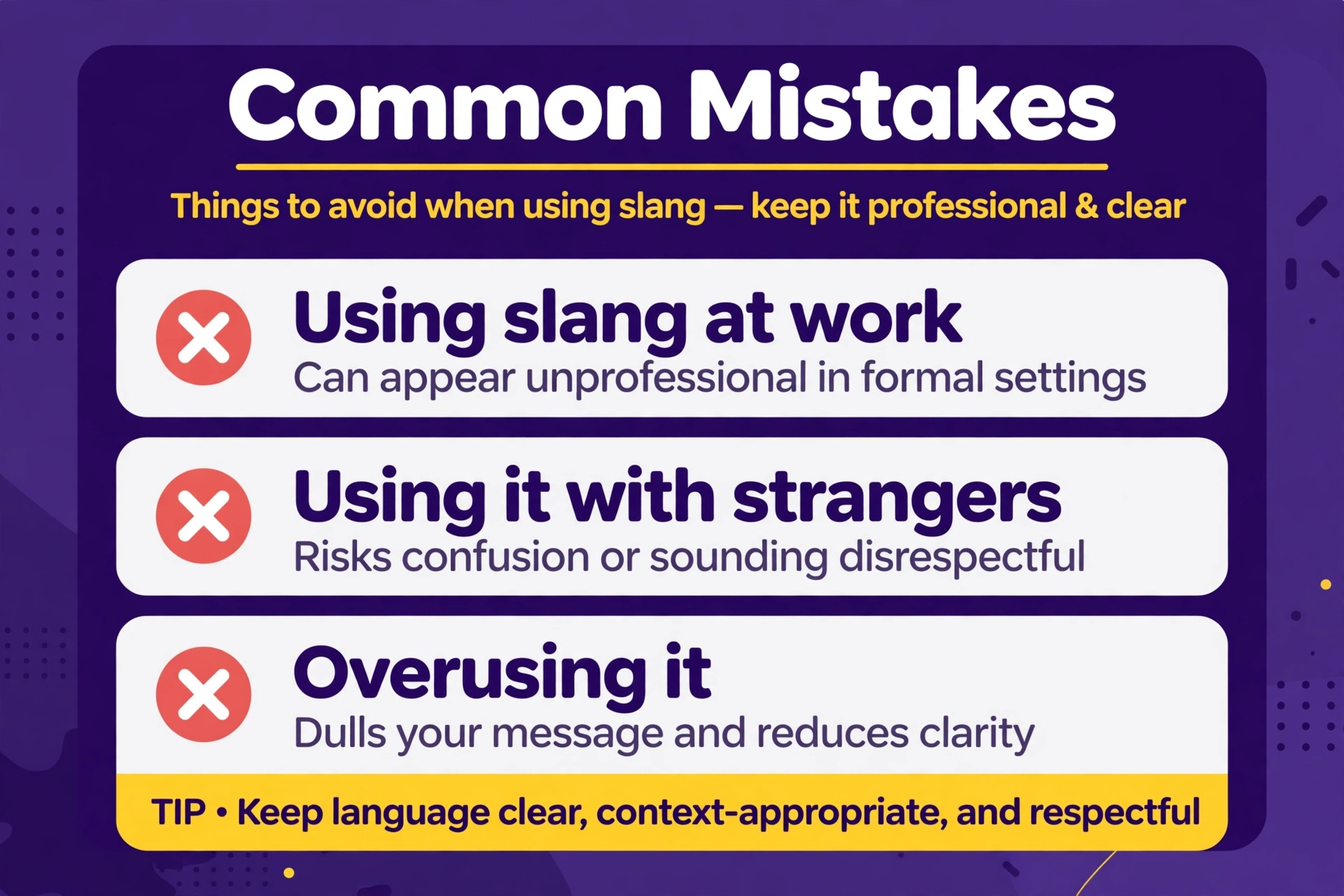
Common Mistakes
FOH is short and simple, but people still use it wrong. These are the mistakes to avoid.
1. Using it in formal or professional messages. This is the most common mistake, and the most costly. FOH contains a swear word, and typing it to a boss, a client, a teacher, or a stranger can damage a relationship or a reputation. If the message matters, use a polite alternative.
2. Using it when you actually agree. FOH is a rejection, not an affirmation. Some people confuse it with agreement slang like fn meaning in text terms or “FS” (for sure), but FOH means the opposite: it says no, not yes. Double-check before you send it.
3. Using it with people who will take it literally. With close friends, FOH is a joke. With a new acquaintance, a family elder, or someone who does not know internet slang, it reads as genuinely rude. Match the abbreviation to the relationship, not just to the moment.
4. Confusing it with “front of house.” If you work in theater, events, or hospitality, FOH might mean something completely different to your colleagues. In a production meeting, “FOH” is a job area, not an insult. Read the room before you react.
5. Overusing it until it loses impact. FOH works because it is dramatic. If you reply FOH to everything, it stops being funny and starts being annoying. Save it for the moments that deserve it — the truly wild claims, the genuinely bad takes, the interruptions that need a firm stop.
6. Sending it without context in a serious argument. In a real conflict, FOH shuts the conversation down. That can be the goal, but it can also escalate things: the other person hears “I don’t respect you enough to listen.” If you want to resolve something, say what is wrong instead of slamming the door with three letters.
Quick Tips
- Pair it with an emoji to set the tone. 😂 means “this is a joke.” 🙄 means “I’m annoyed.” ✌️ means “I’m done here.” The emoji does half the communication.
- Use it as a standalone reply. You do not need a full sentence — “FOH 😂” on its own is a complete response, and it lands harder than a paragraph.
- Add “with that” to target a specific idea. “FOH with that take” is clearer than a bare “FOH,” because it names what you are rejecting.
- Save it for people who know you. FOH is an in-group word. With friends, it is funny. With strangers, it is a risk.
- Never use it in work, school, or formal writing. No exceptions, no matter how casual the channel feels.
- Learn the disbelief use first. The playful “no way!” version is the safest and most common one. Master that before you use FOH as a genuine dismissal.
- Watch for the reply. If someone answers your FOH with laughter, you nailed it. If they go quiet or get defensive, apologize and explain — you misjudged the tone.
- Combine it with other slang carefully. “FOH, you wild” works. “FOH STFU GTFO” is just noise. One dismissive abbreviation per message is enough.


FAQ
1. What does FOH mean in slang?
FOH means “fuck outta here.” It is used to tell someone to go away or to express disbelief, like saying “get out of here” or “no way.” The exact meaning depends on context: between friends it is usually a joke, while in an argument it is a genuine dismissal.
2. Is FOH rude?
Yes, FOH is rude by definition, because the full phrase contains a swear word. Between close friends it is usually taken as playful teasing, but with strangers, coworkers, or elders it reads as genuinely disrespectful. Never use it in professional or formal settings.
3. What does FOH mean in texting?
In texting, FOH is a quick way to reject something or react with disbelief. “FOH 😂” after a wild story means “no way, I don’t believe you.” “FOH, I’m busy” means “leave me alone.” It is one of the most common dismissive abbreviations in group chats and social media comments.
4. Where did FOH come from?
FOH comes from the spoken phrase “fuck outta here,” rooted in Black American English and hip-hop culture. It spread through rap lyrics, then through Twitter, TikTok, and gaming communities, where short, punchy abbreviations thrive. It has been in common online use since at least the early 2010s.
5. What is the difference between FOH and GTFO?
FOH (“fuck outta here”) is a blunt dismissal or an expression of disbelief, and it can be playful. GTFO (“get the fuck out”) is a direct, usually angry order to leave. GTFO is stronger and more aggressive; FOH is the version you use when you want attitude without a full confrontation.
6. Can FOH mean something else?
Yes. In theater and live events, FOH means “front of house” — the audience area of a venue and the team that manages it. That meaning has nothing to do with slang. In everyday texting and social media, though, FOH almost always means “fuck outta here.”
7. How do you reply when someone says FOH to you?
If it was a joke, laugh it off: “😂 okay okay, you got me” or “Fine, I’ll take my bad take elsewhere.” If it was serious, give them space or ask calmly what is wrong: “Alright, I’ll leave it. Let me know if you want to talk.” Matching their tone — playful or serious — is the key.
8. Is FOH appropriate on social media?
It depends on the platform and the audience. In casual comments, TikTok captions, and replies between friends, FOH is normal. On professional networks like LinkedIn, in brand accounts, or in any public post tied to your real name and job, avoid it. The abbreviation is vulgar, and it stays attached to whatever account posts it.
Conclusion
FOH is a small abbreviation with a big attitude. In three letters, it says “go away,” “no way,” and “I don’t believe you” — sometimes all at once. It grew out of Black American English and hip-hop, spread through social media, and earned its place as one of the internet’s favorite dismissals, right alongside GTFO, STFU, and the icy single-word “bye.”
The trick to using FOH well is reading the room. With friends, paired with a laughing emoji, it is a joke that lands every time. In an argument, it is a door slamming — effective, but final. At work or in formal writing, it is a mistake. And in a theater, it is not slang at all: it is the front of house. Context decides everything, which is true of most slang, but especially true of a word whose job is to reject.
Like other blunt abbreviations — including what does OD mean in slang, another term that packs a whole attitude into two letters — FOH works best when you use it sparingly and mean it. Save it for the wild claims, the bad takes, and the moments when a polite “no” just will not do. Use it well, and three letters are all you will ever need. For a deeper look at the phrase’s dictionary definition, see the Urban Dictionary entry for FOH.
