
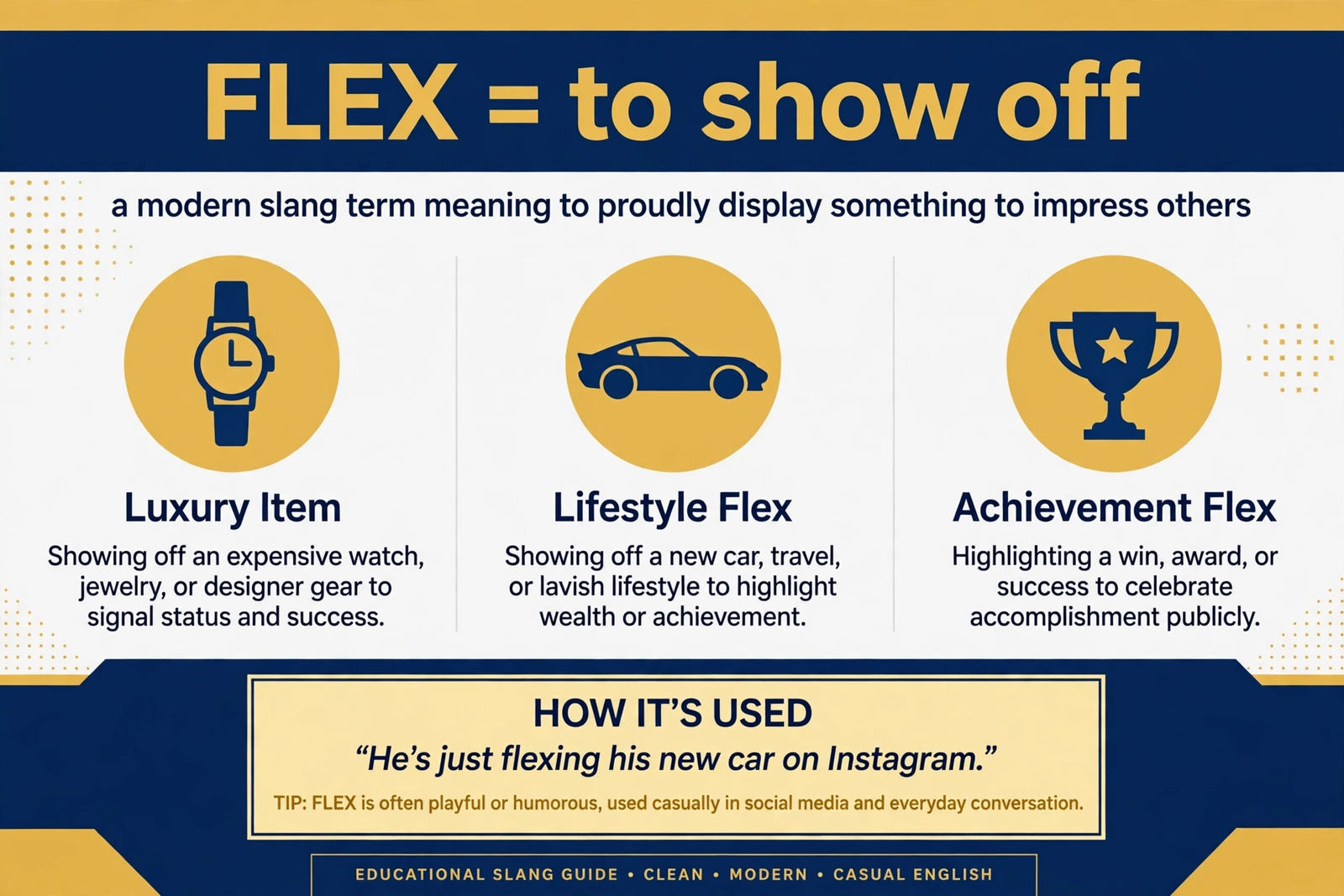
Quick Definition: In slang, “flex” means to show off — to proudly display something you have, something you did, or a quality you are proud of, usually in a way that is meant to impress other people. The flex meaning slang most people search for today comes from hip-hop culture and social media: posting a new car, a luxury watch, a promotion, or a gym selfie is “flexing.” It can be playful and confident, or arrogant and annoying, depending on how — and how often — you do it.
flex meaning slang Meaning & Definition
So, what is the flex meaning slang in plain English? At its simplest, to flex is to show off. When someone says “he’s flexing,” they mean he is deliberately drawing attention to something impressive about himself — his money, his looks, his skills, his lifestyle, or even his connections. The word works as both a verb (“stop flexing on us”) and a noun (“that car is a flex”).
The key to understanding flex is intent. A flex is not an accident. Nobody flexes by mistake. The person doing it wants you to notice, and usually wants you to be impressed — or a little jealous. That is why the word carries a double edge. Among friends, a flex can be funny, a lighthearted bit of showing off that everyone laughs at. A friend who lands a dream job and posts the offer letter is flexing, and most people will cheer for that. But when the showing off feels constant, exaggerated, or insecure, “flexing” becomes an insult: a way of saying someone is bragging instead of just living their life.
Context decides everything. “Nice flex” can be a genuine compliment or a sarcastic jab. “Weird flex but OK” — a hugely popular meme phrase — means the thing someone is bragging about is strange, unimpressive, or completely beside the point. And when someone says “no flex,” they are doing the opposite: downplaying something impressive, the humble version of the same idea.
Flex also has a literal, older meaning that still exists alongside the slang. To flex a muscle is to tense it and show it off — think of a bodybuilder posing on stage. That physical image is where the slang came from: showing off your strength became showing off anything you are proud of. The slang meaning is now far more common than the gym meaning in everyday texting and social media, but the two are cousins, not strangers.
Introduction
You are scrolling Instagram when a classmate posts a photo of a brand-new watch with the caption “small flex.” Or a friend drops a screenshot of their exam results into the group chat and someone replies, “OK, flex on us then.” Or a TikTok creator films themselves walking through a mansion and says, “Just a little flex for the timeline.” The word is everywhere, the tone is half-joking, and the meaning feels obvious to everyone except you.
Welcome to the world of flex slang. Like a lot of modern internet words, flex travelled from a very specific place — hip-hop lyrics and gym culture — into the everyday vocabulary of millions of people. It belongs to the same family of punchy Gen Z slang that gave us words like drip and delulu, and it works the same way: one short word that sums up a whole social behaviour in a single syllable.
This guide explains the flex meaning slang in full — the exact definition, where it came from, how people actually use it in texts, on TikTok, and in rap lyrics, what it is not, and the mistakes to avoid if you ever use it yourself. You will find real examples, a comparison with similar slang, polite alternatives, and answers to the questions people search for most. By the end, you will know exactly when someone is flexing — and whether they mean it as a compliment or a roast.
Origin
The slang use of flex grew out of two places at once: the gym and hip-hop. Bodybuilders have “flexed” their muscles for decades — tensing a bicep to show off size and strength is literally called flexing. That physical display of power became a metaphor. By the 1990s, rappers were using flex to mean showing off wealth and status: jewellery, cars, clothes, and success. The metaphor was perfect — just as a bodybuilder flexes a muscle to prove how strong he is, a rapper flexes his lifestyle to prove how successful he is.
The word’s big break into mainstream slang came through hip-hop lyrics and, later, social media. Songs like “Flex” by artists across the 2010s pushed the term into the charts, and phrases like “we flexin'” started appearing in Instagram captions and Twitter posts. Dictionary.com now lists the slang sense of flex as showing off, proof of how far the word has travelled from the weight room.
Then came the meme era. Around 2018, the phrase “weird flex but OK” exploded across Twitter and Reddit, turning flex into a punchline as well as a compliment. The meme gave everyone a tool for calling out bragging that missed the mark — someone boasting about an odd or unimpressive achievement would be met with “weird flex but OK” and a flood of laughing replies. That single phrase did more to spread flex than any song, because it made the word useful even for people who never flex themselves.
TikTok finished the job in the 2020s. Creators film “flex” videos — showing off outfits, cars, apartments, and achievements — and the word is now a standard part of the platform’s vocabulary. The flex meaning slang has settled into everyday English: your parents probably know it, your boss probably knows it, and your group chat definitely does.
Popularity
Flex is one of the most durable slang words of the last decade, and its popularity comes from how useful it is. Most slang words describe a feeling or a thing; flex describes a behaviour that everyone recognises instantly. We have all seen someone show off, and we have all been tempted to do it ourselves. Having a single word for it makes every conversation about showing off shorter and funnier.
Its popularity also comes from its flexibility — fittingly enough. Flex works as a verb, a noun, and an adjective. You can flex, you can have a flex, and something can be “a flex” (impressive) or “not a flex” (unimpressive). It works in a compliment, a roast, a caption, and a lyric. Very few slang words survive that many jobs, which is why flex has outlasted dozens of trendier terms that burned out in a season.
Social media keeps it alive. Every platform rewards showing off: Instagram is built on lifestyle photos, TikTok runs on achievement videos, and even LinkedIn has its own professional version of flexing — the humble-brag promotion post. As long as people post highlights of their lives online, they will need a word for it, and flex is the word they reach for.
How It Is Used
Flex shows up in three main ways, and spotting which one you are looking at is the whole trick to understanding it.
1. As a verb — to show off. This is the most common use. “He’s always flexing his new car” means he keeps finding ways to mention or display the car. “Stop flexing” is a friendly (or annoyed) request to quit bragging. “Flex on them” means show them what you have got — usually as encouragement before a big moment.
2. As a noun — the thing being shown off. “That watch is a flex” means the watch itself is impressive enough to count as showing off. “What a flex” can be admiration or sarcasm depending on tone. This use turns any impressive object or achievement into a flex, and the word has become a kind of unit for measuring impressiveness.
3. As a joke or a call-out. “Weird flex but OK” is the famous version, but there are others: “that’s a flex?” (sarcastic, meaning it is not impressive at all), “no flex” (humble, meaning I am not trying to show off, but here is something impressive anyway), and “flexing for no reason” (showing off when nobody asked). These uses are the social policing side of the word — the way people decide, out loud, whether a display of success is cool or cringe.
The tone matters more than the words. The same sentence — “nice flex” — is a compliment from a friend who is happy for you and a roast from a stranger who thinks you are trying too hard. Read the room, read the relationship, and read the emoji. A fire emoji after “nice flex” usually means genuine admiration. A skull emoji usually means the opposite.
Examples
Flex is best understood through real situations. Here is how it sounds in the wild — in friendly chats, at work, and in jokes.
Friendly Examples
- Friend 1: “Just passed my driving test first try 🚗”
Friend 2: “OK flex, we see you! Congrats!” - Friend 1: “Got the promotion today, finally!”
Friend 2: “That’s a huge flex, you earned it.” - Friend 1: “Check out my new apartment, the view is insane.”
Friend 2: “Flexing on us already and you just moved in 😂” - Friend 1: “I ran 10k this morning before breakfast.”
Friend 2: “Casual flex, love that for you.”
Professional Examples
- “She flexed her portfolio in the interview and got the job on the spot.” (Here flex is positive — showing your work with confidence.)
- “The startup’s launch post was a subtle flex: new office, new hires, record funding.” (A company showing off its success.)
- “No flex, but our team hit every target this quarter.” (A humble way of announcing a win at work.)
- “He doesn’t need to flex his degree in every meeting — everyone already knows.” (The negative side: showing off that adds nothing.)
Funny Examples
- Person 1: “I woke up before my alarm today.”
Person 2: “Weird flex but OK.” - Person 1: “I can eat a whole pizza by myself.”
Person 2: “That’s not a flex, that’s a cry for help.” - Person 1: “My phone battery lasted all day.”
Person 2: “Wow, flexing a full battery in 2026? Bold.” - Person 1: “I know all the lyrics to every song on this album.”
Person 2: “Huge flex. Nobody asked, but huge flex.”

Comparison with Similar Terms
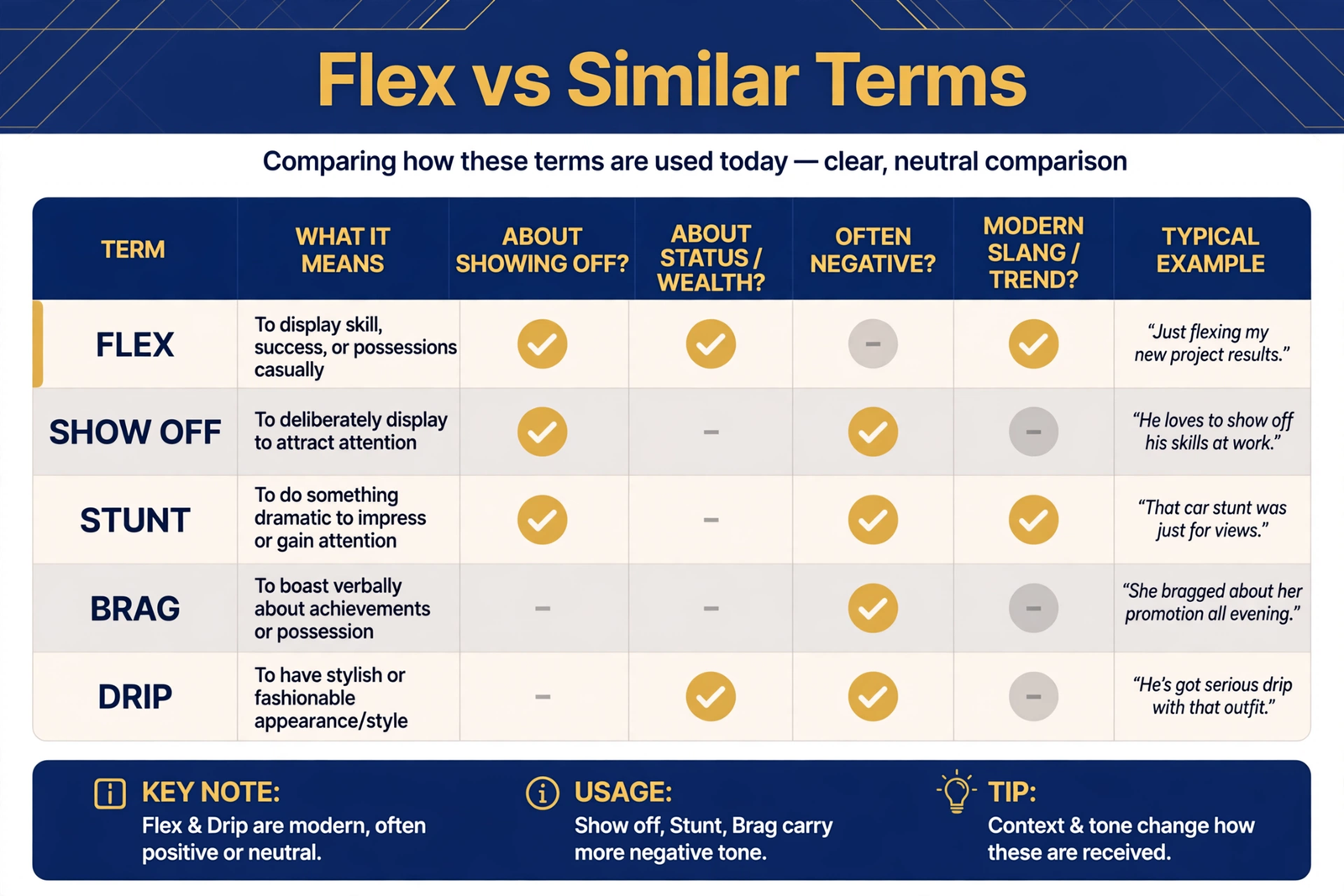
Flex sits in a crowded family of words about showing off. They overlap, but they are not interchangeable — each one has its own flavour.
| Term | What It Means | How It Differs from Flex |
|---|---|---|
| Flex | Showing off something impressive | The general word — covers wealth, skills, looks, anything |
| Show off | Displaying something to impress others | Plain English, no slang edge; flex is the cooler, shorter version |
| Stunt | Showing off, often with money or a flashy display | More aggressive and flashy than flex; stunting implies an audience and a performance |
| Brag | Talking proudly about yourself | Bragging is verbal; flexing is usually visual — posting, wearing, displaying |
| Drip | Stylish clothes and fashion sense | Drip is specifically about fashion; a fit can be drip, and wearing it is a flex |
| Humble-brag | Bragging disguised as modesty | A humble-brag pretends not to be a flex; “no flex” is its slang cousin |
The closest cousin is probably fit culture’s overlap with drip: when someone posts an expensive outfit, they are flexing their drip. And the opposite of flex is not modesty exactly — it is “lowkey,” the slang for keeping something impressive quiet on purpose. A lowkey flex is the art of showing off while pretending you are not.
Alternate Meanings
Flex has a few other lives that are worth knowing, because they show up in searches and conversations too.
Flexing a muscle. The original meaning. Bodybuilders flex their biceps, athletes flex after a win, and anyone posing for a gym selfie is flexing in both senses at once. When someone says “flex your muscles,” they usually mean this literal version.
Flexible schedule / flex time. At work, “flex” can be short for flexible — a flex schedule means flexible working hours, and a “flex day” is a day you choose to take off. This meaning has nothing to do with showing off, and it is the one most likely to confuse people in a professional setting.
Flex in gaming. In games like Overwatch, a “flex player” is someone who can play multiple roles and switch as the team needs. In trading card and sports contexts, “flex” is a roster spot for a player at a flexible position. Both come from the idea of flexibility, not showing off.
Flex as a name. Flex is also a name — a car model (the Ford Flex), a software framework (Adobe Flex), and a nickname people give friends who are into fitness. None of these is the slang meaning, but they explain why a search for “flex” can return such mixed results.
The rule of thumb: if the sentence is about a person and something impressive they own or did, it is the slang meaning. If it is about schedules, muscles, or game roles, it is one of the others.
Professional or Polite Alternatives
Flex is casual slang, so it does not belong in a formal email or a job interview. When you want the same idea in professional language, try these instead:
- Showcase: “She showcased her team’s results in the quarterly review.” Clean, professional, and positive.
- Highlight: “Let me highlight what our department achieved this year.” Perfect for presentations.
- Demonstrate: “He demonstrated his skills during the trial period.” Neutral and credible.
- Share an achievement: “I’d like to share an achievement I’m proud of.” Warm and honest, without the bragging edge.
- Take pride in: “We take pride in the quality of our work.” Confident without sounding arrogant.
In friendly conversation, the polite version of flex is simply sharing good news without the performance. Instead of posting a photo of a new watch with “small flex,” try “finally saved up for something I’ve wanted for ages — so happy.” Same news, same pride, none of the eye-rolls. The achievement is the message; the flex is the packaging.
Common Mistakes
Flex is easy to use and easy to misuse. These are the mistakes that turn a fun bit of slang into a social misstep.
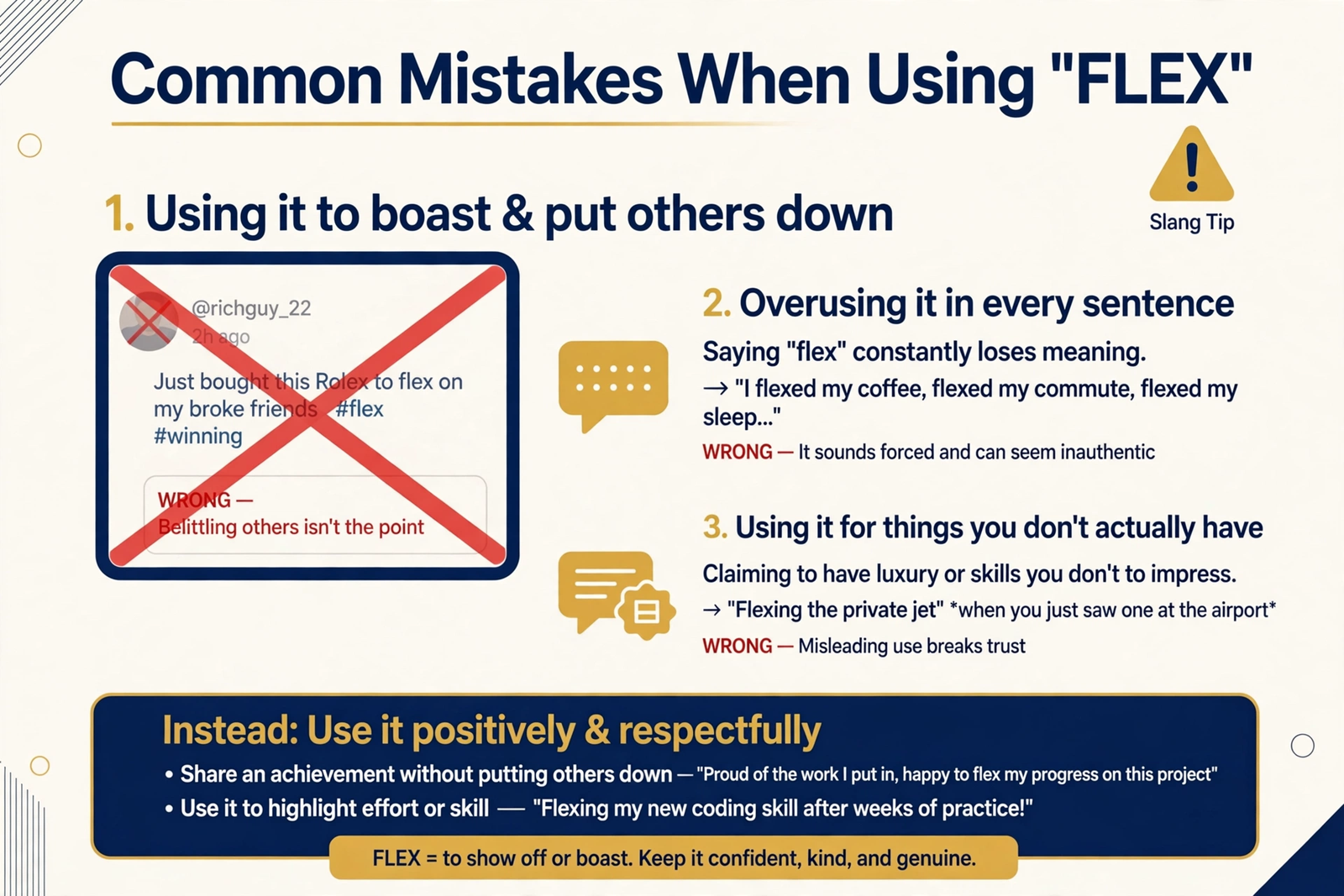
Flexing constantly. One flex is a moment; ten flexes a day is a personality. People who flex in every post train their audience to ignore them — or to mute them. Save it for the things that genuinely matter.
Flexing the wrong thing. This is the “weird flex” trap. Bragging about something nobody values — waking up early, owning a basic phone, finishing a normal task — does not impress anyone. It invites the meme response, and not in a good way. Before you flex, ask whether anyone else would actually find it impressive.
Calling everything a flex. Not every achievement needs the label. When someone shares genuinely sad or serious news and a reply calls it a flex, it lands badly. The word belongs to lighthearted, celebratory moments, not to everything a person posts.
Using flex in formal settings. Telling a hiring manager “let me flex my qualifications” in an interview is a fast way to sound unserious. The word signals casual, internet culture — great for group chats, wrong for boardrooms.
Missing the sarcasm. “Nice flex” is not always nice. If the tone is flat, the emoji is a skull, or the flex itself is unimpressive, it is a roast. Replying “thanks!” to a sarcastic “nice flex” is a small but very public misread.
Flexing someone else’s win. Posting your friend’s car or your partner’s promotion as if it were your own achievement is the fastest way to get called out. A flex has to be yours to work.
Quick Tips
- Flex rarely, flex well. One strong flex beats ten weak ones. Save the word — and the behaviour — for real wins.
- Let the flex speak for itself. Post the photo, share the news, and stop there. Explaining why it is impressive usually makes it less impressive.
- Match the tone to the room. Friends love a playful flex; strangers and colleagues prefer the achievement without the label.
- Use “no flex” for humble wins. It signals confidence without arrogance, and it reads as genuine more often than a bare boast.
- Read the reply before doubling down. If the first response is “weird flex but OK,” the audience has voted. Laugh it off instead of flexing harder.
- Flex your skills, not just your stuff. People respect a flex about something you did far more than a flex about something you bought. Effort impresses; price tags mostly invite envy.
- Keep it short. The best flexes are one line and one photo. A paragraph of justification is not a flex — it is a press release.
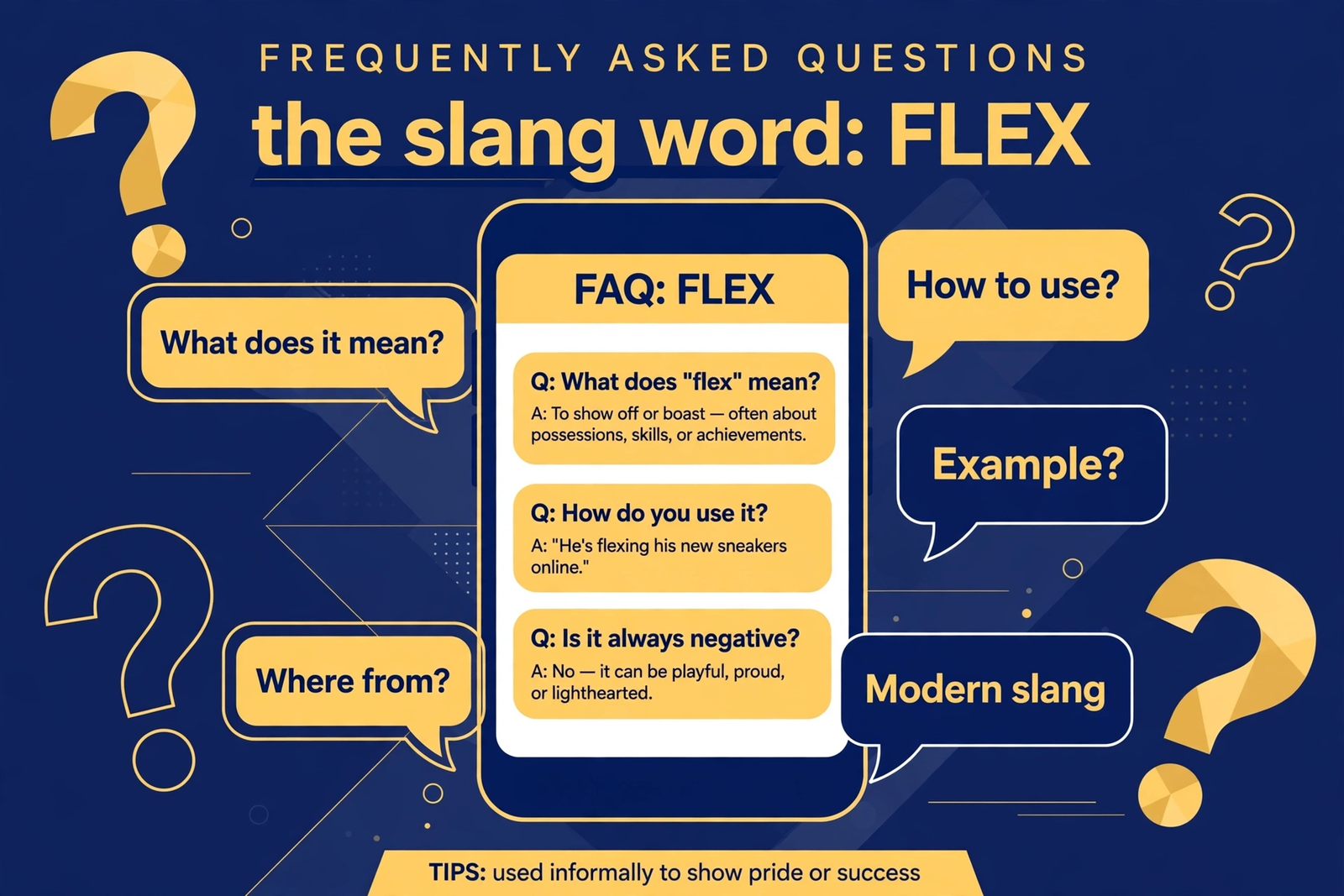
FAQ
What does flex mean in slang?
In slang, flex means to show off — to proudly display something you have, did, or are, so other people notice and are impressed. It comes from bodybuilding (flexing a muscle) and hip-hop culture, and it now covers everything from luxury purchases to exam results posted in a group chat.
What does “weird flex but OK” mean?
“Weird flex but OK” is a meme phrase used when someone brags about something strange, unimpressive, or irrelevant. It means: that was a strange thing to show off, but fine, you do you. It became popular around 2018 and is now the standard joking reply to a bad flex.
Is flexing a good thing or a bad thing?
Both, depending on context. A playful flex among friends — celebrating a promotion or a personal best — is usually positive and fun. Constant, exaggerated, or insecure flexing reads as arrogant and annoying. The same word covers a proud moment and a social mistake; the audience and the frequency decide which one it is.
What does “no flex” mean?
“No flex” means “I’m not trying to show off, but…” — it is a humble way of sharing something impressive. People use it before announcing a win so the boast sounds modest. It is the slang version of a humble-brag, and it usually works because it signals self-awareness.
What is a flex on TikTok?
On TikTok, a flex is a video that shows off something impressive — an outfit, a car, a house, a skill, or an achievement — usually set to music and filmed to look effortless. “Flex videos” are a whole genre on the platform, and the comments decide whether the flex landed or became a “weird flex.”
What does flex mean in rap?
In rap, flex means showing off wealth, status, and success — jewellery, cars, designer clothes, and the lifestyle that comes with fame. Rappers have used the word since the 1990s, and it is one of the genre’s most durable slang terms because the whole culture of rap includes proving your success out loud.
Can flex mean something other than showing off?
Yes. Flex also means to tense a muscle (the original meaning), a flexible work schedule (“flex time”), and a versatile player in gaming (“flex player”). In everyday slang, though, showing off is by far the most common meaning — context tells you which one applies.
What is the difference between flex and stunt?
Flex is the general word for showing off anything impressive. Stunt is a louder, flashier version — it implies a performance for an audience, usually involving money or something dramatic. You can flex quietly with one photo; stunting usually means making a scene. All stunting is flexing, but not all flexing is stunting.
Conclusion
So, what is the flex meaning slang in one sentence? It is showing off — proudly displaying something impressive so people notice. The word travelled from the gym to hip-hop to TikTok, and it stuck because it names a behaviour everyone recognises: the moment pride turns into performance.
The key takeaways are simple. Flex works as a verb and a noun, it can be a compliment or a roast, and the difference is almost always tone and frequency. A rare, genuine flex among friends is fun; a constant stream of flexes is exhausting. Use “no flex” when you want to share a win humbly, watch out for the “weird flex” trap, and never confuse a flex about something you did with a flex about something you bought — effort impresses people far longer than price tags do.
Slang moves fast, but flex has already lasted a decade, and it will probably last another — because as long as people post their highlights online, they will need a word for showing off. Now that you know what it means, you will spot it everywhere: in captions, in lyrics, and in your own group chat. Just try to keep your own flexes rare, real, and worth the attention.
Want to keep decoding the internet’s language? Explore more guides — from what delulu means to the full Gen Z slang 2024 roundup — and you will never be lost in the comments again.

4 thoughts on “Flex Meaning Slang: What Does Flex Mean in Text & on TikTok?”