
Quick definition: In slang, FOMF most commonly stands for “F*** Off, Motherf***er” — a blunt, rude way to tell someone to go away or stop talking to you. It is a harsh dismissal used in heated chats, gaming lobbies, and comment sections. A much rarer, newer reading treats FOMF as a play on FOMO, short for “fear of missing focus,” but the angry, dismissive meaning is the one most people actually mean when they type it. Because the term is uncommon and its tone is aggressive, context matters more with FOMF than with almost any other slang acronym.
FOMF Meaning & Definition
The fomf meaning slang question comes up because FOMF looks like it should be related to FOMO, the famous “fear of missing out.” It is not. FOMF is its own term, and its most widely listed meaning in slang dictionaries is the profane dismissal “F*** Off, Motherf***er.” When someone drops FOMF in a text, a DM, or a Snapchat reply, they are almost always shutting a conversation down — angrily, rudely, and on purpose.
Think of FOMF as the texting equivalent of slamming a door. It is short, sharp, and final. Unlike softer dismissals such as “whatever” or “leave me alone,” FOMF carries real hostility. It is not playful, it is not flirty, and it is not something you say to a friend as a joke unless you both fully understand the joke. Most of the time, FOMF means the conversation is over — and the person typing it is not interested in reopening it.
That said, FOMF is a rare term. You will not see it nearly as often as LOL, OMG, or even its cousin FOMO. It lives mostly in niche corners of the internet: gaming chats, edgy meme pages, heated comment threads, and private group chats where people speak without filters. Its rarity is exactly why people Google it — they see it once, they have no idea what it means, and the four letters give nothing away.
What FOMF stands for
- Primary meaning: “F*** Off, Motherf***er” — an angry, vulgar dismissal. This is the definition listed by slang dictionaries and the meaning most people intend.
- Secondary meaning: “Fear of Missing Focus” — a newer, softer interpretation that plays on FOMO. It describes the anxiety of losing concentration while everyone else stays locked in. This usage is rare and mostly appears in productivity or self-improvement posts.
- As an exclamation: Some people use FOMF as a percussive, final-sounding interjection — a verbal full stop that means “that is it, end of discussion.” This use borrows the hard, punchy sound of the letters rather than the literal acronym.
When in doubt, assume the first meaning. If a stranger sends you FOMF, they are not talking about focus or productivity. They are telling you to go away, and they are doing it in the rudest way possible.
Introduction
Internet slang moves fast, and every year a handful of strange four-letter acronyms bubble up from group chats, gaming lobbies, and TikTok comments. FOMF is one of them. It looks harmless enough — four letters, a familiar rhythm, a passing resemblance to FOMO — but it hits very differently from the slang terms around it. Where FOMO describes a feeling everyone has had, FOMF is a weapon: a short, sharp insult designed to end a conversation in four keystrokes.
In this guide, we break down the full fomf meaning slang picture: what it stands for, where it came from, how people actually use it in texting and on Snapchat, how it compares with similar terms like FOMO, GTFO, and STFU, and the polite alternatives you should use instead. You will also find real example conversations, the most common mistakes people make with it, and answers to the questions people search for most about FOMF.
Origin of FOMF
Nobody can point to a single person who invented FOMF, and that is normal for slang. Like most texting abbreviations, it almost certainly grew out of the early-2000s internet, when forums, chatrooms, and instant messaging rewarded anyone who could say more with fewer characters. The phrase “f*** off, motherf***er” is much older — it has been shouted in movies, songs, and arguments for decades — but squeezing it into four letters was a product of keyboard culture.
The acronym follows a familiar pattern. English profanity compresses well: STFU (shut the f*** up), GTFO (get the f*** out), and IDGAF (I do not give a f***) all turned angry sentences into portable abbreviations. FOMF fits the same family. It takes a two-word insult, keeps the two most forceful letters from each word, and produces something you can fire off in under a second. In gaming culture especially, where typing speed matters and tempers run hot, that efficiency made FOMF useful.
The term never broke into the mainstream the way FOMO did. FOMO had a psychological concept behind it and got picked up by marketers, journalists, and psychologists. FOMF had no such luck — it stayed in the edgy corners of the internet, passed around in memes and flame wars, and never earned a dictionary entry in mainstream references. That is why even heavy social media users often have to look it up the first time they see it.
How FOMF spread
FOMF spread the way most niche slang spreads: not through one viral moment, but through slow seepage across platforms. A gamer uses it in a lobby. Someone screenshots it and posts it to a meme page. A TikTok commenter drops it in a heated reply thread. A curious reader Googles it, and the cycle repeats. Snapchat played a part too, because disappearing messages lower the cost of being rude — people say things in a snap they would soften in a permanent text.
The “fear of missing focus” reading came later, and it looks like a deliberate rebrand: content creators who liked the sound of FOMF but not the profanity tried to give it a cleaner, productivity-friendly meaning. It never really caught on, but it now floats around as an alternate definition, which is one more reason the term confuses people.
Popularity of FOMF
Let us be honest: FOMF is not popular. Compared with FOMO, which appears in headlines and advertising campaigns, FOMF is a fringe term. Search interest is low and spiky — it jumps when a meme or a viral argument pushes it in front of new eyes, then fades again. Most native English speakers under 25 have still never seen it, and even fewer have used it themselves.
That low popularity is actually useful to understand. When a slang term is everywhere, its meaning stabilizes — everyone agrees what LOL means. When a term is rare, its meaning stays fuzzy, and different corners of the internet can use it differently. FOMF sits in that fuzzy zone. The vulgar meaning dominates in slang dictionaries, the productivity meaning shows up in a few blogs, and the exclamation-style use appears in meme captions. If you use FOMF, some people will know exactly what you mean, and others will have to guess.
FOMF is most visible in a few specific places:
- Gaming lobbies and Discord servers, where trash talk is part of the culture and short insults fly fast.
- Heated comment threads on TikTok, X (Twitter), and Instagram, where it works as a final word in an argument.
- Snapchat and private DMs, where disappearing messages make blunt language feel lower-stakes.
- Meme pages, where its harshness is the joke — the shock value is the point.
If your goal is to sound current and fluent in online slang, FOMF is not a term you need in your daily vocabulary. Knowing what it means is valuable — so you can recognize it when someone aims it at you — but using it yourself is rarely a good idea.
How FOMF Is Used in Texting & Social Media
FOMF is almost always used as a standalone dismissal. It rarely appears in the middle of a polite sentence, because it is not a polite word. Someone types it when they are done: done arguing, done listening, done with the other person entirely. The tone is hostile, and the message is “go away.”
Here is how that plays out across platforms:
- In texting: FOMF usually ends a conversation. It follows an annoying message, an unwanted advance, or a provocation — and nothing comes after it.
- On Snapchat: Because snaps disappear, FOMF feels even more offhand, but the meaning is the same. It is often a reply to a snap someone did not want, or a reaction to a streak they are tired of keeping up.
- In gaming: FOMF is trash talk. A player types it after killing an opponent, after losing patience with a teammate, or in response to an insult.
- In comments: FOMF is a mic drop. Someone drops it at the end of an argument to signal they have no more time for the other person.
One thing FOMF is not: a term of endearment. Some slang insults soften over time — “bitch” and “dumbass” can be affectionate between close friends — but FOMF has not made that journey. Even between friends, it lands as an insult unless the joking context is unmistakable.
FOMF tone and intent
| Tone | What it signals | Example situation |
|---|---|---|
| Angry | “I am furious, leave me alone.” | Replying to someone who keeps messaging after being told to stop. |
| Dismissive | “You are not worth my time.” | Ending an argument with a stranger in a comment thread. |
| Joking (rare) | “Haha, get out of here.” | Close friends roasting each other in a group chat. |
| Frustrated | “I have had enough of this.” | Reacting to spam, repeated messages, or a bad take. |
The key point is that FOMF always carries an edge. Even in the joking case, the joke works because the words are harsh — the humor comes from the exaggeration, not from the term being soft.
FOMF Examples in Real Conversations
Examples make slang click, so here are realistic ways FOMF shows up in everyday chats. Notice how in every case, the person typing FOMF is closing a door, not opening one.
Friendly Examples
FOMF is almost never friendly, but between very close friends who roast each other constantly, it can appear as an exaggerated joke. The context has to do all the work — without it, the same message reads as a genuine insult.
- Friend 1: “Bro, I just beat your high score again 😂”
Friend 2: “FOMF, that was pure luck and you know it.” - Friend 1: “You still owe me $5 for lunch.”
Friend 2: “FOMF, I bought the fries, we are even.” - Group chat: “Who ate the last slice of pizza?”
Reply: “FOMF, it was yours yesterday, today it is mine.”
Even here, notice the pattern: FOMF is playful only when both people already know it is a joke. With anyone else, do not risk it.
Professional Examples
There are no professional examples of FOMF, and that is the point. FOMF is profanity, and profanity has no place in work chats, emails, or messages to a boss, client, or colleague. If a coworker is bothering you, the professional version of FOMF is simply not replying, or saying “I am not available right now, let us pick this up later.” If someone sends you FOMF at work, that is a human-resources issue, not a slang question.
For contrast, here is what people actually say in professional settings when they need the same boundary without the insult:
- “I need to end this conversation here.”
- “Please stop messaging me about this.”
- “I am not going to continue this discussion.”
Funny Examples
FOMF shows up in memes precisely because it is over the top. The humor comes from dropping a nuclear-level dismissal on a tiny problem.
- Text: “Did you finish the homework?”
Reply: “FOMF, it is 2am, let me live.” - Comment under a cooking video: “You forgot the salt.”
Reply: “FOMF, Gordon Ramsay, this is a 30-second recipe.” - Gaming lobby: “Nice shot, noob.”
Reply: “FOMF, you camped the whole round.”
In each case, the joke lands because the response is wildly out of proportion to the provocation. That is FOMF’s comedic register — and it only works when everyone knows it is a bit.

Comparison with Similar Terms
FOMF is easy to confuse with other four-letter slang, especially FOMO. The table below clears up the differences — and shows why mixing them up can be embarrassing.
| Term | Full form | Meaning | Tone |
|---|---|---|---|
| FOMF | F*** Off, Motherf***er | Angry dismissal; “go away” | Hostile, vulgar |
| FOMO | Fear of Missing Out | Anxiety about missing fun or news | Neutral, relatable |
| GTFO | Get the F*** Out | Angry dismissal; “leave now” | Hostile, vulgar |
| STFU | Shut the F*** Up | Angry demand for silence | Hostile, vulgar |
| IDGAF | I Don’t Give a F*** | “I do not care at all” | Dismissive, vulgar |
| NGL | Not Gonna Lie | Introducing an honest opinion | Casual, friendly |
| SMH | Shaking My Head | Disappointment or disbelief | Mild, often funny |
The closest relatives are GTFO and STFU. All three are profane dismissals, and they are often interchangeable. The difference is emphasis: GTFO is about leaving, STFU is about being quiet, and FOMF is about the person — it attacks who they are, not just what they are doing. That is why FOMF can feel harsher than the other two, even though all three are rude.
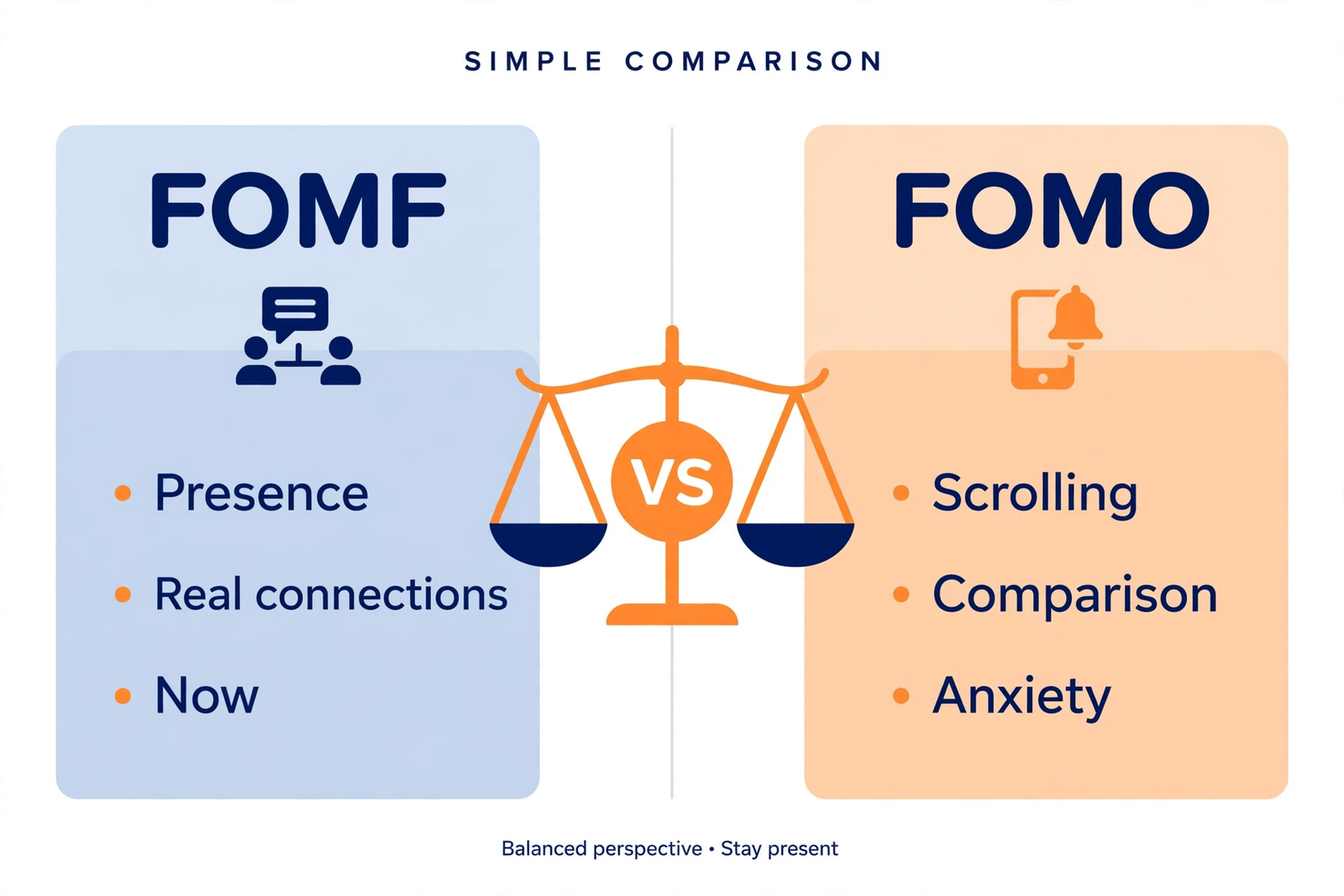
FOMO, on the other hand, is the opposite of FOMF in almost every way. FOMO is a feeling you confess about yourself (“I have FOMO about the party”), while FOMF is an attack you aim at someone else. Confusing the two is a real mistake — imagine telling your boss you have “FOMF” about a meeting. One letter makes the difference between a relatable feeling and a career-ending message. If you want to understand the friendly side of this slang family, our guides to NGL meaning in text and SMH meaning in text show how casual acronyms are supposed to work.
Alternate Meanings of FOMF
Because FOMF is rare, alternate meanings have room to grow. Here are the ones you may run into, and how likely each one is.
1. Fear of Missing Focus
This is the cleanest alternate meaning. In productivity and self-improvement circles, FOMF is sometimes used to mean “fear of missing focus” — the worry that you will lose concentration while everyone else stays productive. It is a deliberate play on FOMO: instead of fearing you will miss a party, you fear you will miss your flow state. This usage is real but uncommon, and it mostly appears in blog posts and captions rather than in actual texting. If someone uses FOMF this way, the surrounding context will make it obvious — they will be talking about work, studying, or screen time, not arguing with anyone.
2. A dismissive exclamation
Some people use FOMF the way others use “pfft” or “whatever” — as a sound rather than an acronym. The hard F and the punchy rhythm make it feel like a verbal full stop. In this use, the speaker may not even be thinking of the full form; they just want a short noise that means “done.” This is the most forgiving reading of FOMF, but it is also the least common.
3. A typo or misreading
Occasionally, FOMF is simply a typo. Someone meant FOMO and their thumb slipped, or someone misread FOMO in a fast-scrolling feed. Before assuming the worst, check the context: if the sentence is about missing an event or a trend, they almost certainly meant FOMO. The fomf meaning slang confusion starts here for a lot of people — one wrong letter, and a relatable feeling turns into an insult.
There is no widely recognized non-profane organization or product called FOMF that matters for texting, and if you see the letters in a brand or username, it is almost certainly a coincidence or a deliberate edgy reference to the slang meaning.
Professional or Polite Alternatives
Since FOMF is profane and hostile, you almost always need an alternative. Here are polite replacements for every situation where FOMF might tempt you:
| Instead of FOMF, say… | When to use it |
|---|---|
| “Please leave me alone.” | Someone will not stop messaging you. |
| “I am not interested, thanks.” | Turning down an unwanted advance politely. |
| “I need to end this conversation.” | An argument going nowhere. |
| “Let us agree to disagree.” | A debate with someone you still respect. |
| “I am busy right now.” | You just need space, not a fight. |
| “Please stop.” | Short, firm, and unmistakably clear. |
| (No reply + block/mute) | Harassment, spam, or someone who ignores boundaries. |
If the situation is genuinely funny and you are with close friends, softer joke dismissals work better than FOMF anyway: “okay, bye,” “get out of here,” or “you are done” all land the joke without the profanity. And if you want a slang dismissal that is rude but not quite as nuclear, STFU meaning in slang covers a term in the same family — though honestly, it is also best kept out of polite company.
Common Mistakes When Using FOMF
Most FOMF mistakes come from its rarity. People use it wrong because they have only seen it once, or because they assume it means something it does not.

1. Confusing FOMF with FOMO
This is the big one. FOMO is safe, mainstream, and self-deprecating. FOMF is profane and aggressive. Typing FOMF when you mean FOMO is like waving when you meant to wave goodbye — except the other person thinks you just insulted them. Always double-check the second letter: FOMO is the feeling, FOMF is the insult.
2. Using it with strangers or at work
FOMF is not a casual word. Using it on a coworker, a teacher, a client, or a stranger is not “being direct” — it is being verbally abusive. In a workplace, it can be a disciplinary issue. Online, it can get you muted, blocked, or banned. There is no context where FOMF is the professional choice.
3. Assuming it is a joke
Some slang insults soften between friends, but FOMF has not earned that status. If you send it to a friend who has never seen it before, they will read the literal meaning — and they will be right to. Never use FOMF as a joke with someone unless you are completely sure they know you are joking.
4. Using it to win an argument
FOMF does not win arguments; it ends them badly. The moment you type it, you have stopped debating and started insulting. The other person stops listening to your point and starts remembering the insult. If your goal is to be persuasive, FOMF is the worst possible tool.
5. Sending it when you mean the “focus” version
If you mean “fear of missing focus,” just say that. Almost nobody will read FOMF that way on their own — they will read the profane meaning first, and your productivity post will look like an outburst. The clean meaning is not established enough to risk it.
Quick Tips for Using FOMF Correctly
- Best practice: do not use it. FOMF has almost no upside. Recognizing it matters; saying it rarely helps.
- If someone sends it to you, take it at face value: they want the conversation to stop. The healthiest response is usually no response — or a calm “understood” if you need to close the loop.
- Check the letters before you send any FOM* acronym. One letter is the difference between FOMO and FOMF.
- In gaming or group chats, remember that moderators treat FOMF as harassment. A joke that gets you banned is not a good joke.
- If you see FOMF in a meme, the joke is the exaggeration — a huge insult aimed at a tiny problem. Laugh, but do not copy the language into real conversations.
- When in doubt, choose the polite alternative. “Please leave me alone” communicates the same boundary as FOMF, and nobody has ever been blocked for saying it.

FAQ

What does FOMF mean in slang?
In slang, FOMF most commonly stands for “F*** Off, Motherf***er,” a rude and angry way to tell someone to go away. A rare alternate meaning is “fear of missing focus,” a play on FOMO, but the insult is the meaning most people intend.
What does FOMF mean in texting?
In texting, FOMF is a blunt dismissal. Someone sends it when they are done with a conversation — usually angrily. It means “stop talking to me” or “go away,” and it normally ends the exchange.
What does FOMF mean on Snapchat?
On Snapchat, FOMF carries the same meaning as in texting: a harsh “go away.” Because snaps disappear, people sometimes use it more casually, but it is still an insult, often sent as a reply to an unwanted snap or a streak someone is tired of keeping.
Is FOMF the same as FOMO?
No. FOMO means “fear of missing out” and describes anxiety about missing something fun. FOMF is a profane dismissal aimed at another person. They share three letters, but their meanings and tones are completely different.
Is FOMF rude?
Yes, very. FOMF is one of the ruder slang acronyms in use. It contains two profanities and is meant as an insult. Do not use it at work, with strangers, or with anyone you want to keep a good relationship with.
Can FOMF mean “fear of missing focus”?
Sometimes, in productivity content, FOMF is used to mean “fear of missing focus.” This is a newer, much rarer reading. Most people who see FOMF will assume the profane meaning, so using it to mean “focus” is likely to be misunderstood.
What should I reply if someone sends me FOMF?
Usually, nothing. The sender is telling you the conversation is over. If you need to acknowledge it, a calm “understood” or “okay” closes the loop without escalating. Do not reply with another insult — it only makes things worse.
Where did FOMF come from?
FOMF likely emerged from early-2000s forum, chatroom, and gaming culture, where long profane phrases were compressed into short acronyms like STFU and GTFO. It never went mainstream the way FOMO did, and it remains a niche term found mostly in gaming lobbies, meme pages, and heated comment threads.
Conclusion
The fomf meaning slang answer is simple, but the term itself is not a friendly one. FOMF most commonly stands for “F*** Off, Motherf***er” — a short, sharp, profane dismissal that ends conversations and, often, relationships. A softer alternate reading, “fear of missing focus,” exists, but it is rare enough that nobody will assume it. The term lives in gaming lobbies, meme pages, and heated comment threads, and its popularity is low precisely because its meaning is so hostile.
The practical takeaway is straightforward: learn to recognize FOMF so it never catches you off guard, do not confuse it with FOMO, and do not use it yourself. Every boundary FOMF sets can be set more clearly — and more safely — with plain words like “please leave me alone.” Slang is supposed to make communication faster and more fun; FOMF makes it faster and more hostile, and that is a trade nobody needs. Now that you know what FOMF means, you can spot it, understand it, and move on — which is exactly what the person typing it wants you to do.
Want more slang explained the same way? Check out our guides to NGL, SMH, and STFU — and if you are curious about the term FOMF is most often confused with, the FOMO vs FOMF comparison table above is the fastest way to keep them straight.
