
Quick definition: Old slang words are informal expressions from past decades — like “groovy,” “rad,” and “the bee’s knees” — that were once everyday language and now carry a fun, nostalgic charm. Some have faded away, while others keep popping up in movies, memes, and everyday conversation.
Old Slang Words Meaning & Definition
Old slang words are the casual, playful expressions that defined how people talked in earlier decades. From the flapper-era “cat’s pajamas” of the 1920s to the totally tubular “rad” of the 1980s, every generation invents its own secret vocabulary — words that signal you belong, that you are in on the joke, that you get it. Slang is language at its most alive: it bends rules, borrows from music and movies, and spreads faster than any dictionary can keep up with.
But slang also ages. What sounded fresh in 1975 can sound hilariously dated in 2026 — and that is exactly why old slang words are so much fun. They are little time capsules. Say “groovy” and people instantly picture bell-bottoms and vinyl records. Say “the bee’s knees” and you are suddenly in a jazz-age speakeasy. These words do more than communicate; they transport us.
In this guide, we will unpack what old slang words really mean, where they came from, why some refuse to die, and how you can use them today without sounding like a walking history museum. You will find 40 classic terms with their meanings, real examples, a comparison with modern slang, and the mistakes to avoid when you drop a vintage phrase into a modern text.
Introduction
Language never stands still, and slang moves fastest of all. Every decade leaves behind a trail of words that once felt cutting-edge and now feel charmingly retro. Some old slang words — like “cool,” first popular in jazz circles in the 1940s — never actually left. Others, like “23 skidoo,” vanished so completely that most people under 40 have never heard them at all.
Why do we still care about these old words? First, they are genuinely useful. A single vintage term can say in one word what a whole sentence cannot: “far out” is not just “surprising,” it is surprising with a 1970s shrug and a smile. Second, they are cultural shorthand. Using old slang words signals nostalgia, humor, and personality — which is why advertisers, screenwriters, and meme creators keep reaching for them. And third, they keep coming back. Gen Z has revived “slay,” “lit,” and “no cap” from earlier eras, proving that slang is less a straight line and more a cycle.
Whether you are writing, texting, or just curious about how people talked before smartphones, this guide gives you the meanings, origins, and real-world examples of the most beloved old slang words — plus practical tips for using them naturally today.

Origin
Old slang words come from everywhere: jazz clubs, military barracks, college campuses, street corners, radio shows, and Hollywood films. Slang has always been the language of insiders — a way for a group to mark itself as different from the mainstream. Jazz musicians of the 1920s and 1930s coined dozens of terms (“hip,” “cool,” “cat” for a person, “gig” for a job) that eventually went mainstream. Soldiers in both World Wars brought home words like “snafu” and “gizmo.” Beatniks, hippies, surfers, skaters, and hip-hop artists each added their own layer.
Many old slang words started as coded language. In the 1920s, during Prohibition, slang helped people talk about alcohol and nightlife without being obvious. In the 1960s and 1970s, counterculture slang marked a break from polite society. And in every era, teenagers have invented slang partly to keep adults guessing — which is why so much vintage slang feels like a secret handshake from another time.
The word “slang” itself first appeared in print in the mid-1700s, probably from Scandinavian roots, and it originally described the language of criminals and vagabonds. By the 1800s, newspapers were already complaining that young people were ruining English with slang — a complaint every generation since has repeated, usually while using slang of its own.
Popularity
Old slang words are more popular now than they have been in decades, thanks to three forces: nostalgia media, social media, and the retro revival cycle. Period TV shows and films — from 1920s gangster dramas to 1980s coming-of-age stories — put vintage phrases back in millions of ears. TikTok and Instagram creators use old slang words ironically and affectionately, turning “groovy” and “rad” into shareable jokes. And fashion’s 20-year nostalgia cycle keeps pulling each decade back into style, words included.
Search interest tells the story. People regularly look up the meanings of words like “groovy,” “rad,” “the bee’s knees,” and “far out” — often after hearing them in a movie, a song, or a grandparent’s story. Teachers use old slang words in history and English lessons. Writers use them to give dialogue an authentic period flavor. And party planners, trivia hosts, and costume-party goers love them because they instantly set a decade’s mood.
Some old slang words have even earned permanent spots in standard English. “Cool,” “hip,” “nerd,” “geek,” “gig,” and “dude” all started as slang and are now so normal that nobody thinks of them as slang at all. That is the ultimate fate of successful slang: it stops being slang and simply becomes the language.
How It Is Used
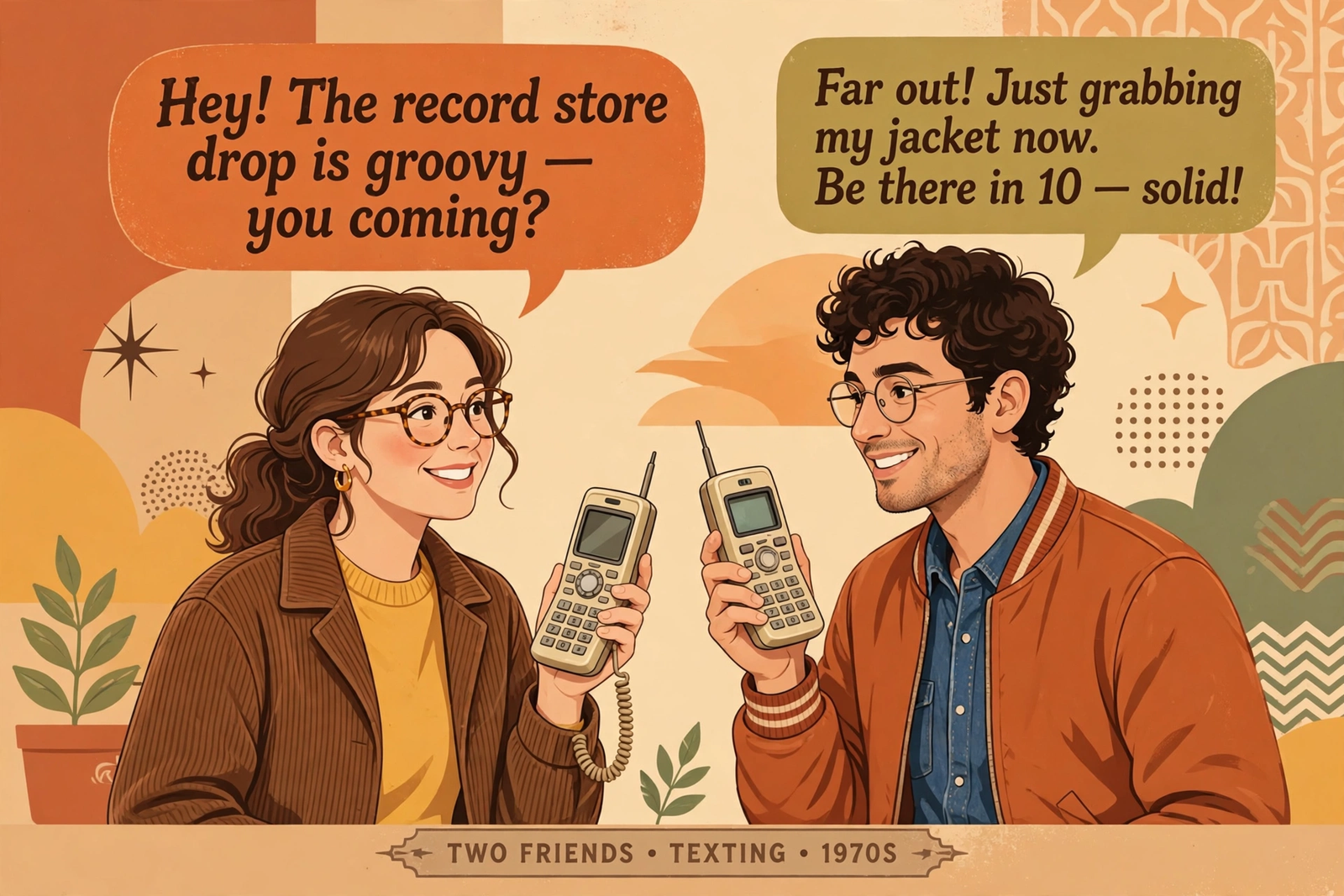
Old slang words show up in four main ways today: nostalgic conversation, humor, period writing, and ironic modern use. In nostalgic conversation, someone might say “that party was totally groovy” with a smile, knowing the word is dated and enjoying it anyway. In humor, old slang words exaggerate a reaction — “Well, isn’t that just the cat’s pajamas?” lands funnier than “That’s nice.” Writers use them to anchor a scene in time: a character who says “23 skidoo” is unmistakably from the 1920s. And ironically, young people drop vintage words into texts and captions precisely because they sound delightfully out of place.
Most old slang words work as adjectives (“groovy music”), exclamations (“Far out!”), or nouns (“a real hep cat”). A few work as verbs — “to dig” something meant to understand or enjoy it in 1960s slang. The key to using them today is tone: say them lightly, with a wink, and they charm; say them stiffly, and they sound like a costume.
Old slang words also thrive in texting and social media, where a single vintage word can carry a whole mood. “That’s so rad” in a comment, “groovy vibes only” in a caption, or “the bee’s knees” in a birthday card — each one adds color that plain language cannot match.
Examples
The best way to learn old slang words is to see them in action. Below are real-feeling examples grouped by tone, so you can match the word to the moment. Notice how each example keeps the meaning clear from context — nobody should need a dictionary to follow your sentence.
Friendly Examples
- “Your new jacket is totally rad — where did you get it?”
- “Thanks for the ride, man. You’re groovy.”
- “This playlist is the bee’s knees. Every song is a banger.”
- “Hey, cool cats — dinner’s ready!”
- “That sunset was far out. I took about fifty photos.”
- “Don’t be such a square — come dance with us!”
- “She’s a real doll, always helping everyone out.”
- “We had a swell time at the fair yesterday.”
Professional Examples
- “The client’s pitch was solid — honestly, a groovy concept for the campaign.” (Use sparingly in formal settings.)
- “Let’s keep the meeting cool and casual; no need to be uptight about the agenda.”
- “His presentation style is old-school but effective — a real throwback in the best way.”
- “That idea is the cat’s meow — simple, memorable, and exactly on brand.”
- “We need a hip, fresh angle for this launch, not the same tired approach.”
- “The new office vibe is far out — open space, plants everywhere, total 70s energy.”
Funny Examples
- “I tried to say ’23 skidoo’ in a meeting and everyone just stared at me.”
- “Grandpa called my sneakers ‘far out’ and honestly, he’s not wrong.”
- “My mom said my haircut was ‘tubular.’ I think that’s a compliment?”
- “He walked in wearing a fedora and said ‘What’s the word, bird?’ — I nearly lost it.”
- “She described the Wi-Fi as ‘the bee’s knees’ and the whole table cracked up.”
- “I’m not old, I’m just fluent in groovy.”
Comparison with Similar Terms
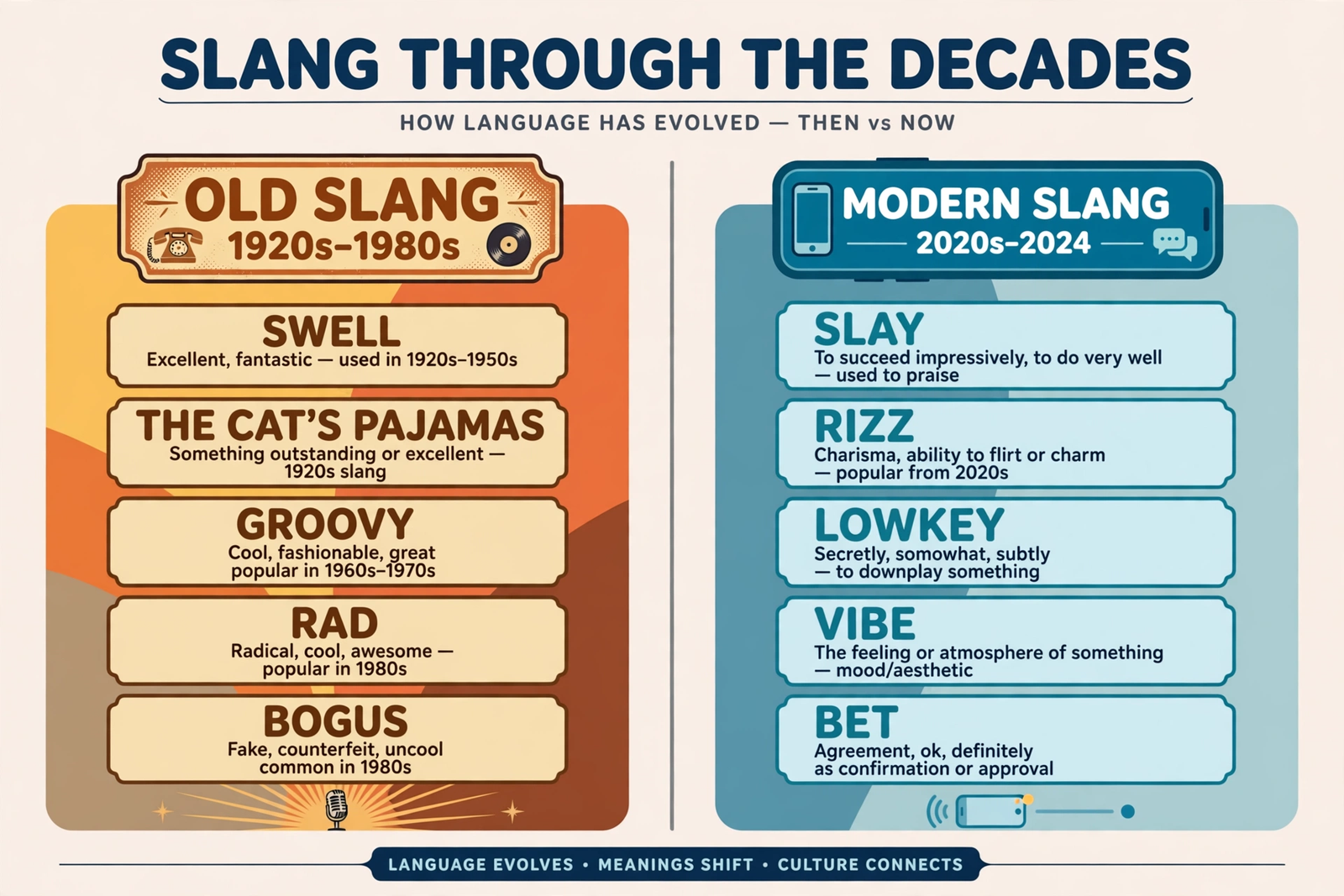
Old slang words and modern slang do the same job — they express approval, excitement, identity, and belonging — but they wear very different clothes. The table below lines up vintage terms with their modern equivalents, so you can see how the meaning stayed the same while the vocabulary changed.
| Meaning | Old Slang Word | Decade | Modern Equivalent |
|---|---|---|---|
| Excellent / awesome | Groovy | 1960s–70s | Lit, fire |
| Excellent / cool | Rad | 1980s | Dope, sick |
| The best / amazing | The bee’s knees | 1920s | GOAT, iconic |
| Amazing / unbelievable | Far out | 1960s–70s | Insane, wild |
| Cool / stylish person | Hep cat | 1930s–40s | Cool kid, vibe |
| Great / wonderful | Swell | 1920s–50s | Awesome, amazing |
| Leave quickly | 23 skidoo | 1920s | Peace out, I’m out |
| Understand / enjoy | Dig it | 1960s | I feel you, I’m here for it |
| Attractive person | Doll / dreamboat | 1940s–50s | Snack, hottie |
| Stiff / uncool person | Square | 1950s–60s | Basic, NPC energy |
Notice the pattern: every generation needs a word for “great” and a word for “uncool.” The concept never changes; only the costume does. That is why old slang words still feel familiar — they are the ancestors of the words we use right now. If you know what “lit” means, you already understand “groovy.” If you have ever called something “fire,” you have felt what “the bee’s knees” meant to a 1920s flapper.
Another useful comparison is with modern slang terms that are themselves already aging. Words like cap (a lie) and flex (showing off) dominate today’s feeds, but in twenty years they may sound as dated as “groovy” does now. Slang is a wheel, not a ladder — and today’s hot word is tomorrow’s vintage charm.
Alternate Meanings
Many old slang words carry more than one meaning, and context is everything. “Cool” is the most famous example: it can mean calm under pressure, fashionable, mildly cold, or simply “okay” (“Cool, see you at seven”). “Bad” famously flipped in the 1980s to mean “good” — “That’s bad!” could be high praise from a teenager in 1985.
“Hip” meant fashionable and in-the-know, but “hip” is also a body part — a pun that comedians of the era loved. “Joint” could mean a place (“a nice little joint downtown”), a marijuana cigarette, or, in jazz slang, a musical performance. “Bread” meant money, while “dough” meant the same thing — and both came from the idea that money is what puts food on the table. “Pad” was an apartment, “threads” were clothes, and “wheels” were a car. Learning the alternate meanings keeps you from misreading vintage dialogue — or from accidentally saying something you did not mean.
Professional or Polite Alternatives
Old slang words are playful by nature, so they do not always fit formal writing or professional settings. If you love the flavor but need a polished tone, swap in a neutral equivalent. “Groovy” becomes “excellent” or “appealing.” “The bee’s knees” becomes “outstanding” or “exceptional.” “Far out” becomes “remarkable” or “surprising.” “Rad” becomes “impressive” or “great.” “Dig it” becomes “I appreciate it” or “I understand.”
That said, a single well-placed vintage word can warm up professional writing. A marketing email that calls a product “the bee’s knees” stands out precisely because it breaks the pattern — just use it once, on purpose, and keep the rest of the message clean. In creative fields, old slang words can be a brand voice; in law, finance, or medicine, keep them in the break room.
40 Classic Old Slang Words and What They Mean
Here is the heart of this guide: a tour through the most beloved old slang words, decade by decade, with plain-English meanings so you can use them with confidence.
1920s — Jazz Age Gems
- The bee’s knees — the best; outstanding. (“Her new dress is the bee’s knees.”)
- The cat’s pajamas — something wonderful or excellent. (“That car is the cat’s pajamas.”)
- 23 skidoo — get out of here; leave quickly. (“The cop showed up, so we said 23 skidoo.”)
- Giggle water — alcohol, especially during Prohibition. (“They hid the giggle water in the basement.”)
- Cat — a cool person, usually a jazz fan or musician. (“He’s a real cool cat.”)
- Swell — great, wonderful. (“We had a swell time.”)
- Big cheese — an important person. (“The big cheese is visiting the office today.”)
- Bluenose — a strict, prudish person. (“Don’t invite the bluenose — she’ll ruin the fun.”)
1930s–1940s — Swing and Wartime
- Hep cat — someone fashionable and in the know. (“He’s a hep cat who knows every jazz club in town.”)
- Dreamboat — a very attractive person. (“That actor is a total dreamboat.”)
- Doll — an attractive or sweet woman. (“She’s a real doll.”)
- Snafu — a chaotic mess-up. (“The whole delivery was a snafu.”)
- Gizmo — a gadget or device. (“What does this gizmo do?”)
- Hubba hubba — an expression of approval, often for someone attractive. (“Hubba hubba! Look at that car.”)
- Joint — a place, especially a bar or club. (“Let’s meet at that little joint on Fifth.”)
- Bread — money. (“I need to earn some bread this summer.”)
1950s–1960s — Rock, Beatniks, and Hippies
- Cool — calm, fashionable, excellent. (“Stay cool, everything’s fine.”)
- Daddy-o — a friendly way to address a man. (“Hey, daddy-o, what’s happening?”)
- Square — a boring, conventional person. (“Don’t be a square — try something new.”)
- Dig it — to understand or enjoy something. (“I really dig this song.”)
- Far out — amazing or surprising. (“Far out! You won the contest?”)
- Groovy — excellent, fashionable, enjoyable. (“That concert was totally groovy.”)
- Pad — an apartment or home. (“Come over to my pad tonight.”)
- Threads — clothes. (“Nice threads! Where’d you get them?”)
1970s–1980s — Disco, Punk, and Skaters
- Rad — excellent, cool (short for “radical”). (“That skateboard trick was rad!”)
- Tubular — awesome, used by surfers and skaters. (“Tubular wave today, dude!”)
- Gnarly — extreme, either awesome or awful. (“That wipeout was gnarly.”)
- Awesome — amazing (it began as 1980s slang before going mainstream). (“Awesome! Let’s do it.”)
- Psyched — excited. (“I’m so psyched for the concert.”)
- Bummer — a disappointment. (“Rain on picnic day? Total bummer.”)
- Fo’ shizzle — “for sure,” popularized by hip-hop. (“Fo’ shizzle, I’ll be there.”)
- Wheels — a car. (“Nice wheels! Is that yours?”)
1990s — The Decade That Keeps Coming Back
- Da bomb — excellent, the best. (“This pizza is da bomb.”)
- Talk to the hand — “I don’t want to hear it.” (“Talk to the hand — I’m busy.”)
- As if! — “No way!” (“You think I’d wear that? As if!”)
- Boo-yah — an exclamation of triumph. (“Boo-yah! I passed the test!”)
- All that and a bag of chips — excellent in every way. (“She’s all that and a bag of chips.”)
- Homie — a close friend. (“What’s up, homie?”)
- Phat — excellent, cool (spelled with “ph”). (“That beat is phat.”)
- Whatever — a dismissive “I don’t care.” (“Whatever — do what you want.”)
Common Mistakes
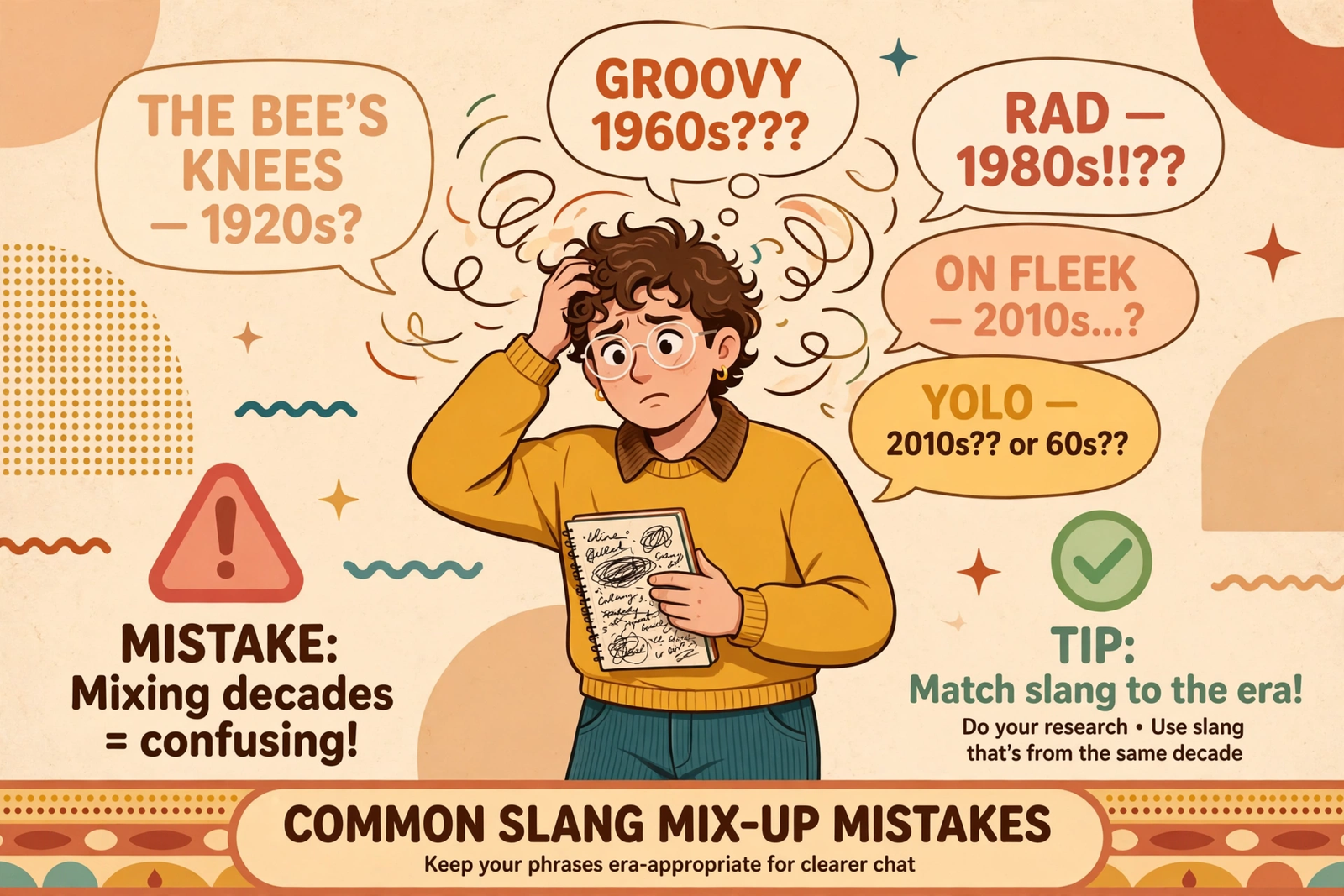
Old slang words are fun, but a few common mistakes can turn a charming phrase into an awkward moment. First, do not overuse them. One vintage word per conversation is a wink; five in a row is a costume. Second, check the meaning before you use a word — “gnarly” can mean awesome or terrible depending on tone, and “bad” flipped meanings entirely in the 1980s. Third, remember the audience: your grandparents will love hearing “groovy,” but a job interviewer probably will not.
Fourth, avoid words with genuinely offensive histories. Some vintage slang carries racist, sexist, or otherwise harmful baggage from its era. If a term’s origin feels sketchy, leave it in the history books. Fifth, do not mix decades randomly in period writing — a 1920s flapper would never say “rad,” and an 1980s skater would never say “23 skidoo.” And finally, do not force it. Old slang words work best when they slip out naturally, like a favorite old song you hum without thinking.
Quick Tips
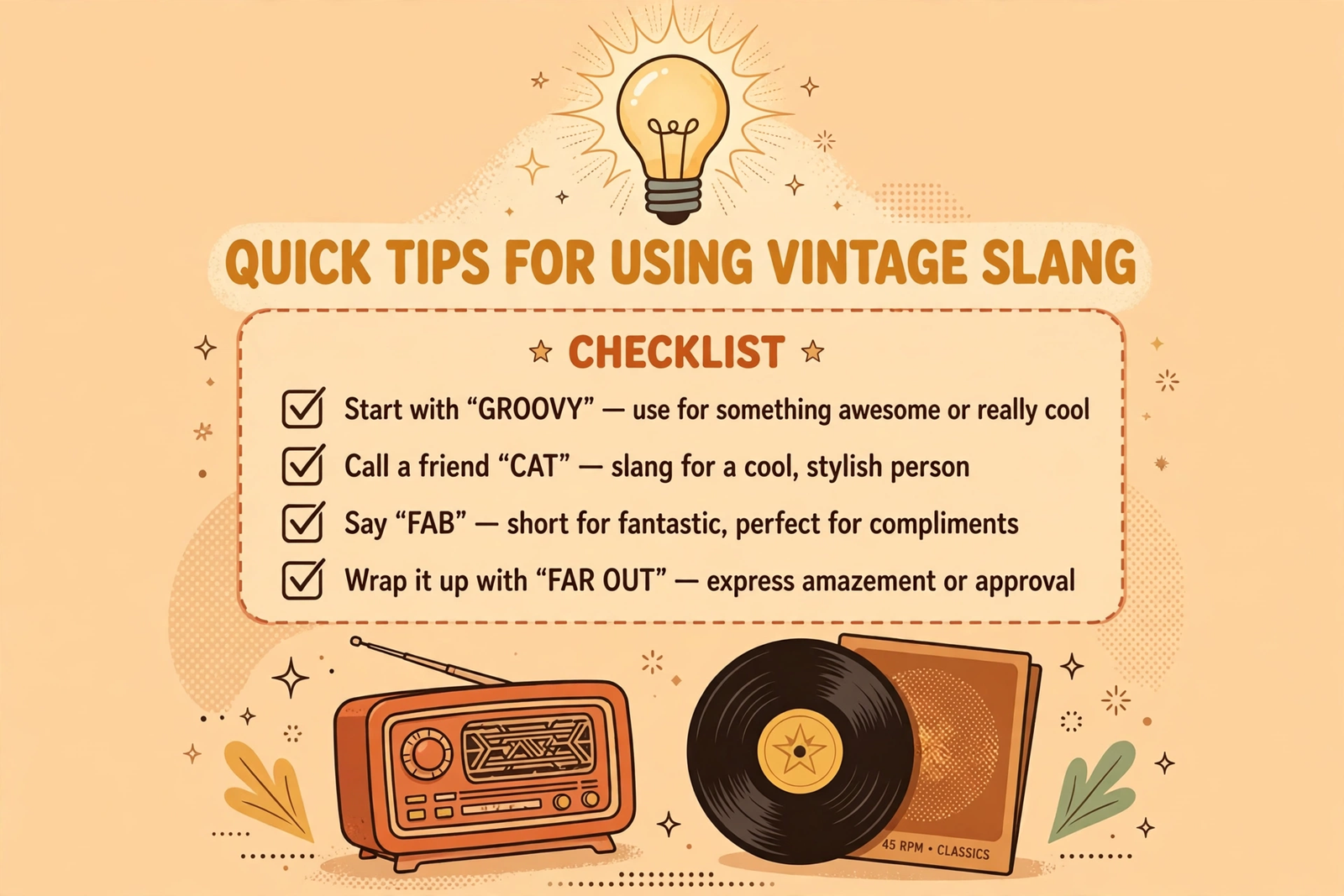
- Start with one word: Pick a single favorite — “groovy,” “rad,” or “the bee’s knees” — and use it until it feels natural.
- Match the mood: Vintage words fit celebrations, jokes, and casual chats better than serious or formal moments.
- Use them in writing: Captions, cards, and party invitations are perfect low-risk places to try old slang words.
- Learn the decade: Knowing a word’s era helps you use it right — and impresses trivia night crowds.
- Pair with context: Surround the word with clear meaning so nobody gets lost. (“That band is groovy — I mean seriously good.”)
- Watch movies from the era: Hearing old slang words spoken naturally is the fastest way to learn their rhythm.
- Teach the kids: Old slang words are a fun bridge between generations — grandparents love explaining them.
- Keep it light: The moment it feels like a performance, dial it back. Vintage slang should feel like fun, not homework.
FAQ
What are old slang words?
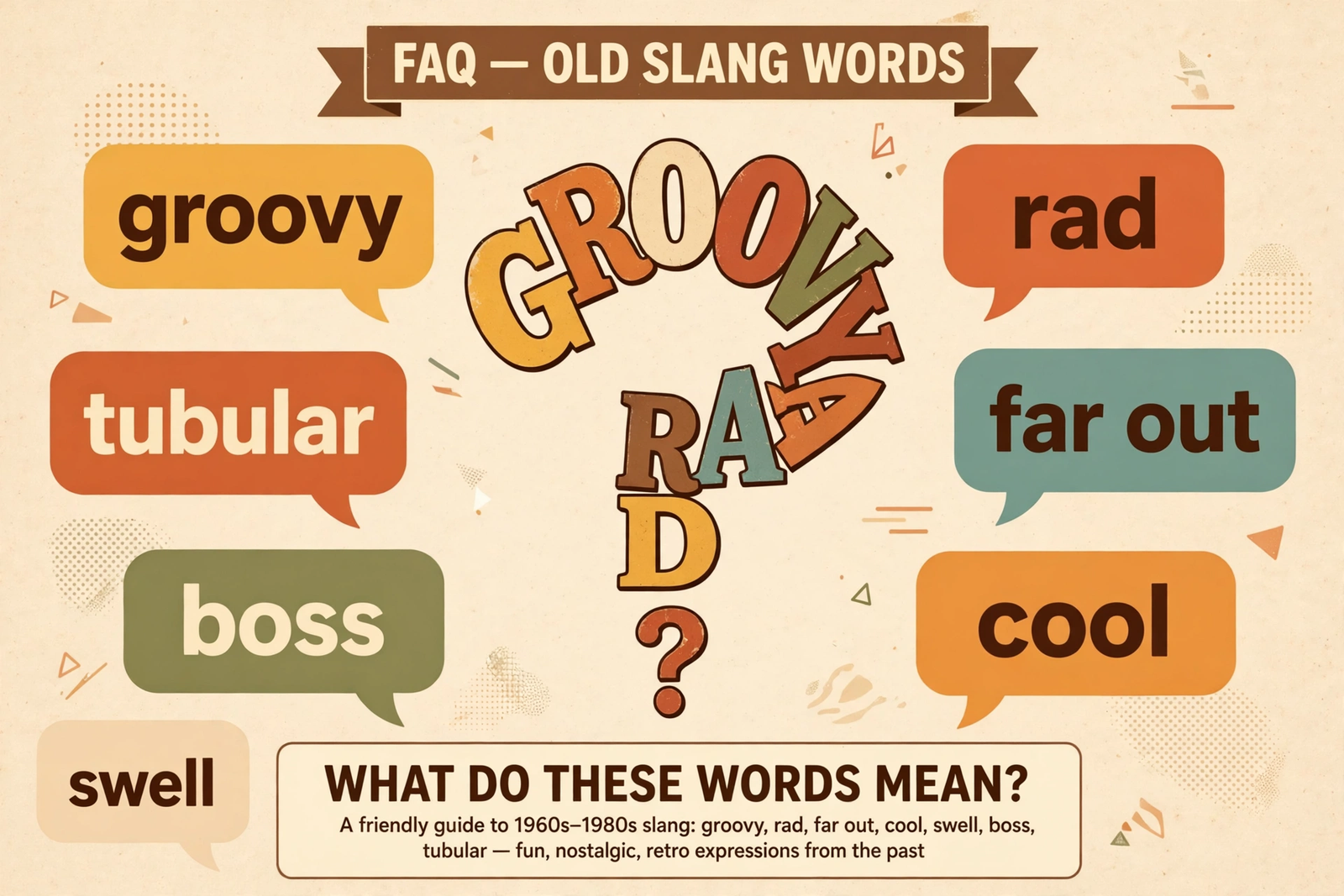
Old slang words are informal expressions from past decades — like “groovy,” “rad,” and “the bee’s knees” — that were popular in their time and now carry a nostalgic, retro charm. They were once everyday language for a generation and are still used today for humor, style, and period flavor.
What is the most famous old slang word?
“Cool” is probably the most famous, because it never actually died — it went from 1940s jazz slang to everyday English. Among purely vintage terms, “groovy” and “the bee’s knees” are the most recognized, thanks to movies, music, and memes that keep them alive.
What does “groovy” mean?
“Groovy” means excellent, fashionable, or enjoyable. It comes from 1960s jazz and hippie culture, where “in the groove” described music that felt just right. Today people use it playfully to describe anything fun or retro-cool.
What does “the bee’s knees” mean?
“The bee’s knees” means the best or outstanding — the highest praise in 1920s slang. It belongs to a family of silly animal phrases from the era, including “the cat’s pajamas” and “the snake’s hips.” Nobody knows exactly why bees’ knees were chosen, which is part of the charm.
What does “rad” mean?
“Rad” is short for “radical” and means excellent or cool. It was hugely popular in 1980s surf and skate culture (“That trick was rad!”) and still pops up today whenever someone wants a quick hit of 80s nostalgia.
Are old slang words still used today?
Yes — some never left (“cool,” “nerd,” “gig”), and others come back in waves through movies, TikTok, and retro fashion. People also use old slang words deliberately for humor and nostalgia, which keeps them circulating long after their original era ends.
How can I use old slang words without sounding weird?
Use one at a time, in casual settings, with a light tone — and make sure the meaning is clear from context. Captions, jokes, and friendly chats are ideal. Avoid stacking several vintage words in one sentence or using them in formal situations like job interviews.
Where do old slang words come from?
They come from music scenes, youth culture, the military, movies, and street life. Jazz musicians, soldiers, beatniks, hippies, surfers, and hip-hop artists all coined terms that spread through radio, film, and word of mouth before eventually landing in dictionaries — or fading into charming obscurity.
Conclusion
Old slang words are more than dusty vocabulary — they are proof that language is alive, playful, and always reinventing itself. Each one carries a decade’s music, movies, and attitude in a single word. “Groovy” holds the 1960s. “Rad” holds the 1980s. “The bee’s knees” holds the jazz age. Learning them is not just a party trick; it is a way to hear history talking.
The best approach is simple: pick a few favorites, learn their real meanings and their decades, and use them lightly, with a smile. Drop “far out” when something surprises you. Call a great idea “the bee’s knees.” Tell a friend their new shoes are “rad.” You will sound fun, not dated — and you might just start a conversation about where words come from, which is one of the best conversations there is.
For more modern slang explained the same way, check out what OP means in slang and what a munch is in slang — the words change, but the fun of decoding them never does. And if you want the bigger picture of how slang evolves, Merriam-Webster’s guide to slang words is a great authoritative starting point.
