Quick definition: Slang is informal, playful language made up of words and phrases that belong to a particular group, generation, or culture. It lives mostly in casual conversation, texting, and social media — not in formal writing. If you have ever wondered what is slang when someone says a word you have never heard before, the short answer is simple: it is the casual vocabulary people use to sound natural, friendly, and in the know.
What Is Slang? Meaning & Definition
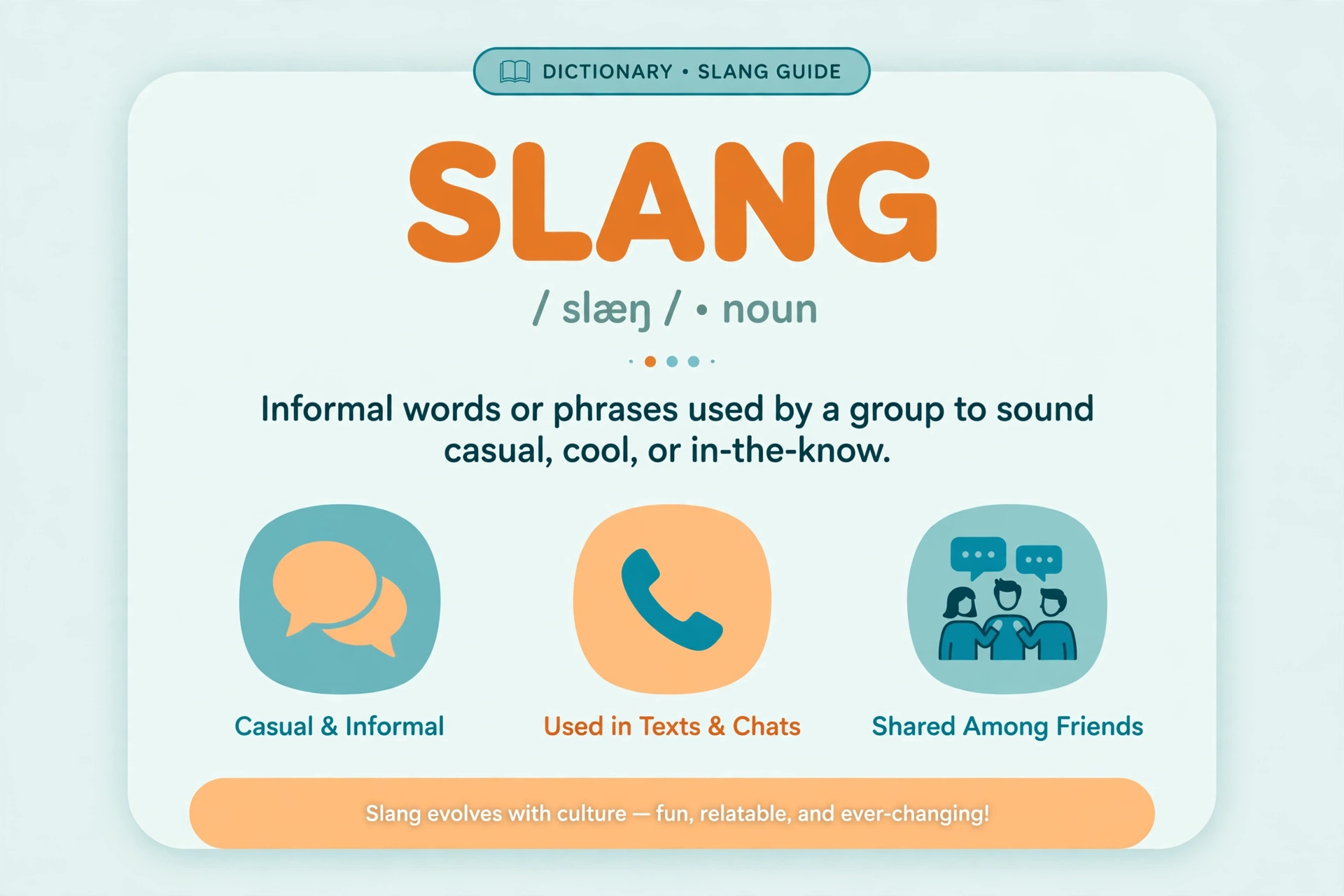
So, what is slang exactly? Slang is a type of informal language built from words, expressions, and meanings that are not part of standard, formal English. It is the language of friends chatting, gamers trash-talking, teenagers texting, and coworkers joking around after hours. While standard English follows the rules you learn in school, slang follows the rules of the group using it — and those rules change fast.
Dictionary definitions agree on the core idea. Merriam-Webster describes slang as language peculiar to a particular group, made of informal and often playful coinages. The Cambridge Dictionary calls it very informal language, usually spoken rather than written, used especially by particular groups of people. In plain words: slang is how real people actually talk when they are not trying to sound formal.
A slang word can be a brand-new invention (like “rizz,” shortened from charisma), an old word given a new meaning (like “lit,” which once meant drunk and now means exciting), a clipped version of a longer word (like “bro” from brother), or two words mashed together (like “frenemy,” friend plus enemy). What makes all of them slang is not their spelling — it is how, where, and by whom they are used.
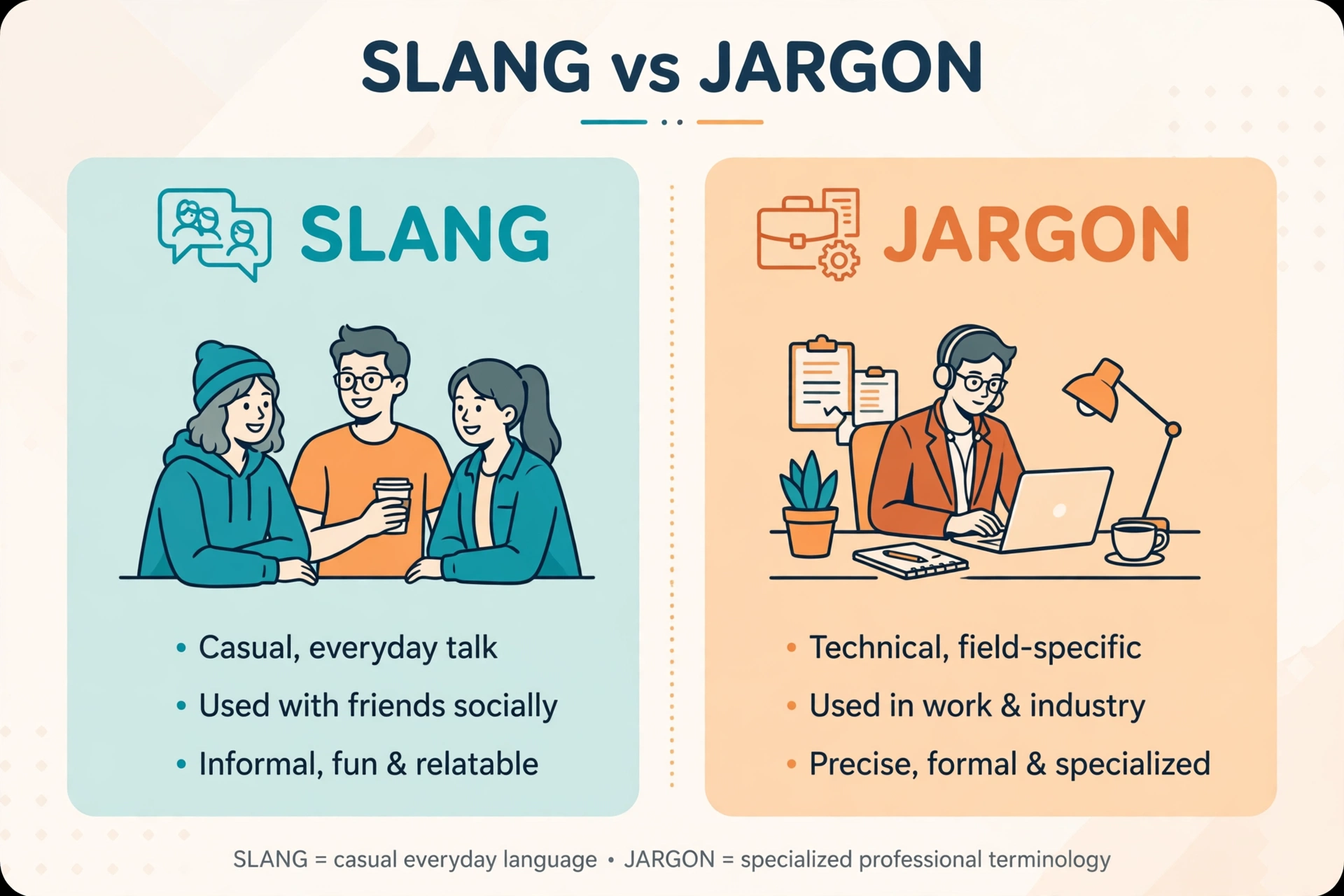
Slang is also different from jargon. Jargon is the technical vocabulary of a profession — doctors, lawyers, and programmers all have jargon. Slang is social: it signals that you belong to a group, share its humor, and understand its unwritten rules. That is why the same slang word can feel completely natural in a group chat and completely wrong in a job interview.
Introduction
Every generation thinks it invented slang, and every generation is both right and wrong. Slang has existed for centuries — the word “slang” itself first appeared in the 1700s — yet the slang of today sounds nothing like the slang of your grandparents. “Groovy” and “far out” once ruled the 1960s. “Rad” and “gnarly” owned the 1980s. Today it is “no cap,” “slay,” “sus,” and “vibe check.” The words change; the human need behind them does not.
People use slang to do things formal language cannot do as well. It builds closeness: using the same slang as your friends says “I am one of you” without saying a word about it. It adds color and humor: “that party was lit” hits differently than “that party was enjoyable.” It creates privacy: groups have always used slang to talk in front of outsiders without being fully understood. And on the internet, slang moves at the speed of a meme — a word can go from one TikTok video to millions of phones in a single weekend.
This guide answers the question “what is slang” completely. You will learn where slang comes from, why it is so popular, how it is used in real conversations, and how to use it without embarrassing yourself. You will also see a comparison with similar terms, the most common mistakes people make, and quick tips for keeping up as slang keeps changing.
Origin
The origin of the word “slang” is uncertain, which is fitting for a word that describes language that lives outside the rulebook. The first recorded uses appear in the mid-1700s in Britain, where “slang” referred to the secret vocabulary of criminals and vagabonds — what we would now call thieves’ cant or argot. Back then, slang was literally a code: a way for people on the margins of society to speak freely in front of police, judges, and respectable citizens.
Over time, the meaning widened. By the 1800s, slang had escaped the criminal underworld and entered everyday speech. Sailors brought back words from distant ports. Soldiers carried slang home from wars. Immigrants mixed words from their own languages into English. Writers like Charles Dickens and Mark Twain put slang into popular novels, and suddenly words that had once marked someone as an outsider became part of mainstream culture.
The 20th century supercharged slang. Jazz musicians in the 1920s gave us “cool” and “hip.” Beatniks and hippies in the 1950s and 60s gave us “groovy” and “far out.” Hip-hop culture from the 1980s onward gave English some of its most durable slang — “dope,” “fresh,” “props,” “diss” — and the internet era turned slang into a global, real-time phenomenon. A teenager in Ohio, a gamer in Seoul, and a student in Lagos can now all start using the same slang word in the same week.
That history explains one of slang’s most important traits: it is always moving. Slang words are born, spread, peak, and fade. Some survive long enough to enter the dictionary — “cool” has been standard English for decades. Most do not. And that is fine. Slang is not supposed to last forever. It is supposed to capture how people feel right now.
Popularity
Slang is more popular today than at any point in history, and the reason is simple: more people are talking in public, in writing, than ever before. Before smartphones, most slang lived in spoken conversation and died with the moment. Today, slang lives in text messages, group chats, comments, captions, memes, and video subtitles — billions of written examples, all searchable, shareable, and remixable.
Social media is the biggest engine of slang’s popularity. TikTok can turn a single phrase into global slang overnight. A viral sound, a meme format, or a celebrity interview can push a word like “rizz” or “slay” into millions of conversations within days. Streaming shows and YouTube creators spread regional slang far beyond its home turf: British slang like “innit” and “peng” is now understood by American teenagers, and American slang like “y’all” and “no cap” is used by English speakers worldwide.
Gaming communities are another major source. Words like “GG” (good game), “noob,” “nerf,” “buff,” and “sus” (from the game Among Us) started inside games and then leaked into everyday texting. The same thing happened with internet culture: “LOL,” “OMG,” “BRB,” and “TBH” began as chat-room shortcuts and are now used by people who have never set foot in a chat room.
Slang is popular because it is useful. It is faster than formal language — “LOL” beats “that made me laugh out loud.” It is warmer — calling someone “bro” signals closeness that “friend” does not. And it is constantly fresh, which matters in a culture where sounding current is a form of social currency. For brands, creators, and anyone communicating with a young audience, understanding slang is no longer optional. It is the difference between sounding like a person and sounding like a press release.
How It Is Used
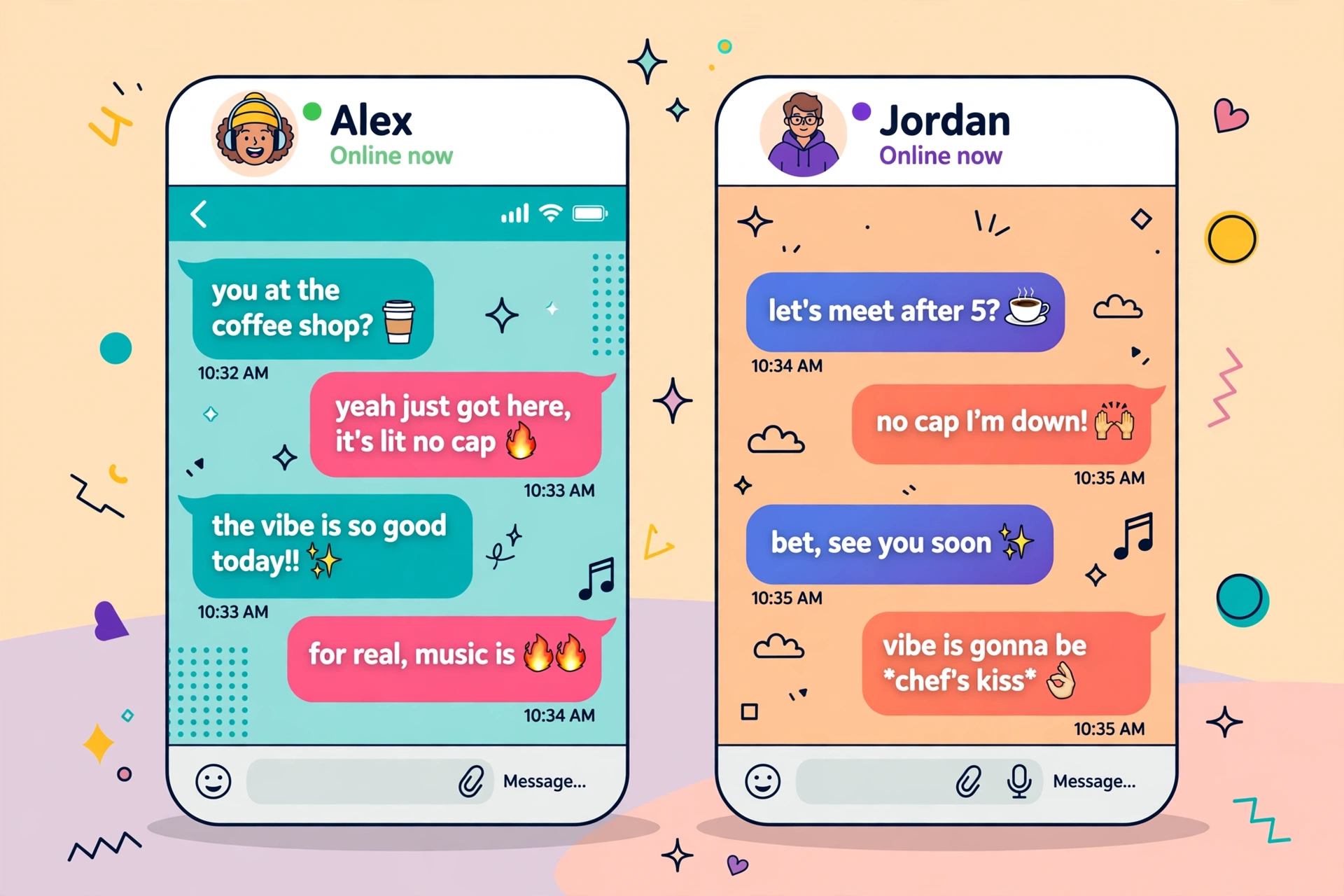
Slang is used in casual, informal situations — and almost never in formal ones. The same person who texts “that’s so sus lol” to a friend will write “that seems questionable” in a work email. Knowing when to switch is the real skill. Slang is appropriate in text messages, group chats, social media posts, friendly conversations, comedy, song lyrics, and casual storytelling. It is usually inappropriate in job applications, academic essays, legal documents, formal speeches, and first messages to strangers in a professional setting.
Slang works through context. The word “bad” can mean “not good” in standard English — but in slang, “that car is bad” can mean the car is impressive. The word “sick” can mean ill, or it can mean amazing. The word “ghost” can mean a spirit, or it can mean cutting off all contact with someone. Without context, slang is a guessing game. With context, it is precise and expressive.
Slang also works through tone. A word like “bro” can be warm, teasing, annoyed, or sarcastic depending on how it is said. “Okay, bro” with a laugh means something very different from “Okay, bro” with an eye roll. In texting, tone is carried by punctuation, capitalization, and emojis — “no cap” reads as honest emphasis, while “no cap 😂” reads as playful exaggeration. Learning slang means learning these tones, not just memorizing definitions.
Finally, slang works through belonging. Using a group’s slang correctly signals that you are part of the group. Using it wrong — or using slang from a group you do not belong to — can signal the opposite. The safest approach is to listen first. Hear how people actually use a word before you try it yourself, and pay attention to who uses it and where.
Examples
Nothing explains slang better than real examples. Below are everyday slang words and phrases organized by tone, with the meaning and a sentence for each. Notice how the same word often changes meaning depending on the situation.
Friendly Examples
- Slay — to do something extremely well. “She slayed that presentation today.”
- Vibe / vibes — a feeling or atmosphere. “This café has such chill vibes.”
- GOAT — Greatest Of All Time. “That basketball player is the GOAT.”
- Low-key — quietly, secretly, or mildly. “I low-key love this song.”
- Hits different — feels special or stronger than usual. “Coffee on a rainy morning just hits different.”
- Bestie — best friend. “My bestie and I are going shopping.”
Professional Examples
Yes, some slang has crossed into the workplace — usually the mild, widely understood kind. Even here, keep it light and know your audience.
- Circle back — to return to a topic later. “Let’s circle back to the budget on Monday.”
- Ping me — send me a quick message. “Ping me when the file is ready.”
- On the same page — in agreement. “Are we all on the same page about the deadline?”
- Bandwidth — time or capacity to take on work. “I don’t have the bandwidth for another project this week.”
- Quick win — an easy, fast success. “That fix was a quick win for the team.”
Funny Examples
- No cap — no lie, seriously. “That movie was amazing, no cap.”
- Salty — bitter or upset, usually over something small. “He’s salty because he lost the game.”
- Ghosting — suddenly cutting off all contact. “She ghosted me after the second date.”
- Tea — gossip or juicy news. “Spill the tea — what happened at the party?”
- Flex — to show off. “He’s just flexing his new car.”
- Big yikes — a reaction to something awkward or embarrassing. “He texted his ex by accident. Big yikes.”
| Slang Word | Meaning | Example Sentence |
|---|---|---|
| lit | exciting, amazing | “The concert was lit!” |
| sus | suspicious, sketchy | “His excuse sounds sus.” |
| cap / no cap | lie / no lie | “No cap, that’s the best pizza ever.” |
| bet | okay, agreed, for sure | “Bet, I’ll see you at 7.” |
| rizz | charm, flirting skill | “He’s got serious rizz.” |
| bussin | really good (usually food) | “This burger is bussin.” |
| dead | laughing very hard | “That meme has me dead 😂” |
| fire | excellent, impressive | “Her new song is fire.” |
Comparison with Similar Terms
Slang is often confused with jargon, colloquialisms, idioms, and dialects. They overlap, but they are not the same thing. Understanding the differences will help you use each one correctly — and will make your writing about language much sharper.
| Term | What It Means | How It Differs from Slang | Example |
|---|---|---|---|
| Slang | Informal words tied to a group or generation | — | “That’s so sus.” |
| Jargon | Technical vocabulary of a profession | Jargon is about work, not social identity | “Deploy the API to staging.” |
| Colloquialism | Informal everyday speech | Colloquialisms are widely accepted; slang is more in-group | “Gonna,” “wanna,” “y’all” |
| Idiom | A phrase whose meaning is not literal | Idioms are fixed expressions, often old and standard | “Break the ice,” “hit the books” |
| Dialect | A regional variety of a language | Dialects include grammar and accent, not just words | British “flat” vs American “apartment” |
| Argot / Cant | Secret vocabulary of a closed group | Argot is deliberately secret; slang is usually public | Old thieves’ cant |
The simplest way to remember it: jargon belongs to a job, dialect belongs to a place, idioms belong to the language itself, and slang belongs to a group of people at a moment in time. That time limit is the key difference. Jargon can last for decades. Slang often lasts for a season.
It also helps to know how slang relates to texting abbreviations, since so much modern slang lives in chats. If you have ever wondered what short forms like fn mean in text or what cfs means in text, those are internet slang too — the same playful, in-group vocabulary, just compressed for speed. The same goes for polite shorthand like tysm meaning (thank you so much) and the endlessly flexible hbu meaning in chat (how about you). They all follow the same rule: informal, fast, and meant for people who already share the context.
Alternate Meanings
The word “slang” itself is mostly used in one sense, but slang words almost always carry alternate meanings — and that is part of what makes slang tricky for learners and fun for native speakers.
First, “slang” can be a noun or a verb. As a noun, it means the informal vocabulary itself: “Teenage slang changes every year.” As a verb, mostly in British English, “to slang” means to insult or abuse someone with harsh language: “They were slanging each other in the street.” That verb use is old-fashioned today, but you will still find it in dictionaries and classic literature.
Second, many individual slang words have more than one meaning, and the meaning depends entirely on the group and the moment. “Bad” can mean bad or impressively good. “Sick” can mean ill or amazing. “Dope” can mean cool, or drugs, depending on the sentence. “Ghost” can mean a spirit, or the act of disappearing from someone’s life. “Tea” can mean a drink, or gossip. Context is the only reliable dictionary for slang.
Third, slang means different things in different places. “Pants” is slang-adjacent trouble in British English (meaning rubbish or bad) and plain clothing in American English. “Biscuit” is a cookie in the UK and a bread roll in the US South. Australian slang like “arvo” (afternoon) and “brekkie” (breakfast) sounds like a foreign language to many Americans. This regional variety is one of the richest parts of slang — and a good reminder never to assume a word means the same thing everywhere.
Professional or Polite Alternatives
Slang is wonderful with friends and risky at work. Here are polite, professional alternatives for common slang, so you can switch registers without losing your meaning.
| Slang | Professional Alternative |
|---|---|
| “That’s sus.” | “That seems questionable.” |
| “No cap.” | “Honestly / In all seriousness.” |
| “That’s lit.” | “That was excellent / very enjoyable.” |
| “He ghosted me.” | “He stopped responding without explanation.” |
| “I’m salty about it.” | “I’m a bit frustrated about it.” |
| “Spill the tea.” | “Could you share what happened?” |
| “That’s a flex.” | “That seems like showing off.” |
| “Bet.” | “Agreed / Sounds good.” |
| “Low-key love it.” | “I quietly really enjoy it.” |
| “Vibe check.” | “How is everyone feeling about this?” |
The rule of thumb: if you are writing to a boss, a client, a teacher, or anyone you do not know well, default to standard English. Save slang for people who already know your sense of humor. When in doubt, leave it out — nobody ever lost a job for writing “that was excellent” instead of “that was lit.”
Common Mistakes
Using slang seems easy, but there are classic mistakes that instantly mark someone as trying too hard — or worse, as disrespectful. Avoid these.
- Using slang in formal settings. Dropping “no cap” into a job interview or a college essay is the fastest way to look unprepared. Match the language to the room.
- Using slang you do not fully understand. If you are not sure what a word means, do not use it. Guessing wrong is worse than saying nothing — especially with slang that comes from a specific culture or community.
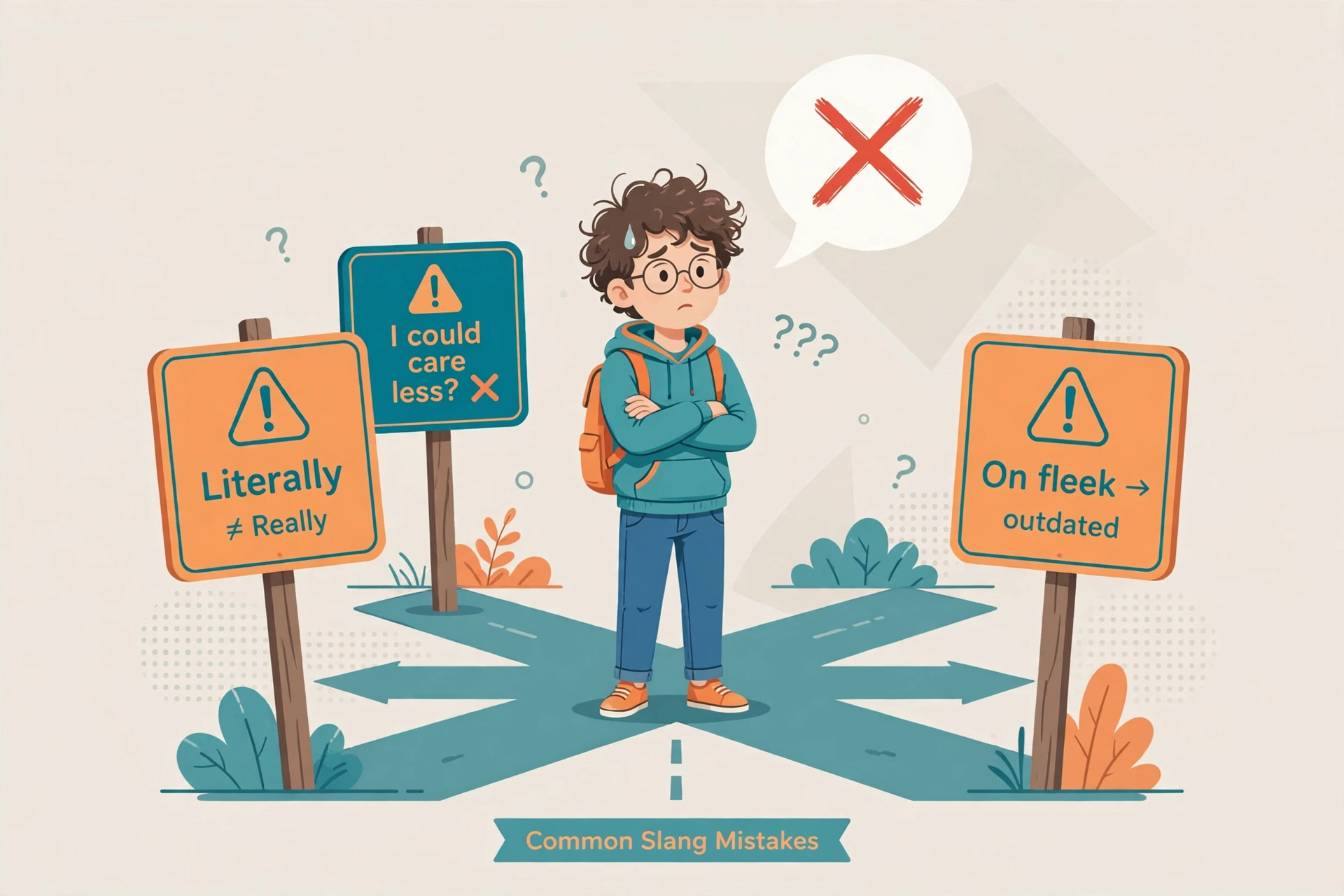
- Forcing slang to sound young. Nothing ages a person faster than loudly using slang that is already outdated. “Groovy” in 2026 is a joke; “on fleek” is a time capsule. If you have to try hard, it is not working.
- Using in-group slang from a group you are not part of. Some slang, particularly African American Vernacular English (AAVE) terms like “lit,” “woke,” “slay,” and “no cap,” carries cultural history. Using it respectfully is fine; using it as a costume is not. Listen first, and give credit where it is due.
- Overusing slang until nothing is clear. A sentence made entirely of slang (“no cap that fit is bussin, deadass slay”) is funny once and confusing twice. Slang works best as seasoning, not as the whole meal.
- Assuming slang means the same thing everywhere. Regional and generational differences are real. A word that is friendly in one place can be offensive in another. Check the context before you repeat what you heard.
Quick Tips
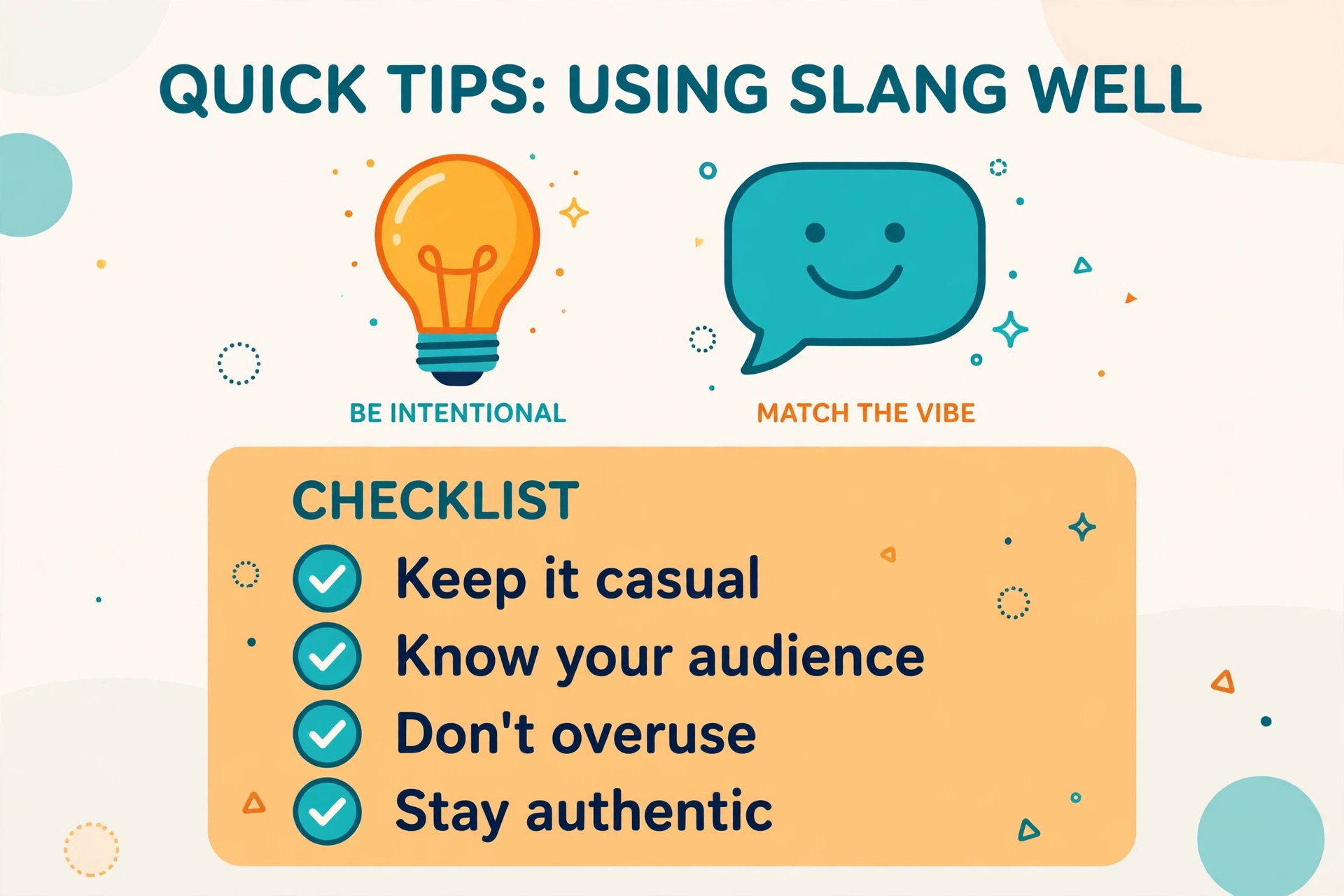
- Listen before you speak. Spend time in the group, chat, or community first. Notice which words people actually use — and which ones they laugh at.
- Learn one word at a time. Do not try to memorize a slang dictionary. Learn a word, use it naturally a few times, then move on.
- Check a slang dictionary when unsure. Sites like Urban Dictionary track new slang fast, and dictionaries like Merriam-Webster confirm when a word has gone mainstream. Cross-check before you trust a single source.
- Watch the tone, not just the word. The same slang word can be a compliment, a joke, or an insult depending on delivery. Tone is half the meaning.
- Keep slang out of formal writing. Resumes, cover letters, academic papers, and official emails should stay in standard English.
- Accept that slang expires. Words you love today will sound dated in two years. That is normal. Enjoy them while they are fresh, and let them go when they fade.
- Use slang to connect, not to impress. The best use of slang is making someone feel included. The worst use is showing off how current you think you are.
FAQ
What is slang in simple words?
Slang is informal language — casual words and phrases used by a particular group of people, like friends, teenagers, gamers, or a region. It is playful, fast-changing, and meant for casual conversation, not formal writing.
What is an example of slang?
Common examples include “lit” (exciting), “sus” (suspicious), “no cap” (no lie), “GOAT” (greatest of all time), “ghosting” (cutting off contact), and “slay” (doing something extremely well). Each one started in a specific group and spread through conversation and social media.
Why do people use slang?
People use slang to feel closer to their group, to add humor and personality, to communicate faster, and to express ideas that formal language handles clumsily. It signals identity and belonging — using the same slang as your friends says you are part of the same world.
Is slang bad English?
No. Slang is not bad English; it is informal English. Linguists consider slang a normal, creative part of how languages grow. It becomes a problem only when it is used in the wrong setting, like a formal essay or a job interview, where standard English is expected.
What is the difference between slang and jargon?
Slang is social and informal — it marks belonging to a group or generation. Jargon is the technical vocabulary of a profession, like medical or legal terms. Jargon is about work; slang is about identity and style.
How does slang change over time?
Slang changes because the groups that create it change. New words appear through social media, music, gaming, and youth culture, spread quickly, and then fade as the next word arrives. Some slang, like “cool,” survives long enough to enter the standard dictionary.
Can slang be used in formal writing?
Generally, no. Formal writing — academic essays, business emails, legal documents, and job applications — should use standard English. Slang in formal writing usually looks unprofessional and can confuse readers who do not share the same background.
Where can I learn new slang words?
Social media platforms like TikTok, X, Instagram, and Reddit are where new slang appears first. Urban Dictionary tracks it quickly, and mainstream dictionaries confirm it once it becomes widely used. The best method, though, is listening to how real people use words in real conversations.
Conclusion
So, what is slang? It is the living, breathing, playful side of English — the informal words and phrases that groups of people invent to talk to each other faster, warmer, and funnier. It began centuries ago as a secret code, grew through music, movies, and migration, and now spreads worldwide in a single viral video. It is not bad English, and it is not a fixed list of words. It is a habit of language: casual, creative, and constantly changing.
The practical takeaways are simple. Learn slang by listening first and using it second. Keep it in casual settings and out of formal ones. Respect where it comes from, especially when it comes from a culture that is not your own. And enjoy it — slang is proof that language belongs to everyone who speaks it, not just to textbooks and dictionaries. The next time a new word pops up in your group chat, you will know exactly what is happening: slang doing what it has always done, keeping conversation human.

1 thought on “What Is Slang? Meaning, Examples, and How It Works in Everyday Talk”