Quick definition: Roadman slang meaning is the informal street language of young people in London and other UK cities — a fast, punchy mix of Jamaican patois, Multicultural London English, and grime and drill culture. A “roadman” is a streetwise young man who lives that culture, and his slang is the vocabulary that comes with it: words like mandem, wagwan, peng, bare, and peak. If you have ever watched a UK drill video or a London TikTok skit and felt lost, this guide translates it all.
Roadman Slang Meaning & Definition
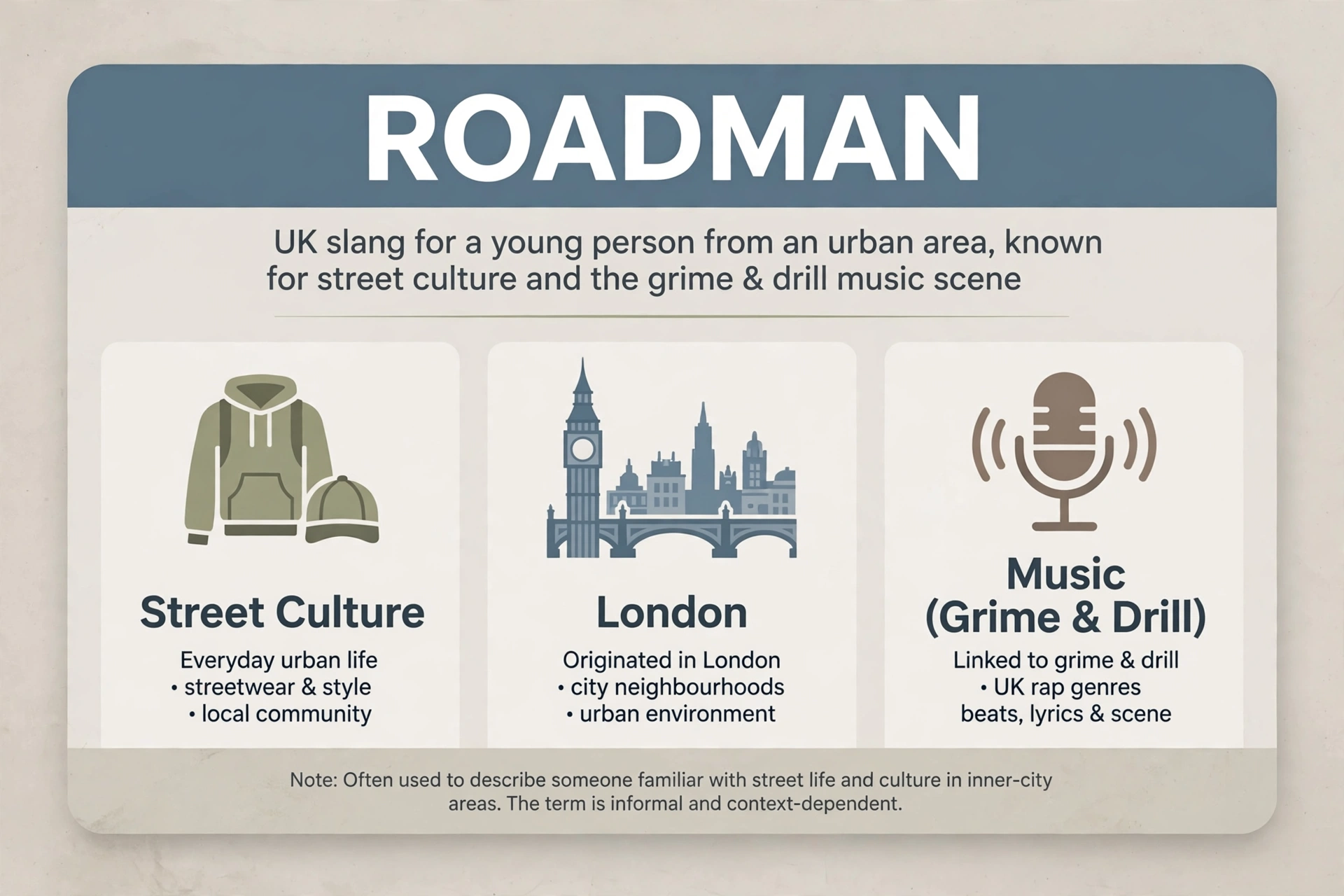
So, what is roadman slang exactly? At its simplest, roadman slang is the everyday vocabulary and way of speaking associated with UK street culture, especially in London. The word “roadman” itself describes a young man who is deeply connected to street life — someone who knows his area, his people, and the unwritten rules of the roads. The “road” here does not mean tarmac or a highway. In UK Black slang, documented since 1997, “road” means street life itself, and being “on road” means living it. As the writer Jeffrey Boakye puts it, a roadman is “a man who does Road.”
The slang is not a single fixed dialect. It pulls from several sources at once: Jamaican patois, West African languages such as Igbo and Yoruba (through British Nigerian and Ghanaian communities), Multicultural London English (MLE), and older British slang that has been reused and given new life. Linguists call MLE a multiethnolect — a dialect that belongs to a genuinely mixed community rather than any single group. It has been formally studied since the mid-2000s, most notably by sociolinguists at Queen Mary University of London, whose research shows roadman slang is not lazy or broken English. It is a rule-governed, creative way of speaking with its own grammar, rhythm, and logic.
It is also important to know that “roadman” carries more than one shade of meaning. In casual conversation it often just means a streetwise young guy with a particular style — tracksuit, puffer jacket, crossbody bag, Air Max trainers — and a particular way of talking. In a narrower sense it can mean someone actively involved in street-level hustling or gang life, a sense recorded by both Collins and the Oxford English Dictionary. And in its oldest, literal sense, a roadman is simply a man who builds or repairs roads, a use that has been in print since the early 1900s. Context decides which meaning is in play, and most of the time, when people say “roadman slang,” they mean the language, the look, and the culture — not a job title.
Introduction
Picture this: you open TikTok and a London teenager looks into the camera and says, “Wagwan, mandem, man’s got bare peng tings at ends, but it’s peak still, you get me?” The comments are full of laughing emojis and people quoting the lines back. If you are from the United States, or even from outside London, that sentence might as well be another language. It is not, quite — it is English, just English that has been remixed by the streets of London over thirty years.
Roadman slang has travelled a long way from the estates and youth clubs where it started. Grime music carried it onto the radio in the 2000s. UK drill took it global in the 2010s. Then TikTok turned it into a meme format, with “roadman” skits racking up millions of views and Americans filming themselves trying to guess what words like “peng” and “dench” mean. Today, roadman slang shows up in TV shows, adverts, football chants, and everyday conversation far beyond London. Understanding it is not just about learning a few funny words — it is about understanding a real, living dialect and the culture that created it.
This guide covers the full picture: the roadman slang meaning, where it came from, the most common words with real examples, how it compares to similar slang, the mistakes people make when they try to use it, and polite alternatives for formal settings. By the end, you will be able to follow a roadman conversation without subtitles — and you will know exactly when not to try speaking it yourself.
Origin
Roadman slang was born in London in the 1990s and early 2000s, in the city’s multicultural inner-city communities. The biggest influence was Jamaican patois. London has had a large Jamaican and Jamaican-heritage community since the Windrush generation arrived from the late 1940s, and Jamaican words have been flowing into London street speech for decades. Words like mandem (your group of friends), wagwan (what is going on), and ting (a thing, or an attractive person) all trace back to Jamaican English. The word-building pattern itself is Jamaican too: take a role or a place and add “man,” the same pattern behind “wasteman.”
The second influence was the mix of languages in London’s estates. Young Londoners growing up side by side — Caribbean, West African, South Asian, white working-class — blended words from each other’s homes into one shared street language. Linguists call the result Multicultural London English, and roadman slang is its most famous street-level form. Cockney, the old East London dialect, contributed its own share as well, though MLE has now largely replaced Cockney among young Londoners.
Music did the rest. Grime, which exploded out of East London in the early 2000s with artists like Dizzee Rascal, Wiley, and Skepta, put roadman speech on records and on the radio. UK drill followed in the 2010s and carried it worldwide. The word “roadman” itself is older than its paper trail suggests: researchers were describing London road culture by 2008, the earliest dated slang use found so far is a 2015 Urban Dictionary entry, Green’s Dictionary of Slang records print citations from 2017, and the Oxford English Dictionary added the slang sense in a 2026 revision. No single person coined it — it grew organically, the way real slang always does.
Popularity
Roadman slang is popular for three reasons: music, memes, and migration. Grime and drill made the vocabulary cool far beyond London. When Stormzy or Dave drops a line full of roadman slang, millions of listeners learn the words whether they live in London or not. The slang then spreads through football culture, streetwear, and social media, where a single viral TikTok can teach a word to a whole generation overnight.
TikTok deserves special mention. “Roadman” skits — usually a comedian performing an exaggerated roadman accent and vocabulary — are one of the platform’s most reliable formats. Americans guessing UK slang words is another. These videos are funny, and they have made words like “peng,” “wagwan,” and “mandem” recognisable around the world. But there is a serious side to the popularity too: researchers have pointed out that parody videos can flatten a genuine, working-class dialect into a stereotype. The slang is real speech for real people, not just a comedy accent.
The slang has also spread across the UK. London remains its home, but Birmingham, Manchester, and Liverpool each have their own local twists. Birmingham roadman slang, for example, mixes in words from the city’s own Caribbean and South Asian communities. What started as a London sound is now a national youth vocabulary, and it keeps growing — new words appear every year through music and social media, while older words fade or go mainstream.
How It Is Used
Roadman slang is used the way any informal language is used: between friends, in group chats, on social media, in song lyrics, and in casual face-to-face conversation. It is fast, economical, and expressive. A single word often does the work of a whole sentence. “Peak” means something is bad or unfortunate. “Bare” means a lot of something. “Safe” can mean thank you, goodbye, or “that’s fine.” Tone and context do the heavy lifting — the same word can be friendly, funny, or dismissive depending on how it is said.
The slang also works as identity. Speaking it signals belonging: you are from the ends, you know the culture, you are part of the mandem. That is why outsiders imitating it can land badly. Used by someone who grew up with it, it is natural. Used as a joke by someone performing a stereotype, it can come across as mocking. The safest approach for a learner is to understand it, enjoy it, and use it sparingly — if at all — unless you are genuinely part of the community that speaks it.
Here is a quick cheat sheet of the most common roadman slang words you will hear:
| Word | Meaning | Example |
|---|---|---|
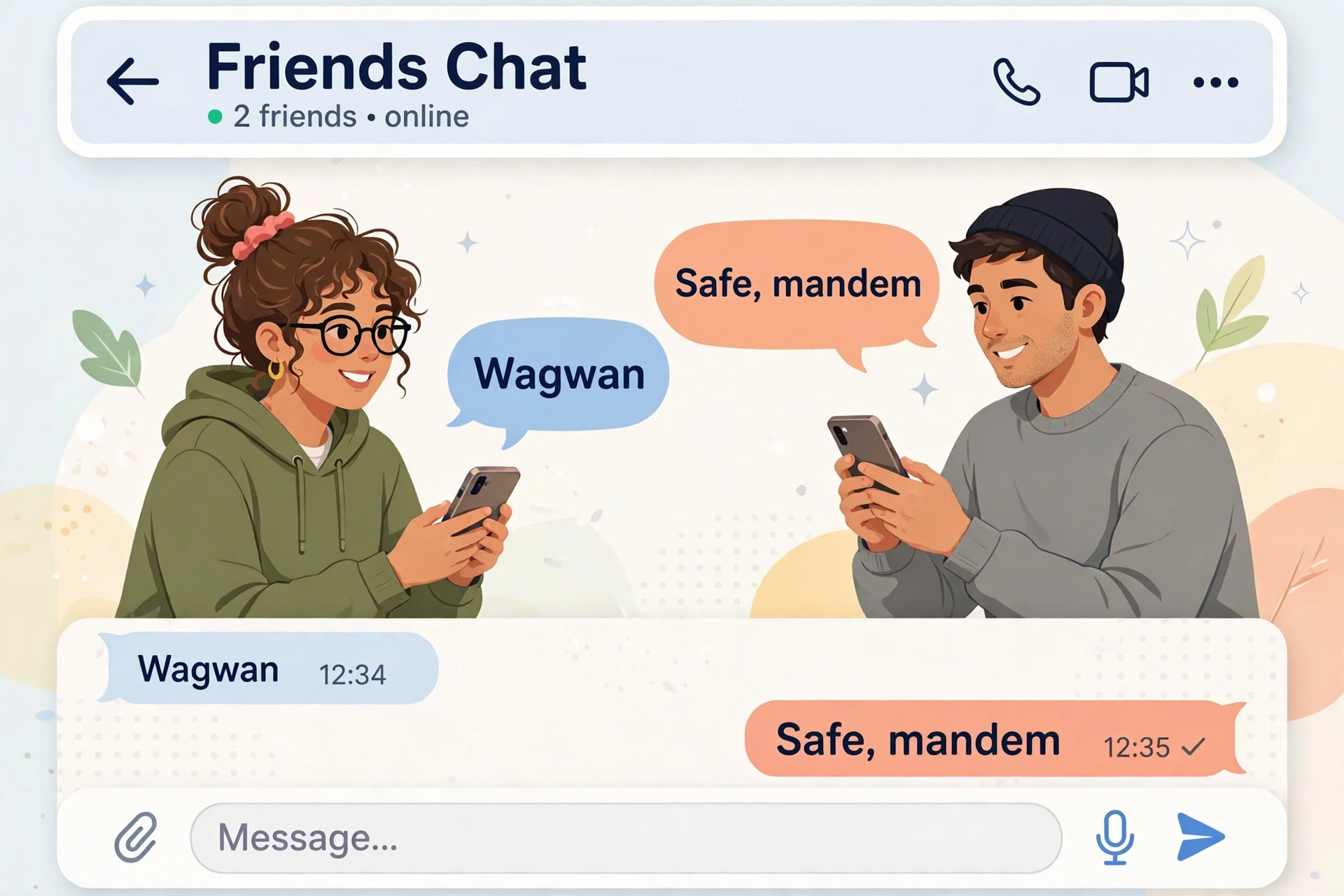
| Wagwan | What’s going on? / Hello | “Wagwan, you good?” |
| Mandem | Your group of male friends; the guys | “I’m linking the mandem later.” |
| Peng | Attractive, excellent, top quality | “That jacket is peng.” |
| Bare | A lot of; very many | “There were bare people at the party.” |
| Peak | Bad, unfortunate, unlucky | “I missed my train — peak.” |
| Ends | Your neighbourhood or home area | “I’m back in my ends tonight.” |
| Safe | Thank you / OK / Goodbye | “Safe for the lift, bro.” |
| Innit | Isn’t it? / Right? (tag question) | “It’s cold today, innit?” |
| Dench | Cool, impressive, attractive | “That tune is dench.” |
| Gassed | Excited, hyped up | “I’m gassed for the match.” |
| Allow it | Forget it / leave it alone | “Allow it, man, it’s not worth it.” |
| Creps | Trainers / sneakers | “Nice creps, where’d you get them?” |
Notice how few of these words have exact one-word translations in standard English. “Peak” is not quite “bad,” “peng” is not quite “attractive,” and “safe” is not quite “thanks.” Each carries a flavour — a mix of approval, solidarity, and understatement — that only makes full sense inside the culture.
Examples
The best way to learn roadman slang is to see it in real sentences. Here are examples across friendly, professional, and funny contexts, with translations so nothing is lost.
Friendly Examples
- “Wagwan, my guy — you coming ends later?” — “Hey, what’s up, my friend — are you coming to my area later?” A warm, everyday greeting between friends.
- “Safe for helping me move, you’re a real one.” — “Thanks for helping me move, you’re a genuine friend.” Safe as a thank you is one of the most common roadman phrases.
- “Link the mandem, we’re going to the match.” — “Meet up with the guys, we’re going to the game.” Link means to meet up.
- “That food was peng, I’m gassed.” — “That food was amazing, I’m so excited/happy.” Pure enthusiasm.
- “Calm, don’t worry about it.” — “It’s fine, don’t worry about it.” Calm is the roadman way of saying “no problem.”
Professional Examples
Roadman slang is informal by nature, so it rarely belongs in professional settings. But it does appear in creative industries, music, media, and youth work, where code-switching is normal:
- “The track needs to sound road, you get me?” — A producer telling an artist the song should sound authentically street. In a studio, this is normal professional shorthand.
- “We’re linking the youth team at ends on Friday.” — A youth worker telling colleagues they are meeting the local young people on Friday. The slang marks trust and familiarity with the community.
- “That campaign was peak — we need a rethink.” — A creative team member saying the campaign went badly. Even in offices, “peak” has slipped into mainstream British workplace slang.
- “Bare people turned up to the launch.” — “A huge crowd came to the launch.” Bare meaning “a lot of” is now used far beyond roadman circles.
Funny Examples (if applicable)
- “Man’s got one crep on and it’s raining — peak, innit?” — “I’ve only got one trainer on and it’s raining — that’s unfortunate, right?” The self-pity is the joke.
- “He thought he was peng, then the mandem started laughing.” — “He thought he looked great, then his friends started laughing at him.” Instant humbling.
- “My mum said ‘wagwan’ to my friends and everyone went silent.” — A parent trying roadman slang is a classic comedy moment, because the words belong to a specific generation and scene.
- “Allow the gym, man’s going to Nando’s.” — “Forget the gym, I’m going to Nando’s.” Priorities, roadman style.
The pattern in every example is the same: short sentences, heavy use of man as a pronoun (“man’s going” means “I’m going”), and words that pack attitude into a syllable or two. If you are learning the slang, start by recognising it, not by performing it.
Comparison with Similar Terms
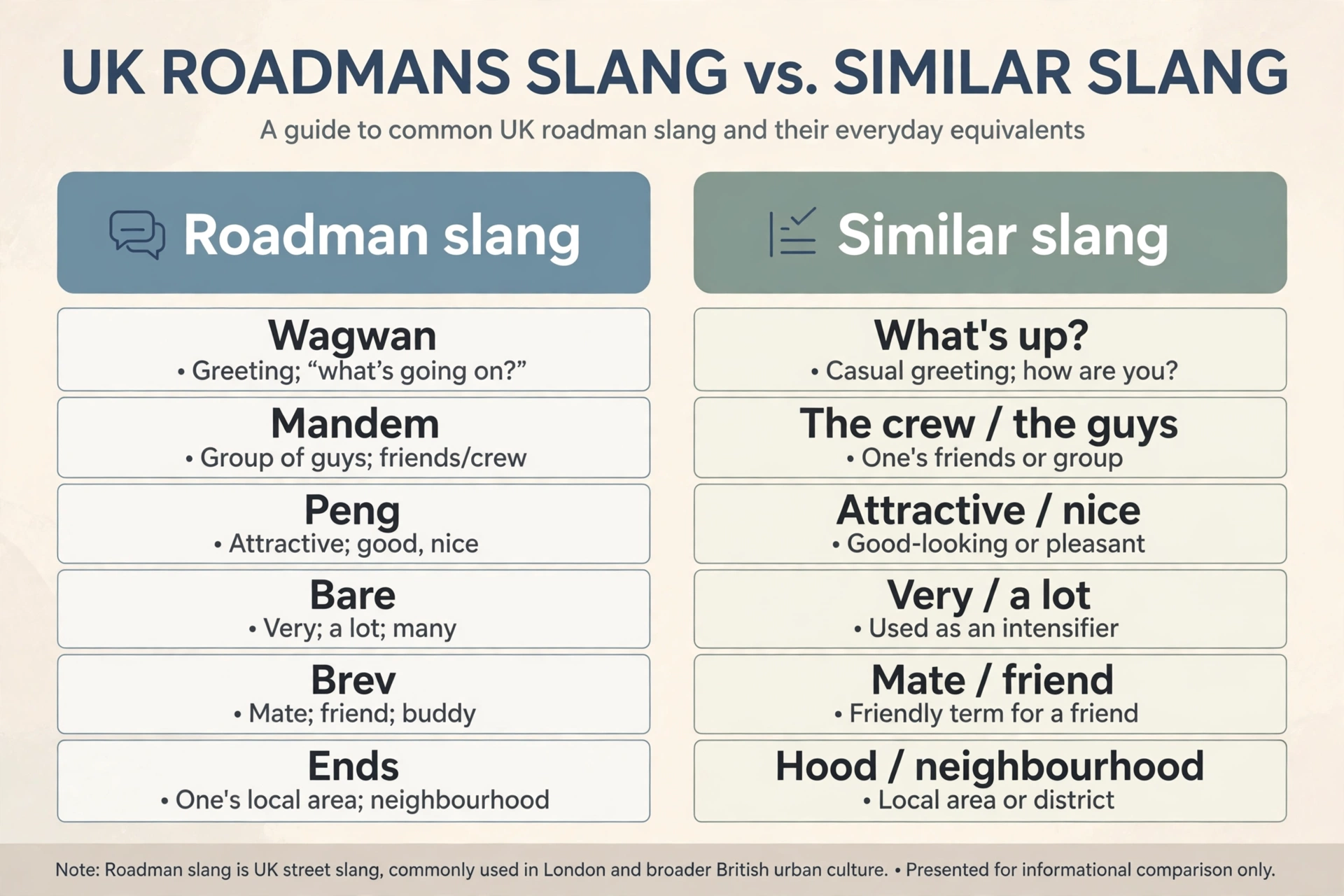
Roadman slang is often confused with other kinds of slang. Here is how it compares to its closest relatives, so you can tell them apart.
| Term | What it is | Key difference from roadman slang |
|---|---|---|
| Roadman slang | London street vocabulary rooted in Jamaican patois and MLE | The reference point: youth street culture, grime and drill |
| Multicultural London English (MLE) | The wider dialect roadman slang sits inside | MLE is the full dialect (grammar, accent, vocabulary); roadman slang is mainly its vocabulary and attitude |
| Cockney rhyming slang | Traditional East London slang (e.g. “apples and pears” = stairs) | Much older, mostly white working-class roots, and fading among young Londoners; roadman slang is its multicultural successor |
| UK drill slang | The vocabulary of drill music lyrics | Heavily overlaps with roadman slang, but drill slang is darker and more specific to lyrics about street life and rivalry |
| Gen Z internet slang | Online slang like “slay,” “no cap,” “rizz” | Mostly American and internet-born; roadman slang is British and street-born, though the two now mix on TikTok |
| Chav slang | Slang associated with a white working-class stereotype | A different subculture with different roots; “chav” is also widely considered an insult, while “roadman” is more often worn with pride |
The most useful comparison is with MLE. Think of MLE as the language and roadman slang as the attitude. A person can speak MLE without being a roadman — teachers, nurses, and office workers in London speak MLE every day. But when the vocabulary, the fashion, the music taste, and the street attitude all come together, that is the roadman package. The slang is the most visible part of it, which is why it travels so far beyond the people who live it.
Alternate Meanings
“Roadman” is not a one-meaning word. Here are the alternate meanings you should know, so you never get caught out by context:
- The street persona (most common): A streetwise young man immersed in UK urban culture — the look, the talk, the music. Neutral, admiring, or mocking depending on who says it and how.
- The harder shade: Someone actively “on road,” meaning involved in street-level dealing or gang life. This is the sense the Oxford English Dictionary and Collins record, and it is the sense to be careful with — calling someone a roadman in this sense is a serious claim.
- The meme and the look: On TikTok and YouTube, “roadman” often means the caricature: the tracksuit, the accent, the catchphrases, performed for laughs. This version is a costume, not a person.
- The literal job: A man who builds or repairs roads. Still standard in some places and the original meaning of the compound. If a 1920s newspaper mentions a roadman, it means a road worker.
- “Roadman slang” as a phrase: Sometimes the whole phrase just means “London street slang” in general, used by people who have never met a roadman. In that loose sense it covers any current UK youth slang.
When you hear the word, ask yourself: is this about language, about a person, about a joke, or about a job? Nine times out of ten, it is about the language or the culture.
Professional or Polite Alternatives
Roadman slang is wonderful in casual conversation and wrong in formal settings. Here is how to say the same things in standard English when the situation calls for it:
| Roadman slang | Polite / professional alternative |
|---|---|
| “Wagwan” | “Hello, how are you?” |
| “Safe” (thanks) | “Thank you very much.” |
| “Bare people” | “A large number of people” |
| “That’s peak” | “That’s unfortunate” |
| “Allow it” | “Let’s leave it there” / “Never mind” |
| “I’m gassed” | “I’m very excited” |
| “Link the mandem” | “Meet up with my friends” |
| “That’s peng” | “That’s excellent” / “That looks great” |
| “Calm” | “That’s fine” / “No problem” |
| “Innit?” | “Isn’t that right?” / “Don’t you agree?” |
The rule is simple: use roadman slang with friends, in music, and in casual online spaces. In a job interview, a formal email, an exam, or a first meeting with someone important, switch to standard English. Code-switching — moving between the two — is a skill, and people who grow up with roadman slang are usually very good at it.
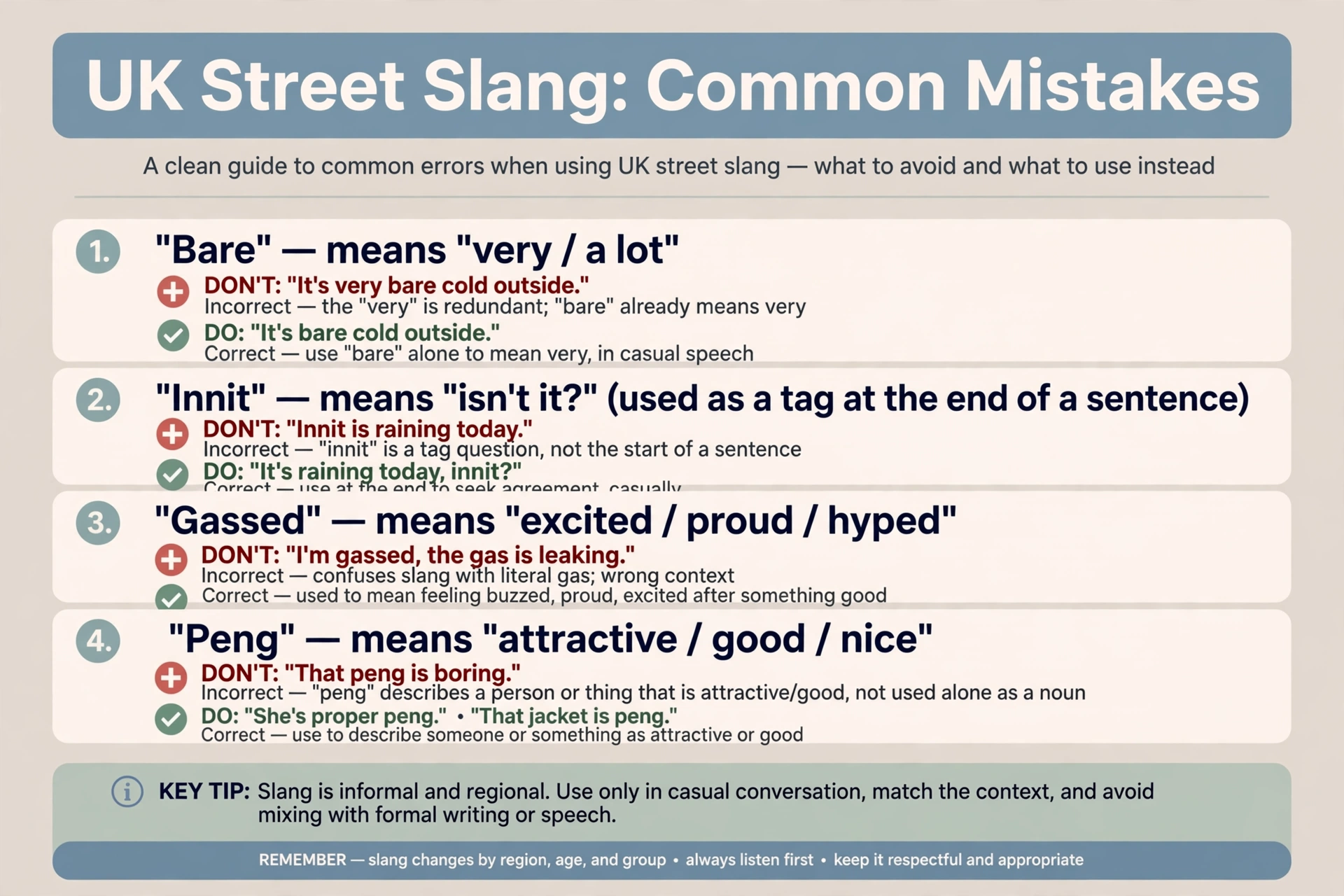
Common Mistakes
Most mistakes with roadman slang come from using it in the wrong place, the wrong way, or with the wrong confidence. Here are the ones to avoid:
- Using it as a costume: Putting on a roadman accent and vocabulary to be funny at a party is the biggest mistake. For the people who speak it, it is not a joke voice — it is how they talk. Imitation reads as mockery.
- Getting “peak” backwards: New learners often think “peak” means something great, because in standard English a peak is the top. In roadman slang, “peak” means bad or unfortunate. Saying “that’s peak” about something you love is the opposite of what you mean.
- Overusing “innit”: “Innit” is a tag question, not a full stop. Ending every sentence with it sounds like a parody, not like a person. Real speakers use it sparingly, where standard English would use “isn’t it?” or “right?”
- Mixing up “mandem” and “man dem”: “Mandem” means your group of friends. Using it to address a stranger, or to mean one person, is wrong. One friend is not “the mandem.”
- Using the hard sense lightly: Calling someone a roadman can imply involvement in street crime, not just a fashion sense. Do not label real people with it unless you know what you are saying.
- Forcing it into formal writing: Roadman slang in a school essay, a CV, or a business email looks unprofessional and can confuse readers. Keep it in casual settings where it belongs.
- Assuming every Londoner speaks it: London is a huge, diverse city. Plenty of Londoners never use roadman slang, and assuming they do is a stereotype, not an observation.
Quick Tips
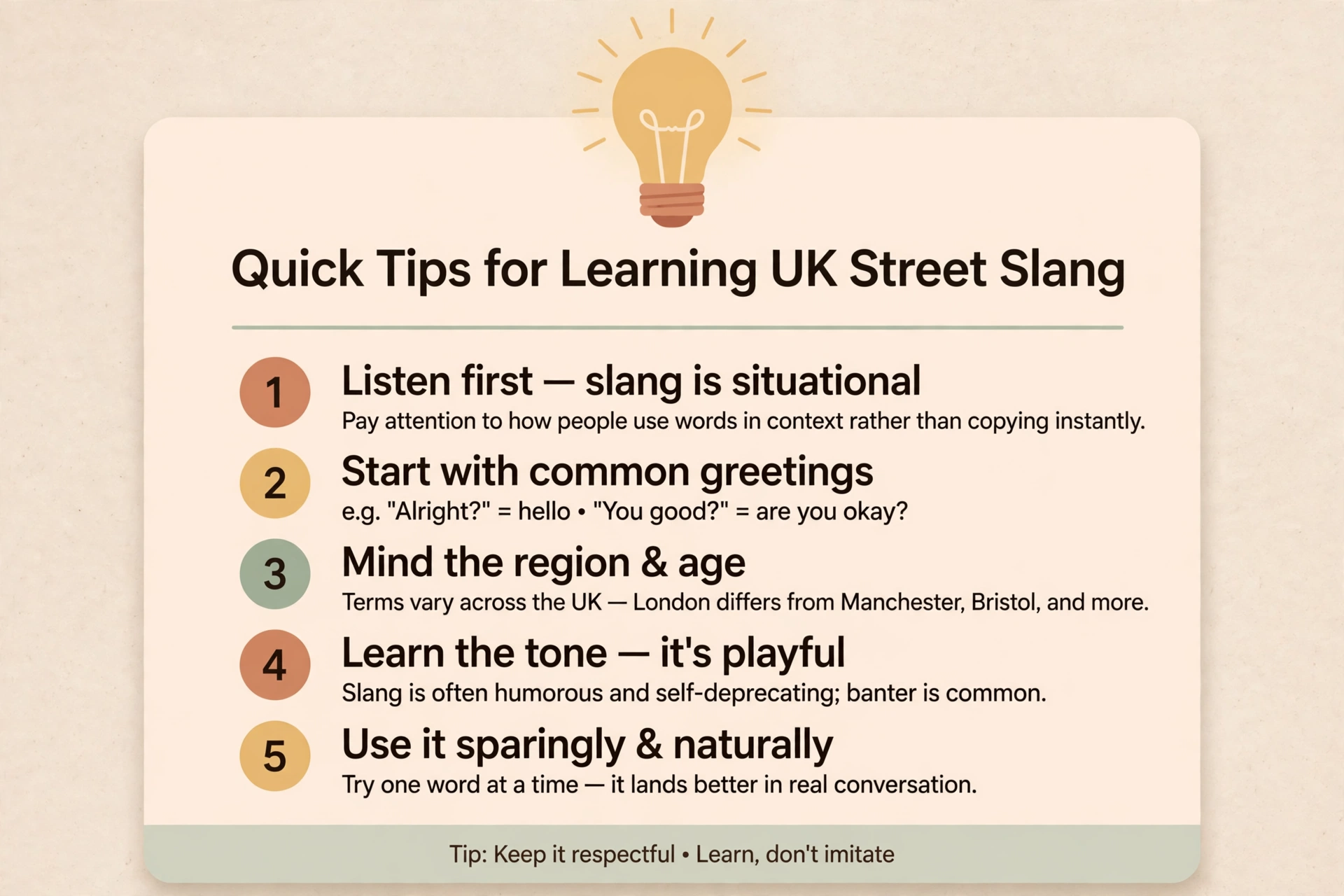
- Listen first, speak second: Spend time listening to grime, drill, and London creators before you try using any of the words. Your ear needs to learn the rhythm before your mouth does.
- Learn the top ten, then stop: Wagwan, mandem, peng, bare, peak, ends, safe, innit, gassed, and allow it will cover almost every conversation. You do not need the whole dictionary.
- Watch the context: If your friends are using roadman slang, you can join in. If they are not, do not be the one who starts — it will feel forced.
- Do not fake the accent: The words are only half of it. A fake London street accent is immediately obvious and usually embarrassing. Speak the words in your own voice or not at all.
- Use TikTok as a classroom: Search for roadman slang explainers and “Americans guess UK slang” videos. They are entertaining and they teach the words in context, with real reactions.
- Respect the roots: Remember the slang comes from Black British and Caribbean communities. Using it with respect means crediting that, not treating it as a generic internet joke.
- Keep a translation habit: When you hear a new word, check it on Urban Dictionary or a slang dictionary before you repeat it. Some roadman words have meanings you would not guess, and a few are offensive in the wrong context.
- Know when to switch: The most fluent speakers code-switch constantly — roadman slang with friends, standard English at work. Copy that habit, not just the words.
FAQ
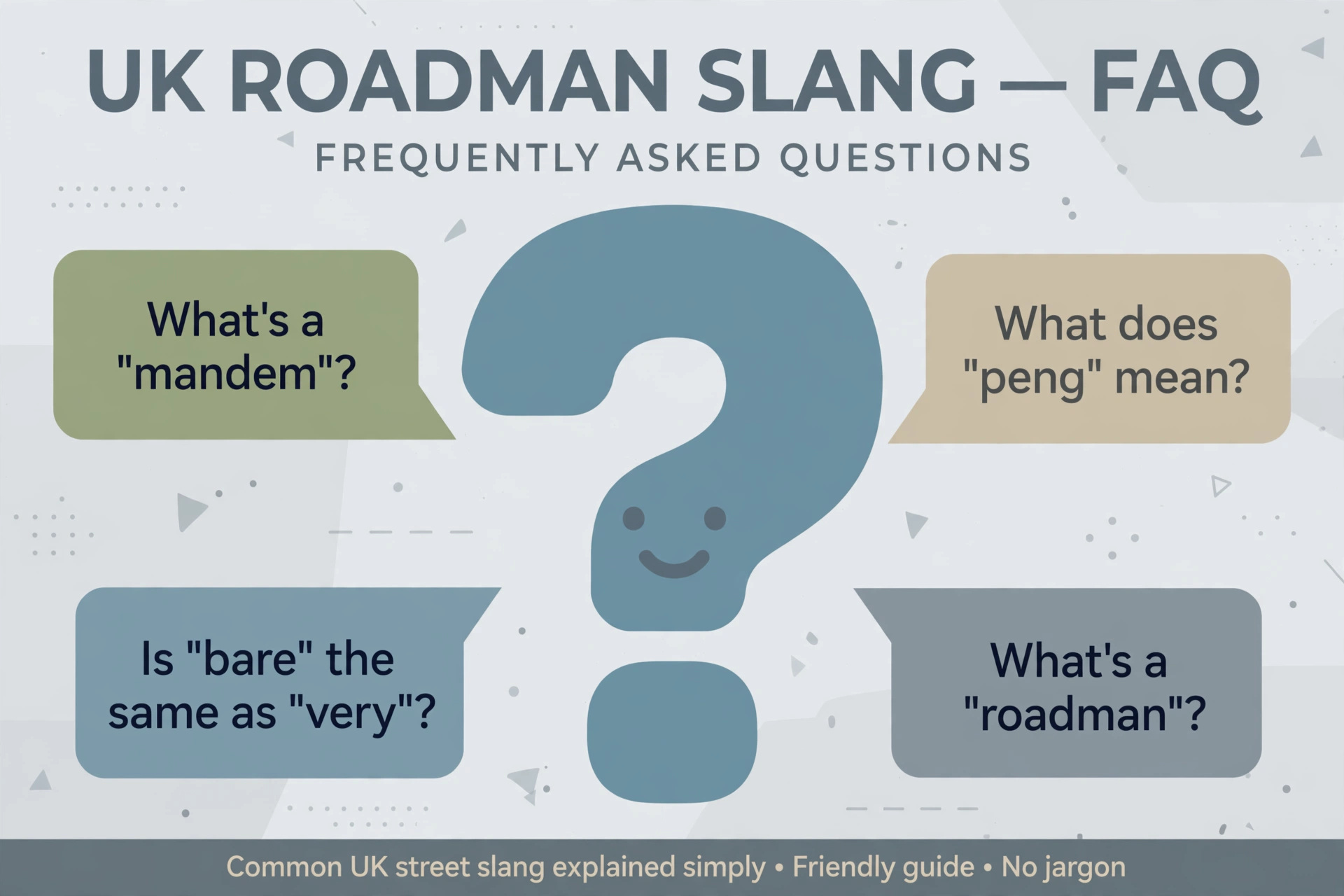
What does roadman slang mean?
Roadman slang is the informal street vocabulary of young people in London and other UK cities, drawn from Jamaican patois, Multicultural London English, and grime and drill culture. It includes words like mandem, wagwan, peng, bare, and peak, and it signals belonging to UK street culture.
What is a roadman in the UK?
A roadman is a streetwise young man deeply connected to UK urban street culture. In everyday use it usually means someone with a particular style and way of speaking. In a narrower sense it can mean someone actively involved in street life, a sense recorded by the Oxford English Dictionary.
Where did roadman slang come from?
It developed in London in the 1990s and early 2000s, growing out of Jamaican patois, West African languages, and Multicultural London English, and it spread through grime and UK drill music. The earliest dated slang use found so far is a 2015 Urban Dictionary entry.
What does “wagwan” mean?
“Wagwan” means “what’s going on?” and is used as a greeting, similar to “what’s up?” It comes from Jamaican patois (“what’s going on” shortened and reshaped) and is one of the most recognisable roadman slang words.
What does “mandem” mean?
“Mandem” means your group of male friends — “the guys” or “my crew.” It comes from Jamaican English, where “man” plus “dem” (them) builds a plural. You would say “I’m linking the mandem” to mean “I’m meeting up with my friends.”
Is roadman slang offensive?
The slang itself is not offensive — it is a real dialect spoken by real people. But using it to mock or stereotype Londoners, or putting on a fake roadman accent for laughs, can be offensive. The words are fine; the mockery is the problem.
What is the difference between roadman slang and Cockney?
Cockney is the traditional East London dialect, famous for rhyming slang, with mostly white working-class roots. Roadman slang is its multicultural successor, built from Jamaican patois, West African languages, and Multicultural London English, and spoken mainly by young Londoners of all backgrounds.
Can I use roadman slang if I’m not from London?
You can understand it and enjoy it from anywhere — the music and videos are global. But speaking it convincingly depends on context. If you are with friends who use it, joining in is fine. If you are performing it as a joke or using it to sound street, it will usually fall flat. Listen first, and use it sparingly.
Conclusion
Roadman slang is much more than a list of funny words. It is the voice of modern London — a living dialect built by Caribbean, African, South Asian, and white working-class communities, sharpened by grime and drill, and now heard around the world through TikTok and streaming. The roadman slang meaning is simple on the surface: streetwise language for streetwise life. Underneath, it carries history, identity, and pride.
The practical takeaways are straightforward. Learn the core words — wagwan, mandem, peng, bare, peak, ends, safe, innit — and you will understand most of what you hear. Remember that “peak” means bad, not good, and that “safe” can mean thank you. Keep the slang in casual settings and switch to standard English when the situation is formal. And above all, respect where it comes from: this is real speech from real communities, not a comedy accent to try on.
Next time a roadman skit pops up on your feed, or a drill lyric drops a word you have never heard, you will not need subtitles. You will know the meaning, the origin, and the culture behind it — and that is the whole point of learning a slang: not to perform it, but to understand the people who speak it. For more everyday British and internet slang, explore the rest of our guides on what slang really is, dodo meaning in slang, and fn meaning in text.
