
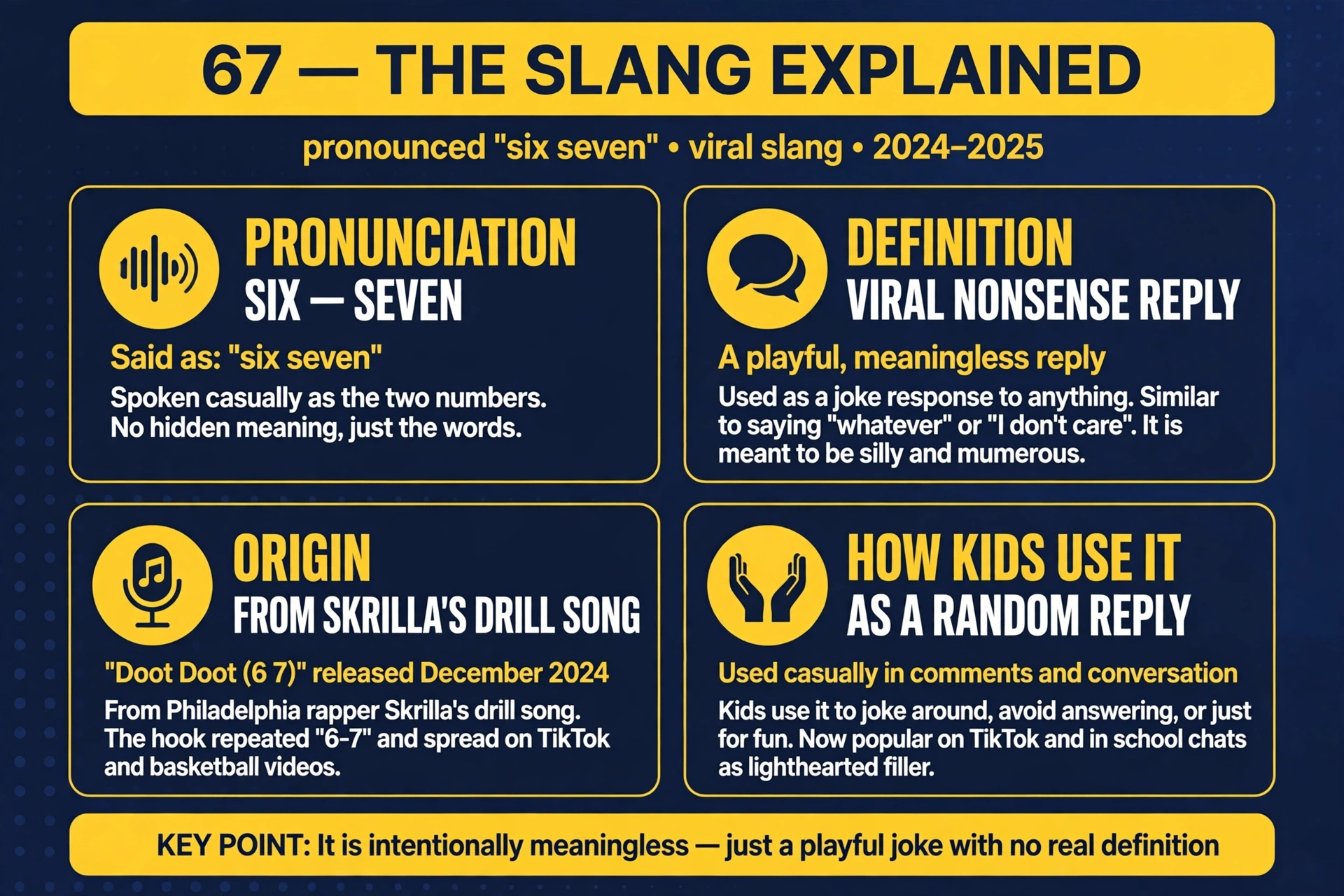
Quick definition: In slang, 67 (pronounced “six seven,” not “sixty-seven”) is a viral, deliberately nonsensical expression popular with Gen Alpha and young Gen Z. It comes from the drill song “Doot Doot (6 7)” by Skrilla, and it works as an all-purpose reply you can drop into almost any conversation — loosely meaning “so-so,” “whatever,” or nothing at all. The point is that it makes no sense, and that is the joke.
67 Meaning Slang & Definition
If you have spent any time around kids lately, you have heard it: a sudden, deadpan “six seven,” delivered with a slow up-and-down hand motion, in response to something that had absolutely nothing to do with numbers. A test score. What is for dinner. Whether it is raining outside. The answer is always “six seven.”
The 67 meaning slang phenomenon is one of the strangest viral language trends of the decade — a number with no real definition that somehow became one of the most repeated words in school hallways. Dictionary.com even named “67” the 2025 Word of the Year, while openly admitting the term is, in their words, impossible to define. As the dictionary put it, perhaps the most defining feature of 67 is that it has no definition at all.
So what does it actually mean? Here is the honest answer, broken down as simply as possible:
- 67 is a nonsense interjection. It is a number you can blurt out as a reply to almost anything, and it is correct every time because it means nothing specific.
- It loosely signals “so-so,” “eh,” or “whatever.” When kids pair it with the weighing-hand gesture — both palms up, alternating up and down like a scale — it works like a shrug: could go either way.
- It is “brainrot” slang. It belongs to the same internet culture family as sigma slang, skibidi, Ohio, and gyatt — intentionally silly, loopable, low-effort humor built for short video.
- It is a social signal. Saying it with the right timing, tone, and hand motion shows you are “in” on current Gen Alpha slang culture — and it confuses every adult in the room, which is half the fun.
The pronunciation matters: it is “six seven” (two separate numbers), never “sixty-seven.” Get that wrong in front of a ten-year-old and you have instantly revealed yourself as an outsider.
Introduction
Every generation gets the slang it deserves, and Gen Alpha has chosen numbers. Where millennials had “LOL” and Gen Z had “no cap,” today’s kids have “six seven” — two digits shouted with total confidence in response to absolutely nothing.
Ask a kid, “How was the test?” and you might get “Six seven,” with that slow weighing hand gesture. Ask, “What is 5 + 5?” and you might still get “Six seven” — deliberately, hilariously wrong. Ask how tall they are? “Six seven.” That mismatch is the entire joke: it is deliberately context-free, and the more wrong the answer, the funnier it is.
The 67 meaning slang trend exploded in late 2024 and 2025, jumping from TikTok sound edits into classrooms, sports celebrations, and eventually mainstream media coverage. Teachers banned it, parents Googled it, Dictionary.com crowned it — and kids kept shouting it anyway, because that cycle of adult confusion only makes it funnier.
In this guide, we will break down exactly where 67 came from, why it has no real definition (and why that is the point), how kids actually use it day to day, the famous hand gesture, how it compares to other brainrot slang like glizzy and mewing, and what parents and teachers should know about it.
Origin
Like most viral slang, 67 has a traceable birth certificate — even if the word itself means nothing. The story starts with music.
“Doot Doot (6 7)” by Skrilla is the source. Skrilla, a Philadelphia-based drill rapper, released the track in December 2024, and the hook repeats “6-7” as a chant. The song itself does not define the numbers — Skrilla has said he left the phrase intentionally undefined, which turned out to be a genius move. A term with no meaning can mean anything, so anyone can use it anywhere and be right.
From there, the spread followed the classic viral recipe:
- TikTok edits (late 2024): Short videos using “Doot Doot (6 7)” as the soundtrack began circulating. Editors paired the chant with basketball highlights, reaction clips, and comedy sketches, looping the “six seven” lyric until it lodged in everyone’s memory.
- The LaMelo Ball connection: Sports edits — especially basketball highlight reels — accelerated everything. The chant got paired with Charlotte Hornets guard LaMelo Ball, who stands exactly 6 feet 7 inches tall. Editors timed the lyric to emphasize height, giving the phrase a secondary, literal usage: in basketball contexts, “six seven” could just mean a very tall player.
- The “67 Kid”: Maverick Trevillian, nicknamed the “67 Kid,” helped push the slang mainstream when a YouTube clip of the boy shouting “67” at a youth basketball game went viral. Overtime Elite player Taylen “TK” Kinney amplified it further among young audiences.
- Mainstream sports adoption: The term jumped the fence into the larger sports world — NBA and WNBA coverage referenced it, NFL players used the gesture in touchdown celebrations, and stars like LeBron James and Paige Bueckers dropped it in interviews. Shaquille O’Neal appeared in a video referencing 67, joking that he has no idea what it means. (But really, who does?)
Many believe the numbers reference 67th Street in Chicago, a possible nod to Skrilla’s background — but the rapper himself has never confirmed a meaning, and Dictionary.com’s linguists concluded there is not one to find. The emptiness is the engine.
Popularity
By 2025, “six seven” had completed the full journey from TikTok sound to genuine cultural phenomenon. A few markers of how big it got:
- Dictionary.com’s 2025 Word of the Year: The dictionary’s Word of the Year award goes to a term that reflects “the social trends and global events that defined that year.” Previous winners include “demure.” In 2025, the honor went to a number with no definition — a first, and a perfect symbol of how internet humor works now.
- Merriam-Webster added it too: The dictionary published a dedicated entry for the slang usage of “six seven,” documenting its pronunciation, its murky meaning, and its song origins.
- National news coverage: Outlets from People to NPR to CBS News ran explainers for baffled parents, and parenting sites like FamilyEducation added it to their Gen Z/Gen Alpha slang guides.
- Classroom chaos: Teachers across the country reported it as one of the most disruptive classroom trends of the year — kids chanting it, doing the hand gesture, and derailing lessons. Some schools attempted to ban it, which, predictably, only increased its power.
- Mashup culture: It started fusing with other viral terms. Kids began saying “six-sendy” — a mashup of 67 and “get sendy” (action-sports slang for going all out) — combining two viral sports-centric terms at once. Other numbers followed: 41 emerged as a similar Gen Alpha number-slang trend.
The popularity follows a pattern researchers of internet culture know well: the term peaked exactly when adults started understanding it. The more explainers got published, the more it became “cringe” for older kids to say it — which is the natural lifecycle of brainrot slang. But like all good memes, it survives in classrooms and group chats long after the mainstream declares it over.
For a deeper look at how dictionaries track terms like this, Dictionary.com’s own write-up documents the journey from drill hook to Word of the Year in detail (dictionary.com/culture/slang/67).
How It Is Used
The beauty of 67 is its flexibility. Because it has no fixed definition, kids deploy it in a handful of recognizable patterns. Here are the main ones you will actually see in the wild:
- As a universal answer. “How tall are you?” “Six seven.” “What time is it?” “Six seven.” “Who is better, them or you?” “Six seven.” Any question works. The wrongness is the joke.
- Whenever the digits 6 and 7 appear. If a math problem, jersey number, or clock time includes 67, kids will exaggerate the reaction — chanting “six seven,” doing the gesture, turning it into a whole bit. Seeing “67” in the wild triggers the meme on sight.
- As a vibe check. With the balancing hand gesture, it loosely means “kinda mid,” “in the middle,” or “not sure.” It functions like a verbal shrug — a way to answer without committing.
- As punctuation. Dropped at the end of a sentence or video for emphasis, the way an earlier generation might have said “period” or “no cap.” It adds nothing and means nothing — and that is the humor.
- As a social signal. Using it correctly — the right timing, the slow drawl, the alternating hand motion — shows you are fluent in current youth culture. Getting it wrong (saying “sixty-seven,” doing the gesture too fast) marks you as an outsider instantly.
The delivery is half the meaning. The classic 67 hand gesture works like this: raise both hands, palms up, and slowly alternate them up and down, as if weighing two invisible objects on a scale. Say “six” on one hand’s rise and “seven” on the other. The motion reinforces the indifferent, “either way” energy of the word — it visually says “could go this way, could go that way, whatever.”
Importantly, there is no official rulebook. Dictionary.com’s own analysis concluded that “perhaps the most defining feature of 67 is that it is impossible to define” — so anyone who tells you there is one correct meaning is either joking or missing the point.
Examples
Here is how “67” shows up in real conversations, organized by tone. Notice that in almost every case, the response has nothing to do with the question — that is the entire point of the bit.
Friendly Examples
| Situation | Example |
|---|---|
| Friend asks how your day was | “Eh, six seven. Nothing crazy.” |
| Someone sends a meme in the group chat | “This is peak six seven energy 😭” |
| Deciding where to eat | “I am six seven on pizza or tacos, you pick.” (with the hand gesture) |
| Reacting to a friend’s basketball highlight | “SIX SEVEN 🔥” (commenting on a tall player’s dunk) |
Professional Examples
Here is the honest truth: 67 has no professional usage. Unlike slang that migrated from texts into workplaces (think “low-key” or “ping me”), “six seven” is firmly a youth-culture in-joke. Saying it in a meeting will not make you sound relatable — it will make you sound like you are doing a bit. The closest thing to a “professional” context is a teacher or coach referencing it knowingly to connect with students, and even then it works precisely because it is not professional language.
Funny Examples
- Parent: “What is 120 minus 53?” Kid, instantly: “67.” (It is actually 67. The one time the meme answer is also the math answer.)
- “How are you today?” “67.” “How tall are you?” “67.” “What is 120 minus 53?” “67.” — The Dictionary.com entry literally uses this three-question sequence as its example, because the repetition is the joke.
- A kid sees a “67” speed limit sign, jersey number, or price tag and starts chanting while doing the gesture, as if the universe itself is in on the meme.
- Someone asks you to meet at 6 or 7, and you yell “SIX SEVEN” as you bike away. (A real example from Reddit.)
- “Happy 6/7 to all of you parenting a child who incessantly says ‘six seven.'” (A real example from X — June 7th is now unofficially the meme’s holiday.)

Comparison with Similar Terms
67 sits inside a whole ecosystem of brainrot and number-based slang. Here is how it compares to the terms it gets confused with or mentioned alongside:
| Term | What it means | How it differs from 67 |
|---|---|---|
| 67 / six seven | Deliberately meaningless viral number from Skrilla’s “Doot Doot (6 7)” | The baseline — the most purely nonsensical of the bunch |
| 41 | Another viral Gen Alpha number-slang term | Same energy, smaller footprint — 67’s younger sibling |
| Skibidi | Nonsense word from the Skibidi Toilet web series | Also meaningless, but tied to a specific video series rather than a song |
| Ohio | “Only in Ohio” — slang for weird, cursed, surreal situations | Has an actual meaning (bizarre/cursed); 67 has none |
| Gyatt | Exclamation of attraction, from “goddamn” | Has a real meaning and a real context; 67 is context-free |
| Sigma | Cool, independent “lone wolf” type (often ironic) | Describes a person or vibe; 67 describes nothing at all |
| Six-sendy | Mashup of 67 + “get sendy” (go all out) | 67’s direct descendant — the meme breeding with other slang |
| Mid | Mediocre, average, unimpressive | Overlaps with 67’s “so-so” reading, but “mid” is a judgment; 67 is a shrug |
The key takeaway: almost every term in this table means something, even if that something is silly. 67 is the rare exception — a viral word whose entire identity is having no identity. That is why linguists find it fascinating and why kids find it hilarious.

Alternate Meanings
Because 67 has no official definition, people have assigned it plenty of unofficial ones. Here is a rundown of the alternate readings floating around:
- “So-so” / “whatever”: The most common folk definition, especially when paired with the weighing hand gesture. It functions as a non-committal “eh.”
- A height reference (6’7″): In basketball contexts, it genuinely refers to being six feet seven inches tall — LaMelo Ball’s listed height, and the reason the chant got paired with basketball highlights in the first place.
- 67th Street: Some listeners believe the numbers nod to 67th Street in Chicago and Skrilla’s background. This is fan theory, not confirmed by the artist.
- A math joke: Kids love that “67” occasionally produces genuinely correct answers (120 − 53 = 67), which fuels the “universal answer” bit.
- Nothing at all: The most honest definition, endorsed by Skrilla (who left it undefined on purpose), Dictionary.com (who called it impossible to define), and one tween TikToker’s widely quoted summary: “I think the point is that it makes no sense.”
One thing it is not: anything offensive. Despite parent-group rumors, 67 has no sexual, drug-related, or vulgar meaning. It is genuinely clean — just deliberately dumb.
Professional or Polite Alternatives
Since 67 has no fixed meaning, “replacing” it depends on which loose reading you intend. Here are natural alternatives for each situation where someone might drop a “six seven”:
| If you mean… | Say instead… |
|---|---|
| “So-so” / non-committal | “It’s alright,” “Could go either way,” “I’m on the fence” |
| “Whatever” / indifferent | “Doesn’t matter to me,” “Either works,” “Up to you” |
| A joke answer to a question | Just answer the question — or say “I have no idea” with a smile |
| Reacting to something funny online | “That’s hilarious,” “This is peak comedy,” “I’m crying 😭” |
In any formal setting — school presentations, job interviews, professional emails — simply do not use 67. It carries zero professional currency, and using it there reads as either a joke or a mistake. The polite alternative to “six seven” is just… normal words.
Common Mistakes
It is hard to “misuse” a word that means nothing — but people do it anyway. Here are the classic mistakes:
- Saying “sixty-seven” instead of “six seven.” The number one giveaway that you are not in on the joke. It is always two separate digits: six… seven.
- Doing the gesture wrong. The classic move is slow: one upturned palm rising while the other falls, alternating like a scale. Doing it fast, or with fists, or with one hand, looks off to anyone fluent in the meme.
- Insisting it has a deep meaning. Every few months someone goes viral claiming 67 is a secret code, a gang reference, or a hidden message. It is not. The artist left it undefined on purpose, and the dictionaries agree. The “real meaning” people are the meme’s favorite victims.
- Using it in serious conversations. Answering “six seven” when someone asks about something that actually matters — a grade, a health question, a real decision — does not read as funny. It reads as dismissive. Read the room.
- Overusing it until it is cringe. Brainrot slang has a shelf life, and nothing kills a meme faster than an adult saying it confidently at the dinner table. Kids retire terms the moment parents adopt them — use sparingly if you want to stay “in.”
- Spelling it “sixty seven” in text. In chats and comments it is written as “67,” “6 7,” or “six seven.” Writing it out as “sixty-seven” marks you as an outsider in text form, too.

Quick Tips
- For parents: Relax — 67 is harmless. It has no offensive meaning, and kids saying it are participating in normal social bonding, not rebellion. If it is disrupting homework time, treat it like any other distraction, not a crisis.
- For teachers: You are fighting a meme, and memes do not lose to bans. The most effective approach teachers report is simply not reacting — the bit dies without an audience. Some educators even use it as a teachable moment about how language and viral culture work.
- For anyone trying to understand Gen Alpha: 67 is a perfect case study in how this generation communicates — irony-first, video-native, and built around shared absurdity. Understanding it means understanding that sometimes the joke is that there is no joke.
- Pronunciation: “Six seven.” Two beats. Slow drawl optional but encouraged.
- The gesture: Palms up, alternating up and down like a weighing scale. Slow is key — rushing it ruins the effect.
- When to use it: Casual hangouts, group chats, reacting to memes, sports highlights, and any moment where a deliberately wrong answer is funnier than the right one.
- When NOT to use it: Class presentations, talking to authority figures about real topics, job interviews, and anywhere the answer actually matters.
- Want to sound fluent? The advanced move is the “six-sendy” mashup — combining 67 with “get sendy” (go all out). It signals you are not just repeating the meme, you are remixing it.


FAQ
What does 67 mean in slang?
In slang, 67 (pronounced “six seven”) is a deliberately nonsensical viral expression popular with Gen Alpha. It comes from Skrilla’s drill song “Doot Doot (6 7)” and works as an all-purpose reply that loosely means “so-so” or “whatever” — or nothing at all. The lack of a fixed meaning is the entire joke.
Where did the 67 slang come from?
It originated from the song “Doot Doot (6 7)” by Philadelphia rapper Skrilla, released in December 2024. It spread on TikTok through basketball highlight edits featuring LaMelo Ball (who is 6’7″ tall), then exploded when a viral clip of a boy nicknamed the “67 Kid” shouting it at a youth basketball game took off in early 2025.
Why is it pronounced “six seven” and not “sixty-seven”?
Because the slang treats the digits as two separate numbers, matching how the hook is chanted in Skrilla’s song. Saying “sixty-seven” is the classic outsider mistake — kids will instantly know you are not in on the joke.
What is the 67 hand gesture?
The gesture involves raising both hands palms-up and slowly alternating them up and down, as if weighing two objects on a scale. It is usually done while saying “six seven” in a slow drawl. The motion reinforces the word’s indifferent, “could go either way” energy.
Is 67 appropriate for kids to say?
Yes. Despite parent-group rumors, 67 has no offensive, sexual, or drug-related meaning. It is genuinely clean nonsense used as a social bonding signal among kids. Teachers find it disruptive in classrooms, but it carries no harmful connotation whatsoever.
Why was 67 named Dictionary.com’s 2025 Word of the Year?
Dictionary.com awards Word of the Year to the term that best reflects the year’s social trends and cultural story. In 2025, that was “67” — a number with no definition that dominated youth culture, sports celebrations, and classrooms. The dictionary openly admitted the term is impossible to define, making it a perfect symbol of internet-age humor.
Does 67 mean anything in basketball?
Sometimes, yes — contextually. In basketball edits and commentary, “six seven” can literally refer to a player who is 6 feet 7 inches tall, like LaMelo Ball. That literal usage is actually part of how the meme spread: editors timed the song’s chant to emphasize tall players’ height.
Is 67 still popular, or is it over?
Like all brainrot slang, it follows a lifecycle: it peaks when adults start understanding it, then older kids begin calling it “cringe” — but it survives for a long time in classrooms, group chats, and meme pages. Mashups like “six-sendy” and spin-offs like “41” show the format is still evolving. Whether it is “over” depends entirely on which hallway you ask in.
Conclusion
The 67 meaning slang story is really a story about how language works in the internet age. A Philadelphia drill rapper chanted two numbers without defining them. TikTok editors paired the chant with basketball highlights. A kid yelled it at a youth game. And within months, a meaningless number became Dictionary.com’s Word of the Year — the first number ever to take the title.
What makes 67 fascinating is not what it means, but what its meaninglessness reveals: Gen Alpha communicates through shared absurdity, irony, and in-jokes that deliberately exclude adults. The hand gesture, the slow drawl, the deliberately wrong answers — they are all social glue, a way of saying “we are in this together” without saying anything at all.
So the next time someone hits you with a deadpan “six seven” — palms up, alternating like a scale — you will know exactly what is happening. They are not answering your question. They are inviting you into the joke. Whether you join in or just smile and move on is up to you, but now you are fluent either way.
Want to decode more of the terms floating around the same group chats? Check out our guides to Gen Alpha slang, sigma slang, mewing, and glizzy — the whole brainrot cluster, explained.

1 thought on “67 Meaning Slang: Why Gen Alpha Can’t Stop Saying “Six Seven””