
Quick Definition: 2020 slang is the collection of informal words and phrases that exploded in popularity during 2020 — the year of lockdowns, TikTok’s rise, and the Among Us boom. Words like simp, bussin, no cap, and sus went from niche internet jokes to everyday speech in a matter of months, and many of them are still part of how we talk online today.
2020 Slang Meaning & Definition
2020 slang means the casual vocabulary that defined how people — mostly Gen Z and young millennials — spoke in 2020. It was not a formal language and it was never written down in one place. Instead, it was a fast-moving set of words that spread through TikTok videos, Twitch streams, Twitter threads, and group chats, then spilled into classrooms, workplaces, and even the news.
What made 2020 slang different from the slang of any year before it was speed and scale. In 2020, the whole world was stuck at home, and everyone was online at the same time. A word could be born in a single viral video on Monday, appear in millions of comments by Friday, and become a headline by the next month. That is why a guide to 2020 slang is really a snapshot of a strange, unforgettable year: the words that survived long enough to matter, the ones everyone recognised, and the ones that still make sense today.
At its core, 2020 slang did three jobs. It showed belonging — using the right word told a group you were one of them. It saved time — one short word could carry a whole attitude. And it made serious things feel lighter, which mattered a lot in a year when the news was heavy almost every single day.
Introduction
If you lived through 2020, you heard its slang whether you wanted to or not. Your group chat was full of it. Your For You Page was full of it. Even your parents probably asked you what “simp” meant at some point. The year gave us a lockdown, a pandemic, a US election, and a cultural reset — and it also gave us a whole new vocabulary that still shapes how people talk on the internet in 2026.
Think back to March 2020. Schools closed, offices went remote, and screen time exploded. TikTok went from a niche app to the centre of youth culture. Among Us turned “sus” into the most repeated word on the planet. Twitch streamers turned “simp” into a running joke so big that some chats banned the word entirely. And through it all, African American Vernacular English (AAVE) kept supplying the raw material — bussin, cap, no cap, and slay all have roots in Black culture long before they went mainstream.
This guide covers the 25 biggest 2020 slang words, what each one means, where it came from, and how to use it without sounding like you are trying too hard. Whether you are decoding an old group chat, writing a caption, or just trying to understand what your teenager is saying, this is the complete 2020 slang dictionary.

Origin
Most 2020 slang did not actually start in 2020. That is the first thing to understand. Words like simp, cap, and bussin had been around for years — sometimes decades — in AAVE, hip-hop lyrics, and regional speech. What changed in 2020 was the amplifier: TikTok, Twitch, and a world stuck indoors gave these words a global stage almost overnight.
Take simp. The word is a clipping of “simpleton”, and it appeared in print as far back as 1903. It floated around hip-hop and internet forums for years. Then in late 2019 and early 2020, TikTok creators and Twitch streamers started using it constantly — jokingly calling each other simps, banning the word in chats, and turning it into a meme. By mid-2020, “simp” was one of the most Googled slang words in the United States.
Bussin followed a similar path. It comes from AAVE, where it described food that was extremely good. In 2020, TikTok food videos pushed it everywhere — suddenly every burger, taco, and plate of mac and cheese was “bussin”. Cap and no cap also come from AAVE and hip-hop, where “cap” meant a lie. Rappers had used it for years, but 2020 was the year it became a default part of online speech, often paired with a cap emoji 🧢.
Then there were the words that really were born in 2020. Sus — short for suspicious or suspect — exploded because of Among Us, the social deduction game that became a lockdown phenomenon. Every meeting in the game was an argument about who was “sus”, and the word leaked into real life within weeks. Hits different also took off in 2020, describing something that felt stronger or more emotional than usual — usually a song, a memory, or a late-night snack.
The origin story of 2020 slang is really the origin story of the pandemic internet: a year when everyone was online, bored, anxious, and looking for connection — and new words were the fastest way to feel connected.
Popularity
By the end of 2020, its slang was unavoidable. Google searches for “simp meaning”, “bussin meaning”, and “no cap meaning” spiked to all-time highs. The words showed up in brand marketing, in TV shows, in news articles explaining Gen Z to confused parents, and even in classrooms, where teachers had to decide whether “no cap” counted as acceptable in an essay (it did not).
Several things made 2020 the perfect year for slang to go viral. First, TikTok’s user base exploded during lockdown, and the app’s algorithm could push a single video — and a single word — to tens of millions of people in a day. Second, gaming boomed: Among Us went from a forgotten 2018 release to one of the most played games in the world, and its vocabulary became everyone’s vocabulary. Third, celebrities and influencers adopted the words, which pushed them from niche communities into the mainstream.
The popularity was not just American, either. Because 2020 was a global lockdown year, the same words spread to the UK, Canada, Australia, and beyond at the same time. A teenager in London and a teenager in Los Angeles were suddenly using the exact same words to describe the exact same things — something that had never really happened before at that speed.
Of course, popularity has a price. By 2021, some 2020 words already felt dated. Saying “simp” unironically in 2024 could get you laughed at. But the best of them stuck around. No cap, bussin, sus, and slay are still in daily use in 2026, and they have earned permanent places in the online dictionary. That is the real test of slang: not whether it trends, but whether it survives.
How It Is Used
2020 slang was used in three main places: text messages and group chats, social media captions and comments, and spoken conversation — especially among friends. The tone was almost always casual. These were not words for job interviews or formal emails. They were words for reacting fast, joking with friends, and showing you were in on the joke.
Most 2020 slang words work as reactions. Something tastes amazing? “Bussin.” Someone is lying? “That’s cap.” You want to stress that you are telling the truth? Add “no cap” to the end of your sentence. Someone is acting shady in a game or in real life? “That’s sus.” The words are short, punchy, and they do the work of a whole sentence.
They also worked as labels. Calling someone a “simp” was a playful insult — a way to tease a friend who was trying too hard to impress a crush. Calling an outfit “drip” was a compliment. Saying a party “hits different” was a way of saying it felt special, usually with a hint of nostalgia. The labels were flexible, and context decided the exact meaning — which is true of almost all slang.
One thing that made 2020 slang tricky for outsiders was how fast meanings shifted. A word could start as a joke, become a compliment, and end up as an insult within months. The safest way to use these words is to watch how people around you use them first, then copy the tone — not just the word.
Examples
Here are the 25 most important 2020 slang words, with their meanings and real examples. If you only remember five of them, make it simp, bussin, no cap, sus, and slay — those were the big five of the year.
| 2020 Slang Word | Meaning | Example |
|---|---|---|
| Simp | Someone who tries way too hard to impress a crush | “He bought her lunch again — total simp move.” |
| Bussin | Really good, usually about food | “These tacos are bussin, no cap.” |
| No cap | No lie, I’m telling the truth | “That was the best pizza ever, no cap.” |
| Cap | A lie, something untrue | “That’s cap, you never met Drake.” |
| Sus | Suspicious, shady, acting weird | “He’s been quiet all game — that’s sus.” |
| Slay | To do something flawlessly or look amazing | “She slayed that presentation.” |
| Hits different | Feels stronger or more special than usual | “This song hits different at 2 a.m.” |
| Drip | Stylish clothes, great fashion sense | “Check the drip on that jacket.” |
| Tea | Gossip, juicy news | “Spill the tea, what happened?” |
| Woke | Aware of social and political issues | “Stay woke, read the full story.” |
| Stan | An obsessed, devoted fan | “I stan that band so hard.” |
| Flex | To show off, usually wealth or success | “He’s just flexing his new car.” |
| GOAT | Greatest of all time | “Serena is the GOAT, no debate.” |
| Lit | Exciting, amazing, fun | “That party was lit.” |
| Lowkey | Secretly, quietly, kind of | “I lowkey love that song.” |
| Highkey | Obviously, openly, very much | “I highkey need a nap.” |
| Vibe | A feeling, atmosphere, or mood | “This place has a chill vibe.” |
| Yeet | To throw something with force, or an excited yes | “He yeeted the ball across the field.” |
| Fire | Excellent, amazing | “That new album is straight fire.” |
| Bet | Okay, agreed, for sure | “You coming tonight?” “Bet.” |
| Shook | Shocked, surprised | “I was shook when I heard the news.” |
| Big yikes | Very awkward or embarrassing | “He texted his ex by accident — big yikes.” |
| Rent free | Stuck in your head, living there without paying | “That song lives rent free in my head.” |
| Main character | Acting like the star of your own story | “She’s in her main character era.” |
| It is what it is | Accepting something you cannot change | “We lost the game. It is what it is.” |
Friendly Examples
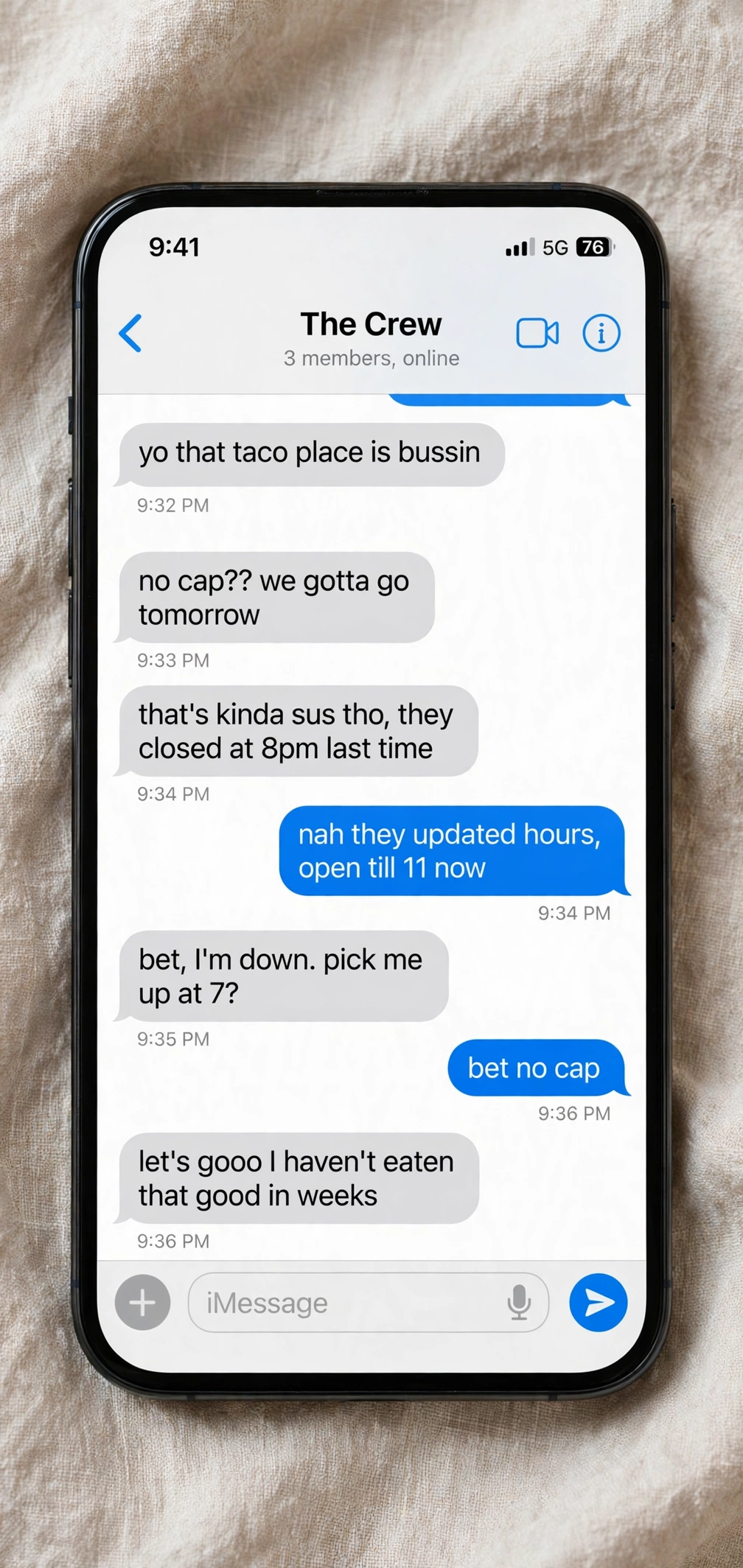
In friendly chats, 2020 slang was warm and playful. Friends used it to hype each other up, joke around, and react in real time. “No cap, you looked amazing last night” is a compliment. “This food is bussin, we have to come back here” is a shared happy moment. “Bro, you are a whole vibe today” is the kind of thing you text your best friend before a night out.
The friendly tone is the default for most of these words. Slay, fire, lit, and drip are all compliments when used with friends. Even “simp” was usually friendly teasing between people who knew each other well — “stop simping over her, she liked your story once” lands as a joke, not an attack, when it comes from a friend.
Professional Examples
Here is the honest truth: almost none of 2020 slang belongs in a professional setting. You would not write “no cap” in a work email or call a client “sus” in a meeting. But the words did show up in professional-adjacent places — marketing, social media management, and youth-focused brands used them constantly to sound relatable.
If you work in social media or marketing, the professional way to use 2020 slang is in captions and ads aimed at a young audience — and sparingly. One “no cap” in a caption can feel authentic; five in a row feels like a brand trying too hard. And in the office itself, keep it to casual conversation with coworkers you know well. “That launch was fire” is fine at the coffee machine. It is not fine in a board report.
Funny Examples
2020 slang was funniest when it collided with real life. “My Wi-Fi is sus” became a lockdown joke. “This quarantine snack hits different” was funny because it was true — everything hit different in 2020, especially at 2 a.m. “I am not a simp, I am just a supportive king” became a meme format on its own. And “the audacity” paired with tea-spilling gossip made for endless group chat drama.
The humour came from exaggeration. Calling a slightly good sandwich “bussin” is funny because it is dramatic. Calling your friend “sus” for taking too long to reply is funny because it treats a normal text like a murder mystery. That is the secret of slang humour: it takes something small and treats it like something huge.
Comparison with Similar Terms
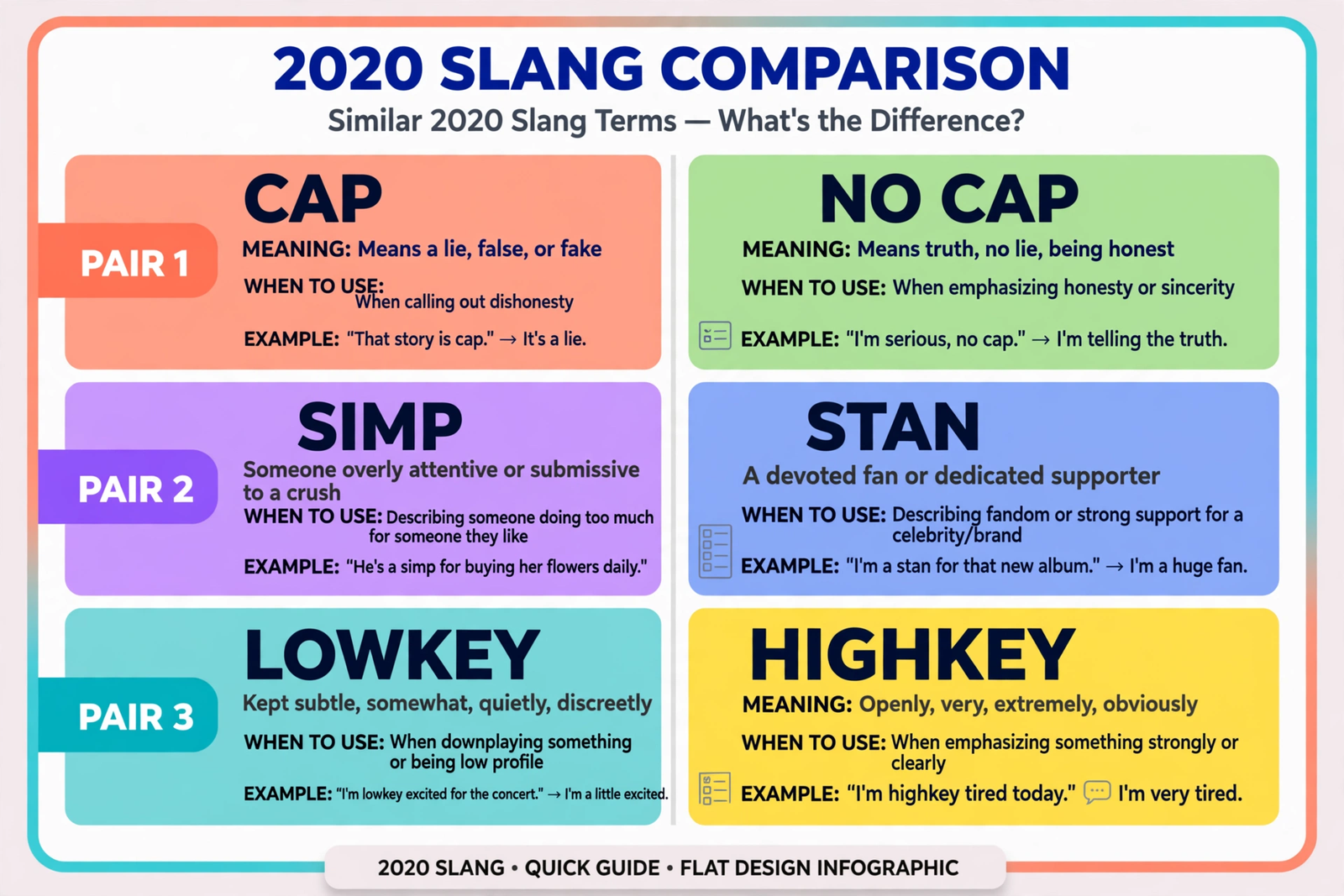
Some 2020 slang words look alike but mean different things, and mixing them up is the fastest way to sound confused. The most common mix-up is cap vs. no cap: they are exact opposites. “Cap” means a lie, while “no cap” means the truth. Saying “no cap, that’s cap” actually makes sense — it means “honestly, that is a lie.”
Simp and stan are another pair people confuse. A simp tries too hard to impress someone they like romantically, usually without getting anything back. A stan is a superfan — devoted, sometimes obsessive, but about a celebrity, a band, or a show, not a crush. You can stan a singer and simp over a classmate, and those are two very different situations.
Lowkey and highkey are also opposites that get mixed up. Lowkey means secretly or a little bit — “I lowkey like that song” means you like it but you are not shouting about it. Highkey means openly and very much — “I highkey need a vacation” means you really, really need one. And sus vs. shook: sus means suspicious, shook means shocked. Your friend can be sus and you can be shook about it, but the words are not interchangeable.
| Term A | Term B | Difference |
|---|---|---|
| Cap | No cap | Cap = a lie. No cap = the truth. Exact opposites. |
| Simp | Stan | Simp = trying too hard for a crush. Stan = devoted fan of a celebrity. |
| Lowkey | Highkey | Lowkey = secretly, a little. Highkey = openly, very much. |
| Sus | Shook | Sus = suspicious. Shook = shocked or surprised. |
| Bussin | Fire | Bussin = usually about food. Fire = good about almost anything. |
| Drip | Flex | Drip = great style. Flex = showing off what you have. |
| Tea | Shade | Tea = gossip. Shade = a subtle insult. |
| Lit | Vibe | Lit = exciting event. Vibe = the feeling or atmosphere. |
Alternate Meanings
Almost every 2020 slang word has more than one meaning, and context decides which one applies. Cap is a good example: in everyday English, a cap is a hat. In 2020 slang, cap is a lie. The cap emoji 🧢 became the visual shorthand — if someone replies to your story with just a cap emoji, they are calling it a lie.
Tea is another one. Outside slang, tea is a drink. In 2020 slang, tea is gossip — “spill the tea” means tell me the gossip. The “T” in tea originally stood for “truth” in drag culture, which is where the phrase comes from. Drip normally means water falling, but in slang it means style. Fire normally means flames, but in slang it means something excellent.
Sus also has a life outside slang — it is short for “suspect” or “suspicious” in police language, and it appeared in British slang long before Among Us. Stan comes from Eminem’s 2000 song “Stan”, about an obsessed fan, and it took twenty years to become everyday slang. GOAT is the animal, but in slang it is the greatest of all time — Muhammad Ali was calling himself the greatest long before the internet turned it into an acronym.
Even 2020 slang itself can mean two different things. It can mean the slang words that were popular in 2020, which is what this guide covers. Or it can mean the slang of the whole 2020s decade — words like rizz, sigma, and skibidi that came later. If someone says “2020 slang” and then mentions “rizz”, they probably mean the decade, not the year. When in doubt, ask which year they mean — it saves a confusing conversation.
Professional or Polite Alternatives
2020 slang is fun, but it is not always appropriate. Here are polite, professional alternatives you can use when the situation calls for it:
- Instead of “no cap”: say “honestly”, “to be frank”, or “in all seriousness”.
- Instead of “that’s cap”: say “that is not accurate” or “I do not think that is true”.
- Instead of “bussin”: say “delicious”, “excellent”, or “really good”.
- Instead of “sus”: say “suspicious”, “questionable”, or “that seems off”.
- Instead of “slay”: say “did an excellent job” or “looked wonderful”.
- Instead of “simp”: say “he is very attentive to her” — or just do not label people at all.
- Instead of “drip”: say “great style” or “well-dressed”.
- Instead of “tea”: say “news”, “update”, or “the full story”.
- Instead of “lit”: say “exciting”, “wonderful”, or “a great time”.
- Instead of “hits different”: say “it feels more meaningful” or “it resonates more”.
The rule is simple: use slang with friends, use plain language at work and in formal settings. Knowing both versions is the real skill — it means you can switch codes depending on who you are talking to, which is exactly what fluent speakers do.
Common Mistakes
The biggest mistake people make with 2020 slang is using it too much, too loudly, and in the wrong place. One “no cap” in a sentence is natural. Three in one sentence sounds like a parody. Slang works best when it is sprinkled in, not poured on.
The second mistake is using words without knowing their roots. Many 2020 slang words come from AAVE, and using them while mocking the accent or culture they came from is disrespectful. Enjoy the words, credit the culture, and do not turn them into a joke about the people who created them.
The third mistake is getting the meaning wrong. Calling something “bussin” when it is a movie, not food, will get you corrected — bussin is mostly about food, even though people stretch it. Calling someone a “simp” for being nice to their girlfriend is a stretch too — simping means over-the-top, one-sided effort, not basic kindness. And using “sus” to mean “suspicious” about a person is fine, but using it to mean “suspicious” about a math problem is a joke, not a real use.
The fourth mistake is using 2020 slang to sound young when you are not. Teenagers can spot a forced “no cap” from a mile away. If the word does not come naturally to you, it is better to say what you mean in plain words than to force slang that does not fit. Authenticity beats trendiness every time.
Finally, do not use slang in serious situations. Telling someone “no cap, I am sorry for your loss” is not comforting — it is confusing. Slang is for casual, light moments. Serious moments deserve serious words.

Quick Tips
- Learn the big five first: simp, bussin, no cap, sus, and slay cover most 2020 conversations. Master those before learning the rest.
- Watch before you speak: see how your friends use a word for a week before you try it yourself. Context is everything.
- One slang word per sentence is enough: stacking three or four sounds forced. Natural speakers use slang lightly.
- Know the origin: most 2020 slang comes from AAVE, hip-hop, gaming, or TikTok. Knowing the roots helps you use words correctly and respectfully.
- Check the year: rizz, sigma, and skibidi are not 2020 slang — they came later. Do not mix decades.
- Use it in text first: slang is easier to practise in chats, where you can see how people react, than in spoken conversation.
- Keep it casual: never use 2020 slang in job applications, formal emails, or serious conversations.
- When in doubt, ask: “what does that mean?” is always better than pretending you know and getting it wrong.

FAQ
What does 2020 slang mean?
2020 slang means the informal words and phrases that became popular in 2020, mostly through TikTok, Twitch, and gaming. The biggest ones were simp, bussin, no cap, cap, sus, slay, and hits different. Many came from AAVE and hip-hop, while others — like sus — exploded because of the game Among Us during lockdown.
What is the most popular 2020 slang word?
Simp was the most searched 2020 slang word, followed closely by bussin and no cap. Simp was a meme, a joke, and a genuine insult all at once, which is why it spread so fast. Sus was the most used in everyday speech because of Among Us, where every game was full of accusations about who was sus.
What does simp mean in 2020 slang?
A simp is someone who tries way too hard to impress a person they like, usually without getting the same energy back — liking every post, buying gifts, and doing favours nonstop. The word comes from “simpleton” and exploded on TikTok and Twitch in 2019–2020. It is mostly used as playful teasing between friends, but it can be an insult too.
What does bussin mean in 2020 slang?
Bussin means really good, almost always about food. “These tacos are bussin” means the tacos are amazing. The word comes from AAVE and spread through TikTok food videos in 2020. It can stretch to music or outfits, but food is its home turf — if you call a movie bussin, people will probably laugh.
What does no cap mean in 2020 slang?
No cap means “no lie” or “I am telling the truth”. You add it after a statement to stress that you are being serious: “That was the best concert ever, no cap.” Its opposite is “cap”, which means a lie. Both come from AAVE and hip-hop, and the cap emoji 🧢 became the visual symbol for calling something a lie.
Is 2020 slang still used today?
Yes, some of it is. No cap, bussin, sus, slay, and drip are still in daily use in 2026, years after they peaked. Others, like simp, sound dated now and mostly show up as jokes or nostalgia. Slang always has a lifecycle: a few words survive and become permanent, while most fade away within a year or two.
Where did 2020 slang come from?
Most 2020 slang came from three places: AAVE and hip-hop culture (simp, bussin, cap, no cap, slay), gaming and streaming (sus from Among Us, simp from Twitch chats), and TikTok, which took words from both and pushed them to a global audience in weeks. The lockdown year meant everyone was online at the same time, which made the spread faster than ever before.
How can I learn 2020 slang without sounding cringe?
Start with the big five — simp, bussin, no cap, sus, slay — and use them lightly, one per sentence at most. Watch how people around you use them before trying them yourself, and keep them in casual chats, not at work. The goal is not to sound young; it is to understand what people mean. Understanding comes first, using them comes second.

Conclusion
2020 slang was more than a list of funny words. It was the language of a year when the whole world went online at once — a year of lockdowns, viral videos, and group chats that never slept. Words like simp, bussin, no cap, and sus gave people a fast, funny way to react, connect, and cope, and the best of them are still with us in 2026.
The key takeaway is simple: 2020 slang is a snapshot, not a rulebook. Learn what the words mean, respect where they came from — especially the AAVE roots behind so many of them — and use them lightly, in the right place, with the right people. If you want to go deeper, check out our guides to no cap meaning, sus meaning, and slay meaning, plus our full Gen Z slang 2024 guide for the words that came next.
For a broader look at how these terms fit into the slang of the whole decade, the Glossary of 2020s slang on Wikipedia is a solid reference. And the next time someone texts you “no cap, this is bussin”, you will know exactly what they mean — no cap.
