
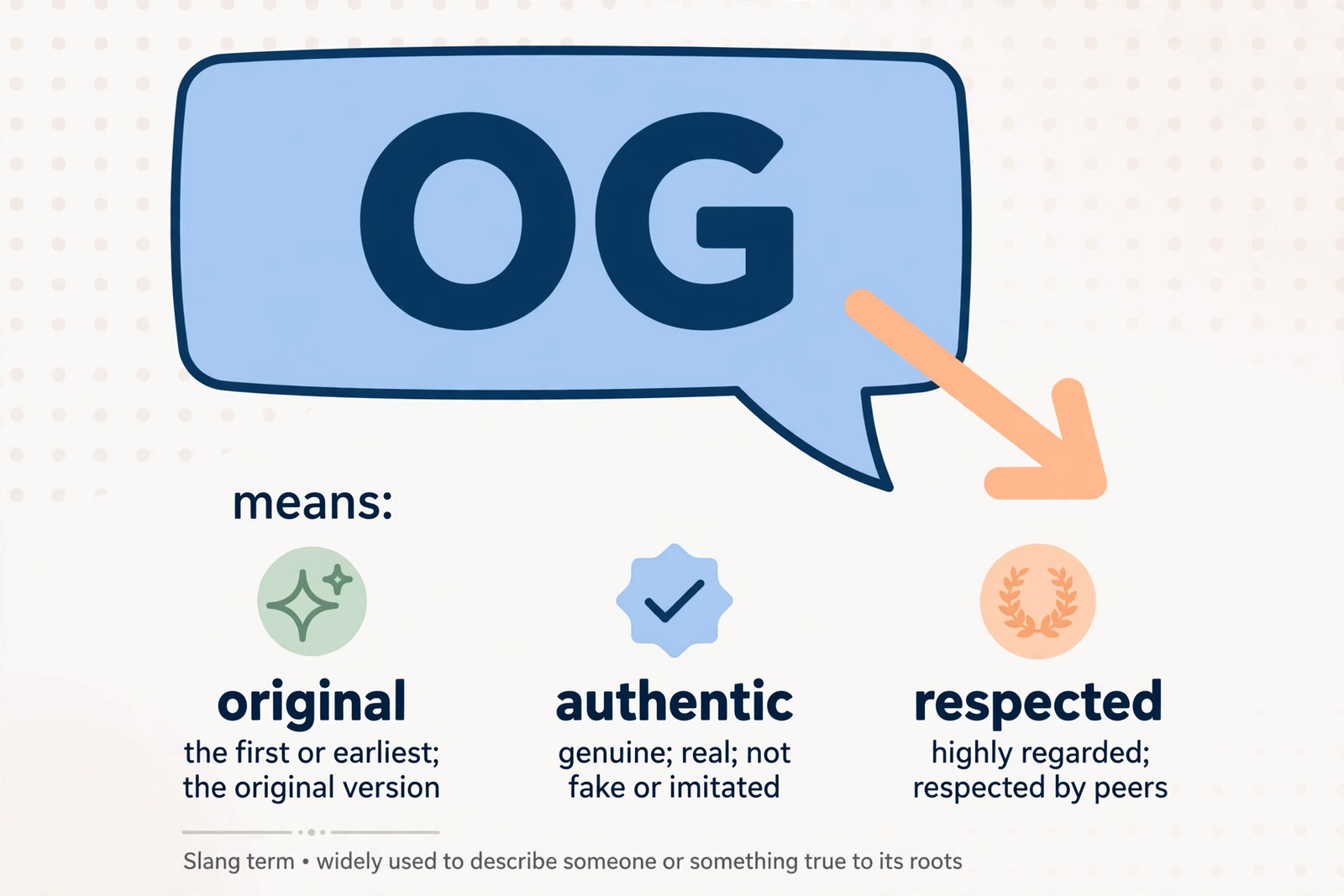
Quick definition: In og slang, OG stands for “Original Gangster.” Today it is used as a compliment for someone or something that is original, authentic, highly respected, or has been around since the beginning. When a friend texts “you’re the OG,” they are not talking about gangs — they are saying you are the real deal, the original, and someone worth respecting.
og slang Meaning & Definition
The og slang meaning is simple on the surface: OG is short for “Original Gangster.” But the way people actually use it in 2026 has almost nothing to do with gangsters. In everyday texting, TikTok comments, Instagram captions, and gaming chats, calling someone an OG means they were there first, they are the authentic version, and they have earned respect over time.
Think of it as the highest compliment in internet culture. A “real OG” is the person who started something, stayed loyal to it, and knows it better than anyone else. It can describe a person (“She’s an OG in this fandom”), a thing (“These are the OG sneakers from 1998”), or even a moment (“That song is OG”). The word carries warmth, admiration, and a little bit of nostalgia all at once.
Major dictionaries have caught up with how people actually use the term. Merriam-Webster defines OG as someone or something that is an original or originator, especially one that is highly respected. The Cambridge Dictionary describes it in a similar way: a person or thing that was among the first of its kind. Both definitions confirm what millions of texters already know — OG has grown far beyond its street origins into a mainstream word for “the original and the best.”
It helps to know that OG is an initialism, not a true acronym. People pronounce it letter by letter — “oh-jee” — rather than as a single word. You will see it written as “OG,” “O.G.,” or lowercase “og” depending on how casual the conversation is. All three spellings mean the same thing, though full caps usually adds emphasis, like shouting the compliment a little louder.
Introduction
You have seen it everywhere: under a TikTok video, in a group chat, in a comment on an old photo. Someone writes “OG” and everyone nods like it is the most natural word in the world. If you grew up with the internet, you probably use it without thinking. But if you are seeing it for the first time — or you are a parent reading your kid’s messages — the obvious question is: what does it actually mean, and is it something you should worry about?
The short answer is that og slang is almost always positive. It is praise, not an insult, and it is not a warning sign. When your friend calls you an OG, they are telling you that you matter, that you were here before everyone else, and that your opinion carries weight. It is the internet’s way of giving someone a gold star for seniority and authenticity.
That said, the word does have a real history, and that history matters. OG did not start on TikTok. It started on the streets of Los Angeles in the 1970s, travelled through hip-hop in the 1990s, and only then became the everyday compliment we see today. Understanding that journey helps you use the word correctly — and helps you spot the rare moments when it means something else entirely, like a cannabis strain or a sports term.
This guide covers everything: the full definition, the origin story, how OG is used in texts, chats, gaming, and social media, real examples in friendly, professional, and funny tones, a comparison with similar slang, the alternate meanings you should know, and the common mistakes to avoid. By the end, you will know exactly when to call someone an OG — and when to leave the word alone. And if you enjoy decoding internet shorthand, you will probably also like our guide to FN meaning in text, another abbreviation that shows up in the same conversations.
Origin of og slang
The og slang story begins in Los Angeles in the early 1970s. At that time, members of the Crips street gang used the phrase “Original Gangster” to identify the veteran members — the people who had been part of the gang since its earliest days and had earned status through years of loyalty. The shorthand “OG” marked someone as a founding figure, not a newcomer. It was a label of seniority and respect inside a very specific world.
For almost two decades, the term stayed mostly inside that world. Then hip-hop picked it up. In 1991, rapper Ice-T released the album “O.G. Original Gangster,” and the phrase exploded into mainstream music culture. Suddenly, OG was not just gang vocabulary — it was a badge of authenticity in rap, a way of saying “I was here first, and I am the real thing.” Other artists followed, and through the 1990s the word spread through lyrics, interviews, and street culture across the United States.
The internet did the rest. As forums, chat rooms, and later social media grew, OG detached from its literal meaning almost completely. On gaming servers in the 2000s, the best player in the lobby was “the OG.” On YouTube and Reddit in the 2010s, the earliest fans of a creator were “OG subscribers.” On TikTok and Instagram today, the original version of anything — a song, a meme format, a pair of sneakers — is “the OG.” The compliment survived; the gang connection faded into background knowledge.
That is why dictionaries now define OG the way they do. Language follows use, and use has made OG a word about originality and respect. The origin is still worth knowing, though, because it explains the word’s emotional weight. Calling someone an OG is not like calling them “cool.” It is closer to calling them a legend — someone whose place in the story cannot be taken away by newcomers.
Why og slang Became So Popular
There are a few clear reasons og slang took over the internet. First, it is short. Two letters carry a whole paragraph of meaning: original, authentic, respected, experienced, first. In a world of character limits and fast-scrolling feeds, that kind of efficiency wins. Typing “OG” is faster than typing “you are the original and most respected person here,” and it lands with more style.
Second, it fills a gap no other word fills. English has words for “old” and words for “good,” but very few words that combine seniority, authenticity, and respect into one compliment. “Veteran” sounds formal. “Legend” sounds dramatic. “Classic” describes things, not people. OG does all of it at once, and it does it casually. That is why it works in a text to a friend, a comment under a video, and a shout-out in a gaming lobby.
Third, nostalgia made it bigger. As internet culture matured, people started celebrating the “originals” — the first version of a meme, the first season of a show, the first lineup of a band. Throwback content performs extremely well on TikTok and Instagram, and OG is the natural label for it. A video captioned “the OG intro” or “OG fans remember this” instantly signals shared history, and shared history builds community.
Finally, celebrities and creators keep the word in circulation. Athletes call each other OGs. Musicians name albums and songs after it. Streamers hand out “OG” status to their earliest supporters like a medal. Every time a public figure uses it as praise, millions of followers absorb the meaning — and the cycle continues. Heading into 2026, OG remains a staple of internet slang, especially in gaming communities, meme culture, and nostalgic throwback content across TikTok and Instagram.
How og slang Is Used in Texts and Chats
In everyday conversation, og slang works in three main ways. First, as a noun for a person: “You’re an OG” means you are a respected original. Second, as an adjective before a noun: “OG fan,” “OG member,” “OG album,” “OG recipe” — in each case, OG means the first or most authentic version. Third, as a standalone label for a thing: “That’s OG” means that is the classic, the real one, the version everything else is measured against.
Context decides the exact shade of meaning. In a group chat, “He’s the OG of this server” means he founded it or has been there longest. In a sneaker community, “the OG colorway” means the original release from years ago, now valuable because of its history. In a comment section, “OGs remember” is a call to everyone who was there from the start — a small test of belonging that long-time fans love to pass.
On TikTok, OG shows up constantly in captions and comments. A creator reposting their first viral video writes “the OG video that started it all.” A fan under a singer’s old performance writes “OG fans were here before she was famous.” On Instagram, it appears in throwback posts: “OG crew, 2015” under a photo of old friends. On Snapchat, it is a quick compliment in a private message. On X (Twitter), it punctuates hot takes: “Unpopular opinion: the OG movie is still the best one.”
In gaming, OG carries real status. The player who has been in a clan since day one is the OG. The original map, the original character skin, the original version of a game before updates changed it — all “OG.” Gamers also use it as a sign of respect after a good match: “GG, you’re an OG at this game.” It is praise that acknowledges skill built over years, not luck in one round.
Capitalization adds tone. Writing “OG” in full caps feels loud and emphatic, like a shout of respect. Writing “og” in lowercase feels softer, more casual, almost affectionate. Neither is wrong — it is simply a volume knob. What matters more is who you say it to: OG is a compliment between equals or from a fan to someone they admire. Used upward, toward a respected elder in a community, it lands perfectly. Used downward, toward someone new, it can sound confusing, since a newcomer cannot be an original by definition.
Examples of og slang in Real Conversations
The easiest way to understand og slang is to see it in real messages. The examples below show how the word changes color with tone — friendly, professional, and funny — while keeping the same core meaning: original, authentic, respected.
Friendly Examples
- Friend 1: “Bro, you taught me everything I know about this game.”
Friend 2: “Nah, you’re the OG. I just watched you play for a year.” - Text: “Happy birthday to the OG of our friend group. None of this exists without you. 🎂”
- Instagram comment: “OG fans remember when she performed in that tiny café before the world knew her name.”
- Group chat: “We need the OG playlist for tonight. No new stuff, just the classics we all grew up on.”
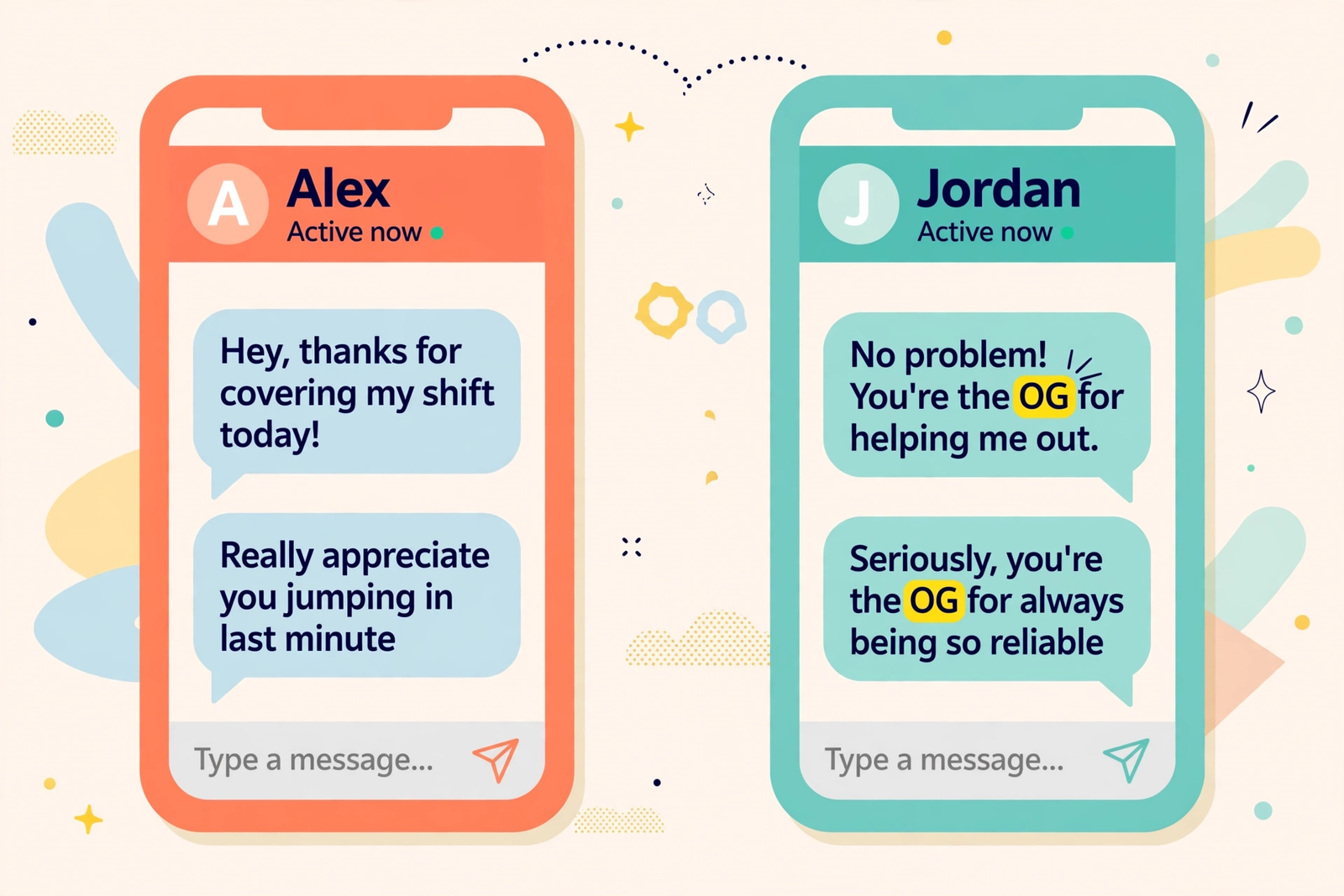
- DM: “You’re an OG for helping me move last weekend. I owe you big time.”
Notice how every friendly example is warm. Nobody uses OG to tease or insult a friend. It is the kind of word you send with a heart emoji, a throwback photo, or a thank-you message. It says: I remember what you did, and I respect it.
Professional Examples
- Work Slack message: “Shout-out to Maria, the OG of this team. She built the process we all still use today.”
- LinkedIn post: “Honored to learn from the OGs of this industry. Twenty years of experience, zero ego.”
- Team meeting: “Let’s ask David — he’s the OG here and knows where all the old files live.”
- Client email: “We’ve brought in the OG designer behind the original brand identity to guide the refresh.”
In professional settings, OG works best in casual workplaces — startups, creative teams, remote chats. In a formal email to a client you have never met, “veteran” or “founding member” is safer. But in a Slack channel or a team shout-out, calling a colleague an OG is a genuine, human way to recognize long service, and most people receive it as a compliment.
Funny Examples
- Meme caption: “Me explaining to my kids that I was an OG Fortnite player before building was cool.”
- Group chat: “I’m the OG of this group chat. I was sending memes here before it was a group chat — it was just me, alone, texting myself.”
- TikTok comment: “OGs remember when this song was just a 15-second clip and everyone lost their minds.”
- Text: “You’re not just a fan, you’re the OG fan. You liked the band before their first album had a name.”
The humor comes from exaggeration. Calling yourself an OG for something small — a group chat, a meme page, a TV show — is a joke about taking pride in very early, very minor loyalty. The word is flexible enough to be sincere and playful at the same time, which is a big part of why it has lasted so long online.
og slang vs Similar Terms: A Comparison
OG is often confused with other slang words that sound similar but mean different things. The table below shows how og slang compares with its closest cousins, so you can pick the right word every time.
| Term | Core Meaning | When to Use It | Example |
|---|---|---|---|
| OG | Original, authentic, respected since the beginning | Praising someone’s seniority or authenticity | “She’s the OG of this community.” |
| GOAT | Greatest of All Time | Calling someone the best ever, not just the first | “He’s the GOAT of basketball.” |
| Legend | Someone famous for remarkable achievements | Praising skill or fame, with or without seniority | “You’re an absolute legend for helping.” |
| Veteran / Vet | Someone with long experience in a field | Formal or semi-formal recognition of experience | “She’s a veteran of the industry.” |
| Old-school | From an earlier time; classic style | Describing style or taste, not a person’s status | “I love that old-school sound.” |
| Day one | Someone who supported from the very start | Talking about loyalty from the beginning | “He’s been a day-one fan.” |
| Real one | Genuine, loyal, trustworthy person | Praising loyalty and character, not seniority | “Thanks for showing up — you’re a real one.” |
The key difference is this: GOAT is about being the best, legend is about being remarkable, and veteran is about experience. OG is about being first and being real. A person can be an OG without being the GOAT — the founding member of a club is an OG even if they were never the best player. And a GOAT does not have to be an OG — a newcomer can become the greatest of all time without having been there since the start. That distinction is exactly why OG has its own place in slang.

Alternate Meanings of OG
Like most short abbreviations, OG has a few other meanings that depend entirely on context. Knowing them saves you from confusion — and from an awkward reply.
- OG Kush: In cannabis culture, OG is famously associated with OG Kush, a well-known marijuana strain that became popular in California during the 1990s. Some people say the “OG” in OG Kush stands for “Ocean Grown,” though the origin is disputed. If a conversation is about strains, flavors, or dispensaries, OG probably means this, not “Original Gangster.”
- Own goal (sports): In soccer and hockey, “OG” in a match report means an own goal — a player accidentally scoring in their own team’s net. You will see it in scorelines and statistics, never in a chat compliment.
- Officer of the Guard (military): In British military usage, OG can stand for the officer of the guard, the officer overseeing guards at a post. This meaning is rare in everyday conversation.
- Oganesson (science): In chemistry, Og is the symbol for oganesson, element 118 on the periodic table. In a science classroom or a textbook, “Og” has nothing to do with slang at all.
- Original (products): In shopping and sneaker culture, “OG” often simply means the original release — the first version of a shoe, a console, or a product, as opposed to a reissue or remake. “OG colorway” is one of the most common uses in this world.
The rule is simple: if the sentence reads like praise for a person or a classic thing, OG is slang. If it sits in a match report, a science paper, or a dispensary menu, it is one of the alternate meanings. Context always tells you which one applies, and in texting and social media, the slang meaning wins almost every time.
Professional or Polite Alternatives to og slang
OG is casual by nature, and there are moments when a more formal word fits better. Here are polite alternatives, with notes on when each one works best:
- Founding member — best for organizations, clubs, and teams. “She is a founding member of the society” carries the same meaning as “She’s the OG” without the slang.
- Pioneer — best for someone who started something new in a field. “He was a pioneer of online education” sounds polished and respectful.
- Veteran — best for workplaces and industries. “A veteran of the newsroom” is warm, professional, and widely understood.
- Original — best for things rather than people. “The original recipe” or “the original cast” says what “OG” says, in plain English.
- Trailblazer — best for formal writing, speeches, and introductions. It adds admiration without informality.
- Long-standing member — best for official bios and announcements where slang would feel out of place.
None of these is a perfect replacement, because none of them packs OG’s exact mix of first, real, and respected into two letters. But when you are writing a formal email, a company bio, or a message to someone you do not know well, one of these alternatives keeps your meaning clear and your tone appropriate.
Common Mistakes When Using og slang
OG is easy to use, but a few mistakes show up again and again. Avoid these and the word will always land the way you intend.
- Calling a newcomer an OG. The word means “original” and “from the beginning.” Calling someone who joined yesterday an OG is a contradiction, and it sounds like you do not know what the word means. Save it for people and things with real history.
- Using it as an insult. OG is a compliment. Saying “OK, OG” sarcastically to mock someone’s age or experience twists the word into something it is not. If you mean it as a joke, make sure the other person knows you are joking.
- Confusing OG with GOAT. As the comparison table shows, OG means first and authentic, while GOAT means the greatest of all time. The first player on a team is the OG; the best player ever is the GOAT. They can be the same person, but the words are not interchangeable.
- Using it in formal writing. “OG” in a job application, a legal letter, or an academic essay will look out of place. In those settings, “founding member,” “veteran,” or “original” does the same job with the right tone.
- Forgetting the cannabis meaning. In a conversation about strains, music festivals, or dispensaries, OG might mean OG Kush. Replying as if someone called you an “original gangster” in that context will confuse everyone. Read the room first.
- Overusing it. Like any slang, OG loses power when it appears in every sentence. One well-timed “you’re the OG” means far more than ten of them in a row. Use it when someone has genuinely earned it.

Quick Tips for Using og slang
- Use it as a compliment, not a label. OG works best when you are praising someone, not categorizing them. “You’re an OG” lands better than “He is an OG person.”
- Pair it with something specific. “OG of this server” or “OG fan since 2019” is stronger than a bare “OG,” because it tells everyone what the person was first at.
- Match the capitalization to the mood. Full caps “OG” adds emphasis and excitement; lowercase “og” feels relaxed and affectionate. Both are correct — pick the one that matches your tone.
- Keep it casual. OG belongs in texts, comments, chats, and friendly shout-outs. In formal settings, switch to “founding member” or “veteran.”
- Check the context before replying. If the conversation is about sports scores, science, or cannabis, OG may not mean what you think. A quick look at the surrounding messages prevents an awkward reply.
- Combine it with gratitude. The strongest use of OG is a thank-you: “You’re the OG for helping me with this.” Respect plus appreciation is a combination people remember.
- Do not force it. If OG does not come naturally to you, do not squeeze it into every message. Slang works when it sounds like you — and sounds strange when it does not.


FAQ: og slang
What does OG mean in slang?
In slang, OG stands for “Original Gangster.” Today it means someone or something that is original, authentic, highly respected, or has been around since the beginning. It is almost always used as a compliment.
What does it mean when someone calls you an OG?
It means they respect you and see you as the real deal — someone who was there first, stayed loyal, and knows what they are talking about. It is praise for your experience and authenticity, not a reference to actual gang life.
Is OG a compliment or an insult?
It is a compliment in nearly every modern use. Calling someone an OG says they are original, respected, and important to a group or community. It only turns negative if someone uses it sarcastically, which is rare.
Where did OG come from?
OG originated in Los Angeles in the early 1970s, where members of the Crips used “Original Gangster” for veteran members. Hip-hop popularized it in the 1990s — most famously through Ice-T’s 1991 album “O.G. Original Gangster” — and the internet turned it into a mainstream compliment.
What does OG mean on TikTok and Instagram?
On TikTok and Instagram, OG means the original version of something or a long-time fan. You will see it in captions like “the OG video,” comments like “OG fans remember this,” and throwback posts celebrating the first version of a trend, song, or meme.
What is the difference between OG and GOAT?
OG means first, original, and authentic. GOAT means Greatest of All Time — the best ever. A founding member of a club is an OG even if they were never the best, and a newcomer can become the GOAT without having been there since the start.
Can OG mean something other than Original Gangster?
Yes. In cannabis culture it can refer to OG Kush, a popular strain. In sports it can mean an own goal. In science, Og is the symbol for the element oganesson. In shopping and sneaker culture, it often just means the original release of a product. Context decides which meaning applies.
Is it OK to use OG at work or in formal messages?
In casual workplaces — a Slack channel, a team shout-out, a creative team — calling a colleague an OG is usually fine and well received. In formal emails, applications, or official documents, use “founding member,” “veteran,” or “pioneer” instead.
Conclusion
The og slang meaning has travelled a long way: from 1970s Los Angeles street culture, through 1990s hip-hop, into gaming lobbies, and finally onto the TikTok and Instagram feeds where most of us meet it today. What survived that whole journey is the core idea — original, authentic, respected, and there from the start. When someone calls you an OG, they are giving you one of the internet’s highest compliments: you were here first, you are the real thing, and your place in the story is secure.
Use it well. Save it for people and things that have genuinely earned it, pair it with something specific, and remember the context — a sports report, a science class, or a dispensary menu may mean something else entirely. And when you want to keep decoding the slang in your feeds, our guides to CFS meaning in text, glizzy meaning, and PTSO meaning in text will help you stay fluent in the language of the timeline.
So the next time you see “OG” under a video or in a message, you will know exactly what it means — and the next time someone earns it, you will know exactly when to say it.
