
Quick definition: what is pillow talking slang — it means the intimate, honest, late-night conversation couples share while lying in bed together, usually after intimacy or right before falling asleep. Pillow talking is about closeness, confessions, dreams, and sweet nothings — the kind of talk that only happens when two people feel completely safe with each other.
What Is Pillow Talking Slang? Meaning & Definition
If you have ever seen someone text “we were pillow talking till 3am” and wondered what that actually means, you are not alone. The phrase what is pillow talking slang is one of the most searched relationship-slang questions right now, because pillow talking sounds simple — and it is — but it carries a whole world of meaning underneath it.
In slang, pillow talking is the verb form of pillow talk: the soft, private, emotionally open conversation between two romantic partners when they are lying in bed together. It usually happens late at night, heads on the same pillow, lights low, phones down. The conversation drifts from silly jokes to deep confessions — childhood memories, secret fears, future dreams, and the little things you would never say in daylight in front of anyone else.
What makes pillow talking different from regular talking is the setting and the honesty. During the day, couples talk about groceries, bills, work, and weekend plans. Pillow talking is the opposite of that. It is unguarded. It is the conversation where someone finally says “I have never told anyone this before” — and means it.
Here is the simplest way to remember it:
| Term | What it means | When it happens |
|---|---|---|
| Pillow talk | Intimate, private conversation between partners in bed | Late night, after intimacy, or before sleep |
| Pillow talking | The act of having that conversation (verb form) | “We were pillow talking for hours” |
| Dirty talk | Sexually explicit talk, usually during intimacy | During foreplay or sex — not the same thing |
| Sweet nothings | Soft, affectionate words whispered to a partner | Any romantic moment, not only in bed |
So when someone asks what is pillow talking slang, the short answer is this: it is the cozy, vulnerable, late-night heart-to-heart that couples share in bed — part romance, part therapy, part best-friend energy, all wrapped up in one quiet moment.
Introduction
Picture this: it is 1:47 in the morning. The room is dark except for the glow of the streetlight through the curtains. Two people are lying side by side, staring at the ceiling — and suddenly one of them starts talking about the dream job they have never told anyone about, or the embarrassing thing that happened to them in seventh grade, or the fear that keeps them awake at night. Nobody planned this conversation. It just happened, because the bed at night is the safest place in the world to be honest.
That is pillow talking. And in the age of texting, TikTok, and Urban Dictionary, the phrase has escaped the bedroom and entered everyday slang. People now say “we were pillow talking” the same way they say “we were vibing” — a shorthand for a whole mood. You will see it in captions, in relationship advice threads, in memes about couples who stay up all night talking, and in texts like “I miss our pillow talks.” It has become one of those phrases that instantly tells you two people are close — really close.
This guide breaks down everything about the term: where pillow talking came from, how it is used in texts and real life, how it differs from dirty talk and sweet nothings, the mistakes people make with it, and how to actually have a great pillow talk with your partner. If you have ever typed ILYSM at 2am or waited up for a goodnight text, you already know the feeling — pillow talking is where that feeling lives.

Origin
The phrase “pillow talk” is much older than TikTok, texting, or even the internet. Dictionaries trace the first recorded use of “pillow talk” to the 1930s, and language historians note the word “pillow” has been linked to intimacy for far longer — in the 1870s, a “pillow-mate” was slang for a prostitute, and “pillow” had signified the bedroom and everything that happens in it for centuries before that.
The phrase went mainstream in 1959 with the classic romantic comedy Pillow Talk, starring Doris Day and Rock Hudson. The film was about two strangers who share a party telephone line and fall in love without meeting — and the title turned “pillow talk” into a household phrase across America. Suddenly, everyone knew what those quiet bedroom conversations were called.
The verb form — pillow talking — came later, with the internet. Urban Dictionary entries for “pillow talking” started appearing in the early 2000s, as texting culture turned nouns into verbs (“we were texting,” “we were FaceTiming,” “we were pillow talking”). On Urban Dictionary, the top definitions describe it as the honest, vulnerable, sometimes sappy exchange of thoughts that only feels right when you are cuddled up next to someone late at night — part cuddle, part confession, part comedy show.
What is interesting is that the core meaning has barely changed in nearly a hundred years. In the 1930s, pillow talk meant private bedroom conversation between lovers. In 2026, pillow talking means the exact same thing — it has just picked up new contexts: long-distance couples pillow talking over the phone, friends joking about “pillow talk” in group chats, and TikTok creators romanticizing the 2am conversation as relationship goals.
Popularity
So why is everyone suddenly asking what is pillow talking slang? A few reasons. First, relationship content dominates social media. TikTok and Instagram Reels are full of “POV: pillow talking with your boyfriend at 3am” videos, couples’ late-night conversation trends, and “things couples say during pillow talk” skits. The phrase has become aesthetic — soft lighting, cozy bedding, whispered confessions — the visual language of modern romance content.
Second, texting made it a verb people actually use. “We stayed up pillow talking” reads naturally in a text in a way “we engaged in pillow talk” never would. Slang always follows the path of least resistance, and “pillow talking” is easy, visual, and instantly understood. You do not need a dictionary to picture it.
Third, there is a real cultural shift underneath the trend. Younger couples talk openly about emotional intimacy, vulnerability, and mental health in ways previous generations did not. Pillow talking has become shorthand for the healthiest part of a relationship — the part where two people actually talk, listen, and feel safe. Relationship coaches, therapists, and advice creators all point to the same thing: couples who talk openly in bed tend to feel closer, and the phrase gives that idea a name people can share and search for.
People are not just looking up the definition — they are asking how to do it, what to say during it, and what it means when a guy or girl wants to pillow talk. The curiosity is practical: people want to know what it says about their relationship — and how to have more of it.
How It Is Used
Pillow talking shows up in two main places: real life and texting. In real life, it is the conversation that happens when the day is over — lights off, heads on pillows, no audience. In texting, people use the phrase to describe that experience after the fact, or to invite it: “come over, let’s pillow talk” or “I miss pillow talking with you.”
The tone of pillow talking is almost always soft and honest. It is not the tone you use in a meeting or a group chat. It is slower, quieter, and more open. People share things during pillow talk that they would not say at dinner with friends — not because the things are scandalous, but because they are personal. A childhood fear. A dream that feels too big to say out loud. An apology that has been waiting for weeks. A silly idea for a business, a trip, a future.
Here are the most common ways people use the phrase:
- Describing the moment: “We ended up pillow talking until 4 in the morning.”
- Missing someone: “I miss pillow talking with you every night.”
- Flirting or inviting closeness: “Come here, let’s pillow talk for a bit.”
- As a relationship milestone: “The first time we went pillow talking, I knew I liked him.”
- Joking with friends: “Spill the pillow talk — what did he say last night?”
- In memes and captions: “POV: it’s 3am and you’re pillow talking about your trauma with your situationship.”
Notice how flexible the phrase is. It can be romantic, funny, nostalgic, or even a little teasing. Context decides the tone — but the core image never changes: two people, one bed, one honest conversation.
Pillow talking is almost always associated with couples, but the phrase has stretched a little. Close friends sometimes joke about “pillow talking” at a sleepover, and long-distance couples pillow talk over the phone or on FaceTime. The common thread is intimacy — emotional closeness, not just physical closeness.
Examples
The best way to understand what is pillow talking slang is to see it in real conversations. Here are examples across different tones — friendly, romantic, and funny — so you can spot it instantly and use it naturally.
Friendly Examples
Pillow talking between partners often sounds like two best friends who happen to share a bed. The topics are light, warm, and a little random:
- “Remember when we got lost on that road trip and ended up eating gas station sandwiches at midnight? Best night ever.”
- “If you could have dinner with any three people, dead or alive, who would you pick?”
- “Okay, be honest — do you think aliens are real? Because I have thoughts.”
- “We were just pillow talking about our dream house. He wants a farm, I want a penthouse. We compromised on a farm with Wi-Fi.”
Friendly pillow talking is the “getting to know you” layer. It is how couples become best friends, not just partners — one random question at a time, at 1am, when nobody is performing anymore.
Professional Examples
Yes, pillow talking can be serious, too. Some of the most important conversations in a relationship happen in this setting, because the guard is down and the honesty is up:
- “Last night we were pillow talking and I finally told her I want to change careers. She just listened — and then said she believed in me.”
- “During pillow talk, he admitted he has been stressed about money. We made a plan together, right there in the dark.”
- “I told him I was scared about the move. He said, ‘We will figure it out.’ That was the whole conversation — and it was enough.”
This is why therapists love the concept: pillow talking creates a low-pressure space for high-stakes honesty. There is no eye contact to maintain, no audience, no rush. Just two voices in the dark saying the things that matter.
Funny Examples
And then there is the other side of pillow talking — the part that is pure comedy. The 2am brain has no filter, and the results are often hilarious:
- “We were pillow talking and he suddenly asked, ‘Do you think fish get thirsty?’ I have never laughed that hard in bed.”
- “Pillow talking with my boyfriend is 10% deep confessions and 90% him doing impressions of our cat.”
- “She fell asleep mid-sentence during pillow talk. I was in the middle of my villain origin story.”
- “We were pillow talking about our future kids’ names and he suggested ‘Kevin.’ Just Kevin. For a girl.”
Funny pillow talking is the secret ingredient. The deep talks build trust; the silly talks build the friendship. A relationship needs both, and the bed at midnight somehow produces both in the same conversation.
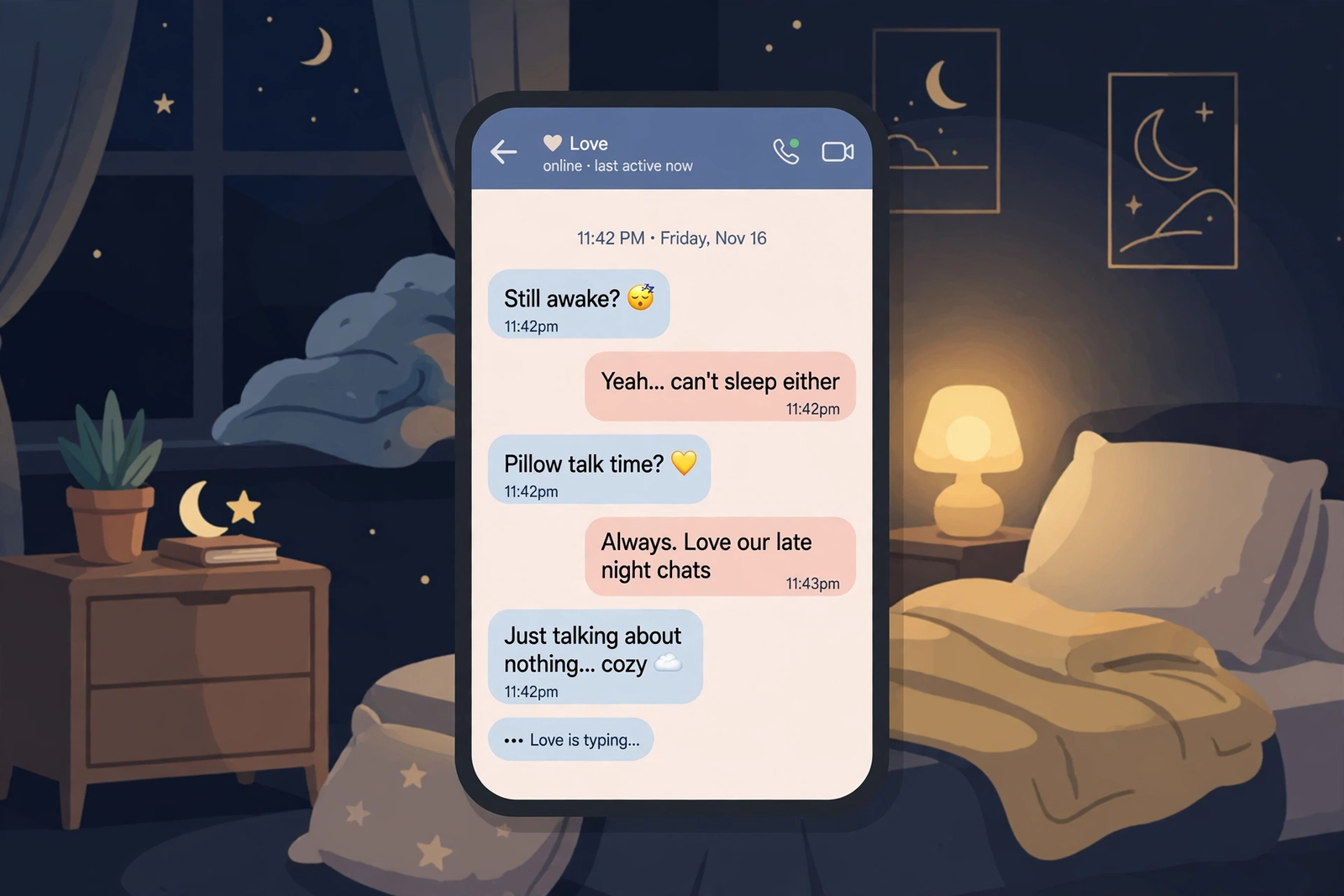
Comparison with Similar Terms
Pillow talking gets confused with a few nearby phrases. The differences matter, because using the wrong term can send the wrong message — especially in text. Here is how it stacks up:
| Term | Meaning | Key difference from pillow talking |
|---|---|---|
| Pillow talking | Intimate, honest conversation in bed, usually late at night | — |
| Dirty talk | Sexually explicit talk during intimacy | Dirty talk is sexual and happens during sex; pillow talking is emotional and happens after (or instead of) it |
| Sweet nothings | Soft, loving words whispered to a partner | Sweet nothings are short phrases (“I love you”); pillow talking is a full conversation |
| Deep talk | A serious, meaningful conversation about life | Deep talks can happen anywhere; pillow talking is specifically the in-bed, late-night version |
| Late-night talk | Any conversation that happens late at night | Much broader — a late-night talk with a friend about work is not pillow talking |
| Heart-to-heart | An honest, private conversation | Very close in meaning, but a heart-to-heart can happen at a coffee shop; pillow talking happens in bed |
| Cuddle talk | Soft conversation while cuddling | Almost the same, but cuddling can happen on a couch at noon; pillow talking implies bedtime intimacy |
The most important distinction is pillow talking vs dirty talk. Dirty talk is part of foreplay — sexual, in the moment, meant to build arousal. Pillow talking is what happens after the moment — emotional, slow, meant to build closeness. One is about desire; the other is about trust. A healthy relationship usually has both, but they are not interchangeable.

Alternate Meanings
Like most slang, pillow talking has picked up a few side meanings over the years. Most of them are still connected to the bedroom — but not all of them are romantic.
- The spy meaning: In espionage stories, “pillow talk” is a classic way secrets leak. A spy charms someone into revealing classified information during intimate moments — the phrase appears in spy novels and movies as a warning: never share secrets in bed. This is the oldest alternate meaning, and it is why “loose lips” and “pillow talk” sometimes appear in the same sentence.
- The gossip meaning: Sometimes people use “pillow talk” to mean juicy gossip shared between partners — the secrets, scandals, and stories that only come out when two people are alone. “What juicy secrets were revealed during your pillow talk?” is a joke friends make, but it points to a real idea: pillow talking is where private information lives.
- The film and pop-culture meaning: For older generations, “Pillow Talk” first means the 1959 Doris Day and Rock Hudson film. For younger people, it might mean the Zayn Malik song “PILLOWTALK” from 2016 — which, fittingly, is about intimacy and late-night closeness. Both uses keep the romantic core.
- The marketing meaning: Beauty and bedding brands have borrowed the phrase for products — “pillow talk” lipstick shades, pillow mists, and bedding collections that promise romance and comfort. When you see it on a product, it is selling the feeling, not the conversation.
In everyday slang, though, the romantic meaning wins by a mile. Unless the context is spies, movies, or makeup, pillow talking means the late-night bedroom conversation — full stop.
Professional or Polite Alternatives
Pillow talking is casual slang, and it is not right for every setting. You would not write it in a work email or say it to your grandmother (probably). Here are polished alternatives for different situations:
| Situation | Say instead |
|---|---|
| Formal writing or advice columns | “intimate conversation” or “private conversation between partners” |
| Talking to family or older relatives | “a heart-to-heart” or “a late-night chat” |
| Work or professional contexts | Do not bring it up at all — keep it private |
| Relationship counselling or therapy | “post-intimacy communication” or “emotional check-in” |
| Polite conversation with acquaintances | “we had a long talk last night” |
| Social media captions (keeping it classy) | “late-night talks with my favourite person” |
The rule is simple: pillow talking is perfect for texts, friends, memes, and casual conversation. For anything formal, swap in “heart-to-heart” or “intimate conversation” and you will never go wrong.
Common Mistakes
Pillow talking sounds easy — just lie in bed and talk, right? In practice, people make a few mistakes that turn a beautiful moment into an awkward one. Here are the biggest ones:
- Confusing it with dirty talk: The number one mistake. If your partner says “let’s pillow talk” and you start with explicit talk, you have misread the moment. Pillow talking is emotional, not sexual. Read the tone first.
- Treating it like a meeting: Bringing up bills, chores, or scheduling during pillow talk kills the mood instantly. “We need to talk about the rent” is not pillow talk — it is a meeting that happens to be in bed. Save logistics for daylight.
- Oversharing too early: Pillow talking builds trust over time. Dropping your heaviest secret on the first night together can overwhelm the other person. Let the depth grow naturally.
- Sharing what was said: The golden rule of pillow talking is privacy. What is said in bed stays in bed. Repeating your partner’s late-night confessions to friends breaks the trust that makes pillow talk possible in the first place.
- Scrolling through your phone: Nothing ends a pillow talk faster than a glowing screen. If you are half-listening while checking notifications, your partner can feel it. Phones down, eyes on the ceiling, ears open.
- Forcing it: Not every night produces a deep conversation, and that is fine. Trying to force a meaningful talk at 2am usually produces the opposite — two tired people pretending to be profound.

Quick Tips
Want better pillow talks? You do not need a script — just a few habits that make the moment work:
- Start with an easy question: “What was the best part of your day?” or “What are you dreaming about lately?” beats “So, what are your childhood traumas?” as an opener.
- Put the phones away: Charge them across the room. The single biggest upgrade to pillow talking in 2026 is removing the blue light and the notifications.
- Ask open questions: “How did that make you feel?” keeps a conversation going. “Did you like it?” ends it. Open questions invite stories; closed questions invite one-word answers.
- Match their energy: If your partner is being silly, be silly back. If they get serious, slow down and listen. Pillow talking is a duet, not a solo.
- Share first: Vulnerability is contagious. If you want your partner to open up, open up first — even a little. “I have never told anyone this” is easier to say second.
- Do not fix, just listen: Most pillow talk is not a request for advice. Your partner usually wants to be heard, not solved. Listen first; offer solutions only if asked.
- End warmly: A good pillow talk ends with something kind — “I love talking to you like this” or simply “goodnight, I love you.” The last words of the night stick.


FAQ
What does pillow talking mean in slang?
In slang, pillow talking means having an intimate, honest, late-night conversation with your romantic partner while lying in bed together. It usually involves sharing feelings, dreams, secrets, and personal stories in a private, relaxed setting — most often after intimacy or right before falling asleep.
Is pillow talking the same as dirty talk?
No. Dirty talk is sexually explicit conversation that happens during intimacy, meant to build arousal. Pillow talking is emotional conversation that usually happens after intimacy, meant to build closeness and trust. They are related but very different in tone and purpose.
What does it mean when a guy wants to pillow talk?
When a guy wants to pillow talk, it usually means he feels comfortable and emotionally close to you — he wants to talk, listen, and connect beyond the physical side of the relationship. It is generally a good sign: he trusts you enough to be vulnerable and wants the quiet, honest conversation that comes with it.
What does it mean when a girl wants to pillow talk?
When a girl wants to pillow talk, she usually wants emotional closeness — to share her thoughts, hear yours, and feel connected before sleep. It is often less about the topic and more about the feeling: being heard, being safe, and being close to the person she trusts.
Is pillow talking only after sex?
Not always. Pillow talking most often happens after intimacy, but it can also happen on any night when a couple is lying in bed talking before sleep — after a long day, during a sleepover, or on a quiet night in. The key ingredient is the intimate, private setting, not what happened before it.
Can you pillow talk over the phone?
Yes. Long-distance couples pillow talk over the phone or on FaceTime all the time — lying in their own beds, talking late into the night. The phrase has stretched to cover any late-night, emotionally open conversation between partners, even when they are not in the same bed.
How do you start pillow talking with your partner?
Start small and easy. Put the phones away, lie down together, and ask an open question: “What was the best part of your day?” or “What is something you have been thinking about lately?” Then listen. The conversation usually deepens on its own once both people feel safe.
Is pillow talking good for a relationship?
Yes — research on post-intimacy communication, including work by University of Connecticut researcher Amanda Denes, links open, affectionate talk after intimacy with greater trust, bonding, and relationship satisfaction. The hormone oxytocin, released during physical closeness, lowers inhibitions and makes honest conversation easier — which is why the bed at night is such a natural place for it.
Conclusion
So, what is pillow talking slang? It is the quiet, honest, late-night conversation between two people who trust each other — part confession, part comedy, part best-friend catch-up, all happening with heads on the same pillow. It is older than the internet, bigger than TikTok, and more important than any single text abbreviation. In a world where most of our talking happens in short, distracted bursts, pillow talking is the opposite: slow, private, and real.
The next time someone texts you “we were pillow talking till 3am,” you will know exactly what they mean — and why they are smiling about it. And if you want more of it in your own relationship, the recipe is simple: phones down, lights low, and one honest question to get it started. If you want to keep decoding the slang in your chats, start with ILYSM (“I Love You So Much”), IYKYK (“If You Know, You Know”), and IKY (“If You Know”) — three more abbreviations that show up in the very same late-night conversations every single day. And for a broader look at how the term is defined and where it comes from, see the Wikipedia article on pillow talk.
