
Quick Definition: Sus meaning slang is short for “suspicious” or “suspect.” When someone says a person, a deal, or a story is sus, they mean it feels off, dishonest, or not quite trustworthy — like something is being hidden. It is the internet’s favourite one-word way to raise an eyebrow.
Sus Meaning Slang Meaning & Definition
The sus meaning slang definition is simple: sus is a clipped form of suspicious (or suspect) used as an adjective in casual speech and texting. If your friend cancels plans for the third time with a vague excuse, their story is sus. If a website offers a brand-new phone for $20, the deal is sus. If a teammate in a game is lurking near the scene of every “crime,” that player is sus.
What makes sus so useful is how much work three letters do. It does not accuse anyone outright — it flags doubt. Saying “that’s sus” is softer than saying “you’re lying,” but everyone understands the message: I don’t fully buy this. That gentle-but-pointed tone is exactly why the word spread from gaming chats into everyday conversation, TikTok comments, group chats, and even news headlines.
Grammatically, sus behaves like a normal adjective. You can intensify it (“so sus,” “mad sus,” “sus AF”), compare it (“susser,” “the sussest”), and pair it with verbs (“acting sus,” “looking sus,” “sounding sus”). It can describe people (“he’s sus”), things (“that link looks sus”), situations (“this whole setup is sus”), and even vibes (“the energy in here is sus”). In short, if something triggers your internal alarm, sus is the word for it.
Introduction
Picture this: you are playing a game with friends, and one player keeps showing up exactly where the trouble happened — every single time. Someone types three letters in the chat: “red is sus.” No explanation needed. Everyone knows what it means, and the vote begins.
That tiny moment captures why sus meaning slang matters. The word went from a niche gaming callout to one of the most recognised slang terms on the planet in less than a year, and it never really left. Parents hear it from their kids, teachers hear it in classrooms, and brands now use it in ads — sometimes correctly, sometimes painfully not.
But sus is far older than the game that made it famous, and it means more than most people realise. It has a 90-year history that runs through British police slang, American street speech, dating apps, and meme culture. This guide covers all of it: the real definition, the surprising origin, how to use sus naturally in texts and conversation, what it means on TikTok and in Among Us, the mistakes that make people sound out of touch, and the polite words to use when sus is too casual for the room. By the end, you will not only know what sus means — you will know exactly when to say it and when to leave it in the group chat.

Origin
Most people think sus was born in 2020 with the game Among Us. It was not. The word’s history stretches back nearly a century, and it took three separate journeys to reach your phone screen.
The British beginning (1920s–1930s). The oldest recorded uses of sus come from Britain, where it was police and street slang for a suspected person or a suspicion itself. Green’s Dictionary of Slang records the noun sus — “a suspected person” — from the 1930s, and the adjective meaning “suspicious” from as early as 1925. It grew out of the verb suss (usually “suss out”), meaning to figure something out or investigate it, which itself came from suspect. The word also became tangled with the infamous “sus law” — the nickname for stop-and-search powers under Britain’s Vagrancy Act of 1824, which let police arrest people merely on suspicion of intending to commit a crime. That power was finally abolished in 1981 after protests that it was used discriminatorily, but the word survived in British slang. Even today, “to suss someone out” is everyday British English, and dictionaries such as Merriam-Webster trace sus back to these roots.
The American adoption (2000s–2010s). In the United States, sus travelled through Black American speech and internet culture as a snappy shortening of “suspicious.” The earliest Urban Dictionary definition, posted in August 2003, defined it simply as “short for ‘suspect’ or ‘suspicious.'” By 2017 it was mainstream enough for dating explainers to call it the modern version of “shady” — a go-to word for a date, a roommate, or a story that did not add up.
The Among Us explosion (2020). Then came the multiplayer game Among Us, where one player is secretly the Impostor and everyone else must figure out who it is. Players started typing “red is sus” or “blue is sus” in the in-game chat to accuse each other, and the game exploded in popularity in August 2020. Suddenly millions of people — including many who had never played the game — were saying sus. The word became so culturally dominant that Merriam-Webster officially added sus to the dictionary in September 2022, a rare honour for a slang term.
So the honest origin story is layered: a 1930s British police term, kept alive in Black American and internet speech, then launched into global fame by a video game. Among Us did not invent sus — it just gave the whole world a reason to say it at the same time.
Popularity
Sus peaked in 2020 and 2021, but unlike most viral slang, it never really faded. There are a few reasons for its staying power.
First, it filled a real gap. Before sus, there was no single short word that meant “I find this questionable but I’m not making a formal accusation.” Shady came close, but sus is faster to type, funnier to say, and works in almost any sentence. It became the default reaction word for an entire generation — the verbal equivalent of the side-eye emoji.
Second, it crossed platforms effortlessly. It started in gaming, jumped to TikTok and Twitter, then into YouTube comments, memes, and real-life conversation. The phrase “sussy baka” — a joking combination of sussy (a playful variant of sus) and the Japanese word baka (fool) — became a meme of its own, spreading the word to people who had never even heard of Among Us. Streamers, celebrities, and even politicians have used it, and each use pushed it further into the mainstream.
Third, it is genuinely useful across ages and contexts. Teenagers use it in school, adults use it about suspicious emails and too-good-to-be-true deals, and gamers still use it exactly as they did in 2020. A word that works in a group chat, a TikTok caption, and a conversation about a phishing email has earned its place in the language. That is why dictionaries added it — and why it still trends years after the game that popularised it cooled down.
How It Is Used
Sus is almost always an adjective, and it slots into sentences the same way “suspicious” does — just shorter and more casual. The most common patterns are:
- “That’s sus.” The classic. A reaction to anything questionable — a story, an excuse, a price, a coincidence.
- “You’re acting sus.” / “He’s being sus.” Calling out someone’s behaviour, not necessarily accusing them of anything specific.
- “Red is sus.” The Among Us formula: [name] is sus. Still used jokingly in any group setting when someone looks guilty.
- “Something feels sus.” A softer version — a gut feeling rather than an accusation.
- “Sus AF” / “mad sus” / “so sus.” Intensified versions for when something is very off.
Tone matters more than grammar here. Said with a laugh among friends, sus is playful teasing — the digital equivalent of a nudge. Said flatly in a serious conversation, it lands as a real challenge: explain yourself. The same three letters can be a joke or a warning, and the difference is entirely in delivery, context, and your relationship with the person hearing it.
Sus also shows up as a noun in older British use (“a sus” meant a suspected person), and as part of the verb phrase “suss out” (“let me suss out what’s going on”), but in modern American texting and gaming, the adjective is by far the most common form. If you are texting in 2026, “sus” the adjective is the one people expect.
Examples
The best way to learn sus is to see it in real conversations. Notice how the meaning stays the same — something feels off — while the tone changes completely with context.
Friendly Examples
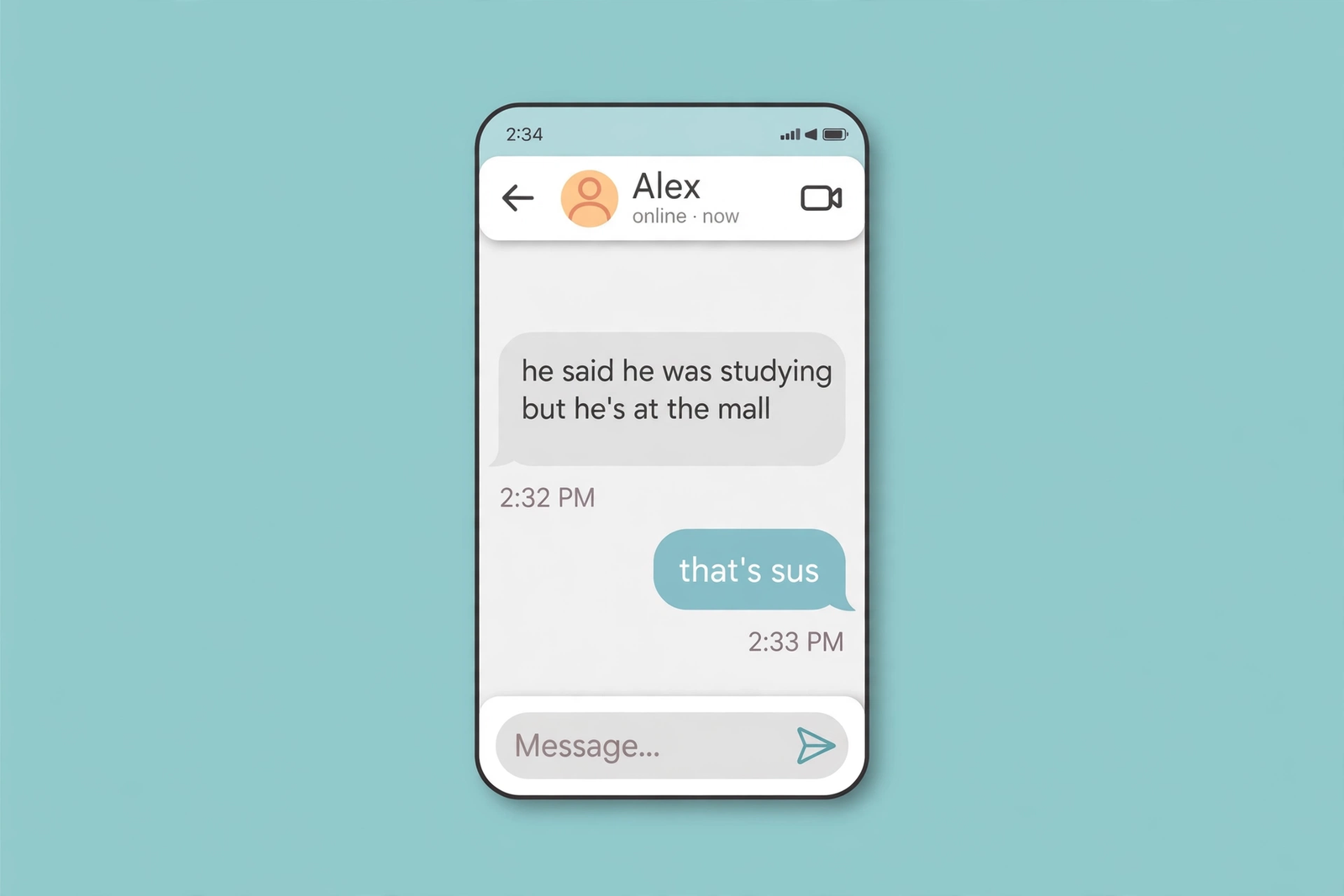
- Friend 1: “He said he was ‘studying’ but his location says he’s at the mall 💀” Friend 2: “Yeah that’s sus, he’s definitely lying.”
- Group chat: “Why did Jake leave the party right before the cake came out? Sus behaviour honestly 😂”
- Texting: “You replied in 0.2 seconds… you were already typing, weren’t you? Sus.”
- Gaming: “Bro, you were the only one near the vault when it got robbed. You’re sus, I’m voting you out.”
Professional Examples
- Work chat: “That invoice email looks sus — the sender address is one letter off from our real vendor. Don’t click the link.”
- Team meeting: “The numbers in this report feel a bit sus to me. Can we double-check the source before we send it to the client?”
- Job search: “A recruiter offered me triple my salary with no interview. Honestly, that sounds sus — I’m going to verify the company first.”
Note that even in professional settings, sus appears in casual internal chats and emails between colleagues. It would be out of place in a formal report or a client-facing document — there, “questionable,” “inconsistent,” or “unverified” do the same job without the slang.
Funny Examples
- “My cat is sitting in the corner staring at the wall again. Very sus. What does she know that I don’t?”
- “He brought a full picnic to a 20-minute meeting. Sus. He’s definitely planning to stay all day.”
- “The wifi only stops working when I have a deadline. Extremely sus behaviour from my router.”
- “She said ‘I’m not mad’ while smiling like a horror movie villain. Sussy baka energy, honestly.”
| Situation | What to say | What it means |
|---|---|---|
| Friend’s excuse doesn’t add up | “That’s sus.” | I don’t believe that story. |
| A deal looks too good to be true | “This offer is mad sus.” | This is probably a scam. |
| Someone is acting secretive | “Why are you acting sus?” | Your behaviour is making me suspicious. |
| Joking with friends | “Okay, sussy baka 😂” | Playful teasing, not a real accusation. |
| Spotting a phishing email | “That link looks sus.” | Don’t trust or click it. |
Comparison with Similar Terms
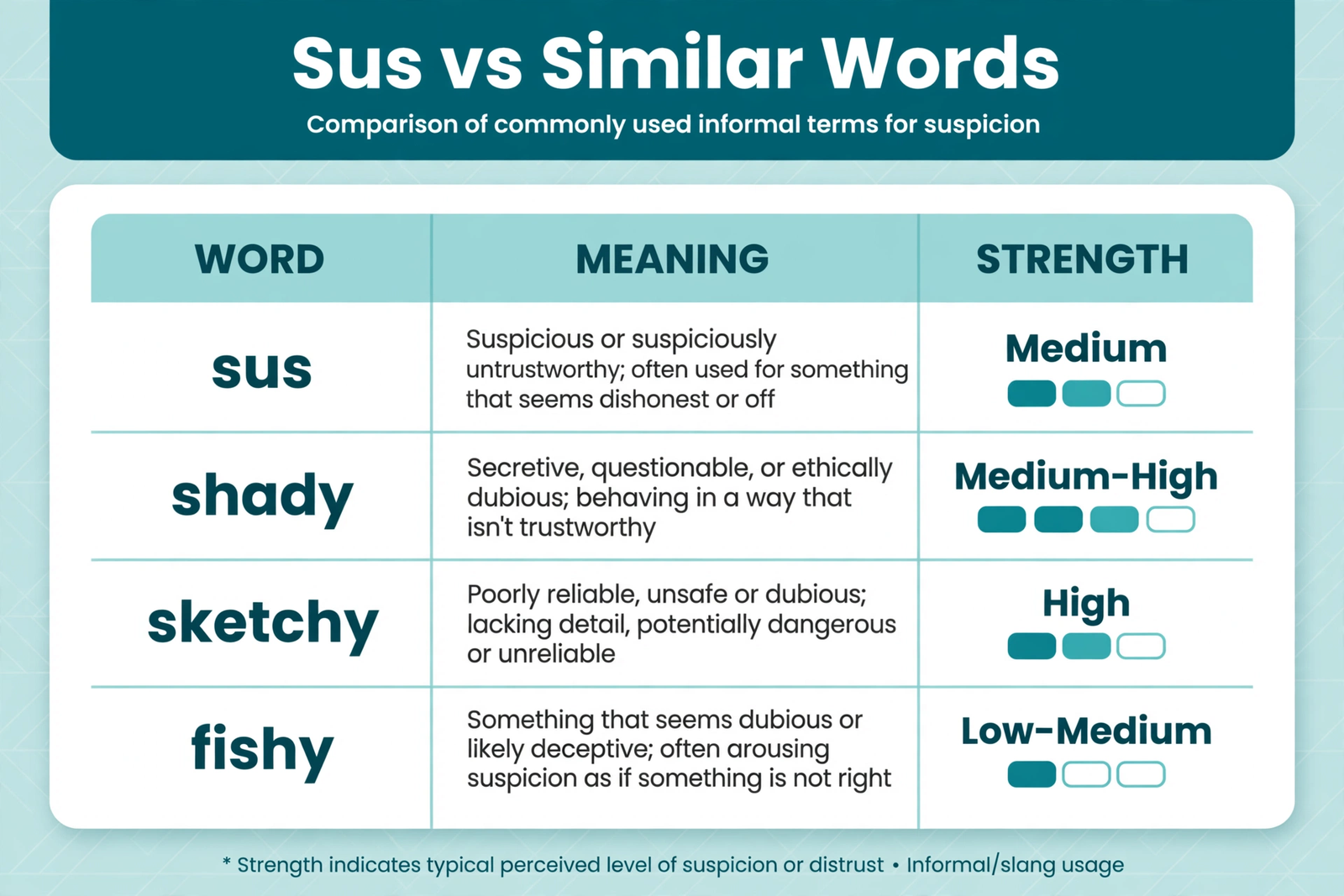
Sus has plenty of cousins, and picking the right one depends on how strong your doubt is and who you are talking to. This table breaks down the closest alternatives so you never mix them up.
| Term | Meaning | Strength | Best used when |
|---|---|---|---|
| Sus | Suspicious, questionable, feels off | Medium | Texting, gaming, casual chat — the all-rounder |
| Shady | Dishonest or untrustworthy | Medium–Strong | Describing a person or business with a bad reputation |
| Sketchy | Unsafe, unreliable, or dodgy | Medium–Strong | Places, people, or situations that feel unsafe |
| Fishy | Something smells wrong (figuratively) | Light–Medium | Stories or explanations that don’t add up |
| Suss / suss out | To figure out or investigate | Neutral | British English; “let me suss it out” |
| Dodgy | Suspicious or of poor quality | Medium | British/Australian English; a dodgy deal |
| Cap / no cap | Lie / no lie | Strong | Calling out a lie directly (see our cap meaning slang guide) |
The key difference: sus is the softest accusation of the bunch. “Shady” and “sketchy” suggest you already believe something is wrong; “fishy” suggests the story doesn’t add up; “sus” simply says your suspicion radar is beeping. That is why it works so well in group chats — you can raise a doubt without starting a fight. If you want the full picture of how gamers and texters call out lies, our guides to cap and tea meaning slang pair naturally with this one.
Alternate Meanings
Like most slang, sus wears more than one hat. The adjective meaning “suspicious” is by far the most common, but you will run into these other uses too.
- A suspected person (noun, older British slang). In 1930s British street and police slang, “a sus” was a suspected person, and being “on sus” meant being arrested under the old suspicion laws. You will still see this in historical writing and British crime novels, but almost never in modern texting.
- Suss out (verb phrase). “To suss something out” means to investigate or figure it out — “Give me a minute to suss out what happened.” This is standard British English and perfectly polite, unlike sus itself.
- Suspended chord (music). In music theory, “sus” is short for “suspended” — a chord like Csus4. If a musician says “play a sus chord,” they are talking about notes, not suspicion. Context makes this one obvious.
- Sussy baka (meme phrase). A joking phrase combining sussy (a cute, exaggerated form of sus) with baka, the Japanese word for “fool.” It is pure meme language — playful, silly, and never meant literally. If someone calls you a “sussy baka,” they are teasing you, not accusing you.
- The 2010s dating usage. For a period in the late 2010s, calling a man “sus” was also used to hint — usually jokingly, sometimes cruelly — that he might secretly be gay. That usage has largely died out, and it is best avoided today: it reads as dated and can come across as insulting rather than funny.
When you see sus in the wild, the surrounding sentence almost always tells you which meaning applies. In a game or a text, it means suspicious. In a music lesson, it means a chord. In a history book, it means the old police slang. Context is the decoder — which brings us to the polite alternatives.
Professional or Polite Alternatives
Sus is casual by nature, so there are rooms where it does not belong: job interviews, formal emails, academic writing, and serious conversations with people you don’t know well. Here are natural replacements that keep your meaning without the slang.
| Instead of | Say this (formal) | When to use it |
|---|---|---|
| “That’s sus.” | “That seems questionable.” | Work emails, meetings |
| “He’s acting sus.” | “His behaviour seems inconsistent.” | Reporting a concern |
| “This deal is sus.” | “This offer seems too good to be true.” | Talking to a seller or bank |
| “That link looks sus.” | “That link looks unverified / potentially unsafe.” | Warning colleagues about phishing |
| “Something feels sus.” | “Something doesn’t add up.” | Any polite conversation |
A good rule of thumb: if you would not say “shady” in the same sentence, don’t say “sus” either. With friends, sus is perfect. With a client, a teacher, or a hiring manager, switch to “questionable,” “inconsistent,” or “unverified” — you keep the doubt and lose the risk of sounding unprofessional.
Common Mistakes
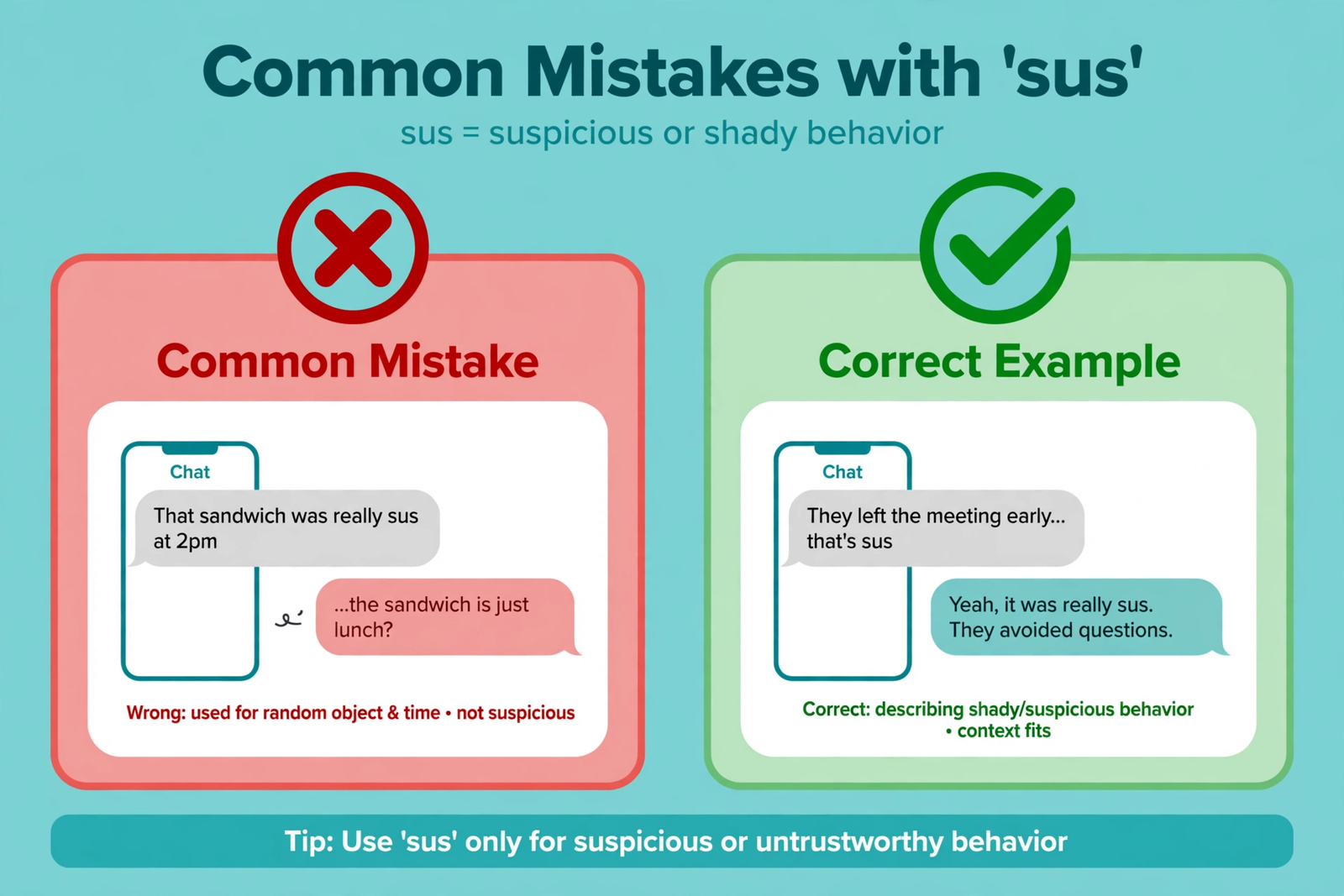
Sus is easy to use, but these are the mistakes that make people sound out of touch — or accidentally rude.
- Using sus as a real accusation. Sus means “I have doubts,” not “I have proof.” Telling someone “you’re sus” in a serious situation can feel like an accusation of lying or cheating. If you have a genuine concern, say it directly instead of hiding behind slang.
- Saying it in formal settings. Dropping “that’s sus” in a job interview or a client email will not land well. Save it for casual conversation and switch to “questionable” or “inconsistent” at work.
- Confusing sus with suss. “Sus” is the adjective (suspicious). “Suss” is the verb (to figure out). “He’s sus” is correct; “He’s suss” means something different — and “let me sus it out” is not standard. Keep them separate.
- Overusing it until it means nothing. If everything is sus — the weather, your lunch, your own reflection — the word loses its punch. Save it for moments when something genuinely feels off, and it stays funny and effective.
- Using the outdated dating insult. The 2010s usage of sus as a coded hint about someone’s sexuality is dead for a reason. Don’t revive it — it reads as insulting, not clever.
- Spelling it “suss” in texts. In American texting and gaming, the standard spelling is sus with one S. “Suss” is the British verb form or the older variant. Using “suss” as the adjective will confuse readers and mark you as unfamiliar with the term.
- Calling everything in Among Us sus. In the game, accusing everyone makes you look like the Impostor. The same applies in real life: constant suspicion makes people stop trusting you.
Quick Tips
- Default test: If you can replace sus with “suspicious” and the sentence still works, you are using it correctly.
- Pair it with evidence: “That’s sus — he said he was home but his location says otherwise” hits harder than “that’s sus” alone.
- Match the energy: Friends joking around? Go full “sussy baka.” A serious chat? Keep it to one calm “that seems sus to me.”
- Use it for scams: Sus is genuinely useful for flagging phishing links, fake giveaways, and too-good-to-be-true deals — saying “this looks sus” can stop a friend from clicking something dangerous.
- Don’t force it: If a sentence sounds unnatural with sus in it, it probably is. The word works best as a quick reaction, not a paragraph.
- Know your audience: Teens, gamers, and group chats love it. Grandparents, hiring managers, and formal emails do not. Read the room.
- Learn the neighbours: Sus travels with other slang — if you want the full toolkit, check our guides to ratchet slang and clanker meaning slang next.


FAQ
1. What does sus mean in slang?
Sus is short for “suspicious” or “suspect.” It describes a person, thing, or situation that feels off, dishonest, or untrustworthy — as in “that’s sus” or “he’s acting sus.” It became globally famous through the game Among Us in 2020, but the word dates back to 1930s British slang.
2. What does sus mean in Among Us?
In Among Us, “sus” means a player is suspected of being the Impostor — the secret killer among the crew. Players type things like “red is sus” to accuse someone, and the group votes on who to eject. The game’s 2020 popularity boom is what turned sus into a mainstream word.
3. What does sus mean in texting?
In texting, sus means something seems questionable or not quite believable — a story that doesn’t add up, an excuse that feels fake, or a deal that looks like a scam. Example: “He said his phone died but he’s been online all day… sus.”
4. What does sus mean on TikTok?
On TikTok, sus means the same as everywhere else — suspicious or sketchy — but it often appears in jokes, memes, and comments, including the phrase “sussy baka.” Creators use it to react to weird videos, fake stories, or suspicious behaviour in stitches and duets.
5. Is sus rude or offensive?
No, sus is not rude by itself — it is casual and playful. But it can feel accusatory if you say it seriously to someone’s face, since it implies you doubt their honesty. Among friends it is teasing; in formal settings, use “questionable” or “inconsistent” instead.
6. What does sussy baka mean?
“Sussy baka” is a meme phrase combining sussy (a playful form of sus) with baka, the Japanese word for “fool.” It roughly means “suspicious fool” and is used as a silly, teasing joke — never as a serious accusation.
7. Where did sus come from?
Sus comes from British police and street slang of the 1920s–1930s, where it meant a suspected person or a suspicion, related to the verb “suss out.” It spread through Black American and internet speech in the 2000s, then exploded worldwide when Among Us players used it in 2020. Merriam-Webster added it to the dictionary in September 2022.
8. What is the opposite of sus?
The opposite of sus is “legit” (genuine, trustworthy) or “checks out” — as in “I verified the seller, it’s legit.” Other opposites include “trustworthy,” “credible,” and “above board.” If something is not sus, people say “it checks out” or “no cap, it’s real.”
Conclusion
Sus meaning slang is one of those rare words that is small, old, and everywhere at once. It started as 1930s British police slang, travelled through American street speech and the internet, and became a global catchphrase thanks to a video game about space crewmates and a secret Impostor. Today it is the fastest way to say “something feels off” — in a text, a TikTok comment, a gaming lobby, or a warning about a scam link.
The key takeaways are simple. Sus means suspicious or suspect, and it works as a soft accusation — doubt without proof. Use it with friends and in casual chats, pair it with a reason when it matters, and swap it for “questionable” or “inconsistent” when the room is formal. Don’t overuse it, don’t confuse it with “suss,” and leave the outdated insult version in the past where it belongs.
Once you know the history, the word gets even better: every time you say “that’s sus,” you are using a piece of slang with nearly a century of stories behind it. And if you want to keep building your slang vocabulary, our guides to cap meaning slang, tea meaning slang, and ratchet slang are the natural next stops.
Quick recap: Sus = suspicious or suspect · born in 1930s British slang · made famous by Among Us in 2020 · added to Merriam-Webster in 2022 · use it when something feels off, and switch to “questionable” when formality matters.

5 thoughts on “Sus Meaning Slang: What Does Sus Mean in Text, Gaming & Everyday Talk? (2026)”