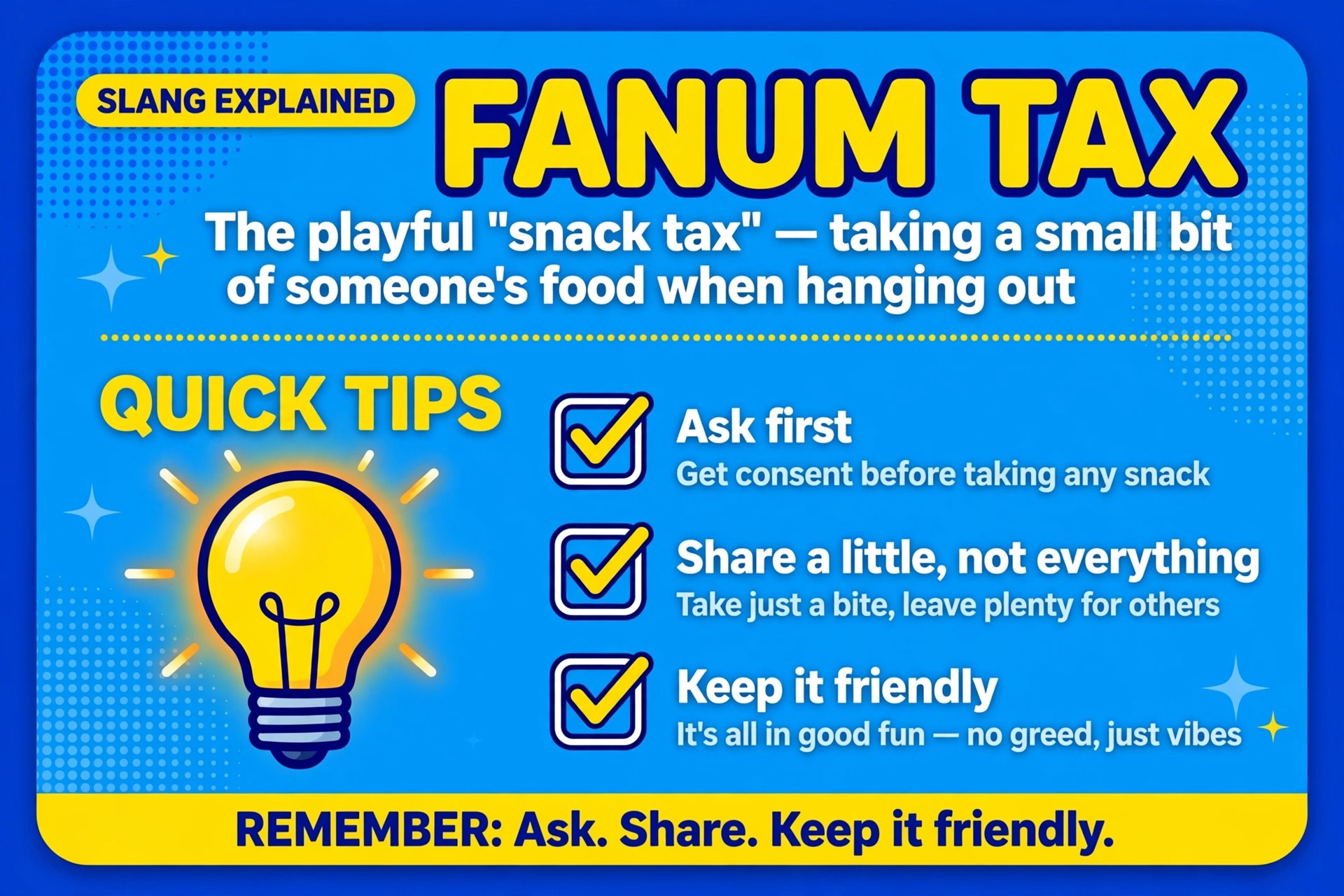
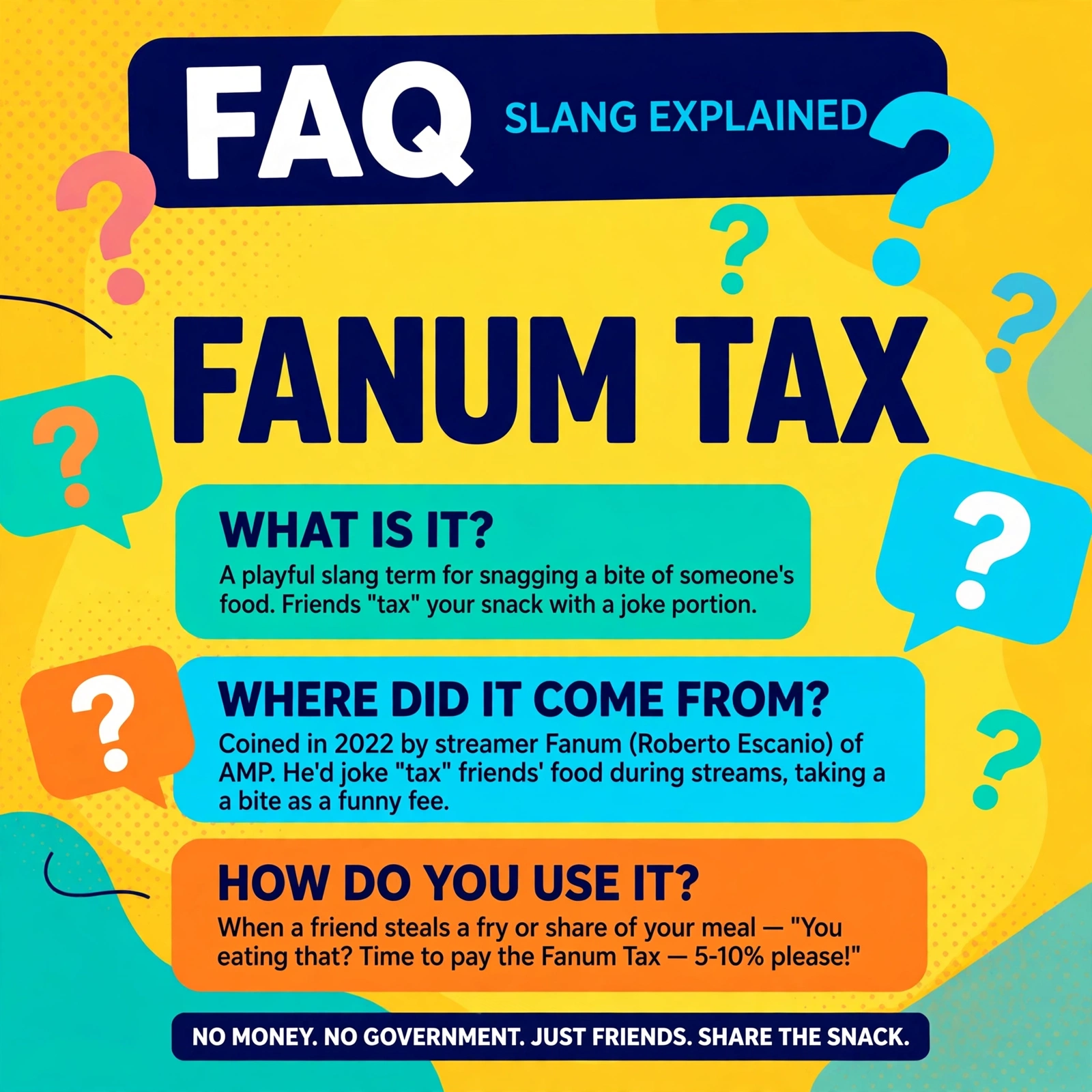
Quick definition: Fanum tax meaning in texting and slang is simple — it is a playful “tax” where someone takes a share of your food or snacks. If a friend grabs a fry off your plate and says “fanum tax,” they are jokingly claiming their cut, named after streamer Fanum who turned taking food from friends into a running joke on his live streams.
Introduction
If you have spent any time around teenagers or on TikTok lately, you have probably heard someone yell “fanum tax!” right before stealing a chicken nugget. Like many viral phrases, fanum tax meaning confuses adults the moment they hear it — is it a real tax? Is Fanum a government agency? The truth is much funnier.
The fanum tax is pure internet humor: an imaginary rule that says if your food looks good, your friends are entitled to a portion of it. It started as an inside joke among streamers, exploded through Twitch clips and TikTok remixes, and became one of the defining words of Gen Alpha slang. In this guide, we will break down the fanum tax meaning in text, where it came from, how to use it naturally, and the mistakes to avoid so you never sound out of touch.
If slang like this keeps tripping you up, you are not alone — abbreviations change fast online. Check our guides on idt meaning in text and wya meaning in text for more everyday internet phrases explained the same simple way.
Fanum Tax Meaning & Definition
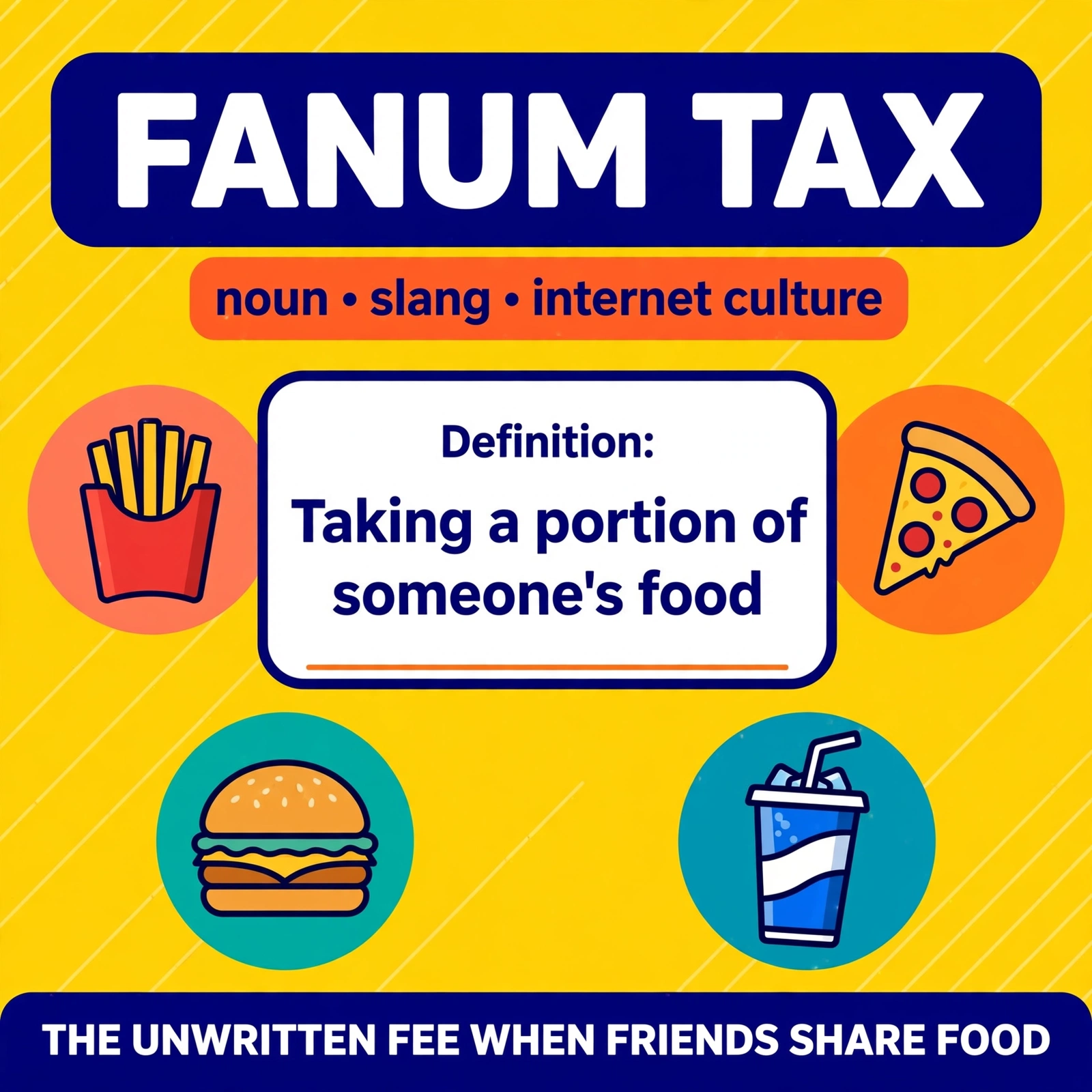
At its core, fanum tax is internet slang for taking or claiming a share of someone else’s food. It works like a joke law: your friend has fries, you want fries, so you declare a “tax” and take a few. Nobody is actually owed anything — the whole point is the comedy of treating snack theft like an official policy.
Here is how the phrase usually shows up:
- As a verb: “He fanum taxed my burger.” (He took a bite of my burger.)
- As a demand: “Pay the fanum tax!” (Give me some of your food.)
- As an excuse: “Sorry, it was the fanum tax.” (Said after grabbing food.)
- As a noun: “That is a heavy fanum tax.” (That was a big portion taken.)
The word “tax” is what makes it funny. A real tax is money you must pay the government; the fanum tax is food you “must” pay your friends. The joke borrows the seriousness of taxes and applies it to something as silly as stealing a fry. Similar food-stealing jokes have existed forever — older siblings have been “taxing” their brothers’ plates since the dawn of time — but the fanum tax gave the joke a name, a mascot, and a meme engine.
Origin
The fanum tax origin traces back to American streamer Roberto Gonzalez, known online as Fanum. Fanum, a Bronx-raised creator of Dominican descent, is a founding member of AMP, the popular streamer collective built around Kai Cenat, Agent 00, Duke Dennis, and ImDavisss.
In late 2022, Fanum developed a running bit on stream: whenever a friend was eating on camera, he would show up and take a portion of their food, calling it his “tax.” The most famous moment came during a December 2022 Christmas stream, when Fanum burst into Kai Cenat’s room and took his plate of cookies. Clips of the cookie heist spread fast, and viewers began using “fanum tax” in chat whenever food appeared on stream.
In a later interview with Wired, Fanum himself explained the concept: if your friend has a good meal and you want a piece of it, you take a little share — “5%, 10% of the meal, maybe 20%.” That casual definition became the canonical explanation of the fanum tax meaning. You can read more about his background on Fanum’s Wikipedia page, which documents the meme’s rise.
Interestingly, the bit almost ended in 2023 when Fanum tried to “tax” Agent 00’s mini-fridge and the two got into a real altercation — proof that the fanum tax works best when it stays a small, funny bite rather than a full appliance.
Popularity
The fanum tax stayed inside streaming culture until October 2023, when it detonated across TikTok. That month, a parody song built on the 2021 track “Ecstasy” — often called “Sticking Out Your Gyat for the Rizzler” or simply the “fanum tax song” — went massively viral. The sound was used in nearly 200,000 TikTok videos and racked up over 320 million views, packing in a cluster of Gen Alpha slang words like gyatt, skibidi, rizz, and sigma.
The New York Times even described this vocabulary as “the language of Gen Alpha,” cementing the fanum tax as more than a Twitch inside joke. From there it followed the classic internet-slang pipeline: streamer bit → viral clips → TikTok meme → schoolyard language → confused parents googling “fanum tax meaning” at the dinner table. Major dictionaries now track it as slang, and even celebrities got in on it — John Cena was famously “fanum taxed” on camera in 2024.
How “Fanum Tax” Is Used in Texting
In text messages and comments, the fanum tax usually appears in three situations:
- Announcing the theft: “Your fries look amazing. Fanum tax incoming.”
- Demanding a share: “You got pizza?? Pay the fanum tax.”
- Reporting what happened: “Left my nuggets for one second and got fanum taxed.”
Tone matters. Between friends, it is playful and signals closeness — you only “tax” people you are comfortable with. In comments on food videos, it is a meme reaction, like saying “take my money” under a cool product video. It is rarely used seriously; if someone says it with a flat tone, they are probably annoyed you actually took too much.
The phrase also pairs well with other slang. You might see “fanum tax + aura points” jokes, or someone combining it with smh energy: “He took HALF my fries. Smh, that was not a tax, that was robbery.”
Examples
Context is everything with slang. Here is how the fanum tax meaning plays out in real conversations, grouped by tone.
Friendly Examples
- Friend A: “Just got loaded nachos 🧀”
Friend B: “Save me some! Fanum tax is real.” - Friend A: “This cookie is insane.”
Friend B: “One bite. That’s the tax.” - “Ordered extra fries specifically because I know the fanum tax is coming.”
- Mom: “Why is there a bite out of my sandwich?”
Kid: “Fanum tax, mom. It’s the law.”
Professional Examples
Honestly? There are almost none — the fanum tax is not office language. The closest you will get is a playful workplace chat:
- “Brought donuts for the team. Fanum tax applies — grab one before the meeting.”
- “Someone fanum taxed my lunch from the office fridge. We need to talk.” (joking complaint)
Rule of thumb: keep the fanum tax with friends, family, and the internet. Do not use it in emails to your boss.
Funny Examples
- “My dog looked at my steak. That’s an automatic fanum tax situation.”
- “POV: you open your chips and hear ‘fanum tax’ from three different directions.”
- “The government taxes my paycheck, my friends tax my pizza. I can’t win.”
- Friend: “Want a bite?”
You: “A bite? Sir, this is a full fanum tax audit.”

Comparison with Similar Terms
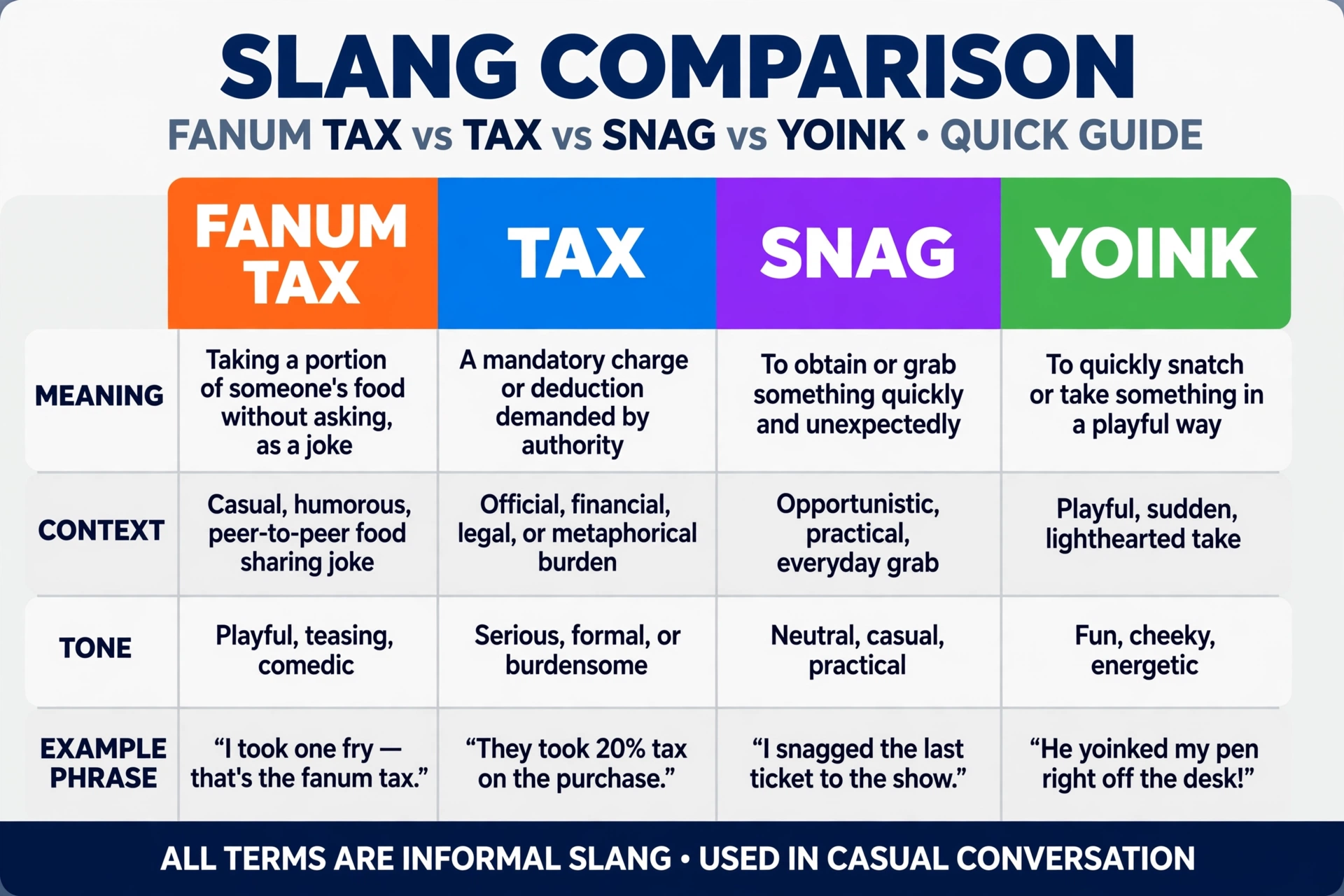
The fanum tax is not the only way to describe swiping food. Here is how it stacks up against similar slang:
| Term | Meaning | How it differs from fanum tax |
|---|---|---|
| Fanum tax | Playfully taking a share of someone’s food | The original meme; tied to streamer Fanum and internet culture |
| Food tax | Taking a bite of someone’s meal as a “fee” | The older, generic version — fanum tax is its viral rebrand |
| Snag | Quickly grabbing something | General theft slang; not food-specific and not a joke “law” |
| Yoink | To take something swiftly and playfully | An older meme word; the taking is quick, not “taxed” |
| Tax (general slang) | Taking a cut of anything, not just food | Broader; fanum tax specifically means food |
Think of it this way: “food tax” is what your dad calls it, “fanum tax” is what TikTok calls it, and “yoink” is what millennials said in 2012. Same crime, different generation.
Alternate Meanings
Unlike some slang with double lives, the fanum tax has one dominant meaning: food-related sharing (or stealing). There are no widely used alternate definitions. The only nuance is that some people stretch it beyond food:
- Snack-only purists: the original meaning — only food and drinks count.
- Expanded use: some friend groups apply it to anything shareable, like “fanum taxing” a charger or a hoodie. This is less common and usually said as a joke.
- As a compliment: “Your fit is fanum tax worthy” — meaning something looks so good it deserves to be “taxed.” Rare, but it exists.
If someone uses “fanum tax” and there is no food in sight, they are almost certainly joking around with the expanded meaning.
Professional or Polite Alternatives
Since the fanum tax is pure casual slang, here is how to say the same thing when you need to sound like an adult:
- “Could I try a bite?” — the universal polite version.
- “That looks amazing — mind if I have some?”
- “I will trade you a fry for a nugget.”
- “Save me a piece, please.”
- In writing: “May I sample some of your dish?”
None of these are as fun, but all of them will survive a job interview.
Common Mistakes
People new to the meme get the fanum tax meaning wrong in a few predictable ways:
- Thinking it is a real tax. No government agency named Fanum is coming for your sandwich. It is a joke.
- Using it with strangers. Declaring “fanum tax” on a stranger’s food is not funny — it is just taking someone’s food. Keep it to friends.
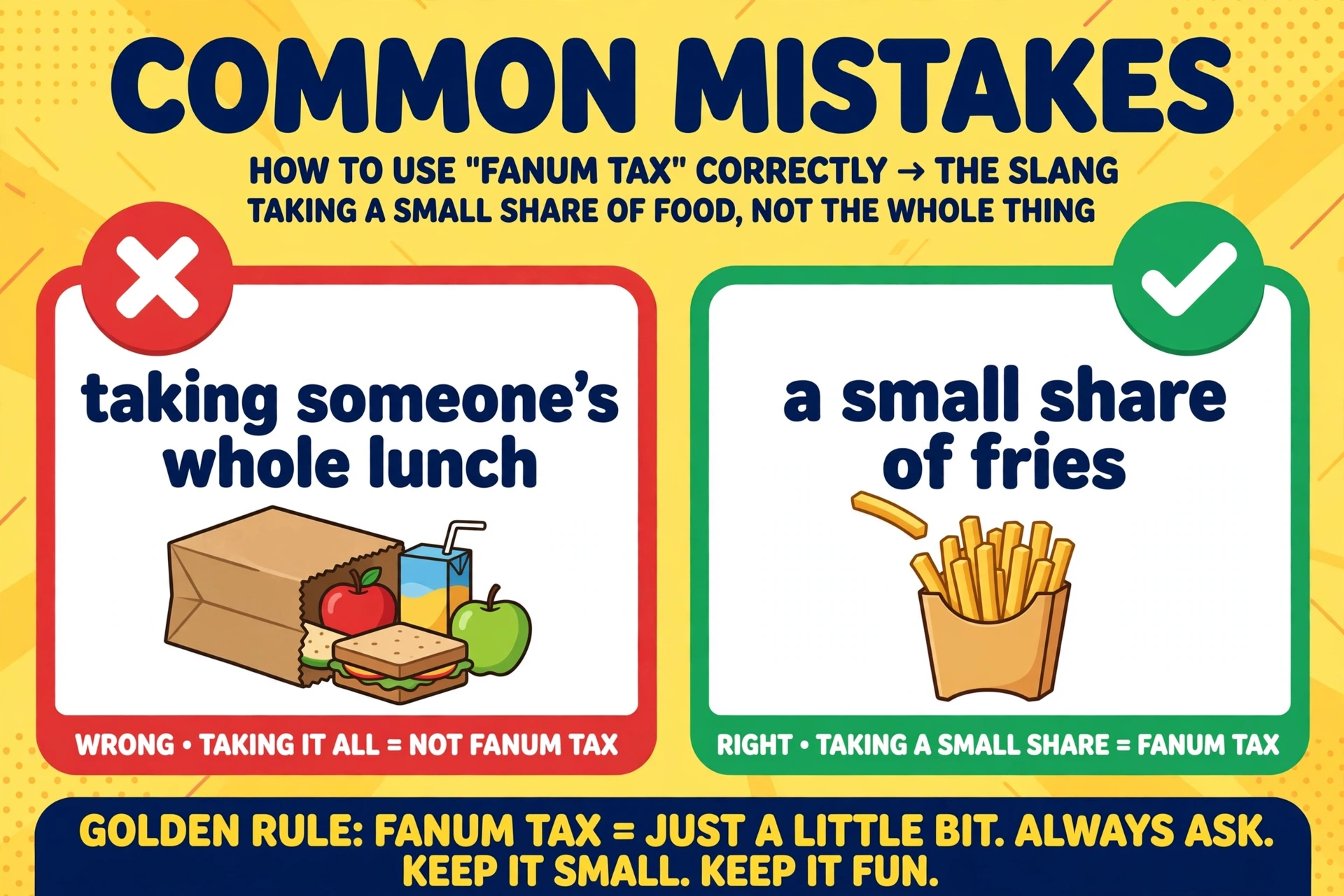
- Taking too much. The meme works for a fry or a bite. Taking half the plate is not a tax, it is theft, and your friends will say so.
- Using it in formal settings. Do not “fanum tax” the client dinner. Read the room.
- Overusing it. Like every meme, saying it ten times a day kills the joke. Deploy it sparingly for maximum comedy.
- Spelling it “phantom tax.” It is Fanum, the streamer’s name — not phantom. Spell it right or the internet will notice.
Quick Tips
- Keep the tax small. One fry, one bite, one sip — that is the spirit of the meme.
- Announce it. Yelling “fanum tax!” before you grab makes it comedy instead of rudeness.
- Know your audience. Friends and TikTok comments: perfect. Grandma’s birthday dinner: maybe not.
- Pair it with the lore. Dropping a “5%… maybe 20%” (Fanum’s own percentages) shows you know the origin and gets laughs from people in the know.
- Accept being taxed. If you deal it, you take it. The fanum tax economy runs on mutual snack theft.
- Do not force it. If nobody laughs the first time, retire the bit instead of repeating it louder.
FAQ
1. What does fanum tax mean in texting?
Fanum tax meaning in texting is a joking “tax” on food — it means someone is playfully taking a share of your snacks or meal. Saying “fanum tax” before grabbing a fry turns snack theft into a meme.
2. Who started the fanum tax?
Streamer Fanum (Roberto Gonzalez), a founding member of the AMP creator group, started it in late 2022. He would take food from friends like Kai Cenat during live streams and call it his “tax,” and clips of the bit went viral.
3. Is the fanum tax a real tax?
No. There is no real tax, no paperwork, and no government involved. It is 100% internet humor — a fake rule that says your friends get a cut of your food.
4. Why is it called a “tax”?
Because a tax is something you are required to pay. The joke pretends your friends have an official right to a portion of your meal, which makes the silly food-stealing feel like serious business.
5. What is the fanum tax song?
In October 2023, a parody song built on “Ecstasy” — often called “Sticking Out Your Gyat for the Rizzler” or the “fanum tax song” — exploded on TikTok, used in nearly 200,000 videos with over 320 million views. It pushed the term deep into Gen Alpha meme culture.
6. Can you use fanum tax for things other than food?
Mostly it means food. Some friend groups jokingly stretch it to other shareable things, but the classic fanum tax meaning is always about snacks and meals.
7. Is it rude to fanum tax someone?
Between close friends who are in on the joke, no — it is affectionate comedy. With strangers, or if you take too much, yes. The golden rule: small portions, friendly people, announced loudly.
8. What is the difference between fanum tax and food tax?
They mean almost the same thing, but “food tax” is the older generic joke while “fanum tax” is its viral, streamer-powered rebrand with a name, an origin story, and a TikTok song behind it.
Conclusion
The fanum tax meaning is simple: it is the internet’s funniest way to describe stealing a fry. Born from Fanum’s on-stream snack raids in late 2022, supercharged by Kai Cenat clips and a viral TikTok song in 2023, it grew from a Twitch inside joke into full-blown Gen Alpha vocabulary. Use it with friends, keep the portions small, announce your “tax” with confidence, and never try it on a stranger’s plate.
Slang moves fast, and the fanum tax is just one entry in a huge dictionary of internet speak. Keep exploring with our breakdowns of iktr meaning in text and idt meaning in text — and the next time someone reaches for your fries yelling “fanum tax,” you will know exactly what is happening.

1 thought on “Fanum Tax Meaning in Text: The Complete Guide to Gen Alpha’s Food Slang”