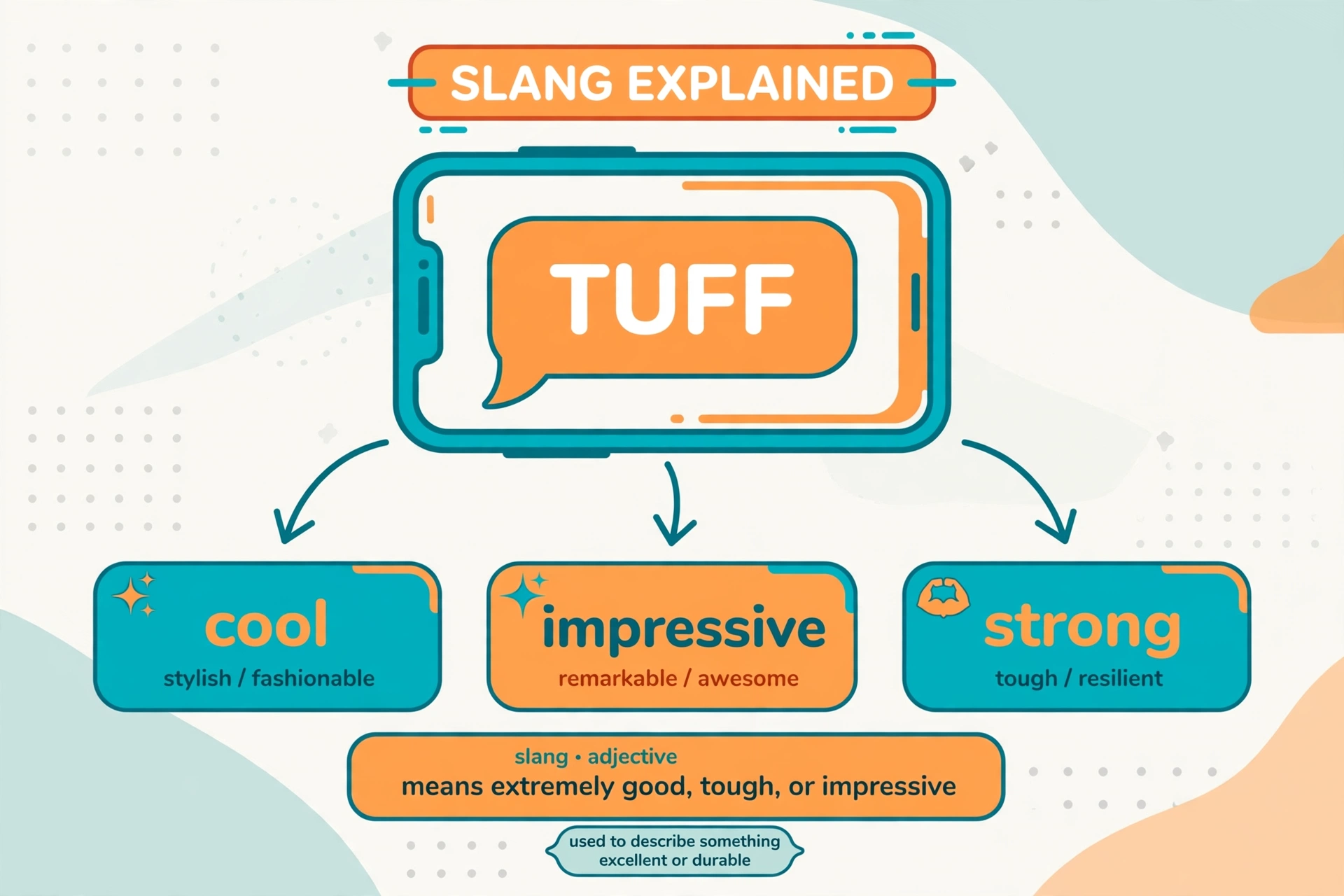
Quick definition: In slang, tuff means cool, impressive, strong, or hard-hitting. It is a stylized spelling of “tough” that Gen Z and social media users drop as quick praise — “That fit is tuff” means “That outfit is seriously cool.” Depending on context, it can also mean “that’s rough” when reacting to bad news.
Tuff Slang Meaning & Definition
The tuff slang meaning is simple once you hear it in context: it is praise. When someone calls your photo, your outfit, your song, or your skate trick “tuff,” they are saying it is impressive, stylish, or solid — the kind of thing that earns respect without needing a long compliment. It is the modern, internet-shaped cousin of the word “tough,” but with the difficulty drained out and the admiration turned up.
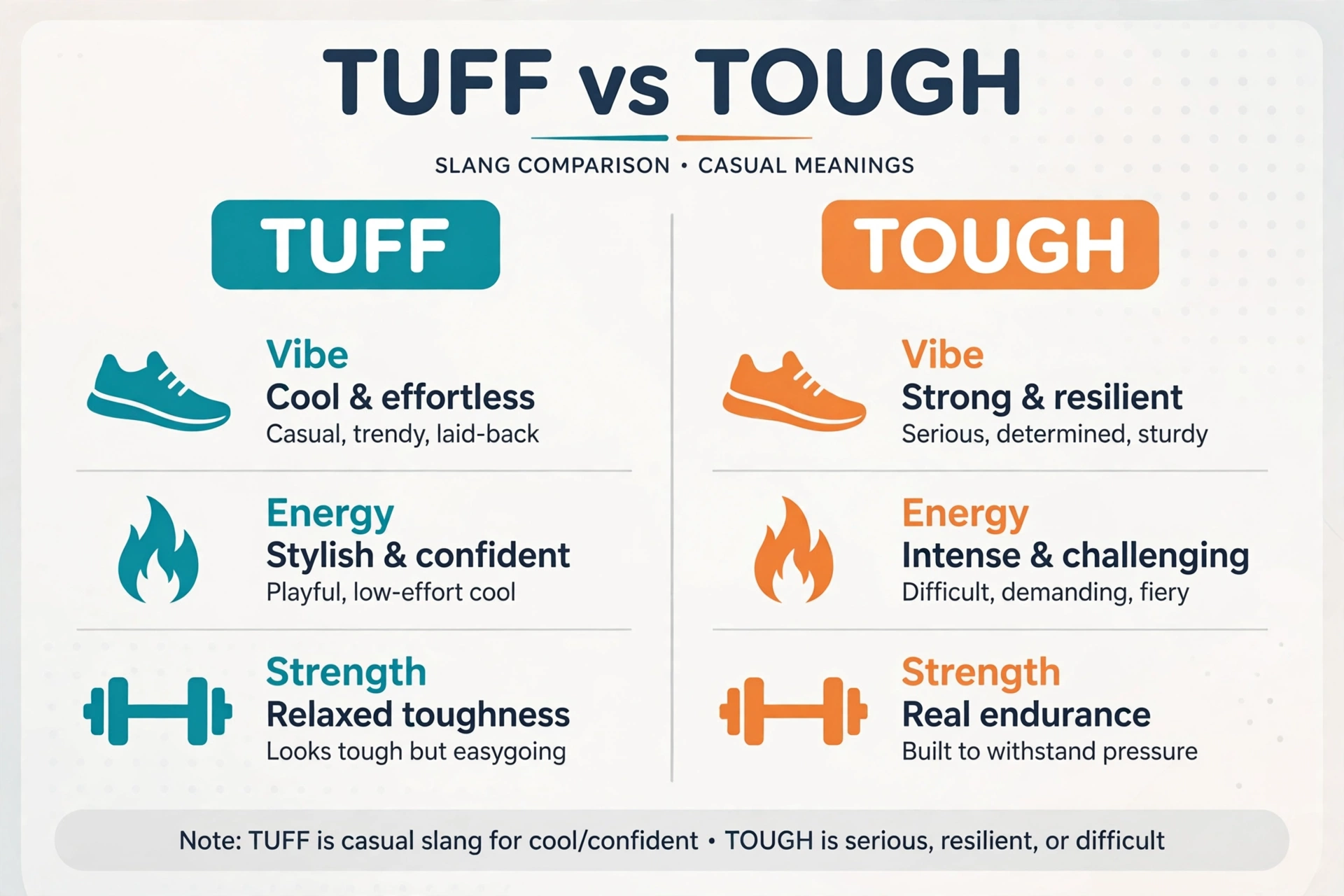
Unlike the standard English word “tough,” which usually describes something difficult, durable, or hard to endure, tuff slang is almost always positive. Saying “that beat is tuff” does not mean the beat is hard to listen to. It means the beat goes hard — it hits, it slaps, it is genuinely good. The spelling itself does the work: the double “f” and the missing “gh” signal that the speaker is being casual, playful, and online, not writing an essay.
There is one important exception. In the right context, “tuff” can also work as sympathy. If a friend texts “I just lost my job” and you reply “Damn, that’s tuff,” you are not complimenting them — you are saying “that’s rough, that’s heavy.” Tone and situation decide which meaning applies, and in practice the surrounding conversation almost always makes it obvious.
Introduction
You have probably seen it a hundred times without noticing: a single word sitting alone in a TikTok comment, under an Instagram fit check, or at the end of a text from a friend. “Tuff.” No emoji, no explanation, no follow-up. Just tuff. And if you did not grow up with it, that one word can feel like a riddle — is it a compliment? An insult? A typo?
It is, most of the time, a compliment — and a strong one. In the slang of TikTok, Instagram, gaming chats, and group texts, “tuff” has become one of the fastest ways to say “I respect that.” It is short, it is punchy, and it carries more weight than a simple “cool” or “nice.” This guide breaks down the full tuff slang meaning, where it came from, how people actually use it in 2026, and the mistakes to avoid so you never use it in the wrong moment.
Origin
The story of “tuff” starts with the ordinary English word “tough,” which has meant strong, durable, or difficult for centuries. The slang spelling is not new at all. Stylized spellings like “tuff” appeared in advertising, comic books, music, and urban speech as far back as the 1960s, usually as a way to sound casual, edgy, or street-smart. A leather jacket brand, a cartoon tough guy, or a song title might use “tuff” because it looked cooler than “tough” on a poster.
What changed is the internet. In the 2010s, hip-hop lyrics, sneaker culture, and skate videos kept the spelling alive, and then TikTok and short-form video gave it a second life. On platforms where a comment has about one second to land, a single punchy word beats a sentence. “Tuff” became the perfect reaction word: faster than “that’s really impressive,” cooler than “nice,” and flexible enough to fit a fit check, a dunk, a beat drop, or a car reveal.
By 2020, the word had fully crossed into mainstream Gen Z vocabulary. It spread from hip-hop and streetwear communities into gaming lobbies, sports edits, and everyday group chats, and by 2025 it was one of the most common one-word compliments on TikTok. The meaning also drifted during that journey. The older, literal sense — physically hard or durable — faded, and the newer sense — impressive, stylish, respected — took over. That drift is exactly why older readers sometimes misread it: they hear “tough” and think “difficult,” while the person typing it means “awesome.”
Popularity
Tuff is not a niche word anymore. It shows up across every platform where young people talk, and it has stayed active while dozens of other slang terms have burned out. A few reasons explain why it stuck:
- It is short. One syllable, four letters, no thinking required. It fits comments, captions, and fast-moving game chat.
- It is versatile. It works for outfits, music, sports, cars, food, art, and people. Almost anything impressive can be tuff.
- It sounds confident. Compared with “nice” or “cool,” tuff carries an edge. It suggests respect, not just approval.
- TikTok made it visual. Fit checks, transition videos, sports highlights, and music clips all invite a one-word verdict — and “tuff” became the default.
The word is most common among Gen Z (roughly ages 12 to 27) and younger Millennials, and it is strongest on TikTok, Instagram, Snapchat, and in texting. It also appears in gaming communities, sneaker and streetwear circles, and hip-hop fan spaces. You will hear it less in formal or professional settings, which is part of the point: tuff is a casual word, and using it casually is what makes it work.
Search interest in the term has stayed steady through 2025 and into 2026, and the questions people ask about it tell the story: “tuff slang meaning TikTok,” “tuff meaning from a guy,” “tuff vs tough,” and “is tuff a compliment.” People are not confused about whether the word exists — they are confused about intent, and that is what the rest of this guide clears up.
How It Is Used
Tuff works as an adjective, a reaction, and a standalone sentence. The grammar is loose on purpose. Here are the patterns you will actually see:
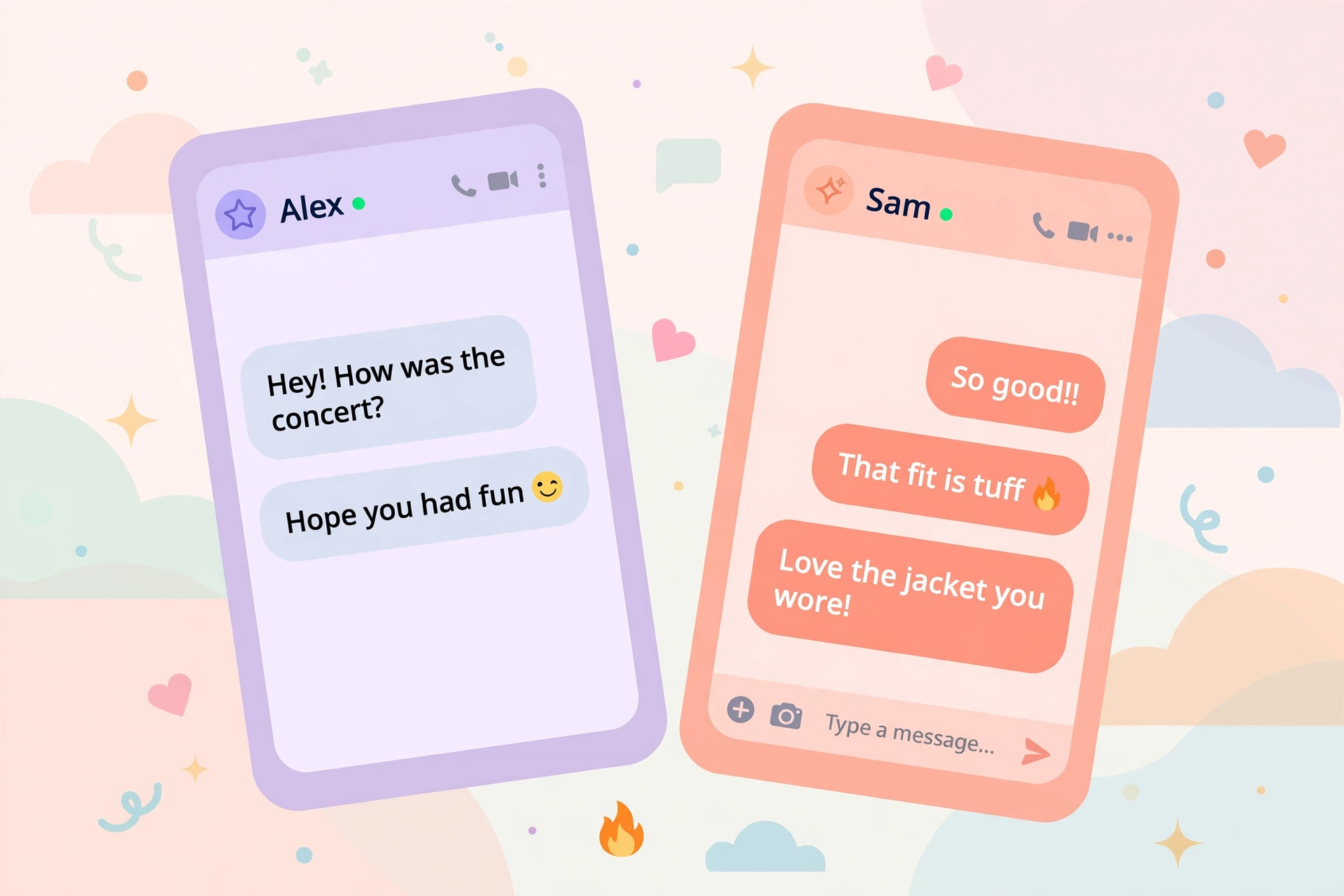
- As a one-word reaction: “Tuff.” / “Tuff 🔥” / “Tuff, no lie.” This is the most common form — a complete verdict in a single word.
- As an adjective: “That jacket is tuff.” / “Your new kicks are tuff.” / “That transition was tuff.”
- With an intensifier: “That’s tuff as hell.” / “So tuff.” / “Mad tuff.” (Adding an intensifier turns up the praise.)
- As sympathy: “You failed the test? That’s tuff.” / “Lost my wallet. Tuff day.” Here it means “that’s rough.”
- About a person: “Bro is tuff.” / “She’s tuff for that.” This praises someone’s skill, courage, or resilience.
The word also pairs naturally with fire emojis, “no cap,” “fr,” and “on god” — all of them ways of saying “I mean this sincerely.” A comment that reads “tuff 🔥🔥” is about as strong a compliment as a TikTok comment section gives. On the other hand, “tuff” on its own, with no emoji and no context, usually still reads as positive. The default meaning online is praise; the sympathy meaning needs a sad or difficult context to activate.
| Form | What it usually means | Example |
|---|---|---|
| “Tuff.” | Quick praise, approval | Comment under a fit check photo |
| “That’s tuff” | That is cool / impressive | Reacting to a skate trick video |
| “Tuff 🔥” | Strong praise, hype | Comment on a new song drop |
| “That’s tuff…” | That’s rough (sympathy) | Reply to bad news in a text |
| “He’s tuff” | He is skilled / respected | Talking about an athlete or artist |
Examples
Friendly Examples
Between friends, tuff is warm, casual praise. It is the kind of thing you say when your friend shows you something they are proud of:
- “Bro, that new haircut is tuff.”
- “Your playlist is actually tuff, send me the link.”
- “That goal was tuff, no lie.”
- “The fit is tuff today, I can’t lie.”
- “You cooked on that edit. Tuff.”
Professional Examples
Tuff is a casual word, so it does not belong in a formal email or a client meeting. But in creative, informal professional settings — a design team chat, a group of creators, a music studio — it works as genuine praise for good work:
- “The new logo concept is tuff. Clients are going to love it.”
- “That demo was tuff — the mix sounds clean.”
- “Your presentation slides are tuff, honestly.”
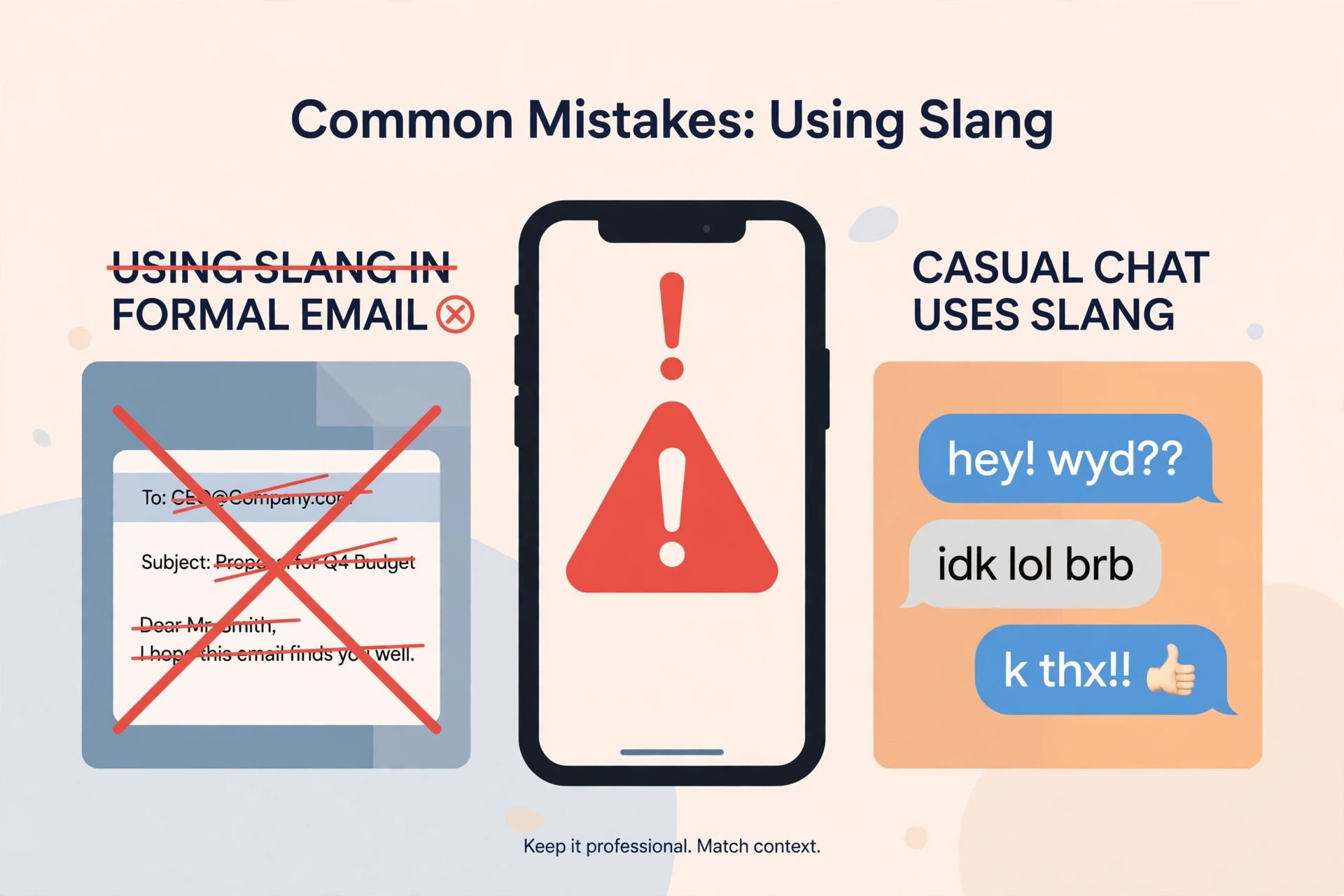
The rule is simple: use it with people who already speak casually with you. With a boss you barely know, or in any formal document, choose “impressive” or “excellent” instead. For more on how slang shifts between casual and formal settings, see our guide to GOAT meaning in slang, another praise word with its own rules.
Funny Examples
Because tuff is so short, it also works as a deadpan joke — praising something small as if it were legendary:
- “Bro made instant noodles at 3am. Tuff.”
- “He parallel parked first try. That’s tuff.”
- “My grandma just beat me at Mario Kart. She’s tuff.”
- “Two-ply toilet paper in a public bathroom? Tuff.”
Comparison with Similar Terms
Tuff overlaps with several other slang praise words, but each one has its own flavor. Knowing the difference keeps you from sounding off:
| Term | Meaning | When to use it | Tone |
|---|---|---|---|
| Tuff | Cool, impressive, strong-looking | Outfits, music, sports, edits, cars | Confident, edgy praise |
| Fire / Lit | Amazing, exciting, hot | Music, parties, food, moments | Energetic, hyped |
| Hard | Impressive, hits hard | Beats, lyrics, photos, plays | Very close to tuff; slightly more music/sports |
| Clean | Stylish, neat, well-executed | Outfits, transitions, designs | Smooth, polished |
| GOAT | Greatest of all time | Legends, best-ever performances | Maximum praise, not casual |
| Dope | Cool, excellent | General praise | Older slang, still understood |
| Bussin | Really good (often food) | Food, music, experiences | Playful, enthusiastic |
The closest cousin is “hard” — “that beat goes hard” and “that beat is tuff” mean nearly the same thing. “Fire” is broader and more emotional, while “clean” is narrower and more about style than impact. “GOAT” is a much bigger claim: calling something tuff says it is impressive, calling someone the GOAT says they are the best ever. If you want the full breakdown of that top-tier praise word, read our guide on what GOAT means in slang.
One more useful contrast is slime meaning in slang — another hip-hop-rooted word that changed meaning online. Where “slime” became a term for a close friend, “tuff” became a term for anything worthy of respect. Both show how a single word can travel from music culture into everyday texting and pick up a whole new job along the way.
Alternate Meanings
Outside of slang, “tuff” has a few completely different meanings, and they are worth knowing so you do not get confused when you meet them in the wild:
- Tuff as sympathy (“that’s rough”): The second slang meaning. “That’s tuff” after bad news means “that’s hard to hear” or “that’s unlucky.” Same word, opposite emotion — context decides.
- Tuff as “durable” or “resilient”: Closer to the original “tough.” “She’s tuff” can mean she is strong enough to handle hard times, not just that she looks cool. This is common in sports and motivational contexts.
- Tuff in geology: In science, tuff is a type of rock formed from volcanic ash. If you see “tuff” in a geology textbook, it has nothing to do with slang.
- Tuff as a name or brand: The spelling appears in brand names, usernames, and gamertags precisely because it looks edgy — the same reason it works as slang.
- “Tuff” in gaming: In gaming chats, tuff usually means a play was impressive (“that clutch was tuff”), but after a loss it can mean “tough luck” — again, context is everything.
The key point: when you see “tuff” on social media, in a text, or in a comment section, the slang meaning — cool, impressive, or rough depending on context — is almost certainly the right one. The geology meaning basically never shows up in a TikTok comment.
Professional or Polite Alternatives
Tuff is casual by design, so there are times to leave it out. In a job interview, a formal email, a school essay, or a conversation with someone who does not use slang, these alternatives carry the same meaning without the streetwear edge:
| Instead of | Say | Best for |
|---|---|---|
| “That’s tuff” | “That’s impressive” | Work, school, formal praise |
| “Your fit is tuff” | “Your outfit looks great” | Complimenting someone politely |
| “That beat is tuff” | “That song is excellent” | Reviewing music professionally |
| “She’s tuff” | “She’s resilient” | Praising someone’s strength |
| “That’s tuff” (sympathy) | “That’s really unfortunate” | Responding to bad news formally |
The flip side also matters: if someone calls your work “tuff” in a casual setting, the polite response is simply “thank you” or “appreciate it.” They just paid you a real compliment — in their language, “tuff” is high praise, roughly on the level of “excellent” in formal language.
Common Mistakes
Tuff is easy to use, but a few mistakes trip people up again and again:
- Mixing up tuff and tough. They sound identical, but they are not interchangeable in writing. “That test was tough” (difficult) is correct; “that test was tuff” would read as praise for the test, which is probably not what you mean. Save “tuff” for compliments.
- Using it as sympathy when you mean praise (and vice versa). “That’s tuff” after a friend’s breakup is sympathy. “That’s tuff” under a photo of their new car is praise. The words are the same; the moment is different. Read the room before you type it.
- Using it in formal writing. Tuff in a resume, a cover letter, or a school essay looks sloppy, not cool. It is a spoken and social-media word.
- Overusing it. If everything is tuff, nothing is. The word works because it is a verdict. Drop it once, at the right moment, and it lands. Spam it in every comment and it turns into noise.
- Correcting someone’s spelling. Tuff is not a typo for tough. If a friend writes “tuff,” they know exactly what they are doing. Correcting it just marks you as out of touch.
- Assuming it is always positive. Most of the time it is, but the sympathy use is real. If someone replies “tuff” to your bad news, they are not celebrating — they are saying “that’s rough, I hear you.”
Quick Tips
- Use it as a one-word reaction. “Tuff.” with a fire emoji is the fastest compliment on the internet. It works under photos, videos, songs, and highlights.
- Match the energy. Tuff fits hype moments — a great play, a clean outfit, a hard beat. It sounds strange next to quiet or serious news unless you mean the sympathy version.
- Pair it, don’t stack it. “Tuff 🔥” is perfect. “Tuff 🔥💯😤🙌” is trying too hard. One or two emojis is enough.
- Use it about things, not just people. Fits, cars, beats, edits, plays, food, art — anything impressive can be tuff. That flexibility is the whole point.
- When in doubt, check the context. Good news + “tuff” = praise. Bad news + “tuff” = sympathy. If you are unsure which one someone means, the message right before it will tell you.
- Don’t force it. If tuff is not a word you naturally use, a simple “that’s awesome” says the same thing. Slang only works when it sounds like you.
- Learn the neighbors. Tuff travels with words like “hard,” “clean,” “fire,” and “no cap.” If you want to sound natural in slang-heavy conversations, knowing the whole set helps — for example, dodo meaning in slang shows how another simple word picked up a completely different job online, and TS meaning in slang covers a term whose meaning changes entirely with context, just like tuff.

FAQ
1. What does tuff mean in slang?
In slang, tuff means cool, impressive, strong, or hard-hitting. It is a stylized spelling of “tough” used as praise — “That fit is tuff” means “That outfit is seriously cool.” In a sad context, it can also mean “that’s rough.”
2. Is tuff a compliment?
Yes, almost always. When someone calls your outfit, music, photo, or skills tuff, they are complimenting you. The only exception is the sympathy use: replying “that’s tuff” to bad news means “that’s rough,” not “nice job.”
3. What does tuff mean on TikTok?
On TikTok, tuff is a one-word compliment in comments and captions. It usually praises a fit check, a transition, a sports highlight, a dance, or a song. “Tuff 🔥” in a comment section is strong approval from the viewer.
4. What is the difference between tuff and tough?
They sound the same but work differently. “Tough” is standard English meaning difficult, strong, or durable (“a tough exam”). “Tuff” is slang spelling used as praise for something cool or impressive (“that jacket is tuff”). In writing, they are not interchangeable.
5. What does “that’s tuff” mean in a text?
It depends on the conversation. After good news or an impressive photo, it means “that’s cool” or “that’s awesome.” After bad news, it means “that’s rough” or “that’s unlucky.” The message before it tells you which one applies.
6. What does tuff mean from a guy?
When a guy says something is tuff, he almost always means it is cool or impressive — it is a compliment. If he says it about your outfit, photo, or skills, he is showing respect or admiration. If he says “that’s tuff” after bad news, he means “that’s rough.”
7. Is tuff Gen Z slang?
Yes. Tuff is most popular with Gen Z (roughly ages 12 to 27) on TikTok, Instagram, Snapchat, and in texting. The spelling itself is older — it appeared in advertising and music decades ago — but its current meaning as quick praise is a Gen Z and social media creation.
8. Can I use tuff in formal situations?
No, not really. Tuff is casual slang. In formal writing, work emails, or professional settings, use “impressive,” “excellent,” or “outstanding” instead. Save tuff for friends, social media, and casual conversations where slang is welcome.
Conclusion
The tuff slang meaning is refreshingly simple: it is a short, confident way to say something is cool, impressive, or worthy of respect. Born as a stylized spelling of “tough,” carried by hip-hop and streetwear, and launched into everyday language by TikTok, tuff has become one of the most useful words in modern slang — a complete compliment in four letters.
The one thing to remember is context. In a comment under a great photo, tuff is praise. In a reply to bad news, tuff is sympathy. Get the context right, use it sparingly, and never write it in a formal email — and you will sound like someone who actually speaks the language, not someone reading it off a list. Now the next time a comment just says “tuff 🔥,” you will know exactly what it means: they think what you did was seriously impressive. And honestly? That is a pretty tuff compliment to get.
For the standard English definition behind the slang, see Merriam-Webster’s entry for “tough” — the word tuff is a stylized spelling of.
