
Quick definition: In slang, a tool is a person who acts foolish, clueless, or easily used by others — someone who lets people push them around, tries too hard to look cool, and does not realize they are being played.
Tool Slang Meaning & Definition
The tool slang meaning is simple but sharp: when someone calls a person a tool, they are saying that person is a fool who can be used like an object. Think of a hammer or a screwdriver — it has no mind of its own, and someone else picks it up and uses it for their own purpose. That is exactly the image behind the insult. A tool, in this sense, is a person who follows others without thinking, brags without backing it up, or lets someone else control their decisions.
Most of the time, the word is aimed at a guy who is acting arrogant, obnoxious, or desperate for approval. It can also describe someone who is gullible — the friend who always pays for everyone, the coworker who does someone else’s work without noticing, or the guy in the group chat who agrees with everything just to fit in. The tone can be light teasing between close friends, or it can be a real put-down when someone is being genuinely annoying.
So, what does tool mean in slang? At its core, it means a foolish, easily manipulated person. The Cambridge Dictionary defines this sense of tool as “someone whose decisions and actions are unfairly controlled by others,” which captures the insult perfectly. It is not a compliment, and it is not a word you want aimed at you — but it is also not the harshest insult out there. It sits somewhere between a joke and a roast, and the context decides which one it is.
Here is the short version you can remember: if someone is being used and does not even know it, people call them a tool. If someone is acting like a jerk while trying to look cool, people also call them a tool. Both uses point at the same idea — a person without independence, confidence, or self-awareness.
Introduction
You have probably seen it in a comment section: someone posts a video of a guy flexing his rented sports car, and the top comment just says, “What a tool.” Or a friend texts the group chat, “He bought her flowers after she ghosted him twice. What a tool.” Everyone laughs, nobody explains, and if you are new to the word, you are left guessing.
That is where this guide comes in. The word tool has been an insult for hundreds of years, but it found a second life online — in group chats, gaming lobbies, Reddit threads, and TikTok comments. In this article, you will learn the full tool slang meaning, where the word came from, how people use it today on TikTok and in texting, and how it compares with similar insults like simp, douchebag, and try-hard. You will also see real examples, common mistakes to avoid, and polite alternatives you can use instead when the situation calls for kindness.
By the end, you will know exactly when someone is being called a tool, whether it is playful or serious, and how to respond without making things worse. If you enjoy decoding internet slang, you may also like our guide to kin meaning slang, another word that traveled from fandom culture into everyday texting.

Origin
The insult did not start on the internet. It started centuries ago, and its history explains why the word stings the way it does.
The figurative sense of tool — a person used by another — dates back to the mid-1600s. Around the same time, the word was also used to describe an unskilled worker or a shiftless person, someone employers could exploit. The image was always the same: a tool is something useful to someone else, not someone with a will of their own. Calling a person a tool meant they were a means to an end, not a person with their own mind.
The word also picked up a second, vulgar slang sense meaning the male genitalia, recorded as early as the 1500s. That older sense is part of why the insult feels especially aimed at men, and why it often carries a macho, show-off flavor — the “tool” is the guy who acts tough and dominant but is really just being used.
By the late 20th century, tool had settled into everyday American slang as a label for an obnoxious, foolish guy. Movies, stand-up comedy, and TV shows spread it further. In the 1990s and 2000s, you could hear it in teen comedies and sitcoms whenever a character needed a quick, punchy insult that everyone in the audience would understand. The internet then picked it up and carried it into group chats, forums, and gaming, where short, sharp insults travel fastest.
Unlike many TikTok-era slang words that explode and fade within months, tool has staying power because it is not tied to one platform or one trend. It is an old insult that the internet simply kept alive, and it still shows up in comments and chats in 2026.
Popularity
Tool is not the freshest word on TikTok, and that is actually part of its charm. It reads as established slang — the kind of word everyone already knows, so it lands instantly without explanation. You will see it most often in a few places:
- Comment sections: under videos of someone showing off, humble-bragging, or getting publicly embarrassed. A single comment saying “tool” can get hundreds of likes because everyone agrees.
- Group chats: friends use it to roast each other after a bad decision, like texting an ex at 2 a.m. or buying something obviously fake to impress people.
- Gaming lobbies: trash talk moves fast, and tool is a quick way to call out a teammate who keeps feeding the enemy team or an opponent who talks big and plays badly.
- Reddit and X: the word shows up in stories and arguments where someone describes a person who got used by a friend, a partner, or a boss.
Gen Z and Millennials both use it, but for different reasons. Millennials grew up hearing it in movies and early internet forums, so it feels familiar and slightly nostalgic. Gen Z uses it more ironically — often in a comment or a meme caption where the joke is that the person being called a tool is trying way too hard to be impressive.
It is worth noting that tool is more of a spoken and typed insult than a hashtag trend. You will not find a “tool challenge” on TikTok, but you will find the word in thousands of comments every day. It is a background word of internet English — always there, always understood, and always a little bit mean.
How It Is Used
People use the word tool in three main ways, and the meaning shifts slightly with each one:
1. As a direct insult. This is the most common use. “He is such a tool” means he is acting foolish, arrogant, or embarrassing. It is almost always said about someone else, not to their face — though it happens there too, usually in an argument.
2. As a description of being used. “She is just using him. He is a tool.” Here the focus is not on arrogance but on gullibility. The person does not realize they are being played, and the speaker is pointing that out — sometimes with sympathy, sometimes with mockery.
3. As playful teasing between friends. “Stop being a tool and just ask her out.” Among close friends, this is a nudge, not an attack. The tone is light, the friendship is secure, and everyone knows it is a joke. The same sentence from a stranger would feel very different.
The word almost always describes behavior, not identity. Someone can act like a tool in one moment and be perfectly fine the next. That is why you will hear phrases like “don’t be a tool” — it is a warning about behavior, the same way “don’t be a jerk” is. And because the insult is aimed at someone’s judgment and self-respect, it hits harder than a generic word like “idiot.” It says: you are not just wrong, you are letting someone else run your life.
Examples
The best way to understand the tool slang meaning is to see it in real conversations. Here are examples across different tones and settings.
Friendly Examples
These are the light, teasing uses between people who know each other well:
- “Dude, you waited three hours outside her office? Stop being a tool and just text her like a normal person.”
- “He bought the same sneakers as the influencer just because the influencer wore them. Total tool move.”
- “Okay, I was a tool last weekend. I paid for everyone’s dinner and they didn’t even say thanks. Never again.”
- “Don’t be a tool — check the price before you buy it, don’t just trust the ad.”
Professional Examples
Here is the honest truth: you should not call someone a tool at work, in a professional email, or in any formal setting. It is an insult, and using it professionally makes you look unprofessional. But it does describe a real workplace pattern, and people talk about it privately:
- “Mark is a tool for the boss. He does all of Dan’s reports and Dan takes the credit every single time.”
- “She keeps volunteering for the weekend shifts because she thinks it will get her promoted. Her manager is just using her as a tool.”
- “I don’t want to be the office tool who says yes to everything. I need to learn to say no.”
If you need to describe this behavior at work, use a polite alternative instead — “he is being taken advantage of” or “she is too accommodating” says the same thing without the insult. You will find more alternatives later in this article.
Funny Examples
The word is funniest when the situation is so obvious that everyone sees it except the person involved:
- “He rented a Lamborghini for his Instagram photos and then took the bus home. What an absolute tool.”
- “Bro flexed his new watch in every photo and it was spelled ‘Rolexx.’ Tool behavior, honestly.”
- “He wore a suit to a house party, talked about his crypto portfolio for an hour, and wondered why nobody talked to him. Certified tool.”
- “She told him she only likes him as a friend for the fifth time and he still bought her a necklace. My guy is a tool and he doesn’t even know it.”

Comparison with Similar Terms
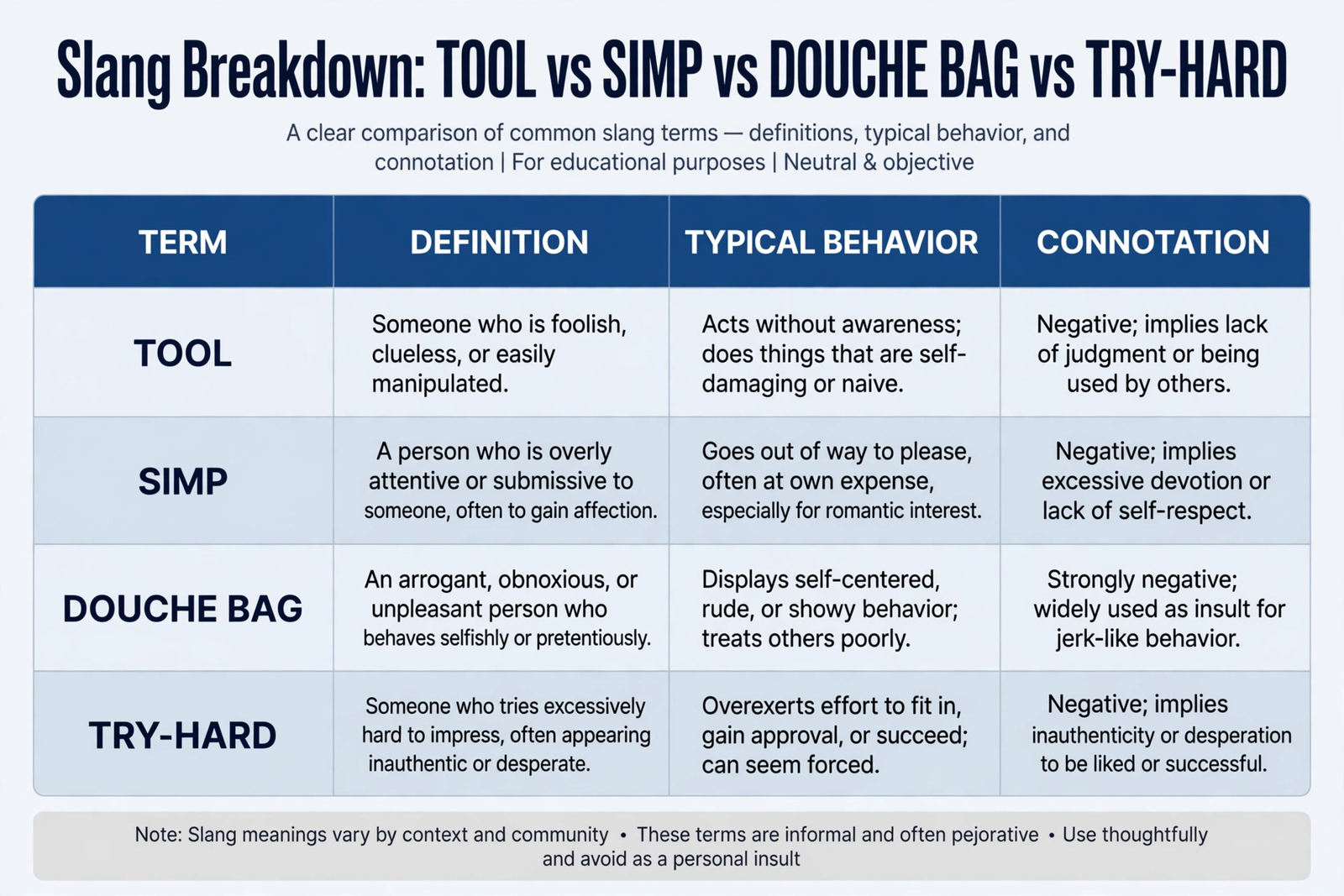
Tool overlaps with several other slang insults, but each one has its own flavor. This table breaks down the differences so you can pick the right word — or recognize which one is being aimed at you.
| Term | What It Means | How It Differs from Tool |
|---|---|---|
| Tool | A foolish, easily used person who tries too hard | The baseline insult — about being used and lacking self-awareness |
| Simp | Someone who does too much for a crush or partner | Specific to romantic attention; a tool can be used by anyone, not just a crush |
| Douchebag | An obnoxious, arrogant jerk | Stronger and ruder; focuses on arrogance, not on being used |
| Try-hard | Someone who tries too hard to impress | Lighter and more playful; a try-hard is annoying, a tool is also being played |
| Loser | Someone unsuccessful or unpopular | Broader and vaguer; tool specifically means manipulated or foolishly arrogant |
| Pushover | Someone who cannot say no | Neutral, not really an insult; describes passivity without the arrogance of a tool |
| Clown | Someone acting ridiculous or embarrassing | About looking foolish in public; a tool is about being used behind the scenes |
| NPC | Someone who thinks and acts like everyone else | About lacking original thought; a tool is about lacking independence and self-respect |
The closest cousins are simp and douchebag. If the person is being used by someone they like romantically, simp fits better. If they are just being arrogant and rude with no one using them, douchebag fits better. Tool covers the middle ground: a person who is both foolish and used, often at the same time. If you want to explore more internet personality labels, check out our guide to NPC meaning slang and our breakdown of sus meaning slang.
Alternate Meanings
Like many slang words, tool has more than one meaning, and the context tells you which one is in play:
- The literal meaning: a hammer, screwdriver, or any instrument used to do a job. “Hand me that tool” in a workshop has nothing to do with slang.
- A gun: in some hip-hop and street slang, a “tool” (or “toolie”) can mean a pistol. You will hear this in rap lyrics — artists like Eminem, 21 Savage, and Future have used it. This is a completely separate meaning from the insult, and it only applies in that musical or street context.
- The vulgar sense: an old slang meaning for the male genitalia, dating back to the 1500s. It is rarely the intended meaning in modern chats, but it is part of the word’s history and part of why the insult feels masculine.
- A useful person (positive): in a few expressions, being “a tool” for a cause can be neutral — like “a sharp tool in the toolbox” meaning a skilled, useful person. This is rare in slang, and the tone of the sentence makes it clear when it is a compliment.
Most of the time, when you see tool in a comment, a text, or a TikTok caption, it is the insult. If someone says “he’s a tool” after a story about a guy getting used, there is no confusion. But if you hear it in a rap song, it might mean a gun — and if you hear it in a hardware store, it definitely means a hammer.
Professional or Polite Alternatives
There are plenty of moments when calling someone a tool would be rude, unhelpful, or just the wrong move — at work, with family, or when you actually care about the person and want to help them. Here are polite ways to say the same thing:
- “He is being taken advantage of.” The kindest and most accurate replacement when someone is being used.
- “She is too accommodating for her own good.” Works well at work or with friends who cannot say no.
- “He is trying too hard to impress people.” Captures the show-off side without the insult.
- “She lacks confidence in that situation.” A gentle way to describe someone who lets others decide for them.
- “He is a people-pleaser.” A modern, widely understood term for someone who agrees with everyone to be liked.
- “She is being a bit naive about his intentions.” Useful when you want to warn a friend without mocking them.
- “He comes across as arrogant.” For the obnoxious side of the behavior, without calling anyone a name.
The rule is simple: if you are trying to help someone, describe the behavior, not the person. “You are letting him use you” helps. “You are a tool” just starts a fight. Save the slang for jokes between friends who will take it well.
Common Mistakes
Even a simple insult can be used wrong. Here are the mistakes people make with the word tool most often:
1. Using it at work or in formal settings. Calling a coworker or a boss a tool — even behind their back — is a fast way to damage your reputation if it gets back to them. Keep it out of the office entirely.
2. Using it about someone you barely know. Between friends, “stop being a tool” is a joke. From a stranger, it is an attack. The word only works as teasing when the relationship is strong enough to carry it.
3. Confusing it with “toolie.” A toolie is a gun in street and rap slang. A tool is a foolish person. Mixing them up can make a sentence confusing — or much more serious than you intended.
4. Thinking it is harmless. Because tool sounds almost funny — it is literally the name of a hammer — people assume it is a light insult. It is not. It attacks someone’s intelligence and self-respect, and it can genuinely hurt, especially if the person really is being used by someone.
5. Using it only about men. The insult is usually aimed at guys, but anyone can act like a tool. Using it as if only men can be foolish or used is a gendered habit worth noticing — the behavior is the problem, not the gender.
6. Overusing it until it loses meaning. If every person who annoys you is a tool, the word stops meaning anything. Save it for the moments when someone is genuinely being used or genuinely acting foolish, and it keeps its punch.

Quick Tips
Here is the practical cheat sheet for the word tool:
- Read the room first. With close friends, it is a roast. With strangers or at work, it is an insult. The same word, very different results.
- Use it for behavior, not identity. “That was a tool move” is softer and more accurate than “You are a tool.” People change behavior; labels stick.
- Check the context. In a rap lyric, tool might mean a gun. In a hardware store, it means a hammer. In a group chat, it means a fool. The setting decides.
- Do not use it to win an argument. Calling someone a tool ends conversations instead of resolving them. If you want to be heard, describe what they did.
- If someone calls you a tool, pause before reacting. Ask yourself whether there is a grain of truth — are you letting someone use you? Sometimes the roast is also a warning from a friend who cares.
- Know the softer alternatives. “People-pleaser,” “too trusting,” and “trying too hard” all say most of what tool says without the sting.
- Never use it with kids or in front of kids. It is a put-down, and kids repeat what they hear. There are better words for every situation involving children.

FAQ
What does tool mean in slang?
In slang, a tool is a foolish, easily manipulated person — someone who lets others use them, tries too hard to look cool, or acts clueless while thinking they are impressive. It is an insult, but a mild one compared with harsher words.
Is calling someone a tool an insult?
Yes. Calling someone a tool is always an insult, even when friends use it jokingly. It says the person is foolish, gullible, or lacking self-respect. Between close friends it can be playful teasing, but from anyone else it is a real put-down.
What does tool mean on TikTok?
On TikTok, tool means the same thing as everywhere else: a foolish or try-hard person. You will see it most in comments under videos of someone showing off, getting embarrassed, or being obviously used by someone else. The tone of the video decides whether it is playful or mean.
What does it mean when a girl calls a guy a tool?
When a girl calls a guy a tool, she usually means he is acting foolish, annoying, or obnoxious — often trying too hard to impress her or someone else, or letting himself be used without realizing it. It is a derogatory term, and it usually signals that she has lost respect for his behavior.
Is tool slang for a gun?
In some hip-hop and street slang, yes — “tool” or “toolie” can mean a pistol. But that is a separate meaning from the insult. In everyday texting, comments, and group chats, tool means a foolish, easily used person, not a weapon.
What is the difference between a tool and a simp?
A simp does too much for someone they like romantically. A tool is a broader insult — the person can be used by anyone (a friend, a boss, a partner) and is also often arrogant or clueless. Every simp could be called a tool, but not every tool is a simp.
Where did the insult “tool” come from?
The figurative sense of tool as a person used by another dates back to the mid-1600s, when it also described an unskilled worker who could be exploited. The image is simple: a tool has no mind of its own, and someone else uses it. The word kept that meaning for centuries before the internet spread it into chats and comments.
Can I call myself a tool?
Yes, and people do it all the time as self-deprecating humor — “I was such a tool last night” is a common way to admit you made a foolish decision. Using it on yourself is usually funny and relatable, as long as you are genuinely joking and not putting yourself down seriously.
Conclusion
The tool slang meaning comes down to one image: a person being used like an object, without realizing it — or acting so foolish and try-hard that everyone else can see it. It is an old insult with a long history, from 17th-century English to 1990s movies to today’s TikTok comments, and it survives because it is short, vivid, and instantly understood.
Use it carefully. Between friends, it is a funny roast. Aimed at a stranger, a coworker, or someone who is genuinely being taken advantage of, it is just mean. And if someone calls you a tool, take a second before you get angry — sometimes the people who roast you are the ones trying to tell you something worth hearing.
Now you know what tool means, where it came from, and how to use it without crossing a line. If you want to keep building your slang vocabulary, start with our guide to ngl meaning in text — one of the most common abbreviations in the same group chats where tool shows up — or check out FYP meaning, the TikTok feed where most of these words are born. Language keeps moving, and the people who understand it are the people who never feel lost in the comments.
