Quick Definition: In slang, tea means gossip — the juicy, often secret details about someone or something. When someone says “spill the tea,” they are asking you to share the gossip. “What’s the tea?” simply means “What’s the news?” or “Tell me what happened.” The term comes from Black LGBTQ+ ballroom culture, where “T” stood for “truth,” and it exploded into mainstream internet slang through RuPaul’s Drag Race, memes, and TikTok. If you see “tea meaning slang” trending, it is almost always this gossip meaning people are asking about — not the drink.
Tea Meaning Slang Meaning & Definition
Tea meaning slang is one of the most widely used gossip words on the internet today. At its simplest, tea is information — specifically, the kind of information people whisper about: who broke up with whom, what really happened at the party, why someone suddenly unfollowed someone else. It is the modern, playful word for gossip, and it carries a very specific flavour: tea is not boring news. Tea is the good stuff — the drama, the secret, the detail everyone wants to hear.
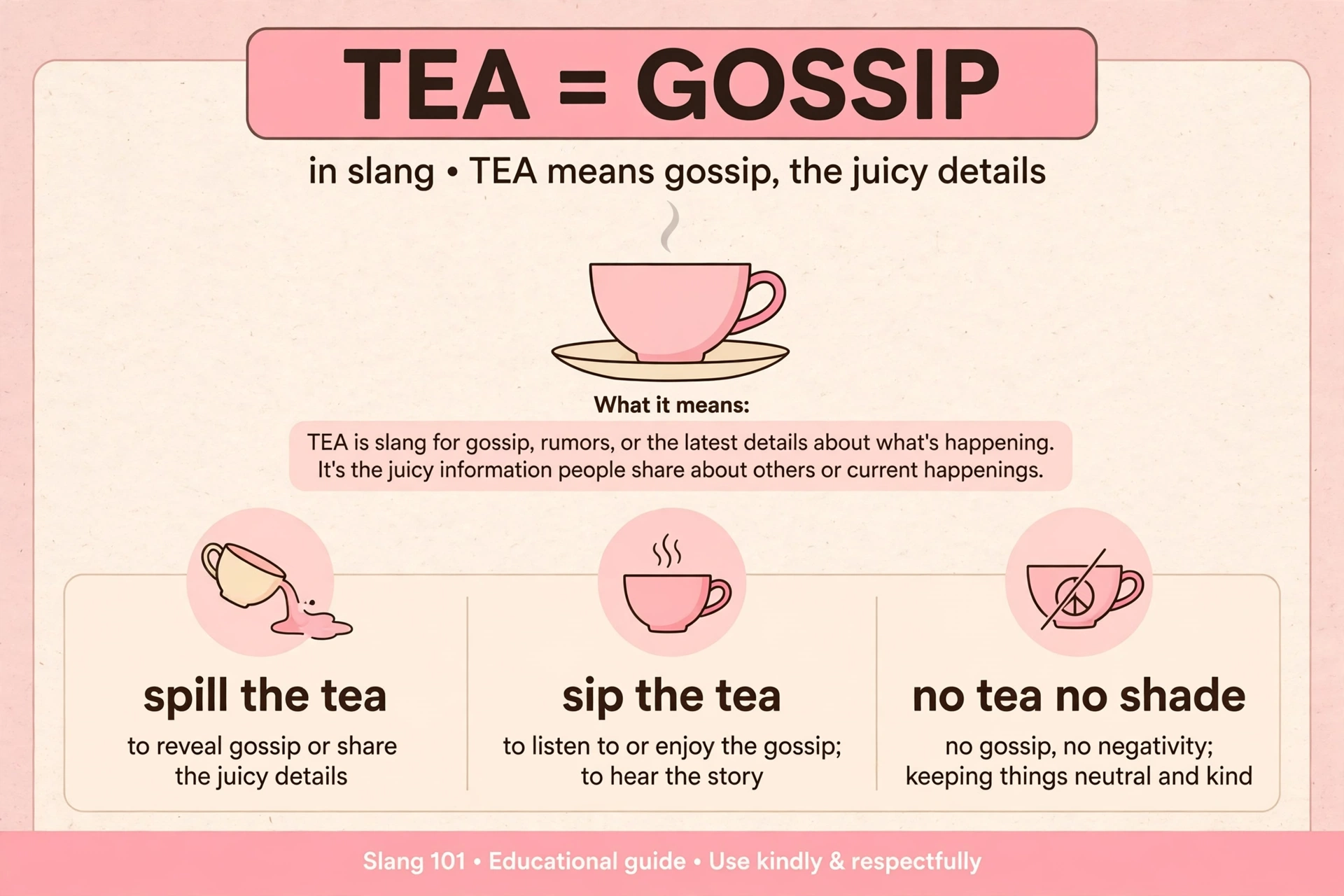
The word works as a noun in almost every use. You can “spill the tea” (share the gossip), “sip the tea” (listen to gossip, often while staying out of the drama), “have tea” on someone (know gossip about them), or say something is “hot tea” (especially juicy or scandalous gossip). There is also the famous phrase “no tea, no shade,” which means “no gossip and no disrespect intended” — a polite way to say something blunt without starting a fight.
What makes tea different from plain old gossip is the tone. Gossip sounds negative and old-fashioned. Tea sounds fun, casual, and very online. It is the word your friends use in the group chat at midnight, the word TikTok creators use in storytimes, and the word that shows up in captions like “the tea is PIPING hot today.” Understanding tea meaning slang is really about understanding how a single word from a small, underground community became one of the most recognisable slang terms in the English language.
Introduction
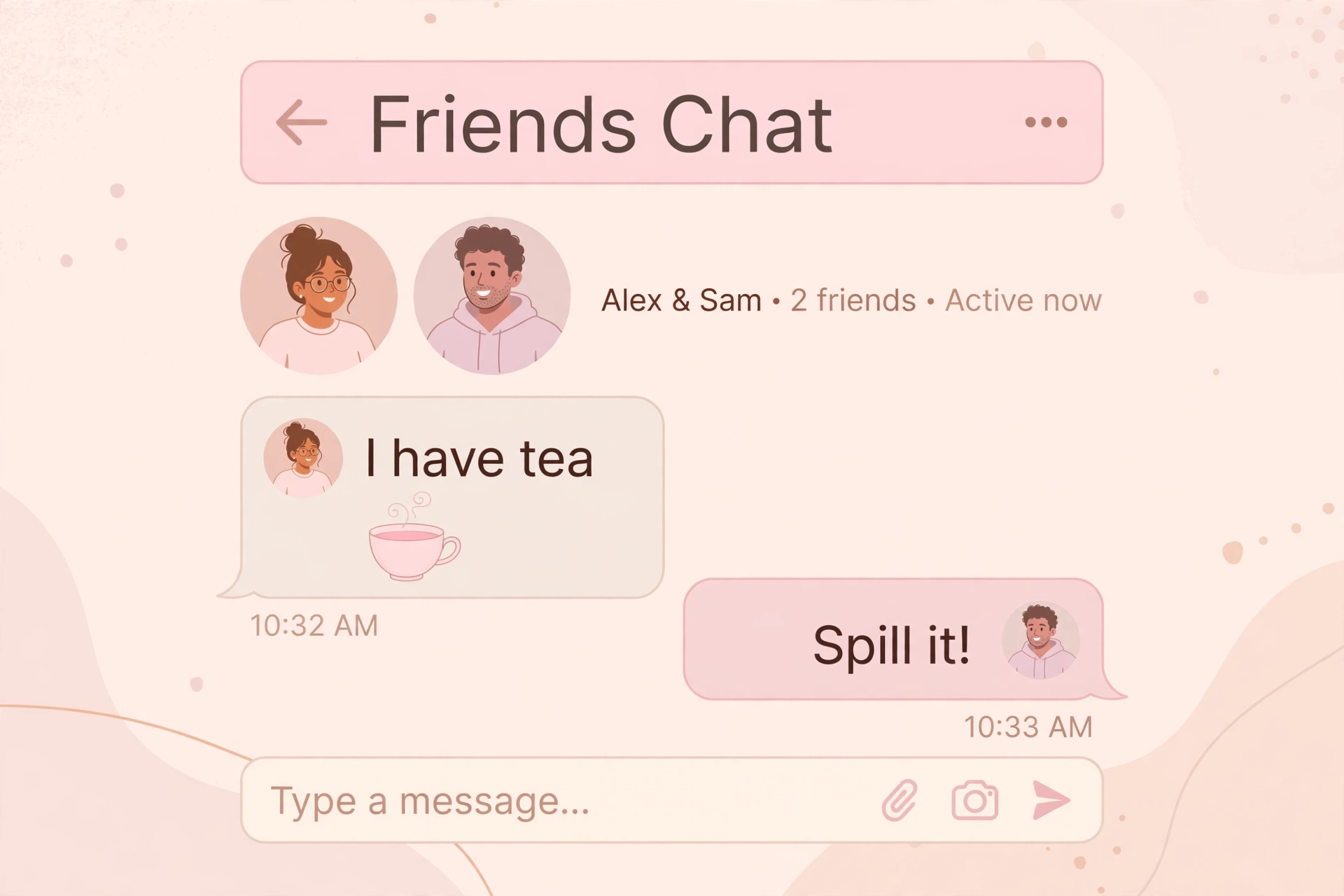
Picture this: your friend texts you out of nowhere — “OMG I have tea ☕” — and suddenly you are wide awake. You do not need to ask what she means. You already know something happened, something good, and you need the details right now. That is the power of tea in slang. One tiny word, three letters, and it instantly tells you that gossip is coming.
Tea has become the internet’s favourite way to talk about gossip without sounding like a gossip. It is playful instead of mean, dramatic instead of dull, and it works everywhere: in texts, on TikTok, in YouTube comments, in Twitter threads, and even in real-life conversation. A teenager in Ohio, a drag queen in New York, and a K-pop stan in Seoul can all use the word tea and mean exactly the same thing.
But tea did not start on TikTok. It started decades ago in a community that most of the world ignored — the Black and Latino LGBTQ+ ballroom scene of New York City. From there it travelled through drag culture, reality television, memes, and social media until it reached the group chat on your phone. In this guide, we will break down everything: the real definition, the origin story, how it is used in texts and on TikTok, real examples, comparisons with similar slang, and the mistakes to avoid so you never use it wrong.
Origin
The origin of tea as slang is one of the best-documented stories in modern slang, and it begins in the ballroom scene of 1980s and 1990s New York. Ballroom culture — the world of drag balls, voguing, and chosen families documented in the film Paris Is Burning (1990) — had its own rich language. In that world, “T” was short for “truth.” To share the “T” meant to tell the real, unfiltered truth about someone or something, often gossip about people in the scene.
Over time, the letter “T” became the word “tea,” a natural bit of wordplay: “T” sounds exactly like “tea,” and the image of sitting around sipping tea while sharing secrets fit perfectly. By the early 2000s, “tea” was firmly established in Black gay culture as the word for gossip. It appeared in drag slang, in club talk, and in the language of the ballroom houses.
The big mainstream breakthrough came with RuPaul’s Drag Race, which premiered in 2009. Contestants on the show used “tea” constantly — “spill the tea,” “no tea, no shade,” “the tea is hot” — and millions of viewers picked it up. The phrase “no tea, no shade” was popularised by the drag queen Lady Bunny and later by RuPaul herself, and it became one of the most quoted lines in reality TV history.
Then came the meme that sealed tea’s place in internet culture forever: the Kermit the Frog “sipping tea” meme. Around 2014, an image of Kermit drinking tea with the caption “but that’s none of my business” went viral. It was the perfect visual for tea — sipping, watching, judging, but staying out of it. The meme turned tea from a drag-culture word into a universal internet word. By the time TikTok arrived in the late 2010s, tea was already everywhere, and Gen Z made it their own, using it in storytimes, “spill the tea” videos, and gossip comment sections.
It is worth remembering where this word came from. Tea is a piece of Black LGBTQ+ culture that the mainstream adopted. Using it is fine — slang is meant to be shared — but knowing its roots is part of using it respectfully, and it is a big reason why the word still carries so much personality today.
Popularity
Tea is not a passing trend. It has been popular for more than a decade, and it keeps reinventing itself with every new platform. When Twitter was the centre of internet culture, tea ruled the group chats and the quote-tweets. When Instagram took over, tea lived in the comments and the story replies. On TikTok, tea became a whole genre: “spill the tea” storytimes, where creators tell dramatic personal stories in parts, are some of the most watched videos on the app, regularly pulling millions of views.
Search interest in tea meaning slang stays high year after year because every new generation of internet users discovers the word and wants to know what it means. Parents hear their kids say it. New TikTok users see it in comments. Non-native English speakers run into it in chats and look it up. Unlike slang that burns out in a few months, tea has staying power because it fills a gap: English never had a fun, casual word for gossip until tea came along.
The word has also spread far beyond the United States. It is used across the UK, Canada, Australia, and in online communities around the world. K-pop fans use it. Gaming communities use it. Reality TV fans use it. It even shows up in mainstream media now — in news headlines, in TV show dialogue, and in brand marketing. When a word jumps from ballroom culture to a fast-food brand’s Twitter account, you know it has fully arrived.
Another reason tea stays popular is its flexibility. It works as a noun (“the tea”), a verb phrase (“spill the tea”), an adjective (“hot tea”), and an entire attitude (“sip the tea and mind your business”). Few slang words are this versatile, and that versatility is exactly why it has survived while so many other terms faded.
How It Is Used
Tea is used in a few standard patterns, and once you learn them, you will recognise the word everywhere. Here is how it works in real conversation:
- “Spill the tea” — Tell me the gossip. This is the most common use. Example: “Girl, spill the tea. What happened at the party?”
- “What’s the tea?” — What’s the news? What happened? Example: “I just woke up. What’s the tea?”
- “Sip the tea” — Listen to gossip without getting involved. Example: “I’m just here sipping my tea and watching the drama.”
- “The tea is hot” — The gossip is really juicy or scandalous. Example: “The tea is PIPING hot today, you guys are not ready.”
- “No tea, no shade” — No gossip and no disrespect intended; I’m just being honest. Example: “No tea, no shade, but that outfit was not it.”
- “I have tea” — I know some gossip. Example: “Call me, I have tea about Jake.”
- “Spill the tea, sis” — A playful, dramatic way to demand gossip, popularised by drag culture and TikTok.
Tea also appears in captions, hashtags, and video titles: #spillthetea, “storytime: the tea on my ex,” “the tea is served.” On TikTok, creators often start videos with “okay so here’s the tea” before launching into a dramatic story. In group chats, a single tea emoji ☕ can be an entire message — it means “I know something” or “tell me everything.”
The tone is almost always playful and casual. Tea is used between friends, in fandoms, and in online communities. It is rarely used in formal or professional settings — you would not say “spill the tea” in a work meeting (unless your workplace is very relaxed). And while tea is usually lighthearted, it can also carry real weight: “having tea” on someone can mean knowing something damaging about them, so context always matters.
Examples
Tea shows up differently depending on who is talking and where. The meaning stays the same — gossip — but the tone shifts. Here are real-world examples across different situations.
Friendly Examples
- “Girl, I have SO much tea from last night. Call me when you wake up ☕”
- “Okay spill the tea, what did he say?? I need details!”
- “The group chat is going crazy right now, the tea is insane.”
- “I wasn’t even there and I already know all the tea. My friends text fast.”
- “Come sit with us at lunch, I have tea about the new teacher.”
Professional Examples
Tea is casual slang, so it rarely belongs in truly professional settings. But in relaxed workplaces, creative industries, and media jobs, it does appear — usually jokingly:
- “What’s the tea on the new office policy? Did anyone hear anything?”
- “No tea, no shade, but the meeting could have been an email.”
- “Spill the tea — who got the promotion?”
- “I’m just sipping my tea over here while the office drama plays out.”
The rule is simple: if you would not say “gossip” out loud in that setting, do not say “tea” either. In formal emails, presentations, or meetings with clients, use neutral words like “the latest news” or “the details” instead.
Funny Examples
- “Me sipping my tea watching two people argue in the comments ☕🐸”
- “I don’t want drama, I just want the tea. There’s a difference.”
- “My toxic trait is thinking I can mind my business while also needing to know all the tea.”
- “The tea is so hot today I burned my tongue.”
- “She said ‘no tea, no shade’ and then proceeded to spill ALL the tea.”
Notice how in every example, tea means the same thing: the gossip, the news, the details. The humour comes from the contrast — the word is small and cute, but the drama it describes is often huge.
Comparison with Similar Terms
Tea is part of a whole family of gossip words, but each one has a slightly different shade of meaning. This table breaks down how tea compares to the terms people most often confuse it with.
| Term | Meaning | How It Differs from Tea | Example |
|---|---|---|---|
| Tea | Gossip; juicy news or secrets | The standard fun word for gossip | “Spill the tea!” |
| Gossip | Talk about other people’s private lives | More formal and more negative than tea | “Stop gossiping about her.” |
| Shade | A subtle insult or disrespect | Shade is an insult; tea is information | “She threw so much shade.” |
| Drama | Conflict or messy situations | Drama is the situation; tea is the story about it | “I don’t need this drama.” |
| Receipts | Proof (screenshots, messages) backing up gossip | Receipts prove the tea is true | “I have the receipts!” |
| The scoop | Inside information or exclusive news | Older, more journalistic; tea is more casual | “Give me the scoop.” |
| Hot goss | Juicy gossip (short for gossip) | Very similar; “goss” is more British/Australian | “What’s the hot goss?” |
| Lowdown | The full truth or inside details | More serious and factual than tea | “Give me the lowdown.” |
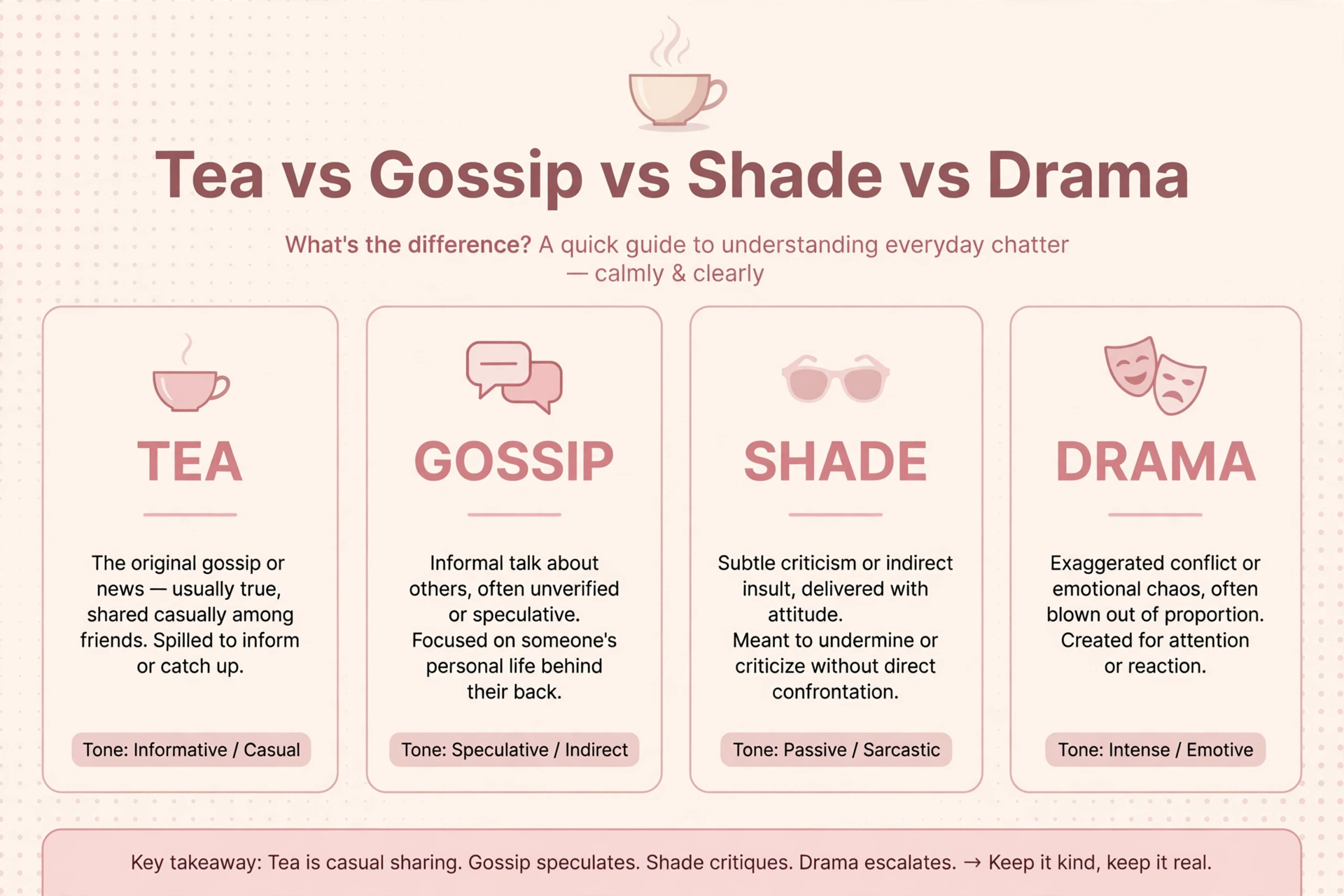
The closest relatives are “shade” and “receipts,” which both come from the same ballroom and drag culture as tea. Shade is what you throw at someone; tea is what you spill about someone; receipts are what you show to prove the tea is real. Together, the three words form the basic vocabulary of internet drama — and if you understand all three, you understand most of stan Twitter.
One important distinction: tea is about information, not insults. Saying “spill the tea” is asking for a story. Throwing shade is being rude. People sometimes mix them up, but in ballroom culture the difference was always clear — and on today’s internet, it still is.
Alternate Meanings
Like many slang words, tea has other meanings that depend entirely on context. Here are the main ones:
- The drink: The original meaning — a hot drink made from tea leaves. If someone says “let’s have tea,” they usually mean the drink, not gossip. Context makes it obvious: “I made you a cup of tea” is about the beverage.
- “T” for truth: The root meaning from ballroom culture. In some older drag contexts, “T” still means truth rather than gossip specifically — “tell me the T” can mean “tell me the truth.”
- Tea as a drug slang (rare): In some older, regional slang, “tea” was a nickname for marijuana in the 1930s-40s (as in “tea pad,” a place to smoke). This use is almost entirely obsolete today and you will basically never hear it in modern conversation.
- Afternoon tea / tea time: In British culture, “tea” can mean a light afternoon meal. Again, context makes this clear — nobody ordering afternoon tea is asking for gossip.
- “Not my cup of tea”: A classic idiom meaning “not something I like or enjoy.” This is the drink metaphor used in a totally different way, and it has nothing to do with gossip.
In practice, confusion is rare. If the conversation is about people, drama, or secrets, tea means gossip. If it is about drinks, food, or kettles, it means the beverage. The internet context — a group chat, a TikTok comment, a tweet — almost always points to the slang meaning.
Professional or Polite Alternatives
Because tea is casual slang, there are times when you need a more neutral way to say the same thing. Here are polite alternatives for different situations:
| Instead of | Say this (formal) | When to use it |
|---|---|---|
| “Spill the tea” | “Could you fill me in on what happened?” | Work, school, formal chats |
| “What’s the tea?” | “What’s the latest news?” | Professional conversations |
| “The tea is hot” | “There’s been quite a development” | Office or family settings |
| “I have tea” | “I heard something interesting” | Any formal context |
| “No tea, no shade” | “No offence, but honestly…” | When giving blunt feedback |
With friends, tea is perfect. With your boss, your teacher, or your grandmother, “the latest news” or “the details” will always be the safer choice. Good slang use is about knowing your audience — and tea is a word that belongs to casual, friendly, online spaces.
Common Mistakes
Tea is easy to use, but there are a few mistakes people make — especially people who are new to the slang. Avoid these and you will sound natural every time.
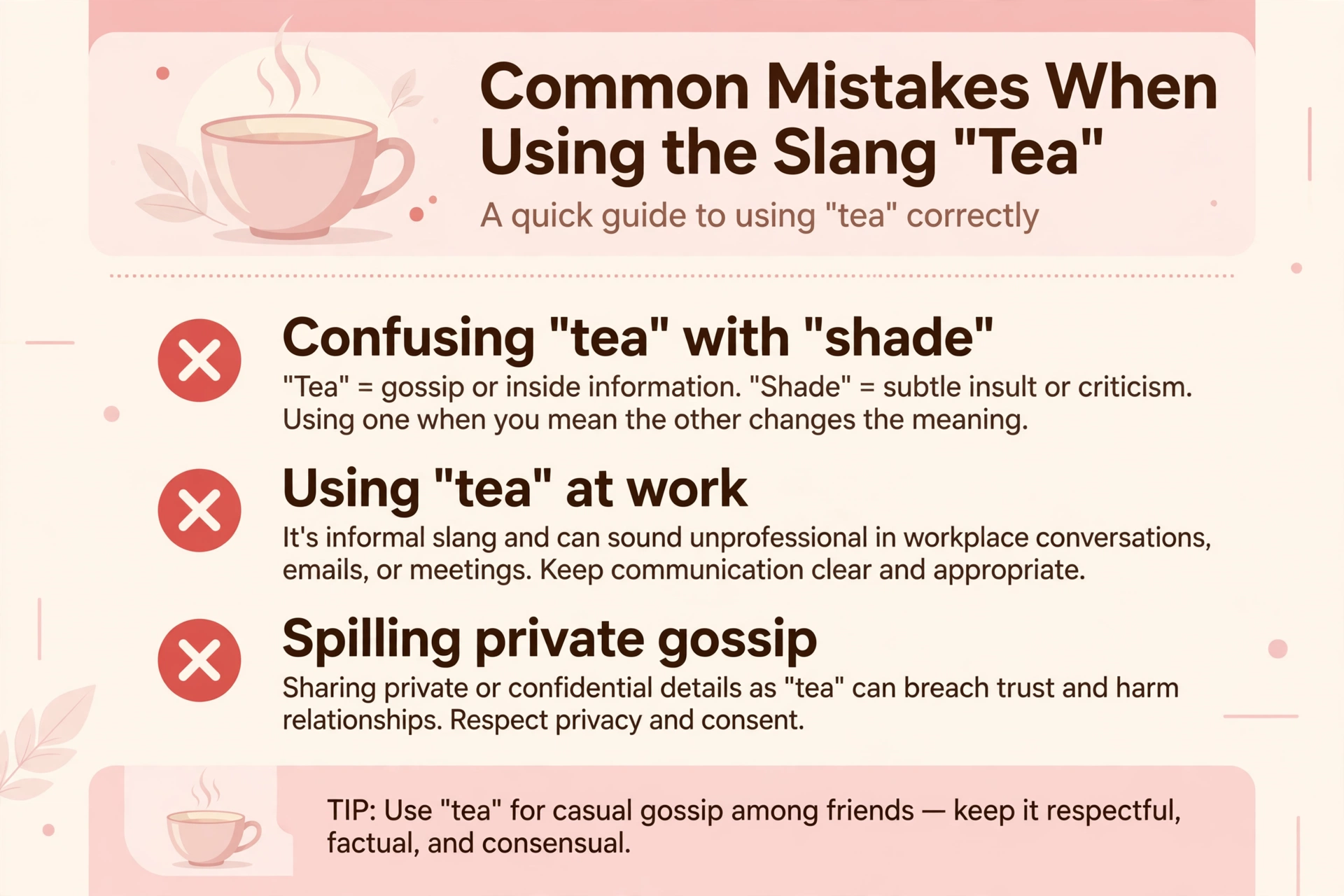
- Using it in formal settings: “Spill the tea” in a job interview or a business email will sound unprofessional. Keep tea for friends and casual chats.
- Confusing tea with shade: Tea is gossip (information). Shade is an insult. Saying “she spilled the shade” does not make sense — she spills tea and throws shade.
- Overusing it: If every sentence has tea in it, the word loses its punch. Use it when there is actual gossip to share, not as filler.
- Spilling tea that is not yours to spill: Some gossip is private for a reason — someone’s health, their relationship problems, or something they told you in confidence. “Spilling the tea” is fun until it hurts someone. If a friend told you something in confidence, it is not your tea to spill.
- Forgetting the Kermit context: If someone replies to drama with just ☕ or a Kermit sipping tea image, they are saying “I’m watching, not participating.” Do not drag them into the argument — that is the whole point of the meme.
- Using “no tea, no shade” before saying something shady: The phrase is supposed to soften a blunt truth, not excuse a rude one. If what follows is genuinely mean, the phrase does not make it okay — and everyone knows it.
- Pronouncing it like the drink in the wrong context: This is not really a mistake — tea the slang and tea the drink are pronounced identically. But in text, people sometimes write “spill the T” (the letter) and “spill the tea” (the word) interchangeably. Both are correct.
Quick Tips
Want to use tea like a native speaker? These quick tips will help you get it right every time.
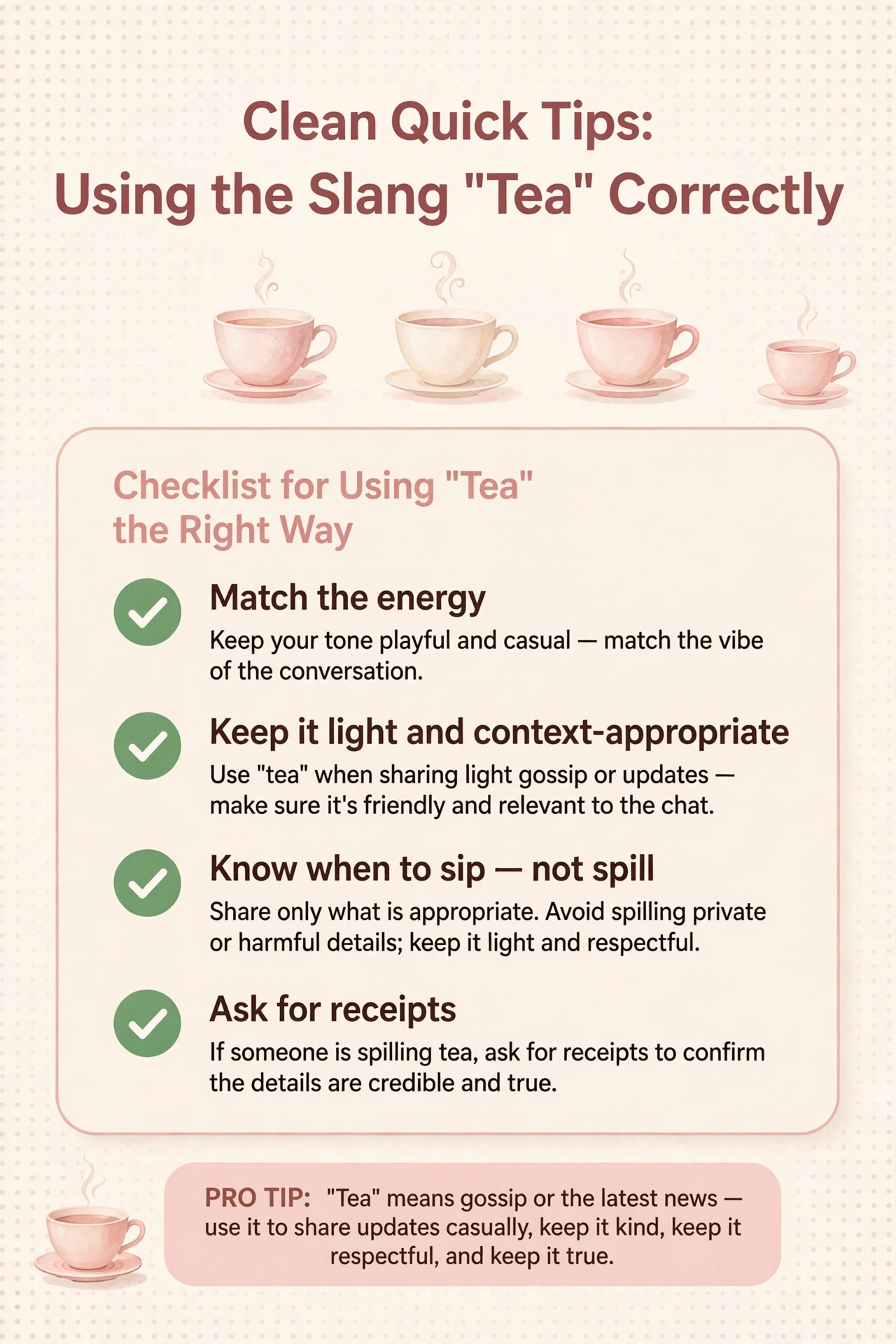
- Match the energy: If your friend texts “I HAVE TEA” in all caps, they are excited — reply with the same energy. “SPILL. NOW.” works perfectly.
- Use the emoji: The ☕ emoji is tea’s best friend. A single ☕ in a reply can mean “I’m listening,” “tell me everything,” or “I know something you don’t.”
- Pair it with “sis”: “Spill the tea, sis” is the classic dramatic version. It works even if the person you are talking to is not your sister — “sis” here just means friend.
- Know when to sip, not spill: Sometimes the smartest move is to listen to the tea without adding to it. “Sipping my tea” means you are entertained but staying out of the drama — and that is often the best place to be.
- Ask for receipts: If someone spills wild tea, it is normal to ask for proof. “Receipts or it didn’t happen” is the standard reply — and it keeps gossip honest.
- Keep it in the group chat: Tea belongs in private chats and friendly spaces, not in public posts that name real people. Screenshots last forever.
- Learn the cousins: Once you know tea, learn fn meaning in text and glizzy meaning too — they show up in the same chats and TikTok comments, and knowing the whole slang family makes everything easier to follow.
FAQ
What does tea mean in slang?
In slang, tea means gossip — the juicy details or secret information about someone or something. “Spill the tea” means “tell me the gossip.” The term comes from Black LGBTQ+ ballroom culture, where “T” stood for truth.
What does “spill the tea” mean?
“Spill the tea” means to share gossip or reveal secret information. It is a playful way of saying “tell me what happened” or “give me the details.” It is most often used between friends in texts, group chats, and on social media.
What does “no tea, no shade” mean?
“No tea, no shade” means “no gossip and no disrespect intended.” It is said before a blunt or honest statement, to signal that the speaker is not trying to start drama — just telling the truth. The phrase was popularised by drag culture and RuPaul’s Drag Race.
Where did tea slang come from?
Tea slang comes from Black and Latino LGBTQ+ ballroom culture in New York in the 1980s and 90s, where “T” stood for “truth.” It spread through drag culture and RuPaul’s Drag Race, then went fully mainstream with the Kermit the Frog sipping tea meme and TikTok.
What does the tea emoji ☕ mean?
The tea emoji ☕ is used to signal gossip. On its own it can mean “I know something,” “tell me everything,” or “I’m just here watching the drama.” It is often paired with the Kermit sipping tea meme to mean “I’m staying out of this, but I’m watching.”
Is tea slang offensive?
No — tea is not offensive. It is playful, casual slang for gossip. However, the gossip itself can be hurtful, so it is best to avoid spreading tea about someone’s private life without their knowledge. The word is fine; what you do with it is what matters.
What is the difference between tea and shade?
Tea is gossip or information about someone. Shade is a subtle insult or act of disrespect toward someone. You spill tea (share gossip) and throw shade (insult someone). Both words come from ballroom culture, but they mean different things.
Can you use tea slang at work?
It depends on the workplace. In relaxed, creative, or media jobs, a joking “what’s the tea?” might be fine. In formal workplaces, meetings, or emails, use neutral alternatives like “what’s the latest news?” or “could you fill me in?” instead.
Conclusion
Tea is one of those rare slang words that is fun to say, easy to use, and rich with history. It started as “T” — truth — in the ballroom scene, travelled through drag culture and reality TV, became a meme with Kermit the Frog, and ended up as the internet’s favourite word for gossip. Today, whether someone texts “spill the tea” in a group chat or a TikTok creator opens a storytime with “here’s the tea,” the meaning is instantly clear: something juicy is about to be shared.
The key takeaways are simple. Tea means gossip — the interesting, secret details about people and drama. “Spill the tea” asks for it, “sip the tea” means watching from the sidelines, and “no tea, no shade” softens a blunt truth. It is casual, playful, and perfect for friends and the internet, but keep it out of formal settings. And remember the difference between tea and shade: one is information, the other is an insult.
Next time your friend texts “I have tea ☕,” you will know exactly what to do: grab your own cup, sit down, and say the two magic words — “spill it.” If you want to keep building your slang vocabulary, check out our guides on zip meaning slang and the big roundup of Gen Z slang 2024 — each one breaks down the meaning, the origin, and the real-world usage, just like this guide. For the dictionary definition, see Merriam-Webster’s entry for tea, which now includes the slang sense.
