
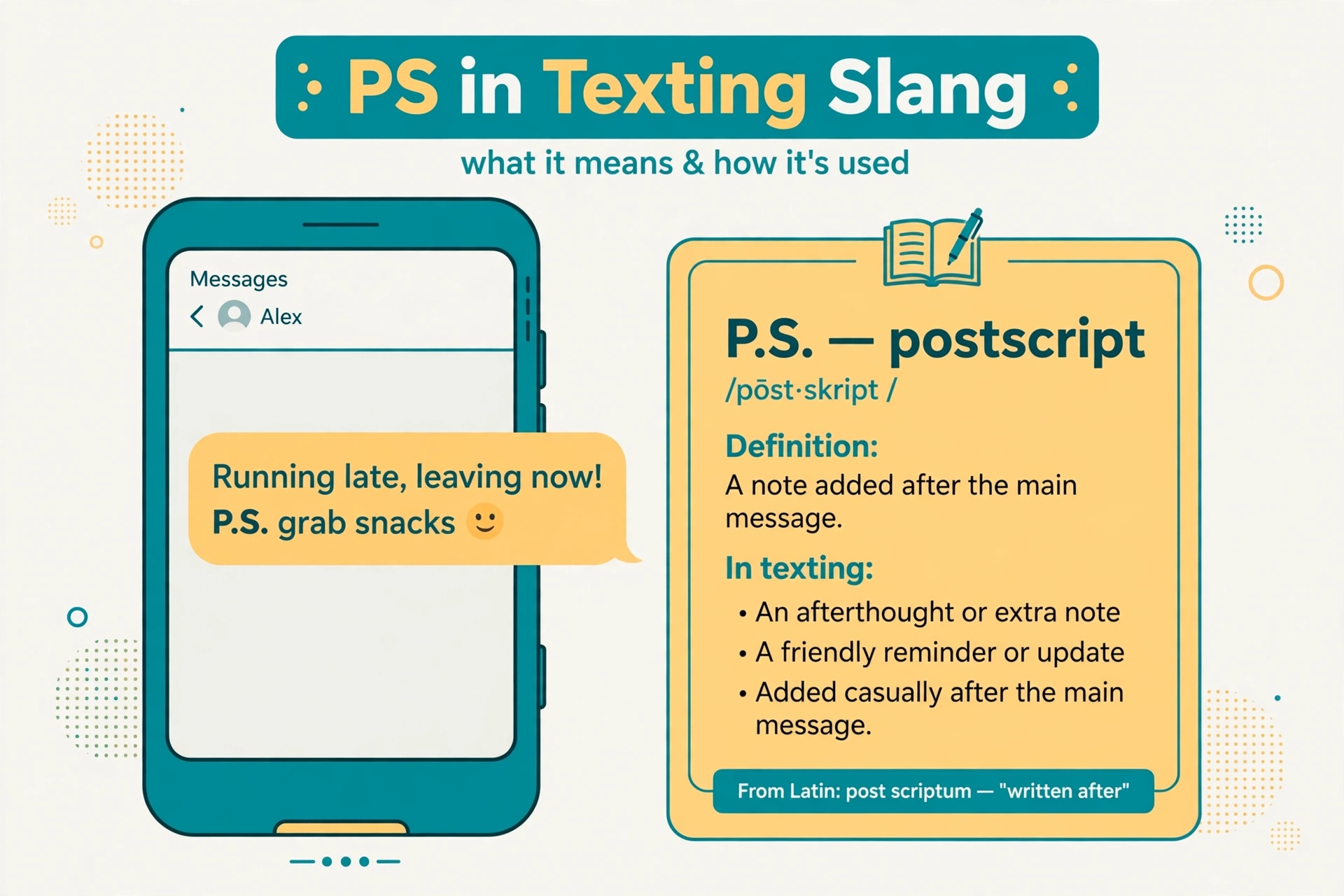
Quick definition: In slang and texting, PS stands for “postscript,” from the Latin post scriptum, meaning “written after.” It adds an afterthought, a forgotten detail, or a bonus comment after the main part of a message, letter, email, or social media post is already finished. In modern slang, PS also shows up in flirty texts (“ps I love you”), funny captions, and casual chats — and it is sometimes confused with PlayStation, so context always matters.
PS Meaning Slang Meaning & Definition
PS meaning in slang is simple: it is short for “postscript,” and it signals that the writer is adding something after the main message. Traditionally, PS appeared at the end of handwritten letters, right after the signature, whenever the writer remembered one more thing to say. Today, the same idea lives on in texts, DMs, emails, and social media captions.
When someone writes “PS” in a text, they are basically saying, “Oh, and one more thing…” It can carry a sweet note, a joke, a reminder, or a detail they forgot to include. The tone depends entirely on what follows it.
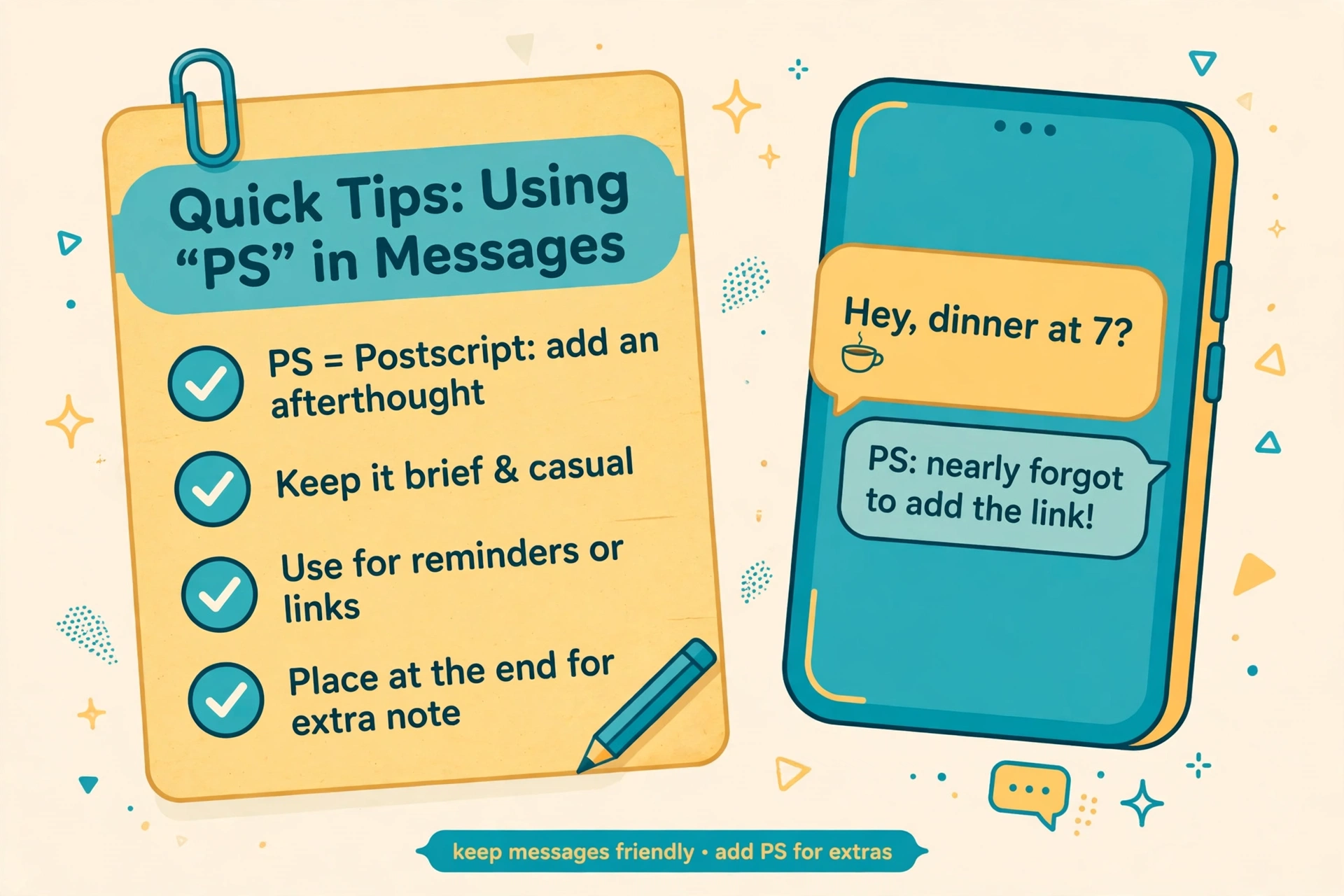
- PS = postscript — an extra note added after the main message is complete.
- In texting slang — an afterthought, a bonus comment, or a playful extra line, often used for emphasis, humor, or affection.
- Capitalization varies — “PS,” “Ps,” and “ps” all mean the same thing; lowercase “ps” feels more casual and is common in quick texts.
- Plural form — “PPS” (post-postscript) adds yet another afterthought after the first PS.
Introduction
You have seen it a thousand times. A friend sends a long text about weekend plans, and then, right at the end: “ps bring snacks.” A crush texts “goodnight” and follows it with “ps I miss you.” A creator posts a photo with a long caption and tacks on “PS: link in bio.” Every time, that tiny two-letter add-on does the same job — it sneaks in one last thought after the message was already supposed to be over.
So why does everyone still use PS in 2026, when editing a text takes two seconds? Because PS is not really about forgetting something anymore. It is a style choice: it makes the extra line feel intentional, like a whisper after the main conversation, or a punchline saved for last. That is also why PSA meaning slang gets confused with PS so often — both are short letter-based abbreviations, but a PSA is a public announcement while a PS is a personal afterthought. In this guide, you will learn the full ps meaning in slang, where it came from, why it is still popular, and how to use it right.
Origin
The story of PS starts long before smartphones — long before email, even. It comes from the Latin phrase post scriptum, which literally means “written after.” In the days of handwritten letters, once you signed your name at the bottom of the page, the letter was considered finished. If you then remembered something else, you could not just hit backspace. You added “P.S.” below your signature and wrote the extra thought there. Merriam-Webster defines a postscript as a note added after a letter or text is finished, a definition that has held steady for centuries.
For centuries, the postscript was a normal part of letter writing, and readers understood the convention instantly: whatever followed the PS was an afterthought — sometimes more honest or more important than the letter itself. When email arrived in the 1990s, PS came along for the ride, and marketers discovered that readers often skim an email but still read the PS. Texting and social media then gave PS its modern slang life: on Instagram, TikTok, X, and Snapchat, “ps” became a casual, lowercase add-on for jokes, flirty lines, and hot takes. Today, when someone writes “ps I love you” at the end of a goodnight text, they are not forgetful — they are using a centuries-old Latin convention to make two words feel more romantic.
Popularity
PS is one of the most durable abbreviations in the English language. While most texting slang burns bright and fades fast, PS has stayed relevant across every generation of communication — from handwritten letters to emails to DMs. Its popularity comes from its flexibility: it works in a love note, a work email, a meme caption, and a group chat.
On social media, creators use PS to add a bonus thought, a disclaimer, or a call to action after their main caption — “PS: new video out now” or “ps this took me 4 hours.” In texting, it is especially popular in flirty and friendly conversations, where a short “ps” before a sweet line makes it feel spontaneous. Search interest in “ps meaning” and “ps meaning slang” also stays steady year-round, partly because new generations keep encountering it, and partly because many people first search it after seeing it in gaming contexts, where PS usually means PlayStation.
- It is universal. Almost every English speaker recognizes PS instantly, across all ages.
- It adds emphasis. A line after a PS feels like a secret or a punchline, so it grabs attention.
- It feels personal. A postscript reads like a direct aside to the reader, not part of a formal message.
- It works everywhere. Texts, emails, captions, comments, and letters all use it — and it is only two letters long.
How It Is Used
PS is used to add something after the main message is finished. The pattern is always the same: main message first, then “PS” or “P.S.,” then the extra thought. But the way people use it changes with the platform and the relationship.
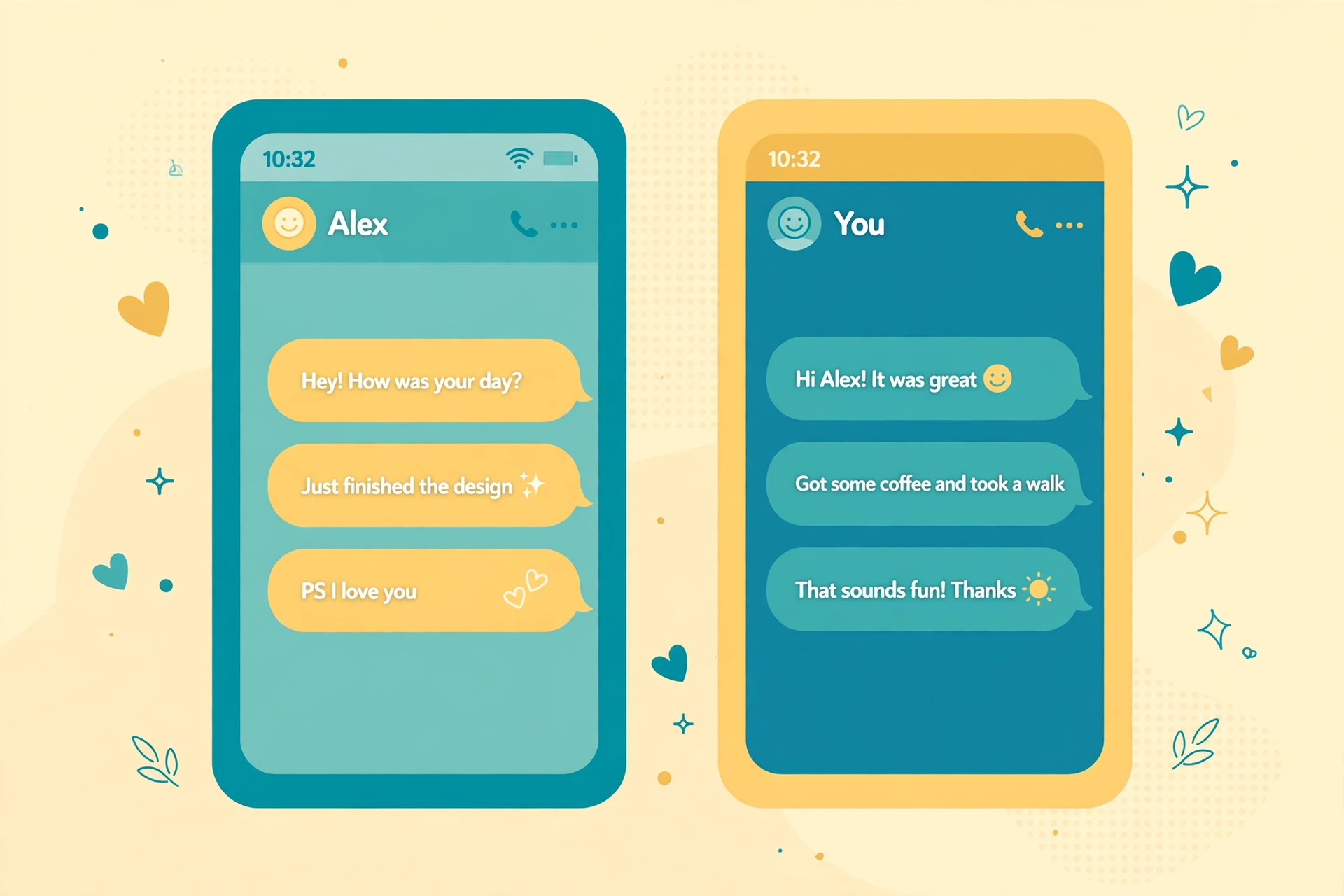
In texting and DMs, PS usually introduces a sweet, funny, or important extra line, often after a goodbye. Someone might text a full update about their day and then add “ps I got the job!!” to make the big news land last, where it hits hardest. Lowercase “ps” is the most common form in casual chats because it feels relaxed and quick.
In emails, PS is still used the traditional way — after the sign-off — to add a reminder, a link, or a repeated call to action, such as “PS: I’ve attached the report for your review.” Marketers use it to restate an offer, because readers often jump straight to the PS.
On social media, PS appears at the end of captions and comments for bonus information (“PS: tutorial in my last video”), humor (“ps I cried making this”), or engagement (“ps tell me your favorite in the comments”). In flirting, it carries emotional weight: “ps I love you” and “ps you looked cute today” hit differently because the PS frames them as spontaneous confessions. In gaming, though, PS usually means PlayStation — “on PS tonight” means playing on a console, not adding a postscript. That is the most common source of confusion, so always check the context.
| Context | How PS Is Used | Example |
|---|---|---|
| Texting | Casual afterthought or flirty extra line | “ps I love you” |
| Formal reminder or repeated call to action | “PS: I’ve attached the file.” | |
| Social media captions | Bonus info, joke, or engagement prompt | “PS: link in bio!” |
| Letters | Traditional note added after the signature | “P.S. Write back soon.” |
| Gaming | Usually means PlayStation, not postscript | “Hop on PS later?” |
| Comments/replies | Quick extra thought after the main reply | “ps this is so accurate” |
The golden rule is simple: if PS comes at the very end of a message, after the main point, it almost always means postscript. If it appears in the middle of a gaming conversation, it probably means PlayStation.
Examples
PS is easy to understand once you see it in real conversations. The examples below show how the tone changes with the setting — friendly, professional, or funny — while the core meaning stays exactly the same.
Friendly Examples
- “Had such a great time today! ps we HAVE to do this again next weekend.”
- “Goodnight! ps I love you, sleep well.”
- “Just sent you the photos from the trip. ps the sunset one is my favorite.”
- “Thanks for helping me move, you’re the best. ps I owe you pizza.”
In friendly chats, PS usually adds warmth, excitement, or a small detail the sender did not want to bury in the main message — and the PS line often holds the most emotional part of the text.
Professional Examples
- “Thank you for your time today. PS: I’ve attached the updated proposal for your review.”
- “Looking forward to our call on Thursday. P.S. Please let me know if the time still works for you.”
- “The report is ready and shared in the drive. PS: The Q3 numbers are on page 4.”
- “Please find the invoice attached. P.S. The payment deadline is Friday, as agreed.”
In professional writing, PS is best used sparingly — once per message, for something genuinely worth highlighting. One clean PS looks confident and intentional; overusing it makes the message look disorganized.
Funny Examples
- “I’m officially on a diet starting Monday. ps I just ordered a pizza.”
- “I’m not saying I’m the favorite child, but… ps mom said I am.”
- “Studying hard for my exam. ps I’ve watched 6 hours of YouTube instead.”
- “I’m over him, totally moved on. ps I checked his profile 4 times today.”
Funny PS lines work because the postscript creates a setup-and-punchline structure: the main message sets up a serious or innocent claim, and the PS delivers the twist.
Comparison with Similar Terms
PS is often confused with other short abbreviations, especially PSA, PPS, and NB. They look similar and all appear in messages, but each one has a distinct job — and knowing the difference keeps you from writing “PSA” when you mean “PS.”
PSA meaning slang is the most common mix-up. A PSA (public service announcement) is a message meant for a wide audience, usually a warning or an important update. A PS, by contrast, is a personal afterthought added to a message that is already written. If you are addressing a crowd, it is a PSA; if you are adding one more thought to your own message, it is a PS.
| Term | Stands For | Meaning | When to Use It |
|---|---|---|---|
| PS | Postscript | An afterthought added after the main message | Adding one extra line at the end of a text, email, or caption |
| PSA | Public service announcement | An important message or warning for a group | Sharing news, a warning, or an update with many people |
| PPS | Post-postscript | A second afterthought, added after a PS | When you have one more thing to add after your first PS |
| NB | Nota bene (“note well”) | A note drawing attention to something important | Highlighting a key detail inside the main message |
| FYI | For your information | Sharing information the reader should know | Passing along a fact or update in the body of a message |
| BTW | By the way | A casual side note or topic change | Dropping a casual extra thought mid-conversation |
| TL;DR | Too long; didn’t read | A short summary of a long message | Summarizing a long post or text at the end |
The closest cousins to PS are PPS and BTW. PPS is literally a second postscript — if you already wrote a PS and then think of something else, you add “PPS” below it. BTW is similar in spirit, but it appears mid-conversation and changes the subject, while PS always comes at the end and adds to the same message. One more term worth knowing is “P.S. I love you” as a phrase in its own right: because it has appeared in countless songs, movies, and letters, many people use it as a romantic sign-off even when the rest of the message has nothing to do with postscripts.
Alternate Meanings
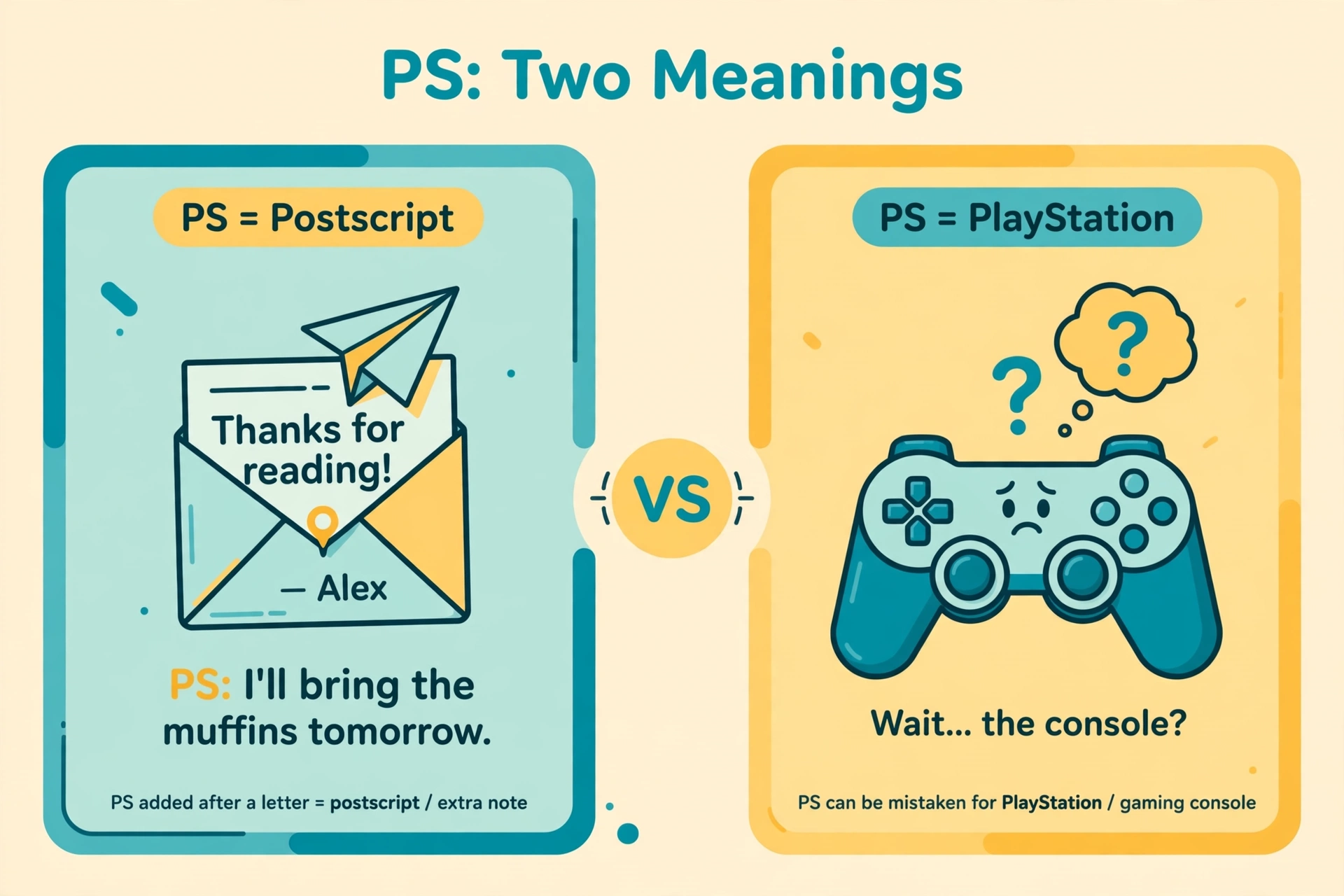
Like many two-letter abbreviations, PS has several alternate meanings depending on the context. In everyday texting and social media, “postscript” is by far the most common one, but you should know the others so you are never caught off guard.
- PlayStation — In gaming, PS almost always refers to Sony’s PlayStation console. “On PS5 tonight?” has nothing to do with postscripts. If the conversation is about games, assume PlayStation first.
- Photoshop — Among designers and photographers, “PS” is shorthand for Adobe Photoshop. “I’ll fix it in PS” means the image will be edited in Photoshop.
- PostScript (printing) — In tech and publishing, PostScript is a page-description programming language developed by Adobe, used in printing. Rare in casual conversation, common in technical contexts.
- Private server / private story — In some gaming and social media circles, PS can mean a private server or a private story, though this is much less common and heavily context-dependent.
- “Psst” (sound) — Occasionally, a lowercase “ps” at the start of a message is a playful spelling of “psst,” the sound used to get someone’s attention quietly. The difference is placement: “psst” starts a message, while a postscript ends it.
How do you tell which meaning applies? Look at three clues: the platform (gaming chat vs. email), the position (end of message vs. middle), and the topic. If a friend texts “ps I love you” at the end of a goodnight message, it is a postscript. If a gamer writes “hop on PS,” it is a PlayStation. Context is the whole game with this abbreviation — which is why it sits alongside confusing terms like TM meaning in text, another short abbreviation whose meaning changes completely with context.
Professional or Polite Alternatives
PS is perfectly acceptable in many professional emails, but there are moments when a more formal phrasing fits better — especially in legal, academic, or very formal business writing. Here are polite alternatives, with notes on when each one works best.
- “One more thing:” — A clean, modern alternative for the end of an email or message. “One more thing: the deadline has moved to Friday.”
- “Additionally,” — Good for adding a related point inside the main body of a message rather than at the end.
- “Please note:” — Best when the extra information is important and the reader should not miss it, such as a deadline or a requirement.
- “I’d also like to add:” — A polite, formal way to introduce an extra point in a business email or a meeting follow-up.
- “As a reminder:” — Ideal when the PS is really a reminder about something already discussed, like a meeting time or a document.
- Just edit the message — In casual texting and work chats like Slack or Teams, the most professional option is often to simply edit the message or send a short follow-up without the PS label.
The key point is that PS itself is not rude or unprofessional — in marketing and business emails, it is a respected technique. The alternatives above are useful when you want to sound extra formal, or when you have already used a PS once and need to add yet another point. In that case, rewriting the message is almost always cleaner than stacking a PPS.
Common Mistakes
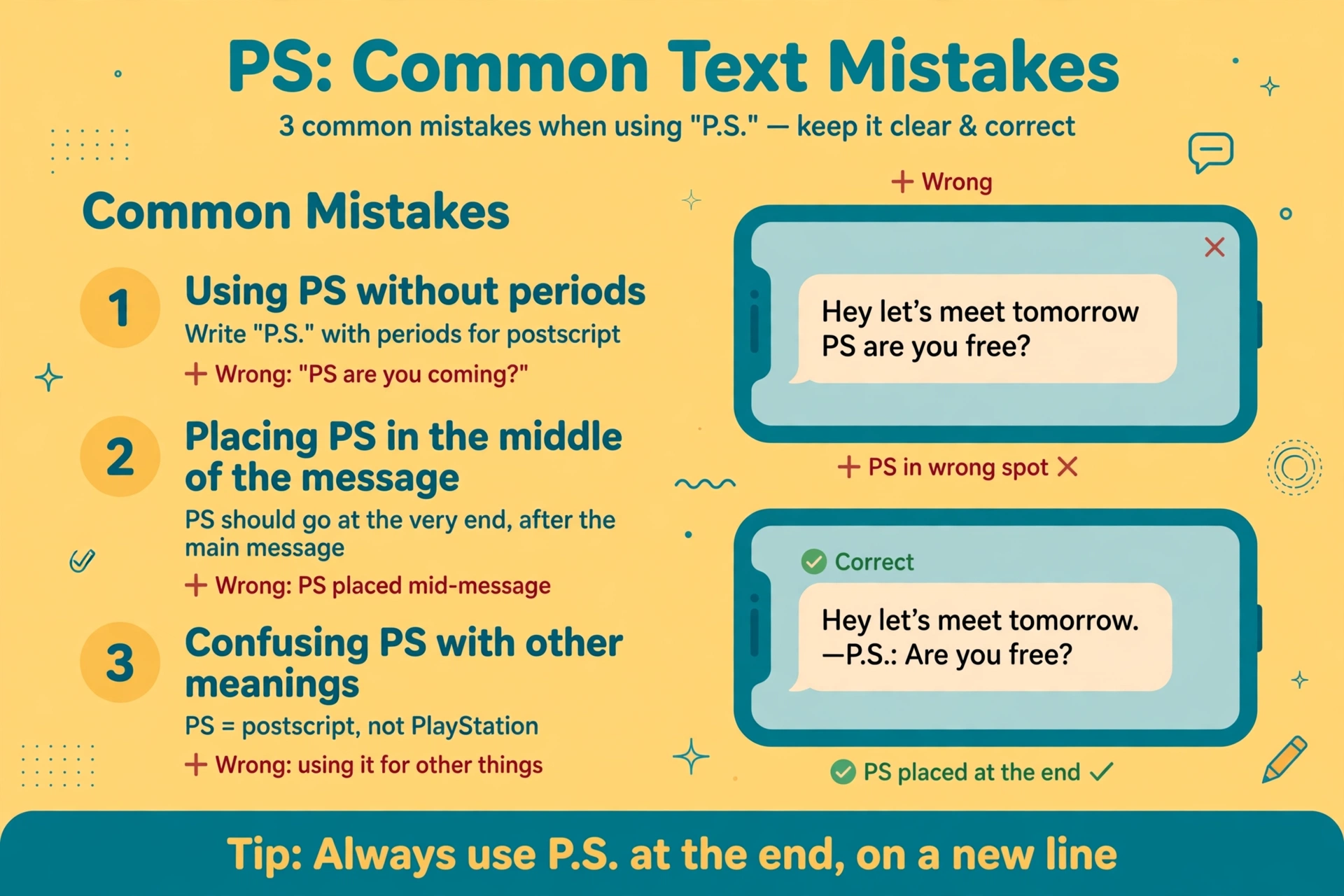
PS is simple, but people still make a few common mistakes with it. Most of them come from overusing it or putting it in the wrong place.
- Using PS for the main point. The most important information belongs in the body of the message, not in the postscript. Save the PS for a bonus, not the headline.
- Stacking multiple postscripts. One PS is clean; a PS followed by a PPS followed by a PPPS looks disorganized. If you have three extra points, rewrite the message.
- Confusing PS with PSA. Writing “PSA: I love you” makes no sense — a PSA is a public announcement, not a personal afterthought.
- Using PS in the middle of a message. A postscript belongs at the end, after the main message and signature. Dropping a “ps” mid-paragraph confuses readers.
- Forgetting the PlayStation meaning in gaming chats. Telling a gamer “ps I’ll be late” could be read as a comment about a PlayStation — spell out the afterthought instead.
- Overusing PS in professional emails. One PS per email is plenty. Two or more make the email look rushed and unplanned.
- Using “ps” for serious or bad news. A postscript softens whatever follows it, which is the wrong tone for serious news. Put that in the main message.
Quick Tips
Want to use PS like a pro? These quick tips will help you get the tone, timing, and placement right every time.
- Put the punchline in the PS. The last line of a message is the one people remember, so save your funniest, sweetest, or most important extra thought for the postscript.
- Keep it short. A good PS is one or two lines. If it needs a paragraph, it probably belongs in the main message.
- Use lowercase “ps” in casual chats. Lowercase feels relaxed and friendly; “P.S.” with periods feels formal and old-fashioned.
- Use PS once per message. One postscript looks intentional; several look forgetful. If you keep thinking of more things, send a fresh message instead.
- Try it in captions. A PS at the end of an Instagram or TikTok caption is a great place for a call to action, a joke, or a question that boosts comments.
- Check the context in gaming. In a gaming chat, “PS” means PlayStation first. Spell out your afterthought or rephrase it to avoid confusion.
- Pair it with emotion, not information. PS works best for feelings, jokes, and emphasis. Dry facts and deadlines usually belong in the main message.
- Use PPS only when truly needed. A post-postscript is fun in a playful letter or a joke text, but in professional writing it is almost always better to rewrite.
One final tip: if you are not sure whether to add a PS, ask yourself whether the extra line would still make sense if it were the last thing the reader sees. If yes, add it. If the message works fine without it, leave it out — the best postscripts feel like a gift, not a chore.
FAQ
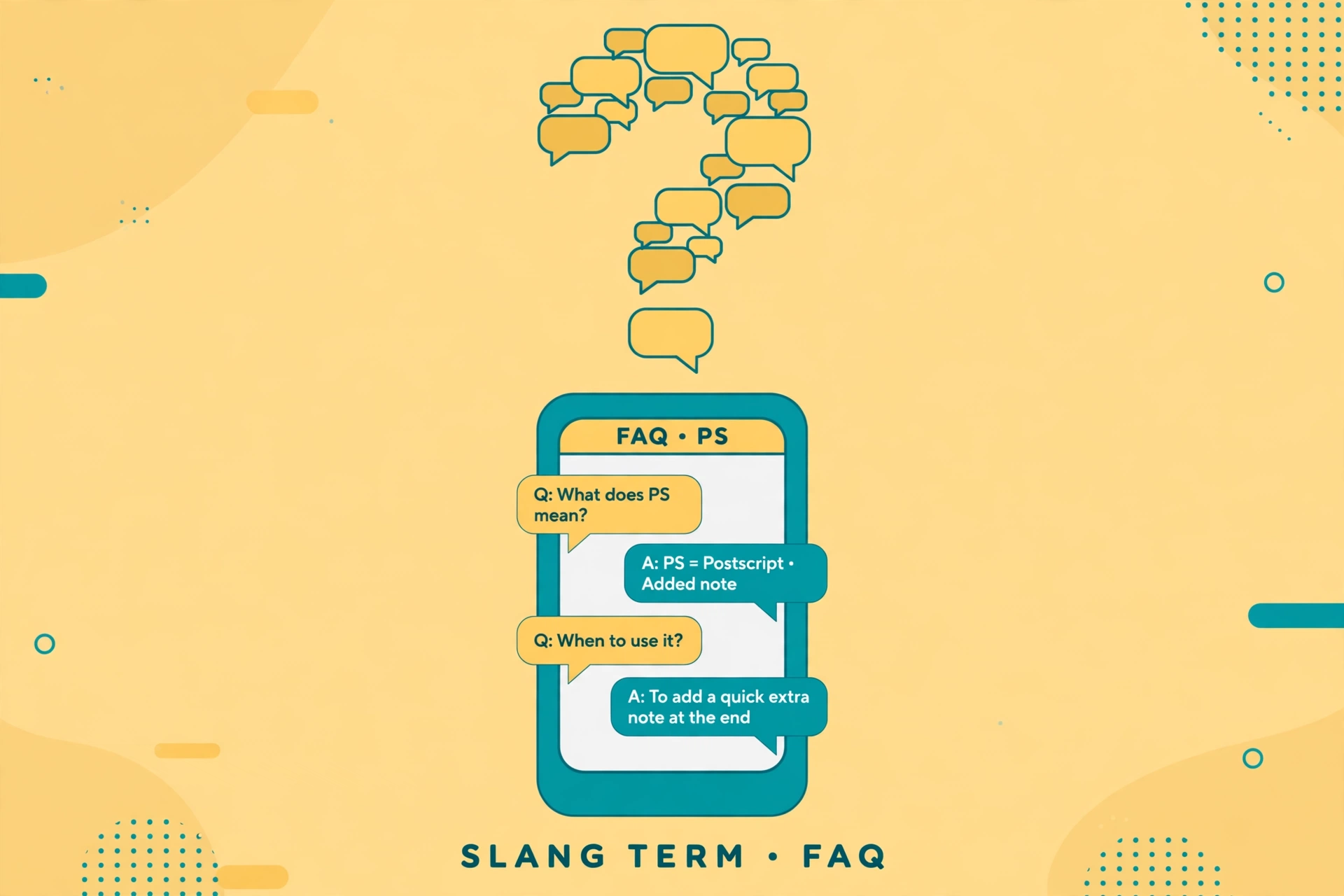
What does PS mean in slang?
In slang, PS stands for “postscript” and means an afterthought added after the main message. In texts and captions, it introduces a bonus line, a joke, or a sweet extra thought — for example, “ps I love you” at the end of a goodnight text.
What does PS stand for in texting?
PS stands for “postscript,” from the Latin post scriptum (“written after”). In texting, it signals that the writer is adding one more thought after the message was already finished, usually something funny, sweet, or important.
What does “ps I love you” mean?
“Ps I love you” is a flirty or romantic way to add “I love you” as an afterthought at the end of a message. The PS framing makes it feel spontaneous and extra sincere, like a confession the sender could not resist adding after saying goodbye.
Is PS the same as PSA?
No. PS means “postscript” — a personal afterthought at the end of a message. PSA means “public service announcement” — an important message or warning meant for a wide audience. They are often confused because both are short abbreviations, but they serve very different purposes.
What does PS mean in gaming?
In gaming, PS usually means PlayStation, Sony’s game console. If someone says “on PS tonight” or “hop on PS,” they are talking about playing on a PlayStation, not adding a postscript. Always check whether the conversation is about games first.
What is PPS?
PPS stands for “post-postscript.” It is a second afterthought added after a PS, used when the writer thinks of yet another thing to add. It is mostly playful today — in formal writing, it is better to rewrite the message than to stack postscripts.
Is it okay to use PS in a professional email?
Yes, PS is acceptable in professional emails when used once and for a genuine highlight, such as an attachment note or a key reminder. Avoid using it multiple times in one email, and do not hide critical information in a PS — important points belong in the main body.
Why do people still use PS in texts when they can just edit the message?
People use PS in texts for style, not necessity. A postscript makes the extra line feel spontaneous, emotional, or funny — like a whispered aside after the main message. It also creates emphasis, because the last line of a message is the one readers remember most. That is why “ps” remains popular in captions, DMs, and flirty texts in 2026.
Conclusion
PS may be one of the oldest abbreviations in the English language, but it has never felt more modern. From Latin post scriptum to handwritten letters, from emails to DMs, the postscript has survived every change in how we communicate — because the human habit behind it never changed. We always have one more thing to say after we think we are finished.
In slang and texting, ps meaning comes down to that simple idea: an afterthought, added with intention. Whether it is a flirty “ps I love you,” a funny caption add-on, or a professional email reminder, the PS works because it breaks the structure of the message and speaks directly to the reader. It is a small trick with a big effect — the last line is the one people remember.
Now you know exactly what PS means, where it came from, how to use it across texts, emails, and social media, and how it differs from lookalikes like PSA and PPS. Use it once per message, keep it short, save it for the line that deserves the spotlight, and watch out for the PlayStation meaning in gaming chats. And if you want to decode more confusing abbreviations, check out our guides to IYKYK meaning and FRFR meaning in text — two more slang terms that, like PS, carry a lot of meaning in just a few letters.
