
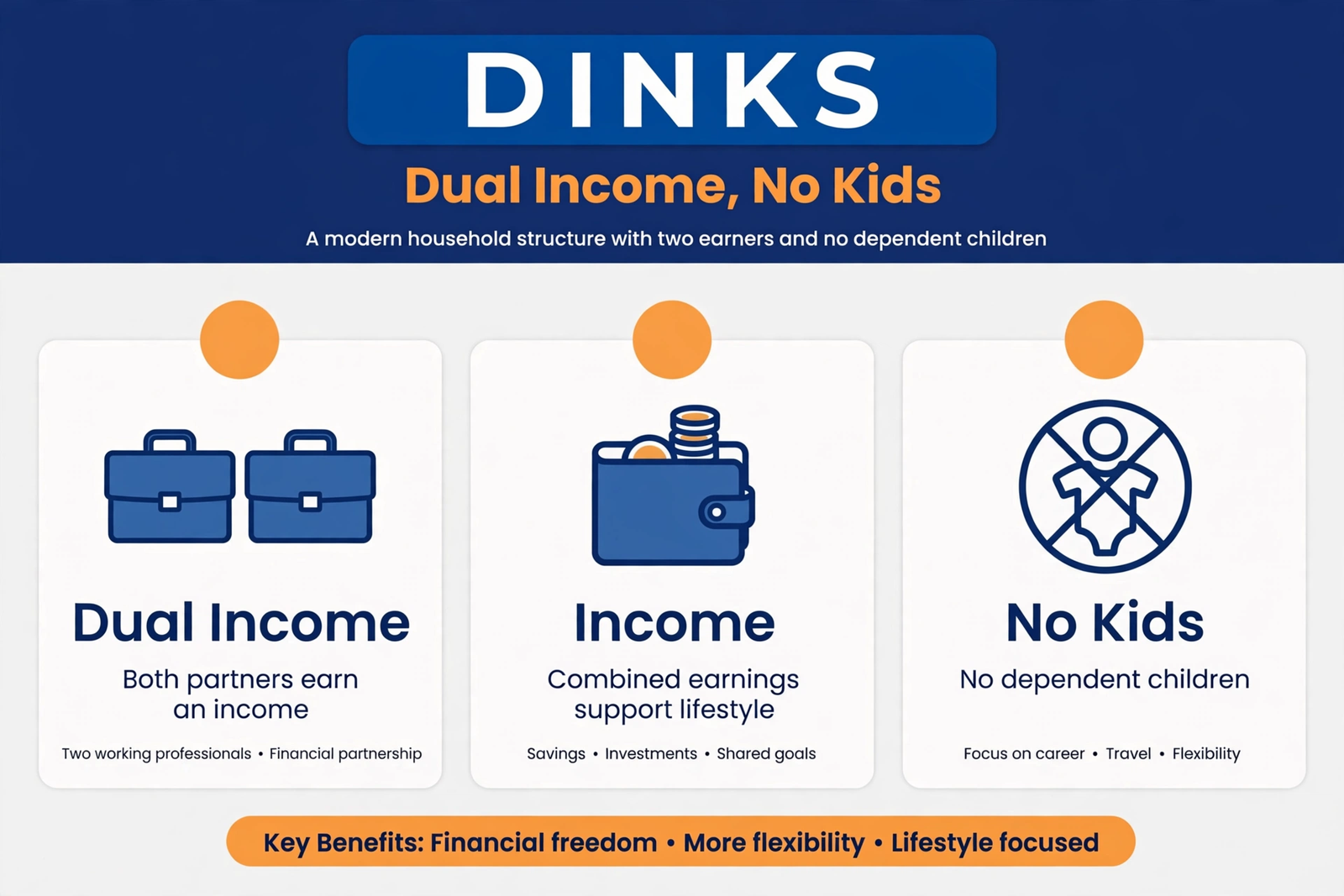
Quick definition: In slang, DINKS stands for “Dual Income, No Kids” — a couple where both partners work and earn money, and they have no children. On TikTok, Reddit, and in personal-finance chats, people use it to describe a childfree lifestyle with two paychecks and (usually) a lot more disposable income.
dinks slang Meaning & Definition
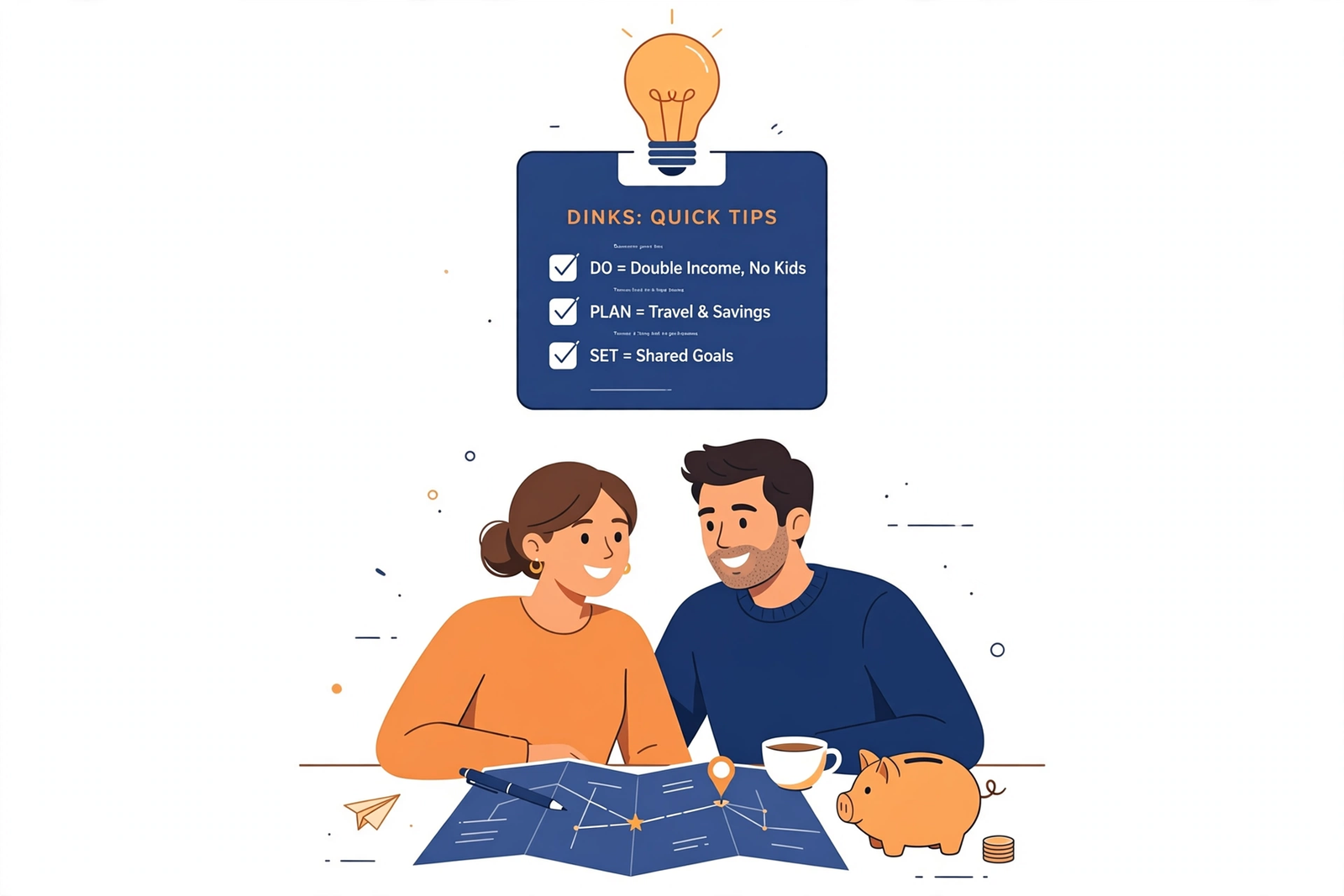
DINKS is an acronym for Dual Income, No Kids. It describes a household — almost always a couple — in which both partners have jobs and incomes, and there are no children to raise or pay for. The word is both a noun (“We’re DINKS”) and an adjective (“a DINKS lifestyle,” “DINKS travel”).
The term sits at the crossroads of internet slang and economics. It started as a demographic label used by marketers in the 1980s, then got a second life online, where young couples started using it proudly — and sometimes defensively — to describe a life built around careers, travel, and freedom instead of kids.
In short:
- Dual = two people, both earning.
- Income = two salaries, two careers, two streams of money coming in.
- No Kids = no children — by choice, or simply not yet.
That is the whole formula. Two incomes, zero kids, and everything that follows from it: more money to spend, more time to travel, and a lot of opinions from everyone else.
Introduction
Scroll through TikTok or Reddit for five minutes and you will meet the DINKS. They are the couple posting from a beach in Bali on a Tuesday. The pair renovating a kitchen they actually use. The two people in the comments saying, “We could never afford this with kids” — and meaning it as a flex, not an apology.
DINKS culture has exploded online because it names something a whole generation is quietly living: two people, two careers, no children, and a lifestyle that looks very different from the one their parents had at the same age. Some DINKS are childfree by choice and proud of it. Others are simply “not yet” — focused on careers, travel, or paying off debt before deciding about kids. And some just stumbled into the label after years of working, saving, and never quite getting around to the baby question.
But the word carries baggage. For every person who hears “DINKS” and thinks “smart financial move,” someone else hears it and thinks “selfish” or “you’ll change your mind.” That tension — between freedom and judgment — is exactly why the term trends. In this guide, we break down what DINKS really means, where it came from, how people actually use it in texts and on social media, what it gets confused with, and how to use it without sounding rude.
Origin
The word DINKS was born in the 1980s, in the middle of yuppie culture. As more married women entered the workforce and stayed in it, marketers and demographers needed a label for a new kind of household: two salaries, no children, and a lot of money to spend. DINKS fit the bill — short, catchy, and easy to put on a chart.
It was, at first, a marketing term, not slang. Advertisers loved DINKS because they were the ideal customers: high disposable income, no school fees, no childcare costs, and a taste for restaurants, travel, cars, and nice apartments. Magazines and newspapers in the late 1980s used the word constantly when writing about young urban professionals.
The term faded a little in the 1990s and 2000s, then came roaring back with social media. Three things brought it back:
- Reddit: Communities like r/DINKs (and the related childfree and FIRE — Financial Independence, Retire Early — forums) turned a dry demographic label into an identity.
- TikTok: Creators started posting “day in the life of a DINKS couple” videos — slow mornings, brunches, spontaneous trips — and the videos went viral precisely because they showed a life without school runs and bedtime routines.
- The cost of living: As childcare, housing, and education got more expensive, more couples started talking openly about choosing two incomes and no kids as a financial strategy, not just a lifestyle preference.
Today, DINKS is used in two different registers. In economics and marketing, it is still a neutral demographic category. On social media, it is an identity label — sometimes a proud one, sometimes a joking one, and sometimes a word people use to argue about how everyone else should live.
Popularity
DINKS is more popular now than at any point since the 1980s, and the numbers help explain why. In the United States, the share of married couples without children has grown steadily, and surveys consistently show younger adults delaying parenthood — or opting out entirely — at higher rates than any previous generation. When a term matches a real demographic shift, it spreads.
On TikTok, #dinks and #dinklife videos regularly rack up millions of views. The most popular ones follow a simple formula: a couple shows what their money and time buy — a renovated home, a long vacation, a fancy dinner on a weeknight — and the caption does the rest. The comments split into two camps almost every time: people who love the lifestyle, and people who warn that they will regret it.
Reddit’s DINKS communities are quieter but deeper, full of practical talk: budgets, retirement plans, house-buying strategies, and how to handle family pressure at holidays. Personal-finance creators love the term because DINKS couples are a natural audience for investing, early retirement, and travel content.
The word has also crossed into mainstream media. Newspapers now run “the rise of the DINKS” stories every year or so, usually when a new survey shows more couples choosing this path. It has become one of those slang terms that started in marketing, passed through the internet, and ended up in everyday conversation.
How It Is Used
In everyday use, DINKS works as both a label and a lifestyle shorthand. Here is how it shows up in real conversations:
- As a self-description: “We’re DINKS, so we can actually afford to eat out on Fridays.” People use it to explain their choices — travel, spending, free time — in one word.
- As a joke or flex: “DINKS life: booked a flight on a Tuesday because we felt like it.” On social media, it is often playful bragging.
- As a demographic label: “This neighborhood is full of DINKS and retirees.” Here it is neutral, just describing who lives somewhere.
- As a financial identity: “Being DINKS let us max out our retirement accounts in our 30s.” In money communities, it is about math, not attitude.
- As a gentle tease: “Must be nice, DINKS.” Friends with kids say this with a smile — and sometimes with a little envy.
The tone matters a lot. Said by a DINKS couple about themselves, it is usually light and proud. Said by someone else, it can sound judgmental — especially if it is used to imply that a couple is selfish for not having kids. Context, as always, is the decoder — the same rule that applies to almost every piece of texting shorthand, from OMW meaning in text to the newest TikTok acronym.
You will also see the singular form DINK (“He’s a DINK — his wife works too and they have no kids”), and spin-off acronyms built on the same pattern, which we cover in the comparison section below.
Examples
The best way to understand a slang term is to see it in real sentences. Here are examples of how DINKS shows up in texts, captions, and everyday talk.
Friendly Examples
- “We’re DINKS now that we’re both working — finally saving for that Japan trip!”
- “DINKS life means brunch at 11 on a Saturday and nobody has to be anywhere.”
- “My sister and her husband are DINKS and their apartment is honestly goals.”
- “Being DINKS, we split everything 50/50 — rent, bills, even the dog’s vet visits.”
Professional Examples
- “As a DINKS household, we were able to put a larger deposit on our first home.”
- “Our financial planner said DINKS couples have a real advantage when it comes to early retirement.”
- “The survey found that DINKS households spend significantly more on travel and dining than the average family.”
- “Many young professional couples are choosing the DINKS path while they focus on building their careers.”
Funny Examples
- “DINKS: we have two incomes, zero kids, and a dog who lives better than most humans.”
- “POV: you’re DINKS and your biggest argument this week was which restaurant to try.”
- “We’re not rich, we’re just DINKS with no one to spend our money on except ourselves.”
- “DINKS energy is booking a hotel just because the bathtub looked nice in the photos.”
Notice the pattern: in friendly and funny uses, DINKS is a badge of freedom. In professional uses, it is a planning category. Same word, different job — and the setting tells you which one it is doing.
| Situation | Example | Tone |
|---|---|---|
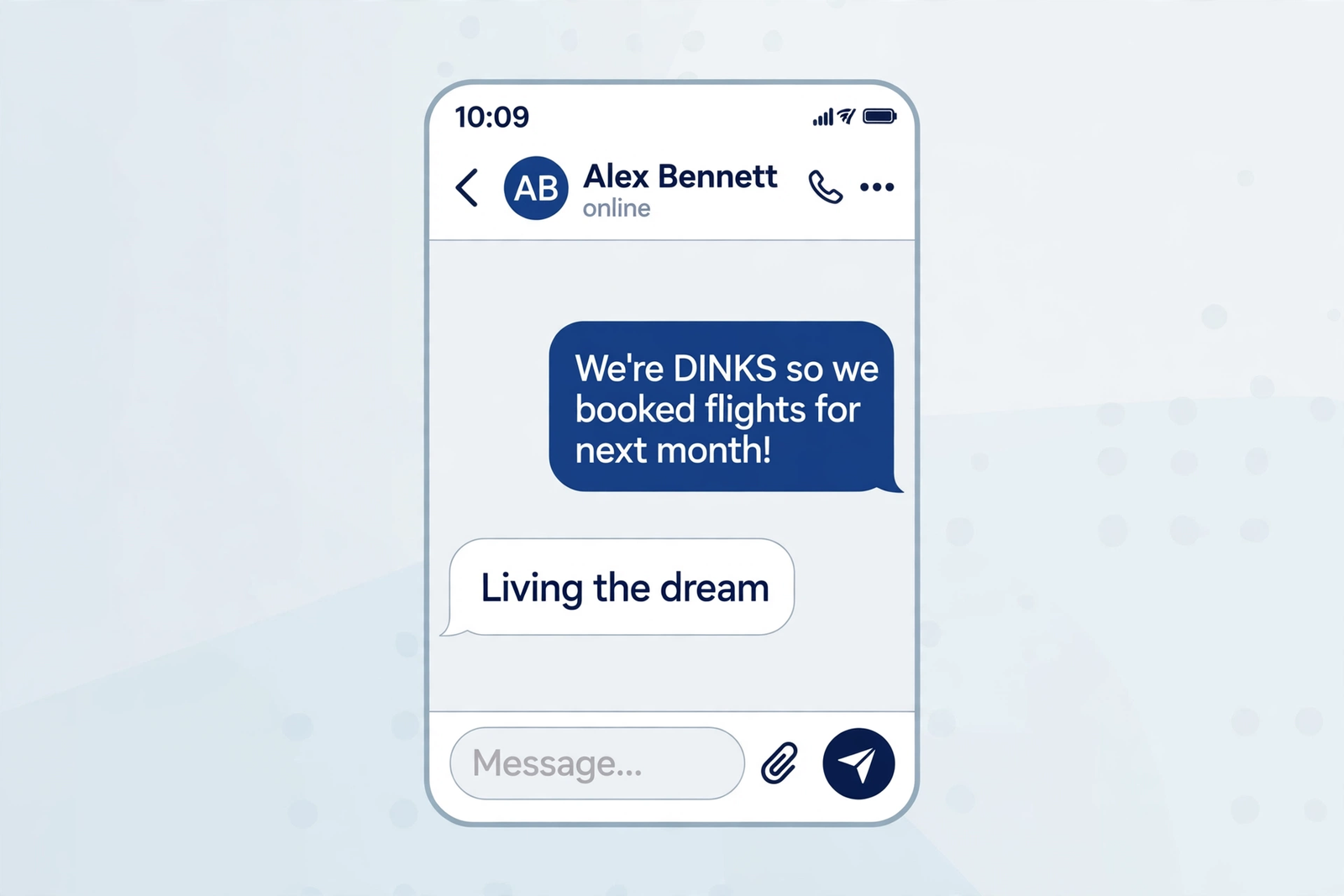
| Texting a friend | “DINKS life — we just booked flights for next month on a whim.” | Playful, excited |
| TikTok caption | “Day in the life of a DINKS couple with no alarm clocks.” | Proud, aspirational |
| Reddit / finance forum | “DINKS here, 32 and 34, trying to max our 401(k)s this year.” | Practical, serious |
| Family dinner | “We’re DINKS for now — kids are a ‘someday’ conversation.” | Diplomatic, careful |
Comparison with Similar Terms
DINKS has a whole family of related acronyms, and they are easy to mix up. Here is how the main ones compare:
| Term | Stands For | What It Means | Key Difference from DINKS |
|---|---|---|---|
| DINKS | Dual Income, No Kids | Couple, both working, no children | The original term |
| DINKY | Dual Income, No Kids Yet | Couple, both working, kids planned later | “Yet” — kids are on the plan, just not now |
| DINKWAD | Dual Income, No Kids, With A Dog | DINKS couple with a dog | Adds a dog; hugely popular on social media |
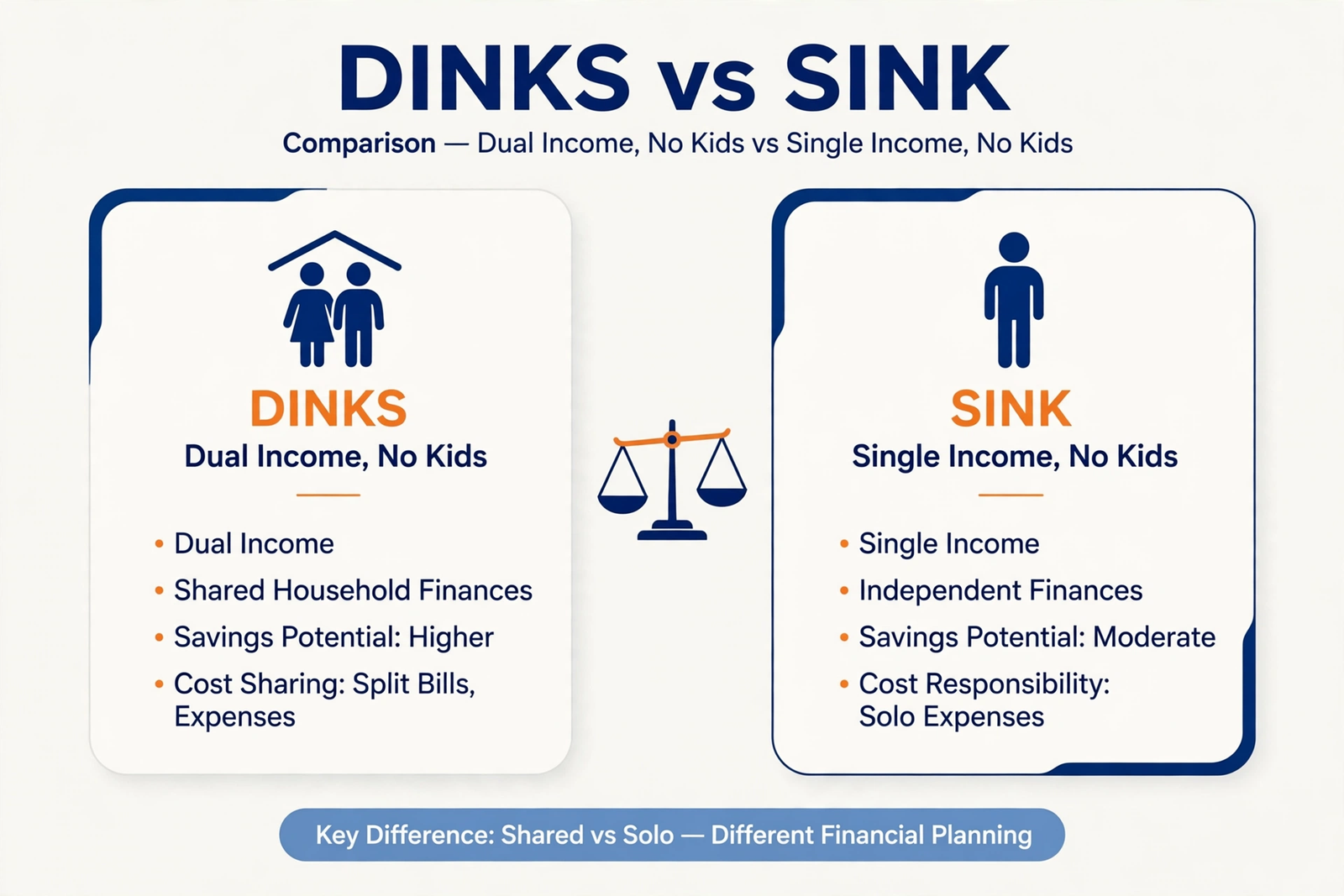
| SINK | Single Income, No Kids | One person, working, no children | Single, not a couple; one income |
| Childfree | — | Choosing not to have children, ever | A life choice, not a money label; can be single or coupled |
| DINKWADs / GINKs | Green Inclinations, No Kids | Environmentally focused, no kids | Motivated by the planet, not just money |
The most important distinction is DINKS vs. childfree. Childfree is a decision about never having children. DINKS is a description of a household’s current situation — two incomes, no kids right now. Plenty of DINKS couples plan to have kids later (that is what DINKY is for), and plenty of childfree people are single, so the two words overlap without being the same thing.
Another common confusion is DINKS vs. DINKY. If a couple says they are DINKY, they are telling you kids are in the future. If they say DINKS, they are not telling you either way — the word only describes the present. When in doubt, DINKS is the safer, broader term.
Alternate Meanings
DINKS almost always means “Dual Income, No Kids” — but the root word dink has a few other lives in slang, and they are worth knowing so you do not get confused.
- “Dink” as a mild insult: In American slang, calling someone a “dink” means calling them a fool or an idiot — but a soft one, more teasing than cruel. “Don’t be such a dink” is closer to “don’t be silly” than to a real insult. It is old-fashioned and rarely used by younger people.
- “Dink” in pickleball: In pickleball, a “dink” is a soft, controlled shot that just clears the net and lands in the opponent’s kitchen (the no-volley zone). It is a core skill of the game, and “dinking” is a whole strategy. If someone says “nice dink” on a pickleball court, they are complimenting a shot, not a lifestyle.
- “Dink” in Australian slang: In Australia, to “dink” someone means to give them a ride on your bicycle — usually on the handlebars or the back. “Can you dink me to the shops?” is a normal request, not an insult.
- “Dink” as a small hit: In sports and gaming, a “dink” can mean a small, weak hit — a dinked single in baseball, or a soft tap in a video game.
None of these has anything to do with Dual Income, No Kids. The giveaway is context: if the sentence is about money, couples, or lifestyle, it is DINKS the acronym. If it is about a bicycle, a pickleball court, or someone being silly, it is the other “dink.”
Professional or Polite Alternatives
DINKS is casual slang, and it does not belong in every setting. If you are writing formally, talking to someone you do not know well, or discussing a sensitive topic, these alternatives work better:
- “A dual-income household without children” — the plain, professional version. Safe for reports, surveys, and formal writing.
- “A couple without children” — simple and neutral, with no acronym and no attitude.
- “Childfree by choice” — use this only if the people involved actually describe themselves this way. It is a personal identity, not a synonym for DINKS.
- “Two working adults, no dependents” — the financial-planning version, useful when the point is money, not lifestyle.
- “We don’t have kids yet” — the warm, everyday way to say it in conversation, especially with family.
One thing to avoid: using DINKS to describe a couple who have lost a child, are struggling with fertility, or simply have not chosen to share their plans. The label is only polite when the people it describes are comfortable with it. If you are unsure, just describe the situation instead of labeling the people.
Common Mistakes
DINKS is a simple word, but people still get it wrong. Here are the mistakes to avoid:
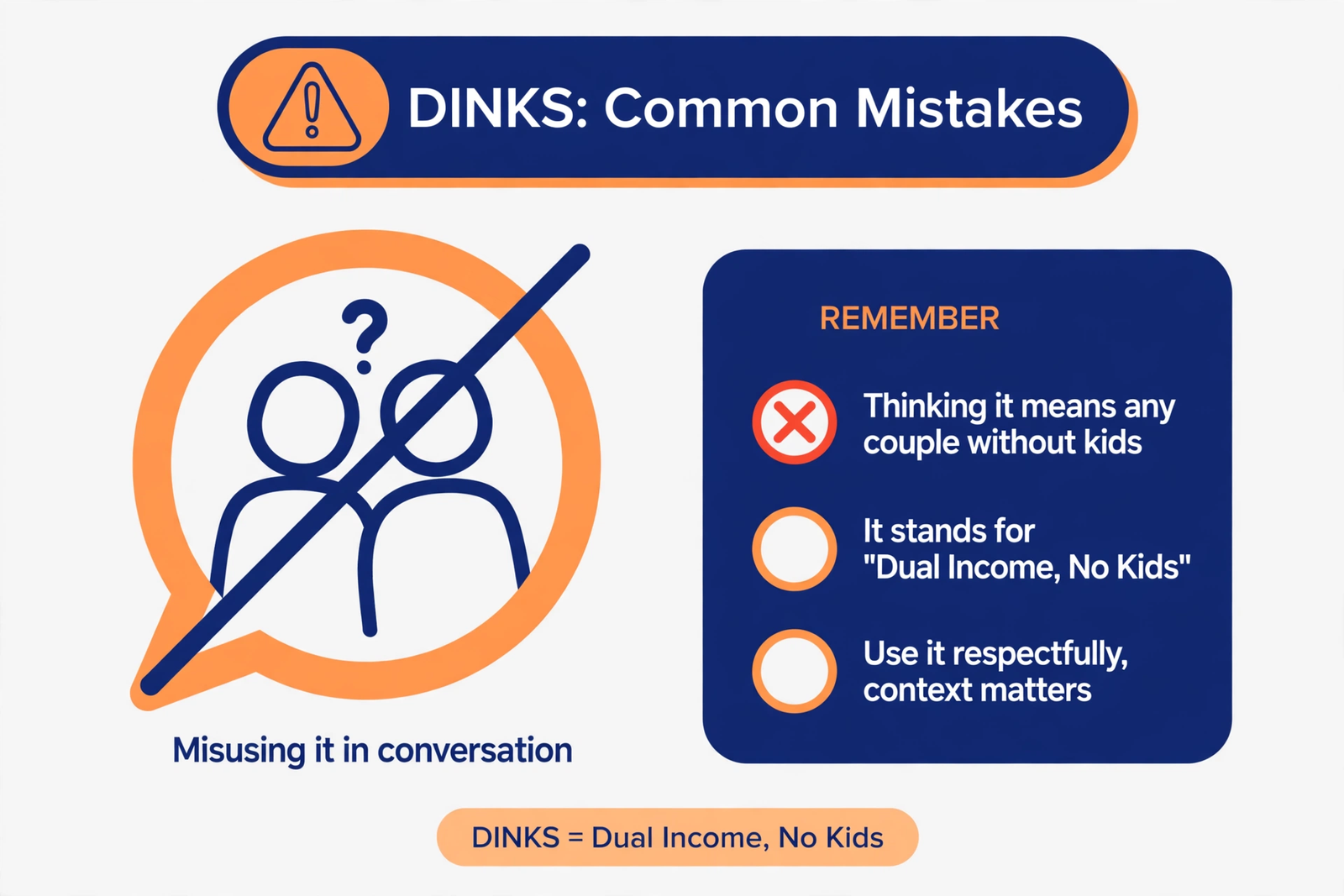
- Assuming DINKS means childfree forever: The biggest mistake. DINKS describes right now, not forever. Many DINKS couples have kids later. Do not treat it as a permanent life sentence.
- Using it as an insult: “Oh, you’re just DINKS, you wouldn’t understand real life.” That is rude, and it turns a neutral label into a judgment. Use the word to describe, not to dismiss.
- Assuming all DINKS are rich: Two incomes do not automatically mean wealth. Plenty of DINKS couples are paying off student loans, rent, and medical bills. The lifestyle varies enormously.
- Calling a single person a DINK: DINKS is a couple’s label — dual income means two people earning. A single person with no kids is a SINK (Single Income, No Kids), not a DINK.
- Forgetting the dog: If the couple has a dog, the internet’s preferred term is DINKWAD (Dual Income, No Kids, With A Dog). It is a joke, but it is also the term people actually search for.
- Using it in formal writing: In a business report or an academic paper, spell it out — “dual-income households without children.” Save DINKS for conversation and social media.
Quick Tips
- Use DINKS for couples only: Two partners, two incomes, no kids. For one person, the word is SINK.
- Add “yet” when it fits: If kids are planned later, DINKY is the more accurate word — and it avoids awkward assumptions.
- Let people label themselves: Some couples love the DINKS tag; others hate it. If they use it, you can use it. If they don’t, don’t apply it to them.
- On social media, pair it with specifics: “DINKS” alone is vague. “DINKS — we saved for a year and took three weeks off” tells a story.
- In money talk, focus on the math: The useful part of DINKS is the financial picture — two incomes, no childcare costs — not the label itself.
- Don’t use it to start an argument: “DINKS vs. parents” debates go nowhere. The word works best as a description, not a weapon.
- Remember the dog rule: Two incomes, no kids, one very spoiled dog? That’s a DINKWAD, and the internet will love it.
FAQ
1. What does DINKS mean in slang?
In slang, DINKS means “Dual Income, No Kids” — a couple where both partners work and earn money, and they have no children. It describes a household and a lifestyle, not a personality type.
2. What does DINKS mean on TikTok?
On TikTok, DINKS usually shows up in “day in the life” videos of couples with two incomes and no kids — travel, nice meals, slow mornings, and home projects. The hashtag is often used proudly, and the comments usually split between admiration and debate about the lifestyle.
3. Is DINKS the same as childfree?
Not exactly. Childfree means choosing never to have children. DINKS only describes the present situation — two incomes, no kids right now. Many DINKS couples plan to have children later, while childfree people (single or coupled) have decided not to.
4. What is a DINKWAD?
A DINKWAD is a “Dual Income, No Kids, With A Dog.” It is the internet’s favorite version of DINKS — two incomes, no children, and one very pampered dog. The term is mostly used jokingly on social media.
5. What is the difference between DINKS and DINKY?
DINKS means dual income, no kids — with no statement about the future. DINKY adds a “Y” for “Yet”: dual income, no kids yet. DINKY couples plan to have children later; DINKS couples may or may not.
6. Can a single person be a DINK?
No. DINKS is specifically about a couple — dual income means two earners. A single working person with no children is a SINK (Single Income, No Kids).
7. Why are DINKS so popular on social media?
Because the lifestyle is visually appealing and financially interesting: two salaries, no childcare costs, and freedom to travel and spend. Creators post about it, audiences argue about it, and the algorithm rewards the debate — which makes the term even more popular.
8. Is it rude to call someone a DINK?
It depends on context. If the couple uses the label themselves, it is fine. If you use it to imply they are selfish, shallow, or missing out on “real life,” it is rude. When in doubt, describe the situation (“they both work and don’t have kids”) instead of applying the label.

Conclusion
DINKS — Dual Income, No Kids — is one of those rare slang terms that started in a marketing meeting and ended up as an identity. It describes a simple reality: two people, two paychecks, no children, and all the choices that come with that combination. For some couples it is a deliberate financial strategy. For others it is just where life has taken them so far. Either way, it is a label about a household, not a judgment about a life.
The key takeaways are easy to remember. DINKS means two incomes and no kids — right now, not necessarily forever. It is not the same as childfree, and it is not the same as DINKY, which adds “yet.” A single person is a SINK, and a couple with a dog is a DINKWAD. And like every slang term, it works best when the people it describes are happy to wear it.
The next time you see a “DINKS life” video or a friend drops the word in a group chat, you will know exactly what it means — and you will know when to use it, when to skip it, and when to just enjoy the brunch photos. Want to decode more internet shorthand? Check out our guide to BTA slang meaning for another three-letter puzzle, our breakdown of fade meaning slang for a word with even more meanings, and our IG slang guide for the two letters everyone types but few can define. For the bigger picture, the Investopedia guide to DINKS explains the financial side of the dual-income, no-kids household in detail.

1 thought on “dinks slang: What Does DINKS Mean in Text, on TikTok & in Real Life?”