
Quick definition: Peruvian slang, known locally as jerga peruana, is the informal, everyday Spanish spoken in Peru. It mixes standard Spanish with Quechua words, English borrowings, and playful wordplay, so a simple word like causa can mean “friend,” chamba can mean “job,” and bacán can mean “cool.” If you have ever wondered what Peruvians really say in Lima, Cusco, or Arequipa, this guide explains the 30 most common peruvian slang words with real meanings, examples, and tips.
Peruvian Slang Meaning & Definition
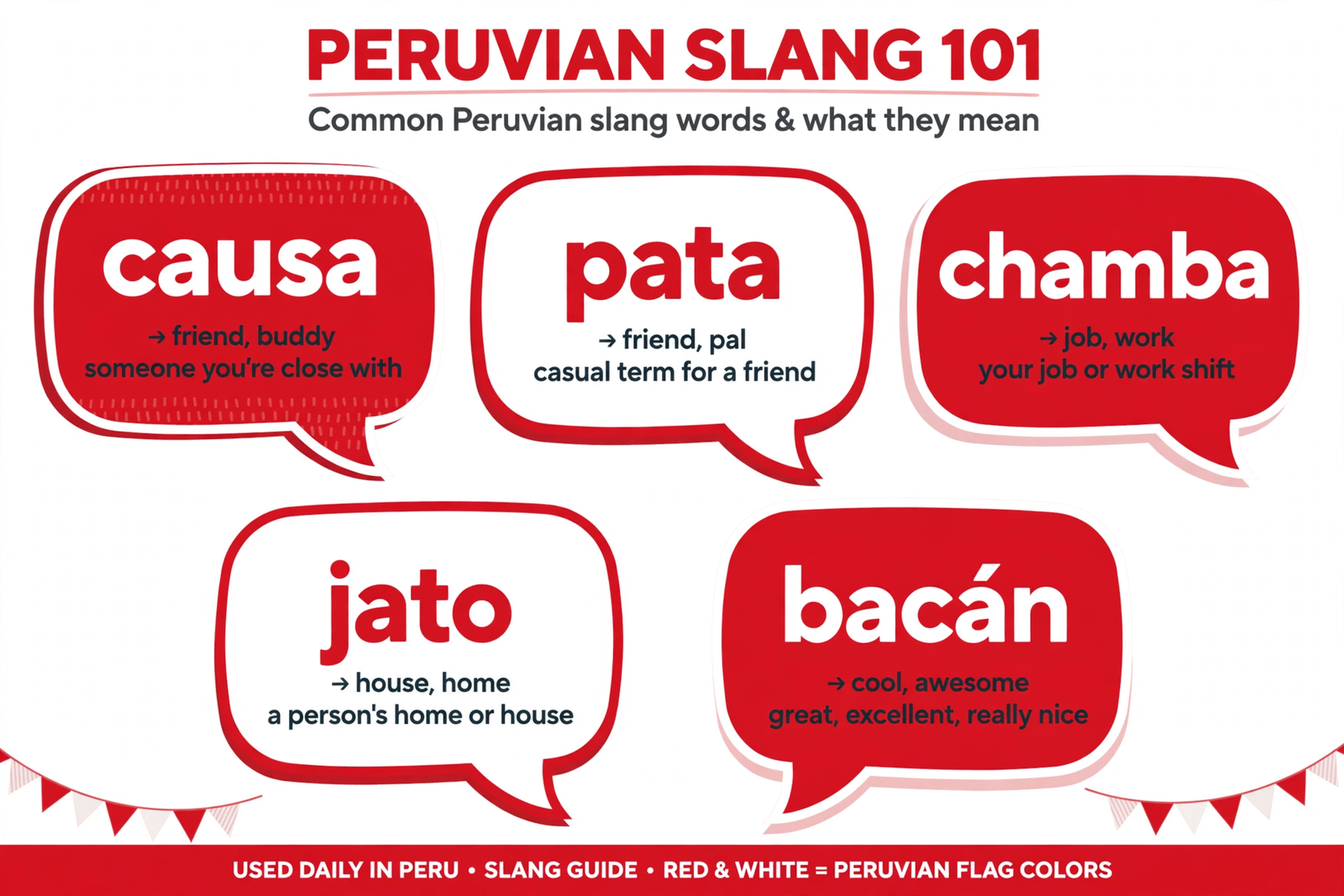
Peruvian slang is the casual, street-level Spanish used by millions of people across Peru. While classroom Spanish teaches you amigo for friend and casa for house, everyday conversation in Peru sounds very different. On the streets of Lima, you will hear causa or pata for friend and jato for house. That gap between textbook Spanish and real-life Spanish is exactly what peruvian slang fills.
The local name for this colorful way of speaking is jerga peruana, and it is much more than a handful of funny words. It is a living part of Peruvian culture, shaped by Indigenous Quechua roots, Spanish colonization, African and Asian immigration, and modern influences from English, social media, and music. Peruvians use slang to show warmth, humor, and belonging. Using the right word at the right moment can turn a stranger into a pata, while using the wrong one can cause an awkward silence or even offense.
For travelers, Spanish learners, and anyone chatting with Peruvian friends online, learning peruvian slang is one of the fastest ways to understand real conversations. It helps you follow WhatsApp chats, enjoy Peruvian TikTok and YouTube videos, order food like a local, and avoid misunderstandings when a word means something completely different from its dictionary definition.
Introduction
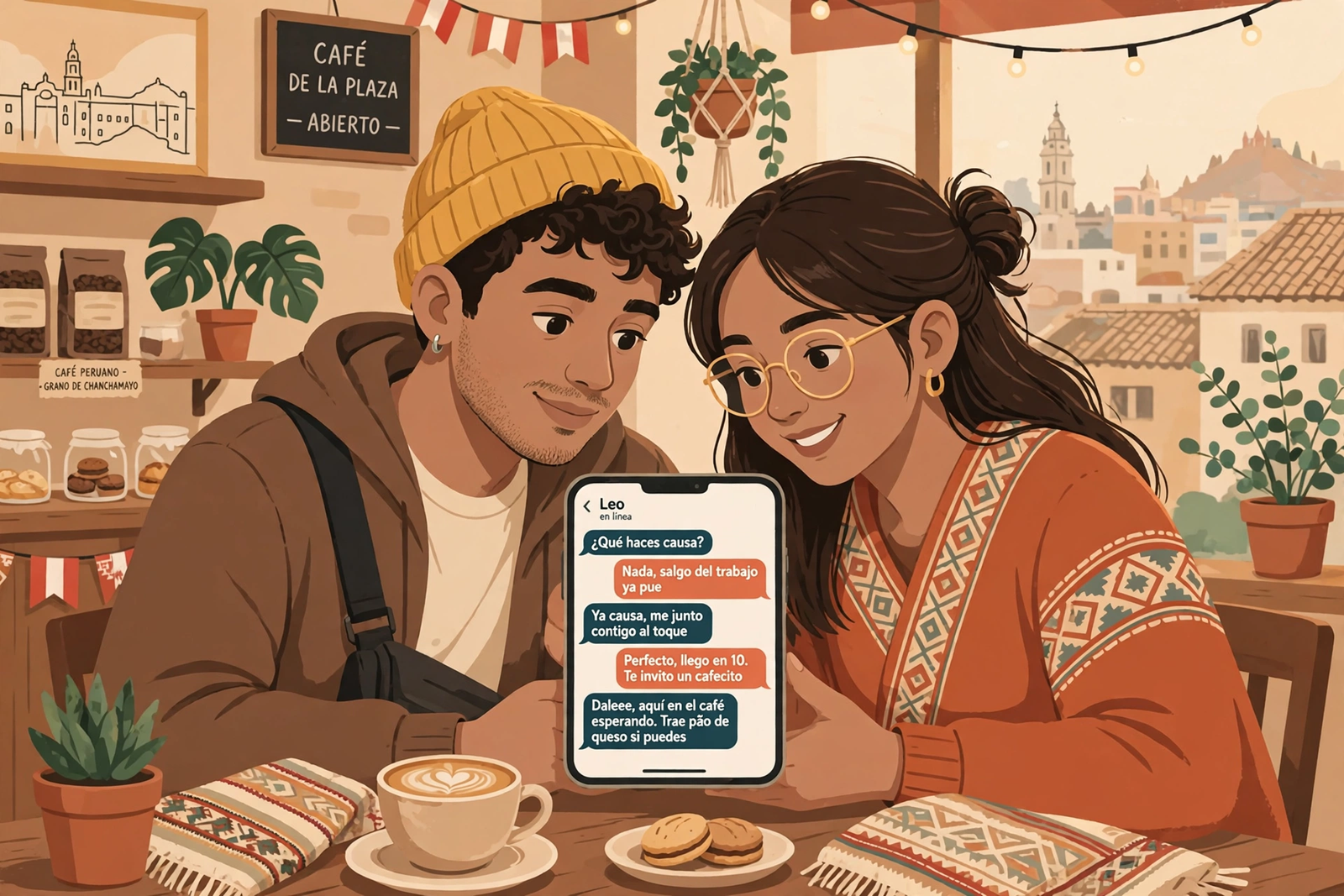
Imagine landing in Lima, opening your phone, and reading a message from your new Peruvian friend: “Oye causa, ¿vamos a jamear y después un tono? Estoy misio, pero tranqui, es al toque.” If you only know classroom Spanish, that sentence looks like a puzzle. Translated into real peruvian slang, it means: “Hey buddy, shall we go eat and then to a party? I am broke, but relax, it is right nearby.”
That is the magic of Peruvian slang. It is warm, funny, creative, and full of personality. Words get shortened, flipped backwards, borrowed from English, and mixed with Quechua. A beer becomes a chela, work becomes chamba, a party becomes a tono, and “cool” becomes bacán or chévere. Once you learn the patterns, the language opens up, and Peru starts to feel less like a destination and more like a place where you belong.
In this guide, you will learn what peruvian slang really is, where it comes from, and how it is used in daily life. You will get 30 essential words and phrases organized by theme, with clear meanings and real example sentences in Spanish and English. You will also see how Peruvian slang compares with slang from Mexico, Argentina, and Chile, what mistakes to avoid, and how to use these expressions politely. Just like decoding modern texting language, where our guide to fn meaning in text breaks down internet shorthand, this article decodes the slang Peruvians use face to face and in chats every single day.
Origin
Peruvian slang did not appear overnight. It grew over centuries from the many cultures that shaped Peru. Before Spanish colonization, the Inca Empire and other Andean peoples spoke Quechua and Aymara. When Spanish arrived in the 1500s, the two languages began to mix. Quechua words entered everyday Spanish, Spanish words were reshaped by Quechua pronunciation, and new expressions were born from the blend.
Later waves of immigration added more layers. African communities brought rhythm and vocabulary, Chinese immigrants shaped food culture (and words like chifa for Chinese-Peruvian restaurants), and Japanese Peruvians added their own flavor. In the 20th century, English borrowings arrived through movies, music, and the internet. That is why a Peruvian might call a security guard a guachimán (from the English “watchman”) or a close friend bróder (from “brother”).
One of the most playful features of peruvian slang is vesre, the habit of reversing syllables. The word jerma (girlfriend) comes from mujer said backwards, and tolaca (naked, playfully) comes from calato reversed. Lima’s working-class neighborhoods, markets, and universities were the great laboratories of this wordplay, and radio, television, and now TikTok spread the best expressions across the whole country.
Today, language authorities such as the Royal Spanish Academy (RAE) document standard Spanish, while the Academia Peruana de la Lengua studies how Peruvians actually speak, including slang. The two perspectives together show that slang is not “bad Spanish.” It is a creative, rule-breaking register of the language with its own history and logic.
Popularity
Peruvian slang is more popular than ever, and the reasons are easy to see. Peru receives millions of visitors every year, drawn by Machu Picchu, Lima’s food scene, and the country’s festivals. Travelers quickly discover that the Spanish they learned in school is only half the story, so searches for Peruvian slang guides, phrase lists, and video explainers keep growing.
Social media has pushed the trend even further. Peruvian creators on TikTok, Instagram, and YouTube use slang in comedy sketches, travel vlogs, and everyday chats, and their audiences repeat the words. A phrase like ¡Asu! or al toque can travel from a Lima street to a global audience in a single viral video. Language-learning apps and expat blogs have followed, publishing longer and better guides every year.
Inside Peru, slang is also a marker of identity. Young people in Lima, Cusco, and Arequipa use it to signal friendship and humor, while older generations use classic expressions that have survived for decades. Regional differences keep things interesting: university students in Cusco may favor different expressions than friends in Arequipa, and coastal Lima slang differs from Andean slang. That variety is part of the charm, and part of why a single list can never capture every word.
How It Is Used
Peruvian slang shows up everywhere: in face-to-face conversation, in WhatsApp and Instagram chats, in markets and taxis, at parties, and at work. The tone is usually warm and informal. Friends greet each other with causa or pata, agree with ya pe, and describe a great night out as un tonazo. In casual texting, Peruvians often shorten words even further and mix slang with emojis, stickers, and voice notes.
Context matters a great deal. The same word can be affectionate among friends and rude in a formal setting. Cholo, for example, can be a warm nickname in one conversation and an insult in another. Conchudo describes a shameless or cheeky person and should be understood rather than used by learners. The safest rule for beginners is simple: learn the friendly, widely used words first, listen before you speak, and copy the tone of the people around you.
Slang also changes meaning with grammar. Chamba can mean a job (“Estoy buscando chamba” — I am looking for work), a hard-working person (“Ella es full chamba”), or careless work when used in the phrase a la chamba. Paja usually means cool or awesome, but it can also describe something tedious depending on the sentence. Paying attention to the full sentence, not just the single word, is the key to understanding peruvian slang in the wild.
Examples
Below are the 30 most useful peruvian slang words and phrases, grouped by theme. Each entry includes the meaning in plain English and a real example sentence with a translation, so you can see exactly how the word works in conversation.
Friendly Examples
These are the warm, everyday words you will hear between friends, in cafes, on tours, and in casual chat. They are safe, friendly, and very Peruvian.
| Slang Word | Meaning | Example Sentence |
|---|---|---|
| causa | Close friend, mate (Lima) | Oye, causa, ¿cómo estás? — Hey mate, how are you? |
| pata | Friend, buddy, pal | Él es mi pata del trabajo. — He is my work friend. |
| pata del alma | Best friend, very close friend | Ella es mi pata del alma. — She is my best friend. |
| mancha | Group of friends, crew | Voy con toda la mancha. — I am going with the whole crew. |
| flaco / flaca | Boyfriend, girlfriend, partner | Voy con mi flaca. — I am going with my girlfriend. |
| bróder | Brother, close friend (from English “brother”) | ¿Qué tal, bróder? — What’s up, bro? |
| chibolo / chibola | Kid, young person, teenager | Ese chibolo juega bien. — That kid plays really well. |
| jerma | Girlfriend (from mujer reversed) | Vino con su jerma. — He came with his girlfriend. |
Friends also use fun interjections. ¡Asu! (short for ¡A su madre!) expresses surprise, shock, or admiration: ¡Asu, qué vista de Machu Picchu! — Wow, what a view of Machu Picchu! And manyas works like “you know?” in English: ¿Manyas? Ayer vi a tu pata en el mercado. — You know? Yesterday I saw your friend at the market.
Professional Examples
Work and money have their own slang in Peru. These words appear in offices, markets, and everyday errands, and they are useful even in semi-formal situations.
| Slang Word | Meaning | Example Sentence |
|---|---|---|
| chamba | Job, work | Tengo mucha chamba hoy. — I have a lot of work today. |
| chambear | To work | Chambeo de lunes a viernes. — I work Monday to Friday. |
| jato | House, home | Vamos a mi jato. — Let’s go to my place. |
| luca | One sol (Peruvian money) | ¿Me prestas diez lucas? — Can you lend me ten soles? |
| misio / misia | Broke, out of money | Estoy misio hasta fin de mes. — I am broke until the end of the month. |
| guachimán | Watchman, security guard | El guachimán abre la puerta a las ocho. — The guard opens the door at eight. |
| tombo | Policeman (playful, sometimes mocking) | Ahí viene el tombo. — Here comes the cop. |
| yapa | A little extra for free | ¿Me da la yapa, caserita? — Can I get a little extra, please? |
Funny Examples
Peruvian humor is quick and playful, and these expressions carry the jokes. Use them with friends who already know your sense of humor.
| Slang Word | Meaning | Example Sentence |
|---|---|---|
| bacán | Cool, awesome, excellent | ¡Qué bacán tu casa! — Your house is so cool! |
| chévere | Cool, awesome (like bacán) | La vista es chévere. — The view is awesome. |
| paja | Cool, great, awesome | El tour estuvo paja. — The tour was great. |
| ¡Qué roche! | How embarrassing! | Me caí en la calle, ¡qué roche! — I fell in the street, how embarrassing! |
| palta | Embarrassment, awkwardness | Me da palta hablar en público. — Speaking in public makes me feel awkward. |
| tranqui | Chill, relaxed, no worries | Hoy será un día tranqui. — Today will be a relaxed day. |
| al toque | Right away, immediately | Lo hago al toque. — I will do it right away. |
| ya pe | OK, come on, let’s go | Ya pe, vámonos. — Come on, let’s go. |
| tono / tonazo | Party / huge party | Hay tono el sábado. — There is a party on Saturday. |
| chela | Beer | ¿Tomamos unas chelas en Barranco? — Shall we have some beers in Barranco? |
| jamear / jama | To eat / food | Vamos a jamear algo. — Let’s go eat something. |
| chifa | Chinese-Peruvian restaurant | Esta noche vamos a un chifa. — Tonight we are going to a chifa restaurant. |
| pituco / pituca | Posh, snobby, wealthy person | Es un barrio pituco. — It is a posh neighborhood. |
| bamba | Fake, knock-off | Esas zapatillas son bamba. — Those sneakers are fake. |
Food and drink deserve a special mention because Peru is famous for its cuisine. Beyond chela and chifa, you will hear chaufa (fried rice) used playfully as a goodbye, and chupar used colloquially to mean drinking alcohol. In chats, these food words mix freely with greetings and plans, much like the casual openers explained in our guide to hbu meaning in chat.
Comparison with Similar Terms
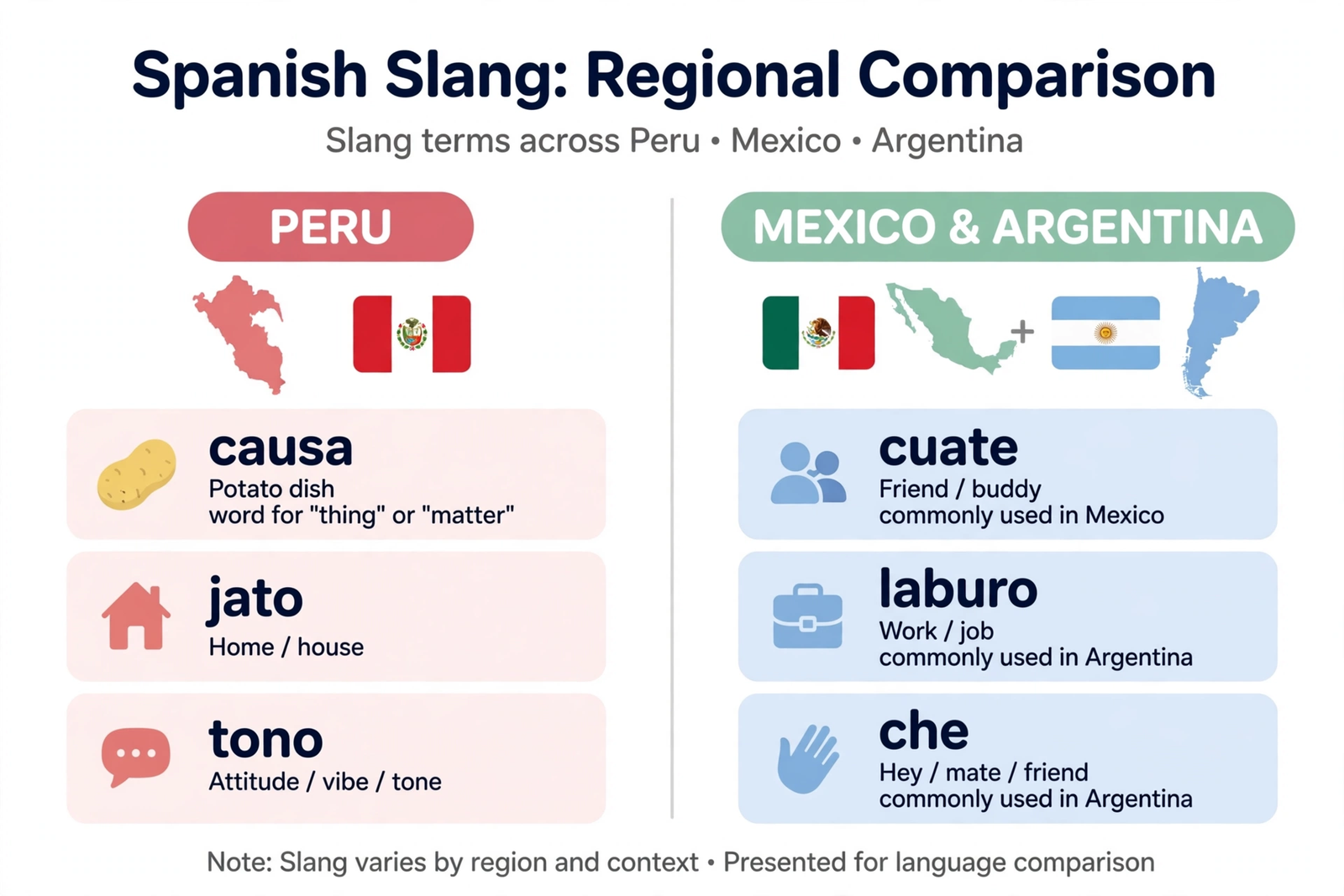
Peruvian slang shares some words with other Latin American countries, but many expressions are unique to Peru. The table below compares the same everyday idea across several countries, so you can see where Peru stands out.
| Idea | Peru | Mexico | Argentina | Chile | Colombia |
|---|---|---|---|---|---|
| Friend | causa, pata | cuate, compa | che, boludo | weón, compadre | parcero, pana |
| Cool / awesome | bacán, chévere, paja | chido, padre | copado, genial | bacán, filete | chévere, bacano |
| Work / job | chamba | chamba | laburo | pega | camello |
| House / home | jato | cantón | la casa | la casa | la casa |
| Beer | chela | chela | birra | chela | pola |
| Money (small amount) | luca (one sol) | lana, varo | mango, guita | luca (1,000 pesos) | plata, lucas |
| Party | tono | fiesta, pachanga | joda | carrete | rumba |
| Right away | al toque | ahorita, al tiro | ya, al toque | al tiro | ya mismo |
A few patterns stand out. First, chamba and chela are shared with Mexico, showing how slang travels across borders. Second, bacán appears in both Peru and Chile, while chévere is shared with Colombia and Venezuela. Third, some words look identical but mean different things: a luca is one sol in Peru but 1,000 pesos in Chile, so context is everything. Finally, Peru’s most distinctive words, causa, jato, tono, and jerma, are rarely heard anywhere else, which is why they feel so unmistakably Peruvian.
Alternate Meanings
Like all slang, peruvian slang words often carry more than one meaning, and the same word can shift with tone, region, and company. Knowing the alternate meanings helps you avoid embarrassing mistakes.
- Paja: Usually “cool” or “awesome” (El concierto estuvo paja), but it can also mean something boring or tedious, and in vulgar use it has a crude meaning. Listen to the tone before repeating it.
- Cholo / chola: Can be an affectionate nickname, a proud cultural identity, or a derogatory insult depending on who says it and how. Learners should avoid using it until they understand the local context well.
- Chamba: A job, a hard-working person, or careless work (a la chamba). The meaning depends entirely on the phrase around it.
- Flaco / flaca: Literally “skinny,” but commonly used as an affectionate word for a partner or friend, even if the person is not thin at all.
- Palta: The fruit avocado in standard Spanish, but in peruvian slang it means embarrassment or an awkward situation (¡Qué palta!).
- Calato / calata: Naked, used playfully among friends. The reversed form tolaca is a joke version of the same word.
- Chaufa: Fried rice as a dish, but also used playfully instead of chau when saying goodbye.
- Asado: In some contexts it describes someone annoyed or upset, while in others it relates to a barbecue. Regional use varies, so check the context.
Professional or Polite Alternatives
Slang is wonderful with friends, but formal situations call for standard Spanish. Here are polite alternatives for the most common peruvian slang words, so you can switch registers smoothly.
| Slang Word | Polite Alternative | When to Use It |
|---|---|---|
| causa, pata | amigo, amiga | Work meetings, talking to older people, first introductions |
| chamba | trabajo, empleo | Job interviews, emails, official documents |
| jato | casa, hogar | Speaking with landlords, hotels, or officials |
| chela | cerveza | Restaurants, bars, formal dinners |
| jamear | comer, almorzar | Business lunches, invitations, polite conversation |
| tono | fiesta, reunión | Talking to colleagues or family elders |
| bacán, paja | excelente, muy bueno | Professional feedback, customer service |
| ¡Asu! | ¡Vaya!, ¡Qué sorpresa! | Any formal or mixed-age setting |
| misio | sin dinero, ajustado de presupuesto | Talking about money politely |
| tombo | policía, agente | Always, when speaking about police formally |
A good rule is to mirror the people around you. If your Peruvian colleague says chamba in a relaxed office chat, you can use it too. If a hotel receptionist speaks standard Spanish, answer in standard Spanish. Switching between the two registers is a skill Peruvians use every day, and it is one of the most impressive things a learner can master.
Common Mistakes
Learning peruvian slang is fun, but a few common mistakes can turn a friendly attempt into an awkward moment. Here are the ones to avoid.
- Using slang in formal settings: Calling your boss causa or describing a client meeting as paja can sound unprofessional. Save slang for friends and relaxed moments.
- Using risky words too early: Words like cholo, conchudo, and pendejo carry strong social weight. Understand them, but do not use them until you truly know the context.
- Mixing up luca across countries: In Peru a luca is one sol, but in Chile it is 1,000 pesos. Quoting prices with the wrong value can cause real confusion.
- Assuming one meaning fits all: Paja, chamba, and flaco all shift meaning with context. Always check the full sentence before assuming you understood.
- Overusing slang to sound local: Dropping ten slang words into one sentence sounds forced. Peruvians mix slang naturally with standard Spanish, usually one or two expressions per sentence at most.
- Ignoring regional differences: A word that is friendly in Lima may be unknown or odd in Cusco or Arequipa. When in doubt, ask a local what people say in that region.
- Translating word for word: ¡A su madre! literally mentions someone’s mother, but as an expression it simply means “Wow!” Outside Peru, the literal translation can sound insulting, so use the short form ¡Asu! instead.

Quick Tips
Want to start using peruvian slang naturally? These practical tips will help you sound friendly, not forced.
- Start with the safe five: Learn causa, pata, bacán, chévere, and al toque first. They are friendly, common, and hard to misuse.
- Listen before you speak: Spend a day noticing which words locals use with each other, then copy the ones you hear most often.
- Learn full sentences, not single words: Memorizing ¿Vamos a jamear? is more useful than memorizing jamear alone.
- Use slang in chats first: Texting Peruvian friends is a low-pressure way to practice. Short phrases like Ya pe, vámonos fit perfectly in WhatsApp.
- Ask when unsure: Peruvians love explaining their slang. Asking ¿Qué significa causa? usually starts a fun conversation.
- Watch Peruvian creators: Comedy sketches, travel vlogs, and street interviews on TikTok and YouTube show slang in real situations with tone and body language.
- Keep a small notebook: Write down new words with an example sentence each time you hear one. Reviewing five words a day builds a strong vocabulary fast.
- Respect the register: Use slang with friends and standard Spanish with strangers, elders, and officials until they invite you to relax.

FAQ
What is peruvian slang called?
Peruvian slang is called jerga peruana. The word jerga means slang or jargon, and peruana means Peruvian. Peruvians also use the word jerga on its own when talking about informal speech.
What does causa mean in Peruvian slang?
Causa means a close friend or mate, mostly used in Lima. It comes from the idea of a shared cause or bond between friends. You can greet someone with Oye, causa, ¿cómo estás? which means “Hey mate, how are you?”
What does chamba mean in Peru?
Chamba means a job or work in Peru. Estoy buscando chamba means “I am looking for work,” and chambear means “to work.” The word is also used in Mexico with the same meaning.
What does bacán mean in Peruvian slang?
Bacán means cool, awesome, or excellent in peruvian slang. For example, ¡Qué bacán tu casa! means “Your house is so cool!” The word is also used in Chile with a similar meaning.
What does chela mean in Peru?
Chela means beer in Peru. Peruvians often say ¿Tomamos unas chelas? to suggest having a few beers with friends. The word is also common in Mexico and Chile.
What does jato mean in Peruvian slang?
Jato means house or home in peruvian slang. Vamos a mi jato means “Let’s go to my place.” It is one of the most commonly used slang words in Lima.
Is Peruvian slang hard to learn?
Peruvian slang is not hard to learn if you start with the most common words. Friendly words like causa, pata, bacán, and al toque are easy to remember and use daily. The challenge is learning which words fit formal and informal settings, which comes naturally with listening and practice.
What is the difference between Peruvian slang and standard Spanish?
Standard Spanish is the formal language taught in schools and used in official settings, while peruvian slang is the informal, everyday Spanish spoken with friends and family. Slang uses different vocabulary, like causa instead of amigo and jato instead of casa, plus playful wordplay, shortenings, and borrowings from Quechua and English.
Conclusion
Peruvian slang is more than a list of funny words. It is a window into how Peruvians think, joke, work, and welcome people. From causa and pata for friends, to chamba for work, jato for home, chela for beer, and bacán for everything cool, these 30 words cover the everyday conversations you will actually hear in Lima, Cusco, Arequipa, and beyond.
The best way to learn is to start small and stay curious. Pick five friendly words, listen to how locals use them, practice them in chats with Peruvian friends, and add new expressions one at a time. Remember to keep slang for relaxed moments, use polite alternatives in formal settings, and ask questions whenever a word surprises you. Peruvians are proud of their jerga and usually happy to explain it.
If you enjoyed decoding Peruvian expressions, keep exploring how people really talk. Our guides to tysm meaning and cfs meaning in text break down the shorthand you will see in chats and social media, so you are ready for every conversation, online or on the streets of Peru. Now go out there, greet someone with a friendly ¡Hola, causa!, and enjoy speaking a little more Peruvian every day.
