
If you have spent any time on sports Twitter, in a gaming lobby, or in a group chat before a big night out, you have almost certainly seen three capital letters fired off like a starting pistol: LFG. The lfg meaning slang is simple at its core — LFG stands for “let’s f***ing go,” a burst of pure excitement, hype, and motivation packed into three letters. People use it to celebrate a win, pump themselves up before a challenge, or rally a group of friends into action. It is loud, it is confident, and it is one of the most energetic slang terms on the internet today. In this guide, we break down exactly what LFG means, where it came from, when to use it, when to avoid it, and how to use it naturally in texts, chats, and social media posts.
lfg meaning slang Meaning & Definition
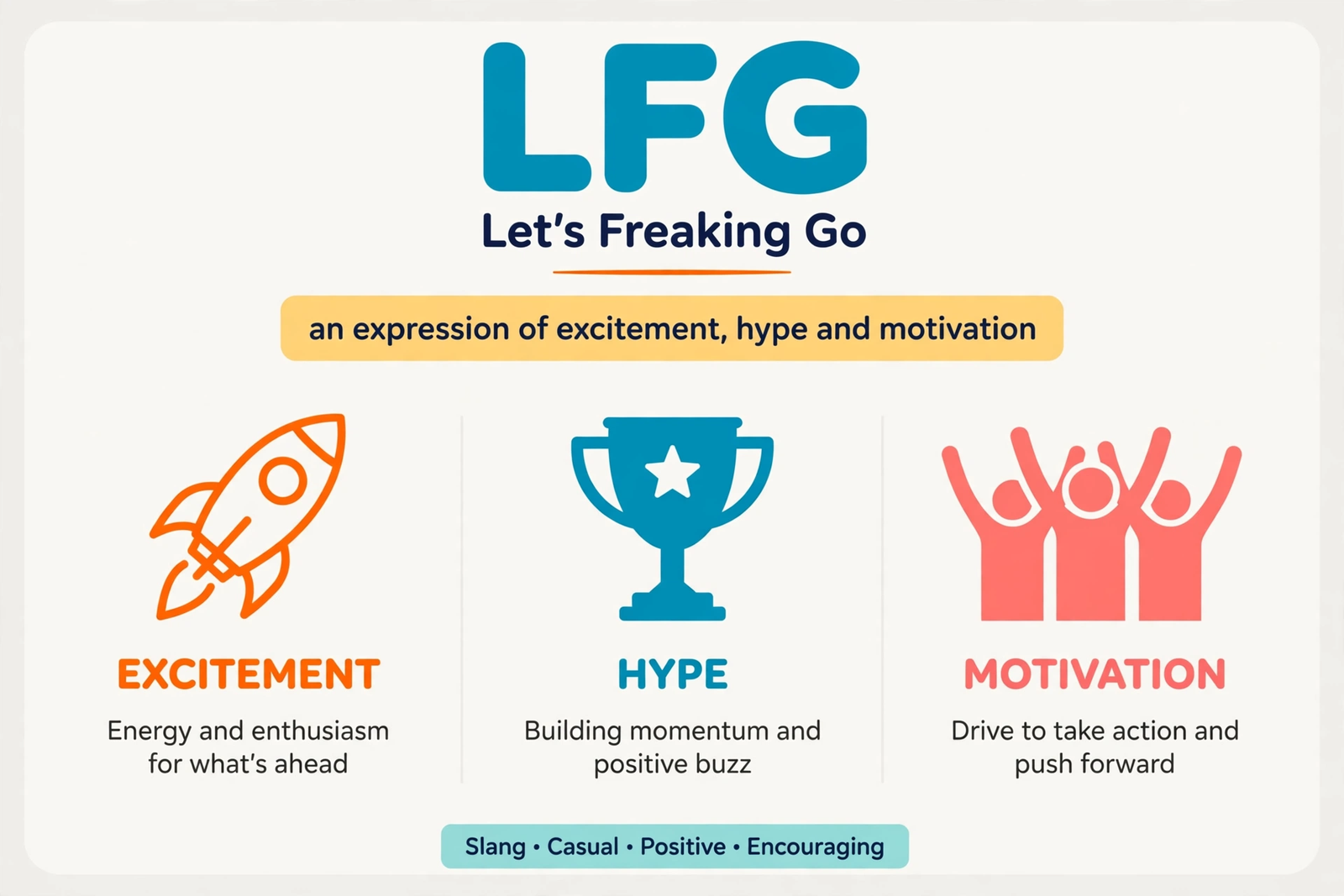
The lfg meaning slang definition is straightforward: LFG is an acronym for “let’s f***ing go.” It is an exclamation of excitement, encouragement, and momentum. When someone types LFG, they are saying “I am ready,” “I am hyped,” or “Let’s do this right now” — all at once. The phrase carries the energy of a locker-room chant and the urgency of a countdown, which is exactly why it spread so quickly from sports and gaming into everyday texting.
Because the full form contains a swear word, many people soften it in polite company as “let’s freaking go.” The meaning stays exactly the same; only the intensity of the language changes. You will also see it written in lowercase (“lfg”) in casual chats, which feels slightly calmer, and in all caps (“LFG!!!”) when someone is genuinely fired up. The exclamation marks are optional, but they are very much part of the vibe.
At its heart, LFG is a hype word. It is not a question, it is not a greeting, and it is not a goodbye. It is a launch button. Someone says LFG when a plan is confirmed, when a game is about to start, when good news lands, or when a group needs a push. If a friend texts “Tickets are booked, we leave Friday!” and you reply “LFG,” you have just said “I am so excited, this is happening, and I cannot wait” in three letters. That efficiency is the whole point of slang, and LFG is one of the best examples of it.
It is also worth knowing that LFG works as both a standalone exclamation and a sentence starter. On its own, “LFG!” is a complete message. Attached to a plan, as in “LFG, game night starts at 8,” it becomes a rallying cry. This flexibility is a big reason the term survived long after many other slang words faded. According to Dictionary.com’s guide to LFG, the term is used to express excitement and enthusiasm, especially in sports and gaming contexts — and that hype-first meaning is exactly how most people use it today.
Before we go deeper, here is the quick version you can keep in your pocket:
- LFG stands for: “let’s f***ing go” (polite version: “let’s freaking go”)
- What it expresses: excitement, hype, motivation, readiness
- Where you will see it: sports posts, gaming chats, group texts, TikTok, Twitter/X, Instagram captions
- Tone: loud, confident, positive, high-energy
- Safe alternative: “let’s freaking go” or simply “let’s go!”
Introduction
Some slang words describe things. Others describe feelings. LFG belongs firmly in the second group, and it describes one of the best feelings there is: the moment right before something fun begins. Think of the seconds before a concert starts and the lights drop, the moment your team runs onto the field, or the second a friend says “we got the table” on a Friday night. That feeling — part excitement, part adrenaline, part pure joy — is what LFG bottles into three letters.
That is why understanding the lfg meaning slang matters even if you never plan to shout it yourself. The term is everywhere in modern internet culture. Athletes post it before championship games. Gamers type it in chat when a ranked match loads. Friends drop it in group chats when weekend plans finally come together. Creators use it in captions to build hype around a launch, a video, or a new project. If you scroll social media for more than a few minutes on a game day, you will see it.
Like other high-energy slang, LFG belongs to a family of short, punchy terms that do a lot of emotional work in very few characters. If you already know the GOAT meaning in slang, you know how a few letters can carry a whole attitude — GOAT declares someone the greatest, while LFG declares that the moment has arrived. Similarly, the NGL meaning in text shows how slang can soften honesty, whereas LFG does the opposite: it turns the volume all the way up. Once you understand this family of terms, reading modern group chats gets a lot easier.
In this article, we will cover the full story of LFG: its sports and gaming roots, how it exploded into mainstream texting, the different ways people use it today, real examples for friendly, professional, and funny situations, and how it compares to similar hype words like “let’s go,” “W,” and “GG.” We will also look at alternate meanings of LFG, polite alternatives for work and formal settings, and the common mistakes people make when using it. By the end, you will know exactly when to fire off an LFG — and when to keep it in your pocket.
Origin
LFG began its life far from group chats and TikTok captions. Its roots are in sports locker rooms and gaming lobbies, two places where short, loud bursts of motivation are a way of life. Athletes have always used chants and shouts to build energy before a game, and “let’s f***ing go” was a natural locker-room version of that ritual — raw, aggressive, and designed to fire a team up. It was the kind of thing you would hear shouted right before kickoff, not written down in a playbook.
From the locker room, the phrase jumped to the gaming world, where it found its perfect home. Online multiplayer games run on quick communication: players type fast, react fast, and celebrate fast. Typing a full sentence like “let’s get ready, everyone, the match is starting” takes too long when the countdown is already running. “LFG” took a fraction of a second to type and said everything that mattered. Gamers began using it at the start of ranked matches, after a clutch play, and when a raid party finally filled up. In massively multiplayer games, players also used “LFG” in a slightly different way — as shorthand in chat channels to mean “looking for group” — but the hype meaning is the one that conquered the mainstream.
The leap from gaming to the wider internet happened gradually through the 2010s and then all at once in the early 2020s. Sports fans carried it from the locker room to Twitter, where athletes began posting “LFG” before big games and fans echoed it in replies. NFL players, UFC fighters, and soccer stars all used it, and every time a famous athlete posted it, thousands of fans copied it. Social media did what it always does: it took a niche phrase, attached it to big emotional moments, and broadcast it to everyone.
TikTok and Instagram accelerated the spread even further. Creators used LFG in captions for gym videos, travel vlogs, business launches, and “day in my life” content — any moment that felt like a beginning worth celebrating. The phrase also became a staple of crypto and trading communities during market rallies, where “LFG” became a chant for rising prices and big wins. By 2023 and 2024, it was no longer a gaming term or a sports term at all. It was simply how the internet says “I am hyped.”
One thing that helped LFG survive while other slang terms burned out is that it is tied to a genuine human emotion rather than a trend. People will always feel excitement before a big moment, and they will always want a fast way to express it. LFG is short, it is vivid, and it works in almost any context where energy is high. That timeless quality is why it has outlasted dozens of other abbreviations that came and went during the same period.
Popularity
LFG is now one of the most widely recognized hype terms on the internet. You will find it in the comments of nearly every major sporting event, in gaming streams on Twitch and YouTube, in fitness content, in entrepreneur and “hustle culture” posts, and in ordinary group chats between friends planning a night out. Its popularity is not limited to one age group either. While it started with younger users, it has spread to athletes in their thirties and forties, coaches, commentators, and even brands that want to sound energetic and current.
Several things explain why LFG became so popular. First, it is extremely short. Three letters are faster to type than almost any other expression of excitement, and in fast-moving chats and live streams, speed matters. Second, it is emotionally clear. Nobody reads “LFG” and wonders whether the sender is happy or annoyed — the energy is obvious. Third, it is flexible. It works before an event, during an event, and after a win, which means it fits into far more conversations than a phrase that only works in one moment.
Sports are still the biggest engine of LFG’s popularity. On game days, the term floods social media. Fans post it hours before kickoff, players post it in pre-game stories, and commentators use it in broadcasts. Championship runs, playoff games, and derby matches all come with a wave of LFG posts. The term has become so connected to sports that many fans now associate it with game day itself, the way others associate it with the start of a match in gaming.
Gaming culture keeps it alive every single day. In competitive games like Valorant, League of Legends, Call of Duty, and Fortnite, players type LFG when a match starts, when a comeback begins, or when a teammate makes an incredible play. Streamers shout it when they win a round, and their chat floods with it in return. This constant daily use in gaming means new players encounter the term almost immediately, and they start using it themselves within days.
The term has also found a home in motivation and fitness culture. Gym-goers caption their workout videos with LFG, runners post it before a marathon, and entrepreneurs use it when launching a product or closing a deal. In these contexts, LFG is less about celebrating and more about self-motivation — a way of saying “I am ready for this challenge” before it begins. That motivational use has helped the term cross over into professional spaces, at least in its softer “let’s freaking go” form.
Search interest in the phrase has stayed strong year after year, which is unusual for internet slang. Most slang terms spike and fade within months, but LFG has shown real staying power. It appears in song lyrics, on merchandise, on gym apparel, and even in marketing campaigns. When a slang term moves from chats onto t-shirts and billboards, it has officially become part of the culture — and LFG made that jump a while ago.
How It Is Used
Using LFG correctly is mostly about timing and tone. The word is a burst of energy, so it works best when the energy of the moment matches it. Here are the main situations where people use it, and how each one works in practice.
1. Before an event or challenge. This is the classic use. Someone posts “Game starts in 10 minutes. LFG!” or “Final exam tomorrow. LFG!” The term acts like a starting gun — it signals that the person is ready and fired up. You will see this before sports games, job interviews, exams, launches, trips, and workouts.
2. To celebrate a win or good news. When something goes right, LFG is a fast celebration. “We won the match! LFG!” or “Got the job! LFG!” It works like a cheer, and it often comes with exclamation marks or fire emojis to turn the volume up even further.
3. To rally a group. In group chats, one person often drops an LFG to get everyone excited about a plan. “Road trip Saturday, who’s in? LFG!” The term is contagious — one person says it, and the rest of the group picks up the energy. It is the digital version of a team huddle.
4. To motivate yourself or others. Sometimes LFG is less a celebration and more a pep talk. “Monday morning, new week, new goals. LFG.” In this use, the person is psyching themselves up, and the audience is almost secondary. Fitness and entrepreneur content is full of this version.
5. As a reaction in live chats and streams. During live streams, sports broadcasts, and gaming sessions, LFG floods the chat whenever something exciting happens. It is a quick, visible way to show you are watching and you are hyped. In a fast-moving chat, short reactions like this are the only ones that keep up.
There are also a few things to keep in mind about tone. LFG is loud by design. In all caps with exclamation marks, it reads as very high-energy. In lowercase — “lfg” — it reads as calmer and more casual, closer to a quiet nod of excitement than a shout. Adding emojis like 🔥 or 🚀 increases the energy, while adding no punctuation at all keeps it relaxed. Choosing between these versions is mostly about matching the mood of the conversation you are in.
It is equally important to know when not to use LFG. Because the full form contains profanity, it is not appropriate in formal work emails, messages to a boss or a client, or conversations with people you do not know well. It is also a poor choice in serious or sad situations — responding to bad news with LFG would be confusing at best and offensive at worst. And if someone shares a quiet, thoughtful achievement, a loud LFG can feel like the wrong register. Save it for moments of genuine excitement, and it will always land well.
Examples
The best way to understand any slang term is to see it in real conversations. The lfg meaning slang becomes obvious once you look at how people actually use it in different situations. The examples below show the term in friendly chats, work-appropriate settings, and funny moments, so you can see how flexible — and how different — each use can feel.
Friendly Examples
- Friend 1: “Concert tickets are booked! We are going on Friday!”
Friend 2: “LFG! I have been waiting for this for months!” - Alex: “Game night at my place, 8 pm. Bring snacks.”
Sam: “LFG, I am bringing the good chips this time.” - Maya: “We just got the apartment! Keys on Monday!”
Jordan: “LFG!!! New chapter starts now!” - Chris: “Beach trip this weekend, everyone is in.”
Taylor: “lfg, I am already packing.” - Emma: “My team made the finals!”
Liam: “LFG! I knew you guys would do it!”
Notice how in friendly chats the term almost always appears at the very start of a reply. That is the pattern: good news arrives, and LFG is the first thing out. Friends also mix the lowercase and uppercase versions freely, depending on how excited they are. A simple “lfg” is a warm thumbs-up; “LFG!!!” is a full celebration.
Professional Examples
In professional settings, the raw form of LFG is usually too strong. But the softer version — “let’s freaking go” or just “let’s go” — carries the same energy in a way that works at work. Here is how people use it without crossing a line:
- Team lead: “The client approved the proposal. Let’s freaking go, team — we start Monday!”
- Colleague: “Product launch is live and early numbers look great. LFG!” (in a casual team Slack channel where this tone is normal)
- Manager: “Q4 starts today. New targets, new energy. Let’s go!”
- Coworker: “We hit our milestone a week early. Let’s freaking go!”
- Founder: “First 1,000 users signed up. Let’s freaking go — this is just the beginning.”
The rule for professional use is simple: know your audience. In a relaxed startup or creative team where casual language is normal, a soft LFG can build team spirit. In a formal email to a client or a senior executive, stick with “let’s go” or “we are ready to begin.” The energy is the same; only the packaging changes.
Funny Examples
- Friend 1: “I finally cleaned my room after three weeks.”
Friend 2: “LFG, the floor has been found!” - Alex: “I woke up before my alarm today. Who am I?”
Sam: “LFG, new person unlocked.” - Maya: “I meal-prepped for the entire week.”
Jordan: “LFG, Gordon Ramsay could never.” - Chris: “I finished my assignment the night before it is due. The night before!”
Taylor: “LFG, character development is real.” - Emma: “I ran 5k without stopping for the first time.”
Liam: “LFG! The couch has officially lost you.”
Funny uses work because they apply big-game energy to small, everyday wins. That contrast is the joke. Saying LFG about cleaning your room is funny precisely because cleaning a room is not a championship final — and everyone in the chat knows it. This playful exaggeration is one of the reasons the term stays fresh: it can be sincere, or it can be a joke, and the audience can tell the difference from context.

Comparison with Similar Terms
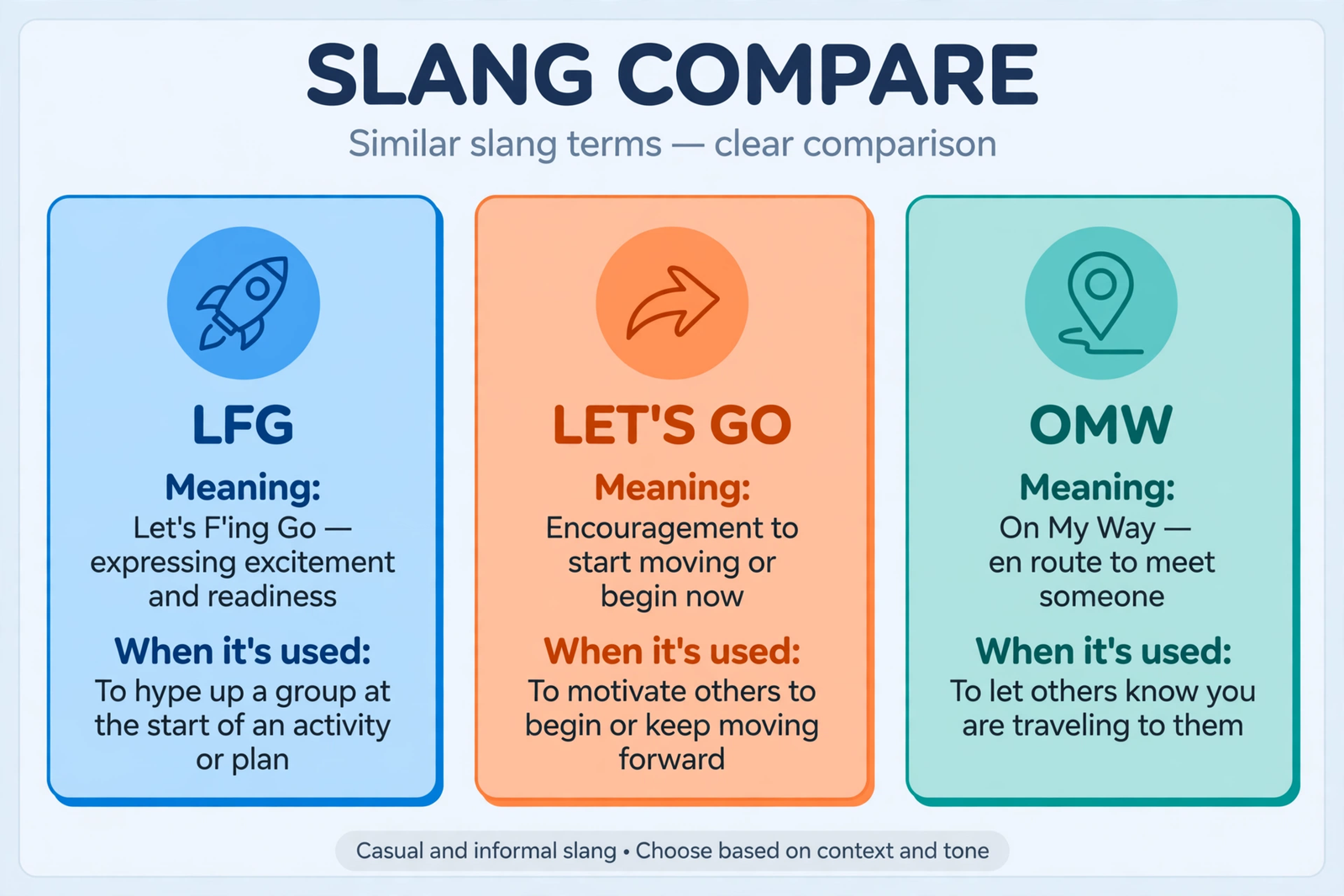
LFG is not the only hype word on the internet, and it is easy to mix it up with similar terms. Each one has its own flavor, and choosing the right one depends on the moment. Here is how LFG compares to the terms people confuse it with most often.
| Term | Full Form / Meaning | When to Use It | Energy Level |
|---|---|---|---|
| LFG | “Let’s f***ing go” — excitement and hype | Before a big moment, after a win, to rally a group | Very high |
| Let’s go | The clean version of LFG | Any excited moment, including work and formal chats | High |
| W | A win or a victory | After something good happens, to celebrate success | High |
| GG | “Good game” — respect after a match | At the end of a game, win or lose | Medium |
| Hype | Excitement or anticipation | Describing the feeling before an event | High |
| YOLO | “You only live once” | Justifying a bold or risky decision | Medium to high |
| Send it | Go for it, take the risk | Encouraging someone to attempt something bold | High |
The closest cousin of LFG is simply “let’s go.” The two mean almost the same thing, and many people use them interchangeably. The difference is intensity and attitude. “Let’s go” is the everyday, all-purpose version — you can say it to your grandmother, your boss, or your best friend, and it will sound fine every time. LFG is the amplified version. It adds urgency, edge, and a touch of rebellion. If “let’s go” is a cheer, LFG is a roar.
“W” is different because it looks backward rather than forward. People say “W” after a win to celebrate what already happened, while LFG is usually aimed at what is about to happen. You can use both in the same conversation — “LFG, we are going to win this” before a game, and “W!” after it — but they play different roles. Similarly, “GG” is about sportsmanship at the end of a game, not hype at the start. It closes a moment; LFG opens one.
Other hype words like “hype,” “send it,” and “YOLO” each cover their own territory. “Hype” describes the feeling of excitement rather than expressing it directly. “Send it” pushes someone to take a risk. “YOLO” justifies a decision you might regret later. LFG is the most versatile of the bunch because it works as motivation, celebration, and rallying cry all at once — which is why it has outlasted many of the others.
Alternate Meanings
Like many internet acronyms, LFG has more than one meaning, and context decides which one someone intends. The hype meaning — “let’s f***ing go” — is by far the most common today, but you should know the others so you are never caught off guard.
- Looking for group: In gaming, especially in MMORPGs like World of Warcraft, LFG has long meant “looking for group.” A player types “LFG dungeon” to find teammates for a quest or raid. This is the oldest gaming use of the abbreviation, and it still appears in game chats today. If you see LFG next to a dungeon name, a raid, or a game mode, this is almost certainly what it means.
- Looking for game: A close cousin of “looking for group,” used by players searching for a match, a lobby, or an opponent. You will see it in gaming forums and Discord servers where people organize matches.
- Let’s freaking go: The cleaned-up version of the main meaning. Some people use LFG while genuinely meaning the “freaking” version, especially in mixed company or public posts. The letters are the same; only the word behind the F changes.
- Local friend group: In some online communities, LFG is used playfully to mean a person’s local circle of friends. This use is rare and usually obvious from context, such as “hanging out with the LFG tonight.”
- Other niche uses: In business or finance contexts, LFG occasionally appears as shorthand for specific company or fund names, and in some regions it is used as an abbreviation in unrelated technical fields. These uses are uncommon, and they almost never appear in casual texting or social media.
How do you tell which meaning someone intends? Look at the context. If the message is about a game starting, a team forming, or a dungeon run, and the letters appear alongside a game mode or a level requirement, it is probably “looking for group.” If the message is an excited reaction to good news, a plan, or a victory, it is “let’s f***ing go.” In practice, the hype meaning dominates social media and texting, while the gaming meaning survives mainly inside actual games. When in doubt, the excitement around the message usually gives it away — “looking for group” is a practical request, while “let’s f***ing go” is pure emotion.
Professional or Polite Alternatives
There are plenty of moments when you want the energy of LFG without the profanity. The good news is that English has no shortage of ways to say “I am excited and ready.” Here are the best alternatives, organized by situation.
For work and formal settings:
- “Let’s go!” — the cleanest direct swap, works everywhere
- “Let’s do this!” — confident, team-oriented, professional
- “We are ready!” — calm, clear, and appropriate in any meeting
- “Time to get started!” — energetic without being casual
- “Let’s make it happen!” — motivational and safe for clients
For casual chats where you still want to keep it clean:
- “Let’s freaking go!” — keeps the LFG spirit without the swear word
- “Here we go!” — short, excited, and universally safe
- “Game on!” — playful and competitive, great before a match or challenge
- “I am so ready for this!” — honest excitement in plain words
- “Bring it on!” — confident and fun, especially before a challenge
For celebrations:
- “We did it!” — simple, warm, and perfect after a win
- “This is amazing!” — genuine and appropriate in any company
- “What a moment!” — reflective, great for big achievements
- “Let’s celebrate!” — turns the energy into a plan
The FRFR meaning in text shows a similar pattern: slang terms often have a raw version and a cleaned-up version, and the skill is knowing which one fits the room. With LFG, the clean versions cost you nothing — the excitement comes through either way. If you are ever unsure whether the full version is appropriate, use “let’s freaking go” or “let’s go” instead. Nobody has ever been offended by the polite version.
Common Mistakes
LFG is easy to use, but people still get it wrong — usually by using it at the wrong moment or in the wrong company. Here are the most common mistakes, and how to avoid them.
1. Using it in serious or sad situations. LFG is a celebration word. Using it after bad news — a lost game, a failed exam, a breakup, or any disappointment — reads as insensitive or confusing. If the mood is serious, choose words that match it. LFG should only appear where excitement already exists.
2. Using the full form at work or with strangers. The F in LFG is a real swear word, and not everyone is comfortable with it. In a work email, a message to a teacher, or a first conversation with someone new, the raw form can damage your impression before you have even made it. Use “let’s freaking go” or “let’s go” instead.
3. Overusing it until it means nothing. Like any hype word, LFG loses its power if you say it twenty times a day about nothing in particular. If every message is “LFG” — about breakfast, about a bus arriving, about a Tuesday — the term stops feeling exciting. Save it for moments that genuinely deserve the energy, and it will hit harder every time.
4. Using it as a greeting. LFG is not a “hello.” Opening a conversation with a random “LFG” when nothing is happening confuses people. It needs a trigger: a plan, a win, a challenge, or an event. Without that context, it is just noise.
5. Mixing it up with “looking for group.” In gaming chats, typing LFG when you mean “let’s f***ing go” — or the reverse — can cause genuine confusion. If a teammate reads your hype message as a request to find a group, they may leave to recruit players instead of celebrating with you. In game chats, a little extra context goes a long way.
6. Forcing it to sound cool. Slang works when it is natural. If you do not normally talk this way, dropping an LFG into a conversation just to sound trendy usually has the opposite effect. Use it because the moment calls for it, not because you think it makes you sound a certain way.
7. Pairing it with the wrong emojis. Emojis shape the tone of an LFG message. Fire, rocket, and muscle emojis amplify the hype. A sad or confused emoji next to LFG sends mixed signals and makes the reader wonder whether you are excited or upset. Keep the emojis on-message.

Quick Tips
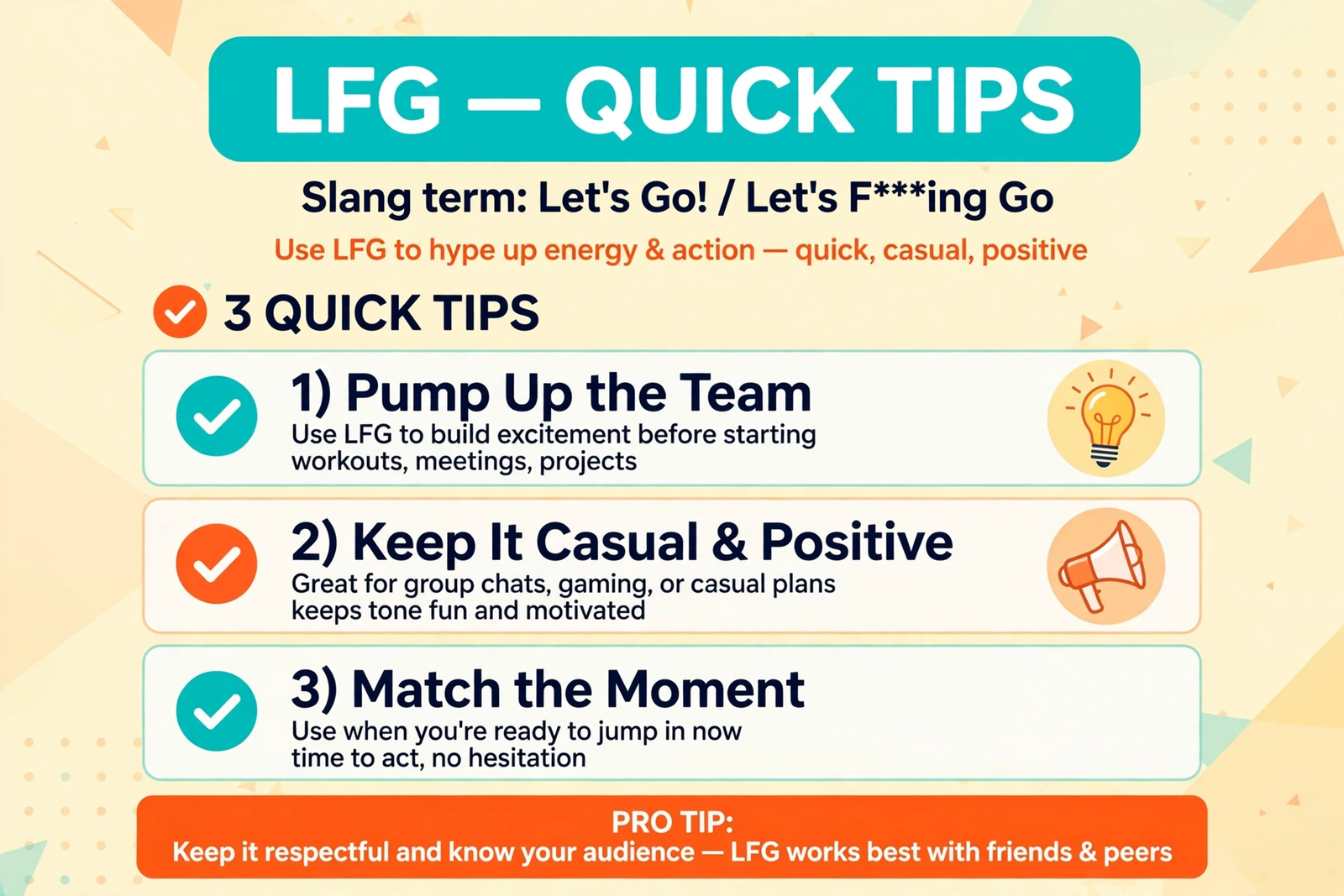
If you want to use LFG like a native speaker of internet slang, keep these quick tips in mind:
- Match the moment. Use LFG when something exciting is starting or just happened. The bigger the moment, the better it fits.
- Choose your case carefully. All caps (“LFG!”) is a shout; lowercase (“lfg”) is a relaxed nod. Pick the version that matches the energy of the chat.
- Keep it clean at work. In professional settings, say “let’s freaking go” or “let’s go” instead of the full form.
- Use it sparingly. The rarer it is, the more powerful it feels. Save it for real moments.
- Let context do the work. LFG works best attached to a plan, a win, or an event. On its own with no context, it can confuse people.
- Read the room in gaming. In game chats, make sure people know whether you mean “let’s f***ing go” or “looking for group.”
- Pair it with good news. The best LFG messages follow good news or precede a fun plan. That is where the term shines.
- Do not force it. If it does not feel natural, “let’s go” says the same thing and fits everywhere.
One more tip worth remembering: the OMW meaning in text is a useful companion term — “on my way” pairs naturally with LFG when plans come together, as in “OMW, LFG!” when you are heading out the door. Combining short slang terms like this is how fluent texters talk, and it is exactly the kind of natural pattern that makes group chats fun to read.
FAQ
What does LFG mean in slang?
In slang, LFG stands for “let’s f***ing go.” It is an exclamation of excitement, hype, and motivation used before a big moment, after a win, or to rally a group. The polite version is “let’s freaking go,” which means exactly the same thing without the swear word. People use it in sports, gaming, group chats, and social media captions whenever energy is high.
What is the lfg meaning slang in texting?
In texting, the lfg meaning slang is the same as everywhere else: an excited “let’s f***ing go.” When a friend texts “LFG” after you share good news or confirm a plan, they are saying they are hyped, ready, and fully on board. It is one of the fastest ways to show enthusiasm in a text, which is why it appears so often in group chats before events, trips, games, and nights out.
Is LFG a bad word?
LFG itself is just three letters, but its full form contains a swear word, so many people consider it mildly rude or inappropriate in formal settings. The abbreviation softens it considerably — most people who would never type the full phrase are comfortable typing “LFG.” If you want to be safe, use “let’s freaking go” or “let’s go” instead, especially at work, at school, or with people you do not know well.
Where did LFG come from?
LFG started in sports locker rooms and gaming lobbies, where short bursts of motivation are part of the culture. Athletes used it as a pre-game chant, gamers used it to hype up a match, and sports fans carried it onto social media. From there it spread through TikTok, Instagram, and Twitter into everyday texting. It also has an older, separate gaming meaning — “looking for group” — used by players searching for teammates.
What does LFG mean in gaming?
In gaming, LFG has two meanings. The most common one today is the hype meaning: “let’s f***ing go,” typed when a match starts, after a clutch play, or when a team is on a comeback. The older meaning is “looking for group,” used by players who need teammates for a dungeon, raid, or match. Context tells you which one applies: if it appears next to a game mode or a level requirement, it is “looking for group”; if it appears as a celebration, it is the hype meaning.
Can I use LFG at work?
You can use the energy of LFG at work, but you should usually use the clean version. “Let’s freaking go” or “let’s go” works well in casual team chats, Slack channels, and startup environments where informal language is normal. Avoid the full form in formal emails, messages to clients, or conversations with senior executives. When in doubt, choose the polite version — the enthusiasm comes through either way.
What is the difference between LFG and “let’s go”?
“Let’s go” is the clean, all-purpose version of LFG, and the two mean almost the same thing. The difference is intensity: LFG is louder, edgier, and more aggressive, while “let’s go” is safe in every situation. If “let’s go” is a cheer, LFG is a roar. Use “let’s go” when you want excitement without any risk of offending someone, and use LFG when you are with friends and the moment deserves maximum energy.
Why is LFG so popular on social media?
LFG is popular on social media because it is short, emotionally clear, and incredibly versatile. It works before an event, during a live moment, and after a win, which means it fits into almost any exciting situation. Athletes, streamers, creators, and brands all use it, and every big game or launch creates a fresh wave of LFG posts. Its connection to genuine excitement — rather than a passing trend — is why it has stayed popular for years while other slang terms faded away.
Conclusion
LFG is one of those rare slang terms that does exactly what it promises. Three letters, one burst of energy, and everyone in the room knows how you feel. The lfg meaning slang is “let’s f***ing go” — a shout of excitement, a rallying cry, and a launch button for whatever comes next. It grew up in locker rooms and gaming lobbies, conquered sports Twitter and TikTok, and now shows up everywhere from championship celebrations to ordinary group chats about Friday night plans.
The key to using it well is timing. Save LFG for moments that deserve it: a game about to start, a win worth celebrating, a plan finally coming together, or a challenge you are ready to face. Choose the full version with friends, the “let’s freaking go” version at work, and the lowercase version when the mood is relaxed. Avoid it in serious moments and formal settings, and never use it so often that it stops meaning anything. Used well, it is one of the most satisfying words on the internet.
Slang keeps changing, and new terms appear every month — but the feeling behind LFG is not going anywhere. People will always want a fast, fun way to say “I am ready, I am excited, and this is happening.” Now that you know the full story, the next time your group chat lights up with a plan, you will know exactly what to type. And if you want to keep building your slang vocabulary, check out the GOAT meaning in slang and the NGL meaning in text guides next — because once you understand the language of the group chat, every conversation gets a little more fun. LFG!
