
Quick definition: The dw slang meaning is “don’t worry.” DW is a short texting abbreviation people use to reassure someone, brush off an apology, or say that everything is fine — most commonly in texts, TikTok comments, Snapchat, Instagram DMs, and WhatsApp chats.
dw slang meaning & Definition
DW stands for “don’t worry.” It is an initialism built from the first letters of the two words — D for “don’t” and W for “worry” — and it works as a fast, friendly way to tell someone to relax. When a friend apologizes for replying late, worries they messed something up, or stresses over something small, a simple “DW” says it’s fine, really, let it go without typing a full sentence.
Unlike slang that changes meaning every few months, DW has stayed remarkably stable. For more than two decades it has meant the same thing in nearly every corner of the internet, which is exactly why it still shows up in millions of chats every day. Dictionary sites such as Dictionary.com list DW as an abbreviation for “don’t worry” in texting and online chat, confirming what most texters already know from experience.
DW is informal by nature. It belongs in casual conversations with friends, family, and people you already know well — not in a job application, a formal email, or a message to your boss. Used in the right place, though, it is one of the warmest two-letter replies in texting: short, calm, and instantly reassuring.
Introduction
You are scrolling through your messages when a friend texts, “Sorry I forgot to reply yesterday 😬” — and before you can type a full answer, they add “DW, I got you.” Wait — did they just tell you not to worry, or did you just tell them? Either way, the message landed exactly as intended: no hard feelings, no drama, everything is fine.
That tiny two-letter word does a surprising amount of emotional work. DW can accept an apology, calm a nervous friend, forgive a small mistake, or shut down an awkward moment before it grows. It is the digital equivalent of a shrug and a smile — don’t stress about it, we’re good.
But DW is not always as simple as it looks. In some corners of the internet it means something completely different, and using it in the wrong setting can make you sound dismissive when you meant to sound kind. In this guide, we break down the full dw slang meaning, where it came from, how it is used on TikTok, Snapchat, and WhatsApp, and the mistakes to avoid — with plenty of real examples you can copy. If you have ever wondered whether DW is friendly, rude, or flirty, you will have a clear answer by the end. And if you enjoy decoding texting shorthand, the same trick applies to abbreviations like FN, which packs a very different attitude into just two letters.
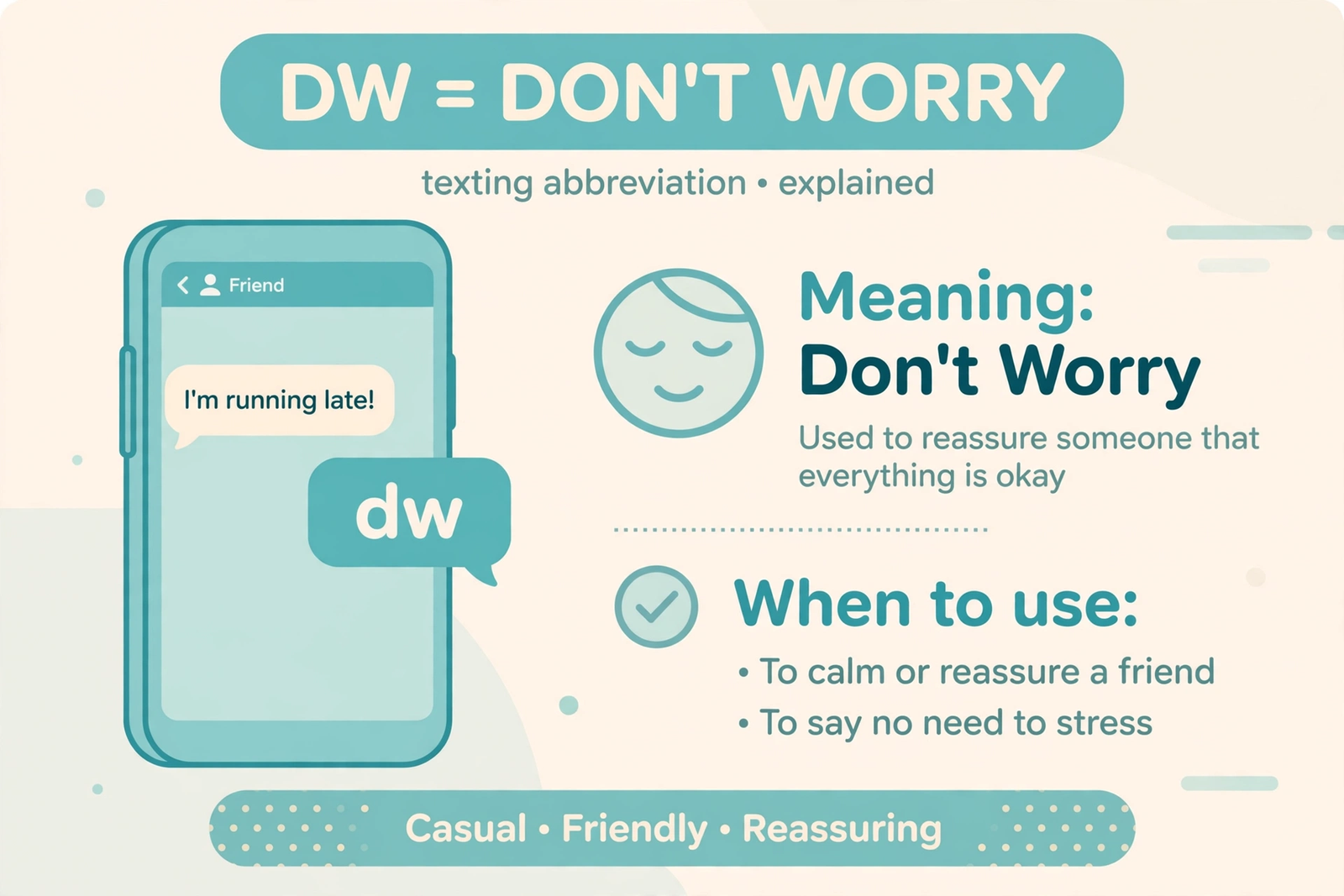
Origin
The phrase “don’t worry” is far older than the internet — people have been saying it to each other for centuries. The abbreviation DW, however, was born out of necessity in the late 1990s and early 2000s, when texting and instant messaging first took off.
Back then, typing was slow and expensive. Early mobile phones had tiny numeric keypads where typing a single word took multiple key presses, and SMS messages were often limited to 160 characters. Internet chatrooms and services like AOL Instant Messenger and ICQ rewarded speed: the faster you could reply, the better the conversation flowed. So everyday phrases got compressed. “Talk to you later” became TTYL, “be right back” became BRB, “laughing out loud” became LOL — and “don’t worry” naturally became DW.
DW spread the same way most early internet slang did: from chatrooms and forums into text messages, then into every messaging app that followed — MSN Messenger, Facebook chat, WhatsApp, Snapchat, Instagram DMs, Discord, and eventually TikTok comments. Because the meaning was obvious from the phrase itself, DW never needed a viral moment to catch on. It simply worked, and it kept working.
There is one important side note about DW’s history. In parenting and relationship forums, a second meaning grew up in parallel: DW as “dear wife,” part of a family shorthand set that includes DH (dear husband), DD (dear daughter), and DS (dear son). That meaning lives mostly on message boards and rarely appears in texting or on TikTok — but it explains why DW sometimes pops up in places where “don’t worry” makes no sense at all.
Popularity
DW is not a trend; it is a permanent resident of internet language. While slang terms like “on fleek” or “yeet” spike and fade, DW has stayed in steady everyday use for more than twenty years. That longevity is rare, and it tells you something important: DW survives because it solves a real problem. People constantly need a quick way to say “it’s okay,” and two letters are faster than a sentence.
On TikTok, DW shows up constantly in comments and captions. Creators use it to brush off small mistakes in their videos (“DW, the audio glitch is part of the vibe”), and commenters use it to reassure creators who seem nervous about posting. On Snapchat and Instagram, it is a staple of casual DMs — the go-to reply to “sorry for the late reply” or “I hope I didn’t mess up.” In group chats and gaming chats on Discord, DW keeps the mood light when someone misses a play or arrives late.
DW’s popularity also comes from its tone. Unlike “whatever” or “idc,” which can sound cold, DW sounds warm. It tells the other person that you heard them, you understood the worry, and you are actively choosing not to make it a big deal. That emotional softness is why people reach for it in exactly the moments when a friendship could feel strained — after a missed plan, a clumsy text, or an awkward apology.
Search interest in DW has stayed consistent rather than spiky, which matches how people actually use it: not as a meme to look up once, but as a word they type every week. If you text in English, DW is part of your vocabulary whether you notice it or not.
How It Is Used
DW is almost always used as a standalone reply or at the start of a short sentence. It is not a word you build a long paragraph around — its whole point is speed and lightness. Here are the five most common jobs it does in a conversation:
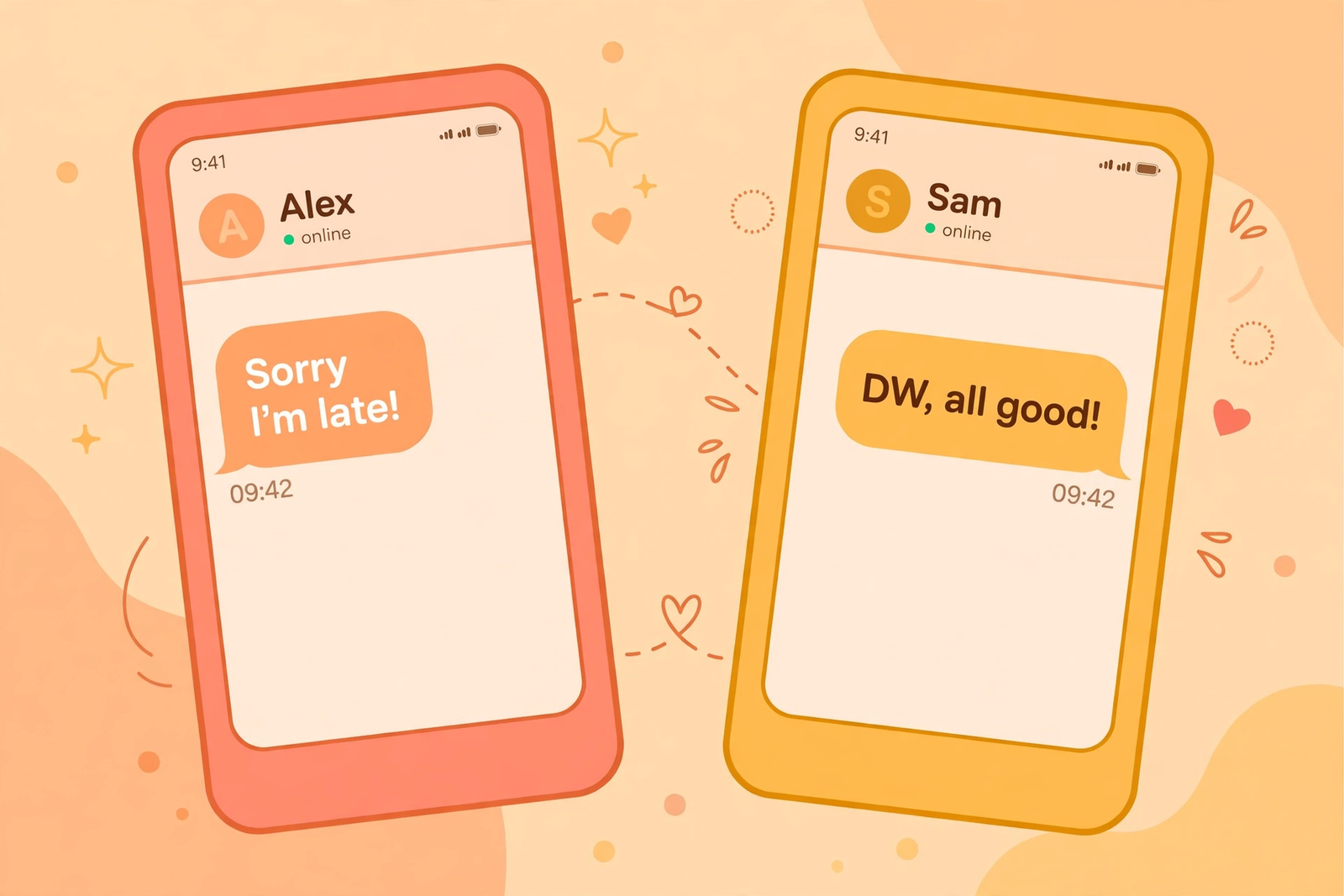
- Accepting an apology: “Sorry I’m late!” — “DW, I just got here too.”
- Calming someone down: “I’m so nervous about the test.” — “DW, you’ve studied enough. You’ll do fine.”
- Brushing off a small mistake: “Oops, I sent the wrong meme 😅” — “DW, it was funny anyway.”
- Saying something is no big deal: “I forgot to bring your charger.” — “DW, I’ll grab it tomorrow.”
- Reassuring before something happens: “DW, I’ve got the tickets. Just show up.”
DW usually sits at the beginning of a sentence (“DW, it’s all good”) or stands alone as a complete reply (“DW 👍”). It can also appear mid-sentence, though less often: “I told her DW about the delay.” On TikTok and in comments, it often pairs with other slang — “DW, it’s giving main character energy” — where it softens whatever comes next.
Tone matters more than spelling. DW in lowercase (“dw”) feels extra casual and relaxed, while uppercase “DW” reads a little more deliberate — but both mean the same thing. Adding an emoji changes the warmth: “DW 😊” is friendly, “DW 🙏” is grateful and calm, and “DW lol” is playful. On its own, without any emoji or extra words, DW can occasionally read as dismissive, especially after a serious apology. If someone is genuinely upset, a longer reply (“DW, seriously, it’s totally fine — don’t even think about it”) lands much better than two bare letters.
DW is also common in gaming and group chats, where fast replies matter. A teammate who misses an objective gets a “DW, we still got this” instead of blame, and that small kindness keeps the team together. The same logic works in work-adjacent group chats with friends — but remember, DW has no place in formal workplace messages. Your manager does not want a “DW” in reply to a missed deadline; they want a plan.
Examples
The easiest way to understand DW is to see it in real conversations. The examples below cover the three tones you will encounter most — friendly, professional-adjacent, and funny — so you can match your reply to the moment.
Friendly Examples
Friendly DW is the version you will use most. It is warm, casual, and usually between people who already trust each other.
- Friend: “Sorry I couldn’t make it to your party 😭” You: “DW! There will be more. We missed you though ❤️”
- Friend: “I think I left my jacket at your place.” You: “DW, it’s here. I’ll bring it on Friday.”
- Friend: “Ugh, I just embarrassed myself in front of everyone.” You: “DW, nobody even noticed. And if they did, they already forgot 😂”
- Friend: “Can I borrow your notes? I lost mine.” You: “DW, I’ll send the photos now.”
- Friend: “Sorry for venting, I know it’s a lot.” You: “DW, that’s what friends are for. Keep going, I’m listening.”
Notice how every reply does two things at once: it removes the worry and adds something kind. That combination is what makes DW feel supportive instead of dismissive.
Professional Examples
DW is informal, so it does not belong in emails to clients or formal work messages. But in casual chats with coworkers you know well — a Slack DM, a WhatsApp group for a class project — a careful DW can work. The rule is simple: only use it when the relationship is relaxed and the stakes are low.
- Classmate: “Sorry, I’ll send my part of the project an hour late.” You: “DW, just send it when it’s ready. We’re on track.”
- Coworker (friendly chat): “I forgot to attach the file, sending now!” You: “DW, no rush at all 👍”
- Teammate: “I can’t make the study session today.” You: “DW, I’ll share my notes after.”
If you are unsure whether DW is appropriate at work, it probably is not — spell it out instead: “Don’t worry about it at all, take your time.” The full phrase carries the same meaning with a professional polish, and nobody will ever fault you for being clear.
Funny Examples
DW also shows up in jokes, memes, and playful exaggeration, where it pretends a disaster is no big deal at all.
- Friend: “I just dropped my phone in the sink 💀” You: “DW, it’s waterproof now. It’s a feature.”
- Friend: “I tripped in front of my crush.” You: “DW, now they definitely noticed you 😂”
- Roommate: “I ate your leftovers, sorry.” You: “DW, I was saving them for the trash anyway.”
- Friend: “I failed the quiz lol.” You: “DW, the quiz failed you. Big difference.”
| Situation | What they said | Best DW reply |
|---|---|---|
| Late reply | “Sorry for replying so late!” | “DW, I do the same thing all the time 😅” |
| Small mistake | “Oops, I sent it to the wrong chat.” | “DW, it happens. Just delete it.” |
| Nervous friend | “I’m freaking out about tomorrow.” | “DW, you’ve got this. Text me after 🙌” |
| Missed plan | “I can’t come tonight, I’m so sorry.” | “DW! We’ll catch up this weekend.” |
| Apology for venting | “Sorry for the long rant lol.” | “DW, I like hearing about your day.” |
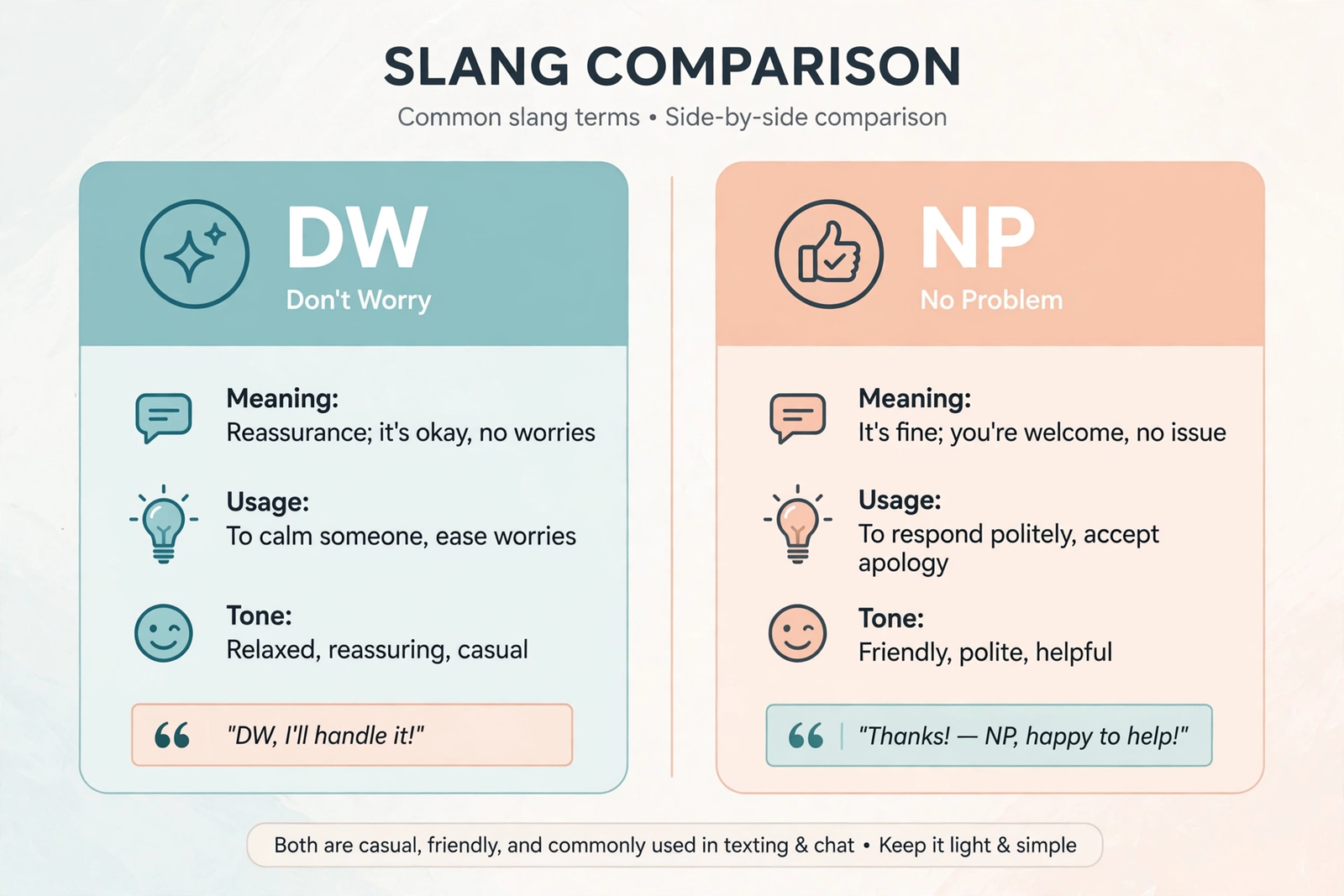
Comparison with Similar Terms
DW is part of a whole family of reassurance slang. Each term means roughly “it’s fine,” but the shade of meaning is different — and picking the right one changes how your message feels.
| Term | Meaning | Tone | Best when… |
|---|---|---|---|
| DW | Don’t worry | Warm, calm | Someone is worried or apologizing |
| NP | No problem | Easygoing | Someone thanks you (“Thanks!” → “NP”) |
| NBD | No big deal | Casual, shrugging | Downplaying something small |
| IDW | I don’t worry | Confident | Talking about yourself, not reassuring others |
| “No worries” | Don’t worry (full phrase) | Friendly, slightly formal | Work chats and polite replies |
| “It’s fine” | It’s okay | Neutral (can sound cold) | Only with a warm follow-up |
| “All good” | Everything is fine | Relaxed, upbeat | Closing a small issue quickly |
The closest cousins are NP and NBD. NP answers a thank-you (“Thanks for the help!” — “NP!”), while DW answers a worry (“I’m so sorry!” — “DW!”). NBD overlaps with DW when something small goes wrong, but NBD describes the event (“no big deal”), while DW addresses the person’s feelings (“don’t worry”). That is why DW feels kinder after an apology: it speaks to the person, not the problem.
“It’s fine” deserves a warning. On its own it can sound annoyed or passive-aggressive, especially after a real mistake — the exact opposite of DW’s warmth. If you mean “it’s fine” kindly, add a softener (“It’s fine, honestly, don’t stress”) or just use DW instead. Similarly, if someone texts you a simple thank-you, DW is the wrong tool; that moment belongs to NP or “you’re welcome,” just as a quick TYSM deserves a “you’re welcome” in return rather than a DW.
Alternate Meanings
In most chats, DW means “don’t worry” and nothing else. But context is everything, and DW has a few alternate meanings that show up in specific places. Knowing them saves you from confusion — and from an embarrassing misread.
- “Dear wife” (forums and message boards): On parenting, relationship, and hobby forums, DW can mean “dear wife,” alongside DH (dear husband), DD (dear daughter), and DS (dear son). Example: “DW and I are redoing the kitchen this weekend.” You will almost never see this in texting or on TikTok.
- “Deep web” (tech discussions): In cybersecurity and tech forums, DW sometimes stands for “deep web” — the part of the internet not indexed by search engines. This usage is rare and always obvious from context.
- “Doctor Who” (fandom): Fans of the TV show sometimes shorten “Doctor Who” to DW in fan communities, especially when discussing episodes. If the conversation is about the TARDIS, DW is not about worrying.
- “Deadweight” / “distilled water” (dictionaries): Traditional dictionaries list DW as an abbreviation for deadweight (shipping), distilled water (science), and dust wrapper (publishing). These meanings belong to technical writing, not texting.
- “Don’t wait” (rare, context-dependent): Occasionally, in planning chats, someone might use DW to mean “don’t wait” (“DW for me, start without me”). This is uncommon and ambiguous — most people write it out instead.
How do you tell which meaning applies? Look at the platform and the sentence around it. In a text, a TikTok comment, or a Snapchat DM, DW is “don’t worry” about 99% of the time. On a parenting forum, it might be “dear wife.” If the sentence makes no sense as “don’t worry,” check the context — and if you are still unsure, just ask. A quick “DW = don’t worry?” takes two seconds, and native texters ask each other things like that all the time.
Professional or Polite Alternatives
DW is perfect for friends, but there are plenty of moments when you need the same reassurance in a more polished form. Here are professional and polite alternatives, matched to the situation:
- “Don’t worry about it at all.” — The full, polite version of DW. Safe for work chats, emails, and messages to people you do not know well.
- “No worries at all.” — Friendly and professional at the same time. Works in most workplaces and with clients.
- “It’s absolutely fine.” — Adds emphasis when someone is genuinely anxious. Good for serious apologies.
- “Please don’t give it another thought.” — Formal and gracious. Best for professional emails and important apologies.
- “Take your time, there’s no rush.” — Perfect when someone apologizes for being slow or late.
- “We’re all good.” — Warm and casual-professional. Great for coworkers you know well.
- “No need to apologize.” — Directly removes the guilt. Use it when someone keeps saying sorry.
- “That happens to everyone.” — Normalizes a mistake. Kind and reassuring without being formal.
The golden rule: match your reply to the relationship. With a best friend, “DW 😂” is perfect. With a teacher, a client, or a new manager, write the words out. The meaning stays the same — only the packaging changes. And if you are texting someone new and want to sound friendly without slang, “no worries” is your safest choice: it carries DW’s warmth in plain English, which is why it works everywhere from class group chats to the kind of message where you would also ask someone HBU to keep the conversation going.
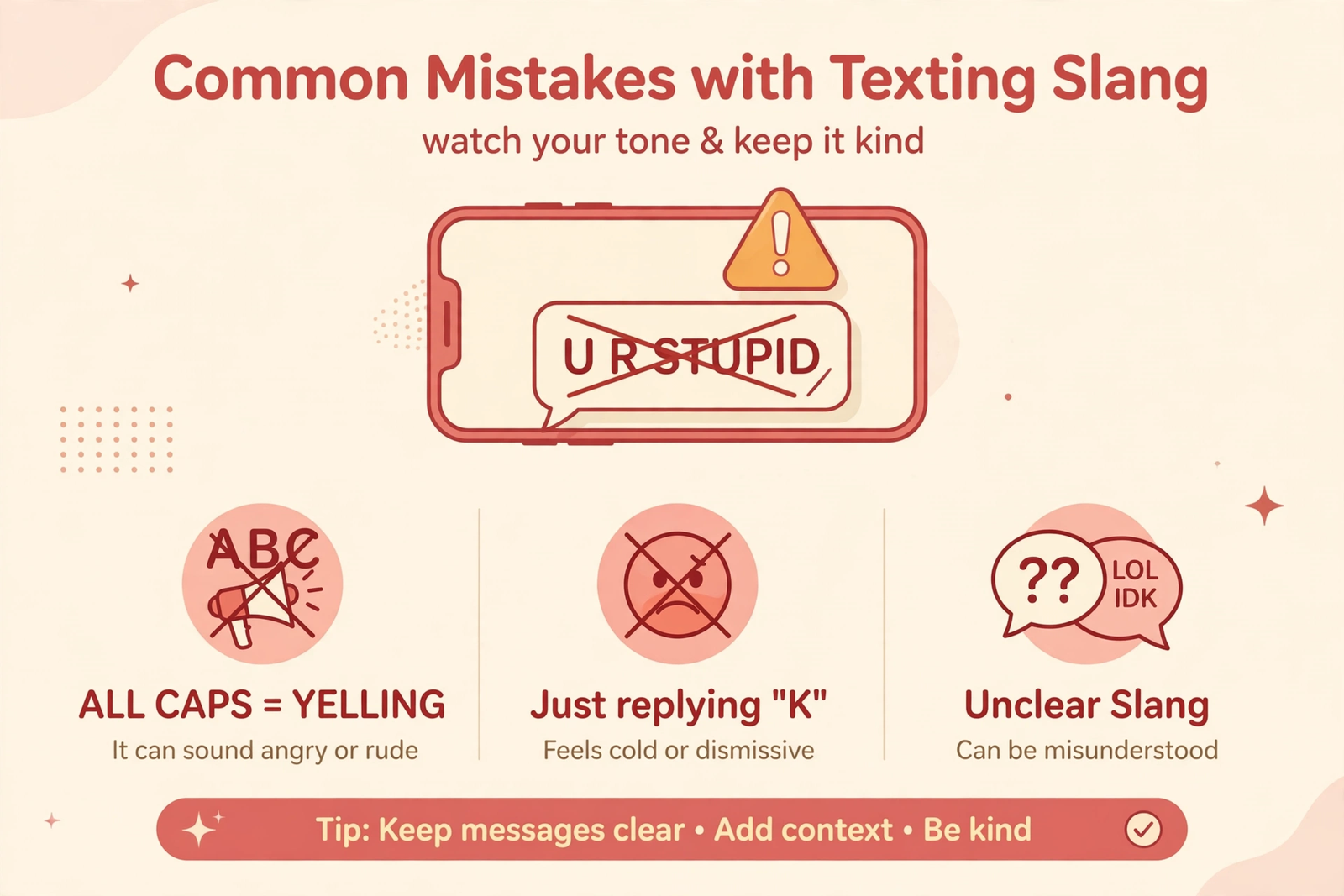
Common Mistakes
DW is simple, but it is easy to use it in ways that backfire. These are the mistakes people make most often:
- Using DW after a serious apology. If someone apologizes for something that genuinely hurt you, a bare “DW” can feel dismissive, like you are brushing them off. Match the weight of the apology: “DW, I know you didn’t mean it — we’re good” works far better than “DW” alone.
- Using DW at work. Replying “DW” to a manager about a missed deadline or a client about a mistake looks careless, even if you mean well. Spell it out: “Don’t worry, I’ll have it fixed by noon.”
- Using DW when you are actually upset. Saying “DW” when you are annoyed is the texting version of saying “I’m fine” through gritted teeth. People can tell. If something bothered you, say so kindly instead of hiding behind two letters.
- Replying DW to a thank-you. “Thanks so much!” deserves “You’re welcome” or “NP,” not “DW.” Using DW here confuses the other person — there was nothing to worry about in the first place.
- Using DW with strangers. A new acquaintance or a customer probably does not expect slang from you. Use the full phrase until you know the relationship is casual.
- Reading DW as flirty. DW is friendly, not flirty. If a crush texts you “DW,” they are reassuring you — not necessarily making a move. Don’t overread it.
- Confusing DW with “dear wife.” On forums, “DW and I went hiking” means the person’s wife, not a reassurance. Context decides the meaning, so read the whole sentence before replying.
- Overusing DW. If every reply is “DW,” your messages start to feel automatic and low-effort. Mix it up with “all good,” “no worries,” or a real sentence now and then.
Quick Tips
Want to use DW like a native texter? Keep these tips in mind:
- Pair DW with warmth after real apologies: “DW, seriously, it’s totally fine ❤️” beats a bare “DW” every time.
- Add an emoji to set the tone: 😊 for friendly, 🙏 for grateful, 😂 for playful. One emoji is enough — don’t stack five.
- Use lowercase “dw” for extra casual chats: With close friends, “dw lol” feels softer than a formal “DW.” Both are correct.
- Follow DW with action when it helps: “DW, I’ll send it now” is more reassuring than “DW” alone because it shows you are already fixing the problem.
- Use DW to de-escalate group chats: When a small argument starts over a missed plan, a quick “DW guys, let’s just reschedule” resets the mood instantly.
- Don’t use DW to end a serious conversation: If someone is opening up about something difficult, “DW” shuts the door. Reply with real words and real listening instead.
- Match the other person’s energy: If they text formally, reply formally. If they text in slang, DW fits right in.
- When in doubt, spell it out: “Don’t worry about it” is never wrong, never confusing, and works in every setting where DW works — plus a few where it doesn’t.

FAQ
1. What does DW mean in texting?
In texting, DW means “don’t worry.” It is a quick, friendly way to reassure someone, accept an apology, or say that something is no big deal — for example, “Sorry I’m late!” → “DW, I just got here.”
2. What is the dw slang meaning on TikTok?
On TikTok, the dw slang meaning is the same as everywhere else: “don’t worry.” Creators and commenters use it to reassure each other, brush off small mistakes in videos, and keep comments supportive and light.
3. Is DW rude or dismissive?
No — DW is normally warm and friendly. But a bare “DW” after a serious apology can feel dismissive, because it looks like you are brushing the person off. After a real apology, add warmth: “DW, honestly, it’s totally fine.”
4. What does DW mean on Snapchat and Instagram?
On Snapchat and Instagram, DW means “don’t worry” in DMs, stories, and replies. It is one of the most common replies to “sorry for the late reply” or “I hope I didn’t mess up,” and it works exactly like it does in regular texting.
5. Does DW mean “dear wife”?
Sometimes, but only on forums. On parenting and relationship message boards, DW can mean “dear wife” (alongside DH for “dear husband”). In texting, TikTok, Snapchat, and WhatsApp, DW almost always means “don’t worry.”
6. What is the difference between DW and NP?
DW (“don’t worry”) answers a worry or an apology, while NP (“no problem”) answers a thank-you. “Sorry I’m late!” gets a DW; “Thanks for your help!” gets an NP. Mixing them up is a common beginner mistake.
7. Can I use DW in professional or work messages?
Generally, no. DW is informal slang, so avoid it in emails, messages to clients, and formal work chats. Use “Don’t worry about it at all” or “No worries at all” instead. A casual DW is only fine in relaxed chats with coworkers you know well.
8. How do I reply when someone texts “DW”?
Just carry on naturally. A “thanks 😊,” a “haha ok,” or simply continuing the conversation all work. If they used DW to reassure you, a quick “thank you, I needed that” is a warm reply. There is no special response required — DW is a green light to move on.
Conclusion
DW means “don’t worry” — two small letters that carry a big message: it’s fine, we’re good, let it go. Born in the chatrooms and SMS chats of the late 1990s, DW survived every new app and platform because it solves a problem every texter has: how to reassure someone quickly and kindly. From TikTok comments to Snapchat DMs to everyday group chats, it remains one of the warmest shortcuts in digital language.
The key takeaways are simple. Use DW when someone apologizes, worries, or makes a small mistake — and add warmth when the moment is serious. Keep it out of formal work messages, spell it out when the stakes are high, and remember the rare alternate meanings (“dear wife” on forums, “deep web” in tech talk) so context never trips you up. Pair it with friendly slang like WSP when you are opening a chat, and you will sound like a natural in any conversation.
Quick recap: DW = don’t worry · reassurance, apology accepted, no big deal · texting, TikTok, Snapchat, Instagram, WhatsApp · alternate meanings: dear wife (forums), deep web (tech), Doctor Who (fandom) · professional alternative: “Don’t worry about it at all.” Now the next time someone texts you “DW,” you will know exactly what they mean — and exactly how to reply.
