
KMT means “kiss my teeth,” and if you are searching for the kmt meaning slang, here is the short version: it is a written form of the loud teeth-sucking sound people make when they are annoyed, unimpressed, dismissive, or in disbelief. It comes from Jamaican and Caribbean culture, travelled through UK slang, and is now all over TikTok, Twitter/X, Instagram comments, and everyday texting. When someone types “KMT,” they are not literally asking you to kiss their teeth. They are rolling their eyes in text form.
You will see KMT in a reply to a bad take, a disappointing message, an obvious lie, or a joke that did not land. It can be rude, playful, dramatic, or exhausted, depending on who sends it and what came before it. In this guide, we break down the full KMT meaning, where it came from, how people actually use it, and when you should avoid it.
kmt meaning slang Meaning & Definition
KMT stands for “kiss my teeth.” It is internet slang for the gesture of sucking your teeth — a sharp, audible sound made by pulling air through clenched teeth. That sound is a universal signal in Caribbean culture: I am annoyed. I am not impressed. I do not believe you. Leave me alone.
In texting and social media, KMT does the same job as the sound itself. It is short, punchy, and instantly understood by anyone who grew up around Caribbean or UK slang. You do not need a long reply when “KMT” says it all.
Here is the definition in plain language:
- Full form: Kiss My Teeth
- Meaning: An expression of annoyance, dismissal, disbelief, or contempt
- Origin: Jamaican Patois and Caribbean culture
- Used on: TikTok, Twitter/X, Instagram, Snapchat, WhatsApp, and text messages
- Tone: Annoyed, unimpressed, sarcastic, or playfully dramatic
- Similar to: SMDH, “tch,” “ugh,” “bruh,” and the eye-roll emoji
So, what does KMT mean in a text? Most of the time, it means the sender is annoyed or unimpressed and does not want to argue about it. It can also mean “I cannot believe you just said that,” “that is nonsense,” or “I am done with this conversation.” Context is everything. The same three letters can be a joke between friends or a sharp shutdown to a stranger.
Unlike some slang that changes meaning every few months, KMT has stayed remarkably stable. Its meaning has been the same for decades. What changed is the audience. Social media took a Caribbean expression and gave it to the whole world.
Introduction
Imagine you text your friend a story about someone cancelling plans for the third time in a row. Your friend replies with just three letters: “KMT.” You do not need an explanation. You can almost hear the teeth suck, see the eye roll, and feel the frustration. That is the power of KMT. It packs a whole attitude into three characters.
Slang works best when it feels like real speech, and KMT is a perfect example. It is not a random abbreviation invented online. It is a written version of a real sound that real people have made for generations. When Caribbean speakers moved to the UK, the US, and Canada, the expression travelled with them. When their children and grandchildren started using TikTok and Twitter, KMT travelled again — this time at internet speed.
Today, you will find KMT in comment sections under celebrity drama, in group chats after a bad decision, in captions about annoying exes, and in replies to obviously fake stories. It is especially popular with Gen Z and younger millennials, but it is not limited to them. Anyone who has spent time around UK slang or Caribbean culture will recognise it instantly.
Part of its appeal is efficiency. Why type a paragraph about how annoyed you are when “KMT” does the job? It is also expressive in a way that plain words are not. “I am annoyed” is a statement. “KMT” is a feeling. It has sound, attitude, and history built into it.
This guide explains the kmt meaning slang in full, from its Jamaican roots to its TikTok fame. You will learn how to use it correctly, how to reply when someone sends it to you, what mistakes to avoid, and how it compares to similar slang like SMDH and ISTG. If you have ever wondered whether KMT is rude, whether it is the same as “kiss my teeth,” or whether you can use it at work, you will find the answer here.
Slang moves fast, and new terms appear every week. Some, like the IJBOL meaning trend, explode and fade. Others, like the TB meaning in texting, quietly become part of everyday language. KMT belongs in the second group. It has lasted because it comes from a real culture and a real gesture, not just a viral moment.

Origin
KMT comes from Jamaica and the wider Caribbean, where “kiss teeth” — also written as “kiss mi teeth” in Jamaican Patois — describes the act of sucking your teeth to show annoyance or contempt. The phrase is not new. It has been part of Caribbean speech for generations, long before smartphones and social media existed.
The gesture itself is simple but expressive. You press your tongue against your teeth and suck air in sharply, creating a loud “tch” or “kissing” sound. It is often paired with an eye roll, a head tilt, or a dismissive wave of the hand. Together, those signals are unmistakable. Nobody who hears a proper teeth suck wonders what it means.
In Caribbean households, “kiss teeth” is something children are often told not to do in front of elders, because it is considered rude and disrespectful. That tells you a lot about its power. It is not a polite sound. It is a challenge, a complaint, and a dismissal all at once. When someone kisses their teeth at you, they are saying they are not happy — and they are not afraid to show it.
So how did a Caribbean gesture become global internet slang? The answer is migration and music. Large Caribbean communities in the UK, especially London, brought Patois expressions into British street slang. Words and phrases from Jamaican culture became part of everyday UK speech, especially among young people. From there, UK grime, drill, dancehall, and afrobeats helped spread the language even further.
Social media did the rest. On Twitter/X, people started typing “KMT” instead of describing the gesture. On TikTok, creators used it in captions, comments, and skits about annoying situations. A sound that once needed to be heard could now be typed, shared, and understood by millions of people who had never been to Jamaica.
It is worth noting that KMT is not just a random abbreviation. It follows the same pattern as other slang that moved from speech to text. People took a phrase they already said out loud — “kiss my teeth” — and shortened it for fast typing. That is why it feels so natural. It was spoken long before it was typed.
Today, the expression is recognised far beyond the Caribbean diaspora. You will hear it in London, Toronto, New York, Atlanta, and Lagos, and you will see it in comments from people with no Caribbean background at all. That is how slang spreads: a strong, expressive phrase finds a new audience, and the new audience makes it their own.
Popularity
KMT has grown steadily in popularity over the past decade, and TikTok has given it its biggest boost yet. On TikTok, KMT appears in captions, on-screen text, and comments under videos about annoying boyfriends, bad dates, rude customers, and unbelievable stories. A creator might act out a frustrating situation, then flash “KMT” on the screen. Viewers instantly get the joke.
Twitter/X is another home for KMT. The platform rewards short, punchy reactions, and KMT is perfect for that. A single “KMT” reply to a bad opinion can get hundreds of likes, because it says what everyone is thinking without starting a long argument. It is the digital version of sucking your teeth and walking away.
Instagram and Snapchat use KMT in a similar way. You will see it in story replies, DMs, and comment sections, especially under posts about drama, gossip, or relatable everyday frustrations. It works well in group chats too, where one “KMT” can speak for the whole group.
Several things explain why KMT became so popular:
- It is short. Three letters are faster than a full sentence, and they fit perfectly in fast-moving comment sections.
- It is expressive. KMT carries tone, attitude, and body language in a way that plain words often do not.
- It is versatile. It works for annoyance, disbelief, dismissal, sarcasm, and playful shade.
- It is cultural. It comes from a real tradition, which gives it more weight than a made-up abbreviation.
- It is visual. Even in text, readers can imagine the gesture, the eye roll, and the facial expression.
Gen Z has played a big role in spreading KMT. Younger users love slang that feels authentic and expressive, and they are quick to pick up phrases from music, TikTok, and UK slang. But KMT is not only a Gen Z term. Older millennials who grew up around Caribbean or UK culture have used it for years, and many people in their thirties and forties recognise it immediately.
In the UK, KMT is especially common. It is part of everyday slang in London and other cities with large Caribbean communities. In the US, it is more common in cities with strong Caribbean and Black British cultural influence, and it is spreading through TikTok to a wider audience. In Canada, particularly Toronto, it is also well known.
Search interest in “KMT meaning” and “what does KMT mean in text” has risen as more people encounter the term outside its original community. That is a normal pattern for slang: first it belongs to one group, then it spreads, then outsiders look it up. If you are reading this guide, you are part of that last step — and that is exactly why clear explanations matter.
How It Is Used
KMT is used as a reaction. It is rarely the start of a conversation. Instead, it appears after something annoying, unbelievable, or disappointing has been said or done. Think of it as a verbal eye roll.
Here are the most common tones behind KMT:
- Annoyed: “He cancelled again. KMT.” The sender is frustrated and tired of the situation.
- Dismissive: “KMT, I am not even going to argue with you.” The sender is shutting the conversation down.
- Disbelief: “You really believe that story? KMT.” The sender thinks the claim is obviously false.
- Contempt: “KMT, look at this nonsense.” The sender thinks something is beneath them.
- Playful shade: Between close friends, KMT can be a joke. “You wore that? KMT.” It is teasing, not a real insult.
- Exhaustion: “KMT, I cannot do this today.” The sender is tired, overwhelmed, or done.
Where do people use it? Almost anywhere informal text is allowed:
- Text messages and DMs: The most common place. A quick “KMT” is a complete reply.
- Group chats: One KMT can react to a message for the whole group.
- TikTok comments: Used to react to videos, drama, and bad takes.
- Twitter/X replies: A short, sharp response to an opinion or claim.
- Instagram comments and stories: Used for shade, jokes, and relatable frustration.
- Captions: Creators use KMT in captions to set the mood of a video or photo.
KMT can stand alone, or it can appear at the start or end of a sentence. “KMT, I am done.” “I swear, KMT.” “KMT, not again.” All of these sound natural. It also pairs well with other slang and emojis, such as the eye-roll emoji, the annoyed face, or “SMDH.”
One important point: tone depends on the relationship. Between close friends, KMT is often playful. From a stranger, or in a serious argument, it can feel rude and confrontational. The letters are the same, but the meaning changes with context. Always consider who you are talking to before you send it.
If you are learning KMT in text for the first time, the safest way to use it is with friends, in casual conversations, and in response to something clearly annoying or funny. Avoid it in formal messages, at work, or with people you do not know well until you understand how they will take it.
Examples
The best way to understand KMT is to see it in real conversations. The examples below show how it sounds in friendly chats, formal settings, and funny situations. Notice how the same three letters can feel completely different depending on the words around them.
Friendly Examples
Between friends, KMT is usually light, dramatic, and funny. It is a way of saying “I cannot believe this” without being serious about it.
- Friend 1: “He said he forgot it was our anniversary.”
Friend 2: “KMT, dump him already.” - Friend 1: “I studied all night and still failed the test.”
Friend 2: “KMT, that teacher is so unfair.” - Friend 1: “I just spent my last £20 on food delivery.”
Friend 2: “KMT, you need to learn to cook.” - Friend 1: “My mum saw my search history.”
Friend 2: “KMT, I would have to move out.” - Friend 1: “He texted ‘wyd’ at 2am again.”
Friend 2: “KMT, block him.”
In these examples, KMT adds humour and sympathy. It says, “I hear you, that is annoying, and I am on your side.” It is the kind of reply that makes a friend feel understood.
Professional Examples
Honestly, KMT does not belong in professional messages. It is too informal and too rude for work emails, messages to a manager, or conversations with clients. But it is useful to know what it looks like, so you can recognise it — and avoid using it by accident.
- Wrong for work: “KMT, this deadline is impossible.” A manager would read this as disrespectful, even if you only meant to be frustrated.
- Better for work: “This deadline is very tight. Can we discuss the timeline?” Same feeling, professional tone.
- Wrong for work: “KMT, I already explained this.” This sounds dismissive and impatient.
- Better for work: “Let me explain this again in a different way.” Clear, polite, and helpful.
- Wrong for work: “KMT, not another meeting.” This can damage your reputation, even in a casual team chat.
- Better for work: “I have a lot on today, so I may need to keep this meeting short.” Honest without the attitude.
The lesson is simple: KMT is for friends, not for the office. If you are frustrated at work, say so in professional language. Save KMT for your group chat after work.
Funny Examples
KMT is at its funniest when it reacts to something ridiculous. TikTok and Twitter are full of these moments.
- “He said he is a ‘nice guy’ but he ghosted three girls this month. KMT.”
- “My phone died right when I was about to win the game. KMT.”
- “She said she does not like pizza. KMT, who does not like pizza?”
- “I went to the gym once and expected abs the next morning. KMT, delusional.”
- “He asked me to split the bill after he ordered a steak and I had a salad. KMT.”
- “My alarm did not go off, my bus was late, and it started raining. KMT, today is cancelled.”
These examples work because KMT adds drama. It turns a small annoyance into a mini-performance. That is why it is so popular in memes, skits, and reaction videos. It is the sound of someone being dramatically done with a situation, and everyone can relate to that feeling.

Comparison with Similar Terms
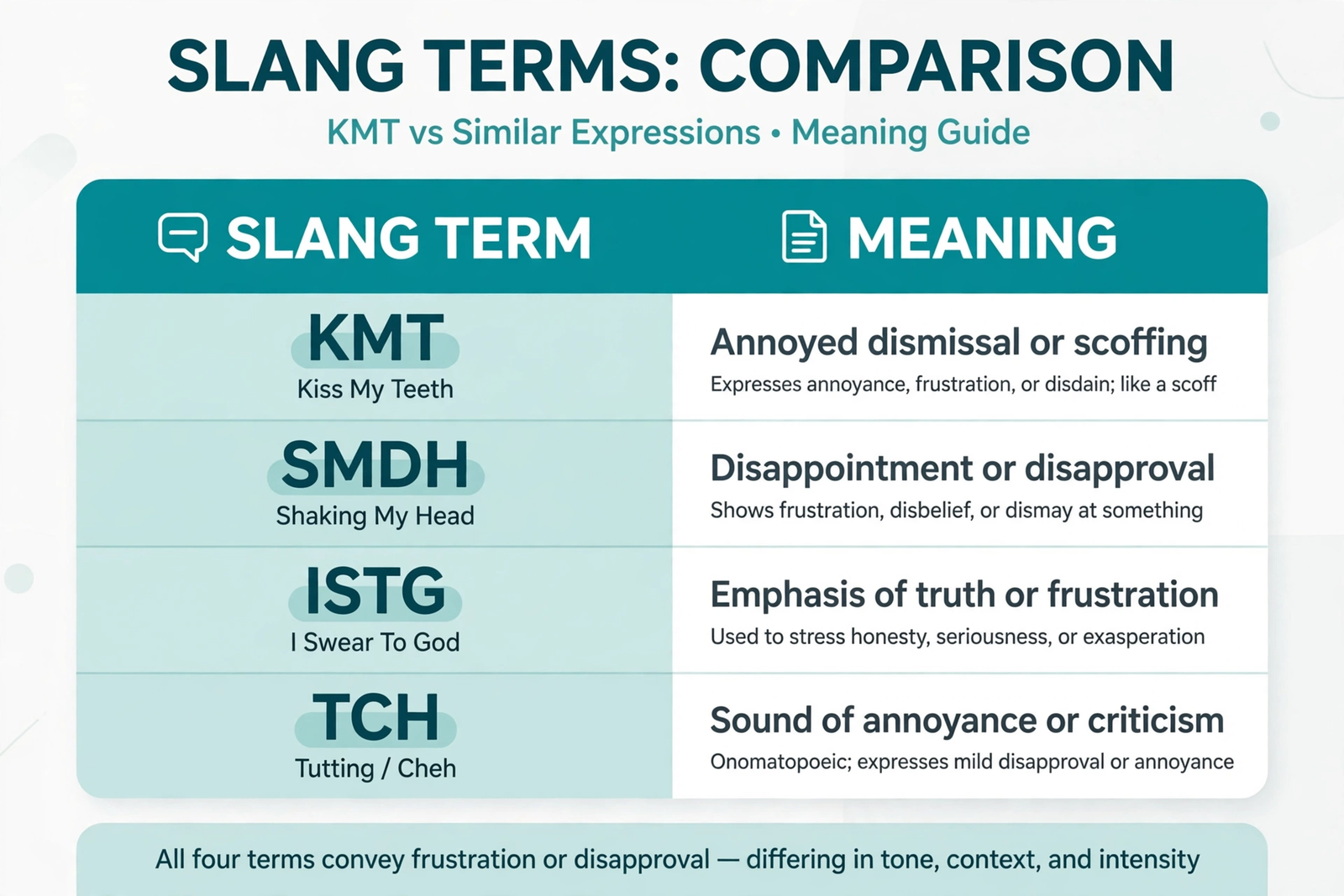
KMT is not the only slang term for annoyance or disbelief. Several other expressions do a similar job, but each one has a slightly different tone. Understanding the differences will help you choose the right one for the moment.
For example, SMDH means “shaking my damn head,” and it is used for disappointment. ISTG means “I swear to God,” and it is used for emphasis or frustration. “Ugh” is a general sound of disgust or annoyance. “Bruh” can mean disbelief, disappointment, or just “really?” Each one fits a different mood.
Here is a simple comparison:
| Term | Full Form / Meaning | Tone | Best Used When |
|---|---|---|---|
| KMT | Kiss My Teeth — teeth-sucking gesture | Annoyed, dismissive, contemptuous | Someone says or does something annoying, unbelievable, or disrespectful |
| SMDH | Shaking My Damn Head | Disappointed, disapproving | Someone does something foolish or disappointing |
| ISTG | I Swear To God | Frustrated, emphatic, exasperated | You want to stress that you are serious or fed up |
| Tch | Written form of the teeth-sucking sound | Mildly annoyed, unimpressed | A small annoyance or a sarcastic reply |
| Ugh | Sound of disgust or frustration | Annoyed, disgusted, tired | Something gross, boring, or frustrating happens |
| Bruh | Brother (used as “really?”) | Disbelief, disappointment, casual | Someone says something silly or shocking |
The closest match to KMT is “tch,” because both imitate the same sound. The difference is strength. “Tch” is softer and more casual. KMT is stronger, sharper, and more cultural. It carries the full weight of the gesture and the attitude behind it.
SMDH is also close, but it is more about disappointment than contempt. You might say SMDH when a friend makes a bad decision. You would say KMT when someone disrespects you or says something you refuse to accept. KMT has more edge.
If you want a quick rule, use KMT when you feel dismissed, disrespected, or done with a conversation. Use SMDH when you feel disappointed. Use “ugh” when you feel disgusted or tired. Use “bruh” when you feel shocked or confused. Each one has its moment, and choosing the right one makes your message clearer.
Learning the clock it meaning can also help here, because that term is about noticing or calling out behaviour, while KMT is about reacting to it. Together, they show how rich modern slang has become — there is a word for almost every feeling.
Alternate Meanings
In slang, KMT almost always means “kiss my teeth.” That is the meaning you should assume when you see it on TikTok, Twitter, Instagram, or in a text message. If the conversation is casual and the tone is annoyed or dismissive, KMT means “kiss my teeth.”
However, like many abbreviations, KMT can mean other things in other contexts. Outside slang, the same three letters can appear as an abbreviation for names, places, organisations, or technical terms. For example, KMT can be initials for a person, a company, or a place name in a specific field. Those uses are rare in everyday conversation, and they depend entirely on context.
The honest rule is simple: if the context is slang, social media, or texting, KMT means “kiss my teeth.” If the context is not slang — for example, a business document, a scientific paper, or a formal name — check the context before assuming the slang meaning. Do not force the slang meaning onto a situation where it does not fit.
You should also be careful about invented meanings. Some websites claim KMT stands for phrases that have no real history or usage. If a meaning does not match how people actually use the term in comments, captions, and chats, it is probably not real. Stick to “kiss my teeth,” because that is the meaning with real cultural roots and real everyday use.
In short, KMT has one dominant slang meaning and a few unrelated non-slang uses. In this guide, and in almost every conversation you will have online, “kiss my teeth” is the meaning that matters.
Professional or Polite Alternatives
KMT is effective, but it is not polite. It can sound rude, dismissive, or confrontational, especially to people who do not know you well or who come from a different culture. If you want to express annoyance without sounding disrespectful, try one of these alternatives instead.
- “I disagree with that.” Clear, calm, and respectful. It states your position without attacking the other person.
- “I see it differently.” A softer way to disagree, useful in discussions and debates.
- “That does not sound right to me.” Good for disbelief. It questions a claim without calling someone a liar.
- “I am not sure about that.” Polite and open. It leaves room for more conversation.
- “I find that frustrating.” Honest about your feelings without being rude.
- “Let us agree to disagree.” A calm way to end a disagreement without a fight.
- “I need a moment to think about that.” Useful when you are annoyed but do not want to react too quickly.
- “That is disappointing to hear.” A professional way to express disappointment at work.
These alternatives work in professional settings, formal messages, and conversations with people you respect. They keep the conversation open, while KMT often closes it. If your goal is to solve a problem, a polite phrase will usually work better than a dismissive one.
That does not mean you should never use KMT. With close friends, in a joke, or in a casual comment, it is fine. The key is knowing your audience. Use KMT when the relationship can handle it. Use a polite alternative when it cannot.
If you are unsure, ask yourself one question: “Would I say this to this person’s face, in this tone?” If the answer is no, choose a softer phrase. Slang is fun, but respect matters more.
Common Mistakes
KMT is simple to use, but people still make mistakes with it. Most of them come from using it in the wrong place, with the wrong people, or in the wrong tone. Avoid these common errors:
- Using it at work: KMT is too rude for professional messages. It can make you look disrespectful, even if you did not mean it that way. Keep it out of work chats and emails.
- Using it with strangers: A stranger may not know you are joking. KMT from someone they do not know can feel aggressive or confrontational.
- Overusing it: If you reply “KMT” to everything, it loses its impact. Save it for moments when you really mean it.
- Using it in serious arguments: KMT can shut a conversation down. In a serious discussion, it can make the other person feel dismissed and unheard.
- Confusing it with other acronyms: KMT is not the same as KMS, KMN, or other similar abbreviations. Always check the letters before you send them.
- Using it with older people or elders: In Caribbean culture, kissing your teeth at an elder is considered very rude. The written version carries the same weight. Be careful with family members and older relatives.
- Using it when you do not mean it: If you are not actually annoyed, KMT can send the wrong signal. A simple “haha” or “really?” might fit better.
- Assuming everyone knows it: Not everyone knows Caribbean or UK slang. Some people will have no idea what KMT means. Be ready to explain it, or use a clearer phrase.
Another mistake is using KMT as an insult when you actually want to have a conversation. If someone says something you disagree with, “KMT” ends the discussion. If you want to change their mind, you need words, not just a reaction. Save KMT for moments when you are done talking, not for moments when you still want to be heard.
Finally, do not use KMT to mock Caribbean culture. The term comes from a real community with a real history. Using it respectfully means understanding where it comes from and not treating it as just a funny sound. Learn the CF meaning and other slang terms the same way — with curiosity and respect for the people who created them.

Quick Tips
Want to use KMT correctly? These quick tips will help you sound natural and avoid awkward moments.
- Use it with friends first. Practice KMT in casual chats where the tone is already playful and relaxed.
- Match the tone. If the conversation is light, keep KMT light. If it is serious, think twice before using it.
- Let it stand alone. A single “KMT” is often stronger than a long sentence. Do not over-explain it.
- Pair it with context. If you want to be clear, add a short follow-up: “KMT, I am so done with him.”
- Do not use it in formal writing. No work emails, no school assignments, no messages to a manager.
- Watch the reaction. If someone seems offended, apologise and explain that you meant it as a joke.
- Learn the gesture too. Understanding the real teeth-sucking sound helps you understand the written version.
- Do not force it. If KMT does not feel natural to you, do not use it. There are many other ways to express annoyance.
- Check the context. Make sure the conversation is informal and the other person will understand the term.
- Use it sparingly. The less often you use KMT, the more impact it has when you do.
These tips apply to most slang, not just KMT. The best slang users are the ones who know when not to use a term, as well as when to use it. That awareness is what makes you sound fluent, not just trendy.

FAQ
Here are the most common questions people ask about KMT, with clear, simple answers.
What does KMT mean in text?
In text, KMT means “kiss my teeth.” It is a written form of the teeth-sucking sound used to show annoyance, dismissal, disbelief, or contempt. When someone texts “KMT,” they are usually annoyed or unimpressed and do not want to continue the conversation in that direction.
What does KMT mean on TikTok?
On TikTok, KMT means the same thing: “kiss my teeth.” Creators use it in captions, comments, and on-screen text to react to annoying, unbelievable, or dramatic situations. It is often used under videos about bad dates, rude behaviour, or relatable frustrations.
What does KMT mean in slang?
In slang, KMT means “kiss my teeth,” an expression from Jamaican and Caribbean culture. It describes the gesture of sucking your teeth to show that you are annoyed, unimpressed, or in disbelief. It travelled from Caribbean speech into UK slang and then into global internet slang.
Is KMT rude?
Yes, KMT can be rude, depending on the context. It is a dismissive expression, and in Caribbean culture, kissing your teeth at someone — especially an elder — is considered disrespectful. Between close friends it is often playful, but with strangers, at work, or in formal settings, it can sound confrontational. Use it carefully.
What is the KMT gesture?
The KMT gesture is the act of sucking your teeth: pressing your tongue against your teeth and pulling air in sharply to make a loud “tch” sound. It is often paired with an eye roll, a head tilt, or a dismissive hand gesture. The sound alone communicates annoyance, disbelief, or contempt without any words.
What is the difference between KMT and SMDH?
KMT means “kiss my teeth” and expresses annoyance, dismissal, or contempt. SMDH means “shaking my damn head” and expresses disappointment or disapproval. KMT is sharper and more confrontational, while SMDH is more about being disappointed by someone’s behaviour. Both are reactions, but they fit different moods.
How do you reply to KMT?
How you reply depends on the situation. If it was a joke between friends, you can laugh it off or reply with humour. If it was serious, ask what is wrong: “What happened?” or “What did I do?” If you sent something annoying, apologise or change the subject. Do not reply with more attitude unless you want an argument.
What is the KMT full form?
The full form of KMT is “kiss my teeth.” It comes from the Jamaican Patois phrase “kiss mi teeth,” which describes the teeth-sucking gesture. In slang and texting, KMT is simply the shortened, written version of that phrase.
Conclusion
KMT is a small term with a big attitude. It means “kiss my teeth,” and it carries the sound, the gesture, and the history of Caribbean culture into every text, comment, and caption where it appears. Whether you see it on TikTok, Twitter, or in a friend’s message, it means the same thing: I am annoyed, I am unimpressed, or I do not believe you.
Now you know the full kmt meaning slang, from its Jamaican roots to its modern fame. You know how to use it with friends, when to avoid it at work, how it compares to SMDH and other similar terms, and how to reply when someone sends it to you. That knowledge will help you read the room — and the chat — more accurately.
The best advice is simple: use KMT where it fits, respect where it comes from, and do not overuse it. Slang is at its best when it feels natural, and KMT feels natural when you understand the feeling behind it. Save it for the moments when a simple eye roll is not enough, and a full argument is too much.
For more on how modern slang works, check out the IJBOL meaning guide and the TB meaning guide. Each term has its own story, and learning them together helps you understand how internet language really works. For a dictionary reference on the expression itself, see Dictionary.com’s slang section.
Next time someone texts you “KMT,” you will not need to look it up. You will hear the teeth suck, see the eye roll, and know exactly what they mean.
