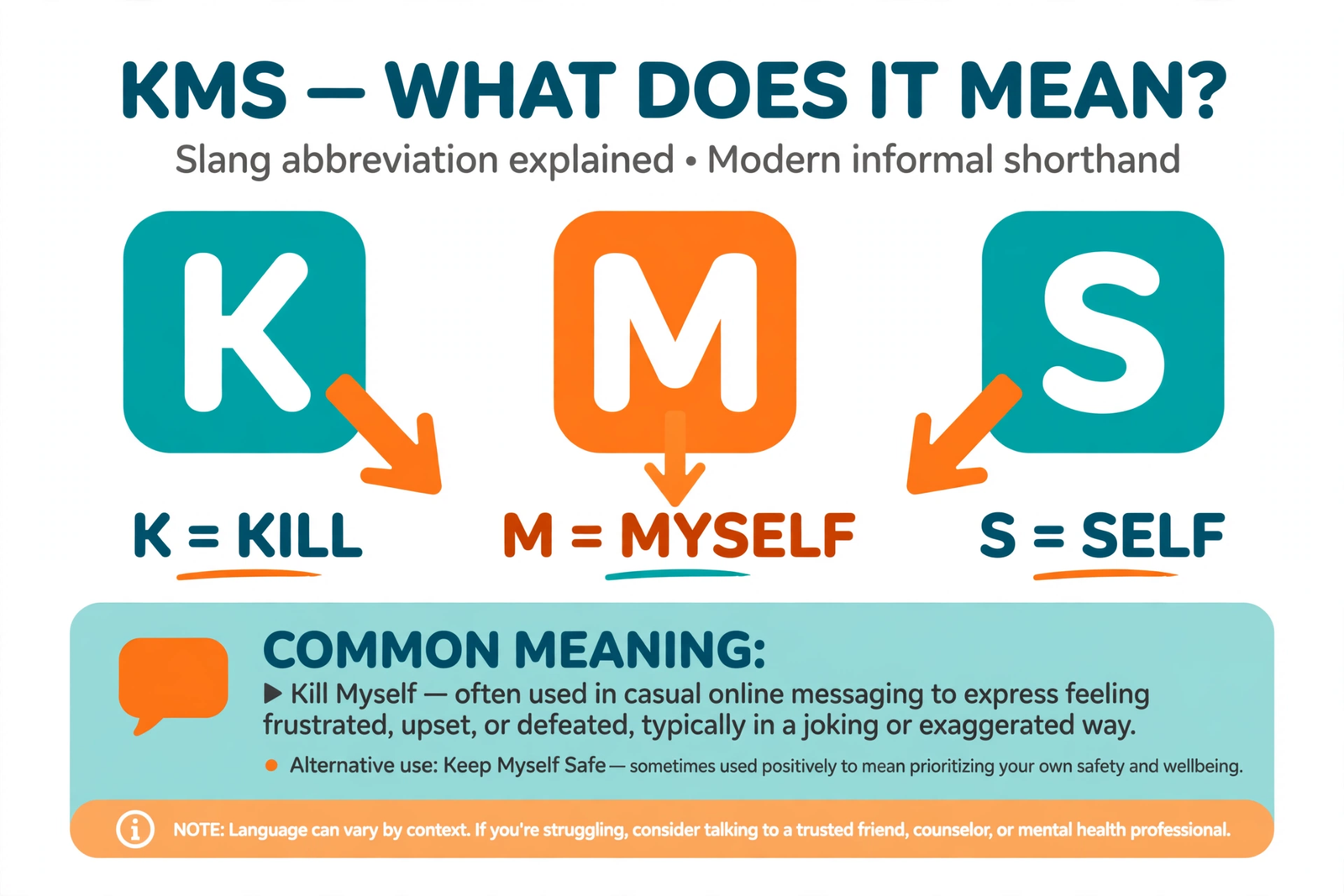
Quick definition: In slang, KMS stands for “kill myself.” Most of the time it is used as an exaggerated, joking way to say “I’m so embarrassed,” “I’m so frustrated,” or “I can’t deal with this” — not as a literal statement. But because the same three letters can also signal real distress, context always matters, and that is exactly what this guide will help you read.
kms meaning slang Meaning & Definition
The kms meaning slang in texting is “kill myself.” It is an initialism — each letter stands for the first letter of a separate word — and it shows up constantly in DMs, group chats, TikTok comments, Snapchat messages, Discord servers, and Instagram captions. When someone types “kms,” they are almost always reacting to something that just happened: a cringe text sent to the wrong person, a failed exam, a brutal roast from a friend, or a plot twist in a show that broke them emotionally.
Here is the important nuance most short dictionary entries skip: the kms meaning slang changes completely with tone. Said between friends after a funny fail, it means “I’m dying of embarrassment right now.” Said alone, late at night, after a string of sad messages, it can mean something far more serious. The letters are the same; the meaning lives in the context around them.
Grammatically, KMS works like a verb phrase. People write “I’m going to kms,” “I will kms,” or simply “kms” on its own as a complete reaction. A close cousin is “killing myself,” which people use when that form fits the sentence better: “This homework is killing myself” is wrong, but “I’m killing myself laughing” uses a different word entirely (see the comparison table below).
Introduction
If you have spent any time on TikTok, Snapchat, or Discord in the last few years, you have seen “kms” flash past in a comment or a chat. It looks harmless — just three lowercase letters — but it carries more weight than almost any other slang abbreviation online. That is because KMS sits at the intersection of two very different internet habits: dark humor, where teens exaggerate everyday disasters for laughs, and genuine emotional expression, where the same words can be a real cry for help.
This guide explains the kms meaning slang in full: where it came from, how it is used on every major platform, what it means in different tones, how it compares to similar terms like KYS and KML, the alternate meanings it carries outside of slang, and the mistakes people make when they use it. By the end, you will know exactly what someone means when they type “kms” — and exactly how to respond.
Origin
The slang use of KMS goes back further than most people expect. The phrase “kill myself” as an exaggerated reaction has existed in spoken English for decades — “Oh God, kill me now” is an old dramatic complaint — but the three-letter abbreviation took off with early internet chat culture. It appears on Urban Dictionary as early as 2007, and Twitter users were posting it by 2009, right as texting shorthand and early social media were exploding. Dictionary.com traces the same history, noting that KMS is generally used as a melodramatic expression of frustration — or, more seriously, of discomfort and sadness.
Two things made KMS stick. First, the early 2000s internet loved dark, self-deprecating humor, and Tumblr and Twitter turned dramatic overreaction into a whole comedic style. Saying “kms” after a minor embarrassment was a way to be funny about feeling awful. Second, it is efficient: three letters replace a whole sentence of frustration. In group chats and fast-moving comment sections, that economy matters.
Over time, KMS spread from forums and Twitter into every platform where young people talk: Snapchat, Instagram, TikTok, Discord, and WhatsApp. It also picked up a second life in gaming, where losing a match in an embarrassing way reliably produces a wave of “kms” in the chat. The abbreviation never really faded the way some slang does, because embarrassment and frustration never go out of style.
Popularity
KMS is one of the most durable dark-humor abbreviations on the internet. Unlike trend-driven slang that spikes for a month and vanishes, it has stayed in steady use for well over a decade. Search interest stays consistent year after year, and the term appears across every age group that grew up texting — though it is most common among teens and people in their twenties.
Several things keep it popular. TikTok and Snapchat reward short, punchy reactions, and “kms” fits perfectly in a comment or a caption. Reaction culture on Discord and in gaming chats treats dramatic overreaction as entertainment. And the abbreviation is flexible: it works as a joke, a vent, a meme caption, and a genuine expression of being overwhelmed, all with the same three letters.
Parents, teachers, and anyone new to texting slang often encounter KMS through a teen’s phone or a viral post — and their first reaction is usually alarm. That alarm is understandable, and it is part of why this term deserves a fuller explanation than a one-line dictionary entry. Most uses are jokes. But “most” is not “always,” and knowing how to tell the difference is a genuinely useful skill.
How It Is Used
KMS is used in three main ways, and telling them apart is the whole game:
- As a hyperbolic joke: This is the most common use by far. Something embarrassing, annoying, or cringe happens, and “kms” is the punchline. “I just called my teacher ‘mom’ kms.” Nobody in this conversation is in danger; the speaker is dramatizing a small disaster for laughs.
- As an emotional vent: Sometimes the frustration is real but not dangerous — a brutal day, a breakup, a failed test, a friendship falling apart. “I failed my driving test again kms.” Here the term means “I feel terrible right now,” and the right response is empathy, not laughter.
- As a serious signal: Rarely, but really, someone uses KMS because they are genuinely thinking about harming themselves. Warning signs include a sudden change in tone, repeated dark messages, withdrawal from friends, or talk of feeling hopeless or being a burden. If you see that pattern, take it seriously: ask directly how they are doing, stay with them in the conversation, and encourage them to contact a trusted adult or a crisis line right away. In the United States, the 988 Suicide and Crisis Lifeline is available 24/7 by call or text.
A good rule of thumb: if the message follows a funny or embarrassing event and the person’s normal joking tone is intact, it is almost certainly hyperbole. If it follows sadness, isolation, or hopelessness — or if it keeps repeating — check in. When in doubt, checking in costs nothing and can matter enormously.
Examples
Real examples show the range of the kms meaning slang better than any definition. Notice how the same letters shift meaning with the situation around them.
Friendly Examples
- “I just waved at someone who wasn’t waving at me kms 😭”
- “My crush just saw my camera roll, kms right now.”
- “I sent the meme to the family group chat instead of my best friend. kms.”
- “Bro I fell asleep on the call and started snoring kms 💀”
Professional Examples
- “I just replied-all to the entire company email with a typo in the subject line. kms.”
- “I called my manager ‘mom’ in the meeting. I want to kms.”
- “My presentation froze on slide one in front of the whole team. kms.”
Even in professional settings, KMS shows up among coworkers who text casually — it is a pressure valve for workplace embarrassment. (In formal emails or with a boss, a simple “That was embarrassing!” is the safer choice.)
Funny Examples
- “My mom just found my search history. kms.”
- “The Wi-Fi died right when I was about to win the game. kms.”
- “I just got roasted so hard by a 12-year-old in the comments, kms.”
- “Me: I’ll just watch one episode. Netflix: it’s 4 AM. kms.”

Comparison with Similar Terms
KMS is often confused with other three-letter slang terms, and mixing them up can change the meaning of a message completely. Here is how it stacks up:
| Term | Meaning | Tone | How It Differs from KMS |
|---|---|---|---|
| KMS | Kill myself | Dramatic, frustrated, embarrassed | The baseline term — self-directed exaggeration. |
| KYS | Kill yourself | Hostile, insulting | Directed at someone else; often used as an insult or in bullying. Never a friendly joke. |
| KML | Killing me laughing / Killing myself laughing | Joyful, amused | Positive — it means something is hilarious, the opposite emotional direction from KMS. |
| kms (kilometers) | Kilometers (distance) | Neutral, technical | Same letters, totally different meaning — context decides. |
| IML / IML | I’m laughing / In my life | Light, casual | Unrelated meaning; shows why abbreviations need context. |
| BRB / IDK | Be right back / I don’t know | Neutral, harmless | Harmless filler abbreviations — KMS carries emotional weight these never do. |
The most important distinction is KMS vs. KYS. KMS points inward (“I can’t take this”), while KYS points outward at another person and is widely considered harassment. If you see KYS aimed at someone, that is bullying, not slang — and it should be reported on the platform where it appears.
Another useful comparison: KMS is the dark-humor cousin of lighter exaggerations like “I’m dead” or “I’m deceased,” which people use when something is funny or shocking. “I’m dead 💀” and “kms 😭” can appear in almost identical situations — the difference is mostly how heavy the joke feels. If you are unsure whether KMS is appropriate in a given chat, “I’m dead” is always the lighter, safer option.

Alternate Meanings
Outside of slang, KMS has several completely unrelated meanings. If you see it in a technical, business, or travel context, it almost certainly is not slang at all:
- Kilometers: The most common non-slang meaning. “The hotel is 5 kms away” just means five kilometers. This is the original meaning of the abbreviation, and it still dominates maps, travel, and sports.
- Key Management Service / Key Management System: In cybersecurity and cloud computing, KMS is software or a service that creates, stores, and manages encryption keys. Amazon AWS KMS is probably the most famous example.
- Knowledge Management System: In business and IT, a KMS is a system for storing, organizing, and sharing an organization’s knowledge — documents, procedures, and expertise.
- Killing Me Slowly: A rarer slang reading, used to express extreme boredom: “This lecture is kms” can mean “this is killing me slowly,” though most readers will still hear the standard meaning first.
Context is the only reliable way to pick the right meaning. A message that says “kms” after a funny fail is slang; a document that says “KMS encryption” is technology; a road sign that says “5 kms” is distance. When in doubt, read the sentence around it.
Professional or Polite Alternatives
KMS works fine with close friends, but it is a poor fit for formal settings, mixed-age groups, or anyone who might read it literally. These alternatives carry the same feeling without the heavy wording:
- For embarrassment: “I’m so embarrassed,” “I want to hide,” “That was mortifying.”
- For frustration: “I’m so done,” “I can’t deal with this,” “This is too much.”
- For funny fails: “I’m dead 😭,” “I can’t 😭,” “Send help lol.”
- For real distress: “I’m really struggling right now,” “I need someone to talk to,” “Today has been really hard.”
The last set matters most. If you actually feel terrible, plain language gets you better support than slang ever will. “I’m really struggling” tells a friend exactly what you need; “kms” leaves them guessing whether you are joking. And if you are on the receiving end, a reply like “Hey, are you okay? Do you want to talk about it?” is always the right move when you are unsure.
Common Mistakes
People get KMS wrong in a few predictable ways:
- Using it as a casual insult: KMS is self-directed. Aiming it at someone else (“kms lol”) is confusing at best and hurtful at worst — that is KYS territory, and it reads as harassment.
- Assuming it is always a joke: Most uses are jokes, but treating every single one as a joke is how real cries for help get missed. Read the context, and check in when the tone shifts.
- Using it at work or school formally: In a Slack channel, a class group chat, or any professional setting, KMS can alarm people who do not know the slang. Keep it for close friends.
- Confusing it with kilometers: “I’ll kms you later” makes no sense; “the store is 3 kms away” is distance, not drama. Same letters, different worlds.
- Overusing it: Like any exaggeration, KMS loses its punch if it appears in every message. Save it for moments that actually feel dramatic, and the joke lands better.
- Replying with laughter to a serious message: If someone’s “kms” follows real bad news, a laughing emoji can feel dismissive. Match your reply to their tone, not to the letters.

Quick Tips
- Read the room: Funny fail plus normal joking tone equals hyperbole. Sad news, withdrawal, or repeated dark messages equals check in.
- Know your audience: Great with close friends; risky with parents, teachers, bosses, or strangers who may read it literally.
- Keep it rare: The less often you use it, the funnier and more meaningful it is when you do.
- Never aim it at others: KMS is about you. Pointing it at someone else turns a joke into an insult.
- When in doubt, ask: “Are you okay?” is a five-second message that can change someone’s whole day.
- Use lighter swaps in public: “I’m dead 😭” or “I can’t” carries the same energy on TikTok comments and public posts without the heavy wording.
- Save the serious words for serious moments: If you genuinely feel hopeless, tell someone directly — a friend, a family member, or the 988 Lifeline (call or text 988 in the US). You deserve real support, not a three-letter joke.

FAQ
What does KMS mean in texting?
In texting, KMS stands for “kill myself.” It is usually used as an exaggerated, joking way to express embarrassment, frustration, or being overwhelmed — similar to saying “I’m so done.” Context decides whether it is a joke or something serious.
Is KMS always a joke?
No. Most of the time it is hyperbole, but not always. If it appears alongside sadness, hopelessness, withdrawal, or repeated dark messages, it may be a real signal of distress. When you are unsure, ask the person how they are doing — it is always better to check in.
What does KMS mean on Snapchat?
On Snapchat, KMS means the same thing as everywhere else: “kill myself,” used as dramatic slang for embarrassment or frustration. Teens commonly drop it in snaps and chats after an awkward or annoying moment.
What does KMS mean on TikTok?
On TikTok, KMS appears in comments and captions as a reaction to cringe, shocking, or relatable content — for example, “POV: you texted your ex by accident, kms.” It is almost always hyperbolic humor in that setting.
What is the difference between KMS and KYS?
KMS is self-directed (“I can’t take this”), while KYS means “kill yourself” and is aimed at another person. KYS is considered an insult or harassment, not a joke, and it should be reported when used to target someone.
Can KMS mean kilometers?
Yes. Outside of slang, KMS commonly means kilometers, especially in travel, maps, and sports. In tech, it can also mean Key Management Service or Knowledge Management System. The surrounding context tells you which meaning applies.
Is it okay to say KMS?
With close friends who understand the slang, yes — it is widely used as a joke. Avoid it in formal, professional, or mixed-age settings, and never use it toward someone else. If you genuinely feel distressed, plain language (“I’m really struggling”) will get you better support.
What should I do if someone texts me “kms” and I think they are serious?
Take it seriously. Reply right away, ask how they are feeling, and stay in the conversation. Encourage them to talk to a trusted adult or a professional. In the US, they can call or text 988 to reach the Suicide and Crisis Lifeline at any time. If you believe someone may act on it, contact emergency services or a trusted adult immediately.

Conclusion
The kms meaning slang is simple on the surface — “kill myself” — but the real meaning is never just the letters. In most chats, it is a joke: a dramatic, funny way to say “I’m so embarrassed” or “I can’t deal with this.” On TikTok, Snapchat, and Discord, it has become a standard reaction to everyday disasters, big and small. And in technical or travel contexts, it may not be slang at all — it may just mean kilometers or a key management system.
The skill is not memorizing the definition; it is reading the context. Tone, timing, and what happened right before the message tell you whether “kms” is a punchline, a vent, or a call for help. Use it lightly with friends, skip it in formal settings, never aim it at someone else, and always check in when the joke stops sounding like a joke. That is how three little letters stay funny — and how you make sure the people behind them are okay.
Want to decode more texting slang? Check out our guides on fn meaning in text, idt meaning in text, and iktr meaning in text — and if you want the full picture of how slang evolves online, start with tysm meaning.
