Quick definition: In slang, DDF means “drug and disease free.” It is a short label people use in dating profiles, hookup ads, and private chats to say they do not use recreational drugs and do not have a sexually transmitted infection (STI). If you have ever seen “DDF” on a dating app bio and wondered what it stands for, this guide explains the ddf meaning slang in full — where it came from, how it is used, what it does and does not guarantee, and the polite alternatives you can use instead.
ddf meaning slang & Definition
The ddf meaning slang is simple on the surface: DDF stands for “drug and disease free.” It is an abbreviation that packs a health and lifestyle claim into three letters. When someone writes DDF in a profile or a message, they are telling the reader two things at once: they do not use drugs, and they believe they are free of sexually transmitted diseases.
Unlike most slang, DDF is not playful or funny. It comes from the world of personal ads, where space was limited and honesty about health mattered. The term is most common in:
- Dating app bios — Tinder, Grindr, Bumble, and similar apps, where users list DDF alongside age, location, and interests.
- Hookup and casual-dating ads — classified-style posts where people state what they are looking for.
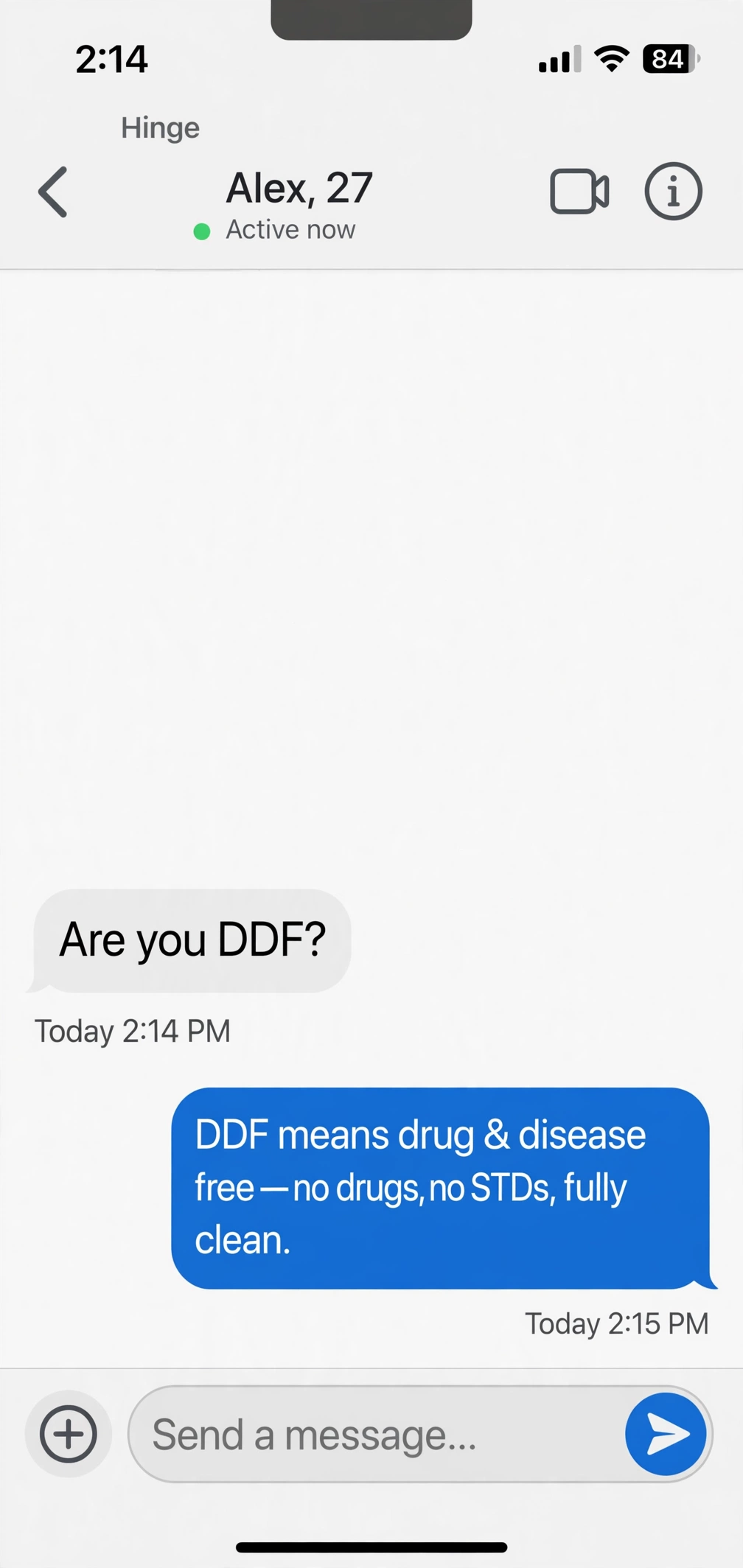
- Private chats and DMs — usually as a question, such as “Are you DDF?” before meeting someone.
- Forum profiles — especially on adult and lifestyle forums where users describe themselves in shorthand.
It is worth noting that DDF is a self-reported claim. There is no verification behind it. Someone can write DDF without ever having been tested, and the term says nothing about how recently they were tested or what they were tested for. That gap between the claim and the proof is one of the most important things to understand about this term, and we will come back to it in the safety section below.
Grammatically, DDF works as an adjective. You will see it in phrases like “DDF guy looking for same,” “must be DDF,” or “DDF and clean.” It is almost never used as a verb, and it rarely appears in ordinary conversation outside dating and hookup contexts. If a friend texts you “DDF?” out of the blue, they are almost certainly asking about your status in a dating or intimate context, not making small talk.
Introduction
Three letters can carry a lot of weight. DDF looks like any other piece of internet shorthand — the kind of abbreviation you scroll past a hundred times a day — but it touches on health, trust, and safety in a way that most slang never does. That is why it is worth understanding properly before you use it or respond to it.
Imagine you are swiping through a dating app and a profile reads: “32, gym regular, DDF, looking for something real.” In three letters, that person has tried to answer questions you might not feel comfortable asking directly. Are they into drugs? Do they have an STI? The abbreviation is designed to settle those questions quickly, before a single message is exchanged.
But quick answers are not always complete answers. DDF tells you what someone claims about themselves, not what a doctor would confirm. It also carries a history that goes back further than dating apps — to newspaper personal ads, early internet forums, and a time when talking openly about sexual health was far less common than it is today.
This article breaks down everything about the ddf meaning slang: the exact definition, the origin story, real examples of how people use it in texts and profiles, how it compares with similar terms like DTF and NSA, the common mistakes people make with it, and the safer, more respectful ways to talk about the same topic. By the end, you will know exactly what DDF means, when it is appropriate, and what to do when someone asks you if you are DDF.

Origin
DDF did not start on TikTok or in a group chat. Its roots go back to the personal ads printed in newspapers and magazines in the 1980s and 1990s, when the HIV/AIDS epidemic made sexual health a matter of urgent public conversation. In that era, people placing “men seeking men” or “men seeking women” ads had very little space and a strong reason to signal that they were healthy. Abbreviations like DDF — and its close cousin “D&D free” — became a compact way to do that.
As the internet grew, the term moved from print to screen. Early online spaces such as Craigslist personals, AOL chat rooms, and adult forums adopted DDF as standard profile shorthand. On these platforms, users often described themselves with a string of abbreviations: age, location, body type, preferences — and DDF sat among them as a health marker. If you browsed personals in the early 2000s, DDF was everywhere.
The rise of smartphones and dating apps gave the term a second life. Grindr, which launched in 2009, and later Tinder and Bumble, normalised short bios where every character counts. DDF survived the move because it does a job no other three letters do: it answers a health question in shorthand. Even as language around sexual health became more open and less stigmatising, the abbreviation stuck around, especially in casual-dating and hookup communities.
It is also worth noting that DDF spread largely through gay dating culture before reaching the mainstream. On apps like Grindr and Scruff, DDF has been a common profile tag for well over a decade. From there it crossed into wider dating-app language, where straight users adopted it too. Today you will find it across nearly every dating platform, though it remains most common in casual and hookup contexts rather than in profiles seeking long-term relationships.
Popularity
DDF is not a trending TikTok word, and it will probably never be one. Its popularity is steady rather than viral, because it serves a practical purpose instead of a fashionable one. People do not use DDF to sound cool; they use it to filter matches and set expectations. That gives it a staying power that trend-driven slang rarely has.
Search interest in the term rises and falls with dating-app usage rather than with memes or celebrity moments. Whenever a new dating app gains users, or whenever a viral post screenshots a dating profile containing DDF, a fresh wave of people looks the term up. That is why “what does DDF mean” remains a common search year after year: every generation of dating-app users meets the abbreviation for the first time and needs a plain answer.
The term is most popular in the United States, the United Kingdom, Canada, and Australia — the English-speaking countries where dating apps are most widely used. Within those countries, it appears most often in large cities, where casual dating culture is strongest and where app-based dating is the norm rather than the exception.
One reason DDF has lasted so long is that no better shorthand has replaced it. Longer phrases like “I am drug and disease free” take up valuable profile space, and euphemisms like “clean” are vague and carry their own stigma. DDF is blunt, specific, and compact — three qualities that keep abbreviations alive long after trendier words fade.
How It Is Used
DDF is used in a few distinct ways, and the meaning shifts slightly with the setting. Here is how it shows up in real life:
- As a self-description in a bio: “28, DDF, into hiking and live music.” Here it functions as a credential, like listing a hobby or a job. The writer wants potential matches to know their status before messaging.
- As a requirement for a match: “Must be DDF. No exceptions.” This is a filter. The writer is saying they will only meet people who claim the same status.
- As a question in a chat: “Are you DDF?” This usually comes up after a few messages, when two people are deciding whether to meet. It is a direct health question, and it can feel blunt — which is exactly why the abbreviation exists. Asking “are you drug and disease free?” in full sounds far more formal and awkward.
- As a reassurance: “Don’t worry, I’m DDF and tested recently.” Here the writer adds a detail — recent testing — that makes the claim stronger and more credible than the abbreviation alone.
- As a joke or ironic comment: Rarely, people use DDF humorously outside dating contexts, for example in a group chat about a health kick: “Day 30 of the gym and eating clean. Basically DDF now.” This usage is uncommon and depends on everyone understanding the original meaning.
Tone matters a great deal with DDF. In a dating profile it reads as practical and matter-of-fact. As a question in a private chat, it can feel personal or even intrusive if it comes too early. A good rule of thumb: the more private the conversation and the closer you are to meeting in person, the more natural the question feels. Dropping “Are you DDF?” as an opening line to a stranger usually comes across as rude.
Context also decides whether DDF is appropriate at all. It belongs in adult dating and hookup conversations. Using it in a work chat, a family group, or a classroom would confuse people at best and offend them at worst. If the conversation is not about dating or intimacy, DDF simply does not belong there.
Examples
The best way to understand DDF is to see it in real sentences. The examples below show how the term appears in profiles, texts, and chats — including the tone each one carries.
Friendly Examples
- “Hey! Loved your profile. I’m 29, DDF, and looking for someone to grab coffee with first — no pressure.” — Warm, low-pressure, and uses DDF as a simple fact about the writer.
- “DDF here too! It’s nice to match with someone on the same page.” — A friendly reply that mirrors the other person’s status and builds common ground.
- “Just so you know, I’m DDF and I get tested every few months. Happy to share results if that helps you feel comfortable.” — Open, honest, and respectful. This is the gold standard for how to use the term.
- “No worries at all — I’m DDF as well. Want to meet for a walk this weekend and see how we click?” — Casual and reassuring, pairing the health claim with a low-key date idea.
Professional Examples
DDF has no real professional setting — it is a dating and health term, not a workplace one. But there are formal, respectful ways to raise the same topic in serious contexts, such as a health discussion with a partner or a conversation with a clinician:
- “Before we take things further, I’d like us both to share recent STI test results. I was tested last month and everything came back negative.” — Direct, respectful, and based on evidence rather than a three-letter claim.
- “I don’t use recreational drugs, and I get screened regularly. I’m happy to talk about sexual health openly if you are.” — A mature way to cover the same ground DDF covers, without the shorthand.
- “My clinic offers free testing every three months, and I keep my results up to date. I think it’s important we’re both comfortable.” — This frames testing as routine self-care, not suspicion.
Funny Examples (if applicable)
Humour and DDF rarely mix, because the topic is health. Still, people do joke with it lightly among close friends:
- “New year, new me: gym five days a week, no junk food, eight hours of sleep. I’m basically DDF now — just need the dating profile to match.” — A playful stretch of the term into a general “healthy lifestyle” joke.
- “His bio just says ‘DDF’ and nothing else. Sir, that is a medical form, not a personality.” — A joke about profiles that list only abbreviations and give no sense of who the person actually is.
- “She asked if I was DDF before she asked my name. Efficient, I guess?” — A light joke about how blunt dating-app conversations can be.
The humour works only because everyone in the joke already knows the meaning. Used with someone who has never seen the term, the same lines would just be confusing.
Comparison with Similar Terms
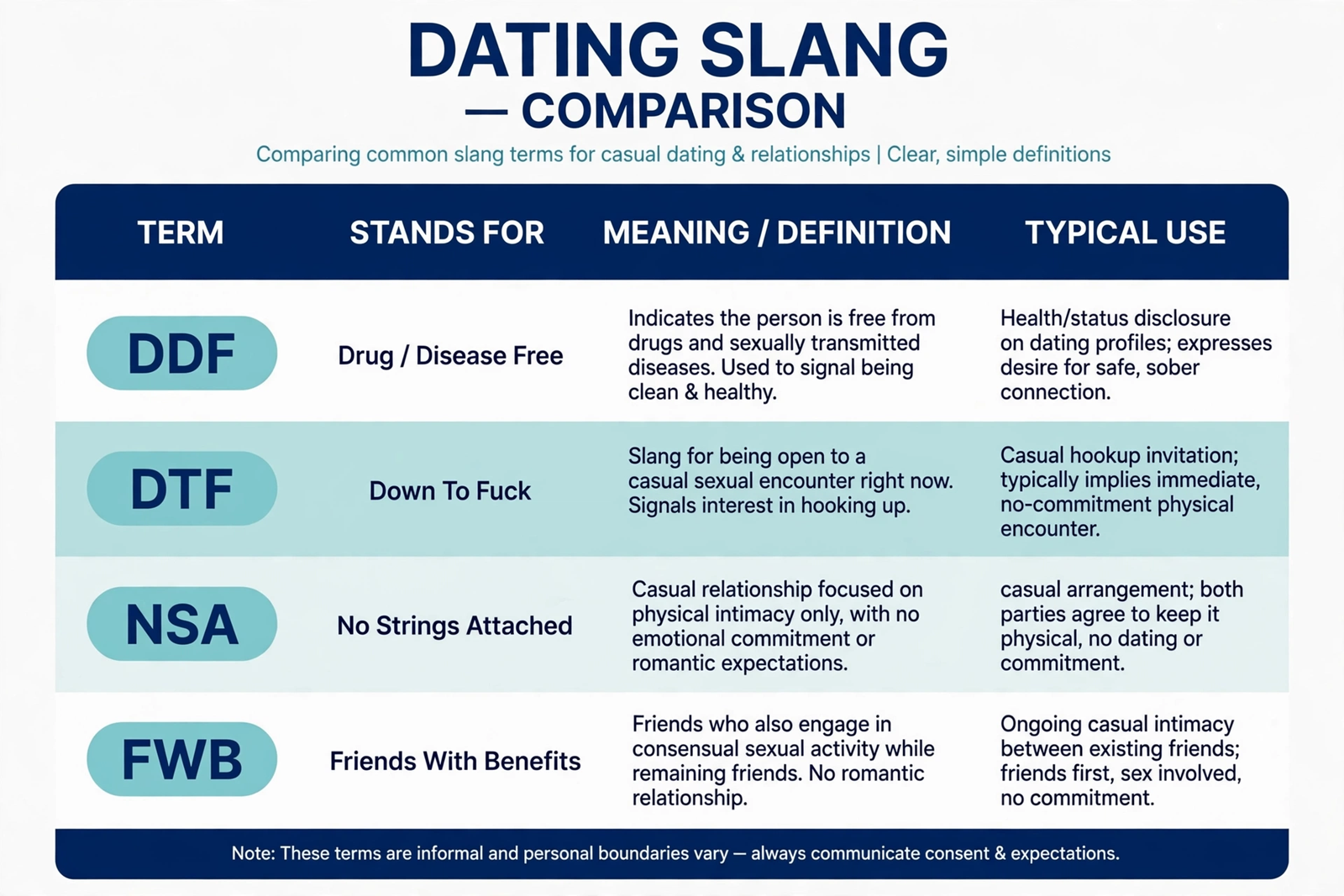
DDF is one of several three-letter abbreviations that fill dating profiles. They look alike, but they mean very different things — and mixing them up can cause real misunderstandings.
| Term | Full Form | What It Means | Where You See It |
|---|---|---|---|
| DDF | Drug and disease free | Claims no drug use and no STIs | Dating bios, hookup ads, private chats |
| DTF | Down to f*** | Open to casual sex | Dating bios, hookup ads, flirty texts |
| NSA | No strings attached | Wants fun without commitment | Dating bios, casual-dating ads |
| FWB | Friends with benefits | Friendship plus casual intimacy | Dating bios, chats between friends |
| STD-free / STI-free | Free of sexually transmitted infections | Same health claim as DDF, without the drug part | Health discussions, dating profiles |
| Clean | — | Informal word for drug-free and STI-free | Profiles, chats, everyday speech |
The most important distinction is between DDF and DTF. They share two letters and a dating-app habitat, but they answer different questions: DDF is about health status, while DTF is about willingness. A person can be DDF and not DTF, or DTF and not DDF — the two claims are independent, and assuming one implies the other is a common mistake.
NSA is different again: it describes the kind of relationship someone wants (casual, no commitment), not their health. You will often see DDF and NSA in the same profile — “NSA, must be DDF” — because the writer wants a casual arrangement with a partner who claims to be healthy.
“Clean” is the word most people reach for in everyday speech, but it is vague and it carries stigma: it implies that people with an STI are somehow “dirty,” which is unfair and untrue. Health educators increasingly recommend saying “STI-free” or “tested recently” instead. DDF avoids the word “clean,” but it has its own limits — it is still only a claim, not proof.
Alternate Meanings
Outside dating slang, DDF has a few other meanings. They are uncommon in everyday conversation, but worth knowing so you do not misread the term:
- Drug and disease free — the slang meaning covered in this article, and by far the most common use online.
- Dubai Duty Free — the airport retailer in Dubai, often shortened to DDF in travel and shopping contexts. If someone writes “Picked up perfume at DDF,” they mean the shop, not their health status.
- Digital distribution frame — a piece of telecoms equipment used in telephone exchanges. You will only meet this meaning in engineering documents.
- Defined daily dose — a measurement used in medicine and pharmacy to compare drug usage. Again, a technical meaning, not a slang one.
- Document description format — an older computing term related to file structures.
In practice, context removes all doubt. On a dating app, DDF always means “drug and disease free.” In a travel blog, it probably means Dubai Duty Free. If the sentence is about a person’s health or dating life, the slang meaning is the right one.
Professional or Polite Alternatives
DDF is blunt, and bluntness is not always what a conversation needs. Here are more polished ways to say the same thing, depending on the situation:
- “I’m drug-free and I get tested regularly.” — Clear, honest, and free of jargon. Works in any serious conversation about health.
- “I was tested recently and everything came back negative.” — Stronger than DDF, because it points to an actual test and a date instead of a vague claim.
- “I don’t use recreational drugs.” — Covers the drug half of DDF on its own, useful when the conversation is about lifestyle rather than sexual health.
- “I take sexual health seriously and I’m happy to share my recent results.” — Warm, mature, and reassuring. It signals the same thing as DDF while sounding like a responsible adult rather than a classified ad.
- “Let’s both get tested before we meet.” — Turns a one-sided claim into a shared plan, which is fairer and safer for everyone.
If you are writing a dating profile and want to signal the same idea more gently, try: “Health-conscious, non-smoker, tested regularly.” It says much of what DDF says, in language that feels personal rather than clinical. And if you are asking someone else, “Would you be comfortable sharing a recent test result?” is far kinder than “Are you DDF?” — and far more likely to get an honest answer.
Common Mistakes
Because DDF touches on health and trust, mistakes with it can have real consequences. These are the ones people make most often:
- Treating DDF as proof. The biggest mistake is believing that three letters equal a clean bill of health. DDF is a self-reported claim. Some people have never been tested; others were tested long ago. If health matters to you, ask for a recent test result instead of accepting an abbreviation.
- Confusing DDF with DTF. As the comparison table shows, these two terms answer different questions. Replying to “Are you DDF?” as if someone asked whether you are “down to” something can lead to an awkward — or unsafe — misunderstanding.
- Asking too early. Opening a conversation with “Are you DDF?” before even saying hello comes across as rude and transactional. Let a little rapport build first, and save health questions for the point where meeting in person becomes real.
- Using DDF as a profile with no other information. A bio that only says “DDF” tells a match nothing about who you are. Pair the health claim with real details — interests, humour, what you are looking for — or people will swipe past.
- Assuming DDF means “safe.” Even an honest DDF claim has limits. Some infections have window periods where tests do not detect them, and “drug free” means different things to different people (does it include alcohol? cannabis where it is legal?). Safe practices matter regardless of what a profile says.
- Using “clean” as a synonym. Calling yourself “clean” instead of DDF implies people with STIs are dirty. The language of sexual health has moved on, and “tested recently” or “STI-free” is kinder and more accurate.
- Sharing someone else’s status. If a match tells you they are DDF — or tells you anything about their health — that information is private. Never screenshot it, share it in a group chat, or gossip about it.
For a fuller picture of how the community defines the term, you can read the crowd-sourced entries for DDF on Urban Dictionary, where real users have posted their own definitions and examples over the years.

Quick Tips
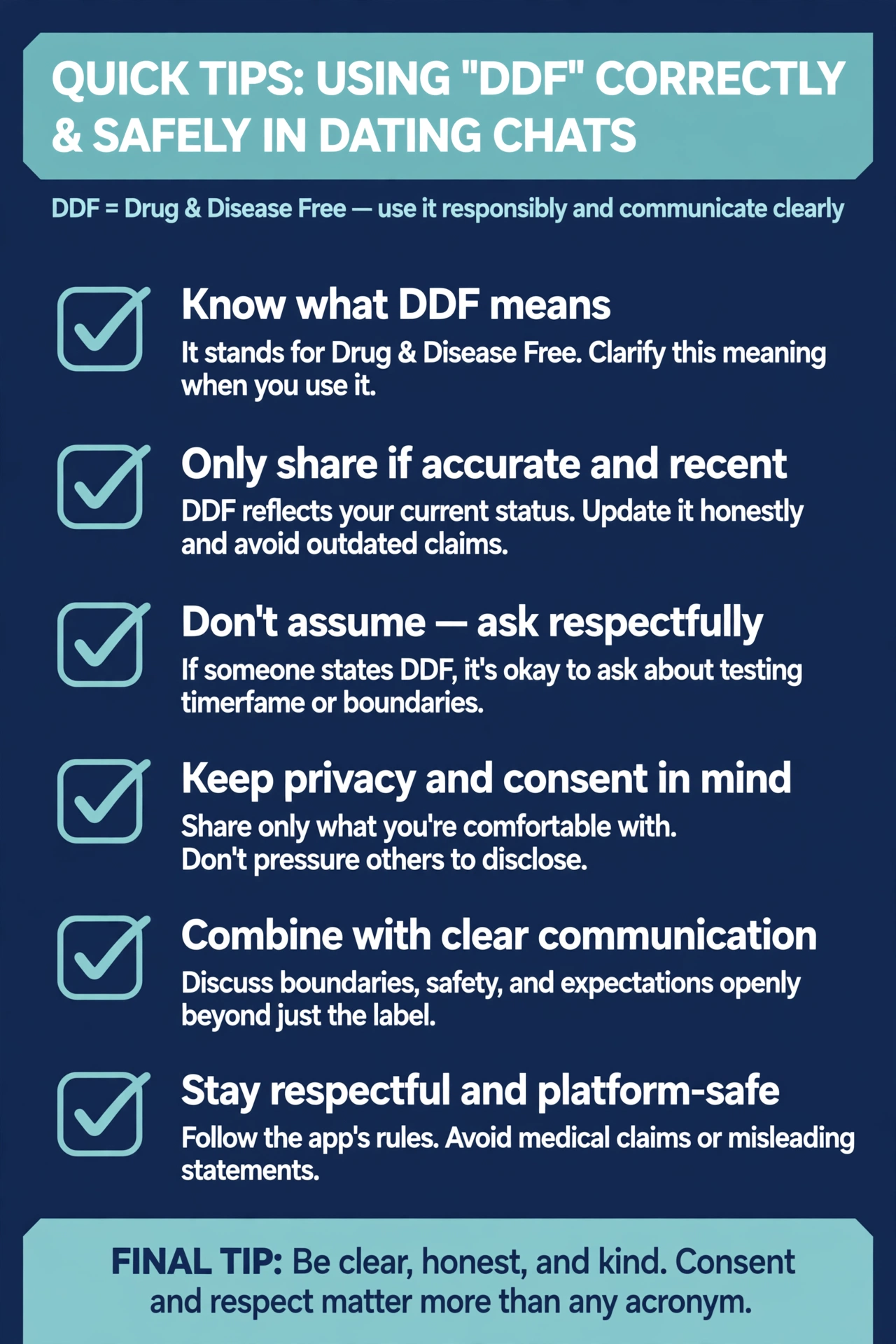
- Pair the claim with a date. “DDF, tested in October” is far more credible than “DDF” on its own. A recent test date turns a claim into useful information.
- Ask kindly, not bluntly. “Would you be comfortable sharing a recent result?” gets a better response than “Are you DDF?” — and it shows respect.
- Keep it in the right place. DDF belongs in adult dating profiles and private chats, not in work messages, family groups, or public posts.
- Do not rely on it alone. Whatever a profile says, use protection and get tested regularly. An abbreviation is not a safety plan.
- Match the tone of the conversation. If the other person is chatting casually, keep health talk brief and matter-of-fact. Heavy or graphic detail too early can end a conversation before it starts.
- Update your profile honestly. If your status changes, update your bio. An outdated DDF claim is worse than no claim at all.
- Learn the neighbours. Knowing terms like DTF, NSA, and ASL will help you read dating profiles quickly and avoid embarrassing mix-ups.

FAQ
What does DDF mean in slang?
In slang, DDF means “drug and disease free.” It is used in dating profiles and chats to claim that a person does not use recreational drugs and does not have a sexually transmitted infection. It is a self-reported claim, not a medical certificate.
What does DDF mean on Grindr?
On Grindr and similar dating apps, DDF in a profile means the user claims to be drug and disease free. It is often listed alongside other shorthand, such as age and location, and sometimes appears as a requirement: “must be DDF.”
What does DDF mean in texting?
In texting, DDF almost always appears in a dating or hookup context. “Are you DDF?” is a direct question about drug use and STI status, usually asked before two people decide to meet in person.
Is DDF the same as DTF?
No. DDF means “drug and disease free” and describes health status, while DTF means “down to f***” and describes willingness to have casual sex. They are independent claims — a person can be one, both, or neither.
Can I trust someone who says they are DDF?
DDF is a claim, not proof. A trustworthy answer usually comes with a detail, such as a recent test date or a willingness to share results. If health is important to you, ask for a recent test result and use protection regardless of what a profile says.
What does DDF mean on Tinder?
On Tinder, DDF has the same meaning as everywhere else: “drug and disease free.” It appears in bios as a self-description or a requirement for matches, and it is most common in profiles open to casual dating.
Is it rude to ask someone if they are DDF?
It depends on timing. Asked after a few friendly messages, when meeting in person is on the table, it is a reasonable health question. Asked as an opening line to a stranger, it usually feels blunt and rude. A softer version — “Would you be comfortable sharing a recent test result?” — almost always lands better.
What are polite alternatives to DDF?
Instead of DDF, you can say “I’m drug-free and I get tested regularly,” or “I was tested recently and everything came back negative.” Both say the same thing in plain, respectful language, and the second is stronger because it points to an actual test.
Conclusion
The ddf meaning slang is short, specific, and practical: DDF stands for “drug and disease free,” a three-letter claim people use in dating profiles and private chats to say they do not use drugs and believe they are free of sexually transmitted infections. It grew out of newspaper personal ads, survived the move to forums and dating apps, and remains common today because no shorter way of saying the same thing exists.
But the abbreviation is only as good as the honesty behind it. DDF is a claim, not a certificate. The people who use it well pair it with a recent test date, ask about it kindly rather than bluntly, and never treat it as a substitute for protection or regular testing. The people who misuse it either confuse it with lookalike terms such as DTF, ask it too early, or trust it too completely.
If you take one thing from this guide, let it be this: understand what DDF promises, respect what it cannot prove, and talk about health in plain, kind language whenever you can. Three letters can open a conversation — but honesty, recent testing, and respect are what actually keep people safe. Next time you see DDF in a profile or a message, you will know exactly what it means, when it is appropriate, and how to respond with confidence.
