
Quick Definition: In slang, lush is a flexible compliment and description. The lush meaning slang most people search for is “attractive, amazing, or gorgeous” — especially in British slang — but the same word can also mean a heavy drinker, something luxurious and rich, or simply something excellent. Which meaning applies depends entirely on context, so this guide breaks down every sense of lush, where it came from, and how to use it without sounding confused.
Lush Meaning Slang: Meaning & Definition
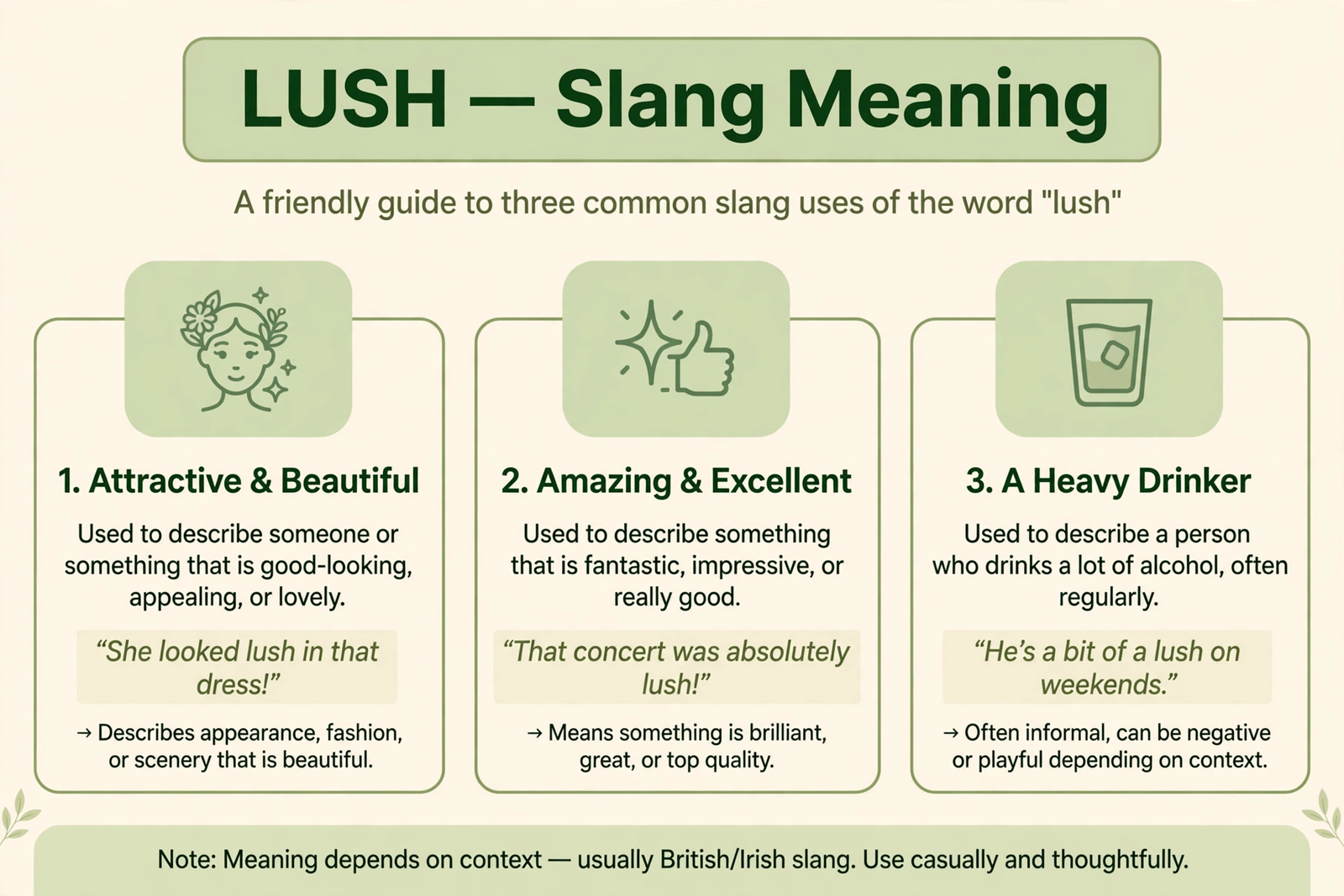
The lush meaning slang in everyday conversation is: something or someone beautiful, impressive, or delightful. If a friend in London texts “that dress is lush,” she means the dress looks gorgeous. If someone says “your voice is lush,” they mean it sounds wonderful. In this sense, lush works like “gorgeous,” “stunning,” or “amazing” — a warm, enthusiastic compliment.
But lush is one of those rare slang words that carries several very different meanings at once. As a noun, a “lush” is someone who drinks too much alcohol — a usage that dates back centuries and is still common in American English. As an adjective in its older, literal sense, lush describes thick, healthy vegetation or something rich and luxurious, like a lush garden or lush velvet curtains.
So how do you know which meaning someone intends? Context is everything. “She’s lush” at a party in Cardiff almost certainly means she looks beautiful. “He’s a bit of a lush” at a bar in Chicago almost certainly means he drinks too much. And “a lush green valley” is not slang at all — it is the original dictionary meaning. The rest of this guide unpacks each meaning with real examples so you never mix them up.
Here is the short version of every meaning covered in this article:
- Attractive or sexy (UK slang): “He looks lush in that photo.” — the most common slang meaning today.
- Amazing or excellent (UK slang): “That cake was lush!” — praise for food, music, or experiences.
- A heavy drinker (noun, US/UK): “Don’t be such a lush.” — informal, mildly insulting.
- Drunk (adjective, older slang): “He came home lush again.” — dated but still understood.
- Luxurious or rich (standard English): “a lush hotel suite” — the formal, non-slang sense.
- Thick and healthy (vegetation): “lush green fields” — the original literal meaning.
- Alcohol itself (old slang noun): “Pass the lush.” — 18th-century usage, now rare.
Introduction
Imagine scrolling through TikTok and reading the comment “omg he’s so lush” under a video of a singer. Then imagine your grandmother saying “the garden looks lush after the rain.” Then imagine a character in an old movie muttering “that guy’s a lush.” Three sentences, one word — and three completely different meanings.
That is what makes lush such a fun word to learn. It has been in English for over 600 years, and it has picked up new jobs in every century: a description of soft, healthy plants; a word for strong drink; a label for a drunkard; and finally, in modern British slang, a compliment for anything beautiful or brilliant. Few slang words have travelled so far.
Today, the word is having a moment. British TikTok, Love Island clips, and Welsh Twitter keep “lush” in daily circulation, while American speakers mostly know the drinking sense. If you have ever wondered whether someone calling you “lush” is flirting, insulting you, or talking about your garden, this guide settles it. You will learn the origin story, the popularity timeline, real examples in friendly, professional, and funny contexts, a comparison with similar slang, the mistakes to avoid, and answers to the eight questions people ask most about the lush meaning slang.
For more modern internet vocabulary, our Gen Z slang 2024 guide explains the words that defined the year — many of them work exactly like lush, packing a whole attitude into a single syllable.
Origin
The story of lush starts in the 1400s, when it meant soft, tender, or succulent — probably from the Old French lache, meaning loose or lax. Early writers used it for food and plants: lush fruit was juicy, lush grass was thick and healthy. That literal sense survives today in phrases like “lush vegetation” and “lush green hills.”
The drinking connection arrived in the late 1700s. Slang dictionaries of the era record “lush” as a word for strong beer or liquor, and by the early 1800s it had become a verb meaning to drink heavily. From there it was a short step to the noun: a “lush” was a person who drank too much. The Wiktionary entry for lush traces these senses through centuries of citations, from 18th-century ballads to 20th-century American crime novels.
The compliment sense — lush as “beautiful” or “excellent” — is a British development. It grew naturally out of the luxurious meaning: if lush velvet is rich and pleasing, then a lush person is rich in appeal. WordReference notes that the slang sense became very popular in the 1960s, especially among schoolchildren, faded, revived in the 1980s, faded again, and then surged around the turn of the 21st century, especially in southern England and Wales. Reality TV and social media gave it its latest boost: on Love Island and British TikTok, “lush” is now a standard compliment, used constantly and without a second thought.
That timeline explains the transatlantic split. In the UK, lush is overwhelmingly positive slang. In the US, the drinking sense still dominates, and the compliment sense is less familiar — which is exactly why Americans searching the lush meaning slang often feel confused. Both meanings are correct; they just belong to different places and different centuries.
Popularity
Lush is not a flash-in-the-pan TikTok invention. It is a slow-burn word that keeps coming back, and each revival makes it stronger. Here is why it stays popular:
British reality TV keeps it on screen. Shows like Love Island made “lush” a nightly word for millions of viewers. Contestants describe each other, dates, and outfits as lush so often that international audiences picked it up too. When a word appears on a hit show every week, it stops being regional and becomes global.
It is short, soft, and positive. Slang that survives tends to be easy to say and pleasant to hear. “Lush” is one syllable, sounds warm, and carries no aggression. Compare it with harsher slang terms — lush feels friendly, which makes it safe to use with friends, family, and even strangers.
It fills a gap. English has plenty of words for attractive — beautiful, gorgeous, hot — but lush adds a specific flavour: it suggests richness and indulgence, not just looks. A “lush voice” is not just a nice voice; it is a voice you could listen to all day. That extra shade of meaning keeps people reaching for it.
Social media rewards it. On TikTok and Instagram, comments need to be quick and expressive. “Lush!” does in one word what a sentence would take longer to say. Welsh creators in particular use it constantly, and their videos travel far beyond Wales, spreading the term to American and Australian audiences who then adopt it themselves.
Search interest reflects this staying power. Unlike viral slang that spikes for a month and vanishes, lush draws steady searches year after year — from people decoding British texts, from language learners, and from Americans who heard it on a show and want to know if it is a compliment or an insult. (It is almost always a compliment.)
How It Is Used
Lush is flexible, but it follows a few clear patterns. Here is how people actually use it in real life:
As a compliment for people. “You’re looking lush tonight.” “He’s a lush bloke.” This is the most common slang use in the UK, and it means attractive, charming, or appealing. It works for men and women, and it is warmer and less blunt than “hot.”
As praise for things. Food, music, clothes, places, weather — almost anything enjoyable can be lush. “That curry was lush.” “The sunset was lush.” “This song is lush.” In this sense it means excellent, delightful, or just really, really good.
As a standalone reaction. Like “wow” or “gorgeous,” lush can stand alone. Someone shows you a photo, and you reply “Lush!” — everyone understands. This one-word use is especially common in texts and comments.
As a noun for a drinker. “He’s turned into a bit of a lush since he moved to the city.” This is the older American sense, and it is mildly insulting — closer to “boozehound” than to a neutral description. Use it carefully; calling someone a lush to their face can start an argument.
In fixed phrases. “Lush life” (a luxurious lifestyle), “lush greenery” (thick plants), and “lush lips” (full, attractive lips) all borrow the word’s sense of richness. These phrases show how the literal and slang meanings blend into each other.
Tone matters more than grammar with lush. Said warmly, it is a compliment. Said with an eye-roll, “lush” can turn sarcastic — “oh, lush, another rainy day” — the same way “great” can mean the opposite of great. Always read the tone, not just the word.
Examples
Real examples make the difference between knowing a definition and actually understanding a word. Here are examples of lush in friendly, professional, and funny contexts — with the meaning explained each time.
Friendly Examples
- “Your new haircut is lush, honestly.” — A warm compliment between friends. Meaning: it looks great.
- “That picnic was lush — we should do it again next weekend.” — Praise for a lovely experience, not just a person.
- “She’s lush, isn’t she? So funny and kind.” — Describing someone’s whole appeal, looks and personality together.
- “Mate, this burger is lush.” — Food praise. In British slang, food is one of the most common things called lush.
- “Thanks for the playlist, it’s lush.” — A casual thank-you that doubles as a compliment.
Professional Examples
- “The venue has a lush garden setting for the reception.” — Here lush means luxurious and green; the formal, non-slang sense is the right choice at work.
- “The hotel’s lush interiors impressed every client who visited.” — Professional copy uses lush to suggest richness and comfort.
- “Her voice has a lush, warm quality that suits narration work.” — A professional compliment: rich and pleasant-sounding.
- “We went with a lush visual style for the campaign — deep colours, soft textures.” — Creative industries use lush to describe rich, appealing design.
Avoid the slang sense in formal writing. Telling your manager “your presentation was lush” might land fine in a casual Cardiff office, but in most workplaces “excellent” or “impressive” is safer.
Funny Examples
- “My bank account is many things, but lush is not one of them.” — Joking that money is the opposite of luxurious.
- “I woke up looking lush… said no one ever on a Monday.” — Self-deprecating humour about morning hair.
- “He called himself a lush after two glasses of wine. Two. Glasses.” — Teasing someone who exaggerates their drinking.
- “The weather in Wales is lush — if you think horizontal rain is lush.” — Sarcastic lush, meaning the exact opposite.
- “My cooking is lush. My smoke alarm disagrees.” — A classic self-own: the food praise undercut by the punchline.
| Situation | What “lush” means | Example |
|---|---|---|
| Complimenting a person | Attractive, appealing | “You look lush tonight.” |
| Praising food | Delicious, excellent | “This cake is lush.” |
| Describing nature | Thick, healthy, green | “Lush green valleys.” |
| Talking about drinking | A heavy drinker | “He’s a bit of a lush.” |
| Describing luxury | Rich, opulent | “A lush hotel suite.” |
| Reacting to music | Beautiful, moving | “That song is lush.” |

Comparison with Similar Terms
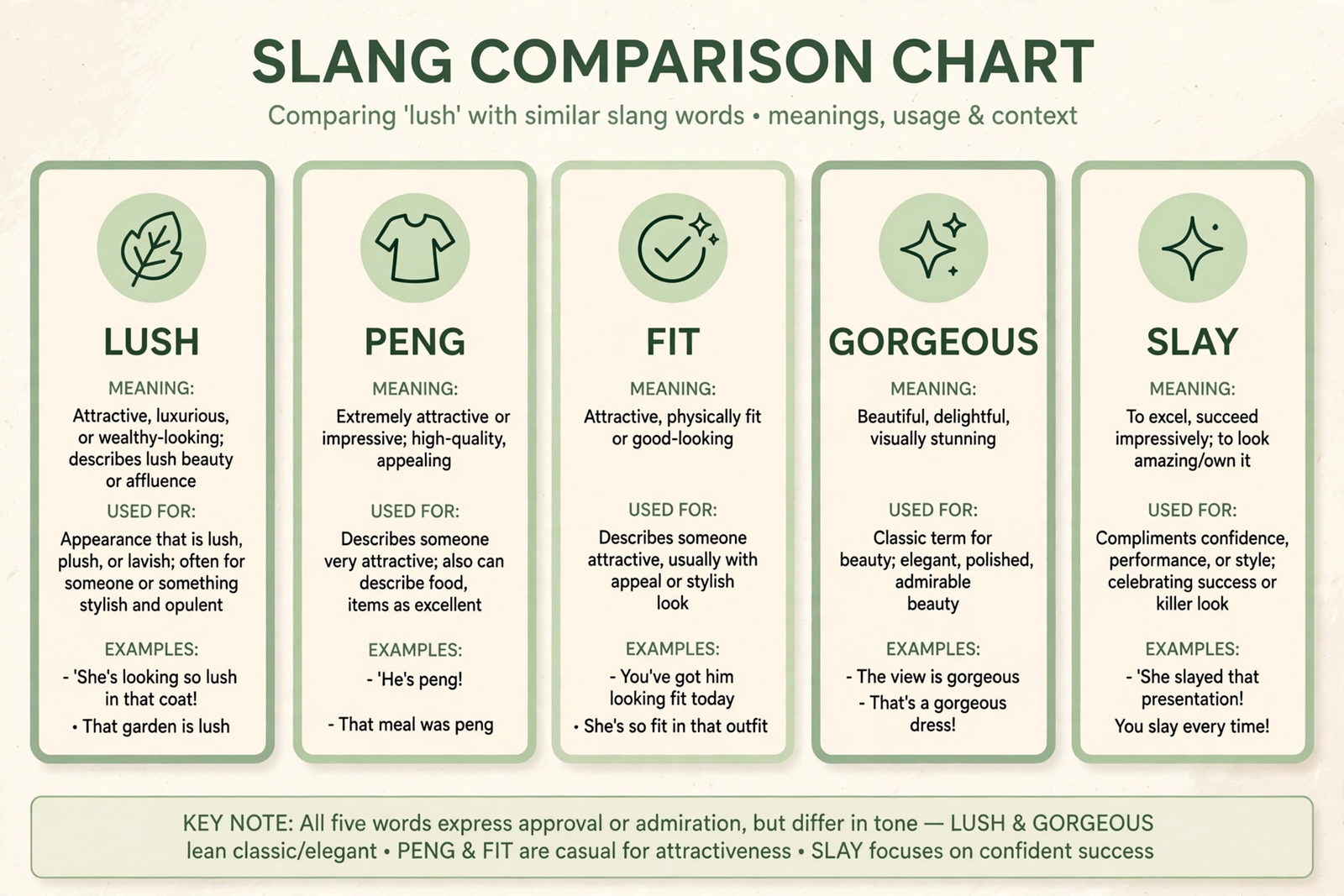
Lush overlaps with several other slang words, but each one carries a slightly different flavour. Knowing the differences keeps you from using the wrong word in the wrong moment.
| Term | Meaning | How it differs from lush |
|---|---|---|
| Lush | Beautiful, excellent, luxurious | Warm and rich; suggests indulgence and softness |
| Peng | Very attractive (UK slang) | More direct about looks; less about overall vibe |
| Fit | Attractive (UK slang) | Shorter, blunter; purely about appearance |
| Buff | Attractive, well-built | Implies physical fitness; lush never does |
| Gorgeous | Very beautiful | Standard English; lush is more casual and playful |
| Bussin | Really good, especially food | Gen Z energy; lush is softer and more British |
| Slay | To look or perform amazingly | Bold and confident; lush is gentle and warm |
| Stunning | Extremely impressive | Stronger and more formal; lush feels cosier |
The closest cousins are “peng” and “fit,” both British slang for attractive — but neither one works for food, music, or a sunset the way lush does. That versatility is lush’s superpower: it is the only compliment in the list that comfortably covers a person, a meal, a song, and a garden. If you want a deeper dive into bold, confident slang, our slay meaning slang guide explains a word with the opposite energy — loud where lush is soft. And if you like playful British compliments, zesty meaning slang covers another term that, like lush, can describe both people and vibes.
One more distinction matters: lush is almost never used as an insult for appearance. Words like “peng” or “fit” can sound objectifying if used carelessly, but lush tends to stay affectionate. That makes it one of the safest slang compliments you can use — as long as you are in the UK sense, not the drinker sense.
Alternate Meanings
Beyond the main slang senses, lush has several alternate meanings worth knowing — especially because they show up in books, films, and older texts.
1. A drunkard (noun). The oldest slang meaning and still the main one in American English. “He’s a lush” means he drinks too much, too often. It is informal and mildly derogatory, similar to “boozehound” or “alky.” You will hear it in classic films and crime novels far more than in modern British conversation.
2. Liquor (noun, obsolete). In 18th- and 19th-century slang, lush itself meant alcohol. “Get on the lush” meant to go on a drinking spree. This sense is extinct in everyday speech but appears in historical fiction and slang dictionaries.
3. Drunk (adjective, dated). “He came home lush” once meant he came home drunk. Modern speakers rarely use it this way, but you may still read it in older books.
4. Luxurious (adjective, standard). “Lush fabrics,” “lush orchestration,” “a lush lifestyle” — the formal sense of richness and abundance. This is the bridge between the plant meaning and the compliment meaning.
5. Sexually attractive (UK slang, specific). In Wales and south-west England especially, lush can carry a flirtier edge than the general “beautiful” sense — closer to “sexy.” Context and tone tell you whether someone means “lovely” or something more suggestive.
6. A talkative person (Hawaiian Pidgin). A rare regional sense: in Hawaii, a “lush” can mean someone who enjoys talking about themselves. Almost nobody outside Hawaii uses it this way, but it shows how far the word has wandered.
The practical rule: in modern texts and social media, assume the compliment sense first. Only switch to the drinking sense when the conversation is clearly about alcohol.
Professional or Polite Alternatives
Lush is casual slang, so it does not belong in every situation. Here are polite alternatives for each meaning, so you can say the same thing in a job interview, a formal email, or a conversation with someone’s grandparents.
| Instead of “lush” (slang) | Say this (polite/formal) | When to use it |
|---|---|---|
| “You look lush.” | “You look lovely / wonderful.” | Complimenting someone politely |
| “That meal was lush.” | “That meal was delicious / superb.” | Thanking a host or reviewing a restaurant |
| “Her voice is lush.” | “Her voice is rich and beautiful.” | Professional feedback |
| “A lush hotel.” | “A luxurious / elegant hotel.” | Formal writing or business travel |
| “He’s a bit of a lush.” | “He drinks more than he should.” | Discussing someone’s habits kindly |
| “That song is lush.” | “That song is beautiful / moving.” | Formal reviews or conversation |
| “Lush!” (reaction) | “Wonderful!” / “Gorgeous!” | Any formal or mixed-age setting |
The drinking sense deserves special care. Calling someone “a lush” is judgemental even in casual speech, and in a professional or caring context it can sound cruel. If you need to talk about someone’s drinking, plain and kind language — “he’s struggling with drinking” — is always better than slang.
Common Mistakes
Lush is easy to use, but these mistakes trip people up — especially Americans hearing the British sense for the first time.
Mistake 1: Using the wrong meaning for the country. Telling an American friend “you’re lush” as a compliment can confuse them — they may hear the drinker insult. In the US, add context (“you look lush in that dress”) so the compliment is unmistakable.
Mistake 2: Calling someone “a lush” as a joke. The noun form is not a compliment anywhere. “A lush” always means a heavy drinker. Never use it playfully about a friend unless you are certain they will laugh — most people will not.
Mistake 3: Using lush in formal writing. In essays, business emails, and job applications, lush sounds too casual. Save it for texts, social media, and friendly conversation, and use “lovely,” “beautiful,” or “excellent” at work.
Mistake 4: Overusing it. Because lush is so versatile, new fans tend to call everything lush — every meal, every outfit, every song. That drains the word of its warmth. Save it for things that genuinely impress you, and it stays a real compliment.
Mistake 5: Confusing lush with “lust.” They sound similar but mean completely different things. “Lush” is about beauty and richness; “lust” is about strong desire. Mixing them up in a text can create a very awkward misunderstanding.
Mistake 6: Assuming it is only about looks. New learners often think lush only means attractive. But “lush” for a meal, a song, or a day out has nothing to do with appearance — it means excellent. If you only use it for people, you are missing half the word.
Mistake 7: Forgetting the sarcastic tone. Like many positive words, lush can flip ironic. “Oh, lush — rain again” means the opposite. If the tone is flat or the situation is bad, the speaker probably means the reverse.
Quick Tips
- Start with compliments. The safest first use of lush is praising something you genuinely like: “This cake is lush.” Nobody misunderstands food praise.
- Watch the article. “Lush” as an adjective is a compliment; “a lush” as a noun is an insult. That tiny word “a” changes everything.
- Match your audience. With British friends, lush is everyday language. With Americans, add context the first time so they hear the compliment, not the drinker sense.
- Pair it with specifics. “Lush” lands better with a reason: “Your voice is lush — so warm and calm” beats a bare “lush” every time.
- Use it sparingly. One lush per conversation keeps it meaningful. Five in a row makes it background noise.
- Listen before you use it. Notice how native speakers around you use lush — for people, food, music, or places — and copy the pattern that fits your circle.
- Keep it out of formal writing. Resumes, cover letters, and academic essays want “excellent,” “beautiful,” or “luxurious” instead.
- Enjoy the versatility. Few slang words cover people, food, music, nature, and luxury. Lush is a small word with a big range — use that range.
FAQ
What is the lush meaning slang in texting?
In texting, the lush meaning slang is “attractive, amazing, or gorgeous.” If someone texts “you’re lush” or “that pic is lush,” they are complimenting you. In British slang it is a warm, casual way to say something looks great or feels wonderful. Only if the conversation is about drinking does it mean a heavy drinker.
Is lush a compliment or an insult?
Almost always a compliment. As an adjective — “you look lush,” “that cake is lush” — it means beautiful or excellent. The only insulting form is the noun “a lush,” which means a person who drinks too much alcohol. The grammar tells you which one it is: adjective equals compliment, noun equals insult.
What does lush mean in British slang?
In British slang, especially in Wales and southern England, lush means attractive, sexy, or excellent. It is one of the most common casual compliments in the UK: people call friends, outfits, food, music, and even weather lush. It is friendly, warm, and widely used by all ages.
What does lush mean in American slang?
In American slang, lush is mainly a noun meaning a heavy drinker or alcoholic — “he’s a lush” is not a compliment. Americans also know the formal adjective senses (lush greenery, lush fabrics), but the British compliment sense is less familiar in the US, which is why the word can confuse American listeners.
Can you call a guy lush?
Yes. Lush works for men and women equally. “He’s lush” means he looks great, and “he’s a lush bloke” is a common British compliment. It is softer than calling a man “hot” and warmer than “good-looking,” which is why many people prefer it.
Is lush a bad word?
No, lush is not a bad word or a swear word. The adjective form is a polite compliment you can use around anyone. The noun form — “a lush,” meaning a drunkard — is mildly rude, but it is not profanity. You can safely use the compliment sense in casual conversation with friends, family, and colleagues.
What is the difference between lush and gorgeous?
Gorgeous is standard English and purely about beauty, while lush is casual slang that also means excellent, rich, or delightful. You can call a song or a meal lush, but you would not usually call a meal gorgeous. Lush is warmer, more playful, and more versatile — but gorgeous is safer in formal situations.
Where did the word lush come from?
Lush comes from the 1400s, when it meant soft and tender, probably from the Old French “lache” (loose, lax). It described juicy fruit and thick vegetation, then became 18th-century slang for liquor, then a word for a drunkard, and finally a British compliment meaning beautiful or excellent. Its long history is why one word carries so many meanings today.

Conclusion
The lush meaning slang is simple once you know the trick: as an adjective, lush is a compliment — beautiful, excellent, rich, or delightful. As a noun, “a lush” is a heavy drinker. Everything else is context. In Britain, it is everyday praise for people, food, music, and moments. In America, the drinking sense still leads. And in its oldest sense, it still describes the thick green world that gave the word its first job six centuries ago.
The key takeaways are easy to remember. Use lush for things and people you genuinely admire, keep “a lush” out of your vocabulary unless you are talking about drinking, add context when speaking with Americans, and save the formal alternatives for work. Do that, and you will sound natural the first time you use it.
Lush survives because it is warm, short, and useful — a little word that can praise a person, a meal, a song, or a sunset without breaking a sweat. Now that you know all seven of its meanings, you will hear it everywhere: in British TV, in TikTok comments, and maybe in your own group chat. When you do, you will know exactly what it means. And if you want to keep building your slang vocabulary, our delulu meaning guide is a great next stop — another word that, like lush, means something completely different depending on who says it and where.
