
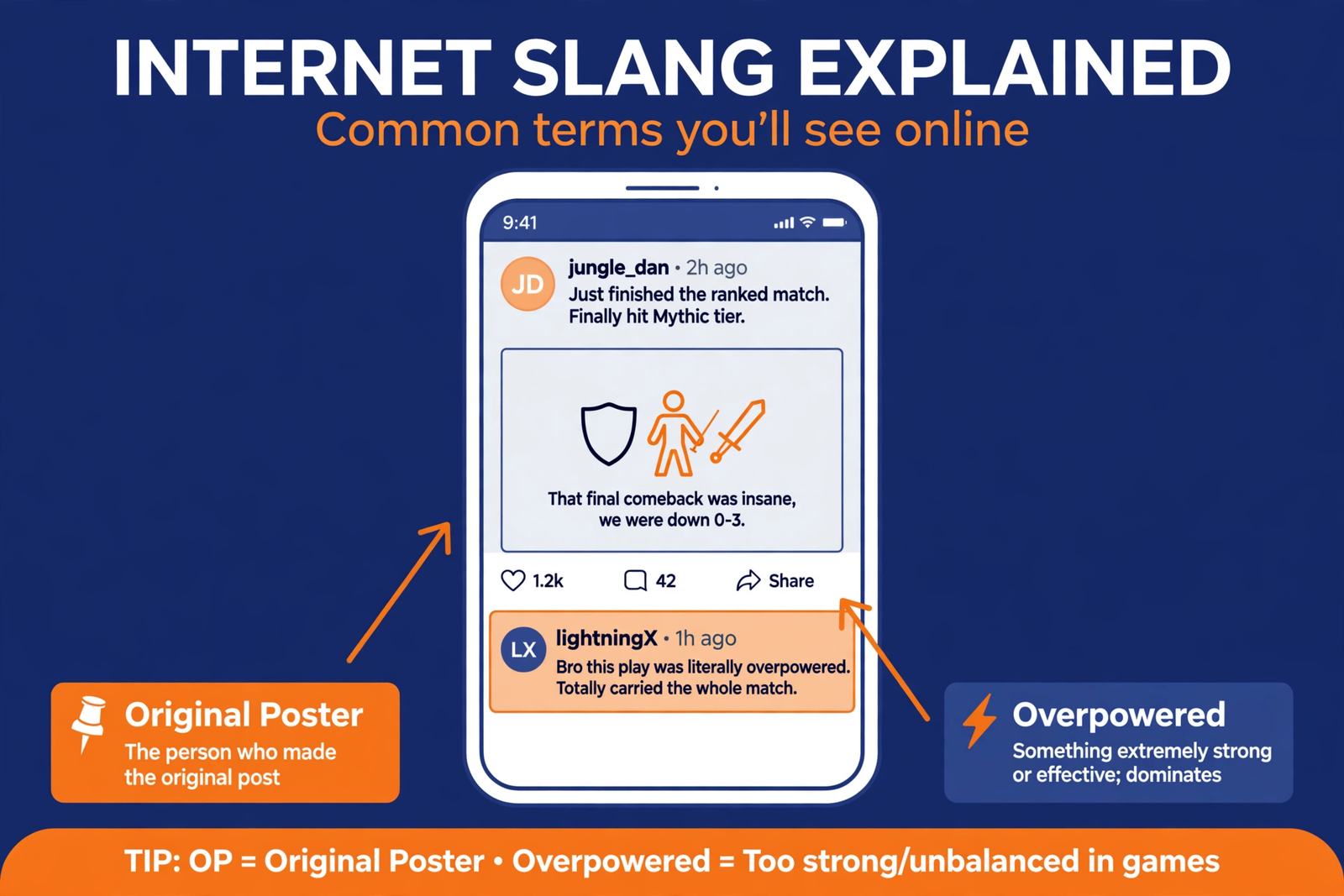
Quick definition: In slang, OP most commonly means “original poster” — the person who started a thread, post, or conversation online — or “overpowered”, used in gaming to describe a character, weapon, or strategy that is unfairly strong. Which meaning applies depends entirely on context: on Reddit and forums it almost always means “original poster,” while in games it almost always means “overpowered.”
OP Slang Meaning & Definition
The op slang meaning is one of the most context-dependent definitions in internet language, because the same two letters carry two completely different meanings. On social media, forums, and comment sections, OP stands for “original poster” — the person who created the thread or post everyone is replying to. In gaming, OP stands for “overpowered” — something so strong it breaks the balance of the game.
Both meanings are correct, and both are used millions of times a day. The trick is reading the room: if someone writes “OP delivered” under a Reddit story, they are talking about the person who posted it. If a gamer writes “that new gun is so OP,” they are complaining that the weapon is too powerful. Once you know the two core meanings, you will almost never be confused again.
There are also a few smaller, niche uses of OP. In K-pop and fandom spaces, it can mean “original photo” or “original picture.” In some online communities it is short for “operator” or “overpowered” in a joking, exaggerated way. But for everyday texting, gaming, and social media, the two main meanings — original poster and overpowered — cover nearly every situation you will meet.
Introduction
You have probably seen “OP” pop up in a comment thread, a group chat, or a heated gaming debate and wondered what it actually stands for. It is only two letters, yet it shows up everywhere: Reddit threads, Discord servers, TikTok comments, Twitter replies, and gaming lobbies. And because it has more than one meaning, guessing wrong can completely change what a sentence says.
Imagine reading “OP is lying” under a viral story. Does that mean the person who posted the story is lying, or that something in the story is too powerful? The answer is obvious once you know the code — but until someone explains it, OP is just another piece of internet alphabet soup. That is exactly why this guide exists.
In this article, we break down the op slang meaning in full: both main definitions, where the term came from, how it is used in gaming versus social media, real examples from chats and comments, and the mistakes people make when they use it. By the end, you will know instantly which OP someone means — and you will be able to use it yourself without sounding out of place. If you enjoy decoding internet slang, you may also like our guide to ill slang meaning, another term that changes meaning with context.
Origin
The term OP as “original poster” was born on internet forums in the early 2000s. On old-school message boards like Something Awful, 4chan, and early Reddit, long threads could run to hundreds of replies, and people needed a quick way to refer to the person who started the discussion. Typing “the person who made this thread” every time was slow, so “OP” became the shorthand. It spread with forum culture and later moved to Reddit, where it is now part of the platform’s everyday vocabulary.
The gaming meaning — “overpowered” — developed separately, in the same era, inside multiplayer gaming communities. As competitive games like World of Warcraft, League of Legends, and Call of Duty grew, players needed a fast way to say that a character, weapon, or ability was too strong compared to everything else. “That character is overpowered” became “that character is OP,” and the abbreviation stuck. Gaming forums, patch-note discussions, and YouTube videos carried it into mainstream gaming language.
Because both meanings grew up on the internet at roughly the same time, they now coexist peacefully. Context does the work of separating them: forums and comment sections default to “original poster,” while games default to “overpowered.” Interestingly, the abbreviation also mirrors older uses — in military and radio language, “OP” has long meant “observation post” or “operator” — but those meanings rarely appear in casual online conversation today.
Popularity
OP is one of the most widely used abbreviations on the English-speaking internet. On Reddit alone, the term appears in millions of comments every year, especially in story-based communities like r/AmItheAsshole, r/relationships, and r/AskReddit, where the original poster is the main character of every discussion. Phrases like “OP delivered,” “OP, you need to leave him,” and “we need an update from OP” are part of Reddit’s basic grammar.
In gaming, OP is equally everywhere. Patch discussions, tier lists, and rage posts all use it: “new character is OP,” “please nerf this OP weapon,” “OP build, try it before it gets patched.” Streamers say it on Twitch, YouTubers put it in video titles, and players type it in chat mid-match. It has become so standard that many gamers use it without thinking, the same way they use GG or LOL.
The term has also crossed into TikTok and Twitter, where short captions and comments reward brevity. A TikTok comment that says “OP ate with this one” means the original poster did a great job. A gaming TikTok that says “most OP loadout in Warzone” means the strongest setup. The abbreviation’s popularity comes from its efficiency: two letters replace a whole phrase, and everyone in the community already knows what it means.
| Platform | Most common OP meaning | Typical example |
|---|---|---|
| Reddit / forums | Original poster | “OP, please update us!” |
| Gaming / Twitch | Overpowered | “This gun is so OP right now.” |
| TikTok / Twitter | Original poster | “OP understood the assignment.” |
| Discord | Either (context decides) | “OP weapon” vs. “ask OP” |
| Group chats | Original poster | “Send this to OP, lol.” |
How It Is Used
As “original poster,” OP is used as a noun to refer to the person who started a post or thread. You will see it in sentences like “OP never replied,” “I agree with OP,” or “OP, what happened next?” It is neutral and respectful — it simply identifies someone without using their username. On Reddit, people also use it as an adjective in phrases like “the OP’s story” or “OP’s update.”
As “overpowered,” OP is used as an adjective to describe something in a game that is too strong. “That hero is OP,” “OP combo,” and “they need to nerf this OP build” are all standard. It can be a complaint, a compliment, or a warning: a complaint when the thing is ruining the game, a compliment when a player is dominating with it, and a warning when friends should try it before the developers weaken it.
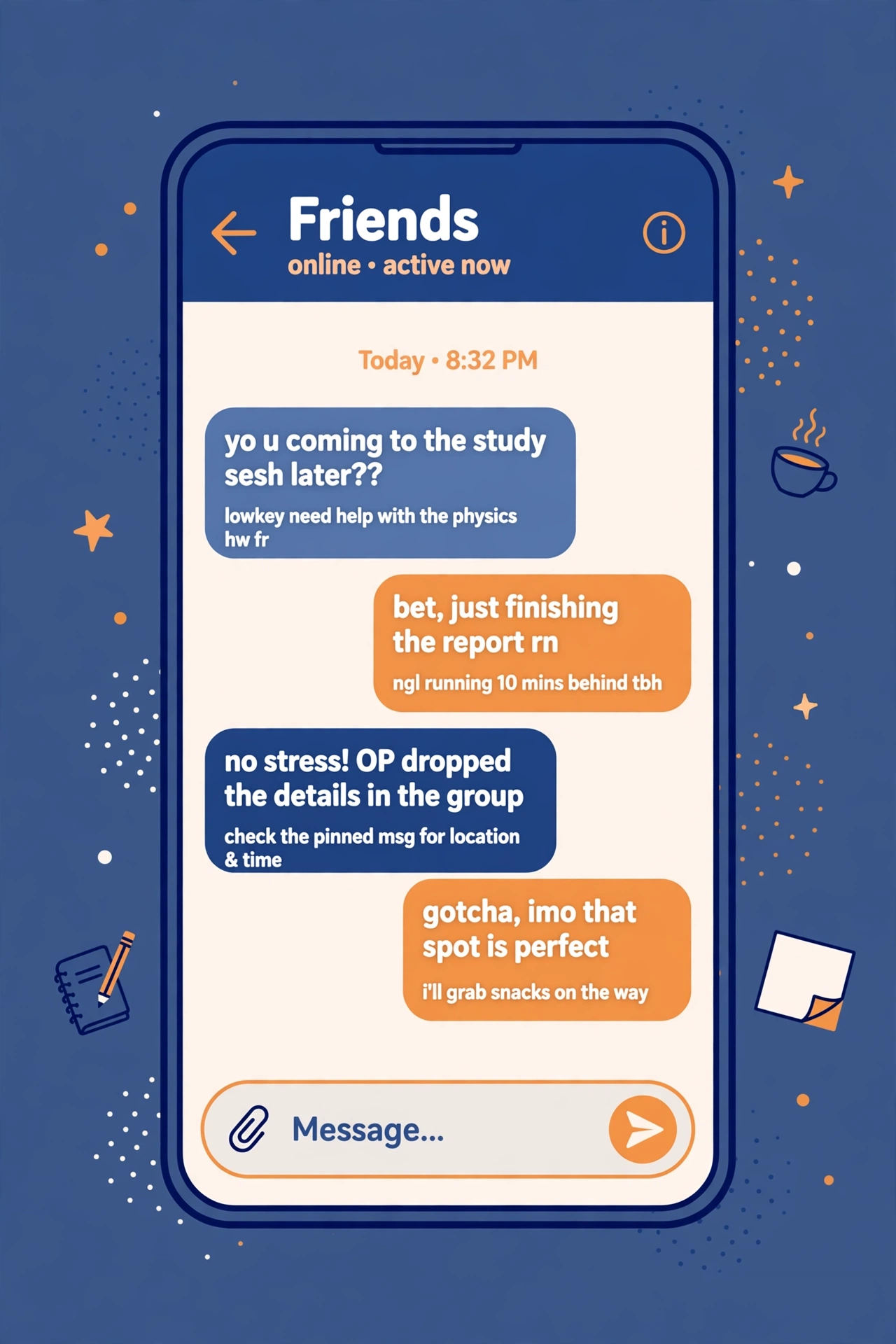
Tone matters. “OP” as original poster is almost always neutral. “OP” as overpowered carries emotion — frustration, excitement, or admiration, depending on who is winning. In text messages, the meaning is usually obvious from the topic: if the conversation is about a post or a story, OP is the poster; if it is about a game, OP is overpowered. When in doubt, look at the sentence around it — the surrounding words will almost always give the answer away.
- On Reddit: “OP” = original poster, used to talk about the person who posted.
- In gaming: “OP” = overpowered, used to describe something too strong.
- On TikTok: “OP” = original poster, usually in praise or reaction comments.
- In Discord: check the channel — gaming channels mean overpowered, general channels mean original poster.
- In texts: “OP” usually means original poster when sharing a screenshot or link.
Examples
The best way to learn OP is to see it in real sentences. Below are examples from friendly chats, professional settings, and funny situations, covering both meanings so you can spot the difference instantly.
Friendly Examples
- “OP’s story was actually so wholesome, I hope they’re doing okay now.” (original poster)
- “Did you see the update? OP finally replied after three months!” (original poster)
- “I agree with OP, that restaurant is overrated.” (original poster)
- “Bro, that new character is so OP, I won five games in a row.” (overpowered)
- “Try this OP loadout before they nerf it next week.” (overpowered)
- “You’re way too OP at this game, teach me your build.” (overpowered)
Professional Examples
- “Per the OP’s original brief, the project scope has not changed.” (original poster — used in work forums)
- “Could the OP clarify the timeline in the comments?” (original poster)
- “The OP raised a valid point about the onboarding process.” (original poster)
- “That strategy is OP in our market right now — competitors can’t match it.” (overpowered, used jokingly in business slang)
Funny Examples
- “OP really said ‘I have a boyfriend’ and then posted her wedding photos.” (original poster)
- “My sleep schedule is OP — I can stay up until 5 a.m. and still function.” (overpowered, joking)
- “That cat is OP, it knocked over three glasses and looked proud.” (overpowered, joking)
- “OP deleted the post after everyone roasted him in the comments.” (original poster)
Notice how the funny examples stretch the gaming meaning into everyday life. Calling your sleep schedule or a cat “OP” is a joke — it borrows the gaming sense of “unfairly powerful” and applies it to something ordinary. This playful crossover is common in internet humor and is a good sign that the term has fully entered everyday slang. For more terms that shift meaning between gaming and everyday chat, check our guide to RS meaning slang.
Comparison with Similar Terms
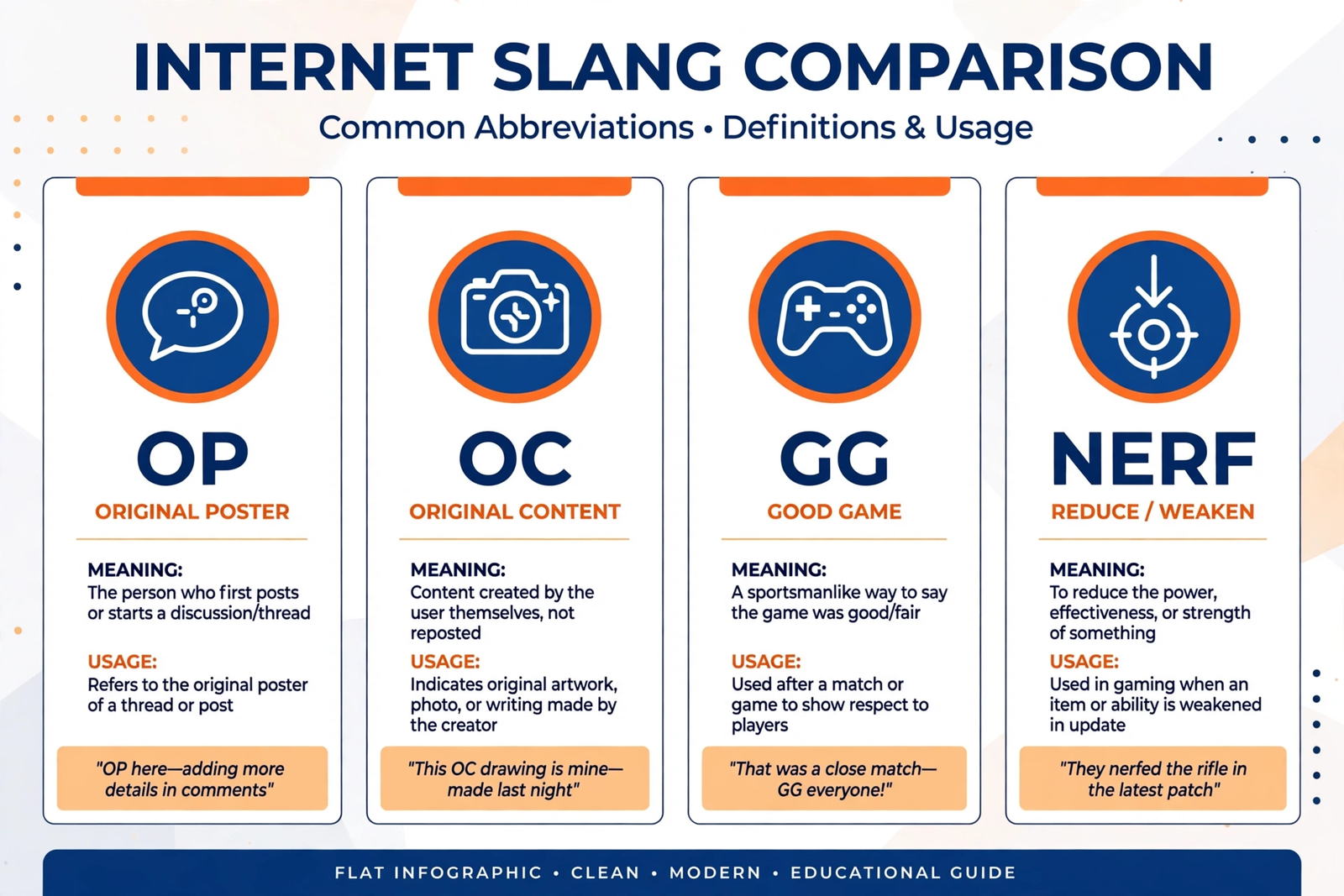
OP is often confused with other internet abbreviations, especially ones that also refer to people or power levels in games. The table below clears up the differences.
| Term | Meaning | How it differs from OP |
|---|---|---|
| OP | Original poster / overpowered | The base term — a person (poster) or a power level (gaming). |
| OC | Original content | Refers to the content itself, not the person who posted it. |
| OT | Off-topic | Marks a comment as unrelated to the thread, not about the poster. |
| GG | Good game | A sportsmanship phrase after a match, not a power description. |
| NERF | To weaken something in a game | The action developers take against OP things — the opposite process. |
| BUFF | To strengthen something in a game | The opposite of a nerf; makes weak things stronger, not OP. |
| NOOB / NEWB | A new or unskilled player | Describes skill level, while OP describes power level. |
| GOAT | Greatest of all time | Praise for a person; OP as overpowered praises (or complains about) a game element. |
The most important distinction is between OP and OC. People sometimes write “great OP” when they mean “great OC,” but the two are different: OP is the person, OC is the content. If someone made an amazing video, the video is OC and the creator is OP. Mixing them up is a small mistake, but regular forum users will notice it.
Another useful comparison is OP versus “nerf.” They are two sides of the same gaming conversation: players call something OP, and then they ask developers to nerf it. If you see both words in the same sentence — “this weapon is OP, it needs a nerf” — you are definitely in a gaming discussion, and OP means overpowered.
Alternate Meanings
Beyond the two main definitions, OP has several smaller meanings that appear in specific communities. Knowing them helps you avoid confusion when the usual definitions do not fit.
- Original photo / original picture: In K-pop, fandom, and photo-sharing spaces, OP can mean the original photo, especially when fans share unedited pictures of idols. Example: “OP (original pic) looks better than the edited version.”
- Operator: In some gaming and military-style communities, OP can be short for “operator,” meaning a playable character or agent. Example: “Which OP do you main in Rainbow Six?”
- Overpowered (joking, real life): People apply the gaming meaning to everyday things for humor — “my coffee is OP today” means the coffee is extremely strong.
- Opening post: A less common forum synonym for the first post in a thread, used interchangeably with “original post.”
- One Piece: In anime communities, OP is sometimes shorthand for the anime “One Piece.” Example: “OP episode 1100 was insane.” Context makes this obvious.
- Out of pocket: Rarely, in some slang circles, people confuse OP with “out of pocket,” but the standard abbreviation for that is OOP, not OP.
If you see OP in a sentence where neither “original poster” nor “overpowered” fits, check the community first. An anime server, a K-pop fan account, and a gaming lobby all use the same two letters differently. The community is usually the best clue.
Professional or Polite Alternatives
OP is casual internet slang, so it does not belong in formal writing, work emails, or professional documents. Here are polite alternatives for each meaning.
Instead of “original poster” (formal):
- “The person who started this thread”
- “The original author of this post”
- “The thread starter”
- “The user who posted this”
Instead of “overpowered” (formal):
- “Excessively strong” or “unbalanced”
- “Disproportionately powerful”
- “Stronger than intended”
- “Needs rebalancing”
In a work chat or a professional gaming discussion, “unbalanced” is the safest replacement for the gaming meaning of OP — it says the same thing without slang. For the forum meaning, simply naming the person (“the author of the post”) is always clear and polite.
Common Mistakes
OP is short and simple, but people still misuse it. These are the most common mistakes to avoid.
- Using OP for the content instead of the person: OP is the poster, not the post. Say “OP’s video was great,” not “that video is such an OP.”
- Mixing up OP and OC: OC means original content. If you made something yourself, it is OC; you are the OP.
- Using the gaming meaning in a forum discussion: Writing “OP is so overpowered” under a Reddit story confuses everyone. Check whether the conversation is about a game before using the gaming meaning.
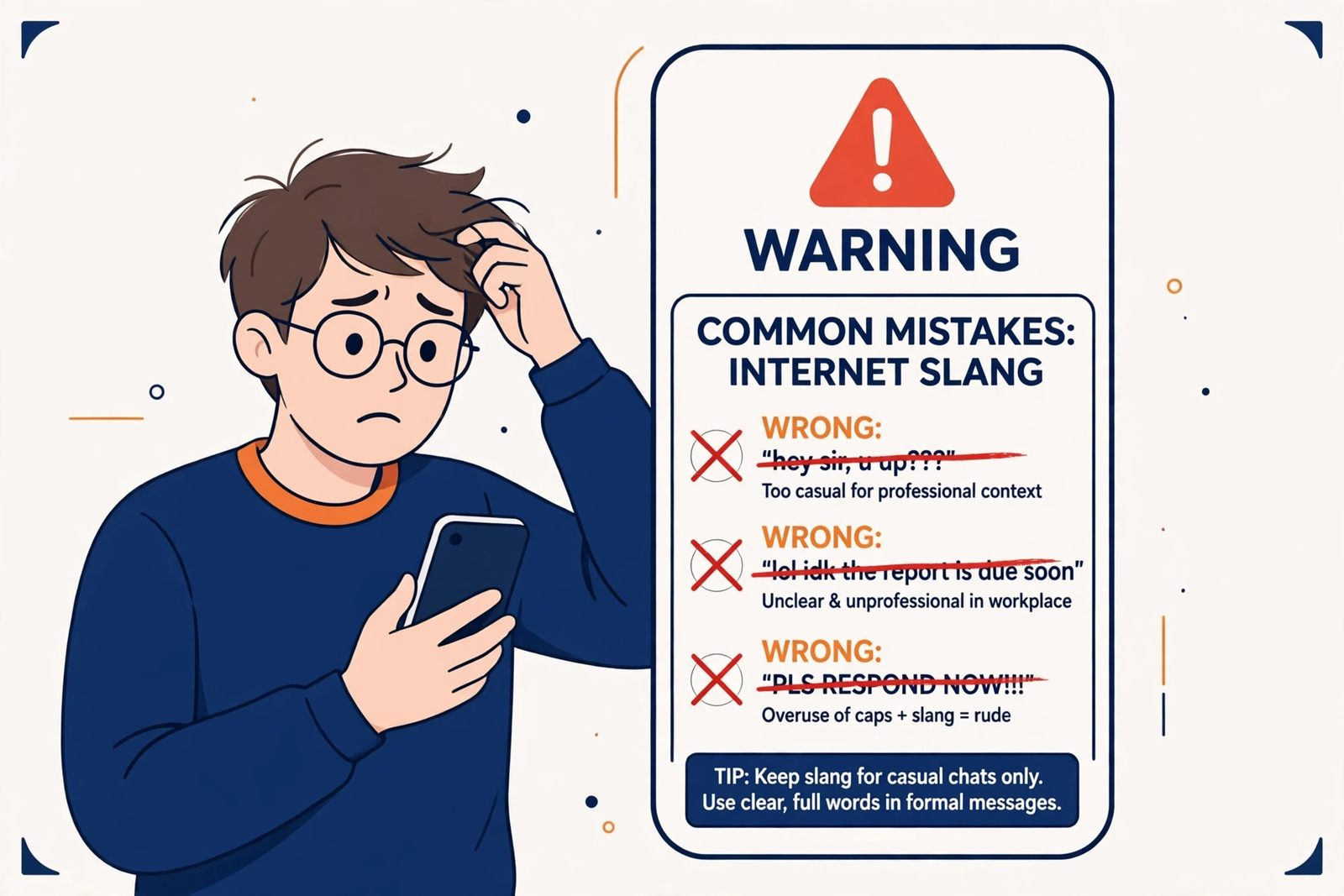
- Using OP in formal writing: It reads as unprofessional in emails, reports, and academic work. Use the full phrase instead.
- Assuming everyone knows it: Older or less online audiences may not know either meaning. In mixed company, write the full phrase the first time, then use OP after that.
- Calling a skilled player OP: OP describes the character, weapon, or strategy — not the player’s skill. A great player with a normal character is not OP; a normal player with a broken character is.
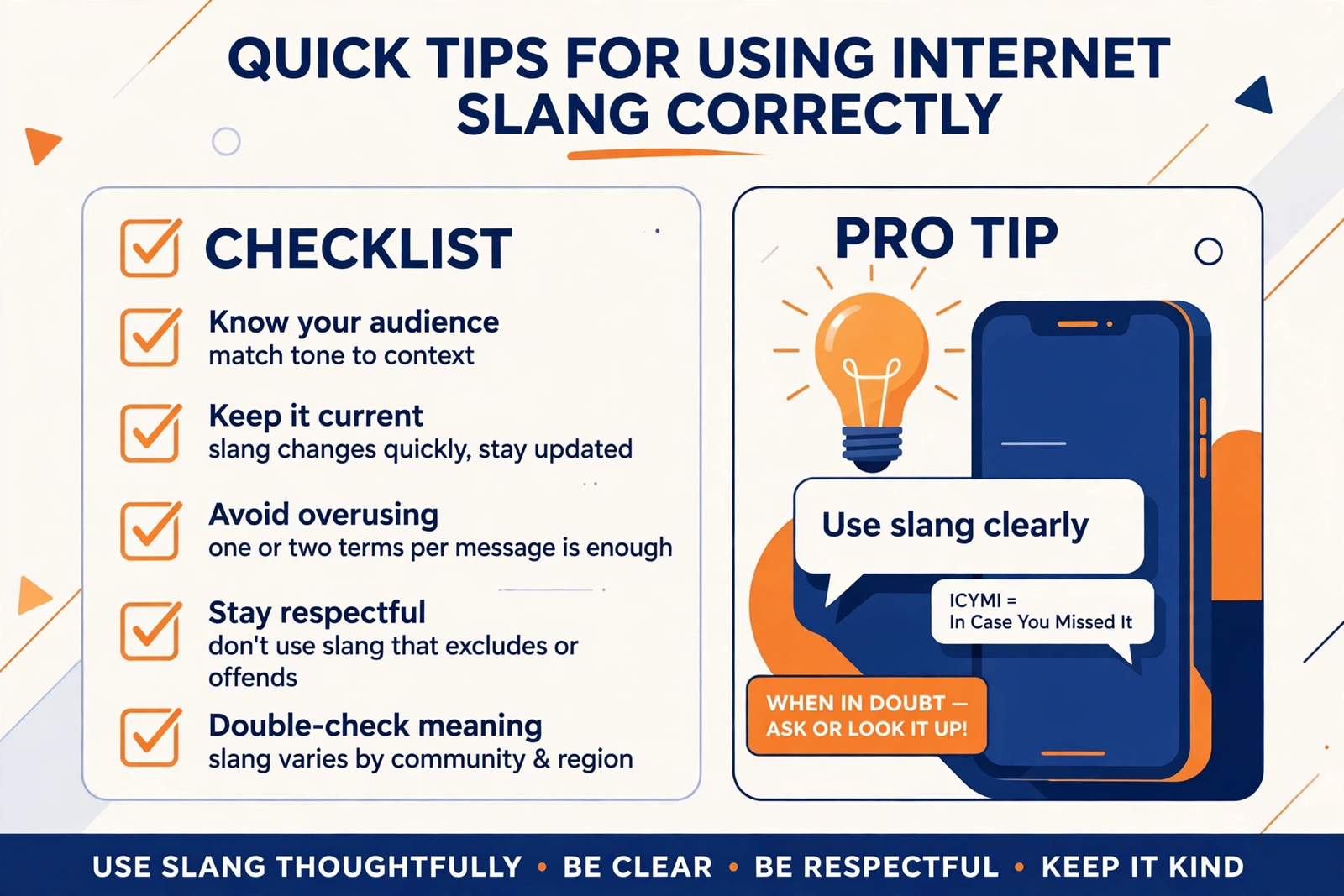
Quick Tips
- Check the platform first: Reddit and TikTok usually mean “original poster”; games usually mean “overpowered.”
- Read the sentence around it: Words like “nerf,” “build,” or “weapon” signal the gaming meaning; words like “update,” “thread,” or “story” signal the poster meaning.
- Use it as a noun for people, an adjective for power: “Ask OP” (noun) versus “that gun is OP” (adjective).
- Do not use it formally: In work or school writing, spell out “original poster” or “overpowered.”
- When in doubt, ask: A quick “do you mean original poster or overpowered?” is better than misunderstanding the whole conversation.
- Pair it with context: Instead of just “OP,” write “OP (the original poster)” the first time in a new conversation.
- Keep it lowercase-friendly: Both “OP” and “op” are used online, but capital “OP” is clearer and more standard.
FAQ
What does OP mean in slang?
In slang, OP means “original poster” on forums and social media — the person who started a post or thread — or “overpowered” in gaming, describing a character, weapon, or strategy that is unfairly strong. Context tells you which one applies.
What does OP mean on Reddit?
On Reddit, OP almost always means “original poster.” It refers to the user who created the post that everyone is commenting on. You will see phrases like “OP delivered” when the poster provides a promised update.
What does OP mean in gaming?
In gaming, OP means “overpowered.” It describes a character, weapon, ability, or strategy that is much stronger than everything else in the game, often to the point of being unfair. Players usually ask developers to “nerf” OP things.
What does OP mean in texting?
In texting, OP usually means “original poster,” especially when someone shares a screenshot or link from social media. For example, “OP deleted the post” means the person who posted it removed it.
What does OP mean on TikTok?
On TikTok, OP means “original poster” — the creator of the video or the person who posted the content being discussed in the comments. Comments like “OP ate” mean the original poster did an excellent job.
Is OP rude or offensive?
No, OP is not rude or offensive. Both meanings are neutral internet shorthand. It is informal, so it is best avoided in formal or professional writing, but it is perfectly polite in casual online conversation.
What is the difference between OP and OC?
OP is the person who posted something (original poster), while OC is the thing they posted (original content). If you create a video yourself, the video is OC and you are the OP.
What does “nerf OP” mean?
“Nerf OP” is gaming slang asking developers to weaken something that is overpowered. A “nerf” reduces the power of a character, weapon, or ability, so “nerf this OP gun” means “make this too-strong gun weaker.”
Conclusion
The op slang meaning comes down to two definitions: original poster and overpowered. On Reddit, TikTok, and forums, OP is the person who started the conversation. In games, OP is the thing that is too strong to be fair. Once you know to check the platform and the words around it, you will almost never mix them up.
Like all internet slang, OP works because it is fast and everyone in the community understands it — but it only works inside that community. Use the full phrase with people who may not know it, keep it out of formal writing, and remember the difference between OP and OC. If you want to keep building your slang vocabulary, our guides to trim meaning slang and hood slang meaning explain more terms that change meaning with context, just like OP does.
Next time you see “OP” in a comment or a game lobby, you will know exactly what it means — and you will be able to use it like a native. For a deeper look at how online slang terms are defined, see Dictionary.com’s slang entry for OP.
