
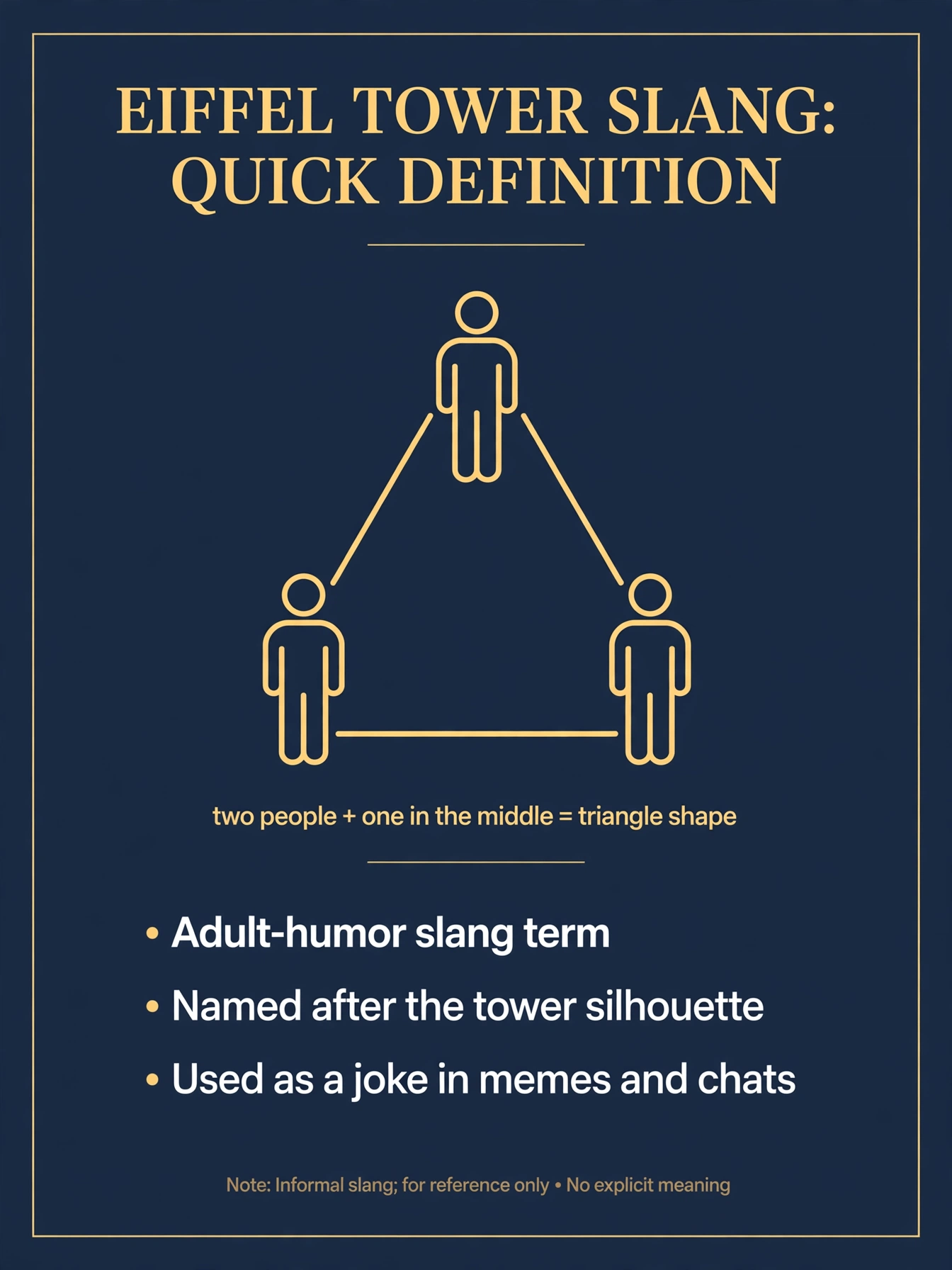
Quick definition: In slang, an “Eiffel Tower” is a cheeky, adult-humor term for a sexual act involving three people — typically two men and one woman — where the two outer participants raise their arms and high-five over the person in the middle, forming a triangle that looks like the silhouette of the Eiffel Tower. It is a joke term from early-2000s pop culture that still pops up in memes, texts, and late-night group chats.
Eiffel Tower Slang Meaning & Definition
Let us get straight to the point, because this is exactly why you are here. When someone says “Eiffel Tower” in slang — not the Paris landmark, not the travel photos on your Instagram feed — they are making a reference to a specific threesome position. The name comes entirely from the shape: the real Eiffel Tower has a wide base that narrows to a single point, and in the slang version, two people stand on either side of a third person in the middle. When the two outer participants lift their arms and high-five (or lock hands) above the middle person, their bodies create a triangle that mirrors the tower’s iconic outline.
Urban Dictionary entries describe it with the site’s usual mix of crude anatomy metaphors and winking humor, and Wiktionary even lists “Eiffel Tower” as a slang verb meaning to perform the act. The term is considered vulgar by most people, so it lives in a very specific lane: jokes between friends, memes, Reddit threads, and raunchy comedy — never in polite conversation.
It is worth knowing the definition even if you would never use the term yourself, because it shows up as a punchline far more often than as a serious proposition. When a meme caption reads “last night was an Eiffel Tower kind of night,” the joke is the absurdity of the mental image, not a factual report. Like much of internet slang, eiffel tower slang is 90% comedy and 10% literal meaning.
Introduction
You are scrolling through TikTok comments, a meme page, or a Discord server when someone drops the phrase “Eiffel Tower” and everyone reacts with a flood of 😂 and 🗼 emojis. You know the Eiffel Tower — the 330-meter iron landmark in Paris, the most-visited paid monument in the world, the backdrop of a million proposal photos. So why is everyone laughing like it is a dirty joke?
Welcome to one of the internet’s favorite bait-and-switch slang terms. “Eiffel Tower slang” takes something wholesome and universally recognized — a romantic French landmark — and turns it into shorthand for something your grandmother definitely should not hear about at Sunday dinner. The humor comes precisely from that contrast: the innocence of the reference versus the very-not-innocent meaning hiding underneath.
This is not a new trick, either. Slang has been hijacking innocent words for adult meanings forever. But few terms do it as efficiently as this one, because the visual pun is instant. Say “Eiffel Tower” to someone who knows, and they immediately picture the triangle. Say it to someone who does not know, and they picture Paris — which makes the eventual explanation even funnier. That double meaning is the engine that has kept this slang alive for over two decades.
In this guide, we will break down the eiffel tower slang meaning completely: where it came from, how it blew up, how people actually use it in texts and on social media, the terms it gets compared to, the mistakes people make with it, and — importantly — what to say instead when you are in polite company. Whether you are here out of curiosity, confusion, or because a friend sent you a meme you did not understand, you will leave with the full picture. For more deep dives into viral internet terms, check out our guides on BFE meaning and zesty meaning in slang.
Origin
Pinpointing the exact birth of “Eiffel Tower” as slang is tricky, because like most dirty jokes, it probably circulated in locker rooms and dorm rooms long before anyone wrote it down. But we can trace its path into mainstream awareness with reasonable confidence.
The earliest documented wave belongs to the early 2000s frat-bro and gross-out comedy era. This was the age of American Pie, shock-jock radio, and the first generation of viral email forwards — a culture that treated crude dares and anatomical jokes as peak entertainment. In that environment, naming a threesome position after a famous triangular landmark was exactly the kind of joke that spread like wildfire. It was visual, it was easy to explain at a party, and it sounded just innocent enough to say in front of people who did not know — which made revealing the meaning a prank in itself.
The term got its biggest mainstream boost from pop culture. It appeared in raunchy comedies and TV dialogue of the 2000s, most notably referenced in films in the Wedding Crashers era of bro-comedy, where characters used it as shorthand for wild, over-the-top party behavior. Each mention on screen sent a fresh wave of curious viewers to Urban Dictionary, where the top-voted definitions cemented the meaning: two guys, one woman, arms raised, triangle formed.
Then came the meme era. As Urban Dictionary became the internet’s slang bible in the 2010s, “Eiffel Tower” settled into its permanent role as a classic entry — the kind of term people look up once, laugh about, and then reference forever. Reaction GIFs, image macros of the actual tower with suggestive captions, and copypasta stories about “pulling an Eiffel Tower” kept it circulating. The 🗼 emoji itself became a wink: drop it in a chat after a wild-night story and everyone who knows, knows.
Interestingly, the slang also spawned a deliberate misspelling variant: “Eifel Tower” (with one F). Some Urban Dictionary entries use this spelling as an inside joke — a way of writing the term that looks like a typo to outsiders but signals to insiders that you are in on the gag. If you see “Eifel Tower” online, it is the same slang wearing a thin disguise.
Popularity
How popular is “Eiffel Tower” as slang today? It occupies a fascinating spot: everyone has heard of it, but almost nobody says it seriously. It is what linguists might call a “recognition term” rather than a “usage term” — its power comes from being understood, not from being spoken daily.
Search interest tells the story. Queries like “eiffel tower slang,” “eiffel tower urban dictionary,” and “what does eiffel tower mean in slang” spike reliably, driven by the same cycle: someone encounters the term in a meme, a TikTok comment, or a group chat, does not get the joke, and Googles it in private. It is a curiosity-driven term, and curiosity about taboo topics never really fades.
On TikTok and Twitter/X, the term thrives as a punchline. Creators use it in “things you should never Google at work” style videos, in storytime memes about wild parties, and in comment sections where the 🗼 emoji does all the talking. On Reddit, it appears in r/AskReddit threads about “slang terms with innocent names and filthy meanings” and in relationship-advice forums where someone is usually asking, wide-eyed, what their partner meant by it.
The term’s staying power comes from three things. First, the visual pun never gets old — the triangle explanation takes five seconds and lands every time. Second, it is anchored to a permanent landmark; as long as the Eiffel Tower stands in Paris, the joke has a reference point. Third, each new generation of teenagers discovers it fresh, which is why a term born in the early 2000s still trends in the 2020s. It is, in a strange way, timeless.
That said, its popularity has a ceiling. Unlike slang that evolves into everyday vocabulary (think of how “ghosting” or “sus” went mainstream), “Eiffel Tower” stays fenced inside adult humor. You will not hear it in a marketing meeting or see it in a brand campaign. Its popularity is deep but narrow — massive recognition, very selective use.
How It Is Used
In practice, eiffel tower slang is used in three main ways, and only one of them is literal. Understanding the difference matters, because misreading the tone is the most common way people embarrass themselves with this term.
1. As a joke or punchline (most common). This is the term’s natural habitat. Someone tells a wild story — a crazy party, a chaotic vacation, a dare gone wrong — and a friend comments “sounds like an Eiffel Tower night 🗼😂.” Nobody is describing an actual event. The phrase functions like a comedic exclamation mark, signaling that was unhinged in the most exaggerated way possible. Meme pages use it the same way: a photo of the actual tower with a caption like “POV: the group chat after Saturday night.”
2. As a dare or hypothetical. In rowdy friend groups, especially among young men, “would you ever do an Eiffel Tower?” works as a shock-value hypothetical — the kind of question asked at 2 AM that everyone laughs off. It is performative edginess, not a plan. The humor comes from saying the quiet part out loud, and the expected response is laughter or mock horror, not a serious answer.
3. As a literal reference (rare). Very occasionally, in adult-oriented spaces — certain subreddits, adult forums, explicit comedy — the term is used to describe the actual act. This is by far the rarest usage, and it is confined to spaces where explicit sexual discussion is already the norm. If you encounter the term anywhere else, assume meaning #1.
Context clues tell you which meaning is in play. If the 🗼 or 😂 emojis are present, if the setting is a meme page or a group chat, or if the sentence structure is “that was such an Eiffel Tower moment” — it is a joke. The term almost never appears as a sincere proposition outside of explicitly adult spaces, because as a “serious” term it is simply too silly to work. Its absurdity is the point.
Examples
Seeing the term in action is the fastest way to understand its tone. Here is how “Eiffel Tower” shows up across friendly, professional, and funny contexts — including where it absolutely does not belong.
Friendly Examples
Between close friends who share a crude sense of humor, the term works as playful exaggeration. Nobody is being explicit; everyone is riffing.
- Friend 1: “Bro, Saturday was INSANE. I don’t even remember getting home.”
Friend 2: “Sounds like an Eiffel Tower kind of night 🗼💀” - Group chat after a wedding: “The open bar + the afterparty = someone definitely pulled an Eiffel Tower last night. Not naming names 😂”
- Reacting to a wild story: “Wait, he did WHAT? Okay that’s officially Eiffel Tower behavior.”
- Birthday roast: “Happy 25th! May your year have fewer Eiffel Tower decisions than last year 🎂🗼”
Notice the pattern: the term describes chaos, not an actual act. It is interchangeable with phrases like “that was unhinged” or “absolute madness” — just with a dirtier wrapper.
Professional Examples
Let us be blunt: there is no professional context where “Eiffel Tower” slang belongs. This section exists as a warning, not a guide. Using it at work — in Slack, in a meeting, in an email, even “as a joke” — is a fast track to an HR conversation.
- What NOT to do: A coworker mentions visiting Paris, and you reply “oh, the Eiffel Tower 😉.” In a work chat, this reads as sexual harassment, not humor — because half the room will know exactly what you implied.
- What NOT to do: Naming a project, Wi-Fi network, or fantasy team “Eiffel Tower” thinking it is a clever travel reference. Someone will eventually explain the other meaning, and it will be awkward for everyone.
- What TO do: If a coworker uses the term not knowing what it means, a private, kind “hey, just so you know, that phrase has a crude second meaning — you might want to avoid it at work” saves them future embarrassment.
- What TO do: In travel, architecture, or tourism contexts, “Eiffel Tower” is simply the landmark. The slang meaning does not taint the literal one — context is everything, and a travel itinerary is unambiguously innocent.
Funny Examples (Memes & Internet Culture)
This is where the term truly lives. A few classic formats:
- The bait-and-switch caption: A stunning sunset photo of the actual tower captioned “me and the boys about to build an Eiffel Tower 🗼.” The comedy is the collision of the romantic image with the crude implication.
- The “things with innocent names” list: “Things that sound wholesome but absolutely are not: Eiffel Tower, rusty trombone, Cleveland steamer…” — the term appears in every version of this meme.
- The emoji-only joke: Someone posts “last night 🗼🗼🗼” in a group chat and everyone loses it. No words needed.
- The trivia flex: “Fun fact: the Eiffel Tower grows 15 cm taller in summer due to thermal expansion. Also, ‘Eiffel Tower’ is slang for something I cannot explain at the dinner table.”

Comparison with Similar Terms
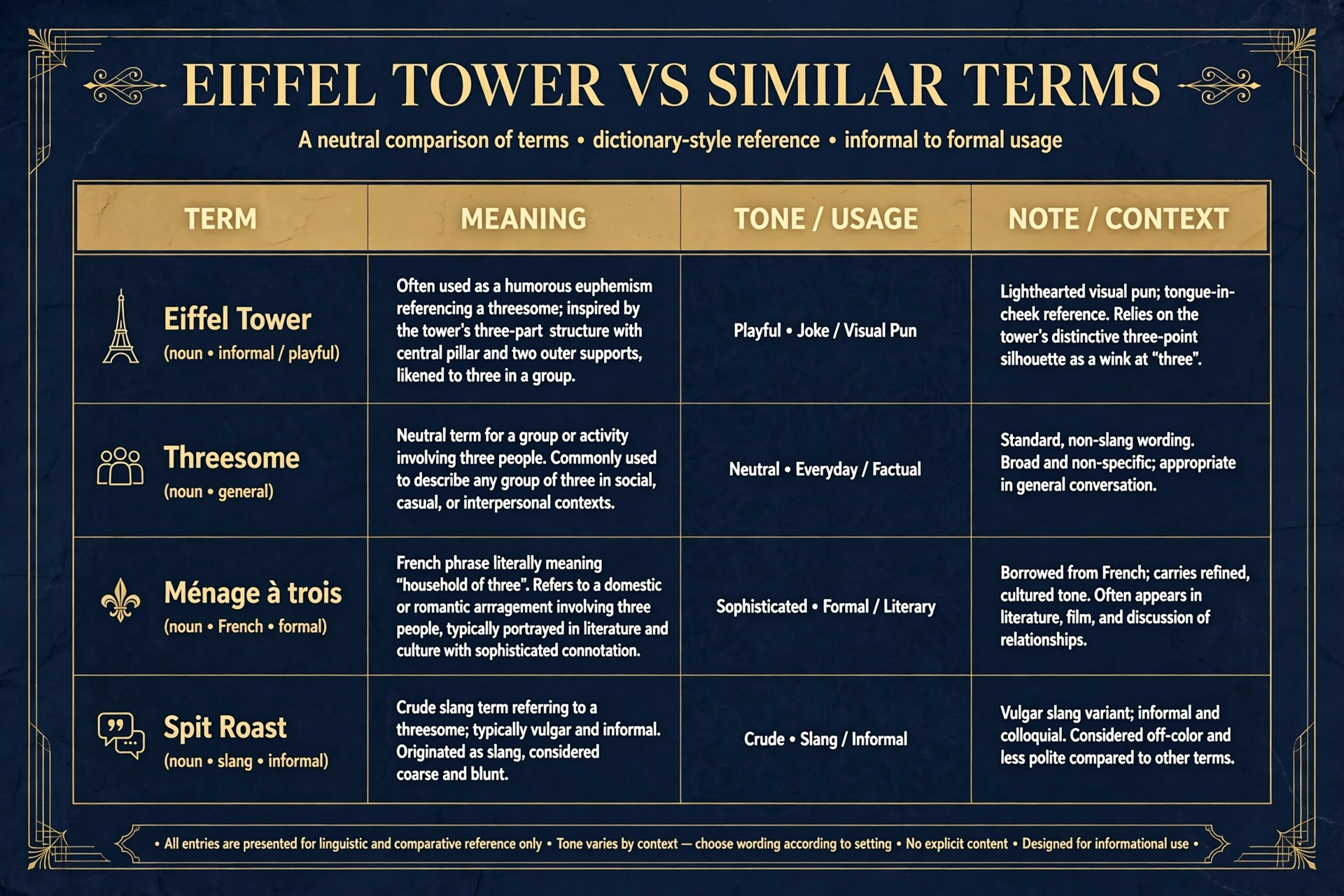
“Eiffel Tower” does not exist in a vacuum — it belongs to a whole family of slang terms that give innocent-sounding names to adult acts, plus a few terms it is often confused with. Here is how it stacks up:
| Term | What It Means | How It Differs from “Eiffel Tower” | Vulgarity Level |
|---|---|---|---|
| Eiffel Tower | Threesome where the two outer partners high-five over the middle person, forming a triangle | — (the reference term) | High |
| Spit roast | Slang for a threesome with one person in the middle | Describes the same general scenario but with a cruder, food-based metaphor and no “triangle” visual | Very high |
| Threesome | Any sexual activity involving three people | The neutral, clinical umbrella term — “Eiffel Tower” is one specific (joke) variation of it | Medium |
| Ménage à trois | French for “household of three”; a threesome, sometimes implying a relationship | Sophisticated/French framing vs. the Eiffel Tower’s bro-comedy framing; can imply romance, not just a one-time act | Medium |
| Devil’s threeway | Crude slang for a threesome (two men, one woman) | Same configuration, but framed as edgy/taboo rather than as a visual pun | Very high |
| High-five | Celebratory hand slap between two people | The innocent gesture that the slang borrows — the joke is that a wholesome high-five becomes the punchline of a dirty visual | None |
| Eiffel Tower (landmark) | The 330-meter iron tower in Paris, completed in 1889 | The literal meaning — shares only the name and the triangular silhouette; context decides which one is meant | None |
The key takeaway: if someone says “threesome,” they might be serious. If someone says “Eiffel Tower,” they are almost certainly joking. The landmark name is doing comedic heavy lifting that the clinical terms cannot do — which is exactly why the slang survived while blunter terms faded into the background of Urban Dictionary.
It is also worth noting how this naming pattern repeats across slang. Just as WYBO and mewing took ordinary words and loaded them with new subcultural meanings, “Eiffel Tower” shows how a proper noun can be fully reprogrammed by joke culture — while keeping its original meaning perfectly intact in every other context.
Alternate Meanings
Like all great slang, “Eiffel Tower” wears several hats depending on who is talking and where. Here are the meanings you might encounter:
1. The literal landmark (the default). In 99% of real-world usage — travel blogs, history books, news articles, your Paris itinerary — “Eiffel Tower” means the iron lattice tower on the Champ de Mars. The slang meaning only activates in joke-friendly, informal, adult-humor contexts. If someone says “we’re visiting the Eiffel Tower in June,” they are talking about Paris. Full stop.
2. The adult slang (the joke). The threesome reference described throughout this article. This meaning lives in memes, Urban Dictionary, raunchy comedy, and private jokes — and it is always signaled by tone, emojis (🗼😂), or the company you are in.
3. The “Eifel Tower” misspelling. With one F instead of two, this variant pops up in Urban Dictionary entries and meme captions as a deliberate wink — a way to write the slang that looks like an innocent typo to outsiders. Same meaning, extra layer of inside joke.
4. The verb form. As Wiktionary documents, “to Eiffel Tower” (or “Eiffel Towering”) is used as a verb in slang: “they tried to Eiffel Tower at the afterparty.” It is rare, it is always a joke, and it follows the same grammar as any other slang verb.
5. The TikTok travel joke. A newer, softer usage: travel creators film themselves at the actual tower with captions like “finally doing the Eiffel Tower 😏” — playing on the double meaning for engagement. The joke only works because the audience knows both meanings, and the creator gets to be cheeky while technically just posting a travel video.
Professional or Polite Alternatives
Sometimes you need to reference the concept — in a serious discussion about slang, in writing, or when explaining the joke to someone — without using the crude term itself. Here are cleaner ways to handle it:
- “A threesome joke/reference” — the simplest neutral description. “It’s a slang term joking about a threesome.”
- “An adult-humor slang term” — accurate without being explicit. Works in any explanatory context.
- “A crude meme reference” — frames it as internet culture, which is usually exactly what it is.
- “A visual pun on the landmark” — emphasizes the joke mechanics rather than the act. Great for linguistic or cultural discussions.
- “That 🗼 joke” — in casual conversation with people who already know, the emoji alone can carry the reference without saying the words.
- “A raunchy Urban Dictionary term” — attributes the crudeness to the source, keeping your own language clean.
The general rule: describe the joke, don’t perform it. Saying “it’s a crude joke about the shape of the tower” communicates everything an adult needs to know, while repeating the full anatomical explanation is rarely necessary — and in mixed company, never appropriate.
Common Mistakes
Because this slang lives or dies on context, people get it wrong in predictable ways. Avoid these:
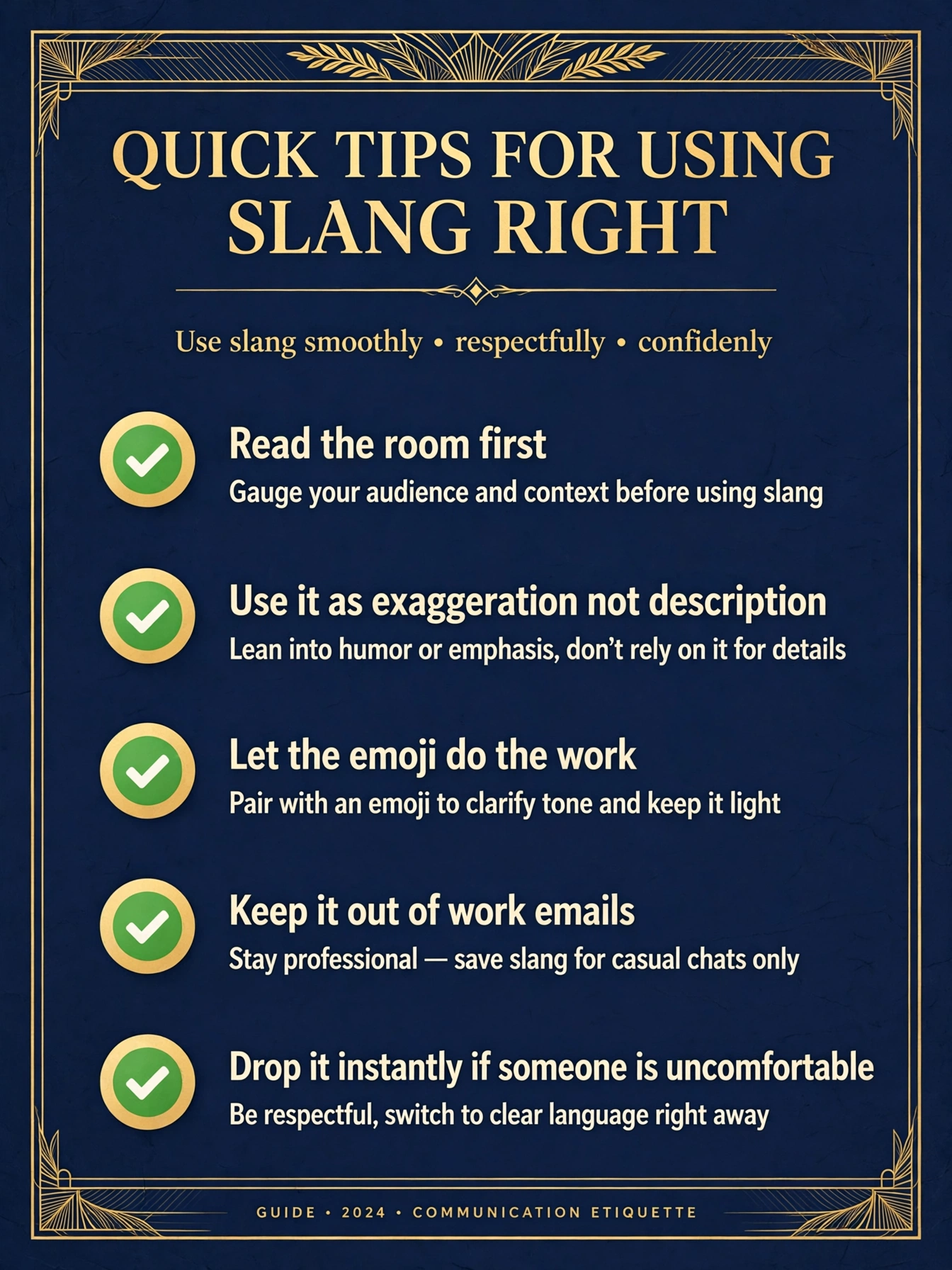
Mistake 1: Using it around people who won’t get the joke — or who’ll get it too well. The worst outcome is not confusion but clarity: saying it in front of your boss, your in-laws, or a teacher who knows exactly what it means. The term’s shock value cuts both directions.
Mistake 2: Assuming it’s a travel reference. This one goes the other way: someone hears “Eiffel Tower” in a meme, assumes it’s about Paris tourism, and repeats it innocently in the wrong crowd — then wonders why everyone is laughing. If you see the term paired with 😂, 🗼, or “last night,” it’s not about France.
Mistake 3: Treating it as a serious proposition. Saying “want to do an Eiffel Tower?” to someone who doesn’t share your humor reads as crude and aggressive, not funny. The term only works as a joke among people with established comedic trust. As an actual suggestion, it’s about as smooth as a brick.
Mistake 4: Misspelling it as “Eifel Tower” by accident. The one-F spelling is a deliberate in-joke. Using it unintentionally just looks like you can’t spell the most famous landmark in France. Spell it right unless you’re in on the gag.
Mistake 5: Overusing it. Like any shock-joke slang, “Eiffel Tower” is funny precisely because it’s rare. Drop it once in a group chat and you’re hilarious; make it your catchphrase and you’re just the person who won’t stop making the same dirty joke.
Mistake 6: Using it with strangers online. Commenting “Eiffel Tower 🗼” on a stranger’s travel photo isn’t edgy — it’s harassment-adjacent. The joke requires shared context; without it, you’re just being crude at someone.
Quick Tips
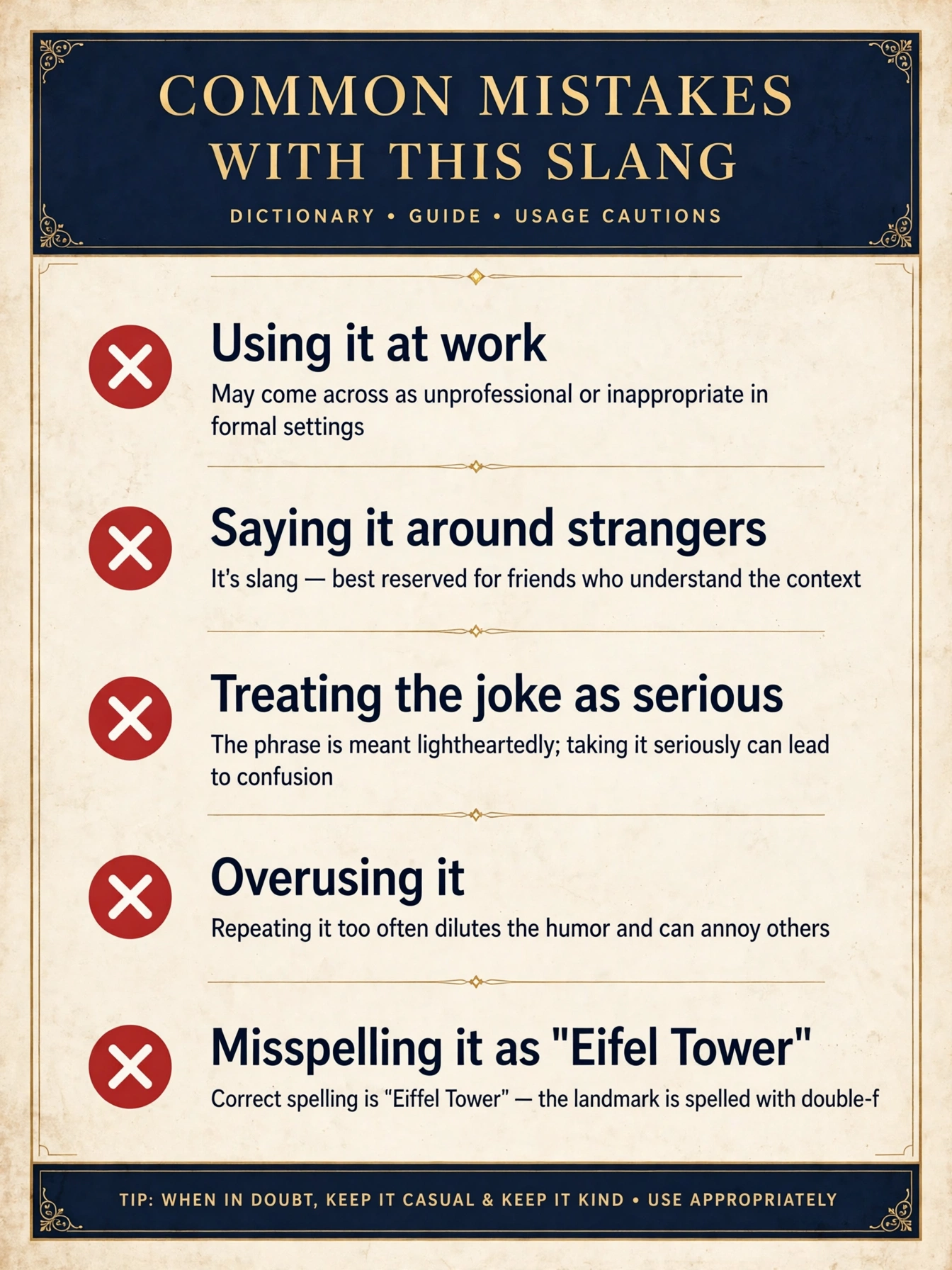
- Read the room first. The term is only funny where crude humor is already welcome: close friends, meme groups, adult comedy spaces. Everywhere else, keep it in your pocket.
- Let the emoji do the work. The 🗼 emoji is the term’s safest form — it signals the joke to those who know while staying deniable to those who don’t.
- Use it as exaggeration, not description. “That party was an Eiffel Tower” (chaos) lands better and safer than any literal usage.
- When in doubt, describe don’t repeat. Explaining “it’s a crude visual pun on the landmark” is always safer than quoting the full definition.
- Keep it out of writing that lasts. Group chats fade; screenshots don’t. Never put the term in work emails, public comments under your real name, or anywhere a future employer might find it.
- Know the exit. If someone’s uncomfortable, drop it instantly — “my bad, dumb joke” — and move on. Doubling down on a dirty joke that missed is how friendships get awkward.
- Enjoy the linguistics. Genuinely, this term is a neat little case study in how slang hijacks proper nouns. Appreciating the mechanics makes you funnier and smarter about internet culture.

FAQ
What does “Eiffel Tower” mean in slang?
In slang, “Eiffel Tower” is a crude adult-humor term for a threesome (typically two men and one woman) where the two outer participants raise their arms and high-five over the middle person, forming a triangle shaped like the Eiffel Tower. It’s used almost exclusively as a joke in memes and casual conversation, not as a serious term.
Is “Eiffel Tower” slang offensive?
It can be. Among close friends who share crude humor, it’s taken as a joke. But in professional settings, around strangers, or with people who don’t appreciate sexual humor, it reads as vulgar and inappropriate. Context and audience decide everything.
Where did the “Eiffel Tower” slang come from?
It emerged from early-2000s American bro-comedy and party culture, got boosted by raunchy films and TV of that era, and was cemented by Urban Dictionary entries and memes in the 2010s. The name is a visual pun on the landmark’s triangular silhouette.
Why is it called the “Eiffel Tower”?
Purely because of the shape. The real tower has a wide base narrowing to a point; in the slang scenario, two people on either side of a third person raise their joined arms overhead, creating a triangle that mirrors the tower’s outline. The innocent landmark name is what makes the joke work.
What does 🗼 mean in texting slang?
The 🗼 (Tokyo Tower, often used as the Eiffel Tower) emoji is frequently used as shorthand for this slang — a winking reference that people “in the know” will catch. In travel contexts it just means the landmark; in joke contexts with 😂 or wild-night stories, it’s the slang.
Can I say “Eiffel Tower” at work or school?
You shouldn’t use the slang meaning at work or school, ever. The literal landmark is obviously fine in travel or history discussions, but the joke version in a professional or classroom setting risks serious consequences. When there’s any doubt, stick to the literal meaning or skip the term.
What’s the difference between “Eiffel Tower” and a threesome?
“Threesome” is the neutral, general term for sexual activity involving three people. “Eiffel Tower” is a specific joke variation describing one particular configuration (the high-five triangle) — and it’s used as comedy far more often than as a literal description.
Is “Eifel Tower” (one F) the same thing?
Yes — “Eifel Tower” with one F is a deliberate misspelling used as an inside joke in some Urban Dictionary entries and memes. It refers to the same slang, with an extra layer of “if you know, you know” wordplay.
Conclusion
“Eiffel Tower” slang is the perfect specimen of internet-age dirty humor: a wholesome proper noun hijacked by a visual pun, launched by early-2000s comedy culture, and kept alive by memes, emojis, and every new generation of teenagers discovering it for the first time. The definition itself takes ten seconds to explain — two people, one in the middle, arms up, triangle — but the phenomenon is richer: it’s about how jokes travel, how landmarks become punchlines, and how a single emoji (🗼) can carry an entire shared understanding.
The practical takeaways are simple. Know what it means so you’re never the confused one in the group chat. Use it only where crude humor is welcome — with close friends, in meme spaces, never at work or with strangers. Prefer the joke form over the literal form, because the comedy is the entire point. And when you need to reference it politely, describe the pun rather than performing the punchline.
Slang like this reminds us that language is a playground, and the internet is its biggest jungle gym. Today’s crude joke is tomorrow’s trivia question — and now, when someone drops “Eiffel Tower” into the chat, you’ll be the one explaining it. Curious about more viral terms with double meanings? Explore our breakdowns of BFE meaning and zesty slang meaning next.
SEO Meta Title: Eiffel Tower Slang Meaning: What It Really Means
SEO Meta Description: What is Eiffel Tower slang? The cheeky joke behind the viral term, its origin, how it is used in texts and memes, common mistakes, and polite alternatives.
SEO-Friendly URL Slug: eiffel-tower-slang
Pinterest/SEO Feature Image Prompt: Clean 1200×630 cover graphic, deep navy night-sky background with a glowing minimalist Eiffel Tower silhouette in gold at center, bold white text overlay reading only “EIFFEL TOWER SLANG”, subtle Parisian bokeh lights, no emojis, modern slang-dictionary aesthetic.
