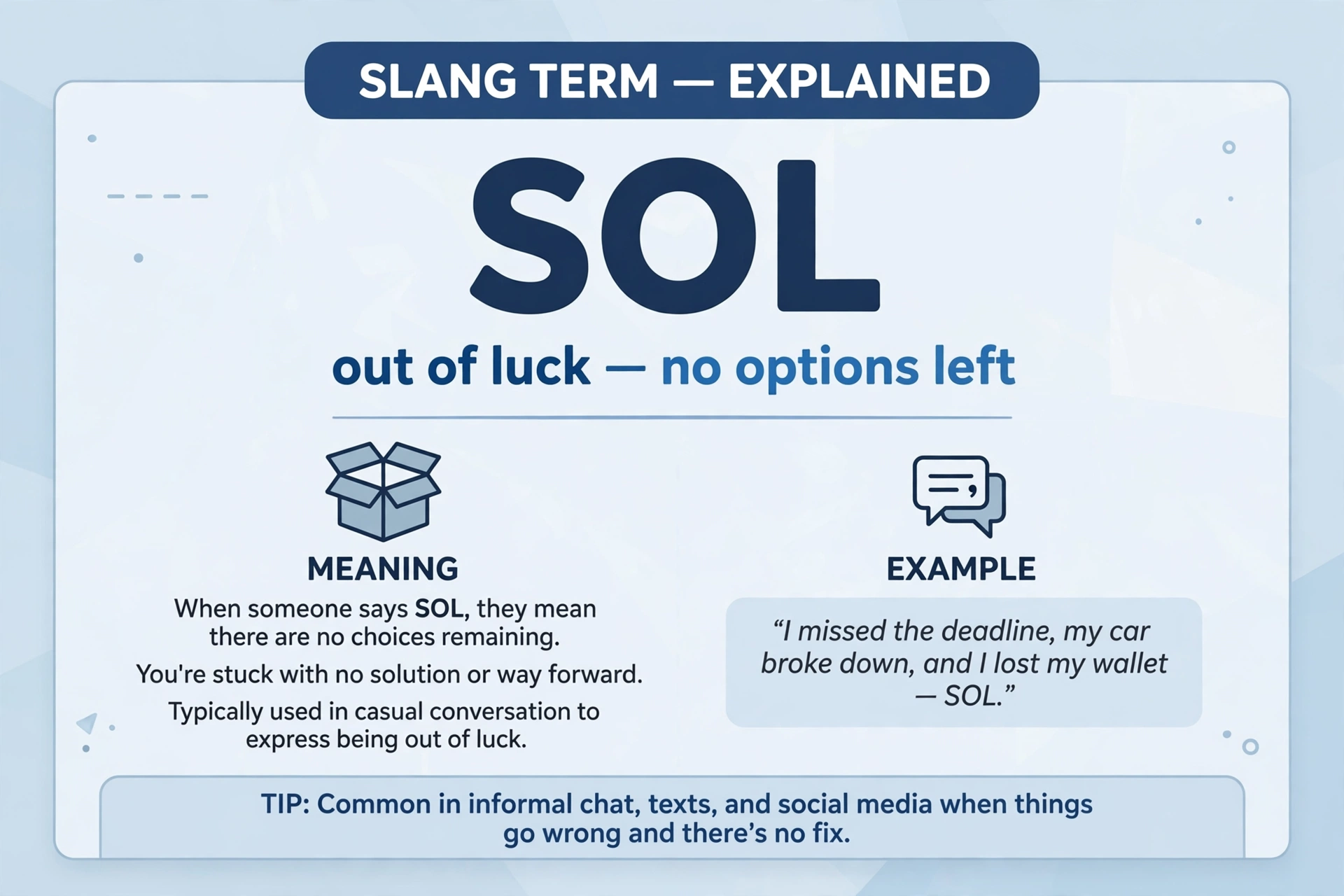
Quick Definition: In slang, SOL means “shit out of luck” — a blunt, informal way of saying someone has run out of options and there is nothing they can do to fix a bad situation. When a person texts “I’m SOL,” they mean they are stuck, unlucky, and out of moves. The politer version of the same idea is “strictly out of luck.”
SOL Meaning Slang & Definition
SOL meaning slang is one of those three-letter abbreviations that carries a whole mood in a single breath. At its core, SOL stands for “shit out of luck,” and it describes the moment when every plan has failed, every backup has run out, and all that is left is to accept it. If your phone dies in the middle of nowhere with no charger, no signal, and no ride home, you are SOL. If you miss the deadline for concert tickets and the show sells out five minutes later, you are SOL. The word does not just describe bad luck — it describes bad luck with no way out.
What makes SOL meaning slang so useful in everyday conversation is its finality. Other phrases leave room for hope: “this is tricky” or “we might be in trouble” suggest there is still something to try. SOL slams the door. It tells the listener that the situation is over, the options are gone, and the only thing left to do is laugh about it or move on. That is why people reach for it in texts, group chats, gaming lobbies, and social media comments — it delivers a full verdict in three letters.
SOL is almost always used as a predicate, the way you would use “stuck” or “doomed.” You say “I’m SOL,” “you’re SOL,” or “we’re SOL,” and everyone instantly understands the picture: no plan B, no rescue, no second chance. It works as a joke, as a complaint, and as a warning, depending on the tone around it. A friend who texts “forgot my wallet, I’m SOL for lunch” is being funny about a small disaster. A manager who says “the server crashed and the backup failed, we’re SOL” is delivering genuinely bad news. The letters stay the same; the weight changes with the context.
It is worth noting that SOL is an initialism, not a word you pronounce as a word. People say the letters — “ess-oh-ell” — rather than reading it as “sol” the way you would say the Latin word for sun. That pronunciation matters, because the lowercase word “sol” has a completely different life: it is the Roman sun god, the fifth note of a musical scale, a Peruvian currency, and a chemistry term for a colloidal solution. None of those meanings is what anyone means when they type SOL in a text message. In slang, SOL is always the luck phrase.
Introduction
You have probably seen SOL in a text and wondered whether it was a typo, a name, or some new piece of internet slang you missed. It is none of those — it is one of the oldest slang abbreviations in American English, and it has survived for more than a century because no other phrase says “there is nothing left to try” quite as efficiently. Three letters, one brutal verdict.
SOL shows up everywhere informal language lives. It appears in texts between friends, in Reddit threads about missed opportunities, in gaming chats after a losing streak, in workplace Slack channels when a system goes down, and in memes about everyday disasters. It is casual, it is slightly rude, and it is extremely versatile. Learning the SOL meaning slang is not just about decoding three letters — it is about understanding a whole attitude toward bad luck: the shrug, the laugh, and the acceptance that sometimes things simply do not work out.
This guide covers everything you need to know about SOL in slang. You will learn exactly what it stands for, where it came from, how it became popular, how to use it naturally in texts and conversations, what it means when a guy or a girl says it, how it compares with similar expressions, what its other meanings are, which polite alternatives to use at work or with family, the mistakes people make with it, and quick tips for using it without sounding awkward. By the end, you will know SOL as well as any native speaker — and you will know exactly when not to use it.
Origin
The origin of SOL meaning slang goes back much further than the internet. The phrase “shit out of luck” was first recorded in American military slang around 1917, during the First World War. Soldiers used it to describe a situation in which a person had exhausted every resource and every chance — no supplies, no backup, no way forward. In the chaos of wartime, where plans fell apart daily, a short phrase that summed up hopelessness was exactly what soldiers needed, and “S.O.L.” spread quickly through the ranks.
After the war, the abbreviation travelled home with veterans and settled into general American slang. Through the 1920s and 1930s, it appeared in hard-boiled fiction, crime novels, and working-class speech, always carrying the same meaning: out of luck, with no recourse. Because the full phrase contains a swear word, the abbreviation served a useful double purpose — it let people say something rude while barely saying it at all. Saying “S.O.L.” in polite company was a wink; everyone knew what it meant, but nobody had actually sworn.
By the middle of the 20th century, dictionaries had picked it up. Dictionary.com lists S.O.L. as slang for “strictly out of luck” and, in its vulgar sense, “shit out of luck,” a definition that has remained stable for decades. The term never really faded. Instead, it waited for the internet to give it a second life. When texting, instant messaging, and online gaming arrived, short abbreviations became the currency of fast conversation — and a century-old piece of military slang turned out to be perfectly built for the job. Three letters, one meaning, zero wasted keystrokes.
That is the quiet secret of SOL’s longevity: it solved a communication problem in 1917, and it still solves the same problem today. Whenever someone needs to say “this is hopeless and I know it,” SOL is waiting.
Popularity
SOL is not a trending TikTok word that will be forgotten by next month. It is a durable piece of American slang that has stayed in steady use for more than a hundred years, and its popularity today comes from its reliability rather than its novelty. It is the kind of word people use without thinking, the way they use “LOL” or “OMG” — a reflex, not a fashion statement.
Part of its staying power is that it fills a gap no polite phrase quite fills. “Unfortunate” is too soft. “Doomed” is too dramatic. “Out of luck” is accurate but flat. SOL adds attitude: it is funny, a little defiant, and honest about the situation. When someone says “I’m SOL,” they are not just reporting bad luck — they are owning it, usually with a shrug. That tone is exactly what group chats and social media reward.
The term is most common in the United States, where it originated, but it is widely understood in the UK, Canada, and Australia, and it appears regularly in international gaming communities and English-language social media. It is used by every age group, though it is most natural among teenagers and adults in casual settings. Older speakers know it from its long history in American English; younger speakers know it from texts, memes, and gaming. Unlike many slang terms that belong to one generation, SOL belongs to all of them.
Search interest in “SOL meaning” stays consistent rather than spiky, which tells you something important: people are not discovering a viral trend, they are encountering a word they have seen a hundred times and finally deciding to look it up. That steady curiosity is the mark of a word that is permanently part of the language.
How It Is Used
SOL is almost always used as a short verdict at the end of a story about something going wrong. The pattern is simple: describe the problem, then deliver the verdict. “The store closed at six and I got there at six-oh-five. I’m SOL.” “I forgot to save the file and the laptop died. I’m SOL.” The abbreviation does the emotional work — frustration, resignation, dark humour — in a single beat.
It is most common in the first person (“I’m SOL”) and the second person (“you’re SOL”), but it works in the third person too (“he’s SOL,” “they’re SOL”). It is rarely used as a noun on its own, and it almost never takes an object. You do not “SOL someone” or “get SOLed.” It is a state, not an action — a label for being out of options.
Tone changes everything with SOL. Said with a laughing emoji, it is a joke about a small disaster. Said flatly, after a list of real problems, it is genuine bad news. Said to a friend who just missed their chance, it can be sympathetic (“aw man, you’re SOL”) or teasing (“haha, you’re SOL now”). The letters carry the facts; the surrounding words carry the feeling. That is why context matters so much with this word — the same three letters can comfort, mock, or warn.
It is also worth knowing where SOL does not belong. Because the full phrase contains a swear word, SOL is informal and mildly vulgar. It is fine with friends, in group chats, on social media, and in casual workplaces. It is not appropriate in formal emails, job interviews, academic writing, or conversations with people who expect polite language. In those settings, “strictly out of luck” or “out of options” says the same thing without the edge.
Examples
Real examples make the SOL meaning slang click faster than any definition. Notice how each one follows the same shape — a problem, then the verdict — and how the tone shifts from friendly to professional to funny depending on who is talking.
Friendly Examples
- “I left my umbrella at home and now it’s pouring. I’m so SOL.”
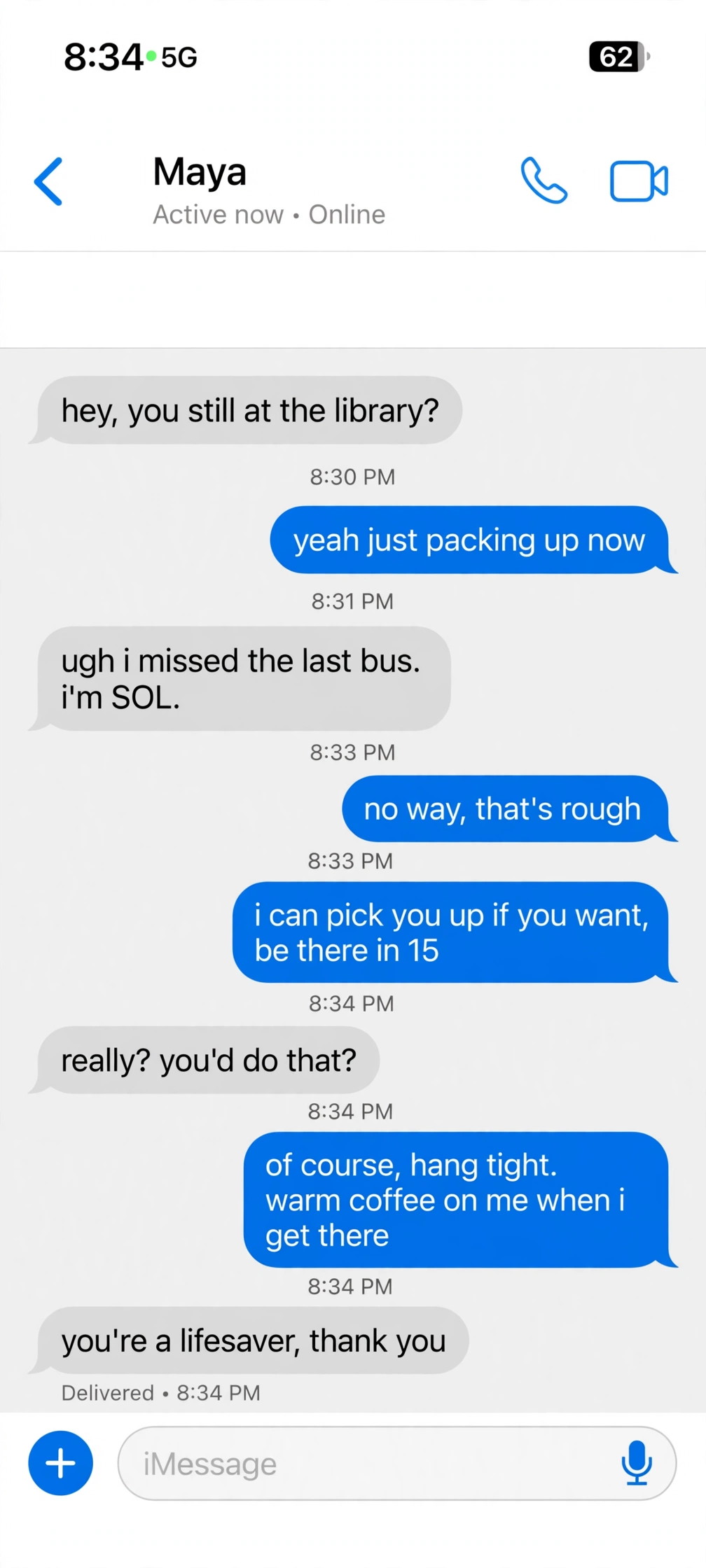
- “Missed the last bus and my phone is at 2%. I’m SOL tonight.”
- “I forgot to charge my controller before game night. Guess I’m SOL.”
- “Tried to get tickets for the concert but they sold out in two minutes. We’re SOL, guys.”
- “Didn’t study for the quiz and the teacher just collected the notes. I’m SOL.”
Professional Examples
- “The client moved the deadline to today and the files are still rendering. We’re SOL unless the system speeds up.”
- “The backup drive failed the same day the server crashed, so we’re SOL on recovering that version.”
- “I submitted the application one day late, so I’m SOL for this round of hiring.”
- “The supplier is out of stock until next month, which means we’re SOL on the launch date.”
Notice that even the professional examples stay informal — SOL is a word you use with colleagues you know well, not in a message to a CEO or a client. When the stakes are formal, “we’re out of options” is the safer choice.
Funny Examples
- “Showed up to the party in the same outfit as the host. I’m SOL and there’s no hiding it.”
- “My Wi-Fi died right before the final boss fight. SOL is an understatement.”
- “Tried to cook dinner, set off the smoke alarm, and ordered pizza instead. The pizza place is closed. I’m SOL and hungry.”
- “Woke up late, missed my alarm, missed the train, and my boss just texted ‘where are you?’ I’m SOL in 4K.”
Comparison with Similar Terms
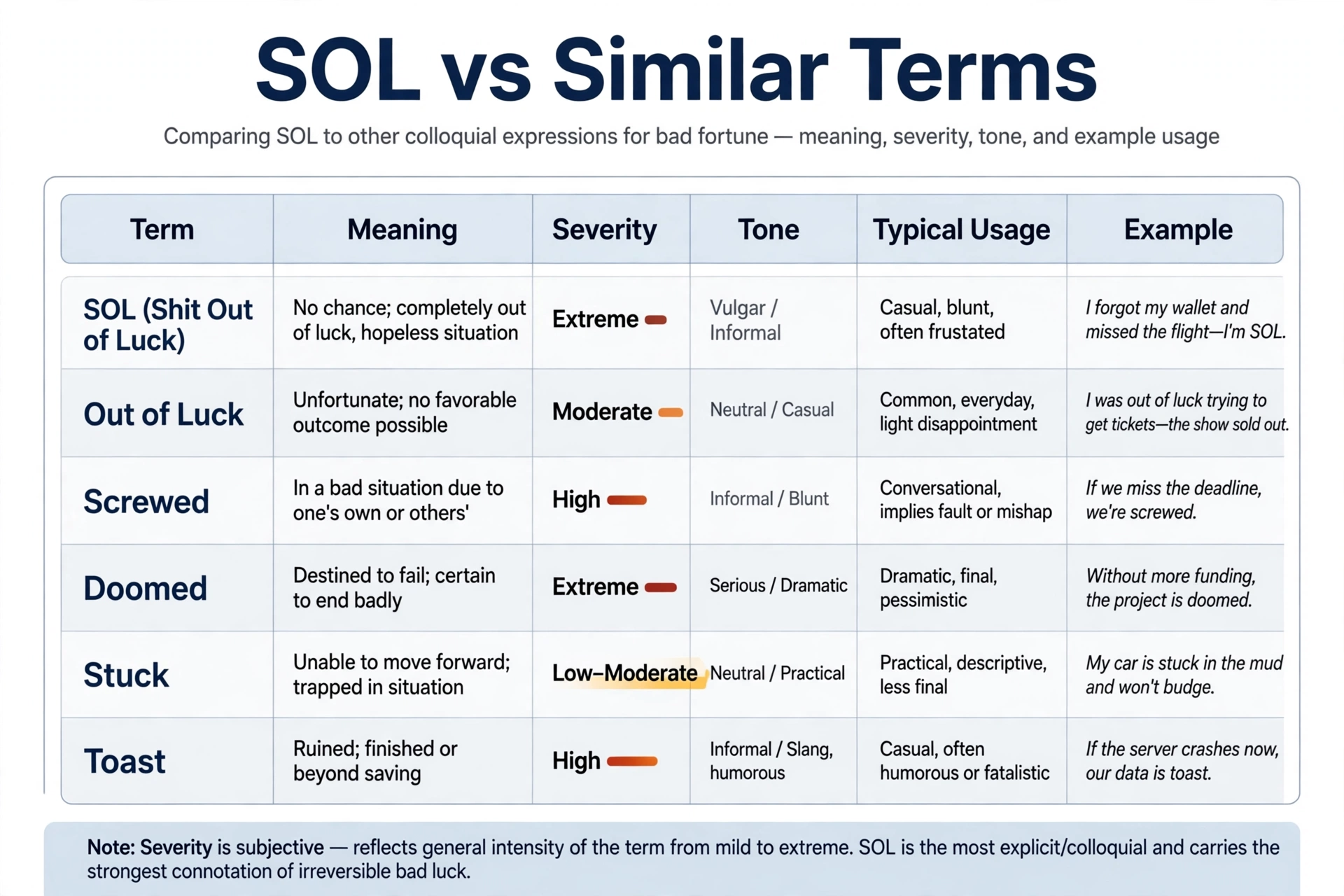
SOL sits in a family of expressions about bad luck, but each one means something slightly different. Knowing the differences keeps you from using the wrong phrase at the wrong moment.
| Term | Meaning | When to Use It | Tone |
|---|---|---|---|
| SOL | Out of luck with no options left | When the situation is final and hopeless | Blunt, funny, slightly rude |
| Out of luck | No good fortune or chance remaining | Any situation, formal or casual | Neutral, polite |
| Screwed | In serious trouble with bad consequences | When things have gone badly wrong | Informal, stressed |
| Doomed | Certain to fail or come to a bad end | When failure feels inevitable | Dramatic, heavy |
| Stuck | Unable to move forward | When you need help or a solution | Neutral, everyday |
| Toast | Finished, ruined, done for | Playful exaggeration of a bad situation | Humorous, casual |
| GG (good game) | Accepting defeat gracefully | After losing a game or competition | Sporting, light |
The closest relative of SOL is simply “out of luck” — in fact, “strictly out of luck” is the polite expansion of the same abbreviation. The difference is attitude: “out of luck” reports the facts, while SOL adds the shrug. “Screwed” is stronger and more stressed than SOL, and it suggests consequences are coming, not just that options are gone. “Doomed” is the most dramatic of the group, and using it for a missed bus would be an overreaction. “Stuck” is the most hopeful — it implies you might get unstuck. “Toast” is SOL’s funny cousin: it means roughly the same thing, but it sounds like a joke even when the situation is serious.
Choosing between them is a question of how bad the situation really is and how formal the conversation is. For a small disaster among friends, SOL or “toast” fits. For a real problem at work, “out of options” or “stuck” is safer. For a catastrophe, “screwed” or “doomed” matches the weight. SOL’s sweet spot is the middle: bad enough to matter, small enough to laugh about.
Alternate Meanings
Like many short abbreviations, SOL has other meanings — but context almost always makes the right one obvious. Here are the alternate meanings you are most likely to meet.
- Sol (Latin for “sun”): In Latin, “sol” means the sun, which is why we have words like “solar” and “solstice.” The Roman god of the sun was also called Sol. If you see “sol” in astronomy, mythology, or science, it is almost certainly the sun, not the slang phrase.
- Sol (music): In music, “sol” is the fifth note of the diatonic scale — do, re, mi, fa, sol, la, ti, do. Singers and musicians use it every day, and it has nothing to do with luck.
- Sol (currency): The sol is the currency of Peru, abbreviated as S/. One sol equals 100 céntimos. Travel and finance articles about Peru use “sol” constantly.
- Sol (Mars day): In astronomy, a “sol” is a solar day on Mars, lasting about 24 hours and 39 minutes. NASA uses the word in every Mars mission update.
- Sol. (solution): In medicine and chemistry, “sol.” is short for “solution,” as in a liquid mixture or a prescribed medicine. You will see it on prescriptions and lab reports.
- Standards of Learning: In Virginia’s public schools, SOL stands for “Standards of Learning,” the state’s testing program. Students and teachers in Virginia use the abbreviation constantly, and they do not mean “out of luck” — although students taking the tests might disagree.
- Slice of life: In anime and online fandoms, SOL can stand for “slice of life,” a genre of stories about ordinary daily experiences. If someone in a fandom chat says “I love SOL anime,” they mean gentle, everyday stories, not bad luck.
- Smile/snort/sigh out loud: In texting, SOL is sometimes used playfully as “smile out loud,” “snort out loud,” or “sigh out loud,” by analogy with LOL. These uses are rare, and they are almost always clear from context — nobody says “I’m SOL” to mean “I’m smiling out loud.”
The practical rule is simple: in a text about a problem, a missed chance, or a disaster, SOL means “shit out of luck.” In science, music, money, or school testing, it means something else entirely. The sentence around it always gives the answer away.
Professional or Polite Alternatives
Because SOL contains a swear word in its full form, there are plenty of moments when you need the same meaning in cleaner language. These alternatives say “no options left” without the edge, and they work in emails, meetings, and conversations with people you need to impress.
- Out of options — the most direct and useful replacement. “We’re out of options on this one.”
- Strictly out of luck — the polite expansion of SOL itself, and the one dictionaries list first.
- No longer possible — formal and factual. “Unfortunately, that is no longer possible.”
- We’ve exhausted our options — professional and calm, good for work emails.
- There’s nothing more we can do — honest and sympathetic, good for customer service.
- Unfortunately, the opportunity has passed — polite and final, good for missed deadlines.
- We’re at a dead end — clear and visual, works in both casual and work settings.
- That ship has sailed — an idiom that means the chance is gone, with a lighter tone.
As a rule of thumb, if you are writing to a boss, a client, a teacher, or anyone older than you in a formal setting, use one of these. Save SOL for friends, peers, and casual chats where a little bluntness is part of the fun.
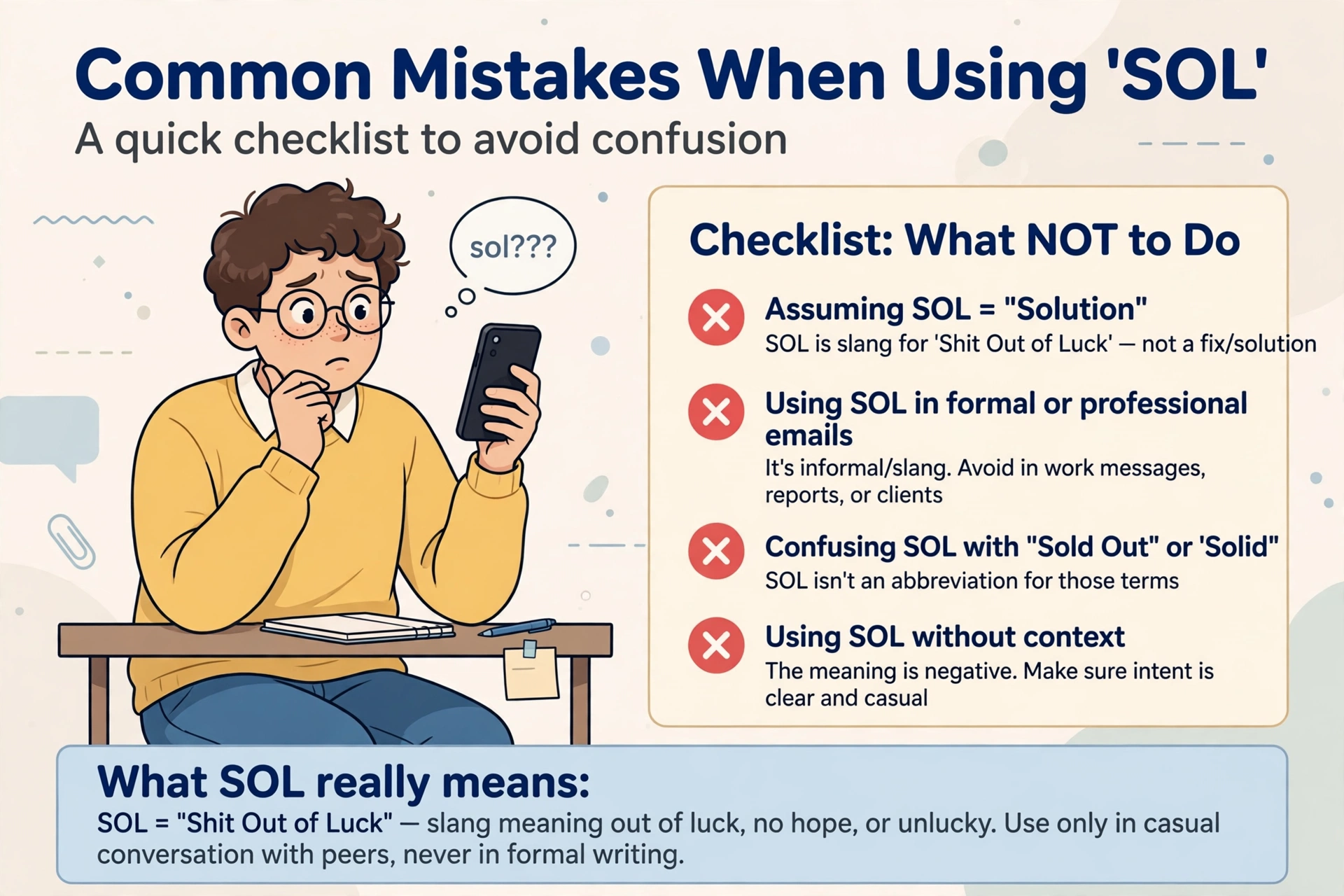
Common Mistakes
SOL is a simple word, but people still use it wrong. These are the mistakes that make a message confusing, awkward, or accidentally rude.
- Using it in formal settings: The most common mistake is dropping SOL into a work email, a job application, or a message to a teacher. Even abbreviated, it carries the swear word’s attitude, and formal readers will notice. Use “out of options” instead.
- Confusing it with “soul”: SOL and “soul” sound similar but mean completely different things. “I’m SOL” means you are out of luck; “I’m soul” means nothing at all. Autocorrect and voice typing cause this mix-up more often than you would think, so double-check before sending.
- Using it for small problems that have solutions: SOL means there is no way out. If you say “I’m SOL” about a problem you could fix in five minutes, you sound dramatic instead of funny. Save it for situations that really are stuck.
- Using it to describe someone else’s serious misfortune: Telling a friend who just lost a job or failed an exam that they are “SOL” can sound cold or mocking, even if you meant it lightly. In serious moments, sympathy beats slang.
- Writing it as “sol” in lowercase in the middle of a sentence about the sun or music: Lowercase “sol” usually means the sun, a musical note, or a currency. If you mean the slang phrase, write it in capitals — SOL — so the reader knows which meaning you intend.
- Overusing it: SOL is funny precisely because it is a verdict. If every message ends with “I’m SOL,” the word loses its punch and starts to sound like complaining. Use it when the situation deserves it, not as a reflex for every inconvenience.
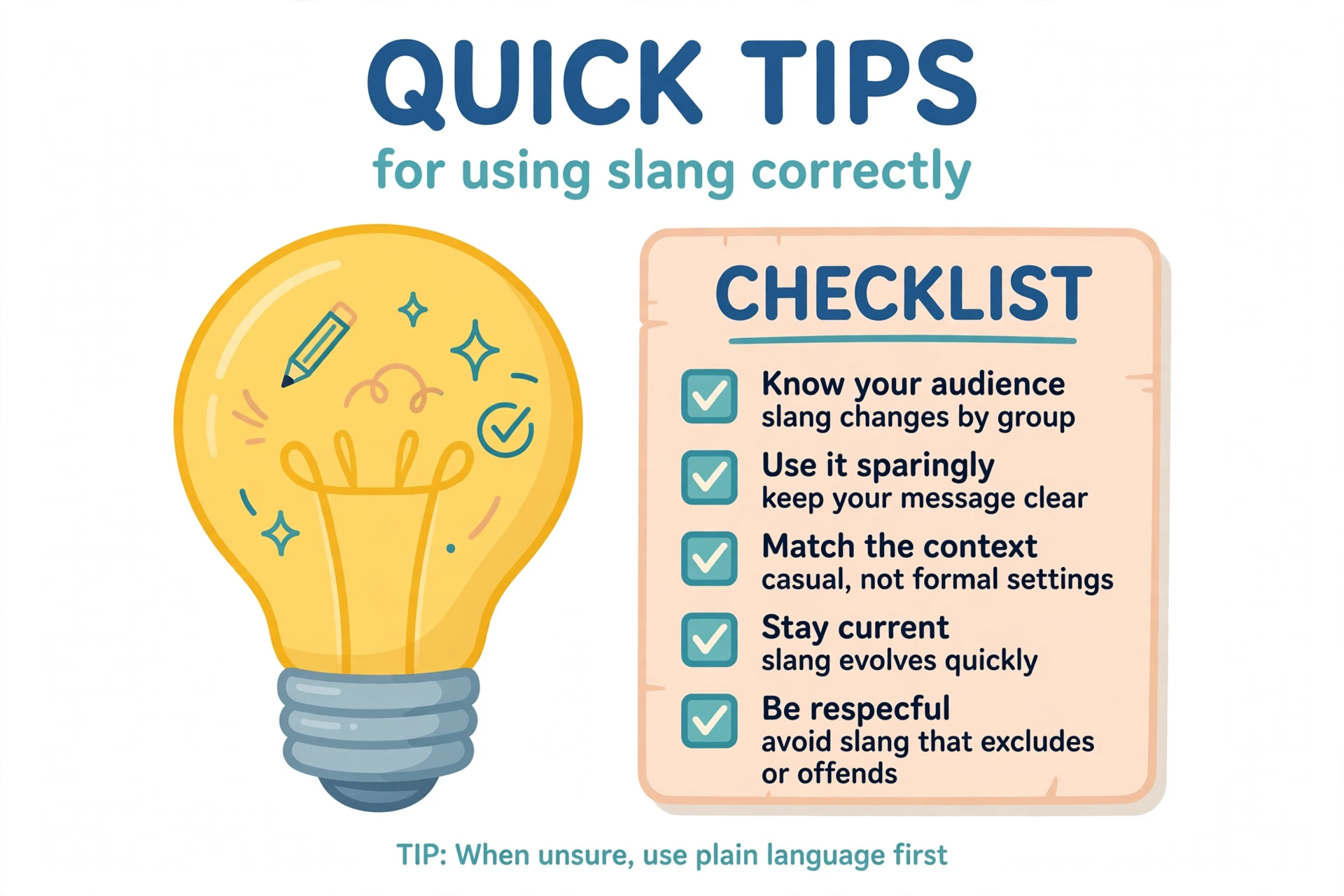
Quick Tips
- Lead with the problem, end with the verdict: “The tickets sold out and I’m SOL” lands better than “I’m SOL” on its own, because the listener needs the story first.
- Pair it with humour: SOL works best with a laughing emoji, a self-deprecating joke, or an absurd detail. It turns bad luck into a story worth telling.
- Keep it capitalised: Writing SOL in capitals signals the abbreviation and avoids confusion with the sun, music, or currency meanings.
- Match the tone to the room: With close friends, SOL is perfect. With a boss or a stranger, choose “out of options” instead.
- Do not use it as a noun or a verb: You are SOL, you do not “SOL” something. Keep it as a state — “I’m SOL,” “we’re SOL,” “you’re SOL.”
- Use it sparingly for impact: The word hits hardest when it is rare. Save it for genuinely stuck situations and it will always get the laugh or the sympathy you want.
- Check your audience’s age and setting: Teenagers and young adults use SOL freely; older or more formal audiences may hear the swear word behind it. When in doubt, go polite.
FAQ
What does SOL mean in slang?
In slang, SOL means “shit out of luck.” It describes a situation where someone has run out of options and there is nothing they can do to change the outcome. The polite version is “strictly out of luck.”
What does SOL mean in texting?
In texting, SOL means the same thing as in speech: the person is stuck with no good options left. For example, “I missed the last train, I’m SOL” means the person has no way home and no backup plan. It is usually used jokingly about small disasters, or seriously about real problems.
Is SOL a bad word?
SOL is mildly vulgar because its full form contains a swear word, but the abbreviation itself is widely accepted in casual conversation. It is fine with friends and on social media, but it is not appropriate in formal writing, job interviews, or professional emails. In those settings, use “out of options” or “strictly out of luck.”
What does SOL mean from a guy?
When a guy says SOL in a text, he almost always means “shit out of luck” — he is stuck, he missed his chance, or his plan failed. For example, “didn’t text her back in time, I’m SOL” means he thinks he missed his opportunity. It is rarely romantic or flirty on its own; it is a complaint about bad luck.
What does SOL mean from a girl?
When a girl says SOL, it means the same thing: she is out of luck and out of options. For example, “my charger broke and my phone is dead, I’m SOL” means she is stuck without a solution. The meaning does not change by gender — only the situation does.
What is the origin of SOL?
SOL comes from the phrase “shit out of luck,” first recorded in American military slang around 1917, during the First World War. Soldiers used it to describe situations with no resources and no way forward. It later spread into general American slang and became popular again with texting and the internet.
What are the other meanings of SOL?
Outside slang, SOL can mean the sun (from Latin), the fifth musical note, the currency of Peru, a solar day on Mars, a chemical solution, Virginia’s Standards of Learning tests, or “slice of life” in anime fandoms. Context always tells you which meaning applies.
What is a polite way to say SOL?
The polite ways to say SOL are “strictly out of luck,” “out of options,” “we’ve exhausted our options,” and “there’s nothing more we can do.” These carry the same meaning without the swear word, and they work in professional and formal settings.
Conclusion
SOL meaning slang is simple, old, and remarkably useful. It stands for “shit out of luck,” and it says in three letters what would otherwise take a whole sentence: the plan failed, the options are gone, and there is nothing left to do but accept it. From its origins in First World War military slang to its second life in texts, group chats, and gaming lobbies, SOL has survived because it solves a problem every speaker faces — how to announce bad luck with honesty, humour, and finality.
The key to using it well is knowing where it belongs. With friends, in casual chats, and in funny stories about small disasters, SOL is perfect — short, vivid, and instantly understood. In formal settings, use “out of options” or “strictly out of luck” instead. Remember to capitalise it, lead with the problem before delivering the verdict, and save it for situations that really are stuck. Used that way, SOL is not just slang — it is one of the most efficient words in the English language.
Now that you know the SOL meaning slang inside and out, you will spot it everywhere — and the next time a plan falls apart, you will know exactly what to say. If you enjoyed this guide, keep exploring our slang explainers, from FN meaning in text and CFS meaning in text to HBU meaning in chat and PTSO meaning in text — each one breaks down another piece of internet language the same way. And when you need the dictionary view, Dictionary.com’s entry for SOL confirms the definition we covered here.
