Quick Definition: Slime slang means a loyal, ride-or-die close friend — someone you trust completely, like a brother. Popularized by Atlanta hip-hop, especially Young Thug and his YSL crew, calling someone your “slime” is a term of endearment that signals deep loyalty, trust, and brotherhood, much like calling someone “bro,” “homie,” or “fam.”
Slime Slang Meaning & Definition
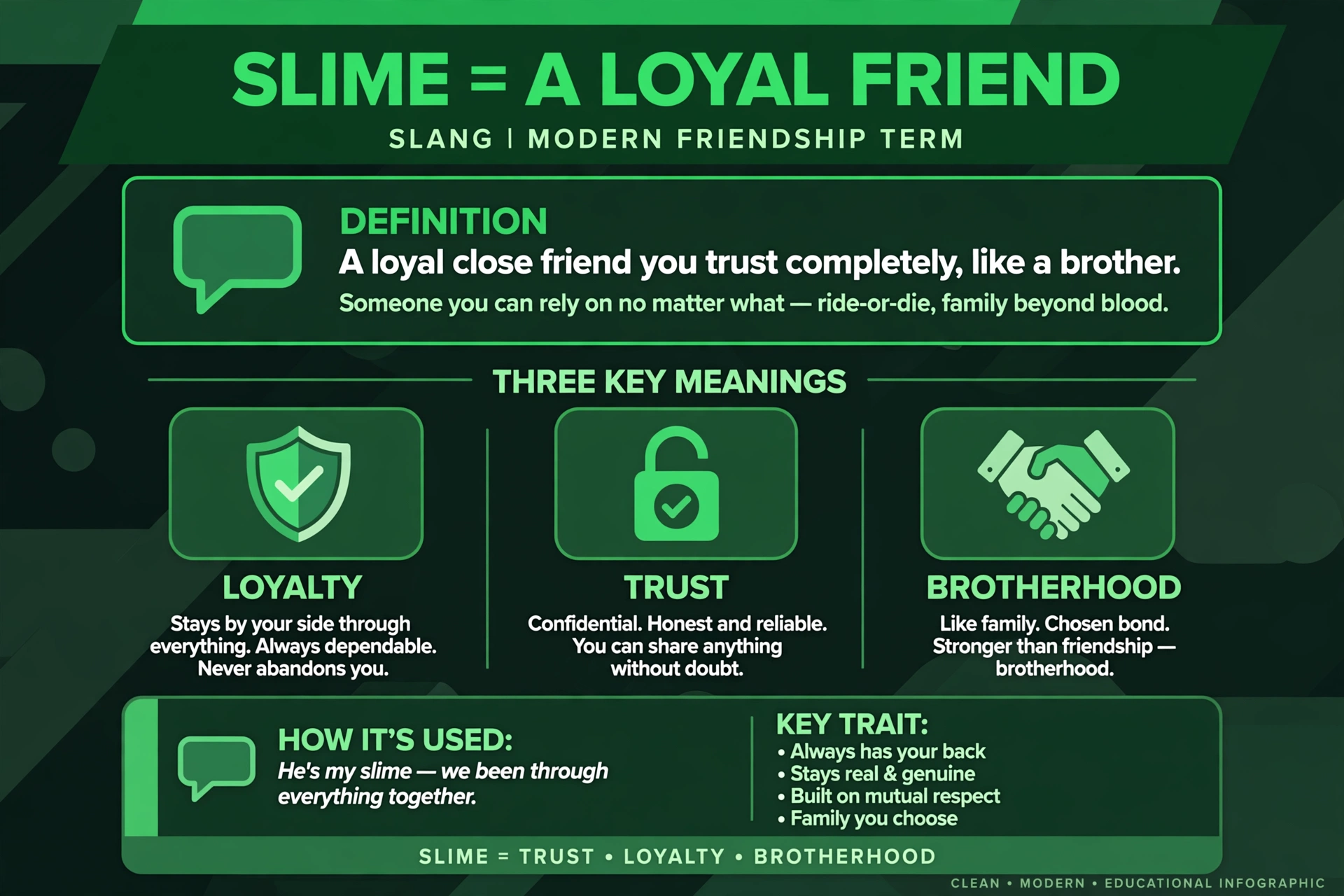
Slime slang is hip-hop slang for a close friend you would do anything for. When someone says “that’s my slime,” they are not talking about the gooey green stuff from science class. They are talking about a person — a day-one friend, a trusted member of their crew, someone who has proven their loyalty over and over again. In short, slime slang turns an ordinary word into a badge of brotherhood.
The word carries a feeling that “friend” alone does not capture. A friend can be anyone you get along with, but a slime is someone who sticks with you no matter what — the same way real slime sticks to everything it touches. That sticky, unbreakable bond is the whole point of the metaphor, and it is why the term caught on so fast in rap lyrics, group chats, and TikTok comments.
It also helps to know that “slime” is sometimes written as an acronym: SLIME stands for “Street Life Intelligence and Money is Everything.” That backronym comes from the same Atlanta street culture that raised the word, and it adds another layer to the term — being a slime is not only about friendship, it is about a whole way of life built on loyalty, street smarts, and ambition.
Introduction
If you have spent any time on TikTok, in a rap comment section, or in a group chat with hip-hop fans, you have almost certainly seen someone called “slime.” Maybe it was “what’s up, slime?” as a greeting, or “my slime got me” under a video about friendship. If you grew up outside that world, the word can look strange — even a little gross. Why would anyone call their best friend a word that means gooey green mess?
The answer is that slime slang has almost nothing to do with the sticky substance. In the world of hip-hop and internet culture, slime is a compliment of the highest order. It says: you are not just my friend, you are my people. You are the one I call first, the one I trust with real things, the one who would show up without being asked. Just like sigma slang took over TikTok with a whole attitude attached to it, slime slang carries a world of meaning in a single syllable.
In this guide, we will break down exactly what slime slang means, where it came from, how it spread from Atlanta rap to mainstream group chats, and how to use it correctly — without sounding forced or accidentally insulting someone. We will also cover the common mistakes people make with the word, the related terms you need to know, and the polite alternatives to use when “slime” is not the right fit.
Origin
Slime slang was born in the hip-hop scene of Atlanta, Georgia, in the early 2010s — though its earliest roots reach back even further. Some rap historians trace the first use of “slime” as a term of endearment to rapper N.O.R.E. in 1999, in the track “Blood Money Pt. 3.” By the 2000s, calling a friend “slime” was already common in Southern street culture and in New York hip-hop circles, passed from crew to crew as a quiet in-group word.
What turned a regional street term into a global slang word was Young Thug. The Atlanta rapper built his entire brand around the word: his 2015 mixtape series was called “Slime Season,” his label and collective became YSL — Young Stoner Life, often stylized as Young Slime Life — and his lyrics used “slime” constantly to refer to his closest friends and collaborators. When Young Thug said “slime,” millions of listeners heard it, and the word began its journey from the streets of Atlanta to the rest of the world.
Gunna, Lil Baby, Lil Keed, Lil Gotit, Playboi Carti, and Lil Uzi Vert all helped carry the word further. Each artist used “slime” in songs and on social media to talk about their own crews, and each use reinforced the same meaning: loyalty, brotherhood, and trust. Future, another Atlanta giant, used the word alongside Young Thug and helped tie it to the snake emoji — the now-famous 🐍 that fans drop in comments to signal they are part of the slime world.
The word also grew a family of related terms. “Slatt” — short for “Slime Love All the Time” — became a greeting and a lifestyle slogan. “Slime Season” became shorthand for a period when someone is winning, unbothered, and surrounded by their people. Together, these words built a small vocabulary of loyalty that fans could use to show they belonged.
Popularity
Slime slang exploded in popularity for a simple reason: it arrived at the exact moment hip-hop became the dominant sound of the internet. In the mid-2010s, Young Thug and his peers were not just charting — they were setting the language of TikTok, Twitter, Instagram, and YouTube before those platforms even had names for what was happening. A lyric could become a caption within hours, and a caption could become a comment-section greeting within days.
The word’s second wave came from TikTok and meme culture. Creators started using “slime” in videos about friendship, loyalty tests, and “day one” friends, and the term spread far beyond rap fans. Today you will see “slime” in gaming lobbies, in Discord servers, in Instagram captions, and in texts between teenagers who have never listened to a Young Thug album. The word has outgrown its origin without losing its core meaning.
Part of the appeal is the sound of the word itself. “Slime” is short, punchy, and fun to say — it lands harder than “friend” and feels cooler than “bro” in the right context. It also carries exclusivity: calling someone your slime implies they are in your inner circle, not just a casual acquaintance. That feeling of belonging is exactly what makes slang spread, and it is why slime slang is still going strong more than a decade after Young Thug first made it famous.
Search interest in the term stays steady year after year, spiking whenever Young Thug, Gunna, or YSL makes headlines. And because the word also has a completely separate life — the DIY slime toy craze that took over YouTube and TikTok in the late 2010s — people keep bumping into it from both directions, which only keeps the slang meaning alive.
How Slime Slang Is Used
Slime slang is flexible, and it works in several different roles in a sentence. The most common use is as a noun meaning “close friend”: “That’s my slime,” “Me and my slime are going to the party,” or “No one can mess with my slime.” In each case, the word replaces “friend,” “bro,” or “homie” — but with extra emphasis on loyalty.
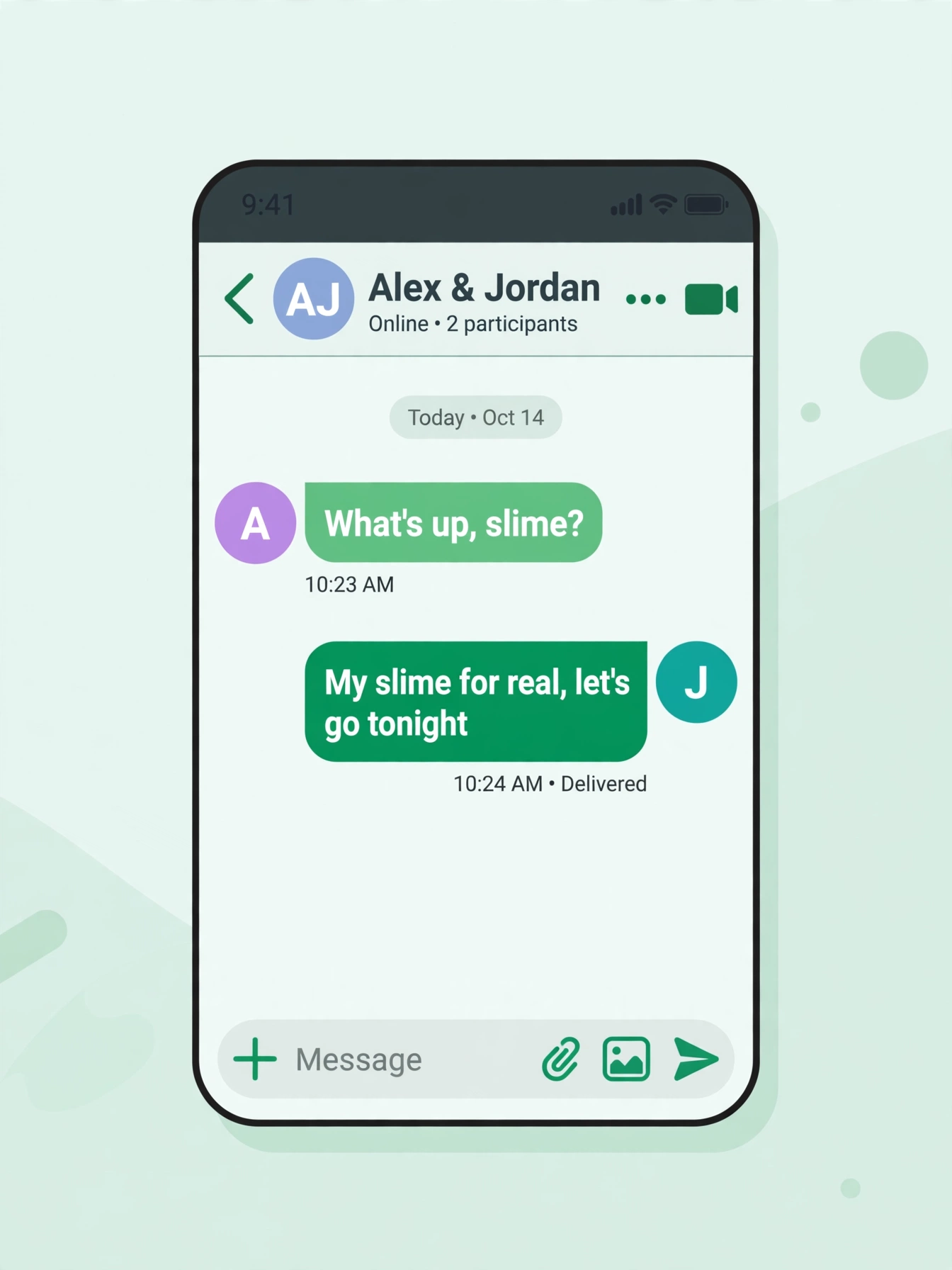
It is also used as a direct greeting, the way you might say “what’s up, bro?” Saying “What’s up, slime?” to a friend is warm, playful, and instantly signals that you two are close. The greeting works best between people who already have that kind of bond; using it with a stranger can feel odd, which is part of what makes it meaningful.
As an adjective or a label, “slime” can describe a whole vibe or lifestyle. Someone might say “we on that slime shit” to mean they are moving with their crew, loyal and unbothered. A fan might comment “slime season 🐍” under a rapper’s post to show support. In these cases the word stops being about one person and becomes a flag for an entire attitude: loyalty first, everything else second.
Tone matters a lot. Between friends, “slime” is affectionate and fun. In a rap lyric, it can sound tough and defiant. In a joke, it can be self-aware and silly — someone might call their friend “slime” precisely because the word sounds a little ridiculous, and that shared joke is the point. The key is that the speaker almost always means it positively, as a compliment about trust and closeness.
Here are the most common patterns you will see:
- As a noun: “My slime picked me up from the airport at 3 a.m.” — a loyal friend who shows up.
- As a greeting: “Yo slime, what are we doing tonight?” — a casual, warm hello between close friends.
- As a possessive: “That’s my slime for real.” — this person is my actual, trusted friend.
- As a lifestyle: “Slime love all the time.” — loyalty as a way of life, often shortened to “slatt.”
- As a compliment: “You a real slime for that.” — you proved your loyalty, and I respect it.
Examples
Real examples make slime slang click faster than any definition. Below are the kinds of sentences you will actually see and hear, sorted by tone — because the same word can feel friendly, professional-adjacent, or funny depending on how it is used.
Friendly Examples
Friendly use is where slime slang lives most of the time. These are the texts and comments between people who already trust each other.
- “What’s up, slime? You coming to the game tonight?”
- “That’s my slime since day one — we grew up on the same block.”
- “My slime just got me the job interview. Real ones always look out.”
- “Happy birthday to my slime! Ten years and counting.”
- “Me and my slime are going to the party, pull up if you’re free.”
- “No one can mess with my slime and get away with it.”
Notice how each example treats the word as a badge of honor. Saying “my slime” instead of “my friend” tells everyone listening that this is not a casual connection — it is a bond that has survived time and trouble.
Professional Examples
Slime slang is casual by nature, so it rarely belongs in a workplace email or a formal meeting. But it does show up in professional-adjacent spaces — music interviews, podcast conversations, social media posts from artists, and behind-the-scenes content where the tone is relaxed.
- “Shoutout to my slime Gunna — we built this label from the ground up.” (an artist crediting a collaborator in an interview)
- “Working with my slime on this album felt like family, not business.” (a musician describing a creative partnership)
- “Our whole team moves like slime — loyal, locked in, and on the same page.” (a creator describing their crew’s work ethic)
The rule is simple: if the setting is formal, use “colleague,” “partner,” or “close friend” instead. If the setting is creative or casual and everyone in the room understands the slang, slime slang can work — but it should never appear in a contract, a client email, or a job interview.
Funny Examples
Because “slime” is also a gooey green substance, the word invites jokes — and people lean into that. The humor usually comes from the contrast between the gross image and the warm meaning.
- “My slime is so loyal he would help me hide a body — and then ask what we are eating after.”
- “Bro called me his slime and I don’t know whether to feel honored or offended.”
- “POV: your slime says he has your back, then eats the last slice of pizza.”
- “We are not friends, we are slime. There is a difference, and the difference is that I will answer your 2 a.m. call.”
- “He is my slime, my homie, my dog, my brother from another mother — pick one, they all mean the same thing.”
Comparison with Similar Terms
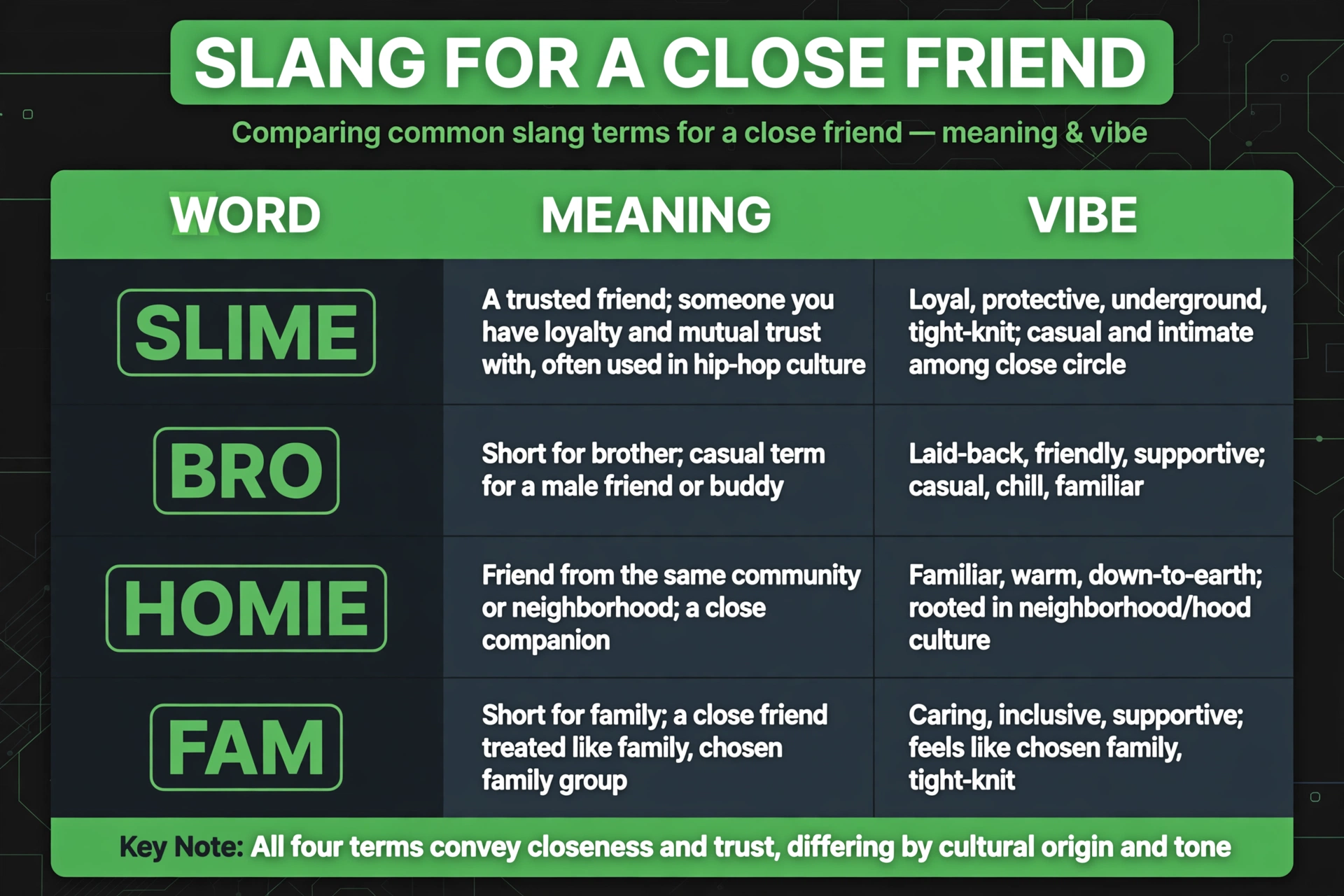
Slime slang overlaps with a lot of friendship words, but each one has its own flavor. The table below shows how “slime” compares with the terms people most often confuse it with, so you can pick the right word for the right moment.
| Term | Meaning | Vibe | Best Used When |
|---|---|---|---|
| Slime | A loyal, ride-or-die close friend | Hip-hop, loyal, street-smart | Talking about a day-one friend or your crew |
| Bro / Bruh | A male friend or brother figure | Casual, universal | Everyday greetings with any guy friend |
| Homie | A close friend from your neighborhood | Warm, old-school hip-hop | Talking about childhood or neighborhood friends |
| Fam | Someone treated like family | Warm, inclusive | Showing affection for a close-knit group |
| Dawg | A trusted male friend | Laid-back, classic slang | Casual conversation with a longtime friend |
| Slatt | “Slime Love All the Time” — a greeting and lifestyle | Hip-hop, YSL culture | Greeting a fellow fan or crew member |
| Ride or die | Someone loyal through anything | Intense, dramatic | Emphasizing extreme loyalty |
| Day one | A friend from the very beginning | Nostalgic, loyal | Talking about a friendship that goes way back |
The closest cousins are “homie” and “fam,” but “slime” adds something they do not: the hip-hop edge and the idea of a crew that moves together. “Bro” works with almost anyone; “slime” works best when the friendship has been tested. And while “slatt” comes from the same world, it is a greeting and a slogan, not a word for a person — you call someone your slime, but you say “slatt” to them. If you want to go deeper into the world of viral internet words, our guide to mewing meaning breaks down another TikTok-era term that spread the same way.
Alternate Meanings
Like many slang words, “slime” has more than one meaning — and some of them are the exact opposite of the friendly one. Context is everything, so it helps to know all the ways the word is used.
1. The literal substance. The original meaning of slime is a thick, gooey, sticky substance — the kind kids make from glue and borax, or the kind a snail leaves behind. This is the meaning most people knew first, and it is still the most common use outside of slang. The DIY slime toy craze of the late 2010s made this meaning huge on YouTube and TikTok, which is why the word feels familiar even to people who have never heard the hip-hop version.
2. A shady or untrustworthy person. In older English, calling someone a “slime” or “slimeball” was an insult — it meant they were sneaky, gross, or morally slippery. This negative meaning still exists, and it is the biggest source of confusion around the word. If someone who does not know the slang hears “you’re my slime,” they might hear an insult instead of a compliment. Tone, relationship, and context decide which meaning lands.
3. A term of endearment for a partner. Some people use “slime” for a significant other they also consider their best friend — “that’s my slime” can mean “that’s my person” in a romantic sense too. The loyalty angle works the same way; the relationship is just closer.
4. The acronym. As mentioned earlier, SLIME is also read as “Street Life Intelligence and Money is Everything,” a motto from Atlanta street culture. When rappers use the word in lyrics, this backronym is often part of what they mean — the word carries both the friendship and the hustle.
5. A snake symbol. In YSL fan culture, the snake emoji 🐍 has become a visual shorthand for slime. Fans drop it in comments to signal loyalty to Young Thug and the crew, the way other fandoms use their own symbols. If you see a comment that is just a snake emoji under a rap post, it is usually a slime shoutout.
Professional or Polite Alternatives
Slime slang is fun, but it is not right for every room. In formal, professional, or mixed company, these alternatives carry the same warmth without the street edge:
- Close friend — the safest all-purpose replacement; works everywhere.
- Best friend — clear and warm, good for speeches and captions.
- Trusted friend / trusted colleague — adds the loyalty angle in professional settings.
- Brother / sister (chosen family) — captures the “like family” feeling without slang.
- Day-one friend — keeps the loyalty and history, but in plain English.
- Confidant — formal, best for writing or serious conversation.
- My people / my crew — casual but widely understood, good for group settings.
A good rule of thumb: if you would not say “bro” in that setting, do not say “slime” either. Save slime slang for friends, fandom spaces, and creative contexts where everyone is in on the joke — and use the plain-English version everywhere else.
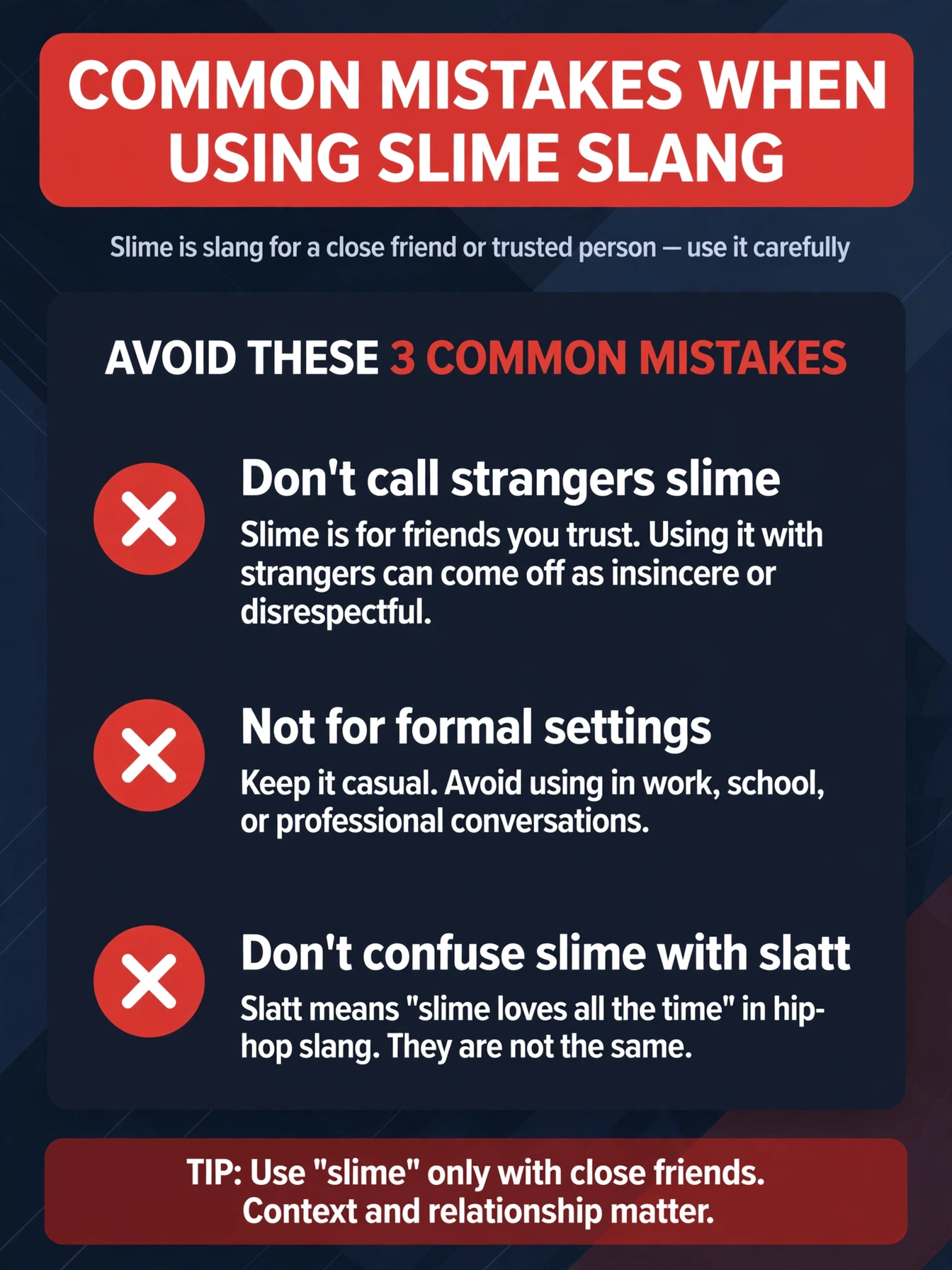
Common Mistakes
Slime slang is easy to get wrong, and the mistakes usually come from using the word in the wrong place or with the wrong person. Here are the ones to avoid:
1. Calling a stranger or acquaintance “slime.” The word implies a deep, tested bond. Using it with someone you barely know can feel presumptuous or just confusing — they may think you are insulting them, since “slimeball” is still an insult in standard English. Save it for real friends.
2. Using it in formal or professional settings. Dropping “my slime” in a work meeting, a job interview, or a client email will almost always land badly. The word is casual street slang, and formal settings need formal language.
3. Forgetting the negative meaning exists. Because “slime” can also mean a shady person, context is your safety net. If you are talking to someone older, someone outside hip-hop culture, or anyone who might not know the slang, the word can easily be misunderstood. When in doubt, explain it or pick a different word.
4. Overusing it until it sounds forced. Slang works because it feels natural. If you call everyone “slime” five times in one conversation, it stops sounding like you and starts sounding like a performance. Use it once, mean it, and move on — the same way you would with any nickname.
5. Mixing it up with “slatt.” “Slatt” is a greeting and a motto (“Slime Love All the Time”), not a word for a person. You say “slatt” to your slime; you do not call someone “my slatt.” Getting this backwards is the fastest way to sound like an outsider.
6. Using it sarcastically with people who will not get the joke. Irony only works when everyone shares the reference. Calling a rival or an enemy “slime” as a joke can read as an insult, because the negative meaning is right there waiting to be heard.
Quick Tips
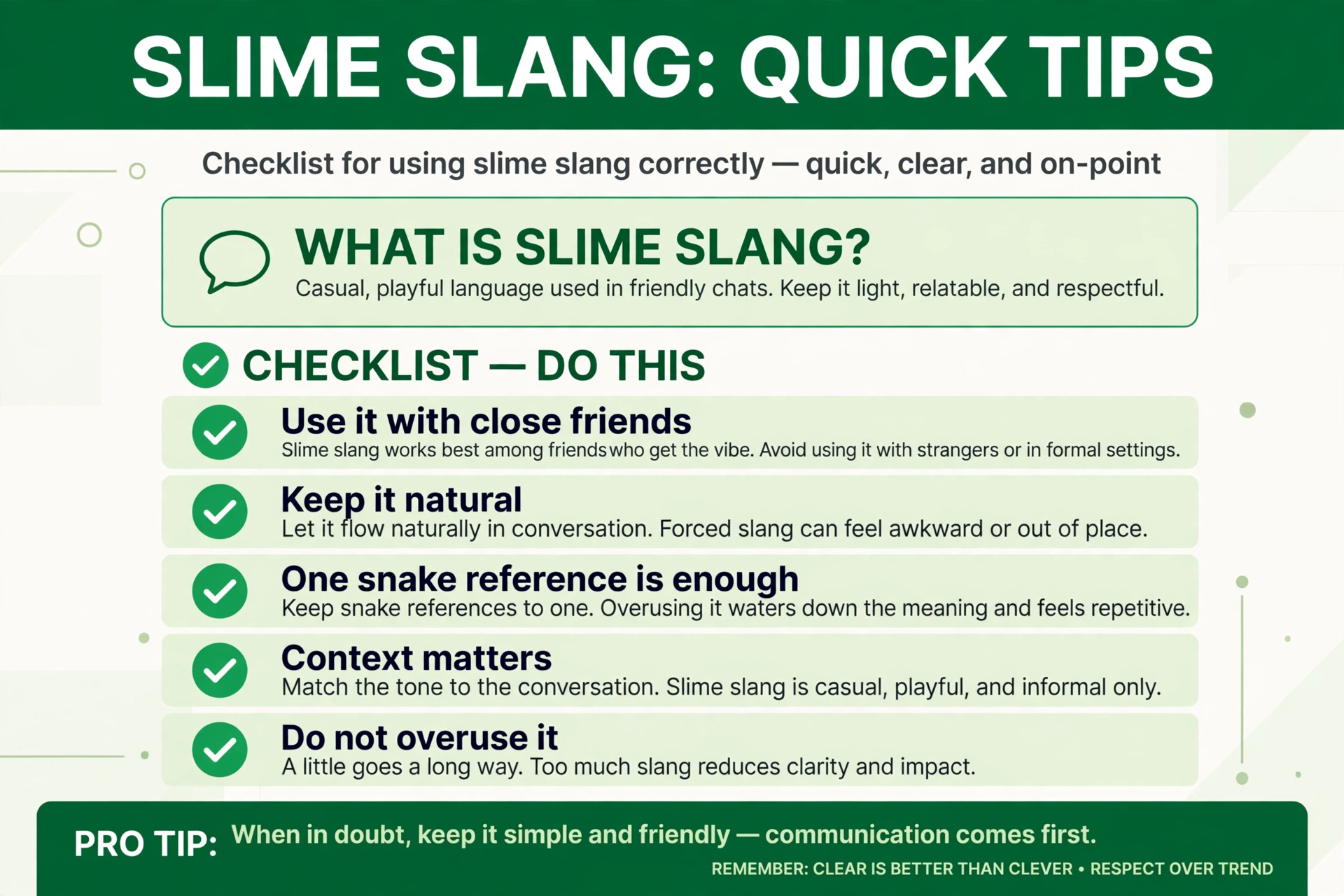
Want to use slime slang like someone who actually belongs in the conversation? These quick tips will keep you sounding natural:
- Use it with your real circle first. Practice the word with close friends who understand it before you try it in a bigger group or online.
- Let it come out naturally. The best slang sounds effortless. If you have to think hard about where to put “slime” in a sentence, the moment has probably passed.
- Pair it with the snake emoji — sparingly. A 🐍 in a comment or caption signals you know the culture, but one is enough. A wall of snake emojis looks like a parody.
- Match the energy of the room. In a rap comment section or a friend group chat, “slime” fits perfectly. In a family group chat with your grandparents, it probably does not.
- Learn the related words too. Knowing “slatt,” “YSL,” and “Slime Season” makes your use of “slime” sound informed instead of borrowed. Context is what separates fans from tourists.
- Listen before you speak. Spend a little time hearing how Young Thug, Gunna, and their fans actually use the word. The rhythm of real usage is the best teacher — and if you want more examples of how internet words travel from rap into everyday chats, the zesty meaning slang guide shows the same pattern with a very different word.
- Never use it to demand loyalty. “Slime” describes a bond that already exists; it cannot create one. Calling someone your slime does not make them loyal — being loyal does.

FAQ
What does slime slang mean?
Slime slang means a loyal, ride-or-die close friend — someone you trust completely, like a brother or a day-one homie. It comes from Atlanta hip-hop culture, where rappers like Young Thug popularized calling their closest friends “slime” to show loyalty and brotherhood.
Where did slime slang come from?
Slime slang comes from Southern hip-hop, especially the Atlanta rap scene of the early 2010s. Early uses trace back to rapper N.O.R.E. in 1999, but Young Thug made the word famous through his “Slime Season” mixtapes, his YSL collective, and constant use in lyrics and on social media.
What does “slatt” mean?
“Slatt” is short for “Slime Love All the Time.” It is a greeting and a lifestyle slogan from the same YSL world as slime slang. Fans and artists say “slatt” to greet each other and to show they live by loyalty. It is not a word for a person — you say “slatt” to your slime.
Is calling someone “slime” an insult?
It depends on context. In hip-hop slang, calling someone your slime is a compliment about loyalty and friendship. But in standard English, “slime” or “slimeball” can also mean a shady, untrustworthy person. Between friends who know the slang, it is warm and positive; with strangers or in formal settings, it can easily be misunderstood.
What does the snake emoji mean with slime?
The snake emoji 🐍 is the visual symbol of slime culture, tied to Young Thug and YSL. Fans use it in comments and captions to signal loyalty and membership in the slime world — similar to how other fandoms use their own symbols. One snake emoji is a nod; a whole comment full of them is usually a joke.
Can girls be called slime?
Yes. Slime slang is not gendered — it describes loyalty and closeness, not gender. Anyone can be someone’s slime, including a girlfriend, a sister, or a female best friend, and many women use the word for their own close friends too.
What is the difference between slime and homie?
Both mean a close friend, but “slime” carries a stronger hip-hop edge and a bigger emphasis on tested loyalty and crew membership. “Homie” is warmer and more old-school, often tied to neighborhood friendships, while “slime” sounds more modern and comes with the whole YSL cultural package — the snake emoji, “slatt,” and the idea of a crew that moves together.
Is slime slang still popular in 2026?
Yes. More than a decade after Young Thug popularized it, slime slang is still widely used in rap lyrics, TikTok comments, gaming chats, and group messages. It has outgrown its Atlanta origins and become a mainstream internet word for a loyal best friend, and it shows no sign of fading.
Conclusion
Slime slang is one of those rare words that packs a whole relationship into a single syllable. At its simplest, it means a loyal, ride-or-die friend — someone who sticks with you the way slime sticks to everything it touches. It was born in Atlanta hip-hop, raised by Young Thug and the YSL crew, and carried by TikTok and meme culture into group chats all over the world. And just like glazing slang found its own corner of internet culture, slime slang earned its place by naming something real: the feeling of having people you can truly count on.
The key takeaways are simple. Use “slime” for people who have earned it — your day ones, your crew, your ride-or-dies. Remember that the word has a second, negative meaning, so context and audience matter. Do not force it, do not overuse it, and do not confuse it with “slatt.” And if you are ever unsure whether the room will understand it, the plain-English version — “close friend” — is always safe.
Now that you know what slime slang means, you will start hearing it everywhere: in lyrics, in comments, in captions, and in your own group chats. And when someone calls you their slime, you will know exactly what they mean — you are not just a friend, you are family. For a full breakdown of the acronym behind the word, see 7ESL’s guide to slime, and keep exploring the slang words shaping the internet, from sigma slang to the newest TikTok terms — because the language never stops moving, and neither should your vocabulary.
