Quick definition: Pirate slang is the colorful collection of words, phrases, and expressions linked to pirates and sailors of the Golden Age of Piracy (roughly 1650–1730) — words like ahoy, matey, avast, and scallywag — that people now use playfully in everyday conversation, memes, text messages, and every September 19 on Talk Like a Pirate Day.
Pirate Slang Meaning & Definition
When someone says “pirate slang,” they usually mean the fun, salty way of speaking we associate with swashbuckling sea robbers: a hearty “Ahoy, matey!” here, a dramatic “Shiver me timbers!” there, and plenty of “arrs” sprinkled in for good measure. It is not a real historical language. Real pirates in the 1600s and 1700s mostly spoke like ordinary sailors of their time — a mix of English, Dutch, French, and Spanish nautical terms, depending on where they came from and which crew they sailed with.
What we call pirate slang today is really a blend of three things. First, genuine old nautical vocabulary: words like ahoy (hello), avast (stop), and landlubber (someone who has never been to sea) that sailors actually used. Second, literary inventions from Robert Louis Stevenson’s Treasure Island (1883), which gave us “shiver me timbers” and “fifteen men on the dead man’s chest.” And third, Hollywood — especially actor Robert Newton, whose exaggerated West Country accent as Long John Silver in the 1950 film version of Treasure Island basically invented the pirate voice we all imitate today.
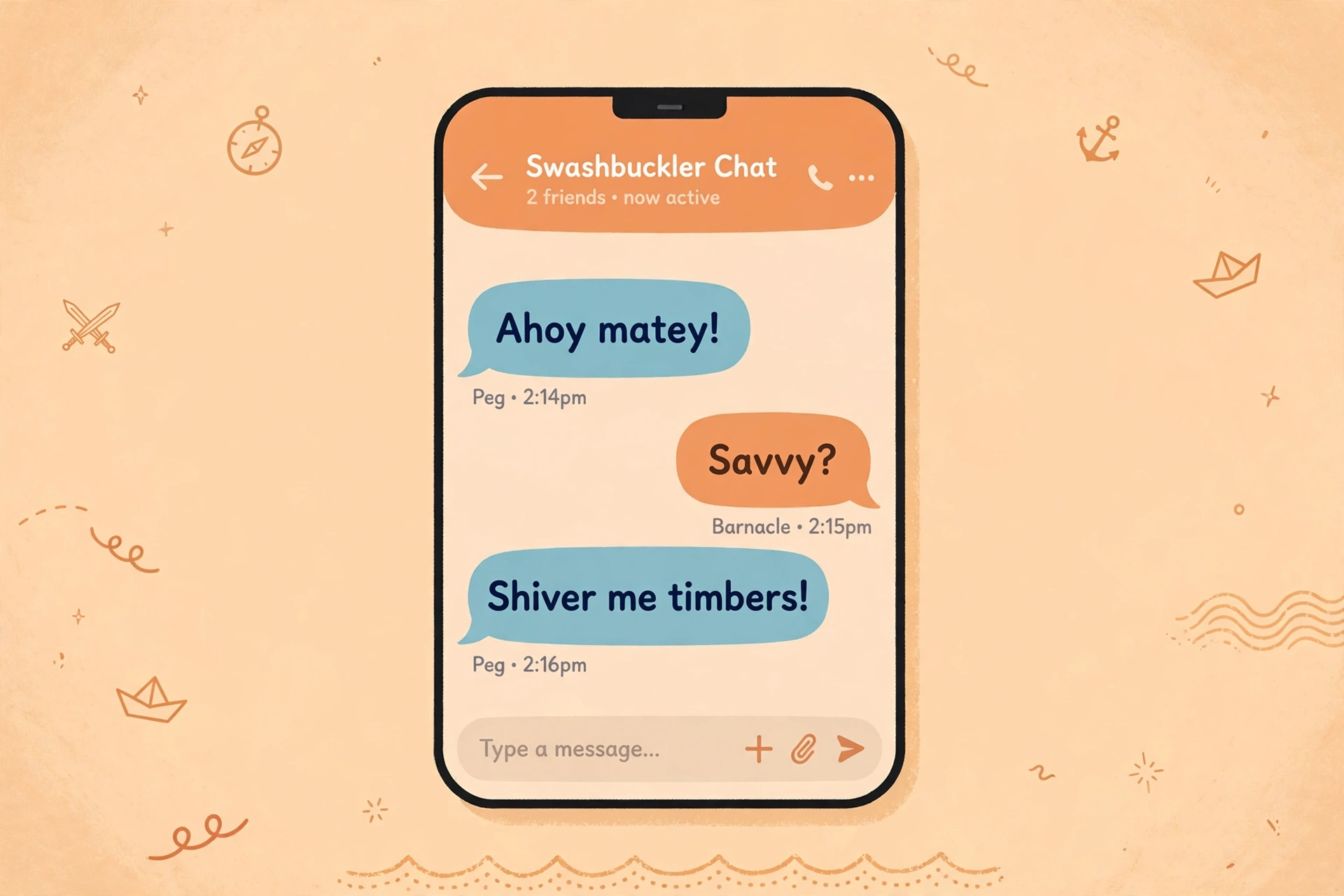
So when you drop a “savvy?” into a group chat or greet a friend with “ahoy, matey,” you are not speaking 17th-century pirate. You are speaking pop-culture pirate — and honestly, that is exactly why it is so much fun.
Introduction
Picture this: your friend walks into the room wearing an eye patch for a costume party, points at you, and declares, “Avast, ye scallywag!” Everyone laughs. Nobody needs a translation, because pirate slang is one of the few joke languages that almost everyone on Earth understands instantly. It shows up in memes, Halloween costumes, kids’ birthday parties, video games, and office Slack channels every single September.
But here is the thing most articles about pirate talk never tell you: half of the words people think are “pirate” were never used by actual pirates at all. “Arrr” as a constant grunt? Pure Hollywood. “Walk the plank” as a punishment? Almost certainly a myth — historians have found almost no evidence that pirates ever made anyone walk a plank. And “shiver me timbers”? A novelist made it up.
That does not make pirate slang any less worth learning. Quite the opposite. Because pirate slang is really a social language — a way to be playful, break the ice, and turn a boring Tuesday into something memorable. Whether you need lines for Talk Like a Pirate Day, a themed party, a funny text, or just want to understand what your kids are shouting while playing pirates in the garden, this guide has you covered. We will break down 40+ terms with plain-English meanings, real examples, a comparison with similar slang styles, and the mistakes that make people sound like a landlubber instead of a legend.
If you enjoy this kind of regional word guide, you will also like our roundup of Australian slang — another dialect where a single word can mean five different things depending on who is saying it.
Origin
Pirate slang traces its roots to the Golden Age of Piracy, roughly 1650 to 1730, when thousands of privateers, buccaneers, and outlaw sailors roamed the Caribbean, the Atlantic, and the Indian Ocean. These crews were remarkably international. A single ship might carry English, Dutch, French, Spanish, and African sailors, so the language of the sea became a practical mash-up — short commands that everyone could understand over wind and cannon fire.
Many of the most famous pirate words started as ordinary nautical terms. Ahoy comes from the Middle English cry used to hail another ship. Avast comes from the Dutch houd vast, meaning “hold fast.” Belay meant to secure a rope, and only later became a way to say “stop that!” Grog was the daily rum ration, watered down by Admiral Edward Vernon — nicknamed “Old Grog” for his grogram cloak — and the word eventually gave us “groggy,” the feeling of a hangover.
The second wave of pirate slang came from books. Robert Louis Stevenson’s Treasure Island introduced Long John Silver, Blind Pew, and the black spot — a mark of death placed on a pirate to warn him his crewmates had turned against him. The novel’s language was so vivid that readers assumed it was how pirates really talked. Then came the movies. Robert Newton’s 1950 performance as Long John Silver, with his rolling Rs and growled “Arrr, Jim lad,” cemented the accent in the public imagination. Disney’s Pirates of the Caribbean films, starting in 2003, gave the whole thing a second life — Captain Jack Sparrow’s constant “savvy?” became the most quoted pirate word of the 2000s.
The final ingredient is Talk Like a Pirate Day. Invented in 1995 by two friends from Oregon, John Baur and Mark Summers, and popularized by humor columnist Dave Barry in 2002, the holiday falls every September 19. It turned pirate slang from a movie novelty into a yearly ritual, with schools, offices, and social media all joining in.
For the real history behind the famous skull-and-crossbones flag, see Britannica’s guide to the Jolly Roger.
Popularity
Pirate slang never really goes away — it just surges. Search interest spikes every single September as Talk Like a Pirate Day approaches, then again around Halloween when pirate costumes flood the shops. The Pirates of the Caribbean franchise, with five films and billions at the box office, keeps the vocabulary alive for every new generation of kids. TikTok creators use pirate voice filters for comedy skits, gamers adopt names like “Cap’nBooty” and “ScurvyDog,” and “Talk Like a Pirate Day” trends on social media year after year.
Part of the appeal is that pirate slang is low-risk fun. Unlike a lot of internet slang, it is not tied to any one generation, it is not offensive when used lightly, and it works in almost any setting — a birthday card, a group chat, a pub quiz team name, or a work email sign-off on September 19. Parents teach it to kids, teachers use it for history lessons, and brands use it for playful marketing campaigns.
There is also a practical reason it sticks: the words are short, vivid, and memorable. “Avast” is more fun than “stop.” “Booty” is more fun than “loot.” “Scallywag” is a far friendlier insult than anything you would actually call someone. Pirate slang lets people be cheeky without being rude — and that is a rare trick in any language.
How It Is Used
Today, pirate slang shows up in four main places. The first is celebration: Talk Like a Pirate Day, Halloween, pirate-themed parties, and kids’ events. The second is humor: memes, jokes, and playful teasing between friends. The third is online: gaming usernames, social media bios, TikTok skits, and Discord servers. The fourth is casual conversation, where a well-timed “ahoy” or “savvy?” works as an icebreaker.
The tone is almost always playful. Pirate slang is a costume you wear with your words — you put it on for fun, and everyone knows you are joking. That is why it works so well in texts and group chats: it signals “I am being silly right now” without needing an emoji to explain it.
Here are the ground rules for using it well:
- Use it in small doses. One or two pirate words per sentence is charming. Every single word is exhausting.
- Match the moment. Great for parties, texts, and jokes. Terrible for job interviews, condolence messages, and serious meetings.
- Keep the classics. Ahoy, matey, avast, savvy, and scallywag are universally understood. Obscure 17th-century terms will just confuse people.
- Pair it with the attitude, not the accent. You do not need to growl your Rs. The words do the work.
- Know your audience. Kids love it. Your boss on a random Tuesday might not.
The Complete Pirate Slang Dictionary: 40+ Terms
Here is the big list — the words and phrases you will actually hear, with plain-English meanings and a quick example for each. Bookmark this table before your next pirate party.
| Pirate Term | Meaning | Example |
|---|---|---|
| Ahoy | Hello / attention | “Ahoy, matey! Good to see ye.” |
| Avast | Stop / pay attention | “Avast ye! No more snacks before dinner.” |
| Matey | Friend / crewmate | “Pass the chips, matey.” |
| Me hearties | My friends | “Listen up, me hearties!” |
| Savvy? | Do you understand? | “We leave at dawn, savvy?” |
| Scallywag | Playful rascal / rogue | “Ye little scallywag, ye ate the last cookie!” |
| Landlubber | Someone who knows nothing about the sea | “He gets seasick on a ferry — total landlubber.” |
| Shiver me timbers | Expression of shock | “Shiver me timbers! That bill is huge!” |
| Booty | Treasure / loot | “We split the booty after the yard sale.” |
| Grog | Rum / alcohol | “A pint o’ grog for the captain!” |
| Yo-ho-ho | Cheerful pirate chant | “Yo-ho-ho and a bottle of rum!” |
| Arrr | General pirate growl / yes | “Arrr, that be the plan.” |
| Buccaneer | A Caribbean pirate | “The old buccaneer told tales of the Spanish Main.” |
| Bilge rat | A disgusting or annoying person | “Get out of me way, ye bilge rat!” |
| Black spot | A mark of death or judgment | “He got the black spot from the crew.” |
| Walk the plank | Forced to walk off a plank into the sea (mostly myth) | “Make him walk the plank!” |
| Davy Jones’ locker | The bottom of the sea / death at sea | “Me phone fell in the ocean — Davy Jones’ locker for it.” |
| Jolly Roger | The pirate flag (skull and crossbones) | “Raise the Jolly Roger!” |
| Dead man’s chest | A treasure chest / a sailor’s sea chest | “Fifteen men on the dead man’s chest.” |
| Cutlass | A short, curved pirate sword | “He waved his cutlass in the air.” |
| Hornswoggle | To cheat or trick someone | “Ye hornswoggled me out of me gold!” |
| Cackle fruit | Eggs (pirate slang for chicken eggs) | “Cackle fruit for breakfast, lads.” |
| Belay | Stop that / cancel that order | “Belay that talk, sailor!” |
| Blimey | Expression of surprise | “Blimey! Look at the size of that wave!” |
| Bucko | Friend / young sailor | “Aye, me bucko, lend a hand.” |
| Cap’n | Captain | “Aye aye, Cap’n!” |
| Crow’s nest | The lookout platform high on the mast | “Up to the crow’s nest with ye!” |
| Groggy | Dazed / hungover (from grog) | “I woke up feeling groggy.” |
| Scurvy | Disease from lack of vitamin C — also used as an insult (“scurvy dog”) | “Ye scurvy dog!” |
| Swashbuckler | A bold, daring adventurer | “He fights like a proper swashbuckler.” |
| Treasure map / X marks the spot | The spot where treasure is buried | “X marks the spot, matey.” |
| Marooned | Abandoned on a deserted island | “They marooned him with a pistol and a bottle.” |
| Keelhaul | A brutal punishment (dragged under the ship) | “Keelhaul the traitor!” |
| Aye | Yes | “Aye, that be true.” |
| Aye aye | Yes, I understand and will obey | “Aye aye, Cap’n!” |
| Nay | No | “Nay, I won’t do it.” |
| Ye | You | “What be ye doing?” |
| Fathom | To understand (originally, to measure water depth) | “I can’t fathom why he did that.” |
| Three sheets to the wind | Very drunk | “He was three sheets to the wind by midnight.” |
| Cut of his jib | Someone’s appearance or character | “I like the cut of his jib.” |
Examples
Knowing the words is one thing — using them naturally is another. Here are pirate slang examples for different situations, so you can see how the tone changes with context.
Friendly Examples
- “Ahoy, matey! Long time no see — how be ye doing?”
- “Happy birthday, me hearty! May yer day be full of booty and cake.”
- “Savvy, friend? We meet at the pub at seven sharp.”
- “Ye did a fine job today, bucko. The Cap’n would be proud.”
- “Fair winds to ye, matey — see ye on Monday!”
Professional Examples
Yes, pirate slang can work at the office — lightly, and only on the right day. Think Talk Like a Pirate Day or a team social, never a client presentation.
- “Ahoy, team! Let’s set sail on this project — first stop, the kickoff meeting.”
- “Avast, me hearties — a quick reminder that the deadline be Friday.”
- “Great work, crew. Ye all earned yer share of the booty (the bonus, that is).”
- “Savvy? If anyone has questions, my door — or me cabin — is always open.”
Funny Examples
- “Shiver me timbers! The Wi-Fi be down again — we be truly lost at sea.”
- “Me parrot filed a complaint with HR. Apparently I be ‘too loud on Mondays.'”
- “I asked the GPS for directions and it said, ‘Arrr, ye be going the wrong way, matey.'”
- “Yo-ho-ho and a bottle of… coffee. The Cap’n runs on caffeine now.”
- “Ye scallywag! Who drank the last of the grog — I mean, the office milk?”
Comparison with Similar Terms
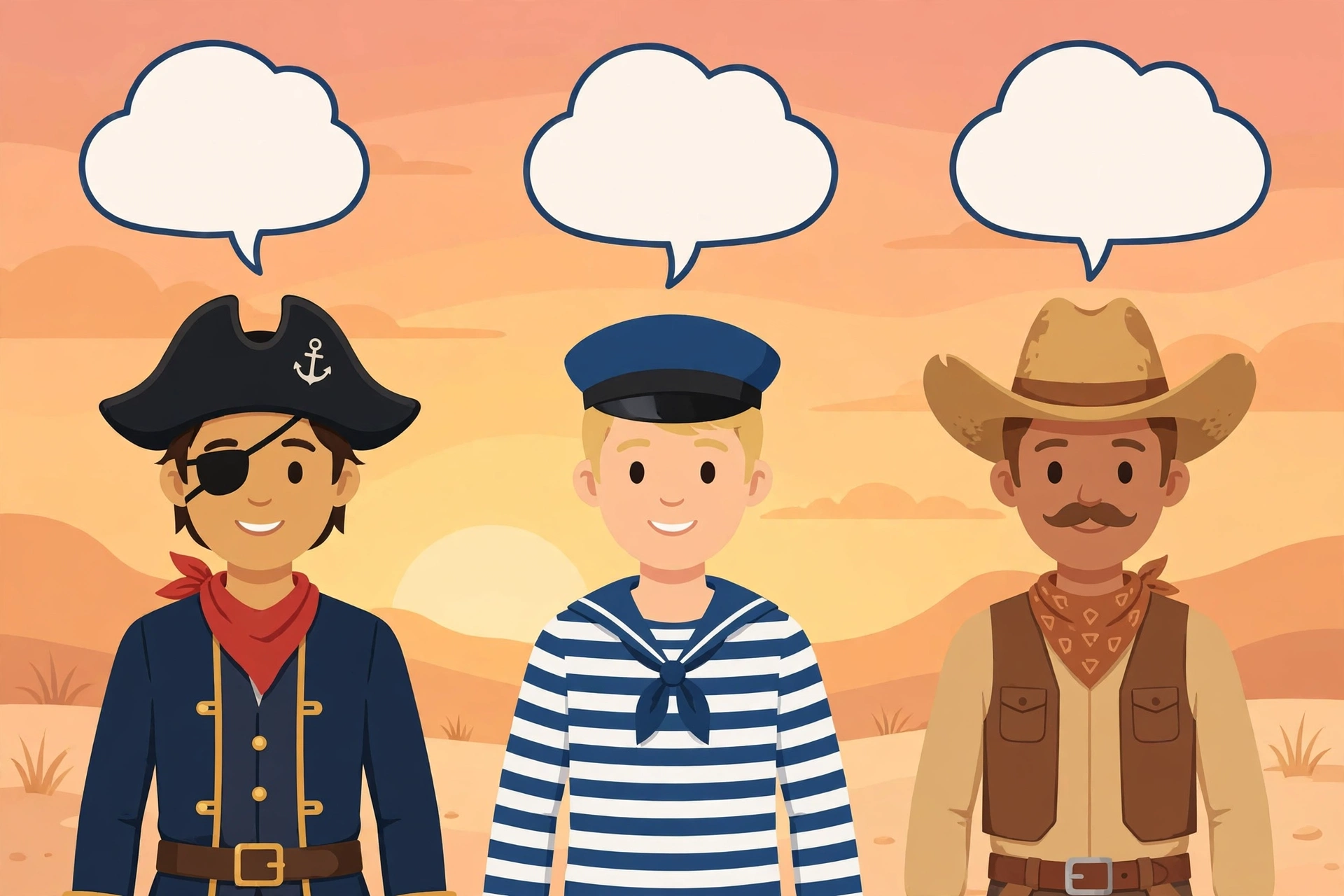
Pirate slang is often confused with other colorful ways of speaking. Here is how it stacks up against sailor slang, cowboy slang, and modern internet slang — so you can pick the right flavor for the moment.
| Style | Origin | Typical Words | Best For |
|---|---|---|---|
| Pirate slang | Golden Age of Piracy + Hollywood | Ahoy, matey, avast, booty, scallywag | Parties, jokes, Talk Like a Pirate Day |
| Sailor slang | Real naval and merchant seafaring | Port, starboard, aft, keelhaul, fathom | Boating, nautical talk, history lovers |
| Cowboy slang | American West, 1800s ranching | Howdy, partner, yeehaw, rustler | Western parties, country events |
| Modern internet slang | Social media, gaming, Gen Z/Gen Alpha | No cap, slay, rizz, aura points | Texts, TikTok, group chats |
The key difference is that sailor slang is mostly real, technical language — “port” and “starboard” are still used on ships today — while pirate slang is mostly theater. Cowboy slang sits somewhere in between: some of it is real ranching talk, some of it is Hollywood. And modern internet slang, like the Gen Alpha slang terms kids use today, changes so fast that a word can be cool on Monday and embarrassing by Friday. Pirate slang has the opposite problem: it has barely changed in 70 years, which is exactly why everyone still understands it.
Another useful distinction: pirate slang is a performance language. Nobody speaks it as their native tongue. That makes it closer to quoting movie lines than to learning a dialect — and that is why getting it slightly wrong is fine. Nobody will correct your “arrr” the way they might correct your French.
Alternate Meanings
The word “pirate” has sailed far beyond the sea, and “pirate slang” can mean different things depending on the context:
- Software piracy: “Pirate” is also used for illegally copied movies, games, and software — as in “pirated software.” This has nothing to do with pirate talk, but it is the most common modern use of the word “pirate” in tech news.
- Pirate radio: Unlicensed radio stations that broadcast without permission are called pirate radio stations, a term from the 1960s offshore stations.
- “Pirate” as a verb: To pirate something means to steal or copy it without permission — “They pirated the movie within hours of release.”
- Booty’s double life: In pirate slang, booty means treasure. In modern slang, it means something very different. Context is everything — do not use “booty” in a work email unless you are clearly talking about a treasure chest.
- Matey vs. mate: “Matey” is pirate for friend. “Mate” is everyday Australian and British slang for friend. They sound similar but belong to different worlds — one is a costume, the other is a real dialect.
- Savvy in business: “Savvy” escaped pirate talk entirely and is now standard business English — “tech-savvy,” “media-savvy,” “business savvy.” Nobody saying “tech-savvy” is thinking about Captain Jack Sparrow.
- Sports and gaming: Teams like the Pittsburgh Pirates keep the imagery alive, and “pirate” shows up constantly in video game names, usernames, and clan tags.
Professional or Polite Alternatives
Pirate slang is fun, but there are moments when “avast, ye scallywag” will not land well. Here is a quick translation table for formal situations — the same energy, minus the eye patch.
| Pirate Phrase | What It Means | Polite Alternative |
|---|---|---|
| “Avast, ye scallywag!” | Stop that, you rascal | “Excuse me — could you please stop that?” |
| “Shiver me timbers!” | I’m shocked! | “Wow, that’s surprising!” |
| “Savvy?” | Do you understand? | “Does that make sense?” |
| “Ye bilge rat!” | You annoying person | “That’s really frustrating.” |
| “Walk the plank!” | You’re fired / get out | “We’ll have to let you go.” |
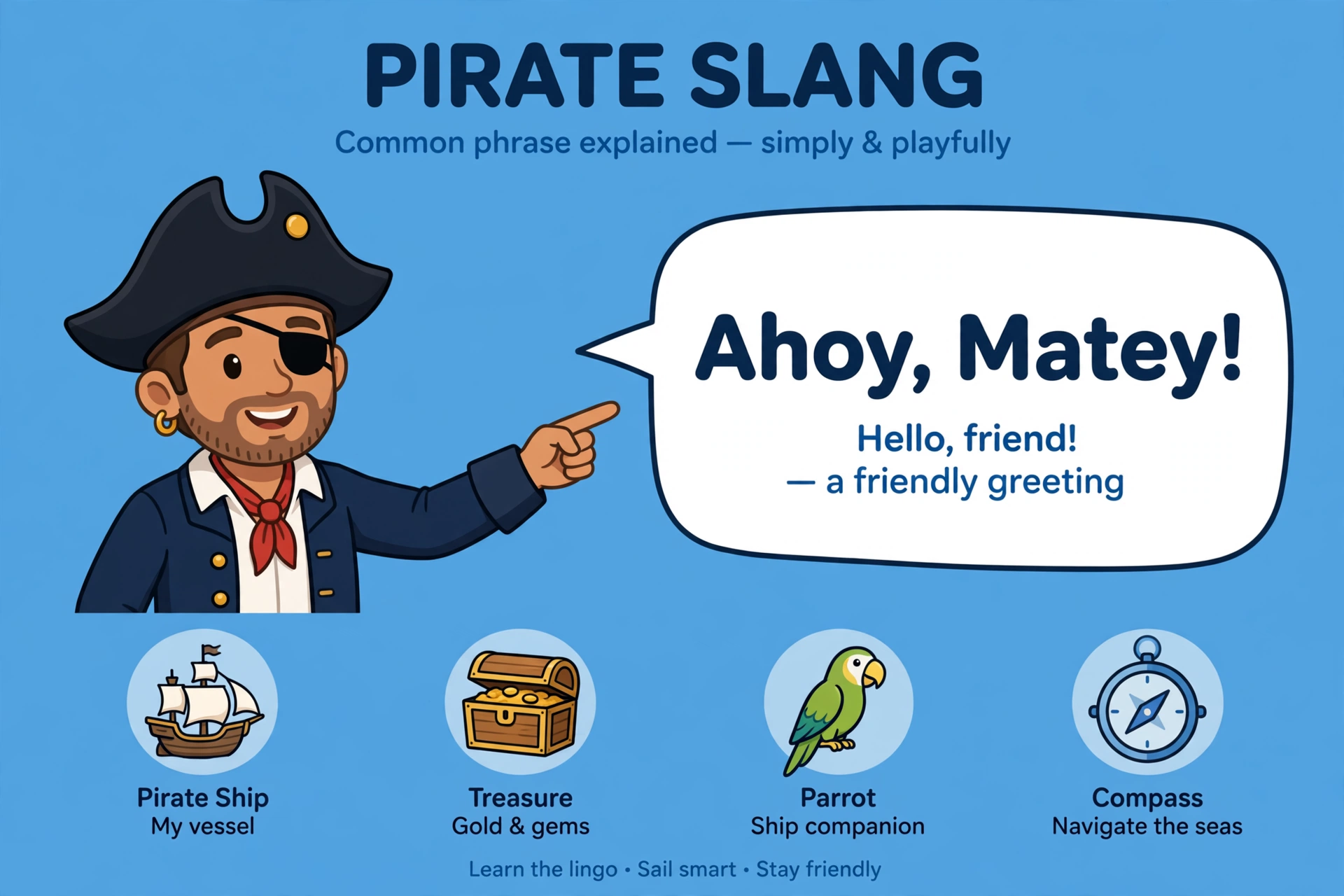
| “Ahoy, matey!” | Hello, friend | “Hi there! Good to see you.” |
| “Where be the booty?” | Where’s the reward / money? | “Could you share the details of the bonus?” |
| “Belay that talk!” | Stop talking like that | “Let’s keep the conversation respectful, please.” |
Common Mistakes
Most people get pirate slang wrong in the same handful of ways. Avoid these and you will sound like a charming pirate instead of a confused landlubber:
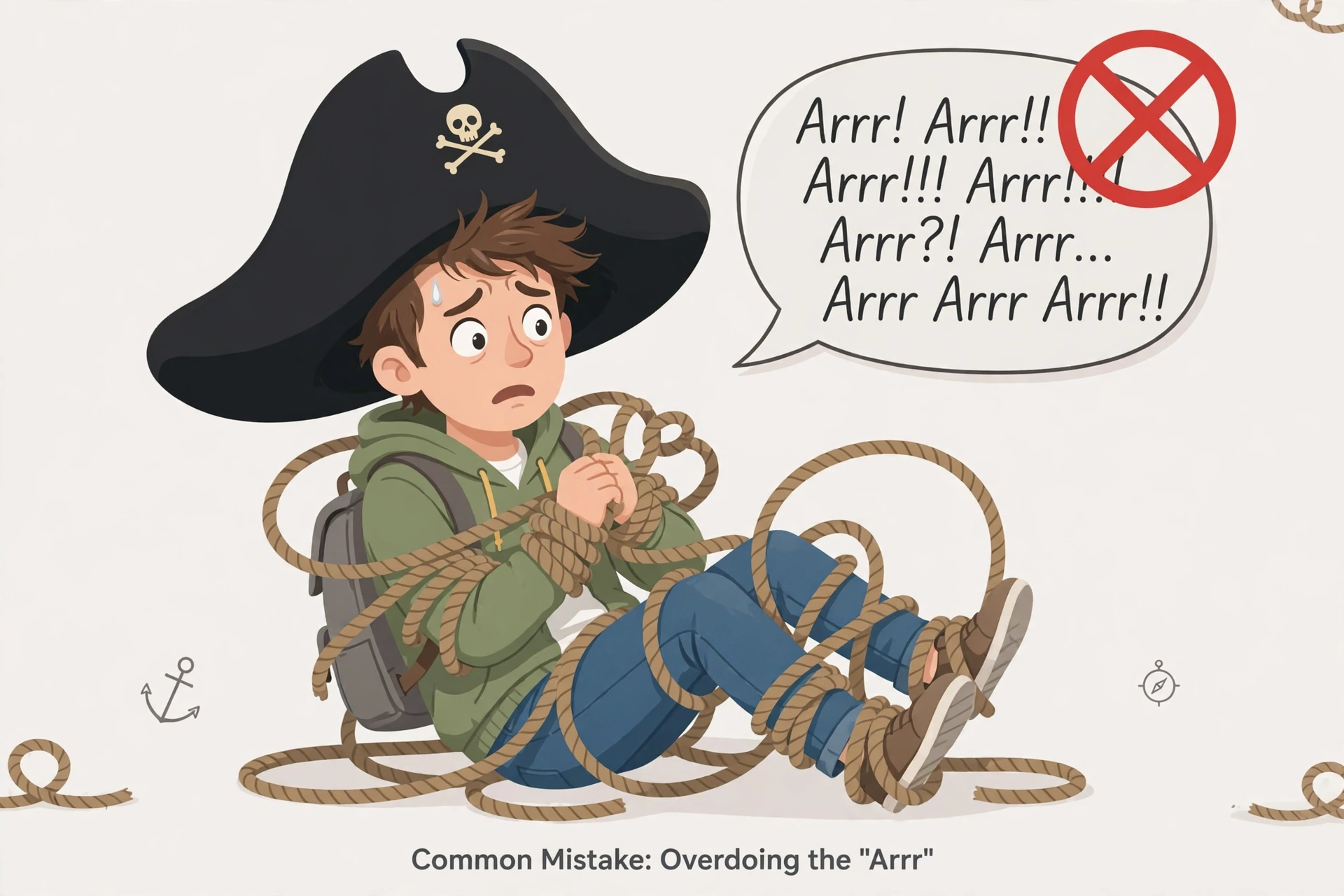
- Saying “arrr” after every word. Real pirates — and good pirate impersonators — use it sparingly. One “arrr” per sentence is plenty. Five is a cry for help.
- Thinking pirates actually talked like this. They did not. The accent and most of the catchphrases come from movies and novels. Knowing that makes you sound smarter, not less fun.
- Using “matey” with strangers in formal settings. Calling your new boss “matey” on day one is a bold move. Save it for friends and parties.
- Mixing up “ye” and “you.” “Ye” means “you” — so “what be ye doing” is correct, but “ye is” is not. Keep it simple: use “ye” only where “you” would go.
- Confusing pirate and sailor terms. “Port” and “starboard” are sailor words, not pirate catchphrases. Dropping them into a pirate joke is fine, but they are not punchlines.
- Overdoing the accent. You do not need to growl, spit, or roll every R. The words themselves carry the joke — say them in your normal voice and they land better.
- Using “walk the plank” as a real threat. It is a joke, not a management technique. In a workplace, it reads as odd, not funny.
- Forgetting the audience. Kids love pirate talk. A formal dinner party? Read the room first.
Quick Tips
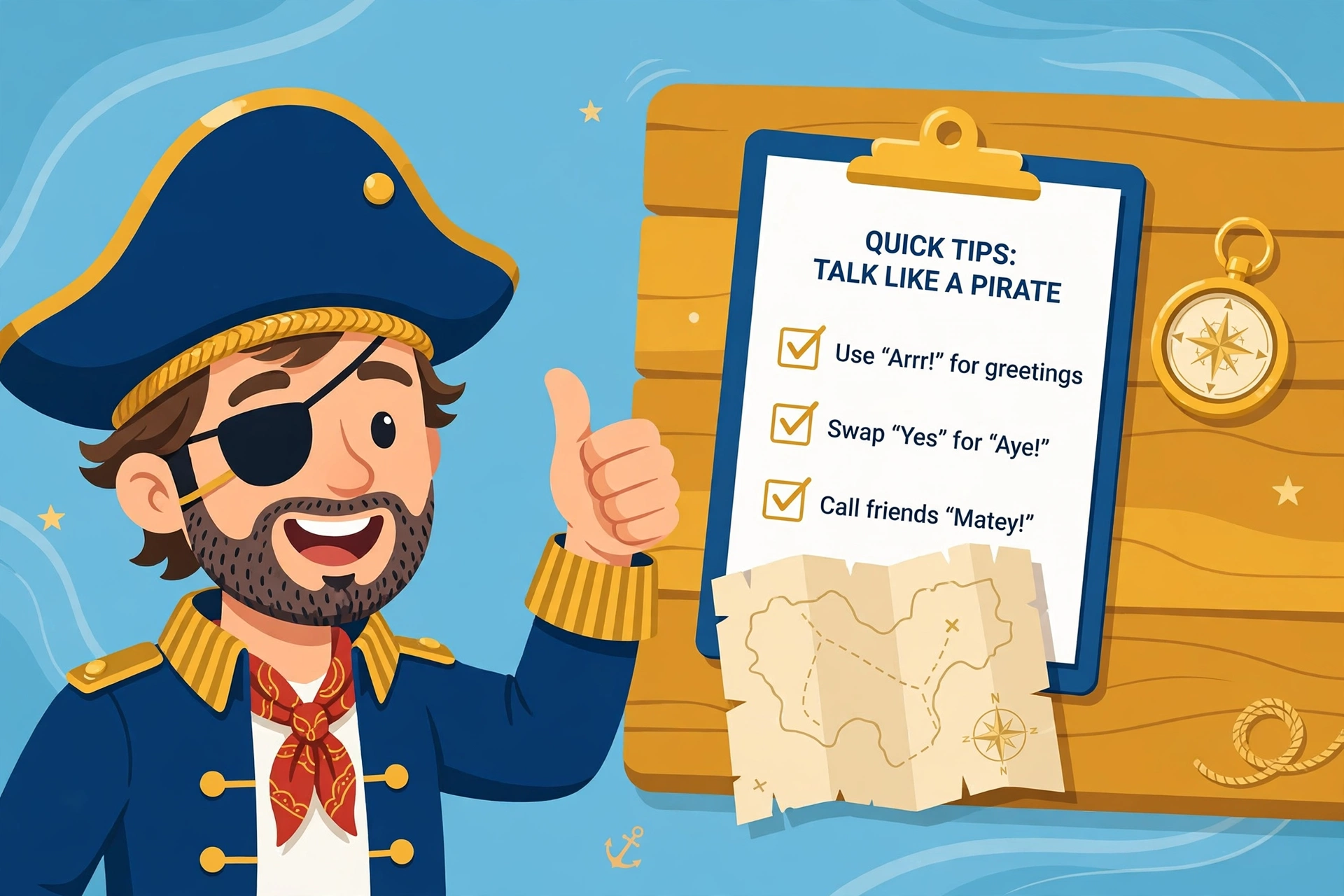
Want to talk like a pirate without sounding like you are trying too hard? These tips will get you there:
- Start with three words. Learn ahoy, matey, and savvy — that trio covers 90% of pirate conversations.
- Swap “you” for “ye” and “your” for “yer.” “What be yer plan, matey?” instantly sounds piratical.
- Drop the “g” sometimes. “Sailin’,” “fightin’,” “drinkin'” — the dropped G is half the pirate sound.
- Add “me” before nouns. “Me ship,” “me crew,” “me treasure” — this one small change does a lot of work.
- Use “be” instead of “is” or “are.” “That be the way” instead of “that is the way.”
- Keep a few phrases ready. “Shiver me timbers,” “dead man’s chest,” and “fair winds” are the greatest hits for a reason.
- Practice on Talk Like a Pirate Day. September 19 is the one day a year when everyone expects it — the perfect low-pressure rehearsal.
- Watch one movie. A single viewing of Pirates of the Caribbean: The Curse of the Black Pearl will teach you the rhythm better than any list.
FAQ
What does pirate slang mean?
Pirate slang is the playful set of words and phrases associated with pirates — like ahoy, matey, avast, and scallywag — drawn from old nautical language, the novel Treasure Island, and Hollywood pirate films. Today people use it jokingly in conversation, texts, parties, and on Talk Like a Pirate Day.
What do pirates say instead of hello?
Pirates say “ahoy!” as a greeting — or “ahoy, matey!” when greeting a friend. “Ahoy” was a real nautical hail used to call attention to another ship, and it later became the standard pirate hello in books and films.
What does “shiver me timbers” mean?
“Shiver me timbers” is an expression of shock or surprise, similar to saying “wow!” or “good grief!” It was popularized by Robert Louis Stevenson’s Treasure Island (1883) — “timbers” refers to the wooden beams of a ship, and “shiver” means to shake or splinter.
Did real pirates actually talk like this?
Mostly, no. Real pirates spoke like ordinary sailors of their time, using practical nautical terms from several languages. The exaggerated “arrr” accent and many famous catchphrases come from Robert Louis Stevenson’s novels and actor Robert Newton’s 1950 film performance as Long John Silver.
What is Talk Like a Pirate Day?
Talk Like a Pirate Day is celebrated every year on September 19. It was invented in 1995 by John Baur and Mark Summers, and became popular after humor columnist Dave Barry wrote about it in 2002. On the day, people greet each other with “ahoy, matey” and drop pirate words into everyday conversation.
What does “matey” mean?
“Matey” means friend or crewmate. It comes from “mate,” the old nautical word for a fellow sailor or companion. Pirates in stories use it as a warm, familiar way to address each other — “pass the grog, matey.”
What does “avast” mean?
“Avast” means “stop” or “pay attention.” It comes from the Dutch phrase houd vast (“hold fast”) and was a real command used by sailors to stop an action, like hauling on a rope. In pirate talk it works as a dramatic “hold on!” or “stop right there!”
How do you say goodbye in pirate slang?
Common pirate goodbyes include “fair winds to ye,” “until we meet again, matey,” and “may yer sails stay full.” For a dramatic exit, “Yo-ho-ho!” works too. If you want to learn more fun slang words, check out our guide to 67 meaning slang — another term taking over group chats right now.
Conclusion
Pirate slang is proof that a few great words can sail for centuries. From the decks of Caribbean ships in the 1700s, through the pages of Treasure Island, onto cinema screens with Captain Jack Sparrow, and into your group chat today — “ahoy,” “matey,” “avast,” and “savvy” have survived because they are short, vivid, and fun to say.
The trick is using them lightly. Learn the classics from the dictionary above, drop one or two into the right moment, and skip the full accent unless you are at a costume party. Know that the history is half real and half Hollywood — and that knowing the difference makes you the most interesting pirate at the table.
So the next time September 19 rolls around, or a friend texts you something ridiculous, you will be ready: “Ahoy, matey! Shiver me timbers — that be a fine tale, savvy?” And if you want to keep expanding your slang vocabulary, dive into our aura points meaning guide next — because modern internet slang changes fast, and yesterday’s pirate is today’s TikTok trend.
