
Quick definition: California slang is the casual, laid-back vocabulary and set of expressions associated with California — words like hella, dude, gnarly, stoked, and no worries — used to sound relaxed, friendly, and unmistakably West Coast in everyday conversation, texting, and social media.
California Slang Meaning & Definition
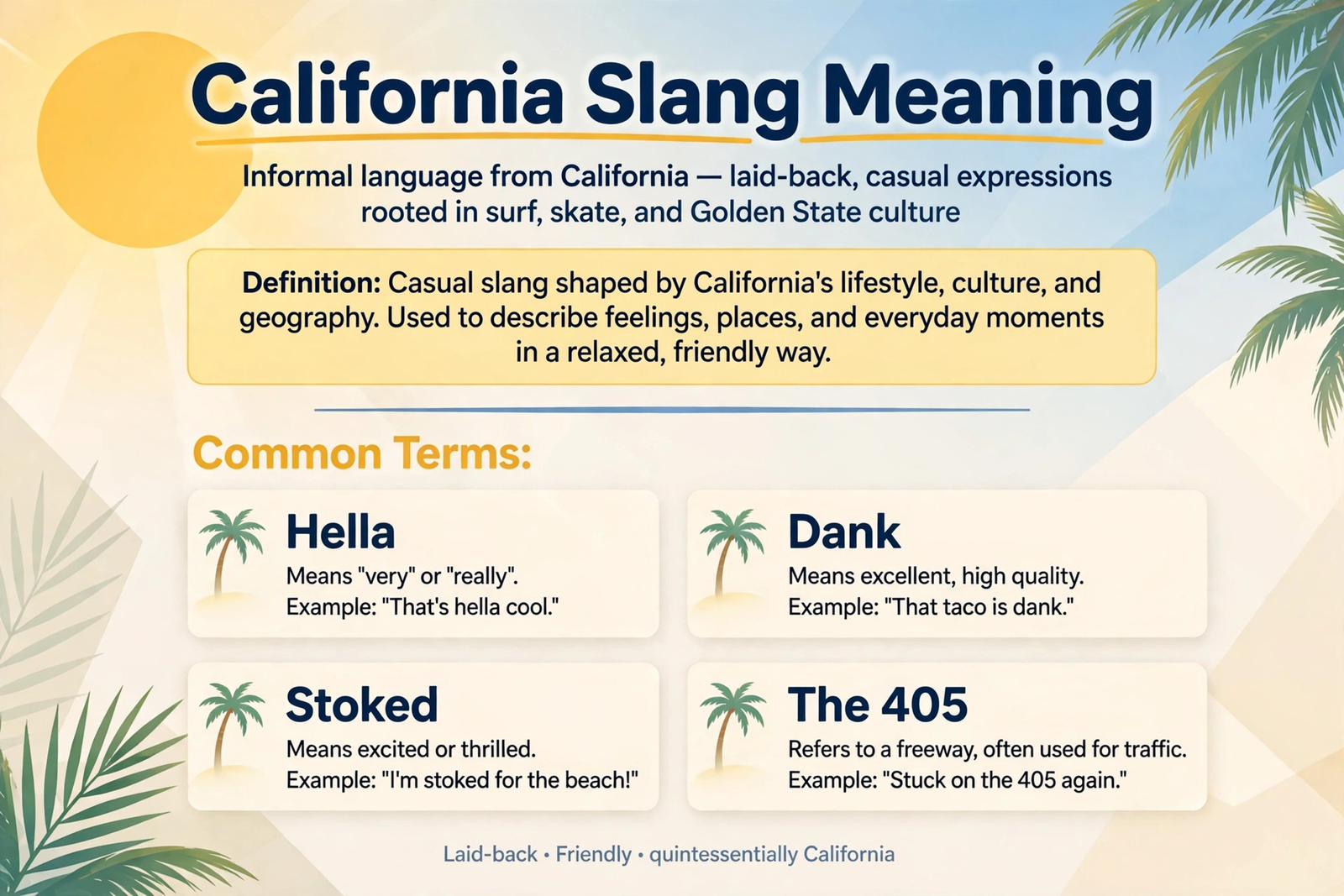
California slang refers to the informal words, phrases, and speech patterns that people in California — especially in Southern California, the Bay Area, and the state’s surf and skate communities — use in everyday conversation. It is not a separate language, and it is not one fixed list of words. Instead, it is a loose collection of expressions shaped by surf culture, skateboarding, hip-hop, Hollywood, tech culture, and the state’s large and diverse population.
When someone asks what California slang means, they are usually asking one of two things. Sometimes they want the definition of a specific word they heard, like hella or gnarly. Other times they want a broader picture: how do Californians actually talk, what makes their speech sound different from the rest of the United States, and which words are worth using — and which ones will make you sound like you are trying too hard.
At its core, California slang is defined by tone as much as by vocabulary. The words themselves are often simple, but the attitude behind them is relaxed, upbeat, and deliberately low-pressure. A Californian might say “no worries” instead of “you’re welcome,” “I’m stoked” instead of “I’m excited,” or “that’s hella cool” instead of “that’s very cool.” The meaning is the same, but the feeling is different — warmer, looser, and less formal.
Some of the most recognizable California slang terms include:
- Hella — very, a lot, really. “That concert was hella good.” This word is strongly associated with Northern California, especially the Bay Area.
- Dude — a casual way to address someone, or an exclamation of surprise. “Dude, you have to see this sunset.”
- Gnarly — cool, impressive, intense, or difficult, depending on context. Originally a surfer term for a dangerous wave.
- Stoked — excited, thrilled, or really happy about something. “I’m so stoked for summer.”
- Bummer — a disappointment or a sad situation. “Missing the flight was such a bummer.”
- Rad — awesome, cool, excellent. A shortened form of “radical” that survived from 1980s surf and skate culture.
- Trippy — strange, weird, or mind-bending. “That movie was so trippy.”
- No worries — no problem, don’t worry about it, you’re welcome. One of the most widely used California phrases.
- For sure — definitely, absolutely, I agree. “Are you coming to the beach? For sure.”
- Chill — relaxed, calm, easygoing — or a person who is easy to get along with. “He’s super chill.”
It is worth noting that many words people call “California slang” are now used across the whole country, thanks to movies, music, and social media. The difference is frequency and combination. A person in Ohio might say “dude” once in a while; a Californian might say “dude,” “hella,” and “for sure” in a single sentence without thinking about it. That density, and the relaxed delivery, is what gives California speech its distinctive sound.
California slang also includes place-based expressions. Saying “the 405” instead of “405” for a freeway, calling the state “Cali” in casual conversation, or describing the weather as “June gloom” all mark someone as familiar with California life. These are not just words — they are small signals of belonging, and they are part of why people are so curious about how Californians talk.
Introduction
Picture this: you land in Los Angeles, step outside the airport, and within five minutes someone tells you the traffic on the 405 is “gnarly,” the tacos down the street are “hella good,” and you should “totally check out” the beach because the sunset is “insane.” You understood every word, but the combination felt different — breezier, more casual, and somehow sunnier than the English you hear back home.
That is California slang in action. It is one of the most imitated and parodied ways of speaking in the United States, and it has been for decades. Movies like Fast Times at Ridgemont High and Clueless, TV shows set in Los Angeles and San Francisco, and songs by California artists have all carried this way of talking far beyond the state line. Today, TikTok and Instagram have spread it even further, which is why teenagers in states that have never seen the Pacific Ocean now say “no worries” and “for sure” without a second thought.
But California slang is more than a collection of funny words from old movies. It is a living, changing part of American English, and it reflects the real history of the state: its surf beaches, its skate parks, its film industry, its tech boom, and its mix of cultures and languages. Understanding it is useful whether you are moving to California, visiting for the first time, texting a friend from San Diego, or simply trying to understand what your favorite creator means when they say something is “so fire” or “lowkey iconic.”
In this guide, we will break down exactly what California slang means, where it came from, why it became so popular, and how people actually use it in real life. You will find real examples for friendly chats, work conversations, and funny situations, a comparison table showing how California terms stack up against similar slang from other places, and a full FAQ answering the questions people search for most. If you have ever wondered whether you should say “hella” or “very,” whether “dude” is still okay to use, or what makes a word sound Californian in the first place, you are in the right place. For a fun contrast, check out our guide to Australian slang, which shows how another sunny, beach-loving culture built its own completely different slang vocabulary.
Origin
California slang did not appear overnight, and it did not come from one single source. It grew over decades, layer by layer, as different groups of people moved to California and mixed their ways of speaking together. To understand where it came from, it helps to look at the four big influences that shaped it.
Surf culture came first. In the 1950s and 1960s, surfers along the Southern California coast developed their own vocabulary for describing waves, weather, and the feeling of riding a wave. Words like gnarly (originally describing a rough, dangerous wave), radical (later shortened to rad), stoked (the rush of excitement after a great ride), and bogus (something unfair or bad) all started in the surf world. Surfers also popularized the slow, drawn-out way of speaking — the famous “surfer drawl” — that movies later turned into a stereotype. The beach was not just a place to surf; it was a whole lifestyle, and its language spread as surf culture became fashionable across America.
Skateboarding and youth culture added the next layer. In the 1970s and 1980s, skateboarders in Venice Beach and other California towns borrowed surf words and added their own. Sick came to mean amazing, gnarly gained its positive meaning of “impressively cool,” and dude became the all-purpose word for addressing a friend. Skate videos, punk music, and later the X Games carried these words to teenagers everywhere. This is also when California slang became strongly associated with being young, rebellious, and laid-back — an image that stuck.
Hollywood and the entertainment industry made it famous. California is home to the film and television industry, and for decades, movies and TV shows have used California speech as shorthand for cool, casual, and fun. The “Valley Girl” accent and vocabulary of the 1980s — “like,” “totally,” “oh my god,” “whatever” — came from the San Fernando Valley in Los Angeles and became a national phenomenon after the movie Valley Girl and the song “Valley Girl” by Frank Zappa. Later, films and shows set in California kept the tradition going, and every new generation of actors added their own spin.
Hip-hop, tech, and immigration kept it evolving. From the 1990s onward, California hip-hop — from Los Angeles, Oakland, and the Bay Area — added words like hyphy (a Bay Area term for wild, energetic, and hyped up) and helped spread hella beyond Northern California. At the same time, the tech boom in Silicon Valley brought in people from all over the world, and Spanish, Spanglish, and other languages influenced everyday speech in Southern California. Words like órale and phrases borrowed from Mexican Spanish became part of the mix, especially in Los Angeles. The result is a slang tradition that keeps changing: older words like groovy fade away, while new ones appear on TikTok every year.
One thing that makes California slang unusual is that it has two regional flavors. Northern California, especially the Bay Area, is known for hella, hyphy, and a slightly faster, more clipped way of speaking. Southern California, especially Los Angeles and San Diego, is known for dude, gnarly, the drawn-out vowels, and the freeway habit of saying “the 405” or “the 101.” People in California can often tell which half of the state someone is from just by listening for a few seconds — and that friendly North-versus-South rivalry is part of the fun.
Popularity
California slang is one of the most widely recognized regional vocabularies in the United States, and its popularity has only grown with the internet. There are a few clear reasons for that.
First, California is the most populous state in the country, and its culture is exported constantly. California produces a huge share of America’s movies, television shows, music, and online content. When millions of people watch a show set in Los Angeles or follow a creator who lives in California, they absorb the way those people talk — often without realizing it. A word that starts in a San Diego skate park can be trending on TikTok in Texas within a week.
Second, California slang sounds friendly and approachable. Unlike some regional slang that can sound harsh or hard to understand, California expressions are mostly positive and easy to pick up. “No worries,” “for sure,” “sounds good,” and “I’m stoked” are all warm, low-conflict phrases. They make the speaker sound relaxed and easygoing, which is an appealing image — and that is exactly why brands, influencers, and even politicians sometimes borrow the style.
Third, the words are useful. Hella is a perfect example: it is shorter and punchier than “very” or “a lot,” and it works as both an adjective and an adverb. “That’s hella far” and “there were hella people there” both sound natural. Words that fill a real gap in the language tend to survive, and hella has survived for decades for that reason. The same is true of dude, which works as a greeting, a name, an exclamation, and a way to show surprise — all in one syllable.
Search interest in California slang also spikes around pop culture moments. A viral movie, a popular show set in California, or a celebrity interview full of “like” and “totally” can send thousands of people searching for what a particular word means. And because so many people now move to California for work, school, or the tech industry, “how to talk like a Californian” has become a genuine practical question, not just a curiosity. New arrivals want to understand their coworkers, their neighbors, and the jokes they hear at the beach — and they do not want to sound lost when someone says the traffic was “gnarly.”
It is also worth saying that California slang has become a kind of cultural shorthand. When a character in a movie says “dude” and “no worries,” the audience instantly understands: this person is relaxed, probably from the West Coast, and probably not in a hurry. That stereotype is not always accurate — California is a huge, diverse state, and plenty of Californians never say “gnarly” — but the association is strong enough that the slang has become famous far beyond the people who actually use it every day. Like the Ohio slang trend, which turned one state’s way of speaking into a nationwide joke, California slang shows how regional speech can become internet culture.
How It Is Used
California slang is used in casual conversation, texting, social media captions, and everyday small talk. It is rarely used in formal writing, legal documents, or serious professional settings — but even there, a light touch of it can appear when people want to sound friendly rather than stiff. The key is context: the same word can be perfect in one situation and out of place in another.
In everyday conversation, California slang works as a social signal. Saying “for sure” instead of “yes” or “I’m down” instead of “I agree to go” tells the other person that you are relaxed and easy to be around. It softens the tone of a sentence. Compare “I cannot come to the meeting” with “Ah, I can’t make it — bummer, but next time for sure.” The second version says the same thing, but it feels warmer and less blunt. That softening effect is one of the main reasons people use California slang, even when they are not from California.
In texting and on social media, California slang is even more common, because written messages lose the tone of voice that makes a sentence sound friendly. A short “ok” can read as cold or annoyed, but “ok for sure!” or “sounds good, no worries” reads as warm and relaxed. That is why you see so many California expressions in captions, comments, and group chats: they add friendliness to a medium that can otherwise feel flat. Stoked, hella, lowkey, and dude are all regulars in Instagram comments and TikTok captions, and many of them have been picked up by Gen Alpha slang creators who mix California words with newer internet terms.
Here are the main ways California slang shows up in real life:
- As intensifiers: Words like hella, super, totally, and so are used to add emphasis. “That was hella fun,” “I’m totally down,” “the food was so good.”
- As greetings and reactions: Dude, what’s up, no way, and for real are used to open a conversation or react to news. “Dude, guess what happened?”
- As agreement: For sure, totally, I’m down, and sounds good all mean yes, but in a relaxed way.
- As reassurance: No worries, it’s all good, and don’t trip (don’t worry about it) are used to tell someone that everything is fine.
- As descriptions: Gnarly, rad, sick, dope, and fire describe something impressive, while sketchy describes something suspicious or unsafe and lame describes something boring or disappointing.
Tone matters a lot. California slang is usually spoken with a relaxed, rising-and-falling rhythm, and many words are stretched out for emphasis: “duuuude,” “no waaay,” “that’s sooo good.” In text, people mimic that with extra letters, repeated punctuation, or emojis: “I’m sooo stoked!! 🌊☀️” The words alone are only half the effect — the delivery is the other half.
It is also important to know where California slang does not belong. In a job interview, a formal email, or a serious conversation, heavy slang can make you sound unprepared or unserious. A light “for sure” or “sounds good” is fine in most workplaces, but a sentence full of “dude,” “hella,” and “gnarly” will stand out in the wrong way. The smart approach is to match the room: use the relaxed style with friends and in casual settings, and switch to clearer, more neutral language when the situation calls for it.
Examples
The best way to understand California slang is to see it in real sentences. The same word can change meaning depending on the situation, the tone, and who is speaking — so the examples below are grouped by context. Notice how the words stay the same but the feeling changes.
Friendly Examples
- “Dude, the beach was hella crowded today, but the water was perfect.”
- “I’m so stoked you made it — I thought you were stuck in traffic on the 405!”
- “No worries at all, take your time. It’s all good.”
- “That taco truck is so fire. We have to go back this weekend, for sure.”
- “What’s up? You down to grab boba after class?”
- “Don’t trip, I already grabbed your ticket. You’re good.”
- “That sunset was insane — like, actually unreal. 🌅”
These are the kinds of sentences you would hear between friends in California every day. They are warm, informal, and full of small intensifiers. Nobody is trying to impress anyone — they are just talking the way people around them talk.
Professional Examples
California slang in a work setting is lighter and more careful. People usually keep one or two casual words and leave the rest out. Here is how it sounds when it works:
- “Sounds good — I’ll send the updated deck over this afternoon, no worries.”
- “For sure, I can cover the morning shift. Just let me know what you need.”
- “That launch went really well. The team did a great job — I’m stoked about the results.”
- “Totally understand. Let’s circle back on Monday and figure out next steps.”
- “The new office is in a great spot — super chill neighborhood, easy parking.”
Notice what is missing: no “dude” to a manager, no “hella” in a client email, and no “gnarly” to describe a quarterly report. The casual words that survive in professional settings are the ones that sound friendly without sounding careless — “for sure,” “sounds good,” “no worries,” and “totally.” Those are safe in most California workplaces, and in tech and creative industries they are practically standard.
Funny Examples
- “Bro tried to surf for the first time and immediately ate it. Gnarly wipeout, dude. 💀”
- “My GPS said 20 minutes. The 405 said: lol, no. It took an hour and a half.”
- “I told my mom the party was chill. It was not chill. It was hella chaotic.”
- “He showed up to the beach in jeans. Jeans! In July! I can’t. 😂”
- “She said ‘let’s just grab a quick coffee’ and three hours later we’re still talking. Classic Cali.”
- “The fog rolled in and my ‘perfect beach day’ turned into a full-on June gloom photoshoot.”
The humor in California slang often comes from exaggeration. A small problem becomes “a whole thing,” a normal sunset becomes “insane,” and a minor inconvenience becomes “such a bummer.” That playful overstatement is part of the charm — and it is also why outsiders sometimes think Californians are overreacting when they are really just joking around.

Comparison with Similar Terms
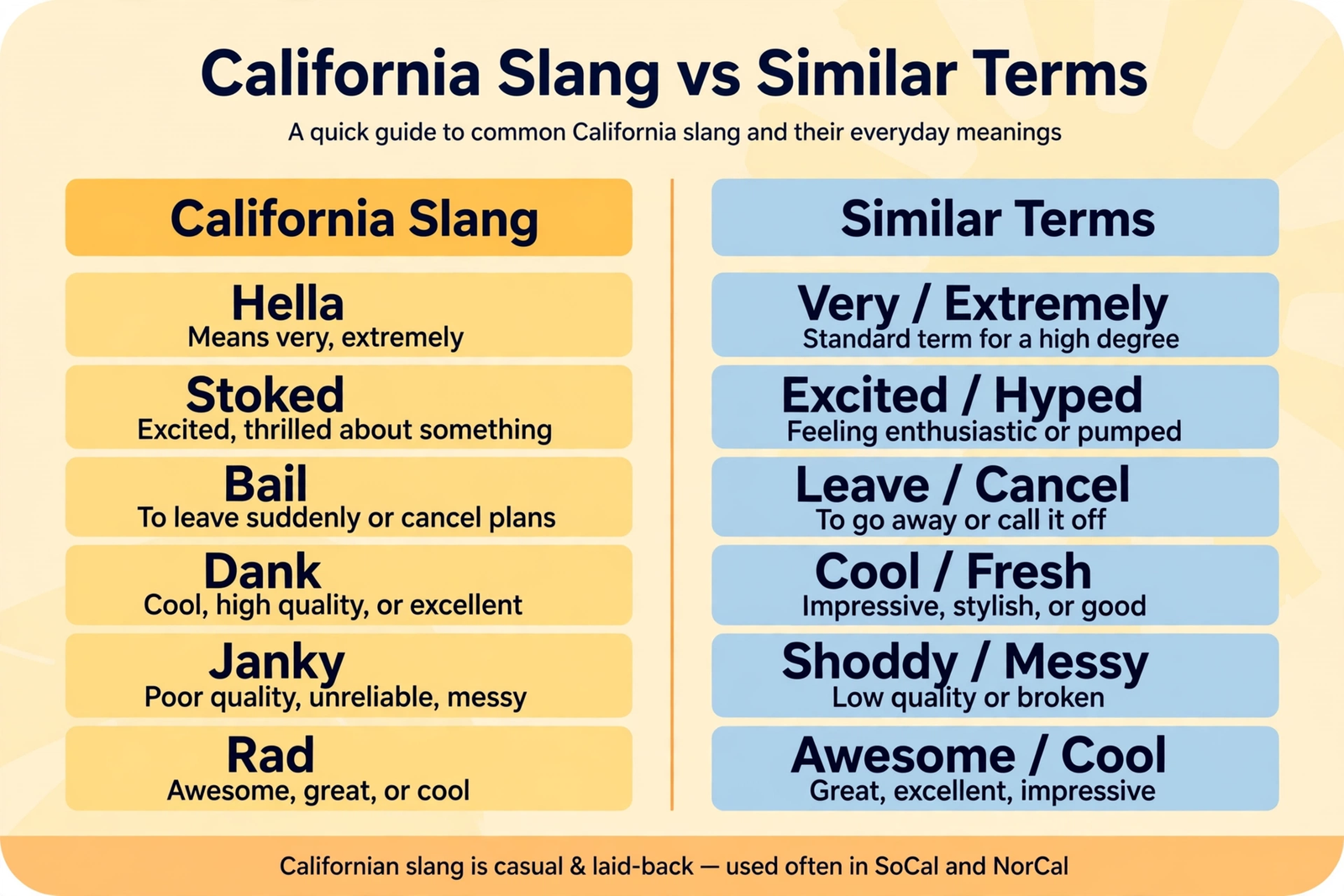
California slang does not exist in a vacuum. Other parts of the United States — and other English-speaking countries — have their own versions of the same ideas. Comparing them helps you see what makes California expressions different, and when a different word might fit better.
| California Term | Meaning | Similar Term Elsewhere | Difference |
|---|---|---|---|
| Hella | Very, a lot, really | Wicked (New England), mad (New York) | Hella is the West Coast version; “wicked good” and “mad cool” are the East Coast equivalents. |
| Dude | Friend, guy, exclamation | Bro, mate, man | Dude is more relaxed and gender-neutral in California use; “mate” is the Australian and British equivalent. |
| Gnarly | Cool, intense, impressive | Sick, dope, lit | Gnarly comes from surf culture; “lit” comes from hip-hop and party culture. |
| No worries | You’re welcome, no problem | No problem, no sweat | Nearly the same meaning, but “no worries” sounds warmer and more laid-back. |
| For sure | Definitely, absolutely | You bet, definitely, 100% | For sure is softer and more casual than a firm “definitely.” |
| Stoked | Excited, thrilled | Pumped, hyped | Stoked suggests happy excitement; “pumped” suggests high energy, often before sports. |
| Chill | Relaxed, easygoing | Laid-back, cool | Nearly identical, but “chill” is more common in California speech and works as both adjective and verb. |
| Bummer | A disappointment | That sucks, what a shame | Bummer is gentler and slightly old-fashioned; it softens bad news. |
A second useful comparison is between Northern and Southern California. Both regions share most of the vocabulary, but the emphasis is different, and locals love to point it out:
| Feature | Northern California (Bay Area) | Southern California (LA / San Diego) |
|---|---|---|
| Signature word | Hella, hyphy | Dude, gnarly |
| Freeway talk | “Take 101 south” (no “the”) | “Take the 405” (always “the”) |
| Speaking style | Faster, more clipped | Slower, more drawn-out vowels |
| Nickname for the state | NorCal | SoCal, Cali |
The takeaway is simple: you do not need to memorize every regional difference, but knowing that “hella” leans Northern and “the 405” leans Southern will help you sound more natural — and will earn you a smile from locals who notice the detail.
Alternate Meanings
Like most slang, California slang terms can mean different things in different contexts, and some words that sound Californian actually have completely separate meanings elsewhere. Here are the most important alternate meanings to know.
Gnarly is the best example. In surf culture, a “gnarly wave” is a dangerous, difficult wave — something to respect and maybe fear. In everyday California speech, “gnarly” flipped to a positive meaning: “that trick was gnarly” means the trick was impressively cool. But the negative meaning never went away. “I had a gnarly crash on my bike” means the crash was bad. The only way to tell which meaning is intended is the context and the tone of voice. If someone sounds excited, it is positive; if they sound pained, it is negative.
Sick works the same way. Outside California, “sick” usually means ill. In California slang — and in youth slang generally — “that’s sick” means “that’s awesome.” The same is true of dope (which can mean cool, or can refer to drugs), fire (excellent, or literally burning), and trippy (strange in a fascinating way, or strange in a confusing way). Context is everything.
California slang as a search term also has a second meaning. Some people searching for “California slang” are not looking for a vocabulary list at all — they are looking for slang from specific California communities, like Bay Area hip-hop slang, Chicano slang from Los Angeles, or surfer slang from Orange County. Others are looking for the meaning of a single word they heard in a song or a show. That is why a good guide covers both the general vocabulary and the specific words people actually ask about.
There is also a geographical alternate meaning worth noting. When people say “Cali,” they almost always mean California, but in texting, “Cali” can also be a person’s name or nickname. And “the Valley” in California usually means the San Fernando Valley near Los Angeles — but in other states, “the valley” can mean something entirely different. If you are unsure, ask which valley someone means before assuming.
Finally, some California slang words have been adopted so widely that they no longer sound Californian at all. Cool, awesome, and dude are now used everywhere, and most people who say them have no idea they were once associated with California youth culture. That is the life cycle of slang: a word starts in one place, spreads, and eventually belongs to everyone.
Professional or Polite Alternatives
California slang is great for casual settings, but there are times when you need a more polished way to say the same thing. Here is how to translate the most common California expressions into professional or polite language:
- Instead of “hella good”: say “excellent,” “outstanding,” or “really impressive.”
- Instead of “no worries”: say “you’re welcome,” “happy to help,” or “not a problem at all.”
- Instead of “for sure”: say “absolutely,” “certainly,” or “I’d be glad to.”
- Instead of “I’m stoked”: say “I’m really excited,” “I’m looking forward to it,” or “I’m thrilled.”
- Instead of “that’s a bummer”: say “that’s unfortunate,” “I’m sorry to hear that,” or “that’s disappointing.”
- Instead of “dude” (as an address): use the person’s name, or simply drop the word. “Hey Alex, did you see this?” sounds better in a work message than “Dude, did you see this?”
- Instead of “chill” (to describe a person): say “easygoing,” “relaxed,” or “great to work with.”
- Instead of “gnarly” or “sick” (to describe something good): say “impressive,” “remarkable,” or “excellent.”
- Instead of “don’t trip”: say “don’t worry about it,” or “there’s no need to worry.”
The goal is not to eliminate California slang from your vocabulary — it is to know when to use it and when to switch. A good rule of thumb: if you would not say it to a judge, a client you just met, or your grandmother in a serious moment, save it for your friends. And if you are writing a formal email, a cover letter, or a report, translate the slang into standard English first. You will still sound like yourself — just the professional version of yourself. If you are curious about a term that sits on the line between playful and rude, our guide to bougie slang shows how another slang word moves between casual and formal contexts.
Common Mistakes
California slang is easy to use badly, especially if you are copying it from movies or social media without hearing it in real life. These are the mistakes people make most often.
Overusing it. The biggest mistake is cramming too many slang words into one sentence. “Dude, that was hella gnarly and so rad, for sure, no worries” sounds like a parody, not a person. Real Californians use one or two slang words per sentence at most, and often none at all. The relaxed tone comes from the rhythm of the sentence, not from the number of slang words in it.
Using “hella” in Southern California the wrong way — or in the wrong place. Hella is strongly associated with Northern California. People in Los Angeles understand it, but they use it less often, and using it constantly in San Diego can sound like you are trying to prove something. It is not wrong, but it is a clue about where you picked up the word. The same goes for using “the” before every freeway number outside Southern California — in the Bay Area, people just say “101,” not “the 101.”
Calling someone “dude” in a formal or serious setting. “Dude” is friendly and casual, which is exactly why it fails in a job interview, a condolence message, or a conversation with someone you do not know well. It can also come across as dismissive if the other person is older or in a position of authority. When in doubt, use the person’s name.
Getting “gnarly” backwards. Because “gnarly” can be positive or negative, using it without enough context can confuse the listener. “That was gnarly” after a car accident and “that was gnarly” after a great concert mean opposite things. Add a clue — “gnarly in a good way” or “gnarly, I hope you’re okay” — so people know which one you mean.
Forcing the accent. The California “surfer drawl” and the Valley Girl style are real, but they are also easy to exaggerate into a stereotype. Stretching every vowel and adding “like” to every sentence does not make you sound Californian; it makes you sound like a character in a comedy sketch. Speak naturally, use the words that fit, and let the vocabulary do the work.
Using slang you do not understand. Some California terms come from specific communities — skate culture, hip-hop, or Chicano culture — and using them without knowing their background can feel off or even disrespectful. If you are not sure what a word means or where it came from, look it up before you use it. A quick check is always better than an awkward correction.

Quick Tips
If you want to sound natural using California slang — and not like you are reading from a list — keep these practical tips in mind:
- Start small. Pick two or three words that feel natural to you, like “for sure,” “no worries,” and “stoked,” and use those first. Add more only when they start to feel automatic.
- Listen before you copy. Spend time listening to how Californians actually talk — in podcasts, shows, or real conversations — and notice which words they use most and which ones they never use. Real usage is always a better guide than a list.
- Match the situation. Use slang with friends, in casual texts, and on social media. Switch to neutral language for interviews, formal emails, and serious conversations.
- Use intensifiers sparingly. One “hella” or “so” per sentence is enough. Two or three in a row sounds forced.
- Learn the regional difference. Remember that “hella” leans Northern California and “the 405” leans Southern California. Getting the small details right makes a big difference.
- Do not force the accent. You do not need a drawl or a Valley Girl voice. The words and the relaxed attitude matter far more than the pronunciation.
- When in doubt, ask. If someone uses a word you do not know, ask what it means. Californians are used to explaining their slang, and asking is always better than guessing wrong.
- Keep it friendly. California slang works best when it makes a conversation warmer. If a slang word makes something sound colder, sharper, or ruder, leave it out.

FAQ
What is California slang?
California slang is the informal vocabulary and set of expressions associated with California, including words like hella, dude, gnarly, stoked, and no worries. It grew out of surf culture, skateboarding, Hollywood, hip-hop, and the state’s diverse communities, and it is known for a relaxed, friendly, and laid-back tone.
What does “hella” mean in California slang?
Hella means very, really, or a lot. It is most strongly associated with Northern California and the Bay Area. For example, “That was hella fun” means “That was really fun,” and “There were hella people there” means “There were a lot of people there.” It works as both an adjective and an adverb.
What does “gnarly” mean?
Gnarly can mean either impressively cool or dangerously difficult, depending on context. It started as a surfer term for a rough, challenging wave. Today, “that trick was gnarly” usually means the trick was amazing, while “that was a gnarly crash” means the crash was bad. Tone and context tell you which meaning is intended.
Is “dude” still used in California?
Yes, “dude” is still very common in California, and it is used by people of all ages — not just teenagers. It works as a casual way to address someone (“Dude, check this out”), as an exclamation of surprise (“Dude, no way!”), and as a general filler word. It is best kept to casual settings, not formal or professional ones.
What is the difference between Northern and Southern California slang?
The main differences are vocabulary and style. Northern California, especially the Bay Area, is known for hella and hyphy, a faster speaking style, and saying “101” without “the” for freeways. Southern California is known for dude and gnarly, a slower, more drawn-out style, and saying “the 405” or “the 101” with “the” before the number.
How do Californians say “very”?
Californians often say “hella,” “super,” “totally,” or “so” instead of “very.” For example, instead of “That was very good,” a Californian might say “That was hella good,” “That was so good,” or “That was totally amazing.” The choice depends on the region, the speaker, and how casual the conversation is.
Is California slang appropriate at work?
Light California slang is fine in many California workplaces, especially in tech, creative, and casual industries. Words like “for sure,” “sounds good,” and “no worries” are widely accepted. Heavier slang like “dude,” “hella,” and “gnarly” is best saved for casual conversations with coworkers you know well, and avoided in formal emails, interviews, and client meetings.
Where did California slang come from?
California slang came from several sources over many decades: surf culture in the 1950s and 1960s, skateboarding and youth culture in the 1970s and 1980s, Hollywood and the Valley Girl trend, Bay Area hip-hop, and the influence of Spanish and other languages in Southern California. Movies, music, and social media then spread it across the United States and around the world.
Conclusion
California slang is more than a list of fun words — it is a window into how California sees itself: relaxed, open, sunny, and a little bit playful. Words like hella, dude, gnarly, stoked, and no worries started on surf beaches and in skate parks, traveled through Hollywood and hip-hop, and ended up in group chats and TikTok captions all over the world. They survived because they are useful, warm, and easy to say — and because they carry a feeling that standard English sometimes misses.
The most important thing to remember is that California slang is about tone as much as vocabulary. Use one or two expressions at a time, match the situation, and let the relaxed attitude come through naturally. Do not force the accent, do not cram every slang word you know into one sentence, and do not use casual words in formal settings. Listen to how real Californians talk, start with the friendly, low-risk words like “for sure” and “no worries,” and build from there.
Whether you are moving to California, visiting for a weekend, texting a friend in San Diego, or just trying to understand what you heard in a song, you now have the full picture: the meaning, the origin, the popularity, the real-life examples, and the mistakes to avoid. So the next time someone tells you the traffic on the 405 was gnarly but the tacos were hella good, you will know exactly what they mean — and you will know just what to say back. For more on how regional American slang works, see our guide to Gen Alpha slang and how younger speakers are remixing California words into something new. And if you want a trusted reference for the word itself, Merriam-Webster defines slang as informal, nonstandard vocabulary — which is exactly what California slang is, at its best: informal language that makes everyday conversation feel a little more human.

2 thoughts on “California Slang: What It Really Means and How Californians Actually Talk”