
What Is FAFO Slang? Meaning & Definition
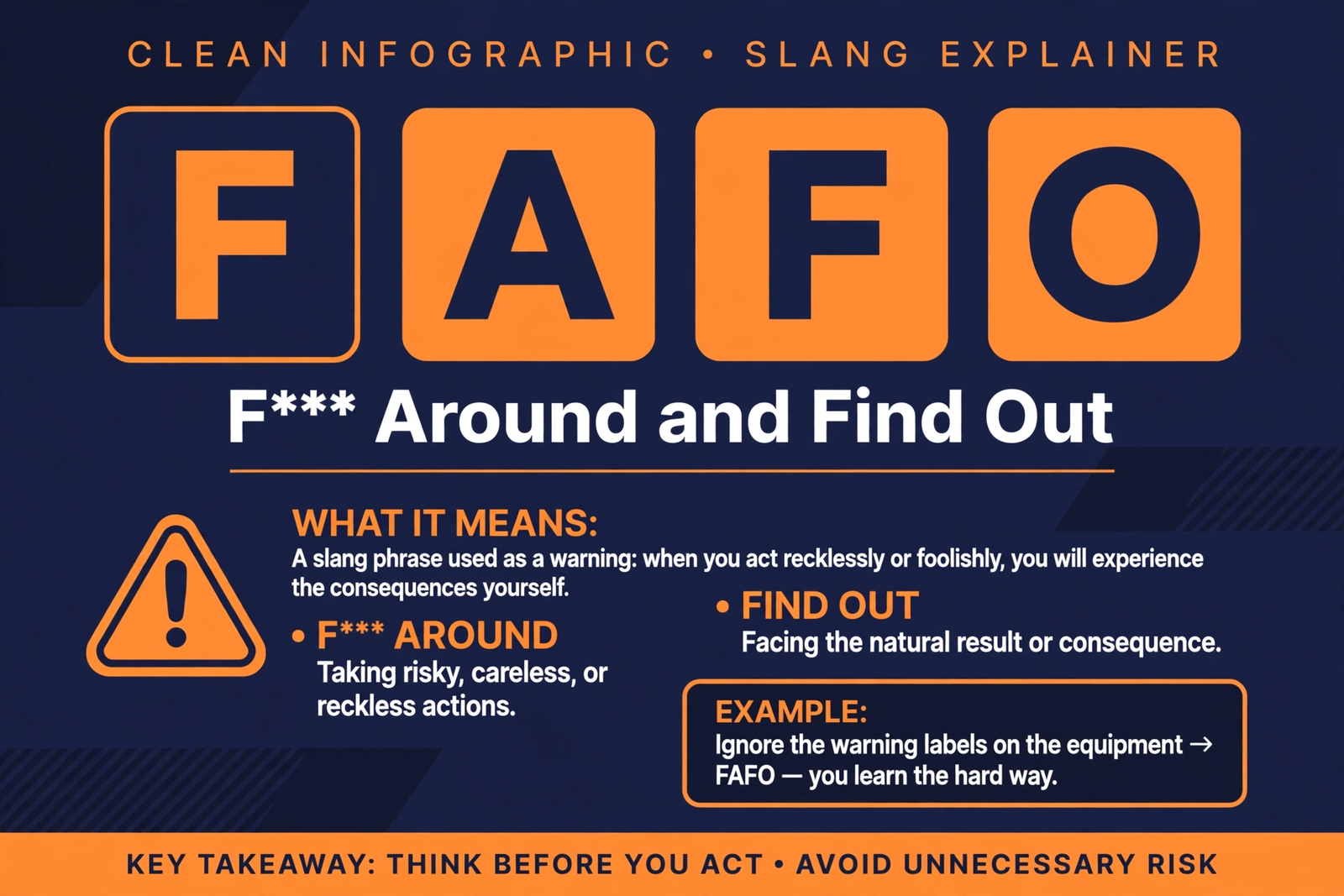
FAFO stands for “F*** Around and Find Out” — a blunt warning that if someone keeps pushing, testing, or provoking, they are about to face the consequences. In short, what is fafo slang? It is internet shorthand for “keep going and you’ll regret it,” used as a threat, a joke, a meme, or a piece of tough-love advice, depending on the tone.
The phrase works because it is short, punchy, and impossible to misunderstand. It tells the other person that the speaker’s patience is gone and the next step is on them. You will see FAFO in TikTok comments, Twitter/X replies, Reddit threads, gaming chats, and group texts — usually right at the moment a conversation turns from playful to serious.
Quick definition: FAFO = “F*** Around and Find Out.” It means: keep messing around and you will discover the consequences the hard way.
Introduction
If you have spent any time on TikTok, X, or Reddit in the last few years, you have almost certainly seen four letters pop up in a heated comment thread: FAFO. It looks like just another random internet acronym, but it carries more attitude than most slang on the internet. One word from a stranger — “FAFO” — can end an argument, start a meme, or warn someone off in a single breath.
What makes FAFO so popular is its flexibility. Friends use it jokingly when someone is about to make a terrible decision (“Eat that gas station sushi. FAFO.”). Rivals use it as a threat (“Keep talking. FAFO.”). Parents, teachers, and bosses use the cleaned-up version to teach a lesson about actions and consequences. And brands, politicians, and influencers have all borrowed it, because nothing else says “I warned you” quite as efficiently.
This guide explains everything: the full meaning of FAFO, where it came from, how it spread from military slang to mainstream TikTok, how to use it correctly, and the mistakes that make people look silly when they try. By the end, you will know exactly when FAFO is funny, when it is serious, and when it is better to say nothing at all.
Origin
FAFO did not start on the internet. The phrase “f*** around and find out” has been part of American spoken English for decades, especially in military, law enforcement, and working-class culture. Drill sergeants, police trainers, and old-school coaches used it as a no-nonsense warning: test the rules, and the lesson will teach itself.
The acronym itself took off much later. The earliest viral uses appeared on Twitter and Reddit around 2018–2020, where the four letters fit perfectly into short, punchy posts. It exploded during the pandemic era, when online arguments were at an all-time high and everyone needed a shorter way to say “go ahead, see what happens.”
Two moments pushed FAFO into the mainstream. First, the phrase became a staple of political and culture-war discourse on social media — a short reply that said everything without a paragraph. Second, TikTok creators turned it into a meme format: videos of people ignoring obvious warnings (touching a hot stove, teasing a guard dog, ignoring a “wet floor” sign) captioned with a simple “FAFO.” The joke landed because everyone has watched someone learn a lesson the hard way.
By 2023, FAFO had crossed from niche internet slang into everyday language. News anchors said it on air, politicians printed it on merchandise, and dictionary sites began tracking it as a serious entry. What started as barracks slang had become one of the most recognizable acronyms of the decade.
Popularity
FAFO’s popularity is easy to measure: it trends every time a public figure ignores a warning and pays for it. Search interest in “what is fafo slang” spikes after viral videos, political showdowns, and celebrity feuds — whenever the internet collectively watches someone learn a lesson in real time.
Why did it catch on so fast? Three reasons:
- It is short. Four letters replace a whole sentence, which is exactly what fast-moving comment sections need.
- It is versatile. The same four letters work as a joke between friends, a warning to a stranger, or a caption on a fail video.
- It is satisfying. There is a universal pleasure in watching someone ignore good advice and face the result. FAFO names that feeling in one word.
On TikTok, the #fafo hashtag has collected hundreds of millions of views, mostly on fail videos and “instant karma” clips. On Reddit, entire threads are built around FAFO stories — people sharing the moment they (or someone they know) ignored a warning and learned the lesson. On X, it is a go-to reply in arguments, often paired with a gif of someone walking into an obvious trap.
The phrase has also escaped the internet. You will hear it in gyms, on construction sites, in locker rooms, and even in parenting — usually in the cleaned-up form “mess around and find out.” Its journey from military slang to mainstream vocabulary is a perfect example of how the internet accelerates language.
How It Is Used
FAFO is almost always used as a warning or a prediction. The speaker is telling someone that their current behavior has a predictable ending — and that ending will not be pleasant. The exact meaning depends on tone and context:
- As a threat: “Keep running your mouth. FAFO.” Here it means: continue, and I will make you regret it.
- As a joke between friends: “Bro, if you text your ex at 2 a.m., FAFO.” Here it means: go ahead, but do not say nobody warned you.
- As a caption or comment: Under a video of someone ignoring a warning sign, “FAFO” means: this is exactly what happens.
- As a life lesson: “I touched the fence after the ‘electric fence’ sign. FAFO.” Here it is self-deprecating — the speaker is the one who found out.
- As a political slogan: On signs and merchandise, FAFO signals defiance — a dare to opponents to test the speaker’s resolve.
Grammar is simple: FAFO works as a standalone sentence, a verb phrase (“he FAFO’d”), or a noun (“that was a FAFO moment”). The past-tense joke form — “he f***ed around and found out” — is common in storytelling, especially on Reddit’s story threads.
One important note: because the full form contains profanity, FAFO is informal. It is fine in casual chats, memes, and social media, but it does not belong in a work email, a job interview, or a conversation with your grandmother — unless your grandmother is very cool.
Examples
Real examples show how flexible FAFO is. The same four letters can be playful, menacing, or funny depending on who says them and where.
Friendly Examples
- “You want to eat the gas station sushi? FAFO, my guy.” — a friend jokingly warning another friend about a bad decision.
- “She said ‘text him, what’s the worst that could happen?’ FAFO energy.” — describing a friend’s reckless-but-fun attitude.
- “I told my brother not to touch my charger. He did. FAFO.” — a light, sibling-style consequence story.
- “Skip leg day again and FAFO when you try to run upstairs.” — gym humor about skipping workouts.
Professional Examples
- “The client ignored three deadline reminders. FAFO season has officially begun.” — office humor about ignored warnings (best kept among coworkers, not sent to the client).
- “Ignore the safety briefing and you’ll FAFO real quick on this site.” — a construction supervisor’s blunt warning.
- “I warned the team the server would crash if we skipped testing. We skipped testing. FAFO.” — an IT war story.
In professional settings, the cleaned-up version — “mess around and find out” — is the safer choice. It keeps the meaning and drops the profanity, which matters when HR might be reading.
Funny Examples
- “Poked the sleeping cat. FAFO. My hand is now a scratch post.” — a classic self-inflicted lesson.
- “He said ‘the dog won’t bite.’ The dog bit. FAFO.” — the internet’s favorite kind of instant karma.
- “Told my kid the stove was hot. He touched it anyway. FAFO: toddler edition.” — parenting humor that every parent understands.
- “Read the ‘wet paint’ sign and touched the bench anyway. FAFO.” — a mistake so relatable it hurts.
Notice the pattern in every funny example: someone ignores a clear warning, does the thing anyway, and the consequence arrives immediately. That is the heart of FAFO — the gap between the warning and the lesson is almost zero.

Comparison with Similar Terms
FAFO is not the only slang that warns people about consequences. Here is how it compares with similar terms you will see in the same comment sections.
| Term | Meaning | Tone | Best Used When |
|---|---|---|---|
| FAFO | F*** around and find out | Warning / threat / joke | Someone ignores a warning and faces consequences |
| Play stupid games, win stupid prizes | Bad decisions lead to bad outcomes | Mocking / judgmental | Commenting on someone else’s self-inflicted problem |
| Instant karma | Immediate payback for bad behavior | Amused / observational | Watching consequences land in real time |
| Mess around and find out | The clean version of FAFO | Warning / playful | When you need FAFO’s meaning without the profanity |
| Don’t poke the bear | Don’t provoke someone dangerous | Cautionary / wise | Warning someone before they provoke a powerful person |
| You asked for it | You brought this on yourself | Blunt / dismissive | After the consequence has already happened |
FAFO sits in the middle of this family: shorter than “play stupid games, win stupid prizes,” sharper than “don’t poke the bear,” and more personal than “instant karma.” It is also the only one of the group that works equally well before the consequence (as a warning) and after it (as a caption).
If you are learning other texting acronyms too, the logic is the same as with terms like FN or HBU — context decides the meaning, and tone decides whether it is friendly or hostile.
Alternate Meanings
FAFO has one dominant meaning, but a few alternate uses exist:
- “F*** Around and Find Out” — the standard meaning, used in 99% of cases. This is the one people mean when they type FAFO.
- “Fool Around and Find Out” — the polite, family-friendly version. Same warning, no profanity. Common in parenting and classrooms.
- “F around and find out” — a half-censored version used in captions where full profanity would get flagged.
- A name or brand: A few small businesses, bands, and gaming clans have adopted FAFO as a name, leaning into the attitude it carries. In those cases the meaning is the same — it is a branding choice, not a different definition.
Unlike some slang that changes meaning by platform, FAFO is stable. On TikTok, X, Reddit, and in text messages, it means the same thing. If you see FAFO, assume the warning version unless the context clearly shows otherwise.
Professional or Polite Alternatives
FAFO is fun, but it is not appropriate everywhere. When the setting is formal, or when you want the same warning without the edge, use one of these instead:
- “Mess around and find out” — the clean version. Keeps the rhythm and the meaning, drops the profanity. Safe for work chats and mixed company.
- “Actions have consequences” — the classic, professional way to say the same thing. Good for managers, teachers, and parents.
- “I did warn you” — perfect for after the consequence lands. Calm, mature, and impossible to argue with.
- “That’s a decision you’ll have to live with” — polite, firm, and slightly ominous. Great for formal settings.
- “Proceed at your own risk” — the corporate version. Boring, but nobody can complain about it.
- “You might want to reconsider” — the gentle warning. Use it when you actually want the person to stop, not when you want to watch them fail.
The rule of thumb: if you would not say the full form out loud in that room, use the clean version. FAFO’s power comes from its bluntness — and bluntness is exactly what formal settings punish.
Common Mistakes
FAFO looks simple, but people use it wrong all the time. Here are the mistakes to avoid:
- Using it as a greeting or filler. FAFO is not a vibe word like “lol” or “bruh.” It needs a warning or a consequence behind it. Typing “FAFO” under a random selfie makes no sense.
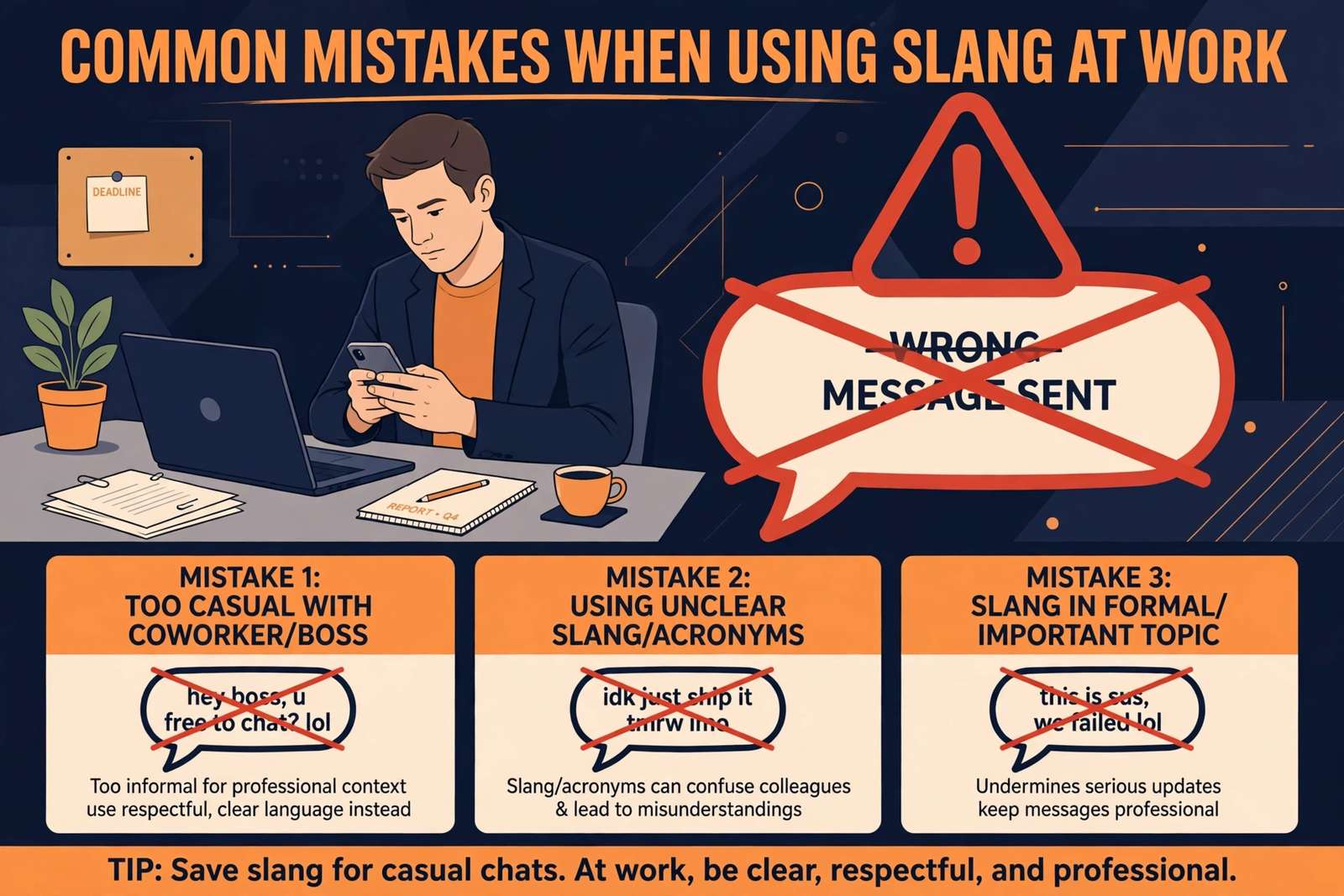
- Using it in formal settings. A work email that ends with “FAFO” is not funny — it is a HR meeting waiting to happen. Use “mess around and find out” or a professional alternative instead.
- Threatening someone seriously. Joking FAFO between friends is fine. Using it to genuinely threaten or intimidate someone is not slang — it is harassment, and platforms will treat it that way.
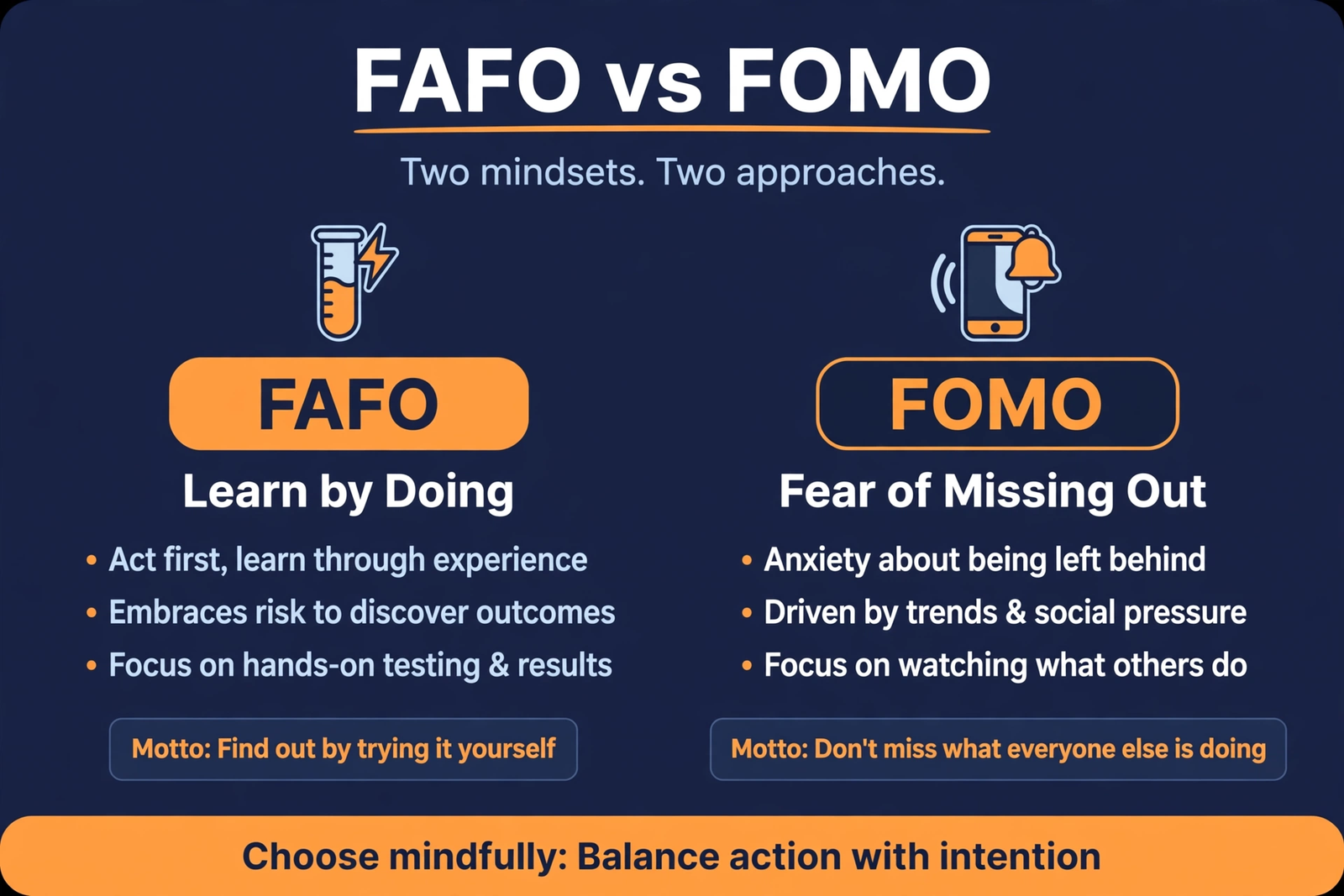
- Confusing it with FOMO. FAFO and FOMO look similar at a glance, but they mean opposite things. FOMO is the fear of missing out; FAFO is a warning about consequences. Mixing them up is an instant credibility loss.
- Overusing it. FAFO hits hard because it is short and rare. If you end every message with it, it stops being a warning and starts being a tic. Save it for moments that deserve it.
- Spelling it wrong. It is FAFO — four letters, no extra vowels, no “FAAFO.” And it is not “FAFO” with a period after every letter. Keep it clean.
One more common mistake: using FAFO when you are the one who should be listening. If someone warns you and you reply “FAFO” back, you have just volunteered to be the example in someone else’s story.
Quick Tips
- Match the tone: With friends, FAFO is a joke. With strangers in an argument, it reads as a threat. Read the room before you send it.
- Use it after a warning, not instead of one: FAFO works best when the warning already happened. “Don’t touch that — FAFO” is perfect. Just “FAFO” out of nowhere is confusing.
- Try the clean version at work: “Mess around and find out” gets the laugh without the risk. Save the full version for group chats with friends.
- Pair it with a story: FAFO is at its funniest as a caption on a fail video or the punchline of a story. Context makes it land.
- Don’t use it to escalate: In a heated argument, FAFO can pour fuel on the fire. If you want the argument to end, say so directly instead.
- Learn the past tense: In stories, “he f***ed around and found out” is the natural way to tell it. “He FAFO’d” works too and is funnier in writing.
- Check the platform: FAFO is welcome on TikTok, X, and Reddit. On LinkedIn or in a professional Slack channel, stick to the polite alternatives.
FAQ
1. What does FAFO mean in slang?
FAFO means “F*** Around and Find Out.” It is a warning that if someone keeps testing, provoking, or ignoring advice, they will face the consequences. It can be a joke, a threat, or a caption on a fail video, depending on context.
2. What is the full form of FAFO?
The full form is “F*** Around and Find Out.” The clean version is “Fool Around and Find Out” or “Mess Around and Find Out.” All versions carry the same message: keep going and you will learn the lesson the hard way.
3. Is FAFO rude or offensive?
It can be. The full form contains profanity, and the tone is confrontational by design. Between friends it is usually a joke, but to a stranger it can read as a threat. In formal settings, use the clean version “mess around and find out” instead.
4. Where did FAFO come from?
The phrase comes from American military and working-class slang, where it was used as a blunt warning for decades. The acronym FAFO spread on Twitter and Reddit around 2018–2020 and exploded on TikTok, where it became the standard caption for fail and instant-karma videos.
5. What does FAFO mean on TikTok?
On TikTok, FAFO is mostly a caption or hashtag on videos where someone ignores an obvious warning and suffers the consequence — touching a hot stove, teasing an animal, ignoring a sign. It means “this is what happens when you don’t listen.”
6. What does FAFO mean in texting?
In texting, FAFO is a short warning or joke. A friend might send it when you are about to make a bad decision (“Text your ex? FAFO.”), or use it to describe a consequence that already happened (“He touched the fence. FAFO.”). Like other texting shorthand — for example IMK or CFS — the meaning is clear once you know the context.
7. Can I use FAFO at work?
Not the full version. The profanity makes it risky in professional settings. The clean version — “mess around and find out” — is safer and still gets the point across with coworkers you know well. In formal emails or with clients, use “actions have consequences” instead.
8. What is the difference between FAFO and FOMO?
They sound similar but mean opposite things. FOMO is the fear of missing out — anxiety about not being part of something. FAFO is a warning that reckless behavior has consequences. One is about missing an experience; the other is about the price of a bad decision.

Conclusion
FAFO is one of those rare slang terms that says everything in four letters. It is a warning, a joke, a meme, and a life lesson rolled into one — and its popularity shows no sign of fading. Now that you know what is fafo slang, you can spot it in a comment thread, use it with friends, and, most importantly, recognize the moment when someone is about to find out.
The key takeaway is simple: FAFO is about the gap between a warning and a consequence. When that gap is short — when someone ignores clear advice and the result arrives immediately — FAFO is the perfect word for it. Use it with friends for a laugh, use the clean version at work, and never use it to genuinely threaten anyone.
And the next time you catch yourself ignoring a warning sign, remember the four letters: you already know what comes next. For the full slang definition and more examples from real usage, see the FAFO entry on Urban Dictionary.
Quick recap: FAFO = “F*** Around and Find Out” · a warning that actions have consequences · born in military slang, made famous by TikTok · funny with friends, risky at work · clean version: “mess around and find out.”
