
Quick definition: Brazilian slang is the informal, everyday vocabulary of Brazilian Portuguese — short words and expressions like e aí, beleza, valeu, and de boa that Brazilians use in conversation, texting, and social media instead of formal Portuguese. If you want to sound like a local and not a textbook, this is the language you need.
Brazilian Slang Meaning & Definition
Brazilian slang refers to the informal words, phrases, and expressions used in everyday Brazilian Portuguese. While standard Portuguese is the language of news anchors, school essays, and official documents, Brazilian slang is the language of the street, the group chat, the beach, and the bar. It is how friends greet each other, how teenagers text, and how strangers break the ice.
The word “slang” itself comes from informal English, but in Brazil the concept is known as gíria. Brazilian slang is not a separate language — it is Portuguese with a relaxed, playful, and constantly evolving twist. A single word can change its meaning completely depending on tone and context: beleza literally means “beauty,” but in a conversation it usually means “all good” or “okay.” Cara literally means “face,” but Brazilians use it the way Americans use “dude” or “man.”
What makes Brazilian slang special is how warm and social it is. Brazil is a culture built on connection, and its slang reflects that. Greetings are longer, agreements are friendlier, and even complaints come wrapped in humor. Learning even ten or fifteen of these expressions will change how Brazilians respond to you — suddenly you are not just a visitor, you are someone who gets it.
This guide covers more than 25 of the most common Brazilian slang words and expressions, with real meanings, pronunciation hints, and example sentences you can actually use. Whether you are planning a trip to Rio or São Paulo, chatting with Brazilian friends online, or just curious about how Portuguese sounds outside the classroom, you will find everything you need here.
Introduction
Imagine landing in São Paulo, opening your rideshare app, and hearing your driver say, “E aí, beleza?” If you only studied formal Portuguese, you might freeze. You learned that “hello” is olá and “how are you” is como você está. Nobody just said that to you. What your driver actually said was the Brazilian equivalent of “Hey, what’s up, all good?” — and the correct answer is a relaxed “Beleza!” or “Tudo joia!”
That is the gap Brazilian slang fills. Formal Portuguese will help you read a menu or ask for directions, but it will not help you make friends, follow a joke, or understand a single Brazilian group chat. Brazilians speak fast, cut words short, and pack enormous meaning into tiny expressions. A two-word reply like “demorô!” can mean “deal,” “agreed,” “let’s do it,” and “I’m in” all at once.
The good news is that Brazilian slang is surprisingly easy to start using. You do not need perfect grammar or a flawless accent. Brazilians love it when foreigners try their slang, and even a well-timed valeu (thanks) or que massa (how awesome) earns instant smiles. This article will walk you through the essentials: what Brazilian slang is, where it comes from, the words you will hear every single day, how to use them without sounding awkward, and the mistakes to avoid. By the end, you will have a working vocabulary of the real Portuguese that Brazil actually speaks — the kind you will never find in a phrasebook. For a quick comparison with how English speakers shorten words in texts, see our guide to fn meaning in text, which shows the same playful shortening habit in American slang.
Origin
Brazilian slang did not appear overnight. It grew out of more than five hundred years of history, mixing Portuguese from colonists with words and rhythms from Indigenous languages, African languages brought by enslaved people, and later waves of Italian, Japanese, German, and Arabic immigrants. Each group left fingerprints on the way Brazilians speak today.
Many classic slang words started in specific places and then spread. Malandro, for example, comes from the street culture of Rio de Janeiro in the early 20th century — the charming trickster figure celebrated in samba music. Balada (a night out or party) came from the word for ballad and was popularized by nightlife culture. Churras, the beloved weekend barbecue, is simply a shortened form of churrasco, and shortening long words is one of the most Brazilian habits of all: cerveja becomes breja, faculdade becomes facul, and beleza becomes belê among close friends.
Television, music, and football accelerated everything. The slang of Rio’s favelas and São Paulo’s streets traveled across the country through samba, funk, soap operas, and comedy shows. In the last fifteen years, social media and messaging apps did the same thing at ten times the speed. Words like crush, treta, and partiu went from niche internet jokes to national vocabulary in a matter of months. Today, new Brazilian slang is often born on TikTok or WhatsApp and spreads to the whole country before any dictionary notices.
Regional variation is also part of the story. Brazil is enormous — larger than the continental United States — so slang changes from state to state. Bacana and legal are understood everywhere, but oxe belongs to the Northeast, bah is the classic interjection of the South, and guria means “girl” mainly in Rio Grande do Sul. The words in this guide focus on the widely understood, nationally popular terms, so you can use them anywhere from Recife to Porto Alegre.
Popularity
Brazilian slang is not a niche interest — it is the default way more than 200 million people talk every day. Brazil is the largest Portuguese-speaking country in the world, and its informal speech dominates everything from WhatsApp voice notes to YouTube comments to reality TV. Anyone learning Portuguese quickly discovers that the formal language taught in courses covers maybe half of what Brazilians actually say.
Search interest in Brazilian slang keeps growing, especially among travelers and language learners. Brazil welcomed millions of international visitors in recent years, and its music, football, and streaming shows reach a global audience. When a Brazilian funk song or a Netflix series from Brazil goes viral, the slang inside it travels with it. Terms like saudade — the famous untranslatable word for a deep, nostalgic longing — have entered English dictionaries and everyday conversation far beyond Brazil.
Among Brazilians themselves, slang is a marker of belonging. Using the right expression at the right moment signals that you are relaxed, friendly, and part of the group. Young people invent new slang constantly as a way of marking their generation, and older slang gets recycled with new meanings. That constant churn is exactly why a good guide matters: the words that matter today are the ones people actually use in 2026, not the ones frozen in a textbook from 1998.
How It Is Used
Brazilian slang shows up in almost every informal situation, but it follows unwritten rules. The most important one is context: slang belongs with friends, family, classmates, coworkers you know well, and anyone your age or younger in a relaxed setting. It does not belong in a job interview, a formal email, or a conversation with an elderly stranger — unless they start it first.
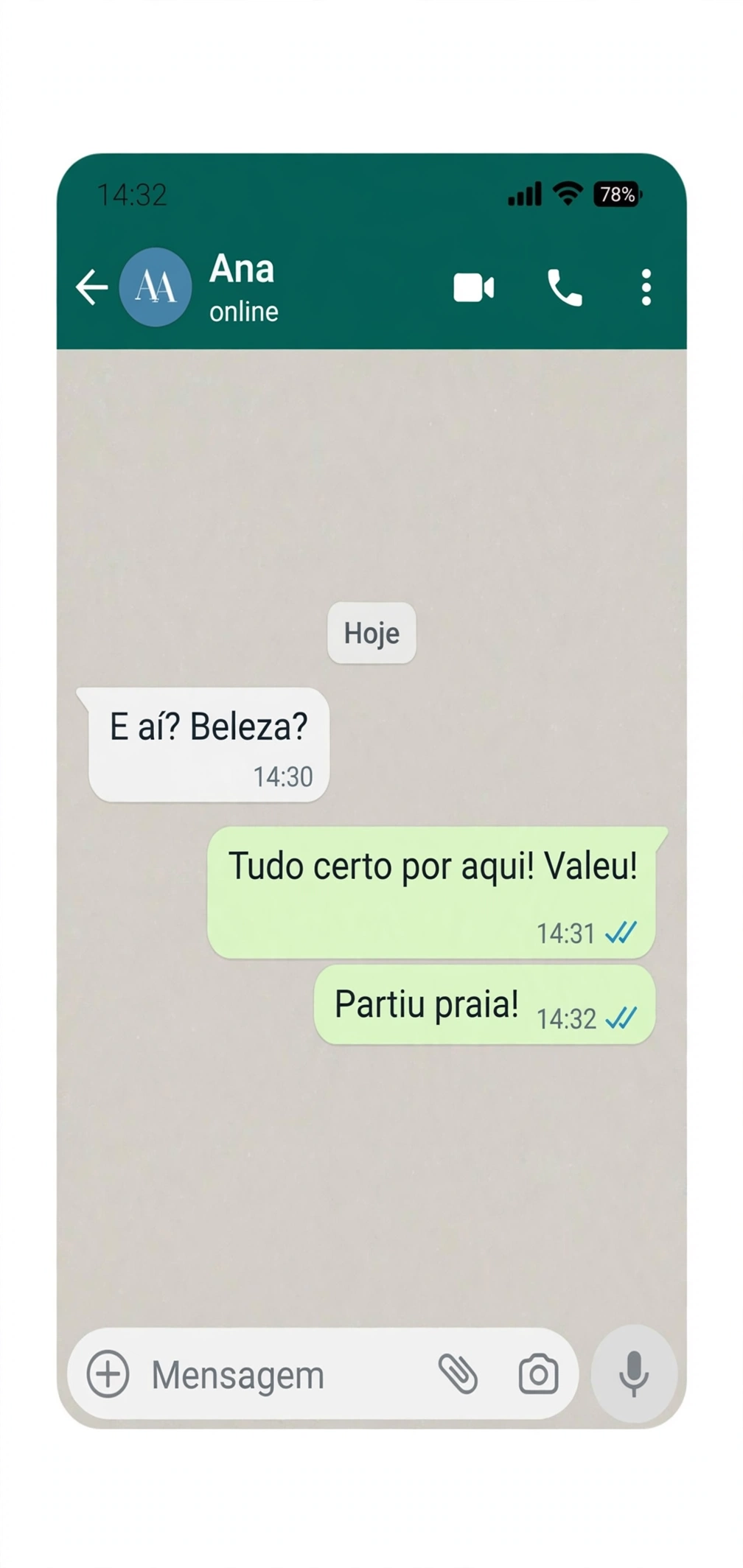
In texting and social media, Brazilian slang is even more concentrated. Messages are short, vowels get dropped, and words get cut in half. Você becomes vc, também becomes tb, beleza becomes blz, and falou becomes flw. A typical WhatsApp exchange might read: “E aí, blz? Partiu praia amanhã?” — “Hey, all good? Are we heading to the beach tomorrow?” If you can read that sentence, you can read Brazilian group chats.
Tone matters as much as vocabulary. Many Brazilian slang words are flexible: cara can be affectionate between friends or confrontational in an argument, depending on how it is said. Que viagem! can mean “that’s crazy!” in amazement or disbelief. When in doubt, keep your tone light and friendly, smile, and let the other person set the energy level. Brazilians are famously forgiving of foreigners who try — enthusiasm covers a multitude of small mistakes.
Examples
The fastest way to learn Brazilian slang is through examples. Below are the terms you will hear most often, grouped by how people actually use them — with friends, at work, and when something is funny.
Friendly Examples
These are the warm, everyday expressions that make up most Brazilian conversation.
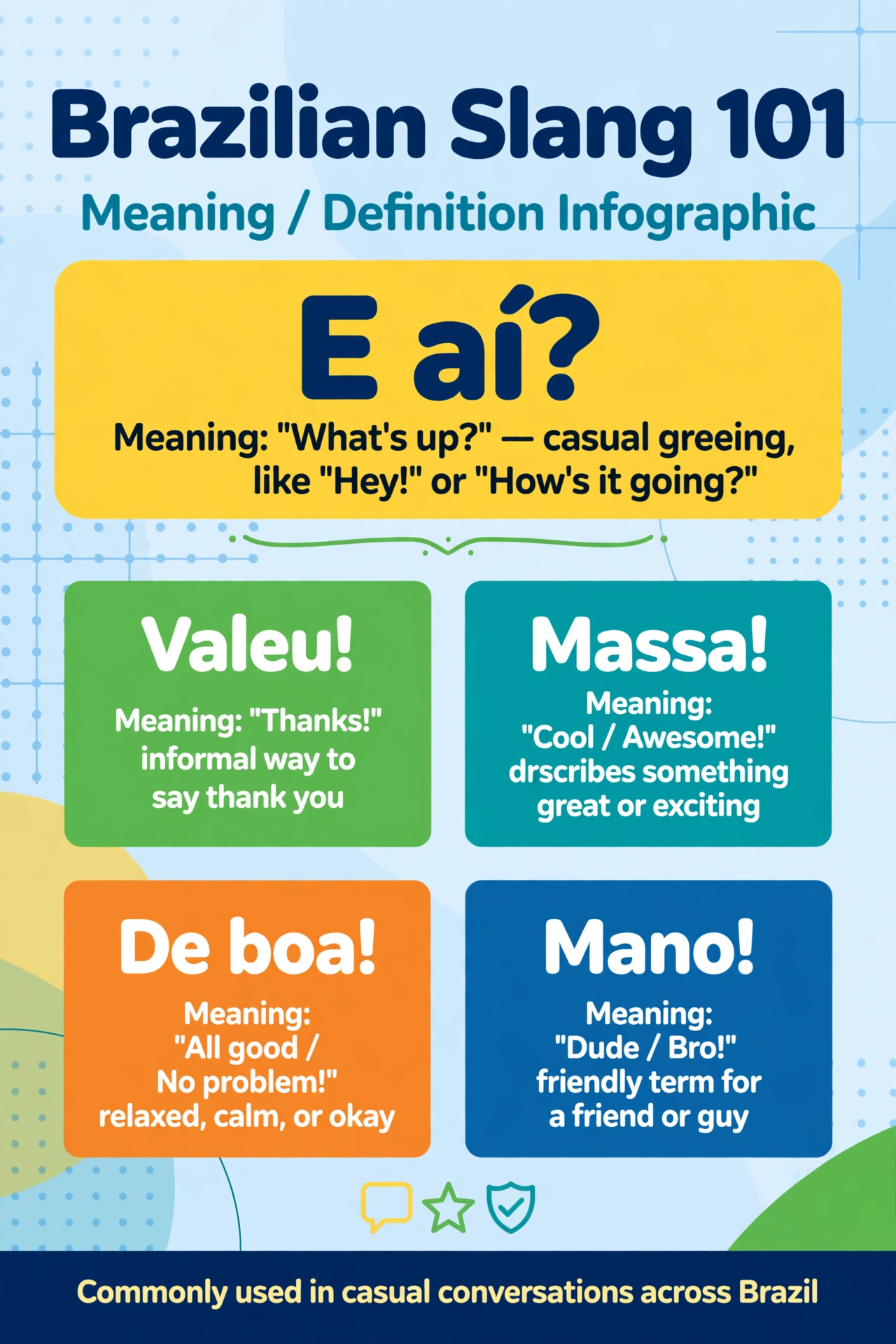
- E aí? — “What’s up?” / “Hey!” The most common greeting in Brazil. Example: “E aí, cara, tudo bem?” — “Hey dude, how’s it going?”
- Beleza? — “All good?” Used as both a greeting and a way to confirm agreement. Example: “A gente se encontra às sete, beleza?” — “We’ll meet at seven, okay?”
- Valeu! — “Thanks!” / “Cheers!” Short for valeu a pena (it was worth it). Example: “Valeu pela carona!” — “Thanks for the ride!”
- De boa — “Chill” / “No worries” / “I’m good.” Example: “Pode deixar, tô de boa.” — “Don’t worry about it, I’m fine.”
- Tá bom? — “Okay?” / “All right?” Used to check agreement. Example: “Amanhã a gente conversa, tá bom?” — “We’ll talk tomorrow, okay?”
- Joia — “Great!” / “I’m good.” Literally “jewel.” Example: “Tudo joia!” — “Everything’s great!”
- Falou — “Okay” / “Deal” / “Got it.” Example: “Te ligo mais tarde, falou?” — “I’ll call you later, okay?”
- Legal — “Cool” / “Nice” / “Great.” One of the most common words in Brazil. Example: “Que legal que você veio!” — “How cool that you came!”
- Bacana — “Cool” / “Awesome.” Slightly old-school but still widely used. Example: “Esse projeto é muito bacana.” — “This project is really cool.”
- Mano / Mina — “Bro” / “Girl” (close friend). Example: “Fala, mano, o que você vai fazer hoje?” — “Hey bro, what are you doing today?”
- Demorô! — “Deal!” / “You got it!” An enthusiastic yes. Example: “Vamos à praia sábado?” “Demorô!” — “Beach on Saturday?” “Deal!”
- Firmeza — “Solid” / “Cool” / “For sure.” Example: “Firmeza, pode contar comigo.” — “For sure, you can count on me.”
- Massa! — “Awesome!” Popular in the Northeast and now nationwide. Example: “Que massa essa festa!” — “This party is awesome!”
- Partiu! — “Let’s go!” / “We’re off!” The classic way to announce plans. Example: “Partiu praia!” — “Let’s hit the beach!”
- Tô ligado — “I know” / “I get it.” Literally “I’m connected.” Example: “Tô ligado, pode deixar.” — “I know, don’t worry.”
Professional Examples
Even at work, Brazilians keep things warm — but the slang gets lighter. These are safe for colleagues you know well.
- Beleza, combinado. — “All good, agreed.” The standard friendly way to confirm a plan at work.
- Valeu pela ajuda! — “Thanks for the help!” Perfectly fine with coworkers.
- De boa, sem pressa. — “No rush, take your time.” A relaxed, polite way to give someone space.
- Topa? — “Are you in?” / “Do you agree?” From the verb topar (to accept). Example: “Topa uma reunião às três?” — “Are you up for a meeting at three?”
- Falou, a gente se fala. — “Okay, we’ll talk.” A friendly way to end a work call.
A word of caution: slang like cara, mano, and véio should stay out of formal meetings and emails. Use the lighter expressions above with colleagues, and save the casual ones for after-work drinks.
Funny Examples
Brazilians love humor, and slang is where the jokes live.
- Que viagem! — “That’s crazy!” / “What a trip!” Used when something is unbelievable. Example: “Ele ganhou na loteria? Que viagem!” — “He won the lottery? That’s crazy!”
- Mó barato! — “Super fun!” Literally “big cheap,” but it means something was a blast. Example: “O show ontem foi mó barato!” — “Yesterday’s show was so much fun!”
- Tô bolado — “I’m annoyed” / “I’m upset.” Example: “Tô bolado, perdi meu voo.” — “I’m so annoyed, I missed my flight.”
- Zuera / Zueira — Playful banter, joking around, or a prank. Example: “É só zuera, relaxa!” — “It’s just a joke, relax!”
- Vacilar — To mess up or slip up. Example: “Vacilei, esqueci a chave.” — “I messed up, I forgot the key.”
- Pisar na bola — To drop the ball, to make a mistake. Example: “Ele pisou na bola com o chefe.” — “He messed up with the boss.”
- Migué — A lame excuse or a dodgy trick. Example: “Não vem com esse migué!” — “Don’t give me that excuse!”
- Bagulho — “Thing” / “Stuff” (context can also mean weed). Example: “Pega esse bagulho pra mim.” — “Grab that thing for me.”
Comparison with Similar Terms
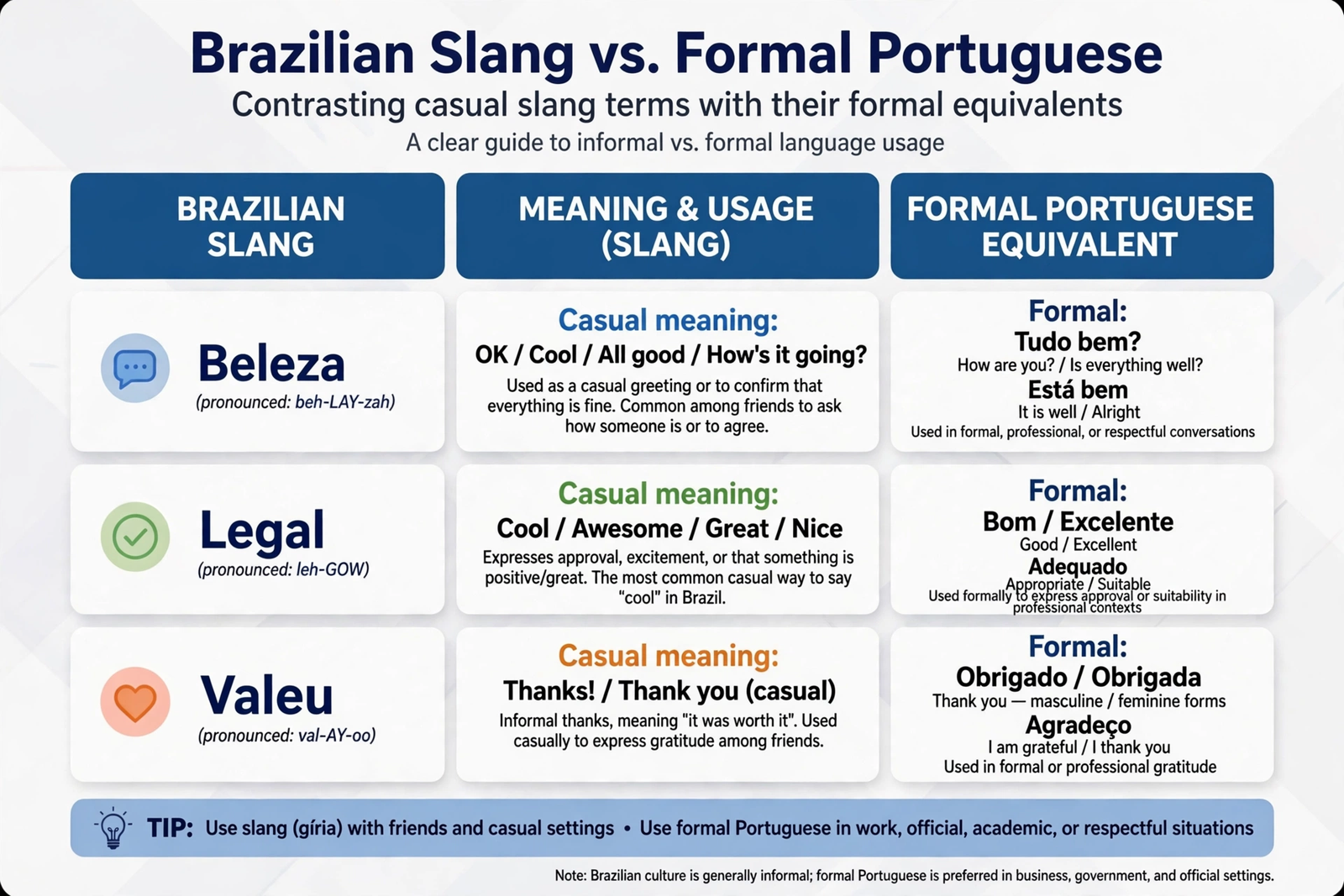
Brazilian slang often confuses learners because several words look like synonyms but carry different feelings. The table below sorts out the most commonly mixed-up terms, so you can pick the right one for the moment.
| Brazilian Slang | Literal Meaning | Real Meaning | Formal Portuguese | English Equivalent |
|---|---|---|---|---|
| Beleza | Beauty | All good / OK | Está bem / Tudo bem | “All good” |
| Legal | Legal / lawful | Cool / nice | Ótimo / bom | “Cool” |
| Bacana | — | Cool / awesome | Ótimo | “Awesome” |
| Valeu | It was worth | Thanks | Obrigado | “Thanks / cheers” |
| Cara | Face | Dude / guy | Rapaz / homem | “Dude / man” |
| De boa | Of good | Chill / fine | Tranquilo | “Chill / no worries” |
| Mano | Hand | Bro | Irmão / amigo | “Bro” |
| Falou | (He) spoke | OK / deal | Combinado | “Got it / deal” |
| Grana | Grain | Money | Dinheiro | “Cash / dough” |
| Balada | Ballad | Party / night out | Festa | “Night out / party” |
| Treta | — | Fight / drama / beef | Briga / conflito | “Drama / beef” |
| Rolo | Roll | Complicated fling / mess | Relacionamento indefinido | “Situationship” |
Notice the pattern: in almost every case, the slang word is shorter, warmer, and more emotional than its formal equivalent. That is the whole point of Brazilian slang — it trades precision for feeling. Grana does not just mean money, it means money talked about casually, the way friends talk. Treta is not just a conflict, it is messy, dramatic conflict worth gossiping about — which is why it pairs naturally with fofoca (gossip), another word you will hear constantly. If you want even more examples with audio pronunciation, FluentU’s guide to Brazilian slang words is a useful companion to this article.
The same logic applies across languages. English speakers do the same thing when they say “bucks” instead of “dollars” or “dude” instead of “man.” If you are curious how that shortening habit works in American texting slang, our guide to hbu meaning in chat breaks down another classic example of casual abbreviation in action.
Alternate Meanings
Many Brazilian slang words have more than one meaning, and context is the only way to tell them apart. Here are the most important double meanings to know.
- Beleza — As a noun it means “beauty,” as a greeting it means “all good,” and said sarcastically (“Que beleza…”) it means “wonderful, just great” in the annoyed sense. Tone decides everything.
- Bagulho — Usually just means “thing” or “stuff,” but in some contexts it refers to marijuana. If someone says “aquele bagulho” with a knowing look, they probably do not mean a random object.
- Cara — Means “face” in formal Portuguese and “dude” in slang, but it can also express surprise (“Cara, sério?!” — “Dude, seriously?!”).
- Massa — Literally “dough” or “mass,” but as slang it means “awesome.” In the Northeast it is extremely common; in São Paulo you will also hear da hora for the same idea.
- Foda — A vulgar word that swings between “amazing” (“muito foda” — “so awesome”) and “terrible” (“que situação foda” — “what a messed-up situation”). Use it only with close friends, never at work.
- Legal — In formal Portuguese it means “lawful,” but nobody uses it that way in conversation. In slang it almost always means “cool” or “nice.”
- Viagem — Literally “trip” or “journey,” but que viagem means “that’s crazy,” and viajar can mean to daydream or to be out of touch with reality.
When a word has two meanings, Brazilians rely on the situation to make it clear, and so should you. If you are unsure, assume the friendlier meaning first — and if someone laughs, you probably just discovered the other one.
Professional or Polite Alternatives
Slang is wonderful with friends, but there are moments when formal Portuguese is the right choice. Here is how to swap the most common slang for polite equivalents.
| Slang | Polite Alternative | When to Use It |
|---|---|---|
| E aí? | Olá, como vai? | Greeting a client or an older person |
| Beleza? | Tudo bem? | Any semi-formal conversation |
| Valeu! | Muito obrigado(a)! | Thanking a stranger or a superior |
| Cara / Mano | Amigo / Senhor | Addressing someone respectfully |
| De boa | Sem problemas / Tranquilo | Reassuring a colleague or client |
| Falou | Combinado / Entendido | Confirming plans at work |
| Grana | Dinheiro | Any financial discussion |
| Topa? | Você concorda? | Asking agreement in a meeting |
The rule of thumb is simple: mirror the other person. If a Brazilian colleague greets you with “E aí, beleza?” you can answer the same way. If they greet you with “Bom dia, como vai?” answer formally. Brazilians switch registers constantly, and matching their level is the most polite thing you can do. When in doubt, start formal and relax only after they do.
Common Mistakes
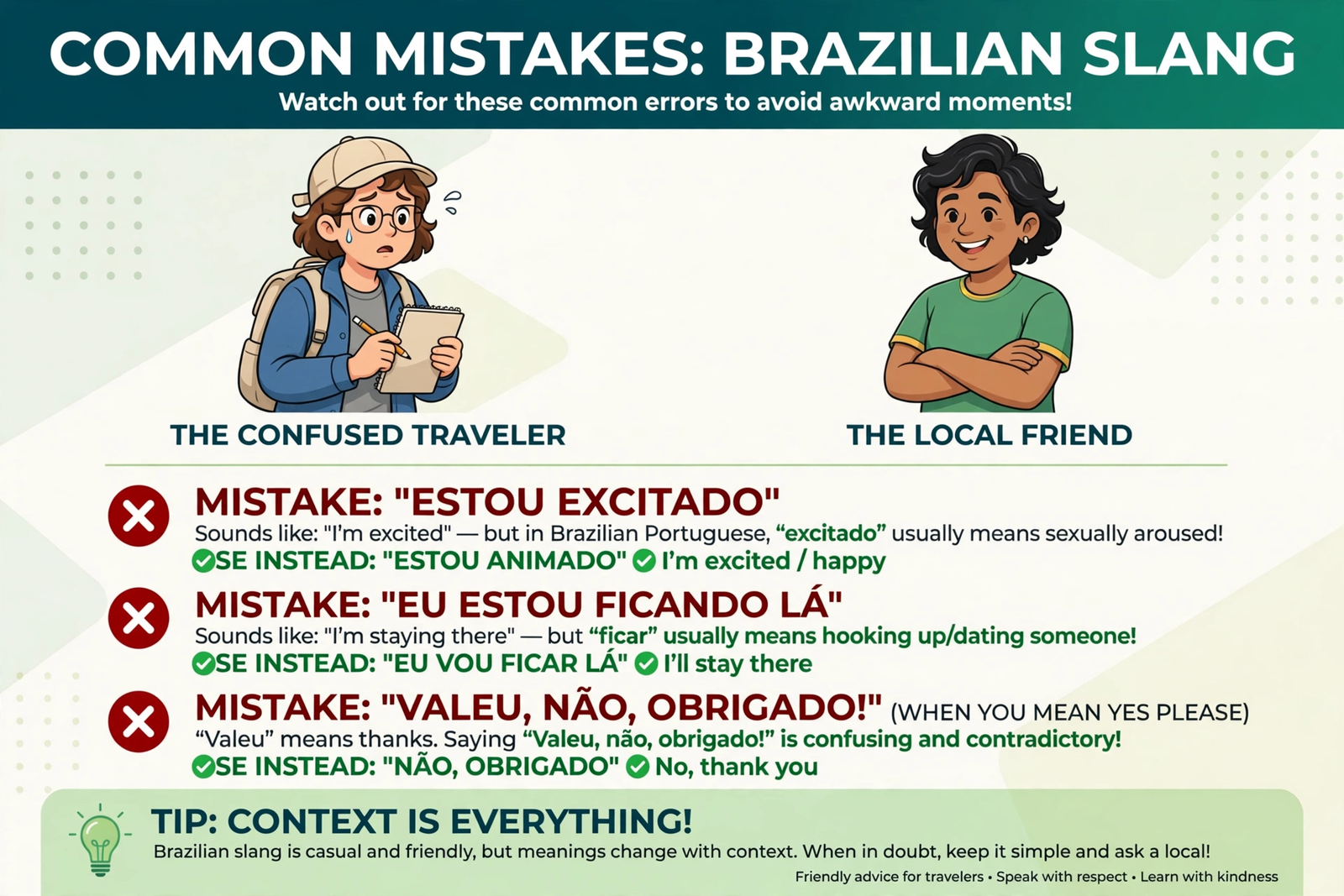
Learning Brazilian slang is fun, but a few mistakes trip up almost every learner. Avoid these and you will sound far more natural.
- Using slang in formal settings. Saying “E aí, cara” to a hotel manager or a job interviewer comes across as disrespectful, even if your grammar is perfect. Save slang for relaxed moments.
- Overusing one word. Learners often fall in love with a single word — usually legal or cara — and use it in every sentence. Brazilians vary their vocabulary, so rotate through several expressions.
- Mixing up beleza and legal. Both are positive, but they are not interchangeable. Beleza confirms agreement (“okay, all good”), while legal describes something as cool or nice. Saying “beleza” about a movie sounds odd; “legal” is the right word.
- Using vulgar slang too early. Words like porra, caralho, and foda are extremely common in Brazil, but they are also vulgar. Using them with strangers or at work can offend people fast. Learn them for understanding, not for your first conversation.
- Pronouncing e aí like “ee eye.” It is closer to “ee-ah-EE” with a soft, quick flow. Listen to native speakers and copy the rhythm rather than reading the letters.
- Translating word for word. Brazilian slang rarely translates literally. Mó barato has nothing to do with cheap prices, and tô bolado has nothing to do with balls. Learn the whole expression and its feeling, not the individual words.
- Ignoring regional differences. A word that is friendly in São Paulo can be confusing in Salvador. Stick to the nationally understood terms in this guide until you know a region well.
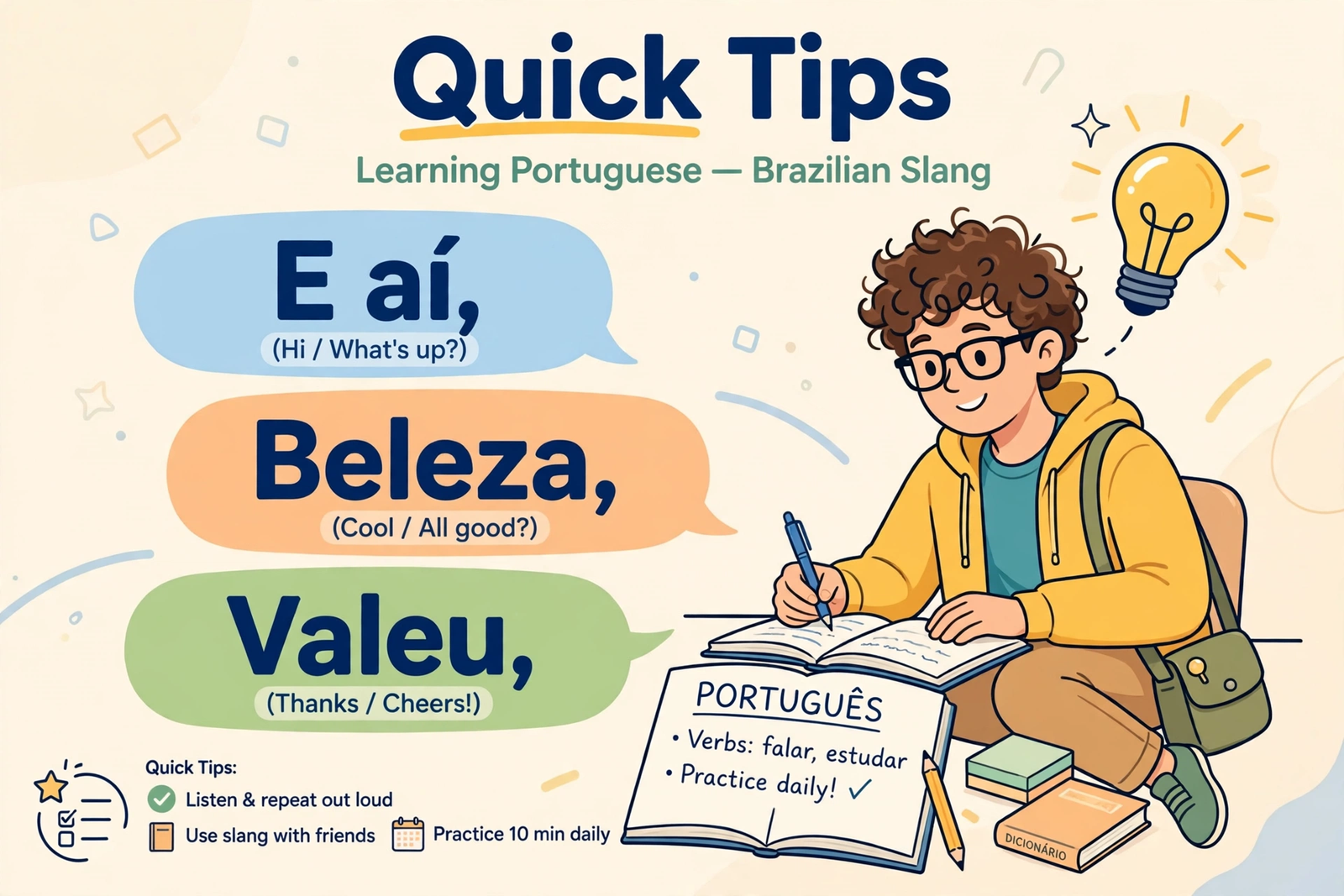
Quick Tips
Want to start using Brazilian slang today? These tips will get you sounding natural fast.
- Start with five words. Memorize e aí, beleza, valeu, de boa, and legal. Those five alone will cover most casual greetings and reactions.
- Listen before you speak. Spend time with Brazilian music, YouTube, or series and notice which slang words repeat. Your ear will learn the rhythm before your mouth does.
- Copy the shortening habit. In texts, Brazilians write blz for beleza, flw for falou, and vc for você. Using these in chats makes you look instantly fluent. For more on how English speakers do the same thing, see our breakdown of tysm meaning.
- Learn saudade. It means a deep longing for someone or something absent, and there is no single English word for it. Using it correctly impresses Brazilians more than any other word in this guide.
- Watch Brazilian shows with subtitles. Series and reality shows are packed with natural slang in real situations. Pause, repeat the line out loud, and try it yourself.
- Practice with Brazilians online. Language-exchange apps and Brazilian gaming communities are full of patient native speakers who love teaching slang — just ask “o que significa…?” (what does… mean?).
- Do not force it. Slang works best when it slips out naturally. One relaxed valeu at the right moment beats ten forced slang words in one sentence.
FAQ
What does Brazilian slang mean?
Brazilian slang, or gíria, is the informal vocabulary of Brazilian Portuguese — everyday words and expressions like e aí, beleza, and valeu that Brazilians use in casual conversation, texting, and social media instead of formal Portuguese.
What is the most common Brazilian slang word?
Beleza is probably the single most common Brazilian slang word. It works as a greeting, a confirmation (“okay”), and a way to say “all good.” Legal (cool) and valeu (thanks) are close behind.
How do Brazilians say “what’s up”?
Brazilians say “e aí?” (pronounced roughly “ee-ah-EE”) to mean “what’s up?” It is the standard casual greeting among friends, and the usual reply is “beleza?” or “tudo joia!”
What does “de boa” mean in Brazilian slang?
De boa means “chill,” “relaxed,” or “no worries.” You can use it to say you are fine (“tô de boa”), to accept something calmly (“de boa, sem pressa”), or to describe a laid-back person or situation.
Is Brazilian slang the same as European Portuguese slang?
No. Brazilian and European Portuguese share a base language, but their slang is very different. Words like beleza, valeu, mano, and balada are distinctly Brazilian, while Portugal has its own slang such as fixe (cool) and bué (a lot). Brazilians and Portuguese people understand each other, but the informal vocabulary often does not cross over.
What does “valeu” mean?
Valeu means “thanks” or “cheers.” It comes from valeu a pena (it was worth it) and is the casual way to thank someone in Brazil — warmer and more common among friends than the formal obrigado.
Can I use Brazilian slang at work?
Light slang like beleza, valeu, and combinado is fine with colleagues you know well, especially in casual messages. Avoid heavier slang like cara, mano, and any vulgar terms in formal meetings, emails, or with clients and superiors.
How can I learn Brazilian slang fast?
Start with the five core words in this guide (e aí, beleza, valeu, de boa, legal), then watch Brazilian shows and listen to Brazilian music with subtitles. Practicing in real conversations — even short ones in language-exchange apps — will lock the words in far faster than memorizing lists.
Conclusion
Brazilian slang is more than a list of funny words — it is the sound of Brazil itself: warm, social, playful, and full of feeling. From a simple e aí greeting to an enthusiastic demorô, these expressions turn formal Portuguese into real human connection. You do not need to learn all 25 words in this guide at once. Start with the five essentials, use them in real conversations, and add a few more each week.
The key takeaways are simple: learn the meaning and the feeling, not just the translation; match your slang to the situation and the person; keep your tone friendly; and do not be afraid to make mistakes — Brazilians appreciate the effort more than perfection. The next time someone asks you “E aí, beleza?” you will know exactly what to say. And if you want to keep building your slang vocabulary, check out our guide to cfs meaning in text for another look at how casual language works online. Valeu for reading — now go practice. Partiu!
