Quick definition: 2010 slang is the collection of informal words and phrases that dominated American English in the early 2010s — terms like YOLO, swag, bae, lit, and like a boss that spread through texting, Twitter, Vine, memes, and hip-hop lyrics, and still shape how we talk online today.
2010 slang Meaning & Definition
When people search for 2010 slang, they usually want one of two things: a nostalgic list of the words everyone used in the early 2010s, or the meaning of one specific term they just saw in an old meme, song lyric, or throwback post. Either way, the answer starts with the same idea — 2010 slang was the language of a generation that grew up with smartphones in its pockets and social media as its town square.
The year 2010 sat at a turning point. Facebook had gone mainstream, Twitter was exploding, Instagram launched that October, and texting had fully replaced phone calls for anyone under thirty. Slang no longer spread slowly from neighbourhood to neighbourhood. A single tweet, a viral Vine, or a Drake lyric could put a brand-new word into millions of conversations overnight. That speed is exactly why 2010 slang feels so distinct: it was the first slang era that was truly born on the internet.
Some of these words faded fast. Others — like lit, savage, and GOAT — never really left. Understanding them is useful even now, because they show up constantly in throwback captions, reaction memes, and conversations with anyone who came of age between 2010 and 2015.
Introduction
Picture a 2012 group chat. Someone texts “YOLO” before doing something reckless. Another replies “swag” with a photo of new sneakers. A third drops a “like a boss” meme. Nobody explains these words, because everyone already knows them. That shared, unspoken vocabulary is what made 2010 slang so powerful — it was a badge of belonging.
Slang has always existed, of course. Every decade has its own words, from groovy in the sixties to rad in the eighties. But the early 2010s were different because the internet compressed the whole cycle. A word could be born on a Tuesday, trend worldwide by Friday, and feel dated by Christmas. Hip-hop artists, reality TV stars, and Vine creators were the main engines, and platforms like Tumblr and Twitter were the highways.
This guide covers the biggest 2010 slang terms, what they actually meant, where they came from, and how they were used — plus the mistakes people still make when they try to use them today. Whether you are decoding an old post, writing a throwback caption, or just curious about how internet language evolved, you will find the full picture here.

Origin
Most 2010 slang came from three overlapping sources: African American Vernacular English (AAVE), hip-hop culture, and early social media. Words like ratchet, turnt, and GOAT had circulated in Black communities and rap lyrics for years before the wider internet picked them up. When platforms like Twitter and Vine gave everyone the same feed, those words crossed over into mainstream use at unprecedented speed.
Take YOLO, the unofficial motto of the era. The acronym for “you only live once” had existed for decades, but Drake’s 2011 track “The Motto” turned it into a global catchphrase. Within months, it was on T-shirts, in graduation speeches, and even in a parody song. The word did not just describe a phrase — it described an attitude: impulsive, fun-first, and proudly unbothered by consequences.
Swag followed a similar path. It started as hip-hop shorthand for confidence and style, then spread through fashion blogs, memes, and everyday conversation. By 2012, grandparents were using it ironically and brands were putting it in advertisements — usually the moment a slang word starts to lose its cool.
Other terms came straight from the technology of the time. “Sliding into DMs” only made sense once Instagram and Twitter direct messages existed. “On fleek” — meaning perfectly styled, especially eyebrows — went viral from a 2014 Vine video and became one of the most repeated phrases of the decade. The platform shaped the word, and the word shaped the platform.
For a formal look at how slang enters the language, Merriam-Webster’s definition of slang traces the same pattern: informal words that start in small groups and spread until dictionaries have no choice but to include them.
Popularity
By 2012 and 2013, 2010 slang was everywhere — not just online, but in classrooms, workplaces, advertising, and even politics. President Barack Obama used “not bad” memes and referenced pop culture in speeches. Brands hired social media managers specifically to sound fluent in the new language. A single slang word in a tweet could earn a company thousands of retweets.
The numbers tell the story. “YOLO” was named one of the most-searched slang terms of 2012, and the Oxford English Dictionary later added several 2010s terms, including YOLO, bae, and selfie. Google searches for “2010 slang” still spike every year around nostalgia season — graduation, New Year’s throwback posts, and “10-year challenge” trends on social media.
Television helped too. Reality shows like Jersey Shore and Love & Hip Hop pushed terms such as “turnt” and “ratchet” into living rooms that had never heard them before. Meanwhile, Vine’s six-second videos turned phrases like “on fleek” and “do it for the Vine” into repeatable catchphrases that millions of teenagers quoted daily.
The popularity was not universal, though. Teachers complained about slang in essays, parents struggled to decode their children’s texts, and every generation gap suddenly had a vocabulary to go with it. That friction was part of the appeal: slang worked precisely because adults did not fully understand it.
How It Is Used
2010 slang was mostly used in casual, peer-to-peer conversation — texting, tweeting, commenting, and joking with friends. It rarely appeared in formal writing, and when it did, it was usually deliberate, for humour or effect. The tone was playful, confident, and often exaggerated.
Here is how the biggest terms functioned in everyday speech:
- YOLO — used before or after doing something bold, risky, or fun: “I’m buying the tickets. YOLO.”
- Swag — confidence and style, either as a noun or an adjective: “He walked in with so much swag.”
- Bae — a term of affection for a boyfriend, girlfriend, or crush: “Movie night with bae.”
- Lit — exciting, fun, or excellent, often about a party or event: “That concert was lit.”
- Turnt — hyped up, excited, or intoxicated at a party: “We got so turnt last night.”
- Ratchet — messy, trashy, or low-class behaviour, used jokingly or critically: “That party was so ratchet.”
- On fleek — flawless, especially makeup or eyebrows: “Eyebrows on fleek today.”
- Like a boss — doing something with total confidence: “Finished the exam like a boss.”
- No homo — a dated qualifier once tacked onto compliments between men; now widely seen as unnecessary and outdated.
- GOAT — “greatest of all time,” used to praise athletes, artists, or anyone at the top of their field.
Context mattered more than the word itself. “Lit” at a concert meant something very different from “lit” in a classroom. And most of these words worked best in small doses — one slang term in a sentence sounded natural; five in a row sounded like a parody.
Examples
The best way to understand 2010 slang is to see it in real sentences. These examples show the friendly, professional, and funny sides of the language — and why tone made all the difference.
Friendly Examples
- “Bae just surprised me with tacos. Best day ever.”
- “That party was so lit, I lost my voice from screaming.”
- “You only live once — YOLO, let’s do it.”
- “Her outfit today? Swag level: one hundred.”
- “We got turnt at the beach and danced until sunset.”
Professional Examples
2010 slang rarely belonged in professional settings, but marketers and social media managers used it deliberately to sound relatable. A brand might tweet “Our new drop is lit” or “Shop like a boss” to connect with a young audience. In an office, the same words would usually appear as a joke — “Let’s crush this presentation like a boss” — rather than as serious language. The rule was simple: slang could sell a product, but it could not write a report.
Funny Examples
- “My eyebrows are on fleek and my life is still a mess.”
- “Me: I’m saving money. Also me, buying concert tickets: YOLO.”
- “That exam was so hard I went in confident and came out like, well, that was ratchet.”
- “Dad just said ‘swag’ at dinner. We are never letting him live this down.”
- “Turnt level: dancing in the kitchen to a song from 2012.”

Comparison with Similar Terms
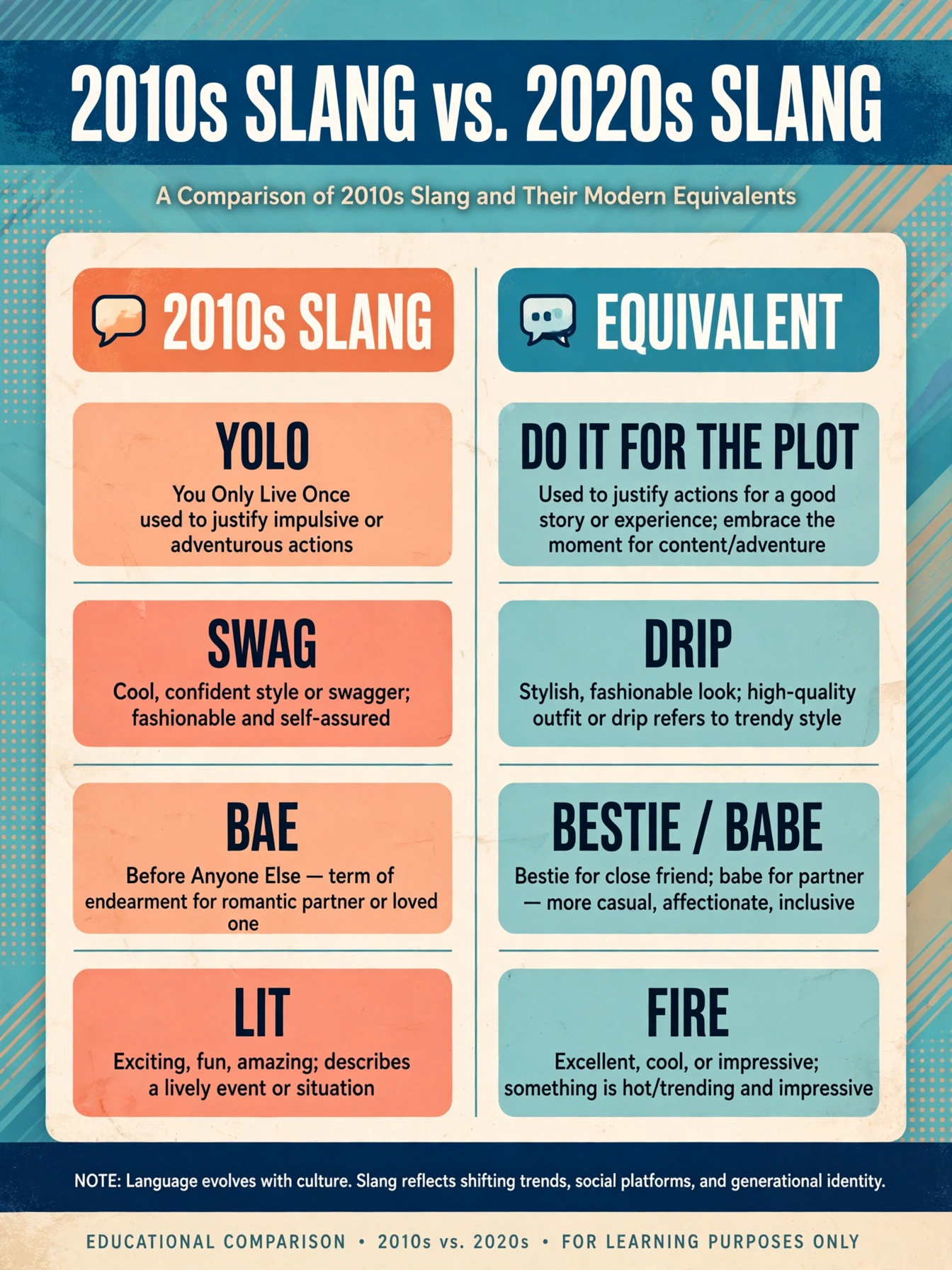
Many 2010 slang words overlapped in meaning, but each one carried its own flavour. The table below shows how the most popular terms compared — and when to use each one.
| Term | Meaning | Closest modern equivalent | Best used for |
|---|---|---|---|
| YOLO | You only live once | Carpe diem, “send it” | Justifying a bold or fun decision |
| Swag | Confidence and style | Aura, rizz | Describing someone’s cool presence |
| Bae | Significant other or crush | Boo, shawty | Affectionate posts and texts |
| Lit | Exciting or excellent | Fire, slaps | Parties, concerts, great moments |
| Turnt | Hyped up or intoxicated | Turned up, wasted | Wild nights out |
| Ratchet | Messy or trashy behaviour | Ghetto (dated), messy | Joking about chaotic situations |
| On fleek | Flawless, perfectly done | On point, ate | Makeup, outfits, photos |
| GOAT | Greatest of all time | The best, elite | Praising legends in sports or music |
| Like a boss | With total confidence | Bossed up, crushed it | Celebrating a win |
| Swag vs. drip | Style and confidence | Drip, sauce | Talking about fashion and attitude |
The key difference between 2010 slang and the slang that replaced it is speed. Words like “rizz” or “slay” spread through TikTok in days; 2010 slang spread through Twitter, Vine, and song lyrics over months. That slower burn is part of why the words feel so nostalgic now — they belonged to a specific moment, and everyone who lived through it remembers the same references.
Alternate Meanings
Several 2010 slang words had other meanings, and context decided which one applied:
- Swag — in older usage, it meant free promotional merchandise (“conference swag”) or stolen goods. The 2010 meaning — style and confidence — was completely separate.
- Bae — besides a term of affection, it is also the Danish word for “poop,” which became a running joke online. Some people also claimed it stood for “before anyone else,” though linguists consider that a backronym invented after the fact.
- Lit — before the 2010s, it usually meant intoxicated or drunk. The decade added the “exciting and fun” meaning, and both senses still exist today.
- Turnt — a variation of “turned up,” it could mean excited, energised, or drunk depending on the sentence.
- GOAT — outside slang, it is simply the farm animal, which is why the acronym is almost always written in capitals to avoid confusion.
- Ratchet — it is also a mechanical tool, and in some regions it described a particular style of music and dance before it became a general insult.
Professional or Polite Alternatives
2010 slang was fun, but it had no place in formal writing, job applications, or professional emails. Here are polite alternatives for the most common terms:
| 2010 slang | Polite alternative |
|---|---|
| YOLO | “Life is short — let’s make the most of it.” |
| Swag | Confidence, style, charisma |
| Bae | Partner, sweetheart, loved one |
| Lit | Wonderful, exciting, fantastic |
| Turnt | Energetic, enthusiastic, lively |
| On fleek | Flawless, perfect, impeccable |
| Like a boss | With confidence, successfully, impressively |
| Ratchet | Messy, chaotic, unrefined (use carefully) |
If you are writing for work or school, these alternatives keep the meaning without the informal tone. Save the original slang for friends, captions, and throwback posts, where it belongs.
Common Mistakes
Using 2010 slang today is mostly about nostalgia — but a few mistakes still trip people up:
- Using it too much. One slang word in a sentence sounds natural. A sentence full of YOLO, swag, bae, and lit sounds like a 2012 meme, not a real message.
- Using it in the wrong setting. “That meeting was lit” might get a laugh from coworkers, but it will not impress a client. Match the language to the room.
- Getting the meaning wrong. People often confuse “turnt” with simply “excited,” or use “ratchet” as a compliment. Both words had sharper, more specific meanings — check before you use them.
- Forgetting the origins. Much of 2010 slang came from AAVE and hip-hop culture. Using the words while ignoring where they came from — or using them to mock the communities that created them — is the fastest way to sound out of touch.
- Mixing decades. Pairing “on fleek” with “rizz” in the same sentence confuses two different eras. If you are going for a 2010 throwback, keep the vocabulary in 2010.
- Using dated or offensive terms. Some 2010 phrases, like “no homo,” have aged badly and are best left in the past. Language moves on — let it.
- Over-explaining the joke. Slang works because it is shared and unspoken. Adding “YOLO, which means you only live once” to a casual text kills the humour instantly.

Quick Tips
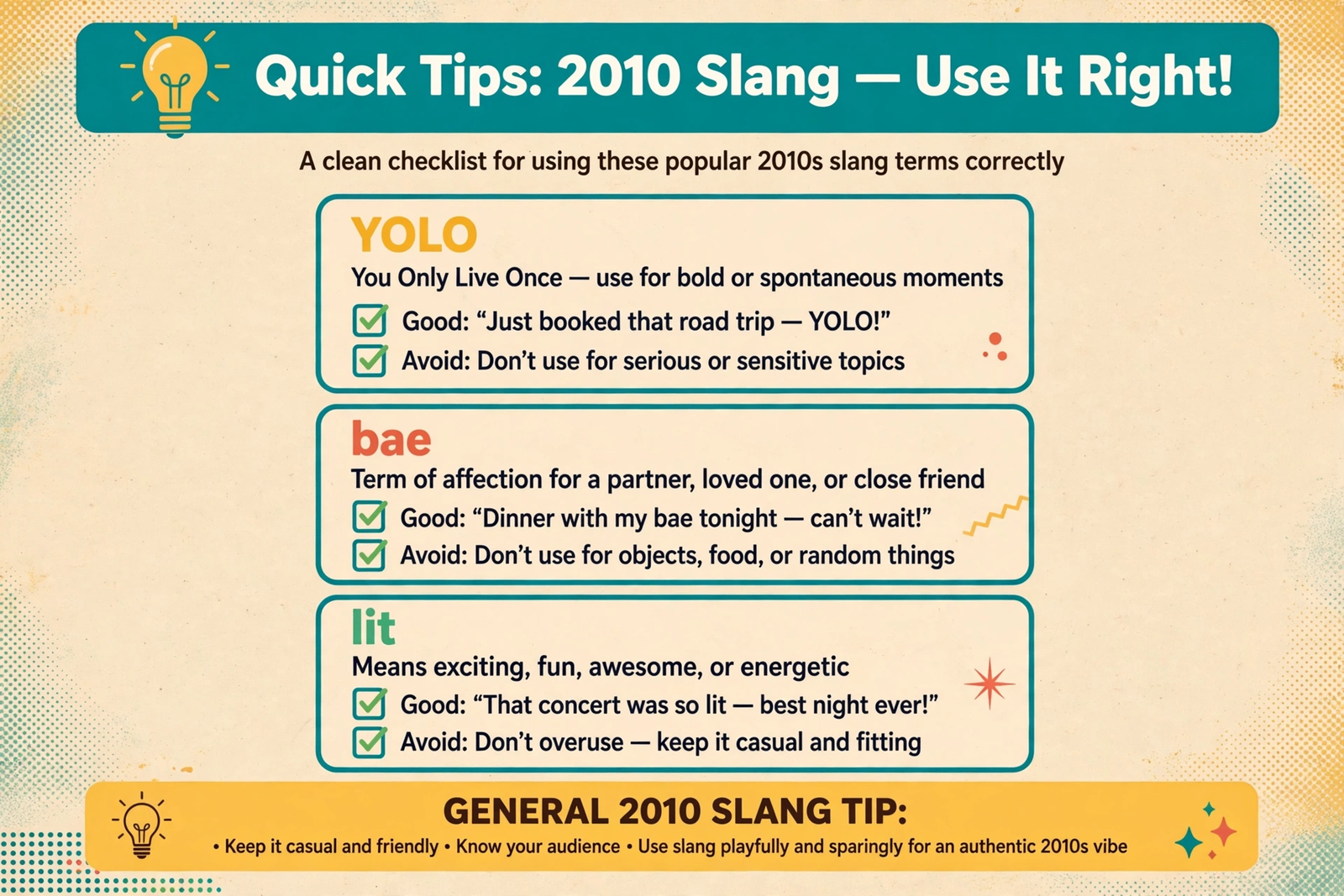
- Learn the big five first: YOLO, swag, bae, lit, and on fleek cover most 2010 throwback captions.
- Use slang sparingly: one term per message is usually enough to set the tone.
- Check the context: a word that was playful in 2012 can feel awkward or dated in a work chat today.
- Pair words with the right era: 2010 slang fits throwback photos, old memes, and nostalgia posts — not breaking news.
- Respect the source: remember that much of this language came from Black culture and hip-hop; use it with appreciation, not mockery.
- Watch modern equivalents: if someone says “aura” or “rizz,” they are using the 2020s version of what “swag” was in 2010.
- When in doubt, skip it: clear, simple language always beats a forced slang word.

FAQ
What does 2010 slang mean?
2010 slang refers to the informal words and phrases that were popular in the early 2010s, such as YOLO, swag, bae, lit, and on fleek. These terms spread through texting, Twitter, Vine, memes, and hip-hop, and they captured the humour and attitude of the decade.
What was the most popular slang word in 2010?
YOLO was arguably the biggest slang word of the era. After Drake used it in his 2011 song “The Motto,” it became a global catchphrase and a symbol of the decade’s carefree attitude. Swag and bae were close behind.
What does YOLO mean in 2010 slang?
YOLO stands for “you only live once.” People used it to justify bold, fun, or risky decisions — from buying concert tickets to trying something new. You can read the full story in our guide to YOLO meaning in slang.
What does bae mean in 2010 slang?
Bae was a term of affection for a boyfriend, girlfriend, or crush, similar to “baby” or “sweetheart.” It appeared in countless captions, texts, and song lyrics in the early 2010s and is still used today, though less often than at its peak.
Is 2010 slang still used today?
Some of it is. Words like lit, savage, and GOAT are still common, while others — on fleek, turnt, and like a boss — mostly appear now in nostalgic or ironic contexts. The language of the 2020s, with words like rizz and slay, has largely taken over everyday conversation.
What does on fleek mean?
On fleek means flawless or perfectly done, and it was most often used for eyebrows and makeup. It went viral from a 2014 Vine video and became one of the most quoted phrases of the decade.
What is the difference between swag and drip?
Swag and drip both describe style and confidence, but swag was the 2010 term and drip is its modern successor. Swag focused on attitude and presence, while drip usually refers specifically to fashion and expensive clothing. You can compare them further in our guide to what drip means in slang.
Where did 2010 slang come from?
Most 2010 slang came from African American Vernacular English, hip-hop culture, and early social media platforms like Twitter, Vine, and Tumblr. Artists, Vine creators, and viral memes carried the words from small communities to the global mainstream.
Conclusion
2010 slang was more than a list of funny words — it was the sound of a generation learning to talk on the internet for the first time. YOLO, swag, bae, lit, and on fleek were short, punchy, and packed with attitude, and they spread faster than any slang before them because the platforms of the decade carried them everywhere at once.
The key takeaways are simple. Learn the big five terms first, use them lightly and in the right context, and remember where they came from. Mix them carefully — one slang word per sentence keeps things natural — and skip the terms that have aged badly. If you keep those rules in mind, a little 2010 slang can still add humour and nostalgia to a caption, a throwback post, or a conversation with friends who remember the era.
Language will keep moving, and today’s slang will be tomorrow’s nostalgia, just like SMH and the rest of the 2010 vocabulary. But understanding 2010 slang means understanding how internet culture grew up — one tweet, one Vine, and one YOLO at a time.
