
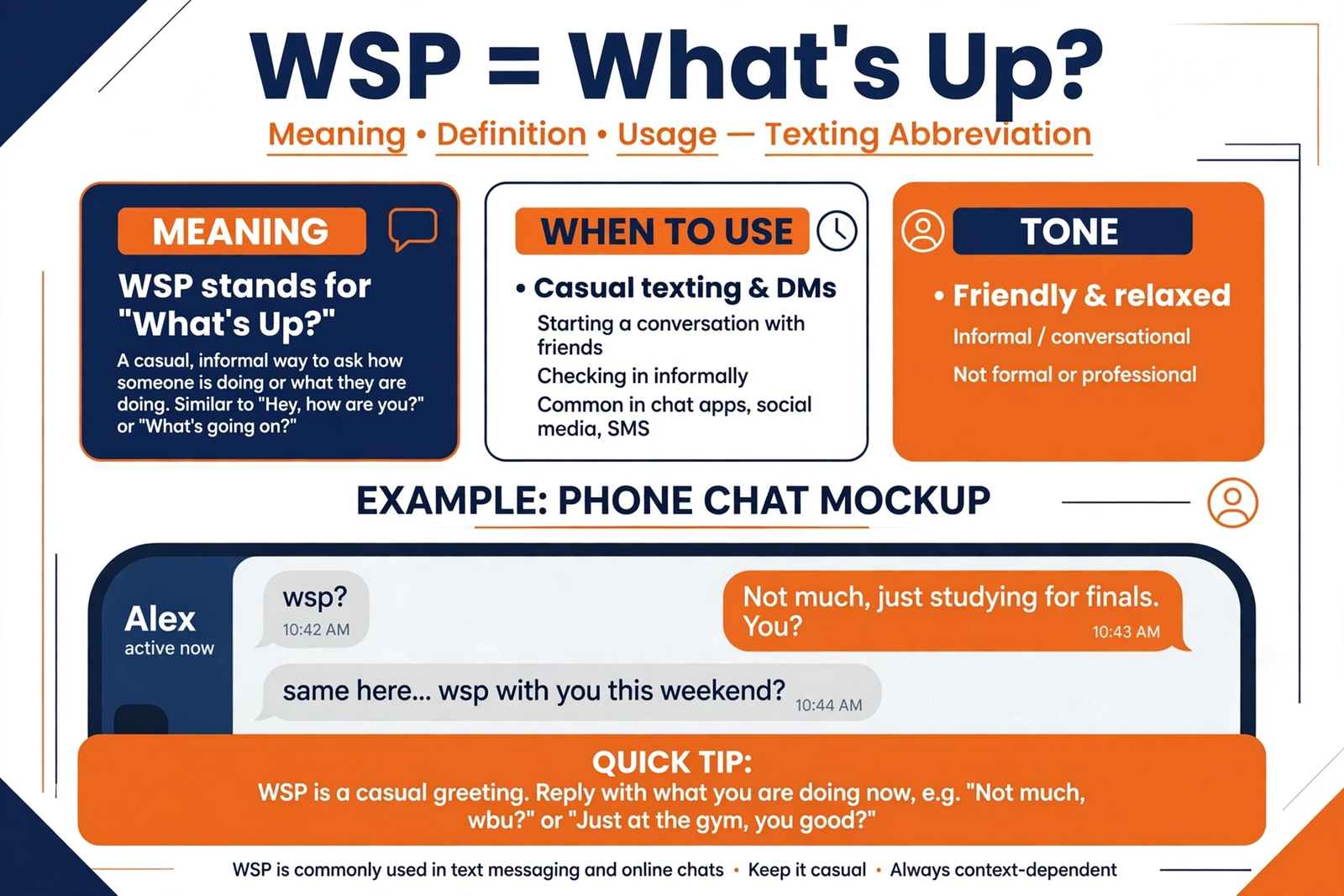
Quick Definition: The wsp slang meaning is simple — WSP stands for “what’s up?” It is a casual texting abbreviation people use as a greeting, a check-in, or a way to start a conversation. When someone sends you “wsp,” they are really asking “hey, what’s going on?” or “what are you doing right now?” You will see it everywhere in 2026: in Snapchat DMs, Instagram messages, TikTok comments, WhatsApp chats, and Discord servers.
WSP Slang Meaning & Definition
WSP slang means “what’s up?” — nothing more complicated than that. It is a shortened, phonetic spelling of the phrase “what’s up,” squeezed into three letters so it can be typed in under a second. The W keeps the “what’s” sound, and the SP captures the “sup” you hear when the phrase is spoken quickly and casually, the same way “wassup” sounds when friends say it out loud.
Unlike acronyms such as LOL or BRB, which take the first letter of each word, WSP is not built from initials at all. It copies the sound of the phrase instead of its spelling. That is exactly why it feels so natural in a text message — it reads the way people actually talk. Dictionary.com defines “wsp” as an abbreviation of “what’s up” used in texting and online communication since at least the early 2000s, and Wiktionary lists the same definition for internet and text-messaging use.
In practice, wsp slang works as three things at once: a hello, a question, and an invitation to talk. A bare “wsp” from a friend usually means “hi, I want to chat.” A “wsp” after a long silence means “we haven’t talked in a while — what’s new?” And a “wsp” with a follow-up, like “wsp, are you coming tonight?”, is simply a casual way to open a real question. The exact shade of meaning always depends on who sent it and what came before it, but the core never changes: it is a friendly, low-effort way to check in.
Introduction
Open any group chat today and you will probably find a “wsp” sitting there, waiting for a reply. It is one of the most common greetings in texting slang, yet plenty of people still pause when they see it for the first time. Is it a question? A greeting? Is the sender annoyed, flirty, or just bored? The honest answer is that it is usually all three at once — or none of them — because wsp slang is deliberately vague, and that vagueness is the point.
Short greetings like this exist because texting rewards speed. Nobody wants to type “Hello, how are you doing today?” when three letters do the same job. WSP joined a whole family of one-breath greetings — sup, wsg, wyd, hbu — that let people open a conversation without committing to a topic. The sender throws out a casual opener, and the reply decides where the chat goes next.
This guide explains the wsp slang meaning in full: what it stands for, where it came from, how people use it on Snapchat, Instagram, TikTok, and in gaming, how to reply without sounding awkward, and the mistakes that make a simple greeting fall flat. You will also find a comparison with similar terms like sup, a table of real examples, and answers to the questions people ask most about WSP.
Origin
WSP grew out of the early days of mobile texting, when every character cost time and often money. In the early 2000s, text messages had a 160-character limit, and carriers charged per message, so people shortened everything they could. “What’s up?” became “wuzup,” then “sup,” and eventually “WSP” for people who wanted the whole phrase in its most compact form.
The phrase itself is much older than the abbreviation. “What’s up?” has been casual American English for generations, but it exploded into pop culture in 1999, when a famous Budweiser beer commercial showed friends greeting each other with a drawn-out “Wassup!” over the phone. The ad ran for years, became one of the first viral memes of the internet age, and fixed “wassup” in the public imagination. WSP is, in a sense, the texting-age child of that moment — the same sound, compressed for a phone keyboard.
Dictionary.com notes that people have used “wsp” in texting and online communication since at least the early 2000s. ProWritingAid’s guide to WSP likewise explains that the abbreviation is used in text messaging and on social media to mean “what’s up?” No reliable source names a single person or community that invented it, so any claim about a specific inventor should be treated as unverified. What is clear is that the abbreviation spread the way most texting slang spreads: teenagers and young adults used it, it jumped from SMS to instant messaging, then to social media, and it never really went away. Unlike slang that burns out in a season, a greeting this useful tends to stick around — and in 2026, WSP is still one of the first greetings new texters learn.
Popularity
WSP is popular for one reason above all: it is the fastest possible way to start a conversation. Three letters, one thumb-tap each, and the ball is in the other person’s court. That efficiency made it a default opener for Gen Z and millennials, and it is now a normal part of everyday texting for almost anyone under 40.
You will see wsp slang most often in these places:
- Snapchat: probably the number-one home of WSP, where short, disappearing messages reward short openers. A “wsp” snap or chat is the classic way to start a streak conversation.
- Instagram DMs: people slide into DMs with “wsp” because it is casual enough not to feel pushy, but direct enough to expect a reply.
- TikTok comments: “wsp” appears in comments and replies as a friendly greeting between creators and followers.
- WhatsApp and iMessage: the everyday home of WSP between friends, siblings, and classmates.
- Discord and gaming chats: gamers use WSP to greet teammates when they log on or join a voice channel’s text chat.
- Dating apps: WSP is extremely common as a first message, because it is low-pressure — though, as we will see, it is not always the most effective opener.
Its popularity has also survived because it adapts. Add a name — “wsp Sarah” — and it becomes personal. Add an emoji and it becomes warmer. Add a question — “wsp, did you finish the assignment?” — and it becomes a practical check-in. The three letters carry almost no meaning on their own, so the context around them does all the work. That flexibility is exactly why WSP has outlived dozens of trendier slang words.
How It Is Used
WSP is used in four main ways, and recognising which one you are looking at makes replying much easier.
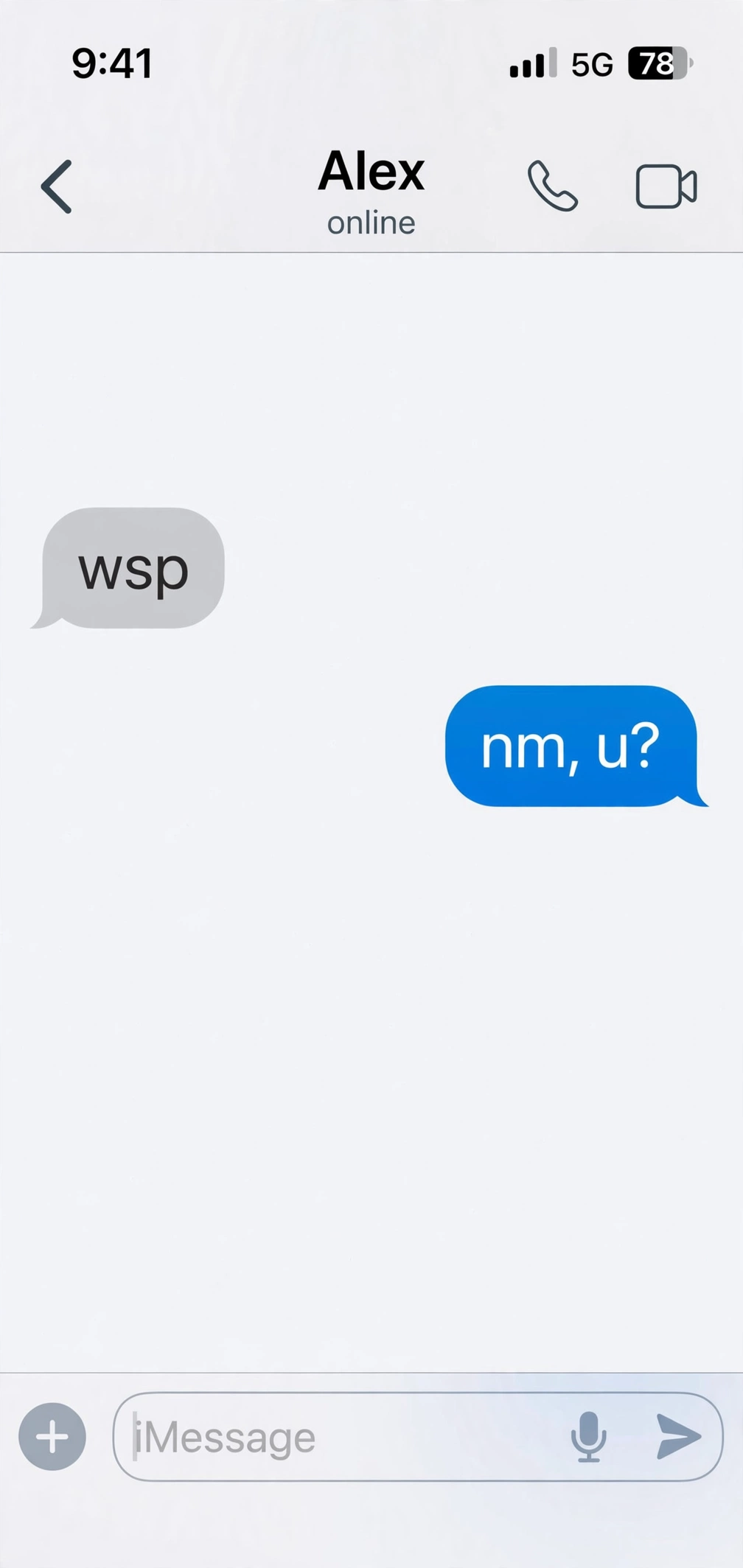
1. As a plain greeting. This is the most common use. “Wsp” on its own simply means “hi.” The sender is not asking for news or information — they are just saying hello and opening the door to a chat. A reply like “hey! nm, wbu?” is all it needs.
2. As a check-in. “Wsp” can mean “how are you?” or “how’s it going?” When a friend you have not spoken to in weeks sends it, they are asking for a quick life update. A good reply gives them something real: “hey! just got back from class, you?”
3. As a conversation starter. Sometimes “wsp” is a fishing line. The sender wants to talk but does not have a topic yet, so they send the shortest possible opener and wait to see if you bite. If you reply with energy and a question of your own, the conversation takes off; if you reply with a flat “nm,” it usually dies there.
4. As a complaint or challenge. Less often, WSP shows up with an edge: “wsp with this traffic?” or “wsp with the wifi today?” Here it means “what is going on with…” — a casual way to complain or ask why something is wrong. The tone is still informal, but the intent is closer to “what’s the deal?” than “hello.”
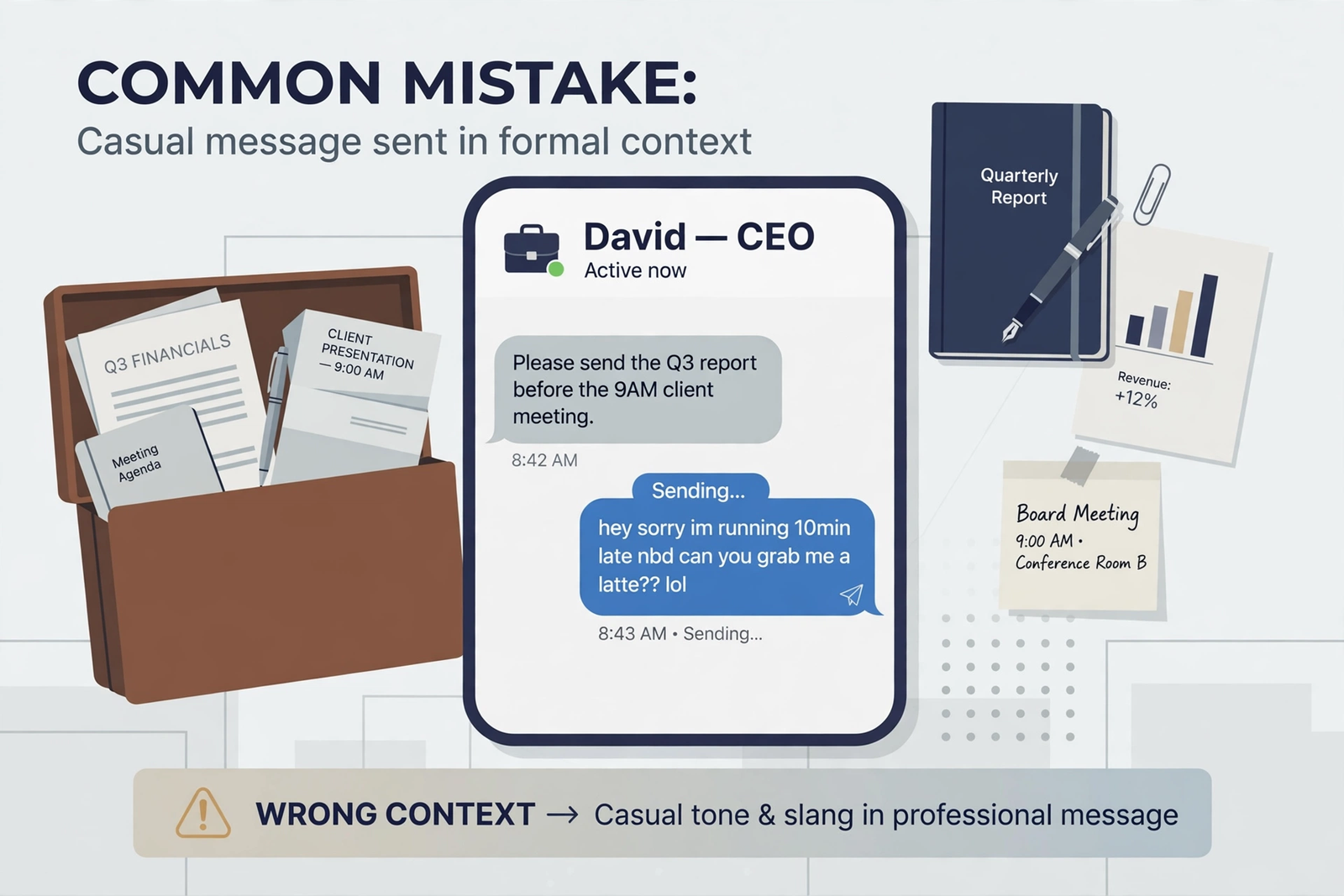
One thing WSP is almost never used for is formal communication. You will not see it in a work email, a message to a teacher, or a first message to a client — and sending it there is one of the classic mistakes covered later in this guide.
Examples
Seeing wsp slang in real conversations is the fastest way to understand it. The meaning barely changes, but the tone shifts completely depending on who is talking and what they want. Here are realistic examples across friendly, professional-adjacent, and funny contexts.
Friendly Examples
- Alex: “wsp”
Jamie: “hey! nm, just watching a show. wbu?” - Sam: “wsp, long time no see!”
Riya: “I know right! How have you been?” - Chris: “wsp bro, game tonight?”
Leo: “yess, 8pm. don’t be late this time 😂” - Maya: “wsp, did you see the new episode?”
Zoe: “just finished it, the ending was crazy!”
Notice how the first message does almost no work — it is the reply that gives the conversation its direction. That is the whole design of wsp slang: a low-effort opener that invites a real answer.
Professional Examples
Strictly speaking, WSP has no place in professional messages. You should not text your boss “wsp” or open a client email with it. But there are casual work-adjacent situations where a light version appears — usually between coworkers who are also friends, and usually outside formal channels:
- Coworker (on a casual team chat): “wsp everyone, who’s coming to the lunch today?”
- Classmate: “wsp, did the professor post the notes?”
- Freelancer to a friendly repeat client (WhatsApp): “Hey! Wsp — just checking in on the draft, all good on your side?”
Even here, the safer move is usually to write the words out: “Hi, how’s it going?” reads as friendly without reading as careless. Save WSP for people who already text you casually.
Funny Examples
- Dan: “wsp”
Emma: “the sky. what do you want 😂” - Tom: “wsp”
Ben: “my blood pressure after seeing your 3am ‘we need to talk’ text” - Sara: “wsp with this homework??”
Ali: “bro I opened the assignment and closed it again. that’s my update.” - Group chat: “wsp” — sent at 2:47 AM, followed by 40 unread messages about absolutely nothing.
The classic joke reply to “what’s up?” is “the sky” or “the ceiling” — a joke so old it is practically part of the greeting now. If someone answers your “wsp” with “the sky,” they are not confused; they are just playing along.
Comparison with Similar Terms
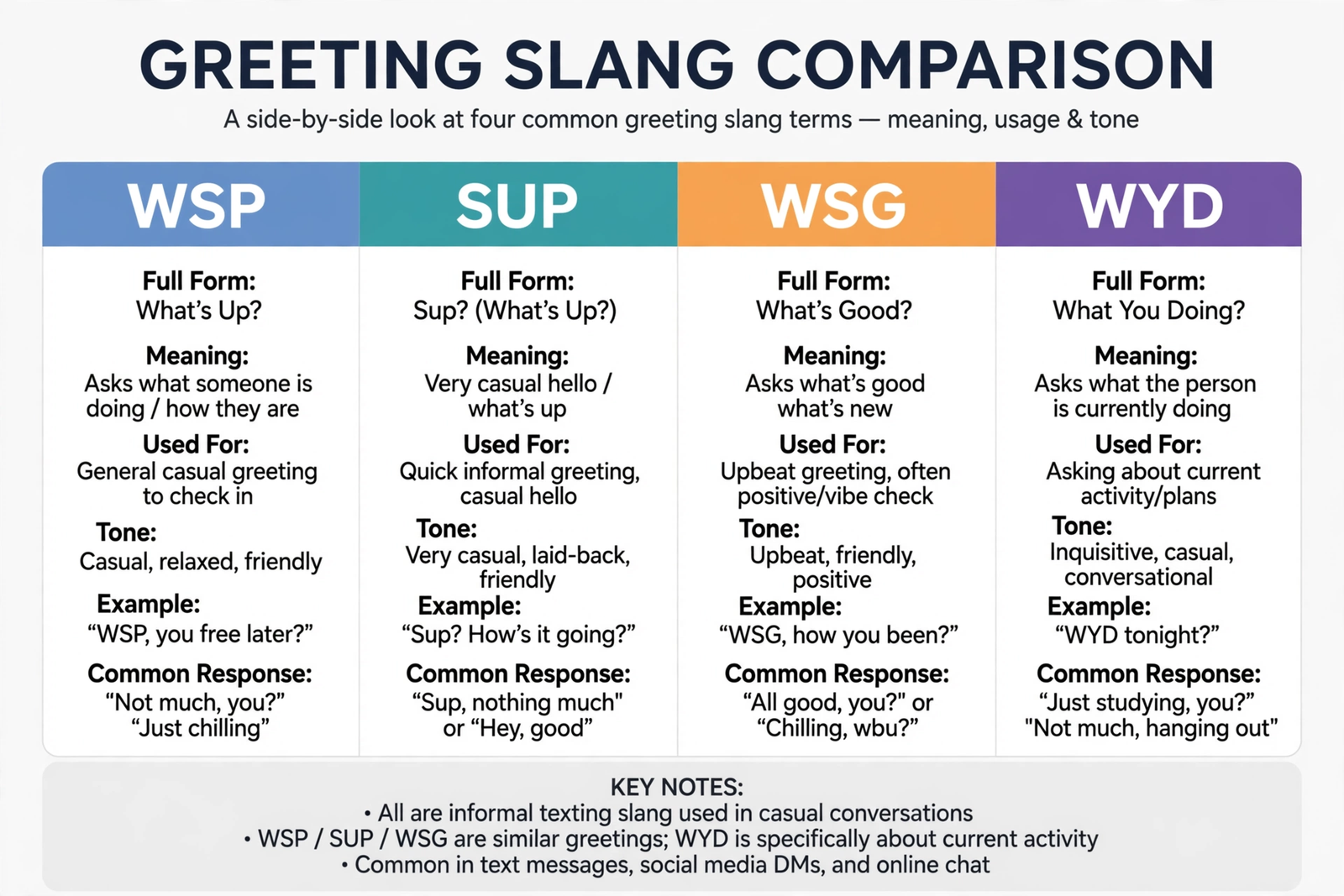
WSP sits inside a crowded family of short greetings, and they are easy to mix up. The differences are small, but they change how a message feels. Here is how wsp slang compares with its closest relatives.
| Term | Full Form | Meaning | Tone | Best For |
|---|---|---|---|---|
| WSP | What’s up? | Casual greeting / check-in | Relaxed, friendly | Opening any casual chat |
| SUP | What’s up? | Same as WSP, even shorter | Very casual, laid-back | Close friends, quick hellos |
| WSG | What’s good? | What’s happening / what’s new | Cool, confident | Checking what’s going on |
| WYD | What are you doing? | Asks about current activity | Curious, direct | Asking what someone is up to |
| WBU | What about you? | Returns the question | Friendly | Replying to a greeting |
| HBU | How about you? | Returns the question | Friendly, warm | Replying to “how are you?” |
| WASSUP | What’s up? | Longer, playful version | Fun, expressive | Enthusiastic greetings |
The practical difference is this: WSP and SUP ask “what’s happening?” in general, WSG asks the same thing with more energy, and WYD asks specifically what the person is doing right now. If you want to start a conversation with no agenda, WSP is the safest pick. If you want to know what someone is doing at this moment, WYD is more precise. And if someone greets you with WSP, answering with hbu or “wbu?” after your own update keeps the conversation moving — it shows you are actually interested, not just being polite.
Alternate Meanings
Like most short abbreviations, WSP can mean other things outside of texting slang. In casual conversation, “what’s up?” covers almost every case, but it helps to know the alternatives so you are never caught off guard.
- “What’s popping?” — Some people use WSP to mean “what’s popping?”, another way of asking what is exciting or going on. The vibe is nearly identical to “what’s up?”, just slightly more energetic.
- “Whisper” (gaming): In some gaming communities, WSP can mean “whisper” — a private message to another player. If someone in a game says “wsp me,” they may be asking you to send them a private message, not asking what’s up. Context makes it obvious: in a game lobby it is usually “whisper,” in a text chat it is almost always “what’s up?”
- WSP Global: WSP is also the name of a large engineering and professional services firm headquartered in Montreal, Canada. If you see “WSP” in a business or construction context, it is the company, not the slang — capital letters and context give it away.
- Water and sanitation program: In development and government documents, WSP can stand for “Water and Sanitation Program.” Again, the context is completely different from a text message.
For everyday texting, though, the rule is simple: if it arrives in a chat, a DM, or a comment, WSP means “what’s up?” around 99 times out of 100.
Professional or Polite Alternatives
Because wsp slang is so informal, it is worth having a few polished alternatives ready for situations where WSP would feel out of place. The meaning stays the same — a warm greeting and a check-in — but the wording shows respect for the setting.
| Instead of “wsp” | Say this | When to use it |
|---|---|---|
| wsp | “Hi, how are you?” | Any polite conversation |
| wsp | “Hello, I hope you’re doing well.” | Emails, first messages to new contacts |
| wsp, did you see this? | “Hi! Just wanted to check — have you seen this?” | Work chats, teachers, clients |
| wsp bro | “Hey! Good to hear from you — how’s it going?” | Friendly but slightly more formal friends |
| wsp with the project? | “Hi, could you share a quick update on the project?” | Work check-ins |
The test is easy: if you would not say “what’s up?” out loud to that person in that setting, do not type “wsp” to them either. A good rule of thumb is to match the other person’s energy — if they text you in full sentences, answer in full sentences. Slang like ngl and WSP belongs with people who already use it with you.
Common Mistakes
WSP is simple, but people still use it in ways that backfire. Avoid these five mistakes and your greeting will land the way you meant it.
1. Using it in formal settings. Texting “wsp” to a boss, a teacher, a client, or a recruiter reads as careless, even if you mean it warmly. Formal settings deserve full words. This is the single most common mistake, and the easiest to avoid.
2. Sending a bare “wsp” to a crush or a new match. On dating apps, a lone “wsp” is one of the most ignored openers there is, because it puts all the work on the other person. Add something real — “wsp, I saw you like hiking — have you done any trails lately?” — and your reply rate will be far higher.
3. Replying with only “nm.” “Not much” is a conversation ender. If you actually want to talk, give the other person something to respond to: “nm, just got home from the gym — wbu?” One extra detail can be the difference between a chat and a dead end.
4. Overusing it. Opening every single conversation with “wsp” gets repetitive fast, especially in a daily chat with the same person. Mix it up with “hey,” “yo,” “morning,” or just jump straight to your point — variety keeps chats feeling alive.
5. Assuming it is flirty — or assuming it is not. WSP by itself is neutral. It becomes flirty only through context: who sent it, what time it is, and what follows. Do not read a crush into a plain “wsp,” and do not assume a late-night “wsp” from someone you like is meaningless, either. Let the conversation tell you which it is.
Quick Tips
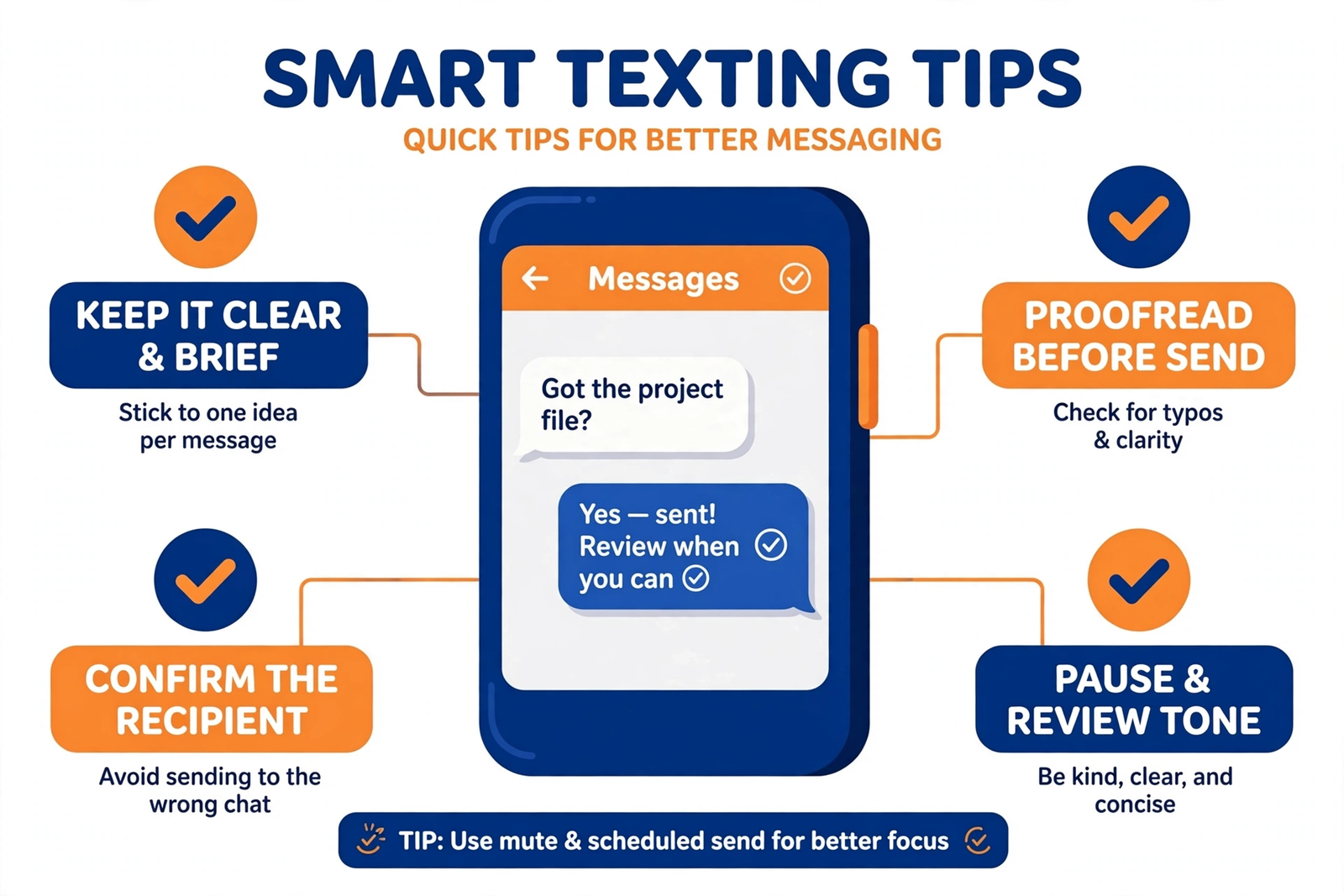
Use these tips to get more out of three little letters:
- Add a name or a detail. “Wsp Alex” feels warmer than a bare “wsp,” and “wsp, did you finish the episode?” gives the other person an instant topic.
- Answer with more than one word. “nm, watching a movie — wbu?” keeps the chat alive. “nm” alone kills it.
- Match the other person’s tone. If they reply with energy, bring energy back. If they reply briefly, do not flood them with paragraphs.
- Use it to reopen, not just open. WSP is perfect for restarting a chat that went quiet: “wsp, long time!” is friendly without being awkward.
- Keep it out of work chats. Unless your whole team texts casually, use full greetings at work — it costs you two seconds and saves you a bad impression.
- Read the timing. A “wsp” at 2 AM usually means someone is bored or thinking of you; a “wsp” at noon usually just means hello. Context is everything.
- Pair it with a question when you need something. “Wsp, are you free Saturday?” works far better than a bare “wsp” followed by a long silence.
FAQ
What does WSP mean in text?
In text messages, WSP means “what’s up?” It is a casual greeting people send to say hello, check in, or start a conversation. The sender is usually asking how you are or what you are doing, and expects a short, friendly reply.
What does WSP stand for?
WSP stands for “what’s up?” It is not a normal acronym made from first letters — it is a phonetic shortening of the phrase “wassup,” keeping the sounds while dropping the vowels. The W covers “what’s” and the SP captures the “sup” sound at the end.
How do you reply to WSP?
The best replies give the other person something to work with. Try “hey! nm, just chilling — wbu?”, “not much, you?”, or “hey! just got home, what’s going on with you?” Avoid a bare “nm” if you actually want to keep talking, because it usually ends the conversation.
Is WSP flirty?
Not by itself. WSP is a neutral greeting, and it only becomes flirty through context — who sent it, when, and what comes next. A late-night “wsp” from a crush might mean more than a midday “wsp” from a classmate, but the letters alone do not prove anything.
What does WSP mean on Snapchat?
On Snapchat, WSP means the same thing as everywhere else: “what’s up?” It is one of the most common ways to open a chat or keep a streak going. People send it as a quick hello, a check-in, or a way to ask what a friend is doing right now.
What does WSP mean in gaming?
In gaming, WSP usually still means “what’s up?” as a greeting when players join a lobby or a Discord chat. In some gaming communities it can also mean “whisper,” as in sending a private message — “wsp me” means “message me privately.” The setting makes the meaning clear.
What is the difference between WSP and SUP?
Almost nothing — both mean “what’s up?” SUP is just even shorter and slightly more casual, while WSP spells out a little more of the phrase. WSP feels a touch friendlier and more complete; SUP feels quicker and more laid-back. People use them interchangeably.
Is WSP rude or unprofessional?
WSP is not rude, but it is very informal. Among friends it is perfectly polite. In professional settings — work emails, messages to teachers, clients, or recruiters — it reads as too casual and can leave a bad impression. In those situations, use “Hi, how are you?” instead.
Conclusion
The wsp slang meaning is one of the simplest in all of texting slang: WSP means “what’s up?” — a fast, friendly way to say hello, check in, or start a conversation. It comes from the early 2000s world of character-limited texting, got a boost from the famous “wassup” commercials of 1999, and survived because three letters can do the job of a whole sentence. Today it lives on Snapchat, Instagram, TikTok, WhatsApp, Discord, and dating apps, and it works just as well as a greeting, a check-in, or a gentle “what’s going on?”
The key to using it well is remembering what it is not: it is not formal, it is not a complete message on its own, and it is not flirty by itself. Pair it with a detail, answer it with more than “nm,” and keep it away from work chats and first messages to strangers — and this tiny greeting will do exactly what it was designed to do: get a conversation started in under a second.
Now that you know what WSP means, you will spot it everywhere — and you will know exactly how to reply. If you enjoyed this guide, explore more everyday internet language in our Gen Z slang 2024 guide, where words like rizz, slay, and sigma get the same full treatment.

2 thoughts on “WSP Slang Meaning: What Does WSP Mean in Text? 7 Real Examples”