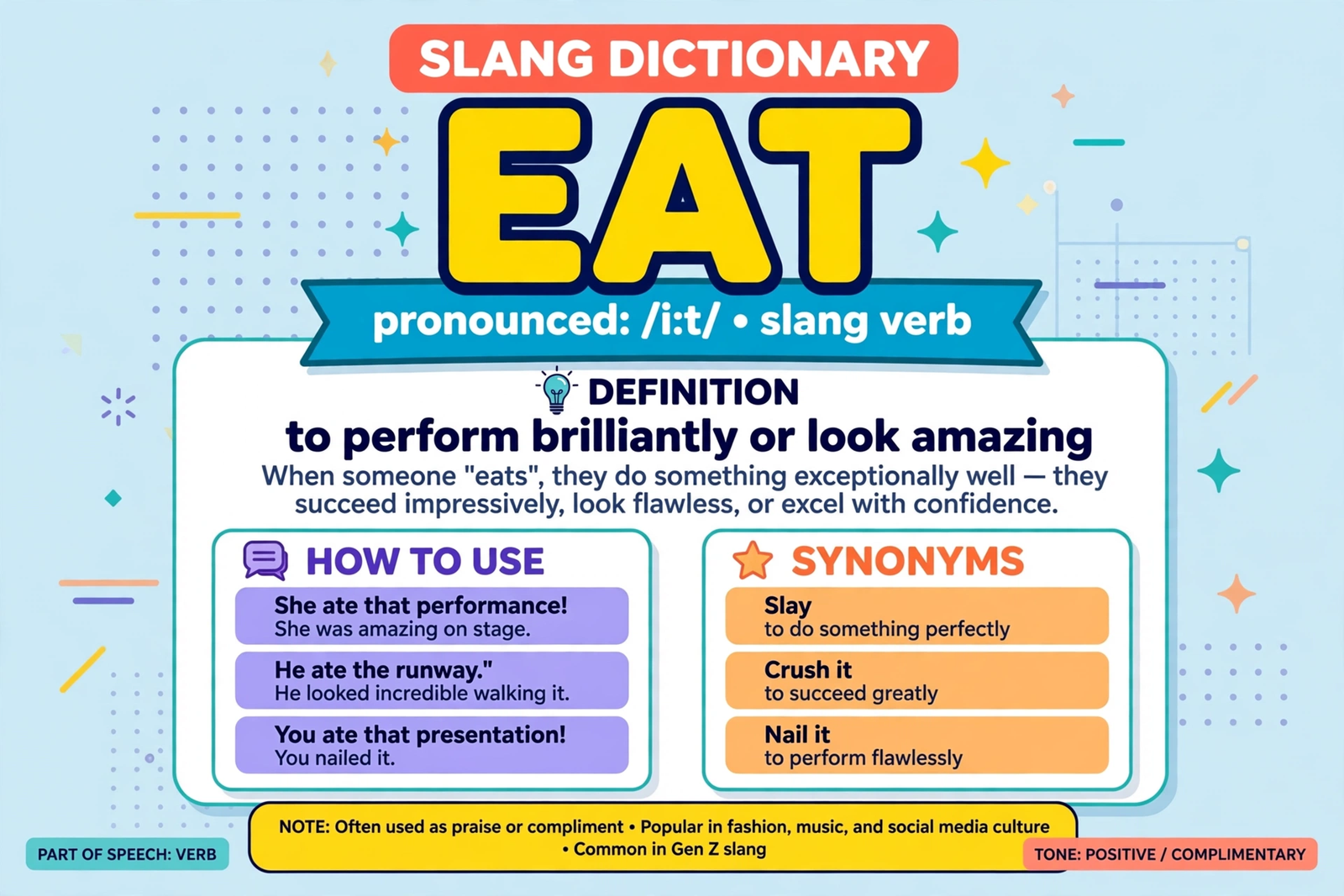
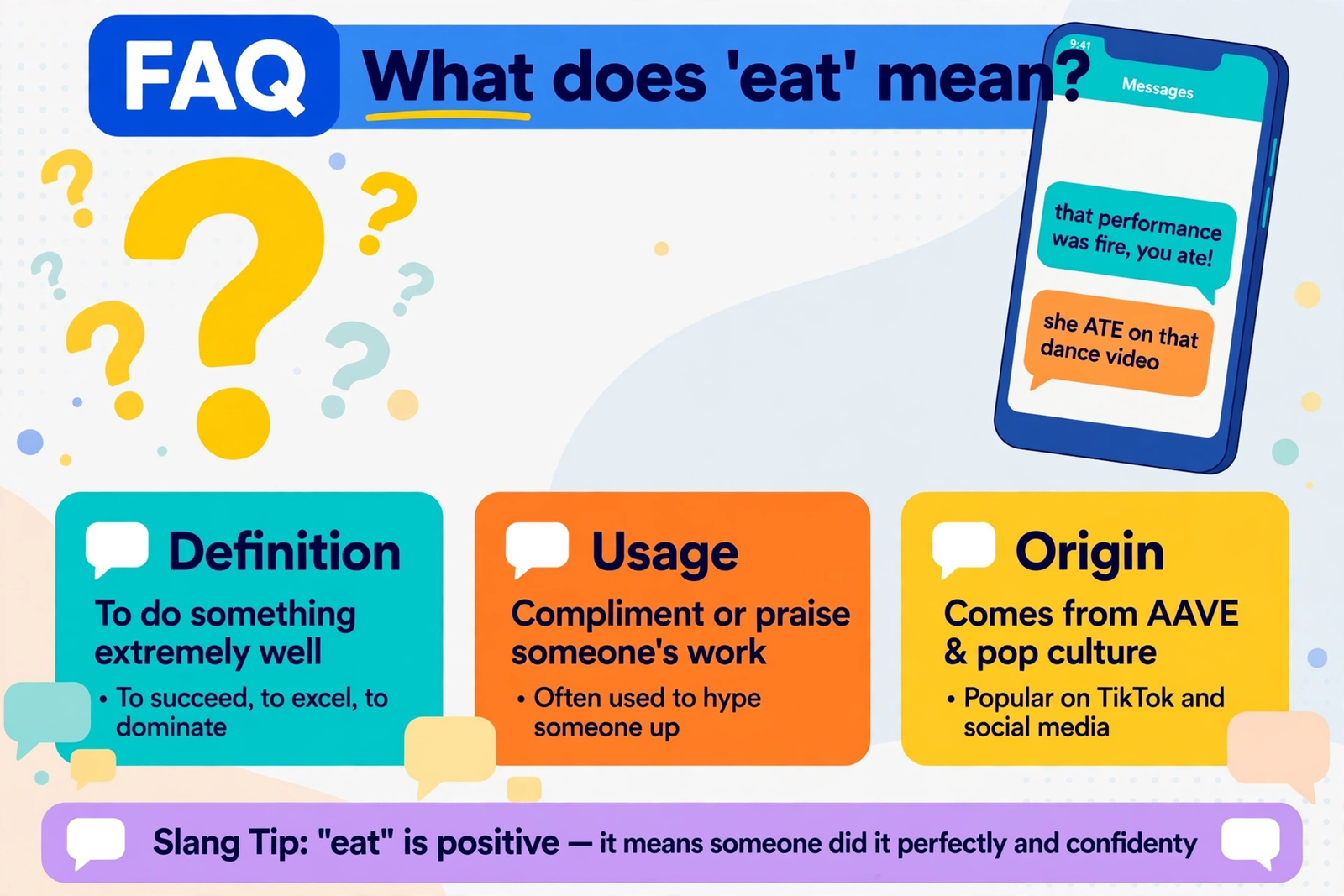
Quick Definition: In slang, “eat” means to perform brilliantly, look amazing, or completely own a moment — as in “she ate that performance” or “he ate and left no crumbs.” The eat slang meaning comes from ballroom and Black queer culture, spread through TikTok and stan Twitter, and today it is one of the most common compliments in Gen Z and internet English. Its past tense, “ate,” is used even more often than “eat” itself.
eat slang Meaning & Definition
Eat slang means to do something exceptionally well — so well that there is nothing left to criticise. When someone says “she ate,” they are not talking about food at all. They mean she delivered a flawless performance, wore a stunning outfit, won an argument, or handled a situation with total confidence. The phrase works as high praise, and the stronger version, “ate and left no crumbs,” means the performance was so complete that nothing was left behind — no mistakes, no weak moments, nothing for anyone else to pick at.
The eat slang meaning is always positive. Unlike some slang words that change meaning with tone, “eat” in this sense is a compliment in almost every context. A singer can eat a vocal run, a dancer can eat a choreography, a student can eat a presentation, and a friend can eat a comeback in a group chat. The word describes excellence that is obvious to everyone watching.
What makes eat slang interesting is how flexible it is. It works as a verb (“she ate that look”), as a standalone reaction (“ATE!”), and as part of longer phrases (“eat it up,” “ate that up,” “she’s eating”). It can describe fashion, talent, confidence, humour, or even a single photo. If something impressed people, someone in the comments has probably said it ate.
It is also worth knowing that “eat” has a second, older slang life. In AAVE and hip-hop, “eat” has long been used in phrases like “eat your words” or “eat it up,” meaning to enjoy something eagerly or accept it fully. The modern compliment sense grew out of that same energy — consuming something completely, leaving nothing behind — but the TikTok-era meaning is specifically about performing or looking flawless.
Introduction
You are scrolling TikTok when a video stops you mid-swipe. A dancer hits every beat of a complicated routine, a creator serves a jaw-dropping outfit, or a singer nails a note nobody expected. You open the comments, and the same word is everywhere: “ATE.” “She ate and left no crumbs.” “The way she ate that??” Nobody is talking about lunch. They are handing out the internet’s favourite compliment — and if you did not grow up with this slang, it can look completely confusing.
That is the world of eat slang. In just a few years, a simple everyday verb has become shorthand for excellence online. It shows up under celebrity red-carpet photos, in reaction videos, in group chats after a friend posts a selfie, and in gaming streams when a player makes an impossible play. It is short, punchy, and instantly understood by millions of people — which is exactly why it spread so fast.
This guide explains eat slang properly: what it means, where it came from, how people actually use it, and the mistakes that make you sound like you are trying too hard. You will find real examples for friendly, professional, and funny situations, a comparison with similar slang like “slay” and “ate,” and answers to the questions people search for most. Whether you are a parent decoding your teenager’s comments, a creator trying to understand your audience, or just curious about internet language, this is the complete guide to eat slang. For more food-flavoured internet words, check out our guide to glizzy meaning — another snack word that became slang.
Origin
The compliment sense of “eat” comes from ballroom culture — the Black and Latino LGBTQ+ ballroom scene in New York that gave the world voguing, “reading,” and “shade.” In ballroom, to “eat” meant to dominate the runway or the dance floor so completely that the competition had nothing left. The phrase “eat it up” was already common in Black American English, meaning to enjoy something fully or to devour praise, and ballroom took that energy and made it a verdict: she ate.
From ballroom, the word travelled through drag culture and into mainstream pop culture. RuPaul’s Drag Race, which borrowed heavily from ballroom language, helped put words like “slay,” “tea,” and “eat” in front of millions of viewers who had never been to a ball. By the late 2010s, “ate” was a regular word on Black Twitter and stan Twitter, where fans used it to praise their favourite artists after a performance, a music video, or a red-carpet appearance.
TikTok finished the job. Around 2020–2021, “ate and left no crumbs” became a viral comment format, and short videos explaining the phrase racked up millions of views. The phrase “she ate” started appearing under almost every impressive video, and the compliment jumped from stan communities into general Gen Z speech. By 2023, it was common enough that mainstream outlets and dictionaries were documenting it — Merriam-Webster lists the slang senses of “eat” alongside its standard definitions, showing how far the word has travelled from the dinner table.
That journey matters, because it explains why the word feels so natural online. Eat slang was not invented by a marketing team or a single viral video. It grew out of a real community, was carried by the people who created it, and only later became a general internet compliment. Knowing that history is part of using the word respectfully.
Popularity
Eat slang exploded in popularity between 2020 and 2023, and it has stayed popular since. The main reason is TikTok: the platform’s comment culture rewards short, emotional reactions, and “ATE” is one of the shortest, most emphatic compliments available. A single word can carry the same energy as a whole paragraph of praise, and it fits perfectly in a fast-scrolling feed.
The phrase also benefited from celebrity use. When pop stars, actors, and influencers started saying “ate” in interviews and captions, the word jumped from internet comments into everyday speech. Music fan communities were especially important — stans use “ate” constantly to praise comebacks, performances, and outfits, and their enthusiasm pushed the word into millions of timelines every week.
Another reason for its staying power is versatility. Most slang compliments are narrow: “fire” describes something exciting, “iconic” describes something memorable. “Eat” covers all of it — a look, a performance, a joke, a clapback, a photo — and it works as a verb, a reaction, and a meme format. That flexibility is why it has outlasted dozens of trendier words that faded in a month.
Today, eat slang is understood far beyond Gen Z. Millennials use it, brands use it in social media captions, and even news outlets use it in headlines about celebrity fashion. It has become one of the standard compliments of internet English, alongside “slay” and “iconic.”
How It Is Used
Eat slang is used in three main ways. The first is as a verb describing a specific performance: “She ate that dance routine,” “He ate the interview,” “They ate that outfit.” The structure is simple — subject + ate/eat + the thing that was done well — and it works for almost any achievement.
The second way is as a standalone reaction. A single “ATE!!!” in a comment section is a complete sentence: it means “that was flawless, I have nothing to add.” People often add extra letters for emphasis — “ATEEE,” “she ATE” — and the exclamation marks do the rest. This is the most common use on TikTok and Instagram, where a one-word comment can still get hundreds of likes.
The third way is the extended phrase “ate and left no crumbs.” This is the strongest version. “No crumbs” means nothing was left behind — no flaws, no weak moments, no room for improvement. It is usually reserved for truly outstanding performances, which is why it hits harder than a plain “ate.” A related version is “ate that up,” which adds the sense of enjoying and consuming the moment completely.
The word also appears in the present continuous: “she’s eating” means she is currently doing brilliantly, and “eat it up” is encouragement to enjoy the attention. All of these forms share the same idea: total, obvious excellence. Tone matters, though — “eat” is casual and enthusiastic, so it fits comments, chats, and social media far better than a formal email or a work presentation.
Examples
Context changes how eat slang sounds, so here are real examples grouped by tone. Notice that the meaning stays the same — flawless performance — but the surrounding words shift with the situation.
Friendly Examples
Friends use “ate” as quick, warm hype. It is the digital version of cheering someone on, and it usually appears right after a photo, a story, or a win.
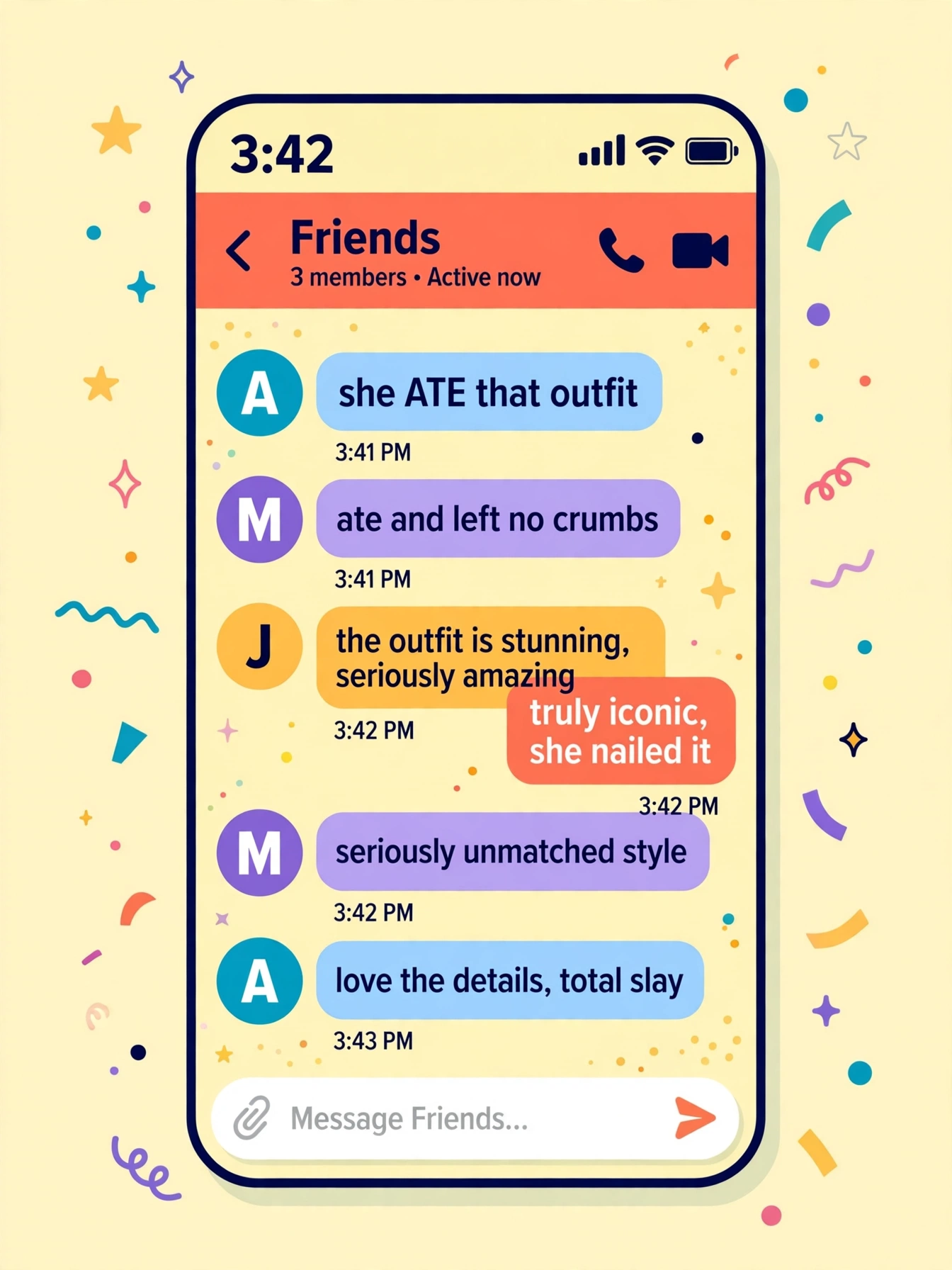
- “Okay, you ATE that outfit. The boots?? The hair?? I’m obsessed.”
- “She posted the graduation pics and honestly she ate. Every single one.”
- “You ate that presentation, bestie. The whole class was staring.”
- “He ate and left no crumbs at the talent show. The crowd went wild.”
- “That selfie? You ate. No notes.”
In friendly use, “ate” is almost always paired with excitement — extra letters, emojis, or a follow-up compliment. The goal is to make the other person feel seen, and the word does that in a single syllable.
Professional Examples
Eat slang is casual, so it rarely belongs in a formal workplace email. But in creative industries, media, and relaxed team chats, people do use it — usually lightly, and usually about creative work rather than corporate results.
- “Our designer ate with this campaign. The client loved every slide.”
- “She ate that pitch — the investors were nodding the whole time.”
- “The social team really ate with the launch video. Two million views in a day.”
- “He ate the interview, honestly. I’ve never seen a candidate that confident.”
The rule for professional settings is simple: use it with colleagues who use slang themselves, keep it about the work, and never use it in front of a client unless the relationship is already informal. A compliment is only a compliment if the other person receives it that way.
Funny Examples
Humour is where “ate” shines, because the word is dramatic by nature. People exaggerate it for jokes, memes, and playful roasts.
- “My cat ate and left no crumbs. She knocked the vase over and looked proud.”
- “Grandma ate that dance challenge and she’s 82. I’m scared of her now.”
- “He said he’d cook dinner and actually ate — I mean, the food was good AND he looked good doing it.”
- “The way my little brother ate that spelling bee… he spelled ‘chrysanthemum’ without blinking.”
- “She ate the group project. The rest of us just watched.”
The joke works because “ate” sets up an expectation of glamour, and then the example is deliberately ordinary — a cat, a grandma, a spelling bee. That contrast is the humour.
Comparison with Similar Terms
Eat slang sits in a family of internet compliments, and the differences between them are small but real. This table compares “eat” with the words people confuse it with most.
| Term | What It Means | When to Use It | Example |
|---|---|---|---|
| Eat / Ate | Performed or looked flawless; owned the moment completely | Performances, outfits, photos, comebacks | “She ate that performance.” |
| Slay | Looked amazing or dominated with confidence and style | Fashion, attitude, bold moments | “She slayed that red carpet look.” |
| Iconic | Memorable and legendary; worth remembering | Moments that will be talked about later | “That entrance was iconic.” |
| Fire / Lit | Exciting, impressive, high-energy | Music, parties, anything with energy | “That song is fire.” |
| Pop off | To perform boldly and impressively, often suddenly | Someone going all-out unexpectedly | “She really popped off in that verse.” |
| Serve | To present a look or attitude with confidence | Fashion and presentation | “She served looks all night.” |
| Bussin | Extremely good, usually about food or music | Food, songs, experiences | “This burger is bussin.” |
The closest cousin is “slay.” The difference is emphasis: “slay” focuses on confidence and style, while “eat” focuses on the completeness of the performance — nothing left, no crumbs. “Serve” is narrower still: it is almost always about looks and presentation. If someone delivered a flawless speech, “ate” fits better than “serve.” If someone wore a stunning dress, either works, and fans will often combine them: “she served and ate.” For a deeper look at another word from the same compliment family, see our guide to drip slang meaning, which covers how style words became praise.

Alternate Meanings
“Eat” is an ordinary English verb, so it carries its standard meanings alongside the slang one. The literal meaning — to consume food — is still the most common use in everyday speech: “Let’s eat lunch,” “I ate too much cake.” Context makes the meaning obvious, and nobody confuses a dinner invitation with a compliment.
There are also a few older slang uses. “Eat your words” means to take back something you said after being proven wrong. “Eat it up” can mean to enjoy praise or attention eagerly, or to believe something completely. “Eat someone alive” means to defeat or overwhelm them, and “eat your heart out” is a playful taunt meaning “be jealous.” These phrases are decades old and come from general English, not from internet slang — but they share the same metaphor of consuming something completely.
In some contexts, “eat” can also be rude or crude, particularly in sexual slang, which is why tone and audience matter. The compliment sense is the dominant meaning in TikTok comments and stan culture, but the word is not appropriate everywhere. If you are unsure whether your audience will read “ate” as a compliment, use a clearer word like “amazing” instead.
Professional or Polite Alternatives
Sometimes “ate” is too casual for the room. Here are polished alternatives that carry the same praise without the slang:
- “She delivered an outstanding performance.” — the safest formal version.
- “That was flawless.” — short, warm, and professional.
- “She absolutely nailed it.” — casual but widely accepted at work.
- “An exceptional job — truly impressive.” — good for emails and feedback.
- “She owned the moment.” — keeps the confidence of “ate” without the slang.
- “That look was stunning.” — the polite version for fashion praise.
- “A masterclass in how it’s done.” — strong praise for a performance or talk.
The key is matching the energy: “ate” is enthusiastic, so a flat “good job” loses the feeling. If you want the same excitement in formal language, add a specific detail — what exactly was flawless, and why it stood out.
Common Mistakes
Eat slang is simple, but people still get it wrong. These are the mistakes that mark someone as new to the word.
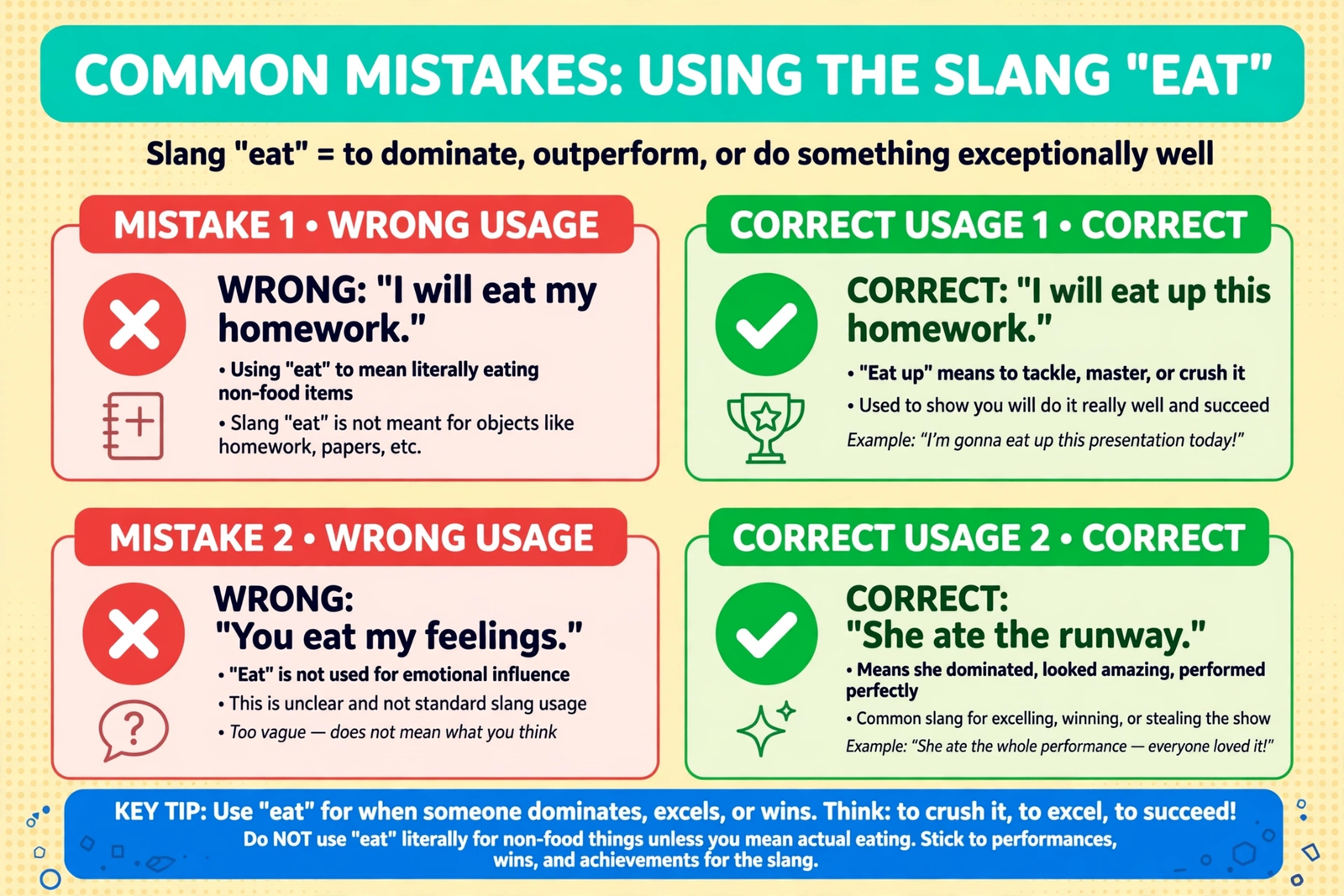
Using it for food. Saying “I ate that burger” is literal, not slang, and calling a meal “ate” will confuse people. The slang sense is about performance and presentation, not about actually eating. The joke version — “she ate” about a meal — only works when everyone knows you are playing with the double meaning.
Using it for something mediocre. “Ate” means flawless. If a performance was just okay, calling it “ate” sounds sarcastic or clueless. Save the word for moments that genuinely impressed people, or the compliment loses its power.
Overusing it. Commenting “ATE” on every video makes the word meaningless. The people who use it best save it for real standouts — which is exactly why it lands so hard when they do say it.
Using it in formal settings. “She ate the quarterly report” sounds wrong in a boardroom, even if the report was excellent. Keep “ate” in casual spaces and use the professional alternatives above at work.
Mixing up “eat” and “ate.” “She ate” (past tense) is the standard compliment for something that already happened. “She’s eating” (present) works for something ongoing. “She eats” on its own sounds odd — use the past tense or the continuous form instead.
Forcing it to sound young. Dropping “ate” into every sentence to seem cool is the fastest way to sound like you are trying too hard. One natural use beats five forced ones, and nobody respects slang that is clearly an act.
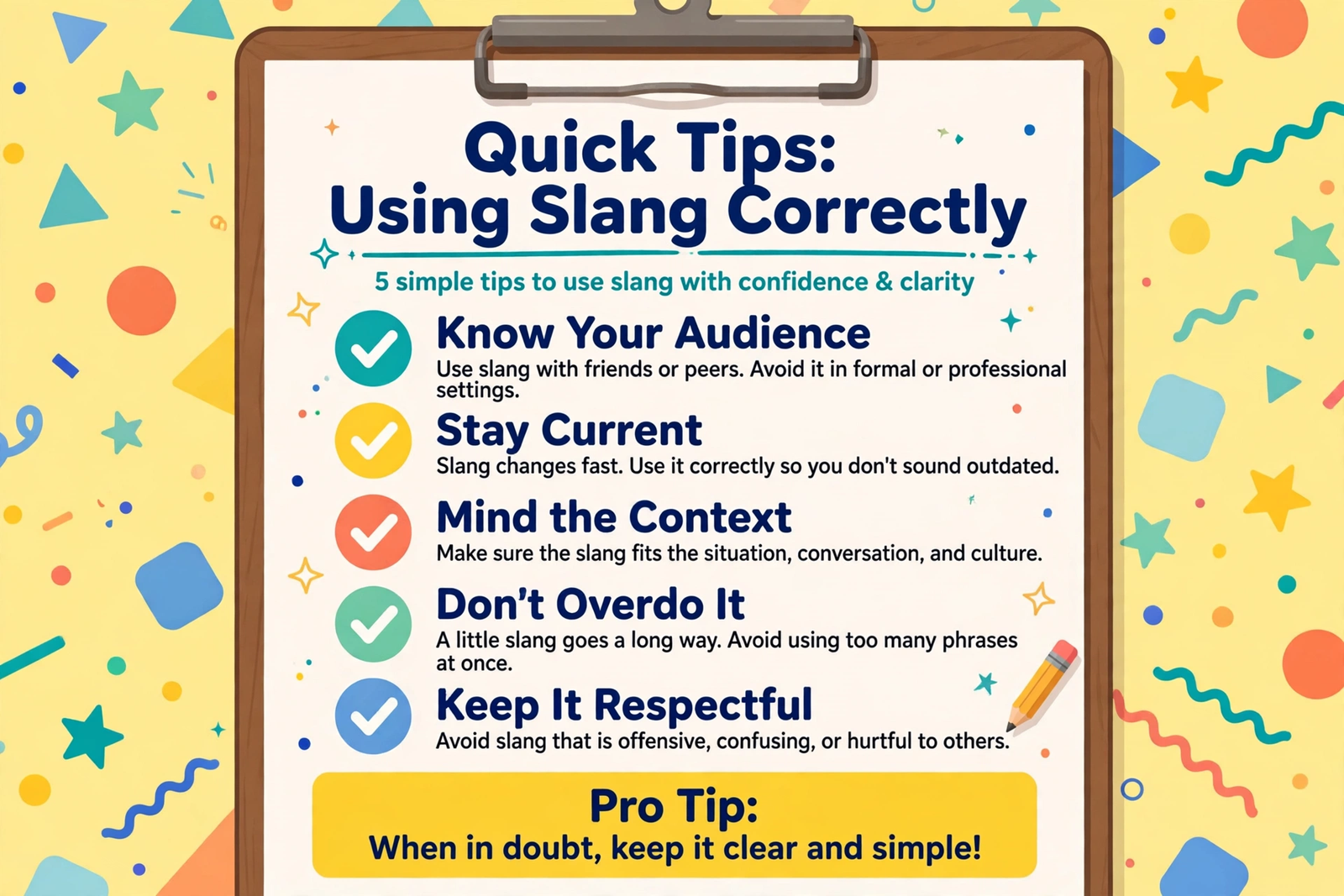
Quick Tips
- Save it for standouts. “Ate” means flawless — use it when something genuinely impressed you.
- Use the past tense. “She ate” is the classic form; “ate and left no crumbs” is the strongest version.
- Match the platform. It fits TikTok, Instagram, and group chats — not formal emails or meetings.
- Add a detail. “She ate that outfit — the colour, the fit, everything” hits harder than “ATE” alone.
- Know the culture. The word comes from ballroom and Black queer culture; use it with respect, not as a joke about its origins.
- Pair it, don’t stack it. “She served and ate” works; “she ate slayed popped off” is too much.
- Read the room. If nobody else is using slang, a plain “amazing” is the better choice.
FAQ
What does eat mean in slang?
In slang, “eat” means to perform brilliantly or look amazing — to do something so well that there is nothing left to criticise. “She ate that performance” means she delivered it flawlessly. The phrase comes from ballroom culture and spread through TikTok and stan Twitter.
What does “ate and left no crumbs” mean?
“Ate and left no crumbs” is the strongest version of the compliment. It means the performance was so complete and flawless that nothing was left behind — no mistakes, no weak moments, nothing for anyone else to improve on. It is reserved for truly outstanding moments.
Is “ate” the same as “slay”?
They are close but not identical. “Slay” focuses on confidence and style, especially in fashion, while “ate” focuses on the completeness of a performance — everything was done perfectly. Fans often combine them: “she served and ate.”
Where did eat slang come from?
Eat slang comes from ballroom culture — the Black and Latino LGBTQ+ ballroom scene in New York — where “eat” meant dominating the runway or dance floor. It travelled through drag culture and Black Twitter, then went mainstream on TikTok around 2020–2021.
Can I use “ate” in a professional setting?
Only in very casual creative workplaces, and only with colleagues who use slang themselves. In formal settings, use alternatives like “she delivered an outstanding performance” or “that was flawless” instead.
What is the difference between “eat,” “ate,” and “eating” in slang?
“Ate” is the past tense and the most common form — “she ate that look.” “Eating” is the present continuous — “she’s eating right now.” “Eat” alone is rare as a compliment; it usually appears in phrases like “eat it up.” For more short-form slang, see our guide to fn meaning in text.
Is eat slang rude?
No — in its TikTok and stan-culture sense, “ate” is a compliment and is not rude. However, “eat” has older crude slang meanings in some contexts, so tone and audience matter. As a compliment about a performance or outfit, it is positive and friendly.
Why do people say “ate” instead of “amazing”?
Because it is shorter, punchier, and carries cultural energy that “amazing” does not. “Ate” signals that you are part of internet culture and that the praise is enthusiastic, not polite. It also fits perfectly in fast-moving comment sections where one word does the job of a whole sentence.
Conclusion
Eat slang is one of the simplest compliments on the internet — and one of the most powerful. A single word, “ate,” can say what a paragraph of praise cannot: that someone performed flawlessly, looked incredible, and left nothing on the table. From its roots in ballroom culture to its home in TikTok comments, the word has travelled a long way, and it has earned its place as a standard part of internet English.
The key takeaways are easy to remember. Use “ate” for moments that genuinely impressed you, prefer the past tense, and save “ate and left no crumbs” for the truly outstanding ones. Keep it in casual spaces, add a specific detail to make the compliment land, and respect the culture the word came from. And if you are ever unsure, a plain “amazing” will always work — slang is at its best when it is natural, not forced.
Language keeps moving, and today’s slang will be tomorrow’s nostalgia. But the idea behind eat slang — celebrating someone who gave everything and left nothing behind — is timeless. The next time a performance, an outfit, or a comeback genuinely impresses you, you will know exactly what to say. And if you want to keep decoding internet praise, start with the classics — from the middle-of-nowhere energy of bfe meaning to the style words in our drip slang guide — and you will never be lost in the comments again.

1 thought on “Eat Slang: What Does Eat Mean in Slang? 7 Fun Examples”