Quick Answer: In slang, trim most commonly means an attractive person — someone who looks sharp, neat, and good-looking — or a fresh, clean look, like a sharp haircut or a well-put-together outfit. In older American slang, “trim” also referred to women or sex, and in cannabis culture it means the leaves trimmed off marijuana buds. The correct meaning of trim meaning slang almost always depends on context, tone, and who is saying it.
Trim Meaning Slang: Meaning & Definition
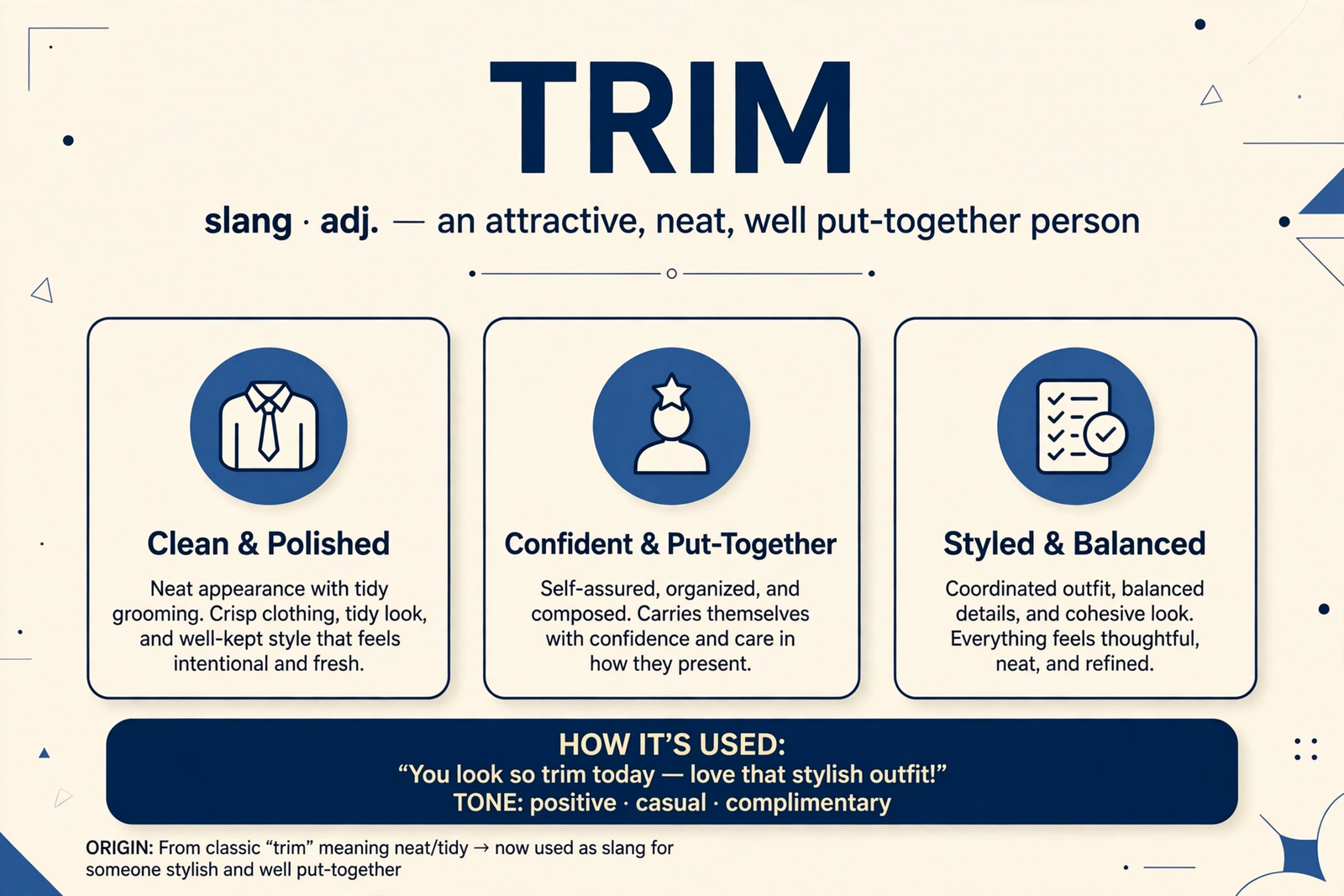
So, what does trim mean in slang? At its core, the slang word “trim” is a compliment about appearance. When someone says a person is “trim,” they usually mean that person looks attractive, fit, and well-groomed — the kind of person who turns heads when they walk into a room. In British and urban slang especially, calling someone “trim” is a quick, casual way of saying they look good.
But that is only the beginning. The trim meaning slang changes quite a bit depending on where you hear it. A teenager in London, a barber in New York, a hip-hop fan quoting old lyrics, and a cannabis grower in California could all use the word “trim” — and mean four different things. That is exactly why this little four-letter word confuses so many people when it pops up in a text, a TikTok comment, or a song lyric.
Here is the short version of every meaning you need to know:
| Meaning | Where You Hear It | Example |
|---|---|---|
| An attractive person | British & urban slang, TikTok, group chats | “She’s proper trim.” |
| A fresh, neat look | Texts, social media, everyday talk | “That trim haircut suits you.” |
| Women / sex (older US slang) | Old hip-hop, blues lyrics, 1980s–90s slang | “He went out looking for some trim.” |
| Cannabis leaves | Cannabis culture, growing communities | “Save the trim for edibles.” |
The most common modern usage — the one you will see on TikTok, Instagram, and in group chats in 2026 — is the first one: an attractive person or a sharp, clean appearance. The older, cruder meanings still exist, but they show up far less in everyday conversation, and they carry a very different tone. Context is everything with this word, and this guide will show you how to read it correctly every time.
Introduction
Slang moves fast, and few words prove that better than “trim.” It started life as an ordinary English word meaning “neat” or “to cut something into shape” — trimming a hedge, trimming your hair, keeping things tidy. Somewhere along the way, that idea of neatness jumped from haircuts and gardens to people themselves. If someone was neat, sharp, and well put-together, they were “trim.” And if someone looked really good? Well, they were trim too.
Today, trim meaning slang is one of those terms that sounds simple but hides a surprising amount of history. It has travelled through British street slang, grime and rap lyrics, American blues songs from the 1920s, locker-room talk, barbershop banter, and cannabis culture — picking up a new shade of meaning at almost every stop. Search it on TikTok or Urban Dictionary and you will find definitions that seem to contradict each other, because they are all true in different contexts.
This guide untangles all of it. You will learn the main modern meaning, the older meanings that still show up in music and movies, the cannabis meaning, and — just as importantly — when using “trim” is a compliment and when it can come across as rude or creepy. By the end, you will know exactly what someone means when they drop “trim” into a conversation, and you will know how to use it yourself without sounding awkward.
If you enjoy decoding words like this, you will also like our guides to zesty meaning slang and glazing slang — two more appearance-based slang terms that travel in the same circles as “trim.”
Origin
The word “trim” has Anglo-Saxon roots, and for centuries it simply meant to make something neat or tidy. You trimmed a beard, trimmed a hedge, trimmed a dress with lace. It described the act of cutting away the excess to leave something clean and sharp. That literal meaning is the seed of every slang meaning that followed.
The jump from “neat and tidy” to “good-looking person” happened gradually, and it happened in more than one place. In British English, “trim” was used as early as the 19th and early 20th centuries to describe someone who was neat, fit, and well-dressed. A “trim figure” meant a slim, well-proportioned body. A “trim” young man was one who took care of his appearance. The compliment was about grooming and shape — someone who looked put-together.
From there, London street slang and later grime and UK rap culture picked the word up and sharpened it. In the 2000s, “trim” in British urban slang increasingly meant an attractive person, full stop — usually a woman, and usually said as a blunt, casual compliment among friends. “She’s trim” became shorthand for “she’s good-looking,” the same way American slang might say “she’s fine” or “she’s bad.” The word’s roots in neatness made it a natural fit: a trim person is one whose whole look is clean and on point.
Meanwhile, a separate and much older American meaning was developing in parallel. In blues lyrics from the 1920s and later in hip-hop, “trim” was used as slang for women in general, for female genitalia, and by extension for sex — as in “getting some trim.” The Online Slang Dictionary records this usage with examples going back decades, and it is the meaning you will find in old rap verses and in films set in the 1970s, 80s, and 90s. It comes from the same “neatness” root, filtered through a much cruder metaphor, and today it reads as dated and objectifying — which is exactly why modern speakers mostly avoid it.
Finally, cannabis culture gave “trim” yet another life. When growers harvest marijuana, they cut the small leaves away from the buds. Those leaves are called “trim,” and they still contain cannabinoids, so they are saved for edibles, concentrates, and hash. In growing forums and dispensary talk, “trim” is a technical term, not a compliment at all.
So the trim meaning slang you meet today is really a bundle of histories: British grooming slang, American street slang, and cannabis jargon, all sharing one short word. The modern TikTok-era meaning — attractive person, fresh look — is the one that dominates in 2026, and it is the one this article focuses on.
Popularity
“Trim” is not the loudest slang word on the internet in 2026 — you will not see it trending on TikTok the way “rizz,” “skibidi,” or “67” did — but it has something those flash-in-the-pan terms do not: staying power. It has been in circulation for decades, it keeps resurfacing in new contexts, and it never fully disappears. That quiet longevity is part of what makes it interesting.
Its biggest modern boost has come from British grime, drill, and UK rap, where artists casually describe someone as “trim” in lyrics and interviews. Fans pick the word up, drop it into TikTok captions and Instagram comments, and it spreads from there — usually without anyone stopping to define it, which is how most slang confusion starts. Reaction videos, “rate my fit” posts, and glow-up content are the places you are most likely to see it now: a comment saying “trim” under a fresh haircut video almost always means the cut looks clean and the person looks good.
Search interest for “trim meaning slang” has also grown steadily, because the word keeps appearing in places where people cannot ask what it means — song lyrics, group chats, comment sections, and subtitled TV shows. Unlike made-up Gen Alpha words, “trim” is a real English word with a dictionary meaning, so people assume they know it — and then the sentence does not make sense. “He’s been chasing trim all night” does not mean he has been chasing haircuts. That mismatch between the familiar word and the unfamiliar usage is exactly what sends people to Google.
It is also worth noting where “trim” is not popular. In formal writing, in most American workplaces, and in polite conversation, it barely appears. It lives in casual speech, music, and social media. Its popularity is regional, too: it is far more common in the UK than in the US, where the older, cruder meaning still colours how people hear it. If you are in London, “trim” is a compliment. If you are in Los Angeles, the same word in the same sentence might land very differently — one more reason to understand all of its meanings before you use it.
How It Is Used
Using “trim” correctly is mostly about reading the room. Here is how it works in each of its main contexts.
As a compliment about a person. This is the most common modern usage. “Trim” functions as an adjective meaning attractive, good-looking, or well put-together. You will hear it in sentences like “She’s trim,” “He’s looking trim today,” or “That girl in the red dress is trim.” It is casual and blunt — more locker-room than love letter — and it usually refers to physical appearance rather than personality. It works best among friends who share the slang. Used toward a stranger, especially a woman, it can feel objectifying, so most people keep it in private conversation.
As a compliment about a look or an outfit. “Trim” can also describe a style rather than a person. “That outfit is trim” means the outfit is sharp, clean, and on point. “Nice trim” after a haircut means the cut is fresh and precise. This usage is the safest of all, because it praises grooming and style rather than someone’s body — and it connects directly to the word’s original meaning of neatness.
As a noun in older American slang. In old hip-hop, blues, and 80s/90s movies, “trim” appears as a noun meaning women or sex: “getting some trim,” “looking for trim.” You will almost never hear this in 2026 from anyone under 40, and you should not use it — it sounds dated, crude, and disrespectful. But you will encounter it when watching older films or listening to classic rap, so it is worth knowing.
In cannabis talk. Among growers and dispensary customers, “trim” is a plain noun: the leaves cut from buds during harvest. “I saved the trim for butter” means the leaves are being used to make edibles. There is nothing slangy or flirtatious about this usage — it is industry vocabulary, and context makes it obvious.
On social media. In comments and captions, “trim” is usually short and positive: “trim,” “looking trim today,” “that trim is crazy.” It shows up under glow-up posts, fit checks, and haircut reveals. Because comments are so short, the surrounding image usually tells you which meaning is intended — if the post is a haircut video, it is about the cut; if it is a photo of a person, it is about how they look.
The golden rule: if the sentence is about how someone looks, “trim” is a compliment. If it is about a plant, it is cannabis. If it sounds like it is from a 1992 rap song, it is probably the older, cruder meaning. And when in doubt, the safest interpretation in 2026 is the compliment one.
Examples
Real examples make slang click. Here is how “trim” sounds in different tones and situations.
Friendly Examples
- “Bro, that fade is trim. Your barber did you right.”
- “She walked in looking absolutely trim — everyone noticed.”
- “New fit? You’re looking trim today, not gonna lie.”
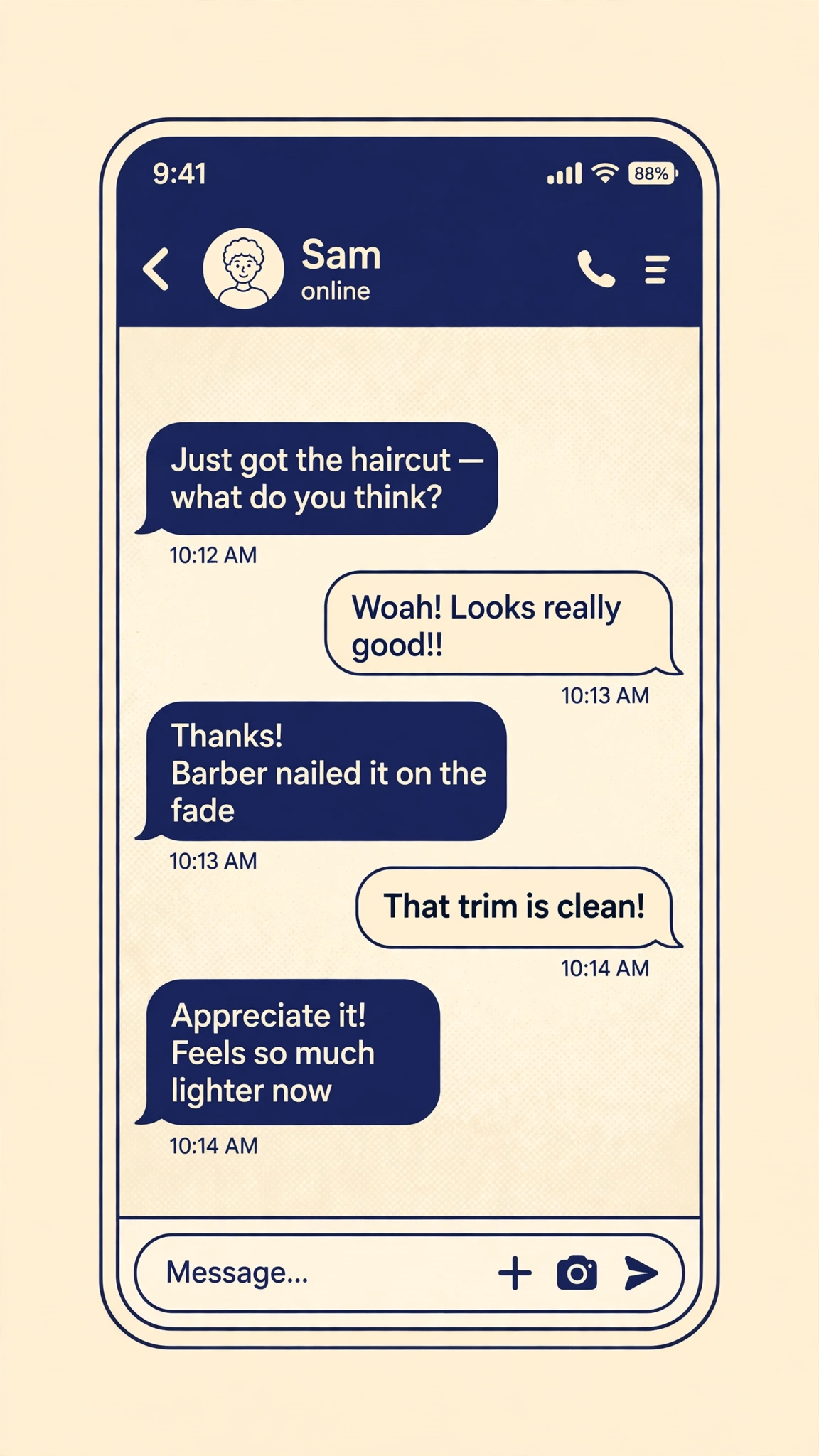
- “Your trim is clean, man. Where’d you get your hair done?”
- “Saw your post — you’re looking trim in that jacket.”
Professional Examples
“Trim” is casual slang, so it rarely belongs in professional settings — but the word’s original meaning (neat, tidy, well-groomed) does appear in formal contexts, and that is where people sometimes get confused. In a workplace, you might hear “a trim, professional appearance” or “keep your workspace trim and organised.” That is the dictionary meaning, not slang, and it is perfectly appropriate. What you should not do at work is call a colleague “trim” — in a professional setting, commenting on someone’s attractiveness with slang is a fast way to make people uncomfortable. If you want to compliment a coworker’s look at the office, “sharp,” “smart,” or “well put-together” does the same job without the slang baggage.
- “He always keeps a trim, professional appearance for client meetings.” (dictionary meaning — fine at work)
- “Her presentation was trim and to the point — no wasted slides.” (neat, concise — fine at work)
- “You look trim today, Sarah.” (slang meaning — avoid at work)
Funny Examples
- “Me: I’m going to save money this month. Also me: spends £60 on a trim that lasts two weeks.”
- “My barber said ‘just a trim’ and somehow I left with a whole new personality.”
- “He thinks one trim makes him a model. The confidence is unmatched, honestly.”
- “POV: you get a trim and suddenly you’re the main character for 48 hours.”
- “My mum said ‘just a little trim’ and the barber heard ‘shave it all off.'”
Comparison with Similar Terms
“Trim” overlaps with a whole family of appearance slang, but each word carries a slightly different flavour. Knowing the differences keeps you from using the wrong word in the wrong moment.
| Term | What It Means | How It Differs from “Trim” |
|---|---|---|
| Trim | Attractive person; neat, fresh look | The baseline — blunt, casual, mostly British/urban |
| Fine | Very attractive person | More common in the US; stronger and more direct than “trim” |
| Bad | Extremely attractive person | Means the opposite of what it sounds like; bolder than “trim” |
| Snatched | Looking perfect, on point (hair, makeup, outfit) | About the look being flawless, not the person being attractive |
| Fresh | Clean, stylish, newly sharp | Closer to “trim” for haircuts and outfits; less about the body |
| Zesty | Flamboyant, lively, extra | About energy and vibe, not neatness — see our guide to zesty meaning slang |
| Bougie | Fancy, high-class, luxurious | About wealth and taste, not physical attractiveness — see bougie slang |
| Fit | Attractive (UK) / in good shape | Very close cousin of “trim”; “fit” is far more common in everyday UK speech |
The closest synonym is probably “fit” — in the UK, “she’s fit” and “she’s trim” are nearly interchangeable, though “fit” is the one you will hear far more often. “Fresh” is the closest match when you are talking about a haircut or an outfit rather than a person. And if you want to describe the same idea without any slang at all, “sharp,” “neat,” “well-groomed,” and “good-looking” all work — which is handy, because “trim” is one of those words where the polite alternative is sometimes the smarter choice.

Alternate Meanings
Because “trim” is a real word with a long history, it carries several alternate meanings that have nothing to do with slang at all — and a few slang ones that are easy to mix up. Here is the full map.
1. The dictionary meaning: to cut or neaten. “I need a trim” at the barber means a haircut. “Trim the hedge” means cut it back. “Trim the fat” means cut away the excess. This is the oldest meaning, and it is still the most common one in everyday speech. If someone says “just a trim,” they are almost certainly talking about hair.
2. The fitness meaning: slim and in shape. “She keeps herself trim” means she stays slim and fit through diet and exercise. “A trim waistline” is a slim one. This meaning sits halfway between the dictionary and the slang: it is about the body, it is complimentary, and it is completely polite. It is also the bridge that connects the old meaning to the new one — a trim figure became a trim person.
3. The older American slang: women or sex. As covered in the origin section, “trim” was once common US slang for women, female genitalia, and sex. You will find it in blues songs from the 1920s, in 1970s blaxploitation films, and in 80s and 90s hip-hop. It is dated now, and most younger speakers have never used it this way — but it still appears in lyrics, which is why people searching “trim meaning slang” sometimes land on definitions that shock them. If the context is an old song or film, this is almost certainly the meaning.
4. The cannabis meaning: harvested leaves. In growing and dispensary culture, “trim” is the leaf material cut from buds. It is sold, saved, or processed into edibles and concentrates. If the conversation is about growing, harvesting, or edibles, this is the meaning — nothing else fits.
5. The nautical and aviation meaning. On a boat or a plane, “trim” means balance — adjusting weight so the vessel sits level. “Trim the sails” means adjusting them for the wind. You will not hear this in a group chat, but it is a reminder of how far this one little word travels.
The pattern is clear: every meaning of “trim” comes back to the same idea — cutting away the excess until only the clean, sharp, good part remains. Whether that is a haircut, a figure, a look, or a person, the core idea never changes. Only the context does.
Professional or Polite Alternatives
Because “trim” can sound blunt — and because its older meaning is genuinely crude — there are plenty of situations where a different word is the better call. Here are polite alternatives for each context, so you can say the same thing without the risk.
- For a person’s looks: “good-looking,” “attractive,” “handsome,” “beautiful,” “stunning,” “sharp.” Example: instead of “She’s trim,” try “She looks stunning tonight.”
- For a haircut or outfit: “fresh,” “clean,” “sharp,” “on point,” “well put-together.” Example: instead of “Nice trim,” try “That cut looks really sharp.”
- For fitness or shape: “fit,” “in great shape,” “well-toned,” “healthy.” Example: instead of “He keeps himself trim,” try “He’s in great shape.”
- For something neat and tidy: “neat,” “tidy,” “well-kept,” “organised.” Example: instead of “a trim workspace,” try “a tidy workspace.”
- In professional settings: stick to “smart,” “polished,” “professional,” or “well-groomed.” These praise appearance without ever sounding like slang — or like a comment on someone’s body.
The general rule is simple: use “trim” with friends who speak the same slang, and use the alternatives everywhere else. If you are texting your best mate about a haircut, “trim” is perfect. If you are complimenting a colleague, a client, or someone you just met, “sharp” or “well put-together” says the same thing with zero chance of being misunderstood. If you like appearance-based slang but want to stay safe, our guide to chopped meaning slang shows the other side of the same coin — what people say when a look does not work.
Common Mistakes
“Trim” is a small word with a big chance of being misunderstood. These are the mistakes people make most often.
1. Using the old meaning without realising it. The most common mistake is using “trim” the way an old rap lyric does — to mean women or sex — without knowing that is what you are saying. If you picked the word up from a song, check which meaning the song actually uses before you repeat it in conversation. In 2026, the compliment meaning is the default, but the old meaning is still in the dictionary of slang, and older listeners will hear it.
2. Calling a stranger “trim.” Telling a friend their new haircut is trim is a compliment. Saying it to a stranger — especially a woman you do not know — can feel like being rated on your body by someone you never asked. Keep this one for people you actually know.
3. Using it at work. Slang about attractiveness has no place in professional settings. Even if you mean it as a harmless compliment about a haircut, “trim” carries enough double meaning that it is not worth the risk. “Sharp” or “smart” does the job better.
4. Confusing it with the barber meaning. “I need a trim” and “She’s trim” use the same word for completely different things, and mixing them up makes for awkward sentences. If you say “I got a trim last night” to someone who only knows the slang meaning, they will hear something very different from a haircut. Context usually saves you, but it is worth being aware of the double meaning.
5. Assuming it means the same thing everywhere. “Trim” is a compliment in London, a dated crude term in parts of the US, and a cannabis product in California. The same sentence can land three different ways depending on where you are. When you are talking to an international audience — on TikTok, in a global group chat, in comments — the safest reading is the modern compliment meaning, but never assume your reader shares your local definition.
6. Overusing it to sound current. Like all slang, “trim” works when it sounds natural and fails when it sounds forced. Dropping it into every sentence to sound cool has the opposite effect — it marks you as someone trying too hard. Use it once, in the right moment, and move on.

Quick Tips
- Read the context first. Haircut video? It means a fresh cut. Photo of a person? It means they look good. Old rap lyric? Probably the older meaning. Cannabis forum? It is the leaves. Context decides everything.
- Keep it among friends. “Trim” is casual slang. It works in group chats, with mates, and in comments — not at work, not with strangers, and not in formal messages.
- Pair it with specifics. “That trim is clean” is vague; “That fade is trim” is a real compliment. The more specific you are, the more natural it sounds.
- Do not use it to rate strangers. Complimenting a friend’s look is fine; rating a stranger’s body is not. The line is simple — if you would not say it to their face, do not type it in a comment.
- Know your audience’s age. Younger listeners hear the modern compliment. Older listeners may hear the 1980s meaning. If your audience spans generations, pick a safer word.
- Use it sparingly. One “trim” in a conversation is natural; five is a performance. Slang lands best in small doses.
- When in doubt, say “sharp.” “Sharp” covers almost every meaning of “trim” — good-looking, well-groomed, on point — with none of the double meanings. It is the universal safe swap.


FAQ
What does trim mean in slang?
In modern slang, trim usually means an attractive person or a fresh, neat look — someone who looks sharp and well put-together. In older American slang it also meant women or sex, and in cannabis culture it means the leaves trimmed off marijuana buds. Context tells you which meaning applies.
Is calling someone “trim” a compliment?
Yes, in its modern British and urban slang sense, calling someone “trim” is a compliment about their appearance — it means they look good, neat, and attractive. But it is a blunt, casual compliment, so it works best among friends. Said to a stranger, it can feel objectifying.
What does “trim” mean on TikTok?
On TikTok, “trim” almost always means looking good or having a fresh look. You will see it in comments under glow-up videos, fit checks, and haircut reveals — “trim” means the person’s look is clean and on point.
What does “just a trim” mean at the barber?
At the barber, “just a trim” means a small haircut — cutting a little length off to neaten the style without changing it. This is the original dictionary meaning of the word, not slang, and it is the most common everyday use.
Is “trim” rude or offensive?
It depends on the meaning and the situation. The modern compliment sense is not offensive among friends, but the older American slang sense — referring to women or sex — is crude and objectifying, and most people consider it rude today. Calling a stranger “trim” can also come across as rude, even when you mean it as a compliment.
What does “trim” mean in cannabis?
In cannabis culture, “trim” is the small leaves cut away from marijuana buds during harvest. The leaves still contain cannabinoids, so growers save them to make edibles, concentrates, or hash. It is a technical term in this context, not slang for appearance.
Where did “trim” slang come from?
It comes from the old English word “trim,” meaning neat and tidy. British slang applied it to well-groomed, attractive people, and UK grime and rap culture spread that meaning in the 2000s. A separate American usage meaning women or sex goes back to blues lyrics from the 1920s and later hip-hop.
What is a polite alternative to “trim”?
“Sharp,” “good-looking,” “well put-together,” and “fresh” all say roughly the same thing without the slang baggage. “Sharp” is the safest all-round swap — it works for people, haircuts, and outfits, in casual and professional settings alike.
Conclusion
The trim meaning slang story is a reminder that the smallest words often carry the most history. What looks like a simple four-letter word turns out to be a bundle of meanings: a compliment about an attractive person, praise for a fresh haircut, an old American slang term for women and sex, a cannabis grower’s technical word, and — underneath it all — the ancient idea of cutting away the excess until only the clean, sharp part remains.
In 2026, the meaning you will meet most often is the modern one: someone who looks good, neat, and put-together. Use it that way, among friends, and it works perfectly. Just remember the other meanings are still out there — in old songs, in other regions, and in other communities — and a quick check of the context will always tell you which “trim” you are dealing with.
So the next time someone drops “trim” into a text, a comment, or a lyric, you will not have to guess. You will know exactly what they mean — and exactly how to answer. And if you want to keep decoding the slang filling your feed, check out our guides to zesty meaning slang, glazing slang, and bougie slang — the same circles, the same group chats, all explained.

1 thought on “Trim Meaning Slang: What It Really Means in Texts and on TikTok (2026)”