Quick Definition: Hawaiian slang is the casual, everyday vocabulary of Hawaii — a mix of Hawaiian words, Hawaiian Pidgin (Hawaiian Creole English), and local expressions used in texts, conversation, and social media. Words like aloha, mahalo, ohana, da kine, and braddah pack warmth, humour, and island culture into a few syllables, and knowing them is the fastest way to understand what people in Hawaii actually mean.
Hawaiian Slang Meaning & Definition
Hawaiian slang means the informal words and phrases that people in Hawaii use every day. It is not one single language. Instead, it is a blend of three things: native Hawaiian words (aloha, mahalo, ohana), Hawaiian Pidgin — the English-based creole spoken across the islands — and local slang that grew up around surf culture, food, and island life.
When someone says “howzit, braddah?” they are not speaking textbook English, and they are not speaking pure Hawaiian either. They are speaking the relaxed, friendly code of the islands. Hawaiian slang shows up in text messages, TikTok captions, Instagram comments, surf lineups, food trucks, and family gatherings. It is how locals say hello, show gratitude, joke with friends, and describe the food they love.
What makes Hawaiian slang special is its warmth. Almost every common word carries a feeling of connection — to people, to place, and to the slower, kinder pace of island life. Learning even a dozen of these words changes how you read a Hawaiian text thread, a travel vlog, or a menu.
Introduction
You have probably seen Hawaiian slang without realising it. A travel influencer captions a beach photo “aloha vibes only.” A friend texts “mahalo!” after you send them a link. A surfer comments “shaka, braddah” under a wave video. These words travel far beyond Hawaii now, thanks to social media, tourism, and pop culture — but their meanings run much deeper than a holiday hashtag.
Hawaii is one of the most culturally mixed places in the United States. Native Hawaiian, Japanese, Filipino, Chinese, Portuguese, and mainland American influences have all shaped how people talk there. The result is a slang vocabulary that borrows from many languages and turns them into something unmistakably local. A single conversation can jump from a Hawaiian word to a Pidgin phrase to an English sentence without anyone noticing.
This guide explains 50+ Hawaiian slang words and phrases in plain English — what they mean, where they came from, how locals actually use them, and the mistakes visitors make. Whether you are texting a friend in Honolulu, planning a trip, or just trying to understand a TikTok comment, you will find the answer here. If you enjoy regional slang, you will also like our guides to Australian slang and the biggest Gen Z slang words of 2024 — both work the same way, turning local culture into everyday language.
Origin
Hawaiian slang grew out of Hawaii’s history. Before outside contact, the Hawaiian language was the only language of the islands. When traders, missionaries, and plantation workers arrived in the 1800s — from America, China, Japan, Portugal, the Philippines, and Puerto Rico — they needed a common way to talk on the sugar and pineapple plantations. That shared language became Hawaiian Pidgin, formally called Hawaiian Creole English.
Pidgin mixed English grammar with words from Hawaiian, Japanese, Filipino, Chinese, and Portuguese. It was the language of the plantation fields, and over generations it became the first language of many local families. Today, linguists recognise it as a full creole language with its own grammar, and most locals switch between Pidgin and standard English without thinking about it.
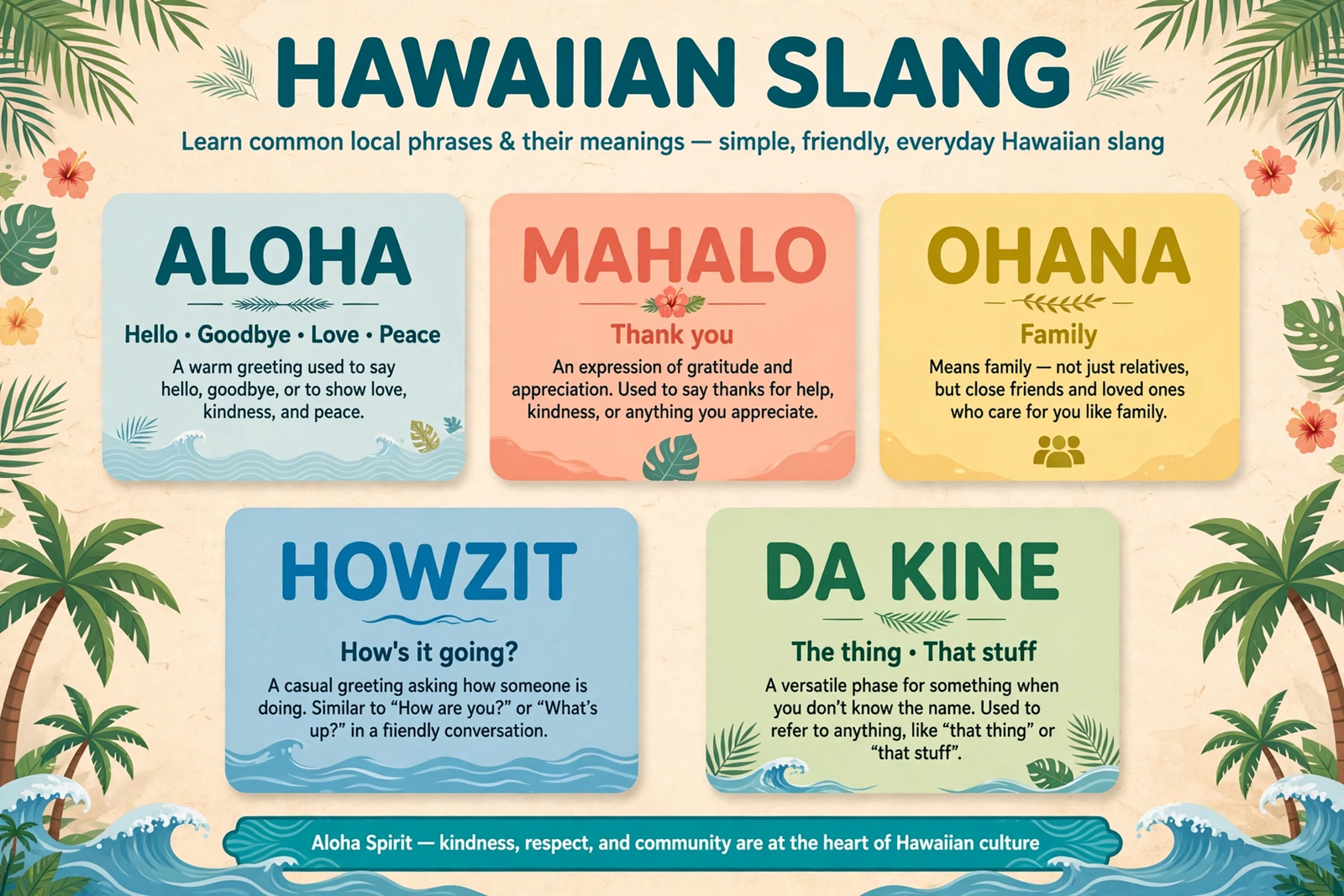
Native Hawaiian words survived alongside Pidgin because they carry meanings English cannot replace. Aloha is not just “hello” — it means love, compassion, and peace all at once. Ohana is not just “family” — it means the people you choose to stand by, including close friends. These words stayed because the ideas behind them mattered.
Surf culture added another layer. Words like “shaka,” “gnarly,” and “stoked” spread from Hawaiian beaches to the whole world in the 1960s and 70s, carried by surf films, music, and magazines. Food culture added more: “grindz” (food), “ono” (delicious), and “pupus” (snacks) came from the mix of Hawaiian and immigrant cooking.
The result is a slang that is more than 200 years in the making — part indigenous language, part plantation history, part beach culture, and now part internet culture too.
Popularity
Hawaiian slang is more popular than ever. TikTok and Instagram have pushed words like aloha, mahalo, and ohana into millions of captions, and travel content keeps them in front of new audiences every day. The Disney film Lilo & Stitch made “ohana means family” famous around the world, and the phrase still appears on T-shirts, tattoos, and wedding invitations.
Search interest in Hawaiian words spikes every summer, when travel season peaks, and again around holidays. People look up “what does aloha mean,” “howzit meaning,” and “da kine meaning” before trips — and then keep using the words when they get home, because they are fun to say and easy to remember.
Local pride also keeps the slang alive. Younger Hawaiians use Pidgin phrases online as a marker of identity — a way of saying “I am from here” in a comment section. Musicians, comedians, and creators from Hawaii mix Pidgin into their content, and mainland audiences have learned to follow along. Unlike some slang that fades in a year, Hawaiian slang has deep roots, so it keeps coming back in every new generation of content.
How It Is Used
Hawaiian slang is used the way any local dialect is used: casually, warmly, and mostly in informal settings. You will hear it in texts between friends, in Instagram comments, at the beach, in restaurants, and at family parties. You will rarely hear it in a formal business email — although even office workers in Hawaii slip an “aloha” or “mahalo” into a message without thinking twice.
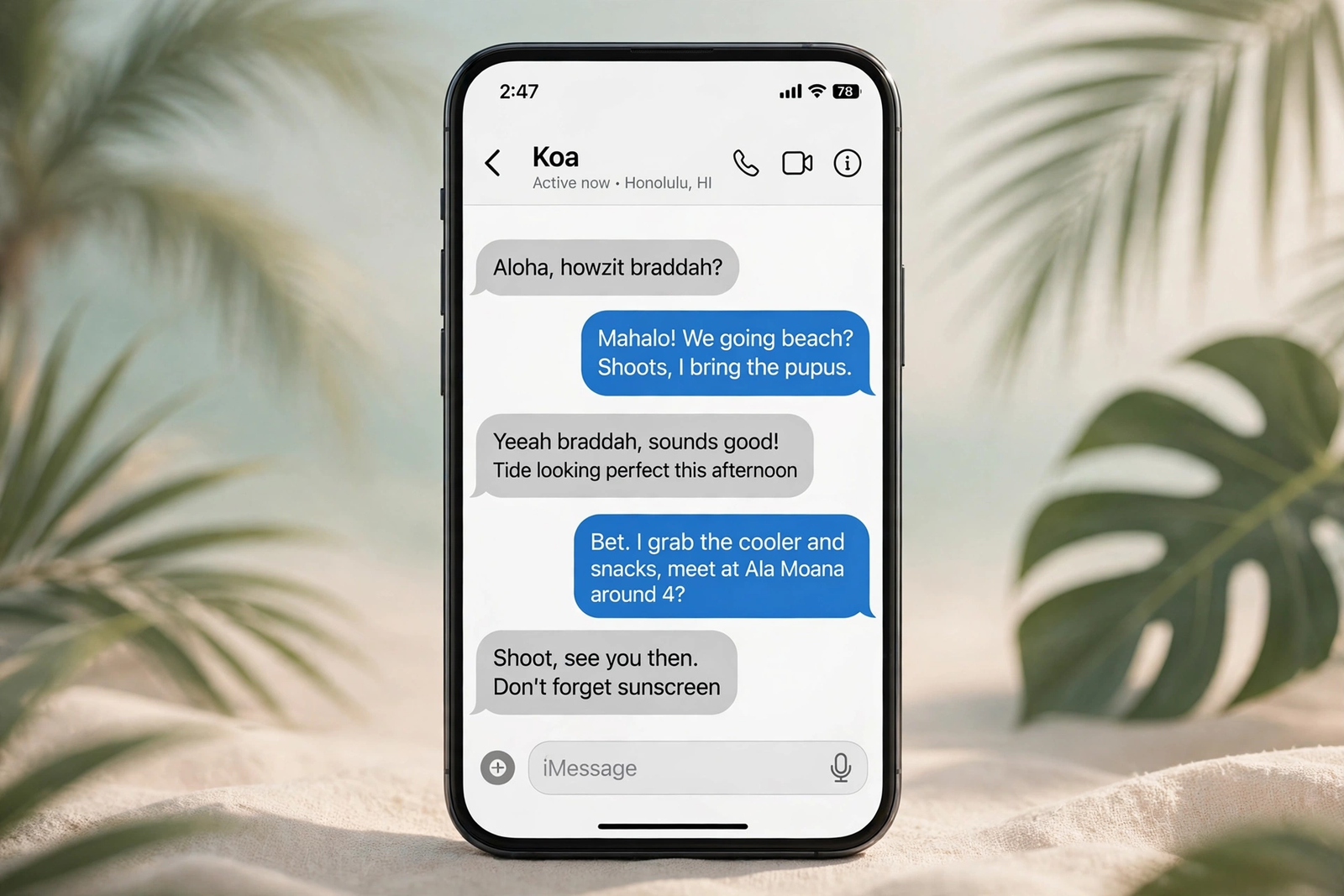
Tone matters more than the word itself. “Howzit” is a greeting, not a real question about your health — the expected answer is “good, howzit you?” The word “braddah” (brother) signals friendship, not a family relationship. “Da kine” is the most flexible word in the language: it can mean “that thing,” “you know what I mean,” or “the stuff we were talking about,” depending on context.
In texting, Hawaiian slang is short and punchy. “Pau” means finished or done. “No can” means cannot. “Shoots” means okay, sounds good, or see you later. These tiny phrases do the work of whole sentences, which is why they survive so well in chats. The same shorthand style powers other internet slang too — if you have ever wondered what fn means in text, you have seen the same pattern: a short phrase that carries a whole attitude.
Visitors should use Hawaiian slang lightly and respectfully. A friendly “aloha” or “mahalo” is always welcome. Trying to speak full Pidgin after a week on holiday usually sounds forced — locals can tell, and they will smile about it, but the warmth lands better when the words are used naturally and sparingly.
Examples
The best way to learn Hawaiian slang is to see it in real sentences. Below are examples in friendly, professional, and funny contexts — the way locals actually use these words every day.
Friendly Examples
- “Aloha, howzit? Long time no see!” — a warm hello to a friend you have not seen in a while.
- “Mahalo for the ride, braddah. I owe you one.” — thank you, with real warmth.
- “We going beach? Shoots, I bring the pupus.” — yes, let’s go, and I will bring the snacks.
- “Da kine was so ono, I had to get seconds.” — that food was so delicious I went back for more.
- “Talk story with Tutu after dinner, she get plenny stories.” — chat and catch up with Grandma; she has plenty of stories.
- “Shaka, brah! That wave was epic.” — the hand gesture and the word together mean approval and stoke.
- “A hui hou — see you again soon.” — a goodbye that promises you will meet again.
Professional Examples
- “Aloha, and mahalo for joining today’s meeting.” — a polite, warm opening used in Hawaii workplaces.
- “The project is pau, so we can send the final report today.” — finished, complete, done.
- “Let’s talk story about the timeline before we decide.” — let’s discuss it properly, not just exchange quick messages.
- “Mahalo for your patience while we fix the issue.” — thank you, in the standard polite local style.
- “We need to be akamai about the budget this quarter.” — we need to be smart and careful.
- “The team worked with real aloha spirit on this launch.” — they worked with kindness, patience, and care.
Funny Examples (if applicable)
- “Broke da mouth! I ate three plate lunches.” — the food was so good it broke my mouth (in the best way).
- “He stay lolo, he tried to surf Pipeline on his first day.” — he is crazy for trying that.
- “No can, I stay pau hana already — time for grindz.” — I can’t, I am off work already, time to eat.
- “Eh, you like go holoholo? I get one new truck.” — want to cruise around for fun? I have a new truck.
- “Small kid time, we used to catch geckos with da kine traps.” — back when we were kids, we caught geckos with those traps.
- “Choke people at the beach today — no parking, no can.” — there are so many people at the beach, there is no parking at all.
Comparison with Similar Terms
Hawaiian slang is often confused with other regional and internet slang. The table below shows how similar words differ — and why Hawaiian terms are not interchangeable with mainland slang.
| Term | Where it comes from | What it means | When to use it |
|---|---|---|---|
| Hawaiian slang | Hawaii — Hawaiian + Pidgin | Local island vocabulary: aloha, mahalo, da kine | In Hawaii, or talking about Hawaii |
| Australian slang | Australia | Shortened words and humour: mate, arvo, brekkie | In Australia, or talking about Australia |
| Gen Z slang | TikTok and the internet | Online-age vocabulary: rizz, slay, sigma | Online chats and social media |
| Surf slang | Surf culture worldwide | Wave and beach terms: gnarly, stoked, shred | At the beach or in surf communities |
| Pidgin (Hawaiian Creole) | Hawaii plantation history | A full creole language, not just slang | Everyday speech among locals in Hawaii |
| Standard English slang | Mainland USA | General informal English: cool, awesome, bro | Anywhere in the US |
The key difference is depth. “Bro” is casual everywhere, but “braddah” carries island identity with it. “Delicious” describes food, but “ono” and “broke da mouth” describe a whole feeling about eating together. And “hello” greets someone, while “aloha” greets them with love and respect. That is why Hawaiian slang travels well but never quite means the same thing away from the islands.

Alternate Meanings
Many Hawaiian slang words have more than one meaning, and context decides which one applies.
- Aloha: hello, goodbye, love, compassion, and a whole philosophy of living kindly. It is a greeting, a farewell, and a value at the same time.
- Da kine: the most famous multi-meaning word in Hawaii. It can mean “the thing,” “whatchamacallit,” “that kind,” or simply “you know what I mean.” Locals understand it from context, gestures, and tone.
- Pau: finished, done, or over — but also used to mean “I am done talking” or “that’s the end of it.”
- Shoots: okay, sounds good, goodbye, or see you later — a one-word answer that covers agreement and farewell.
- Choke: in Pidgin, it means “a lot” or “plenty” — “choke people” means many people, not someone who cannot breathe.
- Grindz / Grinds: food, especially good local food. “Let’s go get grindz” means let’s go eat.
- Shaka: both the hand gesture (thumb and pinky out) and the feeling behind it — hang loose, all good, respect.
- Ohana: family, but also close friends who are treated as family. In Hawaii, ohana is chosen as much as it is born into.
- Makai / Mauka: direction words, not slang in the usual sense — makai means toward the sea, mauka means toward the mountains. Locals use them instead of north, south, east, and west.
Professional or Polite Alternatives
Hawaiian slang is warm and casual, so in formal situations it helps to know the polite equivalent of each phrase.
| Slang | Polite / Professional Alternative |
|---|---|
| Howzit | Hello, how are you? |
| Braddah / Brah | Friend, colleague, or the person’s name |
| Shoots | That sounds good / Thank you / Goodbye |
| No can | I’m afraid that’s not possible |
| Pau | Finished / Complete |
| Da kine | The item / That thing (name it directly) |
| Talk story | Let’s discuss / Let’s catch up |
| Grindz | Lunch / Dinner / A meal |
| Choke | Many / A large number of |
| Lolo | Unwise / Not thinking clearly |
That said, “aloha” and “mahalo” need no replacement at all. They are polite in every setting in Hawaii, from a job interview to a wedding speech. When in doubt, those two words are always safe.
Common Mistakes
Visitors and newcomers make the same mistakes with Hawaiian slang. Avoid these and you will sound respectful instead of awkward.
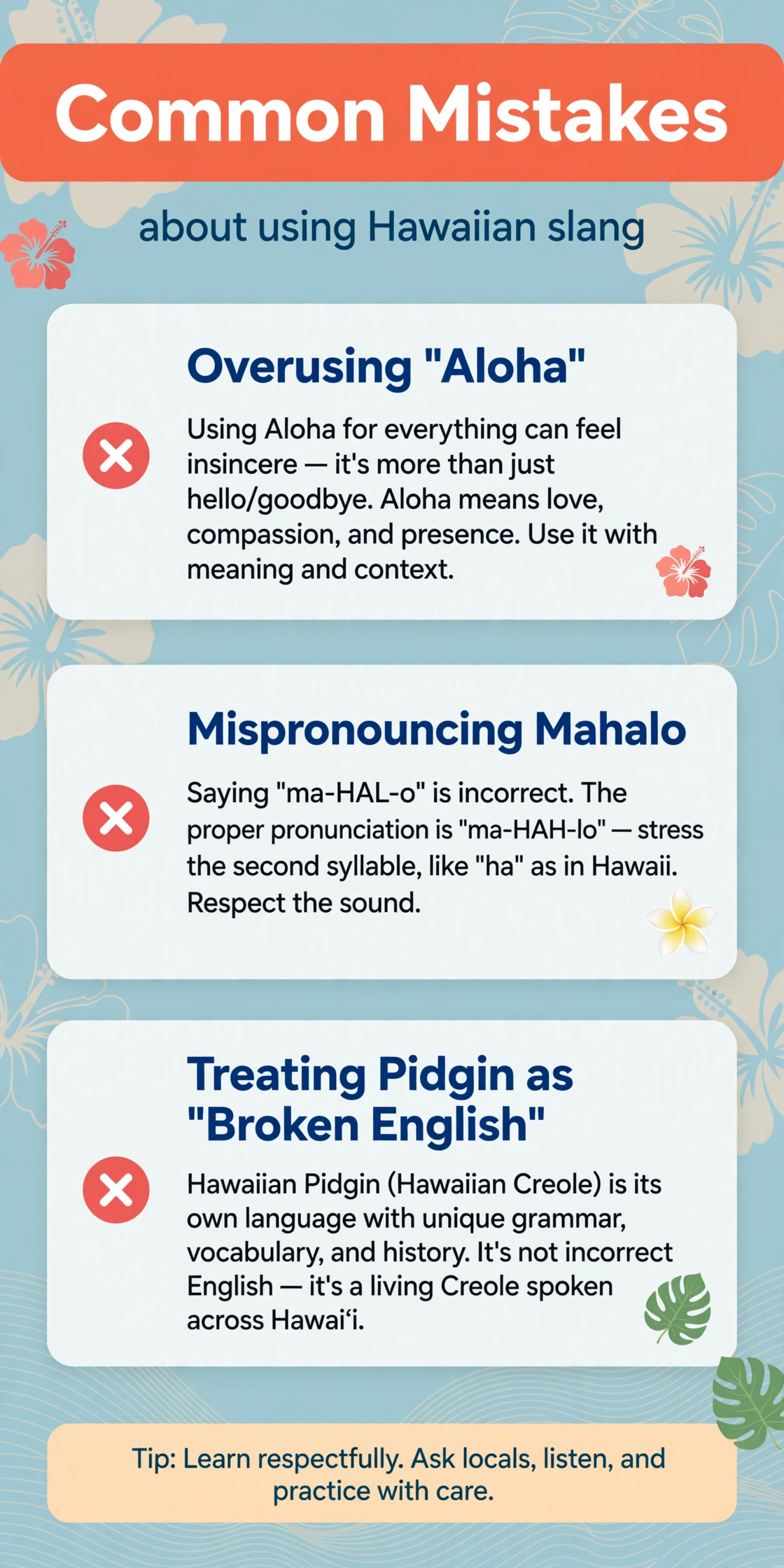
- Overusing “aloha” in every sentence. Aloha is powerful because it is sincere. Dropping it into every line makes it sound like a catchphrase, not a greeting.
- Saying “da kine” without context. Locals use it because everyone in the conversation already knows what “da kine” refers to. If nobody knows, the phrase just confuses people.
- Treating Pidgin as broken English. Hawaiian Pidgin is a real language with its own grammar and history. Calling it “bad English” is insulting to the people who grew up speaking it.
- Using sacred words as decoration. Words like “mana” (spiritual power) and “pono” (righteousness, balance) carry deep cultural and spiritual weight. Using them on a T-shirt slogan or a joke can feel disrespectful.
- Mispronouncing “mahalo” and “ohana.” It is ma-HA-lo (not ma-HAY-lo) and oh-HA-na (not oh-HAN-a). A small effort with pronunciation goes a long way.
- Calling everything “aloha spirit” for marketing. The aloha spirit is a real legal and cultural concept in Hawaii, not a branding trick. Using it to sell things cheapens it.
- Assuming “shaka” means the same as a thumbs-up. It is closer to “hang loose” and “all good” — relaxed approval, not a simple yes.
- Forgetting that Hawaiian words are not slang. Aloha, mahalo, ohana, keiki, and wahine are Hawaiian language words. Pidgin words like “howzit” and “pau hana” are slang. Mixing the two up is common, but knowing the difference shows respect.
Quick Tips
- Start with two words: learn “aloha” and “mahalo” first. They cover most situations and are always welcome.
- Listen before you speak: spend a day hearing how locals use Pidgin, then copy the rhythm instead of forcing the words.
- Use “howzit” as a greeting, not a question: answer with “good, howzit you?” and keep walking.
- Save “da kine” for people who already know the context: it only works when everyone shares the reference.
- Pair words with the shaka: the hand gesture and the word together are more natural than either one alone.
- Learn food words before party words: ono, grindz, pupus, and pau will get you further at a Hawaiian gathering than any greeting.
- Respect sacred terms: use mana, pono, and ohana with the weight they deserve, not as decoration.
- Ask when unsure: locals are happy to explain a word. Asking shows interest; guessing loudly shows the opposite.
- Read the room: Pidgin is warm and casual, so keep it out of formal speeches and official documents.
- Keep learning: every island and every family has its own favourite phrases. The list below is only a starting point — the full vocabulary is much bigger.

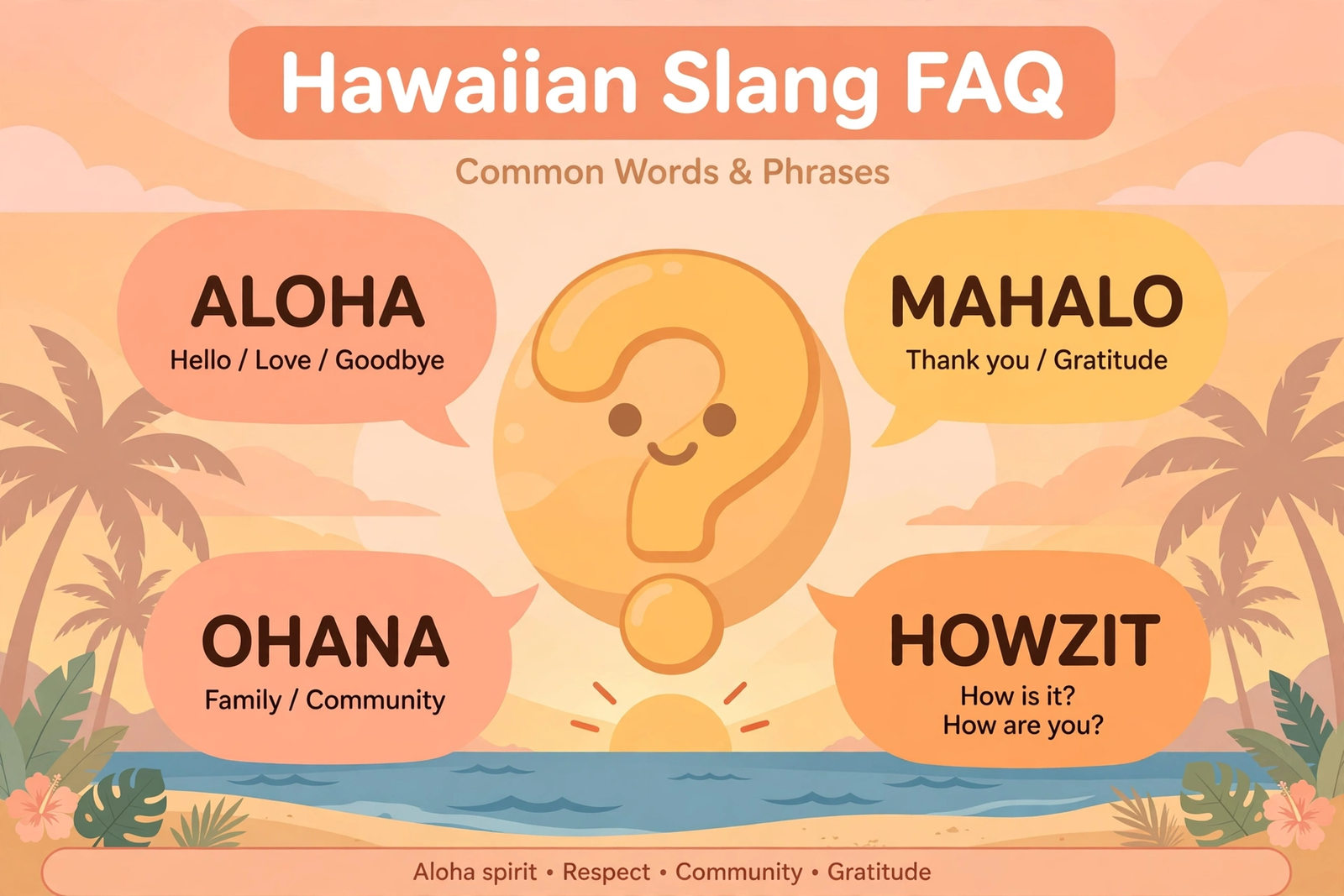
FAQ
What does Hawaiian slang mean?
Hawaiian slang is the casual vocabulary of Hawaii, made of native Hawaiian words, Hawaiian Pidgin phrases, and local expressions. It includes greetings like aloha and howzit, thanks like mahalo, and everyday words like pau (finished), ono (delicious), and da kine (that thing).
What does “howzit” mean in Hawaiian slang?
“Howzit” is short for “how is it?” and works as a casual greeting in Hawaii, similar to “what’s up?” or “how’s it going?” The usual reply is “good, howzit you?” It is not a real request for a health update — it is a friendly hello.
What does “da kine” mean?
“Da kine” is the most flexible phrase in Hawaiian Pidgin. It means “the thing,” “whatchamacallit,” or “you know what I mean,” and its exact meaning comes from context, gestures, and tone. Locals use it when everyone in the conversation already knows what is being talked about.
What does “aloha” really mean?
Aloha means hello and goodbye, but it also means love, compassion, peace, and kindness. In Hawaiian culture it is more than a greeting — it is a way of living, sometimes called the aloha spirit, built on patience, respect, and care for others.
What is Hawaiian Pidgin?
Hawaiian Pidgin, formally called Hawaiian Creole English, is a language that grew on Hawaii’s plantations in the 1800s, mixing English with Hawaiian, Japanese, Filipino, Chinese, and Portuguese words. It has its own grammar and is the everyday language of many local families. You can read more about its history on Wikipedia’s Hawaiian Pidgin page.
What does “mahalo” mean?
Mahalo means thank you in Hawaiian. It is one of the most used and most welcome words in the islands, used in everyday speech, in shops and restaurants, and even in formal settings. It is pronounced ma-HA-lo.
What does “ohana” mean?
Ohana means family in Hawaiian, but it includes close friends who are treated as family. The phrase “ohana means family, and family means nobody gets left behind” was made famous by the film Lilo & Stitch, and it captures the real meaning well.
Is it okay for visitors to use Hawaiian slang?
Yes — a friendly “aloha” or “mahalo” is always welcome, and locals appreciate visitors who learn a few words respectfully. Use the words lightly, pronounce them as well as you can, and avoid sacred terms like mana as decoration. Listening first and copying the local rhythm is the best way to sound natural.
Conclusion
Hawaiian slang is more than a list of fun words. It is the sound of Hawaii itself — a mix of an ancient language, plantation history, surf culture, and family life, all packed into short phrases that carry warmth in every syllable. From “aloha” and “mahalo” to “da kine,” “braddah,” and “broke da mouth,” these words tell you how people in Hawaii greet each other, thank each other, eat together, and laugh together.
The best way to learn them is to use a few, use them well, and keep listening. Start with aloha and mahalo, add howzit and pau to your everyday chats, and save da kine for the moments when everyone already knows what you mean. Respect the words that carry cultural weight, and do not be afraid to ask a local what something means — that question is usually the start of a good conversation.
Language is how a place shares its heart, and Hawaiian slang shares a very generous one. Now that you know 50+ words and phrases, try them out — and when you are ready for more, explore related guides like csl meaning in text and our Australian slang breakdown to see how different places turn everyday life into language.

4 thoughts on “Hawaiian Slang: 50+ Words, Meanings & Examples You Need to Know”