
Quick Definition: Bay Area slang is the informal vocabulary of the San Francisco Bay Area in Northern California — words like hella, hyphy, yadadamean, and slaps that grew out of the region’s hip-hop scene, street culture, and everyday conversation. If you have ever read a text that said “that song hella slaps” and wondered what it meant, this guide explains every term, where it came from, and how people actually use it.
Bay Area Slang Meaning & Definition
Bay Area slang means the set of words, phrases, and expressions that people from the San Francisco Bay Area — San Francisco, Oakland, San Jose, Berkeley, Richmond, Vallejo, and the surrounding cities — use in everyday speech, texts, and music. It is not a separate language, and it is not written in any official dictionary as a single dialect. It is a regional slang vocabulary shaped by the Bay Area’s unique mix of cultures: Black American hip-hop culture, Chicano culture, Filipino and Asian American communities, and the tech world that sits right next door.
What makes bay area slang different from other regional slang is how much of it escaped the region. Words like hella started in Oakland and are now used across the entire United States, and hyphy became a national hip-hop movement in the mid-2000s. Bay Area slang also has a sound of its own. Many of its terms come from rap lyrics — E-40, Mac Dre, Too Short, and Keak da Sneak turned local street words into songs, and the songs carried the words far beyond California.
At its core, bay area slang does three jobs. It shows local pride — using the right word tells people you are really from the Bay. It adds energy — many terms are loud, playful, and exaggerated, just like the hyphy movement itself. And it saves time — a single word like hella can replace “very,” “a lot of,” and “really” in one breath. If you have ever heard someone say “I’m hella tired” or “that party was hyphy,” you were hearing Bay Area slang in action.
Introduction
Picture this: you are scrolling through TikTok and a creator from Oakland says, “That new track hella slaps, yadadamean? We was finna go dumb at the function.” Every word in that sentence is English, but almost none of it means what a dictionary would tell you. Welcome to bay area slang — one of the most creative and influential regional vocabularies in American English.
The Bay Area has been inventing slang for decades. In the 1980s and 1990s, Oakland rappers like Too Short built an entire sound around street language. In the 2000s, the hyphy movement — led by Mac Dre and E-40 — turned local words into a cultural export, complete with its own dance moves, car culture, and fashion. And today, Bay Area slang lives on in group chats, Twitch streams, and TikTok comments, where a single word like hella can signal that you know the culture.
This guide breaks down bay area slang properly: the biggest words, what they really mean, where they came from, and how to use them without sounding like you are trying too hard. You will find real examples, a comparison with other regional slang, the mistakes everyone makes, and answers to the questions people actually search for. Whether you are visiting the Bay, decoding a friend’s texts, or just curious about where words like hella came from, this is your complete guide.

Origin
Bay Area slang did not come from one place. It came from several overlapping sources, and most words can be traced to at least one of them.
Oakland hip-hop and the hyphy movement. The biggest source of bay area slang is the region’s rap scene. Too Short was rapping about Oakland street life in the 1980s, and in the 1990s and 2000s, artists like E-40, Mac Dre, Keak da Sneak, and The Pack turned local words into hits. E-40 is famous for inventing or popularising dozens of slang terms — ghost ride the whip, gas-brake-dippin’, and ya feel me all trace back to his lyrics and interviews. Mac Dre’s hyphy movement, named from the word hyper, gave the Bay its own sound and its own vocabulary at the same time.
Black American culture and AAVE. Many Bay Area terms have roots in African American Vernacular English, shaped by the Black communities of Oakland, Richmond, and San Francisco. Words travelled from the neighbourhood to the radio and then to the rest of the country. Understanding this history matters: these words carry culture, not just comedy, and using them respectfully means knowing they did not start as internet jokes.
Chicano and Latino influence. The Bay Area’s large Mexican American and Latino communities added their own words to the mix. Terms like hyna (a girl or girlfriend) and the playful use of ese come from Chicano street culture, and the region’s Spanglish habits colour everyday speech in ways you will not hear in other parts of California.
Filipino and Asian American communities. The Bay Area has one of the largest Filipino populations in the United States, centred in Daly City and San Francisco. Words like hella itself are sometimes linked to this mix of communities, and the region’s multicultural streets are why bay area slang sounds like no other American dialect — it is a blend of many cultures talking to each other for generations.
The internet era. In the 2010s and 2020s, Bay Area slang spread through social media the way it once spread through mixtapes. TikTok creators, Twitter users, and streamers carried words like hella, slaps, and no cap — a term the Bay shares with the wider hip-hop world — to audiences who had never set foot in California. Some words faded, but the biggest ones became permanent parts of American English.
Popularity
Bay Area slang is more popular today than at any point in its history — and most people using it have no idea where it came from. The word hella is the clearest example. It started in Oakland in the 1970s and 1980s, spread through California in the 1990s, and by the 2010s it was common in texts and tweets across the entire country. The Oxford English Dictionary added hella to its pages, and Merriam-Webster now defines hella as a slang intensifier meaning “very” or “a lot of” — a long way from an Oakland street corner.
The hyphy movement gave bay area slang its biggest national moment. Between 2005 and 2008, songs like E-40’s “Tell Me When to Go” and Keak da Sneak’s “Super Hyphy” put Bay Area words on MTV, in clubs, and on ringtones across America. The movement’s energy — sideshows, ghost riding, going dumb — became a visual language that people recognised even if they did not know the words.
Today, bay area slang stays popular for three reasons. First, Bay Area artists keep inventing words: every new generation of Oakland and San Francisco rappers adds fresh terms. Second, the Bay Area is home to Silicon Valley, so tech workers and creators carry the slang into offices, podcasts, and YouTube channels. Third, TikTok and short-form video reward punchy, distinctive words — and bay area slang is full of them. A word like slaps is short, visual, and instantly understandable, which is exactly what short video needs.
The slang is also a point of local pride. Bay Area natives use it to spot each other — say yadadamean in a room full of strangers and the people from the Bay will smile. In a region that has changed fast, with tech money reshaping whole neighbourhoods, the slang is one of the things that still feels like home.
How It Is Used
Bay Area slang is used in texts, group chats, social media captions, song lyrics, and casual conversation. It is rarely used in formal writing or professional settings, though some words — especially hella — have become casual enough to appear in workplaces and classrooms. Here are the most common ways the vocabulary shows up:
- As an intensifier: Hella is the Bay Area’s most famous word. It means “very,” “really,” or “a lot.” “I’m hella tired” means “I’m very tired.” “There were hella people there” means “there were a lot of people there.”
- To describe energy: Hyphy means wild, energetic, or hyped up. A party, a song, or a crowd can all be hyphy. “That concert was hyphy” means it was loud, fun, and out of control in the best way.
- To praise music: Slaps means a song is excellent. “This track slaps” is the Bay Area way of saying a song is a banger. The word spread so far that it is now used nationally.
- To check understanding: Yadadamean (you know what I mean) and ya feel me are used at the end of sentences to confirm the listener follows. “We finna go to the function, yadadamean?”
- To describe plans: Finna means “fixing to” or “about to.” “I’m finna eat” means “I’m about to eat.” It is used across the southern and western United States, but it is a staple of Bay Area speech.
- To describe showing off: Going dumb means acting wild, dancing hard, or letting loose — originally at a hyphy party or sideshow. “We went dumb last night” means the night got out of hand.
The tone matters as much as the words. Bay Area slang is usually playful, confident, and laid-back. It is the language of friends, not boardrooms — although hella has quietly crossed into offices all over California, where even managers say it without thinking.
Examples
Real examples are the fastest way to learn bay area slang. Here is how the words actually sound in conversation, across different tones and settings.
Friendly Examples
- “That new album hella slaps, you gotta listen to it.” — praising music to a friend.
- “We was at the function last night, it was hyphy as hell.” — describing a great party.
- “I’m finna pull up, yadadamean? Give me like twenty minutes.” — telling a friend you are on your way.
- “She hella funny, I can’t even lie.” — giving a friend a compliment.
- “Ay, you going to the sideshow tonight or what?” — inviting someone to a local car event.
Professional Examples
Bay Area slang is mostly casual, but a few words have softened enough for light professional use:
- “This campaign hella outperformed our last one.” — casual praise in a startup meeting (common in the Bay, risky elsewhere).
- “The new feature slaps, honestly — users love it.” — a product team celebrating a launch.
- “I’m finna send the deck over now.” — a relaxed message to a coworker you know well.
The rule is simple: hella and slaps are safe in casual workplaces in the Bay Area itself. Words like yadadamean, going dumb, and thizz are not — keep those for friends.
Funny Examples
- “Bro ghost rode the whip and the car just kept going — I was crying.” — laughing about a sideshow stunt.
- “He said he wasn’t hungry then ate hella slices. Make it make sense.” — teasing a friend.
- “My grandma said ‘hyphy’ yesterday. The Bay has officially taken over.” — joking about how far the slang has spread.
- “I’m not saying I’m hella smart, but I did pass that test without studying.” — playful bragging.

Comparison with Similar Terms
Bay Area slang is often confused with other regional slang, especially Southern California and New York slang. The words overlap, but the flavour is different. Here is how the Bay stacks up against other regions, and how its own terms differ from each other.
| Bay Area Term | Similar Term Elsewhere | Difference |
|---|---|---|
| Hella | Very / really (everywhere) | The Bay’s signature intensifier; works as both adjective and adverb |
| Hyphy | Lit / turnt (national) | Specifically Bay Area energy — tied to the hyphy music movement and sideshow culture |
| Slaps | Banger / fire (national) | Bay Area origin; now used everywhere for a great song |
| Yadadamean | You know what I’m saying (national) | Faster, more compressed; a Bay Area speech habit |
| Going dumb | Going crazy / wildin’ (national) | Bay-specific phrase for losing control at a party or sideshow |
| Thizz | E / molly (national) | Bay Area word for ecstasy, from Mac Dre’s Thizz Entertainment |
Within bay area slang itself, the terms also have distinct jobs. Hella is an intensifier — it makes other words stronger. Hyphy describes a mood or energy. Slaps is a judgement — it says something is good. And yadadamean is a conversational tool — it checks that the listener is with you. Learning which job each word does is the key to using them naturally, instead of stuffing them into sentences where they do not belong.
Compared with other regional slang guides — from Australian slang with its own rhyming shortcuts to Ohio slang and its meme-driven meanings — Bay Area slang stands out because it came from music first. Most regional slang grows out of everyday speech; Bay Area slang grew out of rap lyrics, and that is why so many of its words have a rhythm to them.

Alternate Meanings
Like most slang, bay area slang terms can mean different things in different contexts. Here are the main alternate meanings to know:
- Hella: Usually an intensifier (“hella good”), but in older Bay Area usage it could also mean “a hell of a” — as in “a hella party,” meaning a huge party. The meaning depends on where it sits in the sentence.
- Hyphy: Most often means energetic or wild, but it also names the music genre itself — hyphy is a style of hip-hop with fast tempos and heavy bass, not just a mood.
- Slaps: Usually means a song is great, but it can also describe anything excellent — “that burrito slaps” is a perfectly normal Bay Area sentence.
- Thizz: The drug ecstasy, but also a lifestyle and a record label — Mac Dre’s Thizz Entertainment turned the word into a brand, so “thizz” can mean the music, the party, or the feeling.
- Turf: In the Bay, turf can mean your neighbourhood or home territory (“my turf”), but it is also a dance style — turf dancing, born in Oakland, is a whole art form with its own moves and battles.
- Gas: In Bay Area car culture, gas means excellent or high quality (“that car is gas”), but nationally it also means marijuana. Context decides which one is meant.
- Function: A party or gathering — “we at the function” — but in other regions the same word can mean a formal event. In the Bay, a function is almost always a casual party.
Professional or Polite Alternatives
Bay Area slang is fun, but it does not fit every room. Here are polite alternatives for the most common terms:
| Bay Area Slang | Polite Alternative |
|---|---|
| Hella tired | Very tired / extremely tired |
| That song slaps | That song is excellent / really good |
| It was hyphy | It was energetic / lively |
| Yadadamean? | Do you know what I mean? |
| I’m finna go | I’m about to leave / I’m going to go |
| We went dumb | We had a wild time / we let loose |
| That car is gas | That car is impressive / high quality |
| Ghost ride the whip | Do not say this at work — there is no polite version |
The general rule: in a job interview, a formal email, or a conversation with someone you do not know well, use the plain English version. Save the slang for friends, family, and casual settings where everyone speaks the same way.
Common Mistakes
Bay Area slang is easy to misuse, and the mistakes are easy to spot. Here are the ones people make most often:
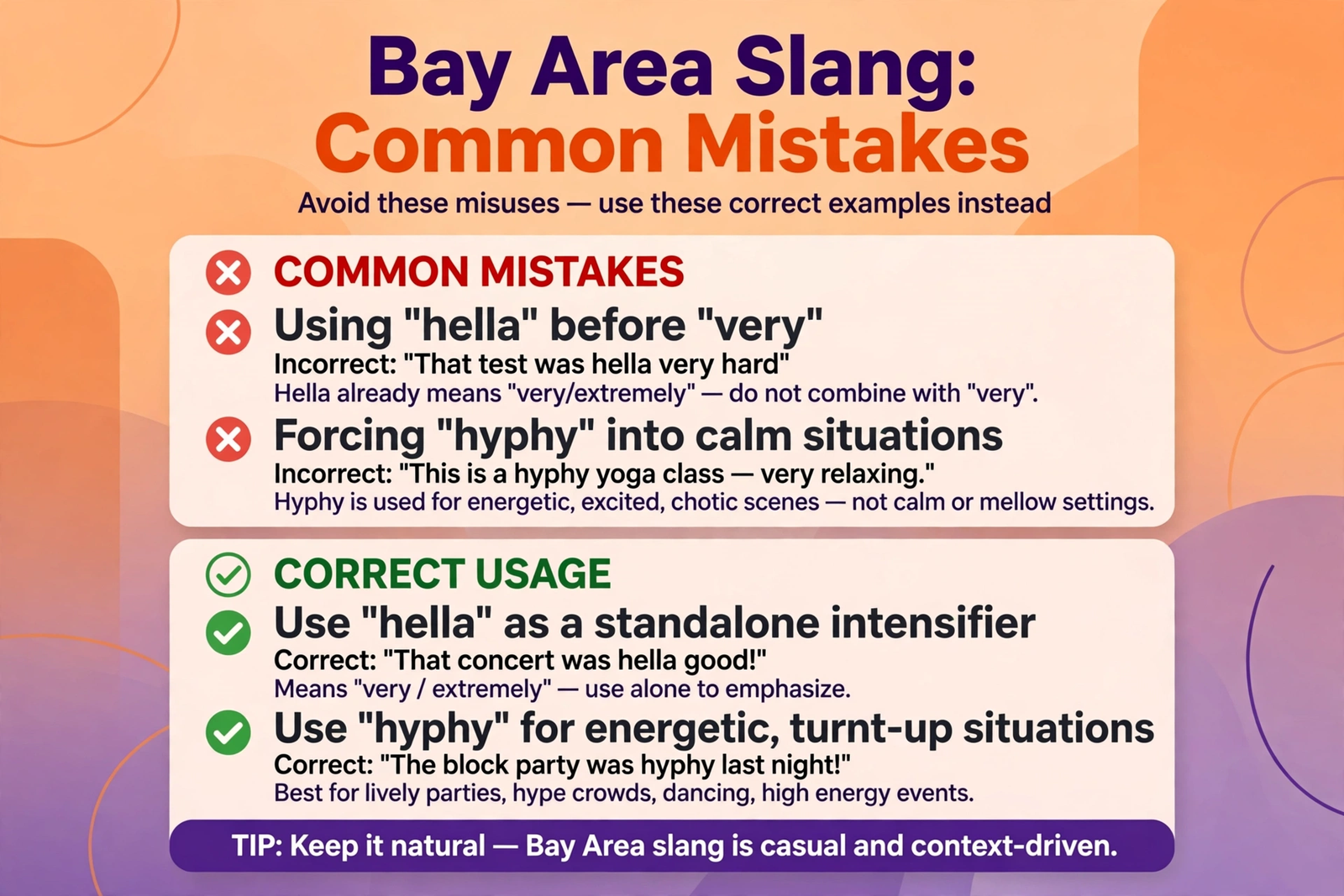
- Using hella wrong: Hella goes before adjectives and nouns — “hella good,” “hella people.” Saying “hella much” or “hella very” sounds off. One intensifier at a time is enough.
- Forcing hyphy into calm situations: Hyphy means wild energy. Calling a quiet dinner “hyphy” is a contradiction — the word needs noise, movement, and excitement to make sense.
- Saying yadadamean to strangers: It is a friendly check-in, not a formal question. Using it with a boss or a stranger can sound too casual or even confusing if they have never heard it.
- Mixing Bay Area slang with other regions: Saying “that song hella slaps, no cap, on God” piles three different slang traditions into one sentence. Each phrase is fine alone; together they sound like a parody.
- Using thizz lightly: Thizz refers to a drug. Using it as a joke about being energetic can be offensive or confusing, especially around people who know what it really means.
- Claiming Bay Area slang you did not grow up with: Locals can tell when someone is performing the accent rather than speaking naturally. Use the words you actually understand, and skip the ones you are guessing at.
- Spelling it wrong: It is yadadamean (or “yadadamean?”), not “yada da mean.” It is hyphy, not “hifi” or “hyper.” Spelling matters because these words are usually written in texts and captions.
Quick Tips
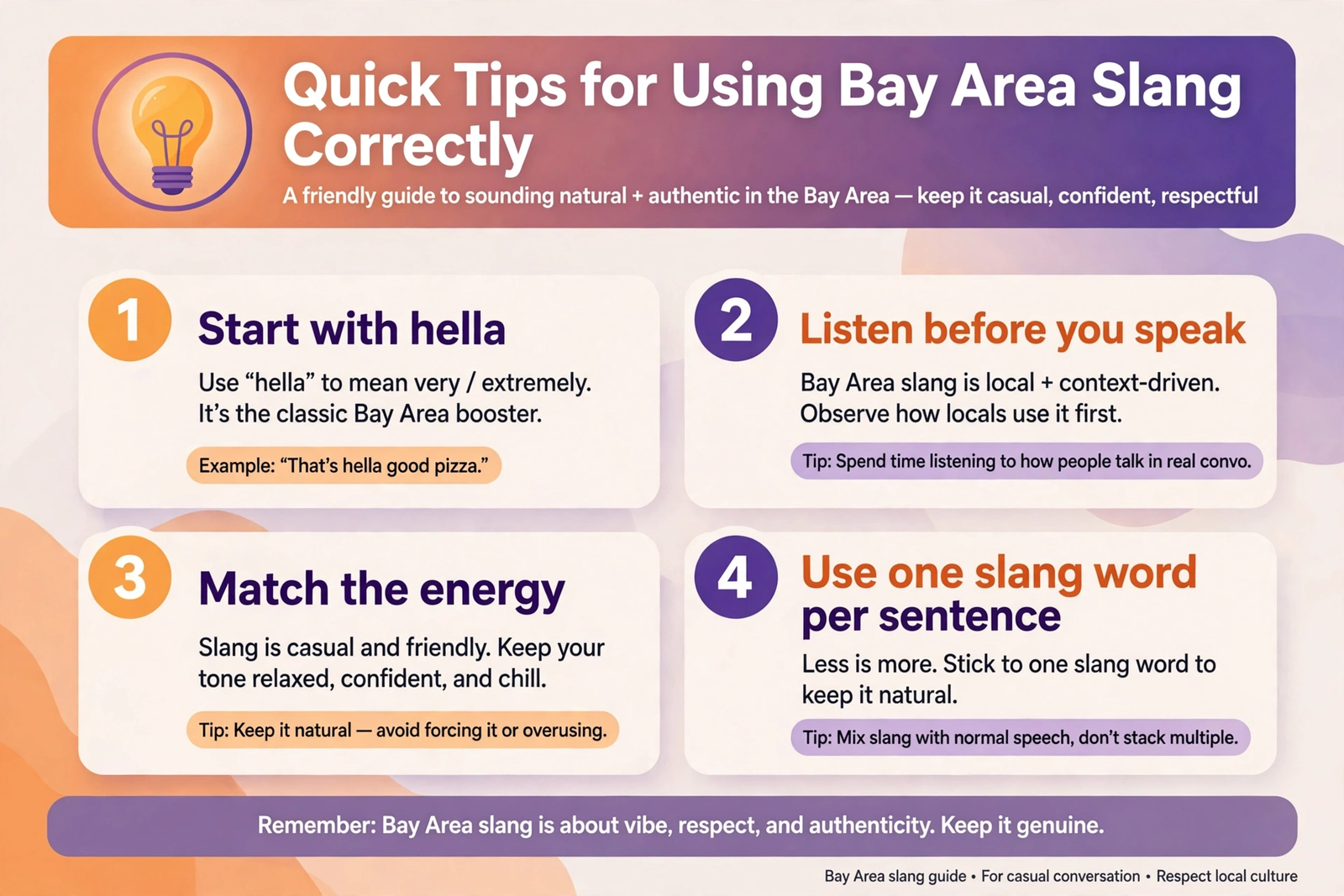
- Start with hella: It is the safest and most widely understood Bay Area word. Master it first, then add others one at a time.
- Listen before you speak: Spend time hearing how Bay Area natives use these words — in music, interviews, and videos — before trying them yourself.
- Match the energy: Hyphy words belong in high-energy moments. Hella works anywhere casual. Match the word to the mood.
- Use it in texts first: Trying new slang in writing is lower risk than saying it out loud. A text gives you time to get the sentence right.
- Respect the source: Bay Area slang comes from Black, Chicano, and Filipino communities. Use it with respect, and do not mock the accent or the culture behind it.
- Do not overdo it: One slang word per sentence is plenty. Two or three in a row sounds forced — the way locals actually talk is mostly normal English with slang sprinkled in.
- Learn the music: Listen to E-40, Mac Dre, Too Short, and Keak da Sneak. The slang makes much more sense when you hear it in the songs that created it.
- Know when to stop: In formal settings, drop the slang entirely. The words are for friends, not for job interviews.
FAQ
What does bay area slang mean?
Bay area slang is the informal vocabulary of the San Francisco Bay Area — words like hella, hyphy, yadadamean, and slaps that come from the region’s hip-hop scene, street culture, and everyday conversation in cities like Oakland, San Francisco, and San Jose.
What does hella mean in Bay Area slang?
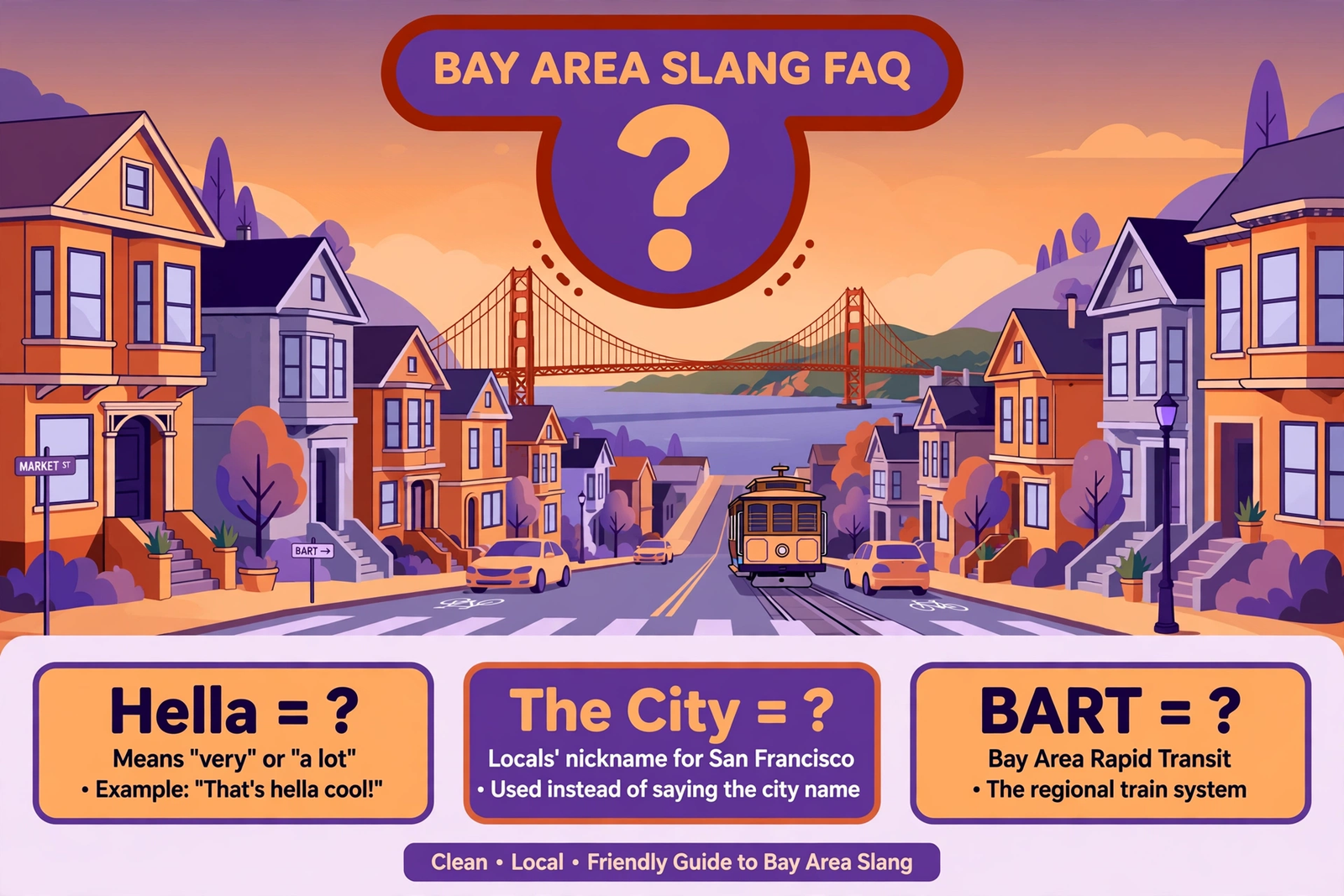
Hella means “very,” “really,” or “a lot.” “I’m hella tired” means “I’m very tired,” and “there were hella people” means “there were a lot of people.” It is the most famous Bay Area slang word, and it started in Oakland before spreading across the whole country.
What does hyphy mean?
Hyphy means wild, energetic, and hyped up — originally from the word “hyper.” It also names a style of Bay Area hip-hop music made famous by Mac Dre and E-40 in the mid-2000s, known for fast tempos, heavy bass, and high-energy parties called sideshows.
What does yadadamean mean?
Yadadamean is a compressed form of “you know what I mean.” Bay Area speakers put it at the end of a sentence to check that the listener understands or agrees — as in, “We finna go to the function, yadadamean?”
What does slaps mean in slang?
Slaps means something is excellent, especially a song. “That track slaps” is the Bay Area way of saying a song is a banger. The word started in the Bay Area and is now used across the United States for music, food, and anything else that is surprisingly good.
Is Bay Area slang the same as California slang?
Not exactly. Bay Area slang is Northern California slang, and it is different from Southern California slang. The Bay has hella, hyphy, and yadadamean; Southern California has its own words, like “the” before freeway numbers and different surf and skate terms. They overlap, but a Bay Area native can usually tell the difference.
Where did Bay Area slang come from?
It came from Oakland and San Francisco hip-hop, Black American culture, Chicano communities, and Filipino communities in the Bay Area. Rappers like E-40, Mac Dre, Too Short, and Keak da Sneak turned local street words into songs, and the songs carried the words around the world.
Is it okay to use Bay Area slang if you are not from the Bay?
Yes, in casual settings and in small doses — just like other regional slang covered in guides such as Gen Alpha slang. Use the words you genuinely understand, respect where they came from, and skip terms tied to drug culture or street life that you do not fully understand. One word used naturally is better than five forced ones.
Conclusion
Bay Area slang is more than a list of funny words — it is the sound of a region that has shaped American culture far beyond its size. From hella in Oakland to hyphy on MTV to slaps in every group chat in the country, these words travelled from Bay Area streets to the whole world, carried by music, migration, and the internet.
The key takeaways are simple. Learn hella first, because it is the word you will hear most. Understand that hyphy is an energy, slaps is a compliment, and yadadamean is a conversation. Use the slang lightly, respect the communities that created it, and never force a term just to sound local. Slang is at its best when it builds connection — a shared laugh, a quick compliment, a joke everyone gets.
Language will keep moving, and today’s Bay Area slang will keep evolving with every new artist and every new trend. But if you understand bay area slang, you understand something bigger: how a small region with a big sound changed the way America talks. Keep exploring — from regional trends like delulu and the newest TikTok terms to the classics — and you will never be lost in the comments again.
