Quick definition: 90s slang words are the informal words and catchphrases that defined American youth culture in the 1990s — expressions like “as if,” “da bomb,” “talk to the hand,” and “all that” — used to say something was cool, to disagree sarcastically, or to shut down a conversation with style. Many of them came from hip-hop, skate culture, and hit TV shows and movies, and plenty are still used today.
90s Slang Words Meaning & Definition
When people search for 90s slang words, they usually want two things: a list of the words themselves, and what each one actually meant. At its core, 90s slang was the everyday language of a generation raised on MTV, the Fresh Prince, dial-up internet, and the mall food court. It was playful, exaggerated, and confident — a way for teenagers and young adults to sound cool, funny, or unbothered without saying much at all.
Unlike formal English, 90s slang words were rarely written down in dictionaries when they were popular. They spread through song lyrics, sitcom catchphrases, and school hallways. A word like “phat” (meaning excellent) or “dope” (meaning really cool) could travel from a rap song to a classroom in a single week. That speed is exactly why the decade produced so many expressions that still feel instantly recognizable more than 30 years later.
Today, 90s slang words show up in three main places: nostalgia content, memes and TikTok throwbacks, and everyday speech — because several of these words never actually died. “Chill,” “legit,” “my bad,” and “whatever” are still completely normal in 2026. Others, like “talk to the hand” or “psyche,” survive mostly as jokes or retro references. Knowing which is which is the difference between sounding fun and sounding like a costume.
Introduction
Picture this: it is 1995, you are wearing baggy jeans and a windbreaker, and someone asks if you want to go to the mall. “As if I would miss it,” you say, flipping your hair. “That new CD is da bomb.” Your friend answers, “Whatever — let’s bounce.” In four short sentences, you have just used four of the most iconic 90s slang words ever spoken, and everyone within earshot understood you perfectly.
The 1990s were a golden age for slang. Hip-hop went mainstream, sitcoms like The Fresh Prince of Bel-Air, Friends, and Seinfeld turned catchphrases into national habits, and movies like Clueless gave an entire generation a new vocabulary overnight. Slang was not just language — it was identity. The words you used told people which music you liked, which shows you watched, and whether you were, in the words of the decade, all that.
This guide is the complete, no-fluff breakdown of 90s slang words: what they meant, where they came from, how to use them in real sentences, and which ones still work today. Whether you are writing a throwback caption, settling a debate with a friend, or just feeling nostalgic, you will find the full list, clear examples, and the mistakes to avoid — all in one place. The same pattern still drives slang today: just look at how a single number became a whole trend in our guide to 67 meaning in slang.
Origin
Most 90s slang words did not appear out of nowhere. They came from a handful of powerful cultural engines that all peaked at the same time.
Hip-hop and R&B were the biggest source. Words like “phat,” “bling,” “homie,” “dope,” and “fly” moved from rap lyrics into everyday speech as hip-hop became the dominant sound of the decade. Will Smith’s 1997 hit “Gettin’ Jiggy Wit It” turned “jiggy” into a household word, while TLC’s “No Scrubs” (1999) made “scrub” the go-to insult for a guy with no ambition. Snoop Dogg’s playful “-izzle” wordplay even created its own mini-dialect, with “fo’ shizzle” meaning “for sure.”
Television and film were the second engine. Clueless (1995) alone gave the world “as if,” “whatever,” and the valley-girl habit of ending statements with “like.” The Fresh Prince of Bel-Air spread “chill” and “yo” to suburban living rooms. Seinfeld turned “yada yada” and “not that there’s anything wrong with that” into everyday phrases, while Wayne’s World (1992) made “schwing” and “not!” famous. A single episode could put a new word in millions of mouths by the next morning.
Skate and surf culture contributed the surfer-dude vocabulary: “gnarly,” “rad,” “tubular,” “awesome,” and “dude” itself. These words had existed since the 1980s, but the 90s skate boom — Tony Hawk, the X Games, and baggy skate fashion — pushed them into the mainstream.
African American Vernacular English (AAVE) deserves special credit. A large share of 90s slang — including “diss,” “dope,” “fly,” “homie,” “phat,” and “word” — originated in Black American communities and spread through music and media. Understanding that history matters: these words were not invented by Hollywood, they were borrowed by it.
Finally, the decade’s technology shaped slang too. Dial-up internet, pagers, and early chat rooms gave us “TMI” (too much information), “LOL” in its earliest days, and “cyber” everything. The 90s were the last decade when slang spread mainly by word of mouth and television — which is why it felt so shared, so universal, and so tied to specific shows and songs.
Popularity
So why were 90s slang words so popular — and why do people still search for them today?
First, the 90s were the peak of monoculture. Before streaming and social media fragmented audiences, tens of millions of people watched the same shows, heard the same songs, and quoted the same movies. A catchphrase from Clueless or a lyric from a Will Smith song could become national slang within weeks. That shared experience is why 90s slang still feels like a common language for anyone who grew up in the decade.
Second, the words were fun to say. “Booyah,” “schwing,” “psyche,” and “talk to the hand” are performative — they come with a gesture, a tone, or a dramatic pause. Slang that is fun to perform spreads faster than slang that is merely descriptive, and the 90s produced more performative phrases than any decade before or since.
Third, nostalgia keeps them alive. The 90s revival — in fashion, music, and streaming reboots — has brought the decade’s language back with it. Gen Z discovered 90s slang through TikTok and thrift-store fashion, while millennials use it as a badge of shared memory. Words like “dope,” “fly,” and “legit” never left; words like “as if” and “da bomb” return every time a 90s-themed party or meme goes viral.
Search interest backs this up. People look up 90s slang words to write retro captions, to understand lyrics and old movies, to settle arguments about what a word meant, and to teach their kids the language of their own youth. It is one of the most durable nostalgia topics on the internet — and unlike fashion trends, the words cost nothing to bring back.
How It Is Used
90s slang words worked in a few clear patterns. Once you know the patterns, you can use almost any of them correctly.
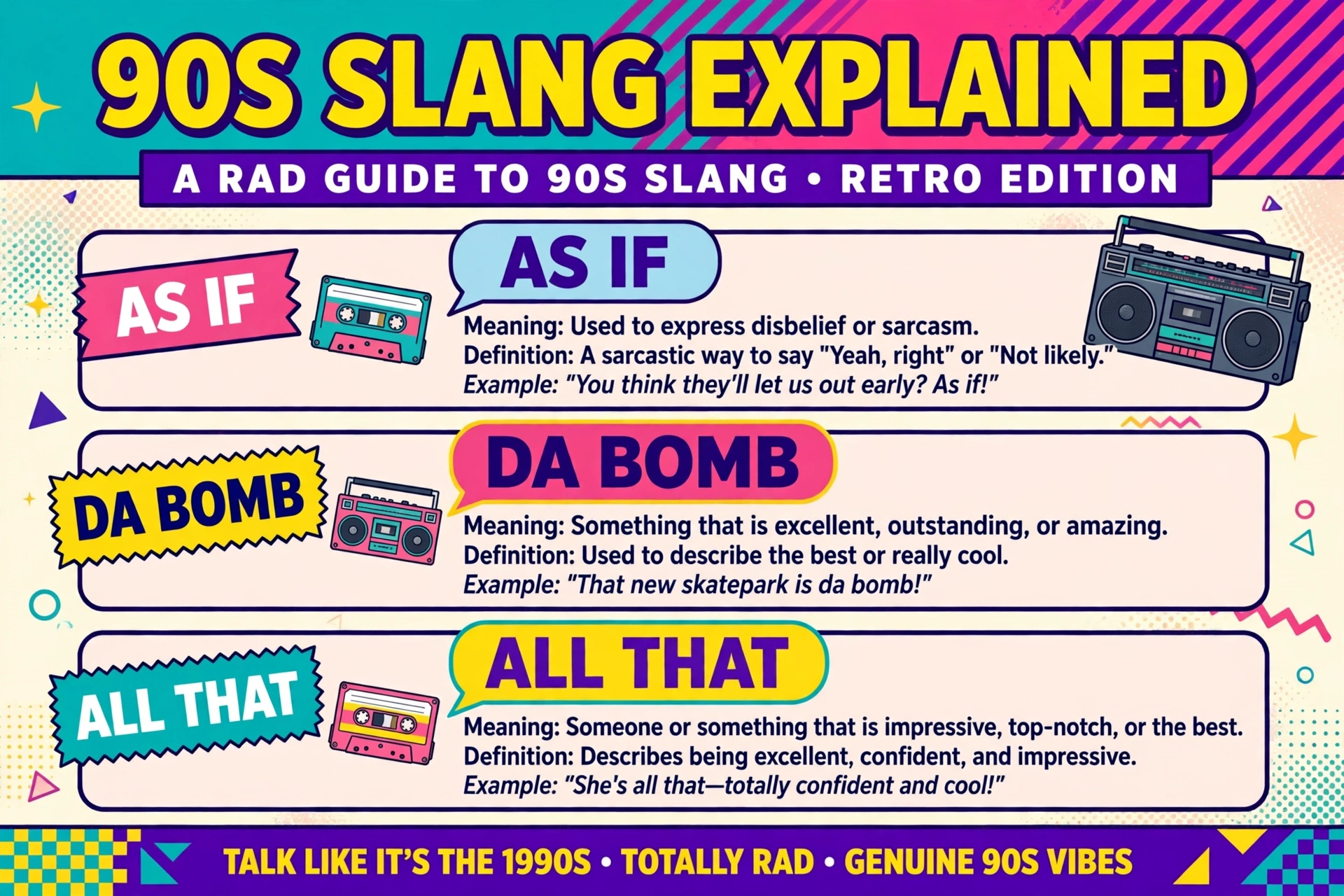
- As praise: “da bomb,” “phat,” “dope,” “fly,” “tight,” “fresh,” “all that” — all of these meant something was excellent, cool, or impressive. Example: “That new album is da bomb.”
- As dismissal: “whatever,” “talk to the hand,” “as if,” “not,” “bounce” — used to shut down a conversation or reject an idea. Example: “You want me to clean my room? As if!”
- As excitement: “booyah,” “cha-ching,” “schwing,” “woohoo” — shouted when something great happened. Example: “I got the last ticket — booyah!”
- As agreement or greeting: “word,” “yo,” “aiight,” “totally,” “you go girl” — quick ways to say hello, agree, or cheer someone on. Example: “Word — let’s do it.”
- As an intensifier: “mad” (very), “hella” (very, mostly West Coast), “totally” (completely). Example: “She’s mad talented.”
- As an insult or warning: “scrub,” “wack,” “buggin’,” “trippin’,” “diss” — used to call out bad behavior or low quality. Example: “That excuse was wack.”
The golden rule of using 90s slang words today is context. In a nostalgic caption, a themed party, or a joke between friends, they land perfectly. In a job interview or a formal email, they do not — with a few exceptions. “My bad,” “chill,” “legit,” and “whatever” (used lightly) have fully crossed into modern standard casual speech. The rest are best kept for fun, retro, or playful moments.
Tone matters as much as the word. Most 90s slang was delivered with a specific attitude: confident, sarcastic, or celebratory. Saying “as if” flatly does not work; it needs the eye roll. Saying “booyah” quietly does not work; it needs the energy. If you are going to use these words, commit to the delivery — that is half the meaning.
Examples
The best way to learn 90s slang words is to see them in real sentences. Here are examples grouped by tone, so you can match the word to the moment.
Friendly Examples
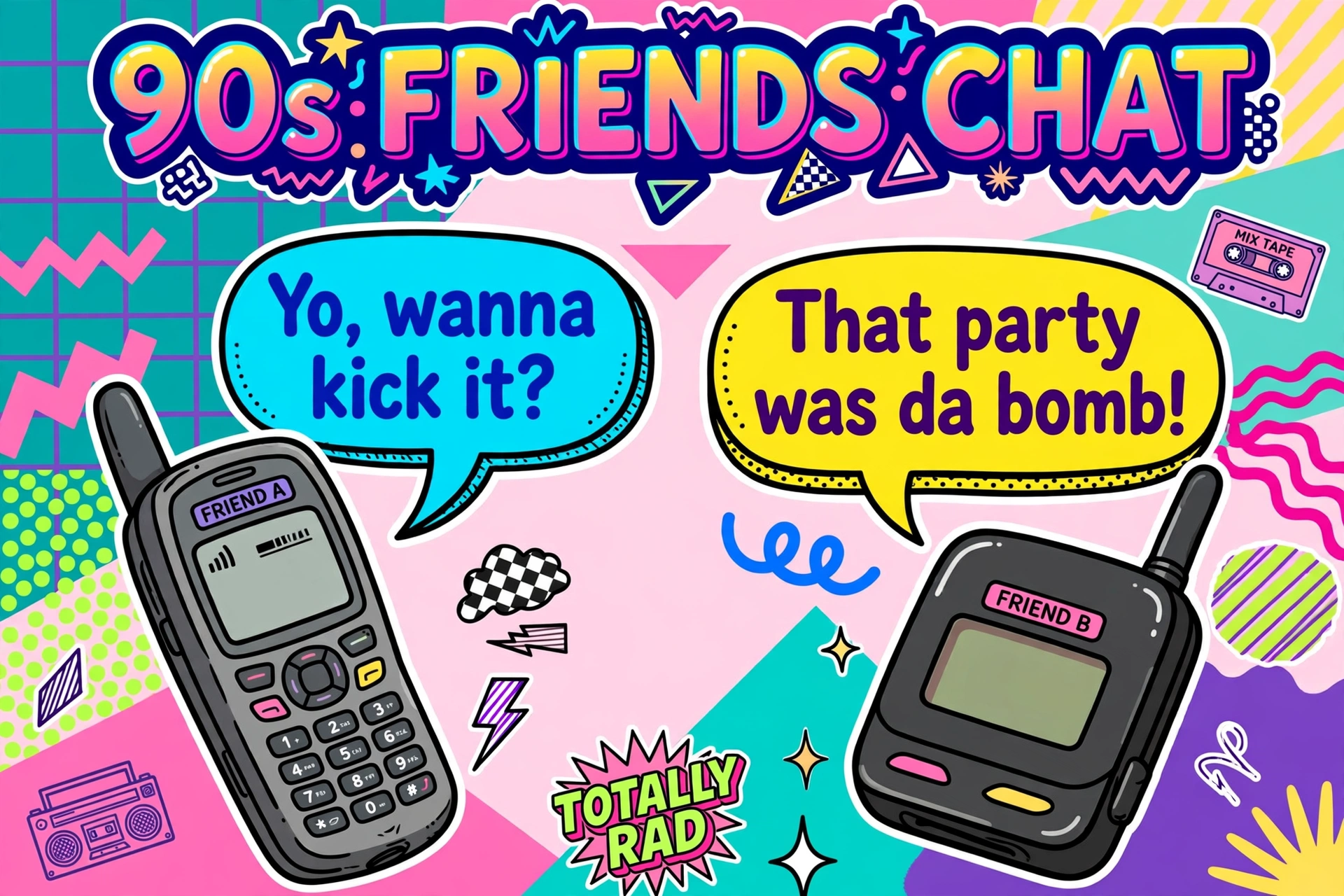
- “Yo, what’s up? Wanna kick it at the mall later?” — a casual invitation between friends.
- “Your new kicks are so fly. Where did you get them?” — a genuine compliment.
- “That party was totally awesome. We should go again next weekend.” — excitement shared with a friend.
- “Don’t worry about it, homie. I got you.” — reassurance between close friends.
- “You looked fresh to death at the dance last night.” — high praise for someone’s outfit.
Professional Examples
Most 90s slang does not belong at work — but a few expressions crossed over so completely that they are now standard casual English. Use these carefully, and only in relaxed workplaces:
- “My bad — I forgot to attach the file. Sending it now.” — a light, natural apology.
- “Let’s chill on the launch date until the numbers come in.” — “chill” meaning “wait” or “relax.”
- “That vendor is legit. We have worked with them for years.” — “legit” meaning trustworthy or genuine.
- “Whatever works for the client is fine with me.” — “whatever” as flexible agreement, not dismissal.
- “The new design is rad — the client is going to love it.” — “rad” as casual praise in a creative workplace.
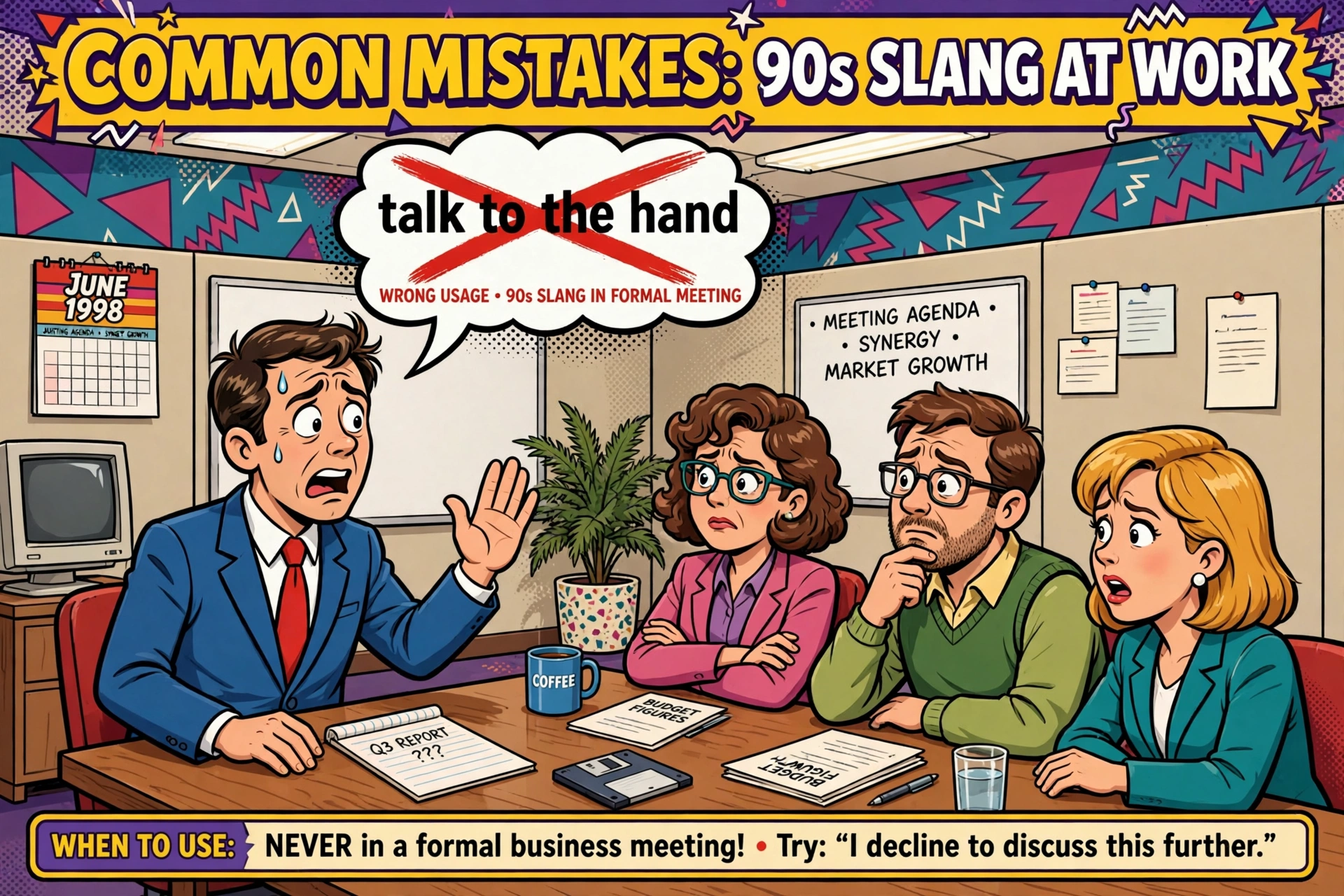
Avoid the rest at work. Telling your manager “talk to the hand” or calling a project “da bomb” in a board meeting will not land the way you hope.
Funny Examples
- “He said he could beat me at Mario Kart. As if!” — sarcastic disbelief.
- “You thought I was actually going to do the dishes? Psyche!” — a classic fake-out.
- “Talk to the hand, because the face ain’t listening.” — the full, dramatic version of the dismissal.
- “I’m outtie — peace!” — a playful way to leave, popularized by 90s comedies.
- “That haircut is so not the shiznit.” — using 90s praise sarcastically, in reverse.
Notice how the funny examples all rely on exaggeration. That is the secret of 90s slang: it was never meant to be subtle. It was meant to be performed.
Comparison with Similar Terms
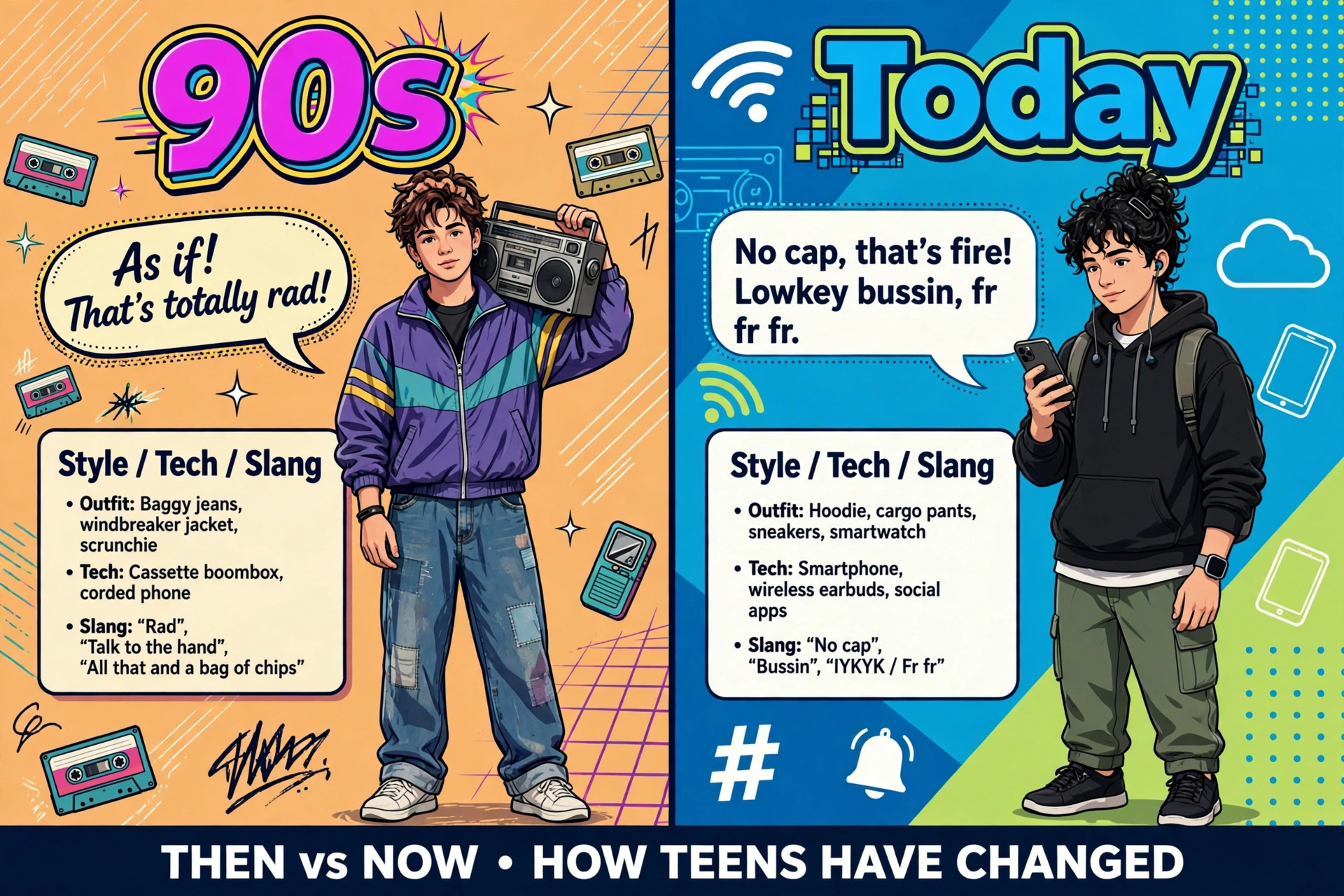
Every decade has its own slang, and the 90s version sits between the surfer slang of the 80s and the internet slang of the 2000s. Comparing them shows exactly what made the 90s unique — and why some words survived while others faded.
| Meaning | 90s Slang Words | 80s Equivalent | 2000s / Modern Equivalent |
|---|---|---|---|
| Really cool / excellent | Da bomb, phat, dope | Rad, tubular, gnarly | Lit, fire, slaps |
| Stylish / attractive | Fly, fresh, tight | Cool, hot | Drip, clean, fine |
| Leave / go away | Bounce, I’m outtie | Split, cruise | Dip, ghost, I’m out |
| Disagreement / no way | As if, not, whatever | No way, gag me | Nah, cap, no cap |
| Very / a lot | Mad, hella, totally | Totally, like | Super, lowkey, deadass |
| Friend | Homie, homeboy, dawg | Buddy, pal, dude | Bro, bestie, fam |
| Crazy / overreacting | Buggin’, trippin’ | Freaking out | Wildin’, tweaking |
| Money | Benjamins, cha-ching | Bucks, dough | Bread, bag, racks |
The pattern is clear: each generation reinvents the same handful of ideas — cool, leaving, disagreeing, money, friendship — with new words. The 90s versions were louder and more theatrical than the 80s versions, and more face-to-face than the internet slang that followed. Modern slang like “lit” or “slaps” is the direct descendant of “da bomb” and “phat”: same job, new outfit.
One more comparison worth making: 90s slang words vs. today’s texting slang. Modern terms like “lol,” “omg,” and “ngl” are built for typing fast on a phone. 90s slang was built for saying out loud — for shouting across a room, for a movie one-liner, for a song lyric. That is why the 90s words feel bigger and more quotable. They were designed to be heard, not read.
Alternate Meanings
Some 90s slang words had more than one meaning, and a few of them meant something completely different outside slang. Watch out for these:
- Dope: In slang, “really cool.” In older usage, it also meant drugs (especially marijuana or heroin). Context decides which one is meant — “that beat is dope” is praise; “he’s on dope” is not.
- Fly: In slang, stylish or attractive. Literally, it is also an insect — and “fly” as a verb means to travel by air. “She’s fly” is a compliment; “there’s a fly” is a pest problem.
- Tight: In 90s slang, excellent or cool. It can also mean close-fitting, or emotionally close (“we’re tight” means “we’re close friends”). All three meanings are still used.
- Fresh: In slang, cool or new-looking. Literally, it means recently made or not stale — “fresh bread” has nothing to do with slang.
- Mad: As 90s slang, an intensifier meaning “very” (“mad cool”). In standard English, it means angry or insane. “I’m mad about it” and “it’s mad good” mean opposite things.
- Bad: In slang, “bad” could mean good — “that car is bad” was high praise, similar to Michael Jackson’s “Bad.” This is the classic slang reversal, and it still confuses people today.
- Scrubs: In 90s slang, a “scrub” was a guy with no ambition. Today, “Scrubs” is also the name of a popular TV show and the word for medical clothing. Same word, three worlds.
- All that: As praise, it meant the best. But said sarcastically — “oh, you think you’re all that” — it meant someone had an inflated ego. Tone flips the meaning completely.
The lesson: never assume a 90s slang word has only one meaning. Read the sentence, listen to the tone, and check the context before deciding what someone meant.
Professional or Polite Alternatives
Love the energy of 90s slang but need to sound professional? Here are polite, modern alternatives that keep the meaning without the retro attitude:
| 90s Slang Word | What It Meant | Polite / Professional Alternative |
|---|---|---|
| Whatever | I don’t care / dismissal | “That works for me” / “I’m flexible on this” |
| My bad | My mistake | “My apologies — I’ll fix that” |
| Talk to the hand | I’m not listening | “Let’s revisit this later” / “I need to focus right now” |
| Da bomb / dope | Excellent | “Outstanding” / “Excellent work” |
| Chill | Relax / wait | “Let’s take a step back” / “No rush” |
| Bounce | Leave | “I have to head out” / “I need to go” |
| Legit | Genuine / trustworthy | “Credible” / “Reliable” |
| As if | No way / I disagree | “I’m not sure that will work” / “I respectfully disagree” |
| Rad | Cool / great | “Great” / “Impressive” |
| Trippin’ / buggin’ | Overreacting | “Let’s stay calm and look at the facts” |
Notice that “my bad,” “chill,” and “legit” barely need replacing at all — they have become so normal that most people do not even recognize them as slang anymore. Those three are the true survivors of the 90s, and using them anywhere is completely safe.
Common Mistakes
Using 90s slang words is fun, but it is easy to get wrong. Here are the mistakes people make most often:
- Mixing decades: “Groovy” is 60s/70s, “tubular” is 80s, “lit” is 2010s. Calling all of them “90s slang” is the most common error in nostalgia lists. If you are not sure a word is from the 90s, check before you use it.
- Using dead slang seriously: Saying “talk to the hand” in a real argument today will get a laugh, not respect. Dead slang works as a joke; using it seriously makes you sound like a parody.
- Overusing it: One or two 90s phrases in a caption is charming. An entire paragraph of them is exhausting. Pick your best line and let it breathe.
- Getting the meaning backwards: “All that and a bag of chips” is praise, not an insult. “Wack” means bad, not good. “Phat” is spelled P-H-A-T and means excellent — “fat” with an F is something else entirely.
- Forgetting the tone: “As if” needs sarcasm. “Booyah” needs energy. “Whatever” needs the eye roll. Delivered flat, these words fall flat.
- Using slang you do not understand: Some 90s words came from specific communities and cultures. Using them without knowing their history — especially words rooted in AAVE — can come across as careless. Learn the origin before you borrow the word.
- Spelling errors: “Shiznit” (not “shiznet”), “psyche” (not “sike”), “aiight” (not “alright”), “fo’ shizzle” (not “for shizzle”). The spellings are part of the style — get them right.
Quick Tips
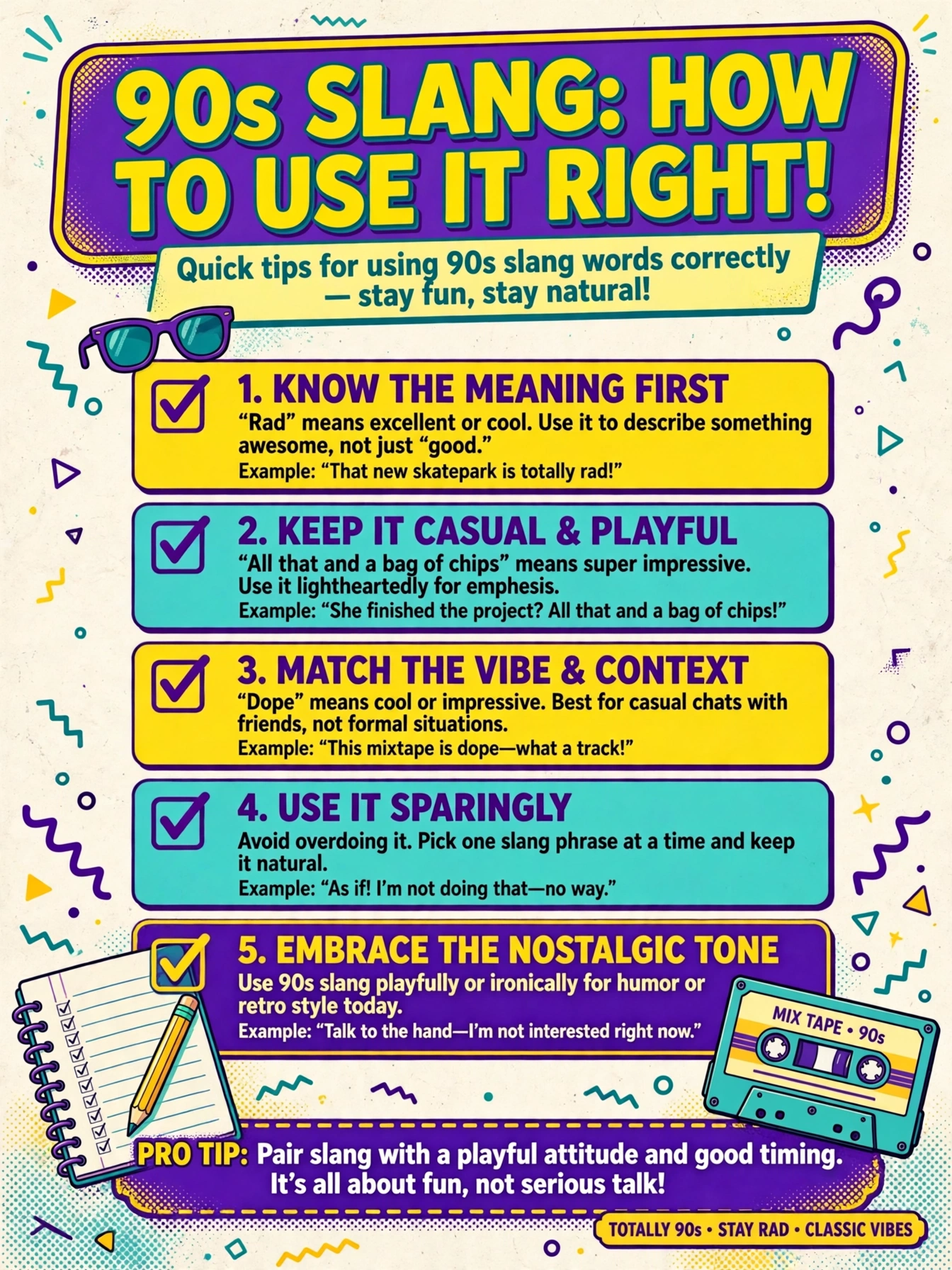
Want to use 90s slang words well — in captions, conversations, or content? Follow these quick tips:
- Start with the survivors: “My bad,” “chill,” “legit,” “whatever,” “dope,” and “fly” still work in everyday speech. Master those before trying the theatrical ones.
- Match the moment: Save “booyah,” “schwing,” and “talk to the hand” for parties, jokes, and throwback posts — not for serious conversations.
- One phrase per caption: A single “as if” or “da bomb” in an Instagram caption hits harder than five 90s words competing with each other.
- Pair it with the reference: Quoting Clueless, Fresh Prince, or a 90s song lyric makes the slang land instantly — people recognize the source and smile.
- Check the decade: Before calling something 90s slang, do a quick search. A surprising number of “90s” lists are full of 80s words.
- Use it with people who get it: 90s slang is a shared-memory language. It works best with people who lived through the decade or love its culture.
- Don’t force it: If a 90s word feels unnatural coming out of your mouth, skip it. The decade’s whole attitude was effortless cool — trying too hard is the least 90s thing you can do.
FAQ
What are the most popular 90s slang words?
The most popular 90s slang words are “as if,” “whatever,” “da bomb,” “talk to the hand,” “all that,” “dope,” “fly,” “phat,” “booyah,” “chill,” “my bad,” “legit,” “psyche,” and “scrub.” These appeared in hit movies, TV shows, and songs, which is why they spread nationwide and are still recognized today.
What does “as if” mean in 90s slang?
“As if” means “yeah, right” or “no way” — a sarcastic way to strongly disagree with something. It was popularized by the 1995 movie Clueless. Example: “He thinks he can beat me at basketball? As if!”
What does “da bomb” mean?
“Da bomb” means something is excellent, amazing, or the best. Example: “This pizza is da bomb.” It was one of the most common ways to praise something in the 90s, and it is still used today as a nostalgic compliment.
What does “talk to the hand” mean?
“Talk to the hand” means “I’m not listening to you” — a playful, dramatic way to shut down a conversation, usually said while holding up an open palm. The full version adds “because the face ain’t listening.” Today it is mostly used as a joke or retro reference.
Which 90s slang words are still used today?
“Chill,” “legit,” “my bad,” “whatever,” “dope,” “fly,” “fresh,” “tight,” and “rad” are still used in everyday speech and have mostly lost their “slang” label. Words like “as if,” “da bomb,” and “booyah” survive mainly in nostalgic, humorous, or themed contexts.
What is the difference between 80s and 90s slang?
80s slang leaned on surfer and skater words like “tubular,” “gnarly,” and “totally awesome,” while 90s slang was shaped more by hip-hop, R&B, and sitcom catchphrases — “da bomb,” “phat,” “as if,” and “talk to the hand.” The 90s versions were louder, more performative, and more tied to specific TV shows and songs.
Where did 90s slang come from?
Most 90s slang came from hip-hop and R&B music, African American Vernacular English, skate and surf culture, and hit TV shows and movies like Clueless, The Fresh Prince of Bel-Air, Seinfeld, and Wayne’s World. AAVE was the source of many of the decade’s most famous words, which then spread through music and media.
How can I use 90s slang words without sounding cringe?
Use one phrase at a time, pick words that still feel natural (like “my bad” or “chill”), match the moment (parties, captions, jokes with friends), and commit to the tone. Avoid stacking five retro phrases in one sentence, and do not use dead slang like “talk to the hand” in serious situations — save it for laughs.
Conclusion
90s slang words were more than just funny phrases — they were the sound of a decade that knew how to have fun with language. From the sarcastic snap of “as if” to the pure joy of “booyah,” from the smooth confidence of “fly” to the casual apology of “my bad,” these words captured a moment when pop culture was shared, music was loud, and everybody seemed to be in on the same joke.
The best of them never left. “Chill,” “legit,” and “my bad” are now just part of how we talk. The rest live on in memes, throwback parties, and the fond memories of anyone who grew up quoting Clueless or singing along to Will Smith. And every time a new generation discovers them on TikTok, the decade gets a little encore.
So go ahead — drop an “as if” into your next group chat, call something “da bomb” at your next 90s night, or just enjoy knowing exactly what your older cousin meant all those years ago. The 90s may be over, but the slang? The slang is forever fresh. Word.
For a deeper look at how slang evolves, the Merriam-Webster definition of slang is a useful starting point. And if you want to see how 90s words connect to today’s texting language, check out our guides to 67 meaning in slang, sigma meaning in slang, GOAT meaning in slang, and mid meaning in slang — the new generation’s slang follows the same rules the 90s invented.
