Quick definition: In slang, dodo meaning slang is simple: calling someone a “dodo” means calling them silly, foolish, or a little clueless, usually in a playful, teasing way rather than as a serious insult. It comes from the extinct dodo bird, whose popular image was a clumsy creature that was not very bright. Today you will hear it in group chats, TikTok comments, and friendly banter, almost always with a smile behind it.
Dodo Meaning Slang Meaning & Definition
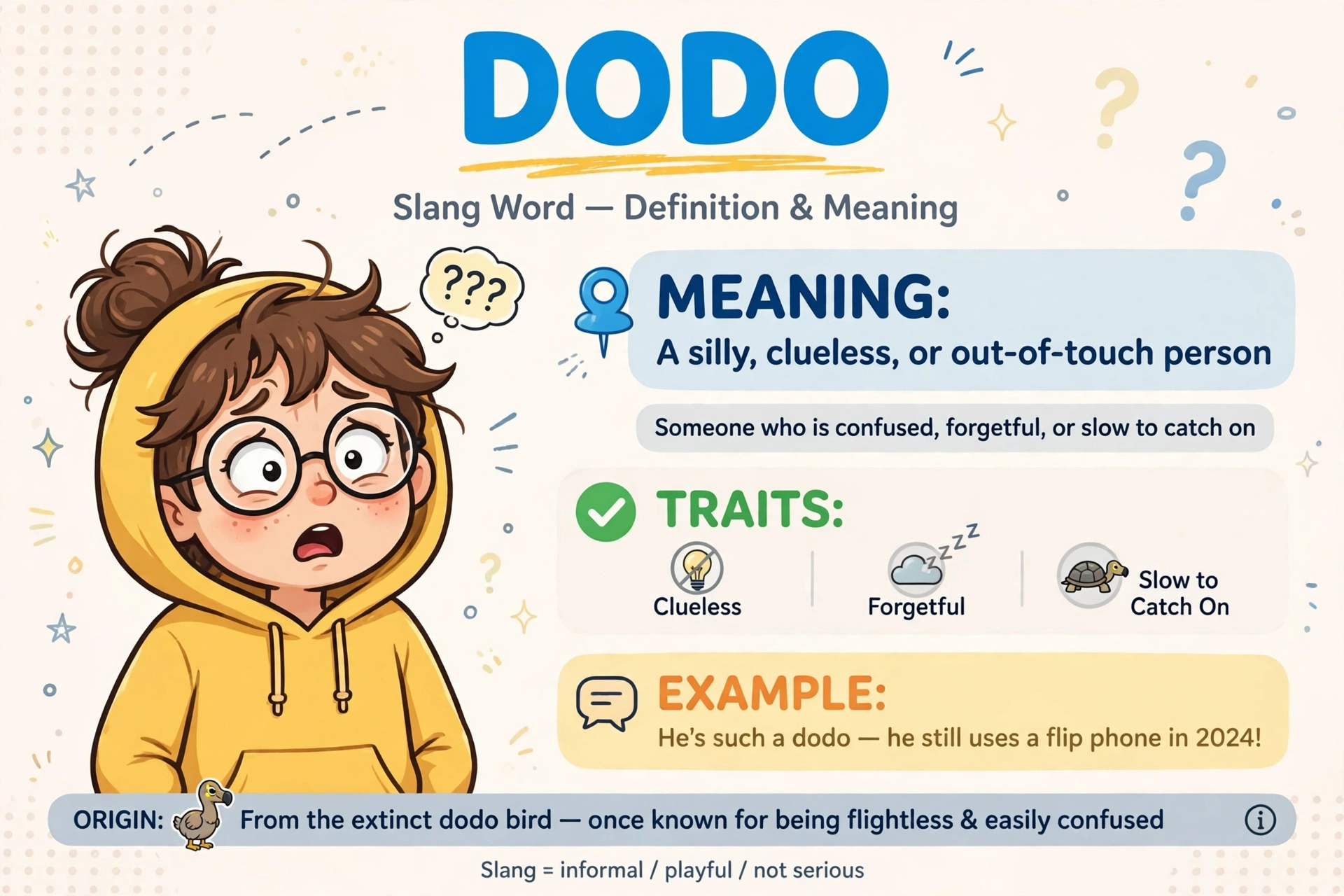
When someone says “you are such a dodo,” they are not giving you a biology lesson. They are saying you just did something goofy, forgetful, or a bit slow on the uptake. Maybe you walked into the wrong classroom, tried to unlock your front door with your car key, or confidently announced a fact that everyone else knew was wrong. The word lands softly. It pokes fun at the moment, not at your intelligence as a person.
That softness is what makes dodo meaning slang different from harsher insults. Words like “idiot” or “moron” shut a conversation down. “Dodo” keeps it light. It says, “that was silly,” and then everyone moves on, often laughing, including the person who was called a dodo. It is the kind of word friends use with each other, parents use with kids, and coworkers use when the mistake is harmless and the mood is good.
There is a second, related sense worth knowing. A “dodo” can also mean someone who is hopelessly behind the times, or something that is outdated and on its way out. If your uncle still prints out every email and refuses to use a smartphone, a teenager might jokingly call him a dodo. If a piece of technology has been replaced by something better, people say it has “gone the way of the dodo.” In both cases the idea is the same: out of step, out of date, or a little behind everyone else.
Context is everything with this word. Said between friends after a funny mistake, dodo is affectionate teasing. Said with a cold tone to a stranger, or repeated again and again to the same person, it can still sting. The word itself is mild, but the delivery decides whether it feels like a joke or a jab. If you are not sure the other person will take it as a joke, do not use it.
Introduction
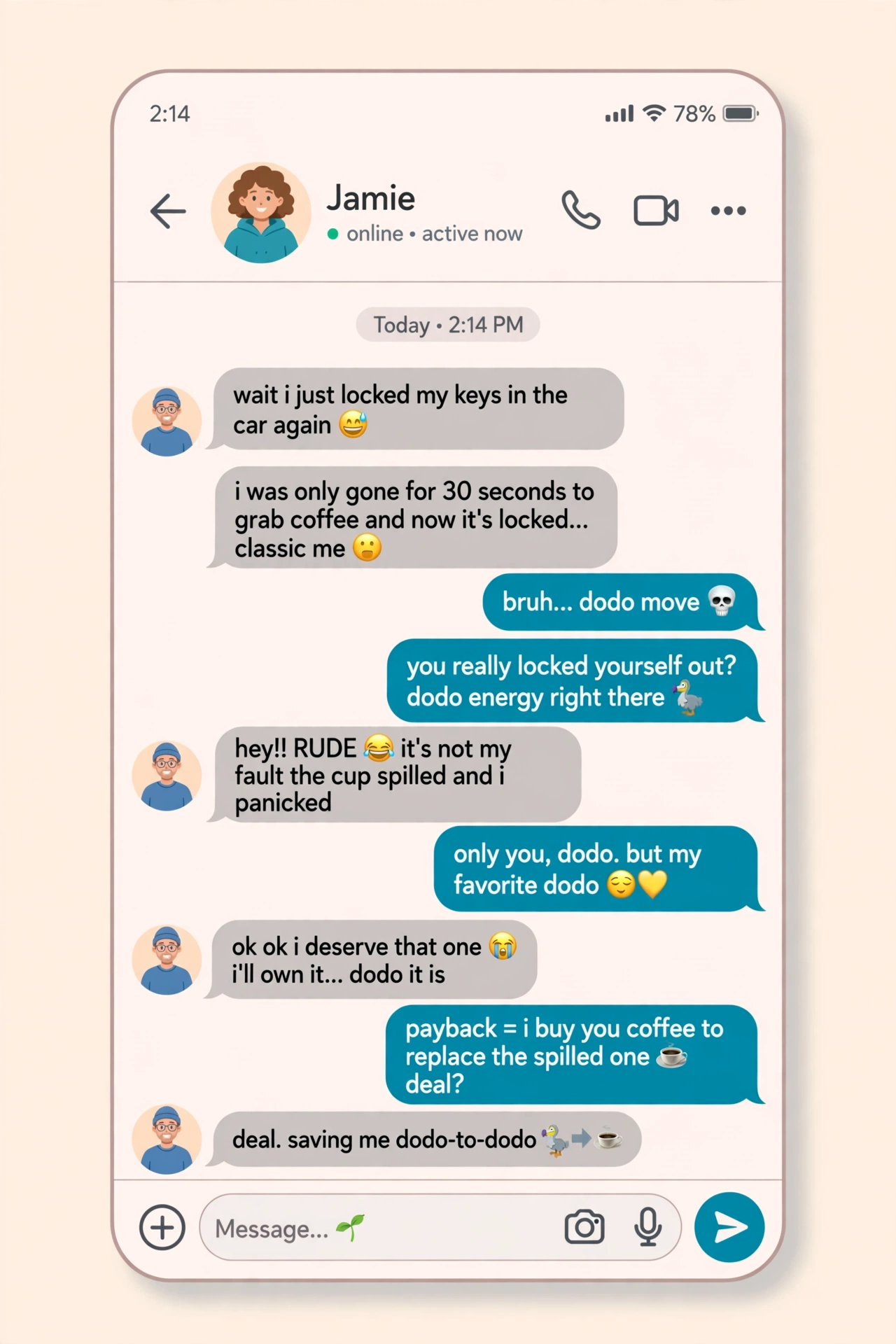
Scroll through a group chat after someone shares an embarrassing story and you will probably find it within seconds. “Bro, you are such a dodo.” “Okay, dodo, explain that one again.” “I locked my keys in the car again. I am a certified dodo today.” The word is short, funny to say, and instantly understood, which is why it has survived for generations while trendier slang comes and goes.
What makes dodo meaning slang interesting is that it did not start on the internet at all. It started with a real bird, became a dictionary insult, turned into a famous idiom about extinction, and then found a second life online as a meme-friendly tease. Understanding the word means understanding all of those layers at once: the bird, the insult, the idiom, and the joke.
It also helps to see dodo in contrast to praise slang. Where a word like GOAT crowns someone the greatest of all time, dodo does the opposite in the gentlest possible way. It crowns someone the silliest in the room, just for a moment, and usually just for laughs. Nobody actually believes their friend is a dodo. That is exactly why the joke works.
Origin
The story starts on the island of Mauritius, in the Indian Ocean. The dodo was a large, flightless bird, related to the pigeon, that lived only there. Dutch sailors encountered it in the late 1500s and early 1600s, and within less than a century of human contact, the bird was extinct, gone by the late 1600s. Hunting, habitat loss, and animals introduced by humans all played a part.
The name itself points straight at the slang meaning. According to Merriam-Webster, “dodo” comes from the Portuguese word “doudo,” meaning silly or stupid, and its first known use in English dates to 1628. Early sailors saw a big, flightless bird that did not fear humans, walked right up to them, and could not fly away, and they reached an unkind conclusion about its intelligence.
That conclusion, it turns out, was probably unfair. Modern research suggests dodos were not nearly as dumb as their reputation claims. They had simply evolved on an island with no natural predators, so they had no reason to fear anything or to fly away. A bird that has never needed to be afraid looks fearless, or foolish, to a stranger with a weapon. The popular image stuck anyway, and the bird became a symbol of foolishness in English.
From there, the jump into slang was natural. By the time dictionaries recorded the slang sense, “dodo” already meant two related things: a stupid person, and a person hopelessly behind the times. The bird’s fate gave English one of its best idioms, too. “Dead as a dodo” means completely, unquestionably dead or finished, and “to go the way of the dodo” means to become obsolete and disappear, like DVD rental stores, phone books, and fax machines.
Popularity
Dodo never really left the language, but social media gave it a fresh boost. It is short, it repeats a fun sound, and it works perfectly as a one-word reply. On TikTok, in Instagram comments, on Snapchat, and in gaming chats, “dodo” shows up as a caption, a nickname, and a punchline. A creator posts a video of themselves failing at a simple task, and the comments fill up with “dodo behavior” and “certified dodo.” The person is not being bullied. They are being celebrated for a relatable, funny fail.
Part of the appeal is that dodo feels old-fashioned in a charming way. It sounds like something a grandparent would say, which makes it funny when a teenager says it. That retro flavor is a big reason slang words survive: they feel both familiar and fresh at the same time. Unlike slang that depends on a single viral video or a single celebrity, dodo does not need an explanation. Almost every English speaker already knows the bird, so the joke lands immediately.
The word also travels well across ages. Kids use it because it sounds silly and is safe to say at school. Adults use it because it is a polite way to say “that was not very smart” without actually being rude. That wide range is rare for slang, and it is why dodo meaning slang keeps appearing in searches year after year, long after flash-in-the-pan terms have faded.
How It Is Used
In everyday use, “dodo” is almost always a noun, and it usually takes “a” or “such a” in front of it. You say “you are a dodo,” “do not be a dodo,” or “what a dodo.” It can also work as a playful nickname: “Okay, Dodo, your turn.” Less commonly, people use it as an adjective, as in “that was a real dodo move,” meaning a silly or poorly thought-out action.
It shows up in a few common patterns. First, self-deprecation: people call themselves a dodo after their own mistakes, which is a way of laughing at yourself before anyone else can. Second, friendly teasing: friends call each other dodos after harmless slip-ups. Third, the idiom: “gone the way of the dodo” for anything outdated. Fourth, gentle criticism: a parent or teacher might say “do not be a dodo” to warn someone without scolding them harshly.
The tone is usually warm, but it depends on who is speaking and who is listening. Between equals who joke around all the time, it is harmless. From a boss to an employee, from a stranger to a stranger, or in an argument where feelings are already hurt, it can feel patronizing. A good rule is simple: only call someone a dodo if you would be happy for them to call you one back, in the same tone, in front of the same people.
| Situation | Example | What it really means |
|---|---|---|
| Texting a friend | “You brought the wrong charger again, dodo.” | Playful teasing about a small mistake. |
| Self-deprecating post | “I just waved at a stranger I thought was my friend. I am a dodo.” | Laughing at your own embarrassment. |
| Gaming chat | “Bro walked straight into the trap. Certified dodo.” | Funny fail, not a serious insult. |
| Talking about old tech | “Floppy disks went the way of the dodo.” | Completely obsolete and gone. |
| Warning someone kindly | “Do not be a dodo, check the date before you book.” | Gentle advice, not a scolding. |
Examples
The best way to get a feel for dodo meaning slang is to see it in real sentences. Notice how the same word changes color depending on the tone around it. In friendly examples it is warm. In professional settings it is almost always better avoided. In funny examples it is the punchline itself.
Friendly Examples
- “You are such a dodo, you put your shirt on inside out again.”
- “Okay dodo, tell me again how you locked yourself out of your own house.”
- “I tried to pay with my library card at the coffee shop. Total dodo moment.”
- “Do not be a dodo, bring a jacket. It is freezing out there.”
- “We both forgot the tickets. We are a pair of dodos.”
Professional Examples
In a workplace, dodo is risky, and most of the time you should skip it. If you do hear it at work, it will usually be self-deprecating or between close colleagues, never in a formal email or a performance review. These are the safer forms:
- “Sorry, dodo move on my part, I sent the draft to the wrong folder. Fixed now.”
- “I am feeling like a bit of a dodo today, I have opened the same file three times.”
- “Quick heads-up so nobody pulls a dodo like I did: double-check the attachment before you hit send.”
Notice the pattern: at work, people use dodo on themselves, not on others. That keeps the humor without making anyone feel talked down to. If a manager called an employee a dodo in front of the team, it would feel very different, even if the manager meant it as a joke.
Funny Examples (if applicable)
- “Me, confidently giving directions to a place I have never been: certified dodo.”
- “He tried to microwave a metal bowl and then acted surprised. Dodo of the year.”
- “My phone was in my hand the whole time I was looking for my phone. I am the dodo now.”
- “She set three alarms and still slept through all of them. Legendary dodo energy.”
- “I said ‘you too’ when the waiter said ‘enjoy your meal.’ Dodo behavior, honestly.”
Comparison with Similar Terms
Dodo sits in a big family of words for silliness, but it has its own flavor. Some words are harsher, some are warmer, and some are about different things entirely. Knowing the differences keeps you from accidentally sounding mean when you meant to sound funny.
| Term | Meaning | How it differs from dodo |
|---|---|---|
| Dodo | Silly, clueless, behind the times | Playful and mild; the baseline of this article. |
| Goofball | Silly in a fun, lovable way | Warmer than dodo; almost always affectionate. |
| Airhead | Forgetful, not paying attention | More about distraction than a single silly act. |
| Idiot | Stupid person | Much harsher; a real insult, not a joke. |
| Clown | Foolish person, or someone acting ridiculous | Can be playful, but can also be a serious diss. |
| Cap / No cap | Lie / no lie | About truth, not intelligence. |
| Drip | Style, confidence, cool outfit | Praise for how someone looks, not a tease. |
| Tuff | Tough, cool, impressive | Praise for attitude; the opposite energy to dodo. |
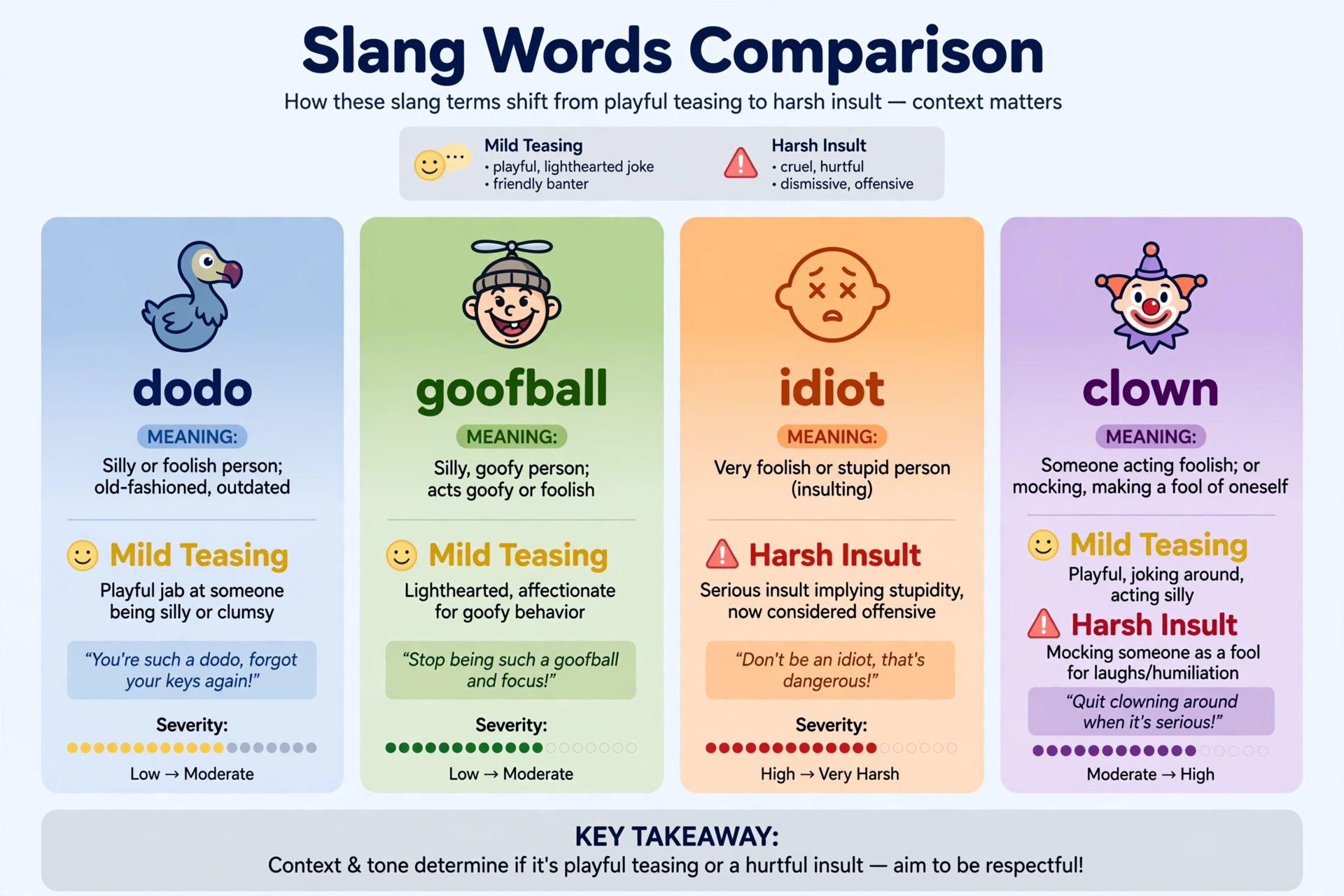
The key difference is intensity. If “idiot” is a slap, “dodo” is a tap on the shoulder. Goofball is even softer and almost purely affectionate, while airhead points at a habit of not paying attention rather than one funny mistake. Clown is the trickiest of the bunch: among friends it can be just as playful as dodo, but in an argument it becomes a genuine insult fast. Dodo stays in the safe middle most of the time, which is why it works so well as everyday teasing.
It is also worth noting what dodo is not. It is not a compliment, even when it is friendly. Calling someone a dodo always points at a mistake or a gap in knowledge, even if everyone is laughing. That is different from praise slang like drip or tuff, which celebrate someone. Use dodo when the moment is funny and small. Use praise words when someone actually did something well.
Alternate Meanings
Like many old words, dodo has picked up a few other meanings along the way, and they can cause confusion if you do not know them.
First, the literal meaning is still alive: the dodo is the extinct bird itself. In science writing, history books, and nature documentaries, “dodo” simply means that bird, with no insult intended. If someone says “scientists want to bring back the dodo,” they are talking about de-extinction research, not calling a scientist silly.
Second, in Louisiana French, “faire dodo” means to go to sleep, and parents say “do-do” to small children at bedtime. This is pronounced more like “doe-doe” and has nothing to do with the bird or the insult. It comes from the French “dormir,” to sleep. If you hear a parent in New Orleans say “time to go dodo,” they are sending a child to bed, not teasing them.
Third, do not confuse “dodo” with “doo-doo.” Spelled with a hyphen and a double “o” in the middle, “doo-doo” is a childish word for excrement. The two words sound similar, which is part of why kids find both of them funny, but they mean completely different things. Mixing them up in a sentence can turn a mild tease into an embarrassing mistake of your own.
Finally, Dodo is also used as a name and a nickname in some families, and as a brand name for various companies. In those cases it is just a name, chosen because it sounds friendly and memorable, not because anyone is calling the person or company foolish.
Professional or Polite Alternatives
There are plenty of moments when “dodo” is too informal, even if you mean it kindly. In a work email, a classroom, a customer service chat, or a conversation with someone you do not know well, these alternatives say the same thing more politely:
- Instead of “do not be a dodo,” try “just a quick heads-up” or “worth double-checking.”
- Instead of “you are such a dodo,” try “easy mistake, happens to everyone.”
- Instead of “that was a dodo move,” try “that did not quite go as planned.”
- Instead of “he is a dodo,” try “he is still learning the ropes” or “he is a bit old-fashioned about that.”
- Instead of “gone the way of the dodo” in a formal report, try “now obsolete” or “no longer in use.”
These alternatives keep the kindness without the teasing edge. They are especially important when there is a power difference, for example between a manager and an employee, or a teacher and a student. A joke that feels equal between friends can feel like a put-down when one person has authority over the other.
Common Mistakes
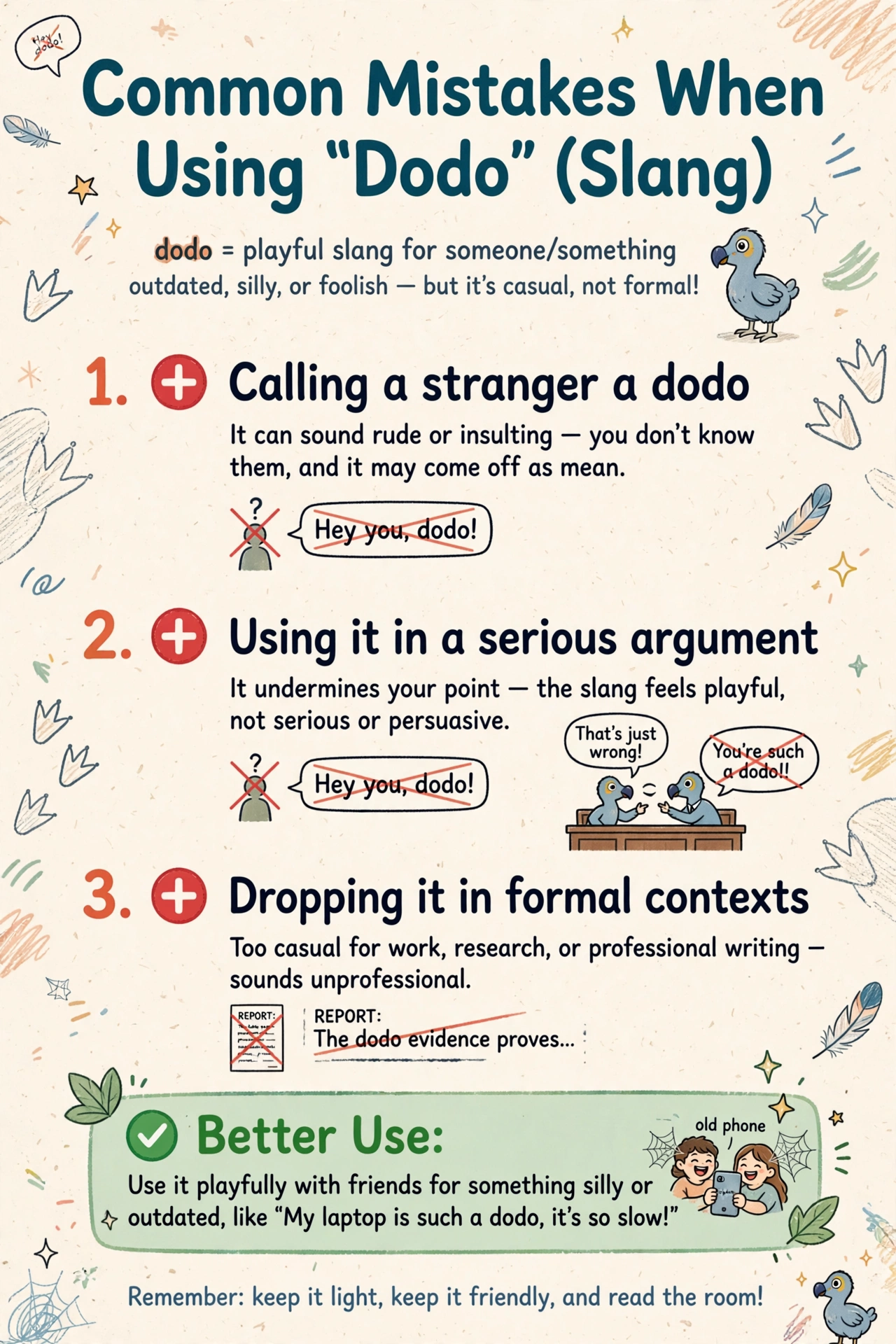
Most mistakes with dodo are about tone and audience, not grammar. Here are the ones people make most often:
- Using it on a stranger. A joke that works between best friends can feel rude from someone you just met. Save dodo for people who know you are joking.
- Using it in a serious argument. Once feelings are hurt, “dodo” stops sounding playful and starts sounding dismissive, as if you are not taking the other person seriously.
- Repeating it too often. Calling the same person a dodo every day turns a joke into a label. Even a mild word stings when it becomes someone’s nickname against their will.
- Using it at work about someone else. Self-deprecating use is usually fine. Using it about a colleague, especially in front of others, is not.
- Confusing dodo with doo-doo. One is a playful tease from a bird’s name. The other is a childish word for poop. Spell it as one word, “dodo,” when you mean the slang term.
- Assuming everyone knows it is a joke. Non-native English speakers, younger kids, or people who have never heard the bird story might take it literally and wonder why you are calling them an extinct animal.
- Using the idiom wrong. “Dead as a dodo” means completely finished, not just sleeping or quiet. “Gone the way of the dodo” means extinct or obsolete, not just old.
Quick Tips
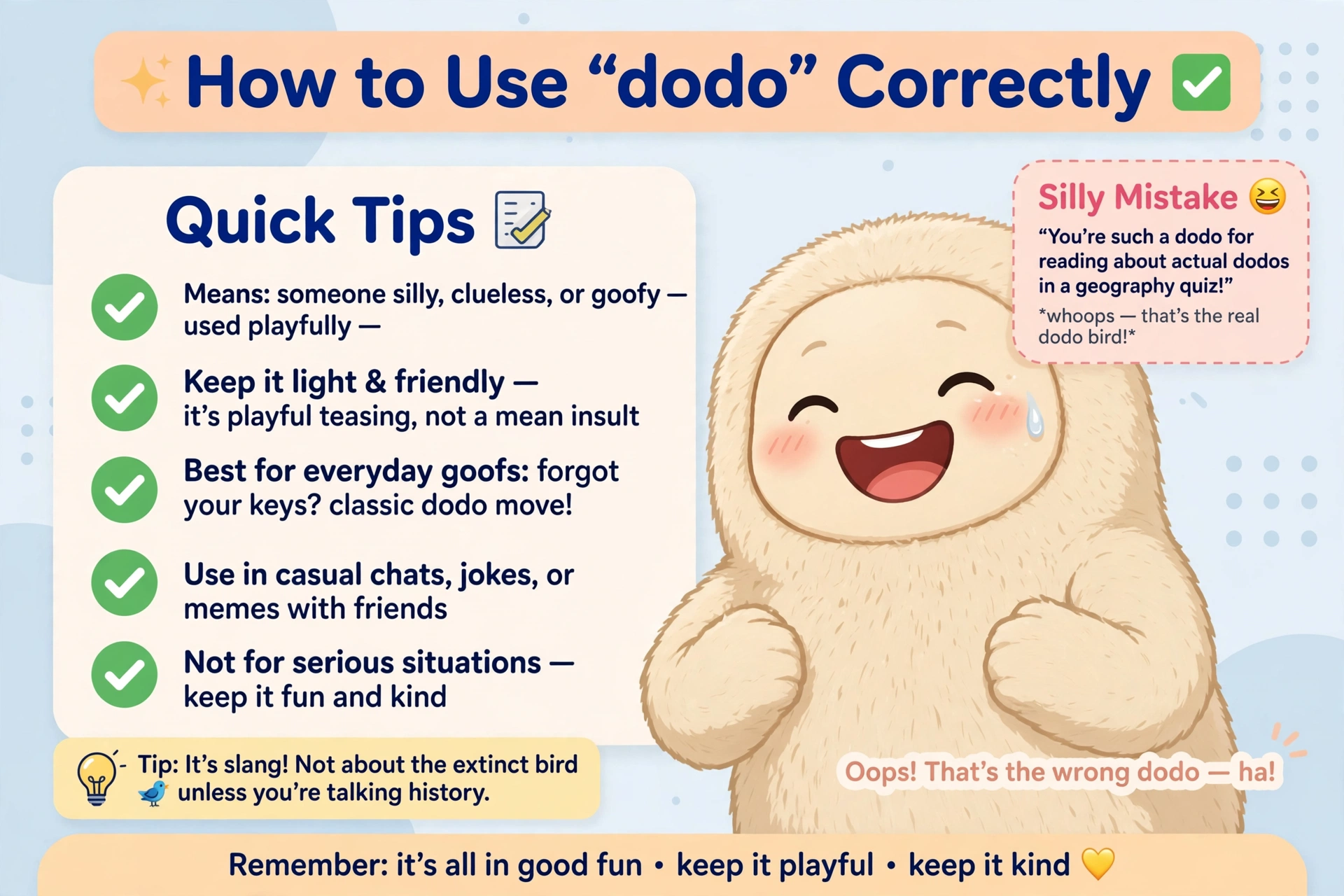
- Keep it friendly: Use dodo only when everyone is laughing, including the person you are teasing.
- Try it on yourself first: Self-deprecating dodo jokes are the safest version. “I am such a dodo today” almost never offends anyone.
- Pair it with the funny detail: “Dodo” works best with the story attached: “I am a dodo, I just tried to unlock the car with my house key.”
- Read the room: If the mood is tense, formal, or sad, skip the teasing entirely and just help fix the mistake.
- Use the idiom for things, not people: “That old phone has gone the way of the dodo” is a great line. It works because no one’s feelings are involved.
- Know when to switch: If someone looks hurt, drop the joke immediately. A quick “sorry, I was only joking, no harm meant” fixes most dodo slip-ups.
- Save it for informal chats: Texts, group chats, captions, and friendly conversation are dodo’s natural home. Formal writing is not.
FAQ
What does dodo mean in slang?
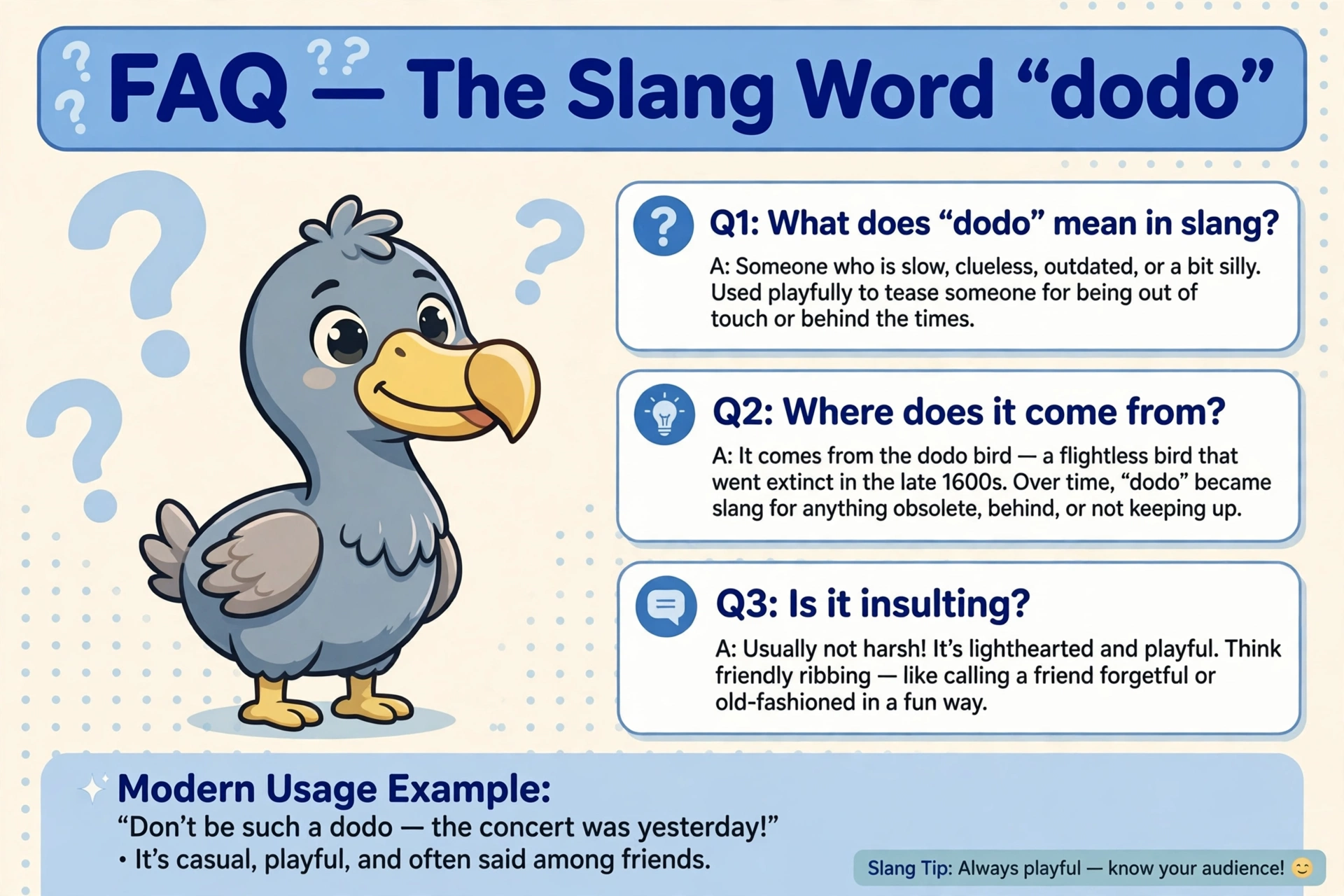
In slang, dodo means a silly, foolish, or slightly clueless person, used in a playful, teasing way. It comes from the extinct dodo bird, whose popular image was a creature that was not very bright. It is a mild tease, not a harsh insult.
Is calling someone a dodo an insult?
It can be, but usually it is not meant as one. Between friends, after a harmless mistake, it is affectionate teasing. Said coldly, repeatedly, or to a stranger, it can feel dismissive or rude. Tone, relationship, and context decide which one it is.
Where did dodo slang come from?
It came from the dodo bird of Mauritius, a flightless bird that went extinct in the late 1600s. Its name comes from the Portuguese word “doudo,” meaning silly or stupid. Because the bird famously did not fear humans and could not fly away, it became a symbol of foolishness, and the name became slang for a silly person.
What does “dead as a dodo” mean?
“Dead as a dodo” means completely and unquestionably dead, finished, or gone. It is used for emphasis: a plan that is dead as a dodo is not coming back. The related phrase “gone the way of the dodo” means something has become obsolete and disappeared, like an outdated technology.
Is dodo used on TikTok and social media?
Yes. On TikTok, Instagram, and in gaming chats, dodo shows up as a caption, a comment, and a self-deprecating joke about a funny fail. Phrases like “certified dodo” and “dodo behavior” are common in comments on videos where someone makes a silly, relatable mistake.
What is the difference between dodo and doo-doo?
Dodo, spelled as one word, is the slang term from the bird’s name, meaning a silly person. Doo-doo, spelled with a hyphen, is a childish word for excrement. They sound similar but mean completely different things, so spelling matters.
Can I call my friend a dodo?
Yes, if that is how you already joke around together and you know they will take it as a joke. It works best after a small, funny mistake, and even better if you also laugh at your own dodo moments. If you are unsure, try it on yourself first.
What are polite alternatives to dodo?
Try “easy mistake,” “happens to everyone,” “a bit forgetful today,” or “still learning.” In formal writing, replace “gone the way of the dodo” with “now obsolete.” These alternatives keep the meaning without the teasing edge, which makes them safer at work and with people you do not know well.
Conclusion
Dodo meaning slang is a small word with a long history. It started with a real bird on a real island, became a dictionary word for a silly person, gave English one of its most vivid idioms, and then found new life as a friendly online tease. That journey is exactly why it still works today: everyone already knows the bird, so everyone gets the joke.
The key to using it well is gentleness. Save dodo for funny, harmless moments, use it on yourself as freely as on your friends, and drop it the moment it stops feeling funny. Used that way, it does something only the best slang can do: it turns a small embarrassment into a shared laugh, and reminds everyone in the room that being a little silly sometimes is completely human.
Next time you catch yourself making a classic dodo move, like searching for the phone that is already in your hand, you will know exactly what to call it. And next time a friend calls you a dodo, you will know they probably mean it with a smile, not a sting. Sometimes the silliest words are the ones that bring people closest together.
