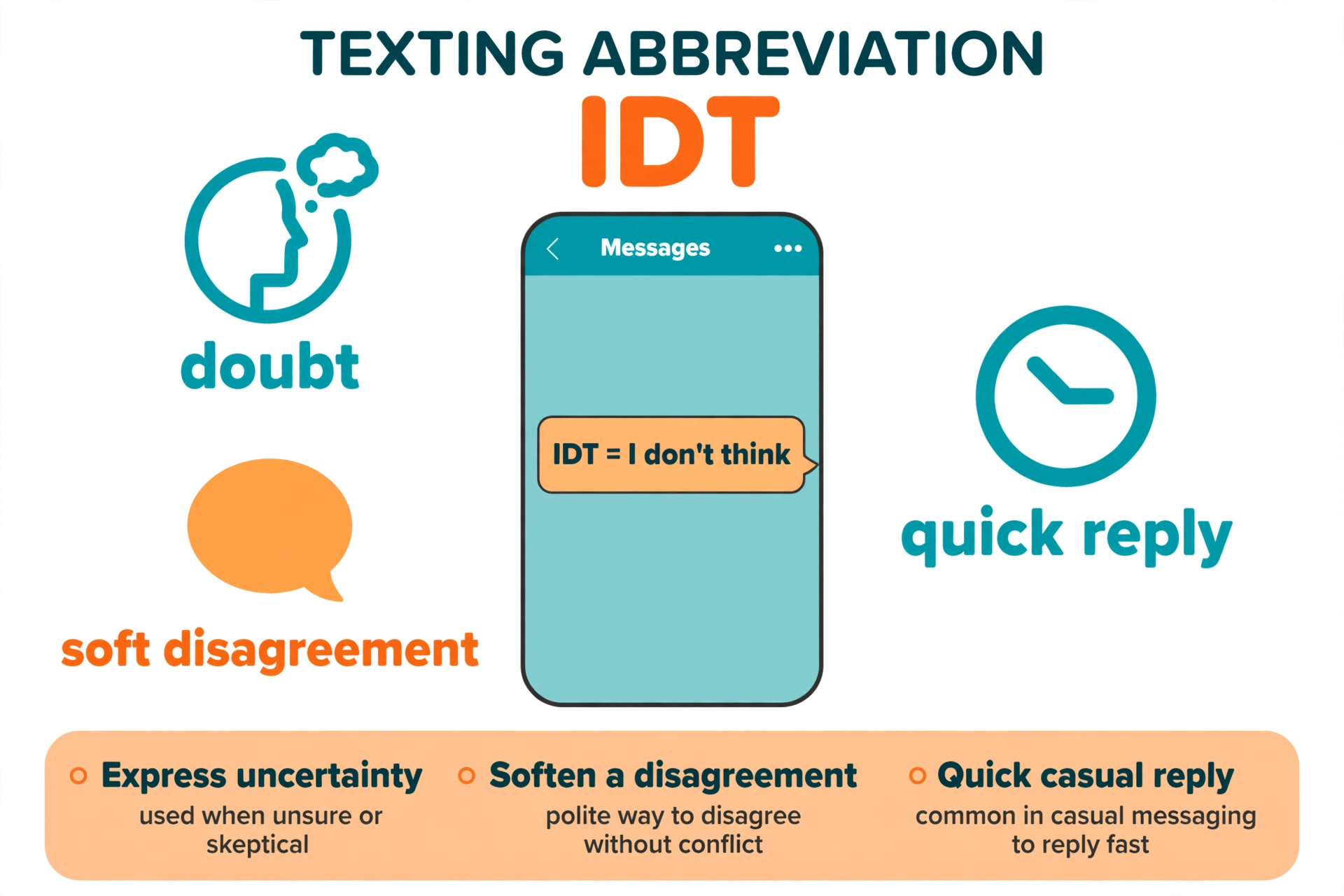
Quick Definition: IDT stands for “I Don’t Think.” It is a casual texting abbreviation people use to express doubt, gentle disagreement, or uncertainty — for example, “IDT that’s going to happen.” It is informal, so it belongs in chats with friends and family, not in professional emails.
IDT Meaning in Text — Meaning & Definition
IDT is an initialism that stands for “I Don’t Think.” In texting and online chat, it works as a quick, soft way to say you disagree with something or you are not sure about it, without typing out the full sentence.
Unlike some slang terms that completely change meaning depending on the app, IDT has stayed remarkably stable. Across text messages, WhatsApp, Instagram DMs, TikTok comments, Snapchat, and gaming chats, it almost always means the same thing: a mild, casual “I don’t think so.”
| Term | Stands For | Core Meaning | Tone |
|---|---|---|---|
| IDT | I Don’t Think | Doubt or gentle disagreement | Casual, soft |
| IDTS | I Don’t Think So | A slightly firmer “no” | Casual |
| IDK | I Don’t Know | Lack of knowledge | Casual, neutral |
IDT is pronounced letter by letter (“eye-dee-tee”) if it is ever spoken aloud, but in practice almost nobody says it — it exists to save keystrokes while typing, not to save syllables while talking.
Introduction
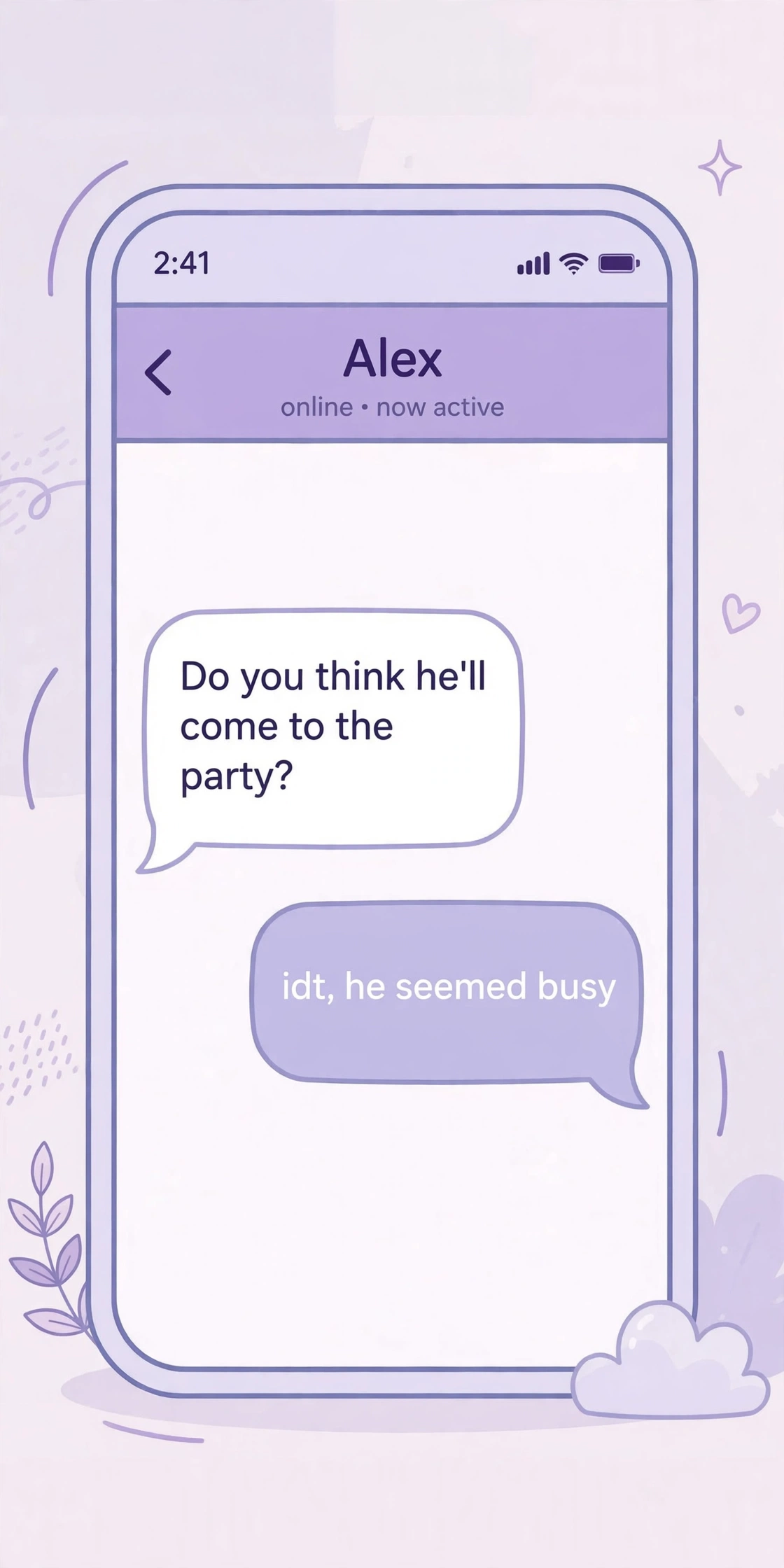
You are scrolling through your messages when a friend drops a single line: “IDT he’s coming tonight.” You pause. Is that a yes? A no? A maybe? If you have ever stared at those three letters wondering what someone meant, you are not alone.
Texting abbreviations multiply every year, and while some fade in a month, IDT has quietly stuck around for over two decades. It belongs to the same family of doubt-expressing shortcuts as IMK (in my knowledge) and TTM (talk to me) — small clusters of letters that carry a surprising amount of tone. But IDT is special: it lets you disagree with someone without sounding harsh, which is exactly why it survives in group chats, comment sections, and DMs everywhere.
In this complete guide, you will learn exactly what IDT means in text, where it came from, how to use it naturally, how it compares to similar abbreviations, the mistakes to avoid, and polite alternatives for formal situations. By the end, you will read and use IDT like a native texter.
Origin
IDT was born in the golden age of character limits. In the late 1990s and early 2000s, SMS text messages were capped at 160 characters, and old mobile keypads required multiple taps for a single letter. Typing “I don’t think that’s right” was genuinely annoying — so people started compressing the phrase into three letters.
The abbreviation spread through the same channels that carried LOL, BRB, and IDK into the mainstream:
- Early chatrooms and forums — where fast back-and-forth replies rewarded brevity.
- AIM and Yahoo Messenger — the instant-messaging giants of the 2000s, where teens lived after school.
- SMS culture — where every character counted and T9 predictive text made short forms even faster.
As smartphones replaced keypad phones, many old abbreviations died out — but IDT survived because it fills a specific emotional niche. Saying “no” outright can feel blunt; saying “I don’t think so” takes effort. IDT threads the needle: it disagrees gently, in three keystrokes. That usefulness kept it alive through the WhatsApp era, the Instagram era, and now the TikTok era, where it regularly appears in comments under bold claims and hot takes.
Popularity
IDT is not the loudest abbreviation on the internet — it never became a meme like “no cap” or “rizz” — but it is one of the most durable. Its popularity comes from utility rather than trendiness.
Where you will see IDT most today:
- Text messages and WhatsApp — quick replies between friends and family.
- Instagram and TikTok comments — reacting skeptically to a claim in a video (“IDT that’s real 😂”).
- Gaming chats — fast coordination where typing speed matters (“IDT we can win this round”).
- Group chats — softening disagreement so nobody’s feelings get hurt.
Who uses it: mostly teens and adults under 40 in casual digital conversation. It is far less common among older texters, which is exactly why parents and grandparents often have to look it up.
Why it stuck around: unlike trend slang that burns out, IDT solves a permanent communication problem — how to say “I disagree” nicely and quickly. As long as people text, they will need that.
How It Is Used
IDT is flexible, but it always carries the same core job: expressing doubt or soft disagreement. Here are the main ways people use it:
- To express doubt: “IDT it will rain today.” — You are unsure about the forecast.
- To disagree gently: “IDT that’s the best option.” — Softer than “No, you’re wrong.”
- To hedge an opinion: “IDT, but we could try it.” — You leave room to be convinced.
- To reply quickly: “IDT so.” — A complete thought in six characters.
- To add sarcasm: “Oh sure, IDT he even studied 😏” — Tone flips playful or mocking.
IDT tone guide:
| Situation | Example | Tone It Carries |
|---|---|---|
| Friend’s plan | “IDT the bus will be on time.” | Casual doubt |
| Group chat debate | “IDT pineapple belongs on pizza.” | Playful disagreement |
| Reacting to gossip | “IDT she actually said that 😂” | Skeptical, amused |
| Softening a “no” | “IDT I can make it tonight, sorry!” | Polite, apologetic |
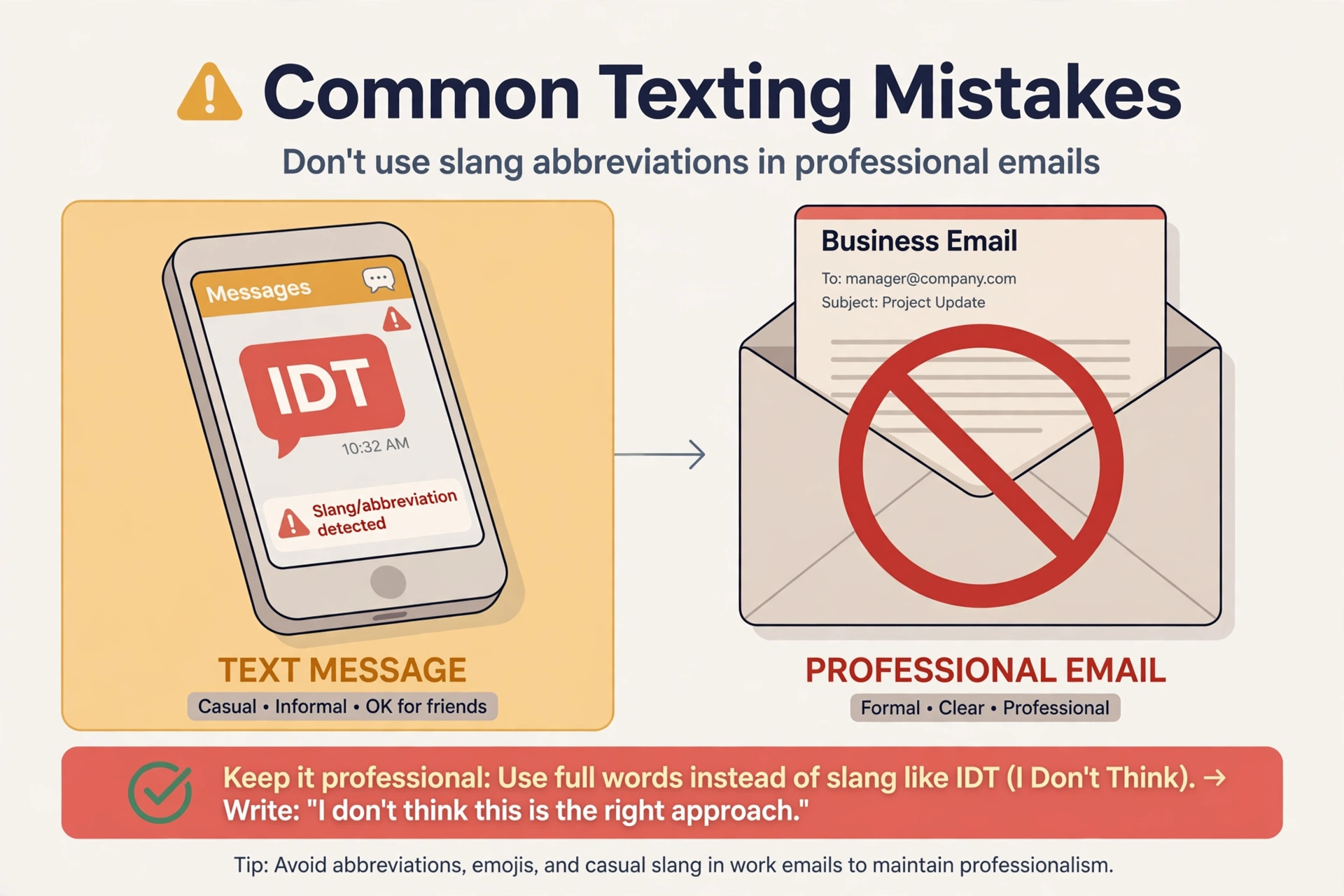
The golden rule: IDT is always informal. It signals “we’re chatting casually,” so keep it out of anything official.
Examples
Seeing IDT in real conversations is the fastest way to master it. Notice how the same three letters shift meaning slightly with context, punctuation, and emojis.
Friendly Examples
- Ayesha: “Do you think the new café is good?”
Bilal: “IDT it’s worth the hype, tbh. Coffee was mid.”
→ Honest opinion between friends, softened with “tbh.” - Sara: “Movie night at 8?”
Hina: “IDT I can make it 😅 mom needs help with dinner.”
→ A gentle, apologetic decline. - Danish: “This shortcut will save us 20 minutes.”
Ali: “IDT, but let’s try it anyway 😄”
→ Doubt plus willingness — friendly and open.
Professional Examples
A quick warning first: IDT does not belong in formal professional writing. Never use it in emails to clients, job applications, or messages to your boss. That said, in relaxed internal chats (like a casual Slack channel with teammates you know well), you might see it:
- “IDT the client will approve this version — maybe we prepare a backup?”
→ Acceptable only in an informal team chat; in email, write “I don’t think the client will approve this version.” - “IDT we can finish by Friday, but I’ll confirm after the standup.”
→ Fine among close coworkers on chat; never in a status report.
When in doubt at work, spell it out. “I don’t think” costs you ten extra characters and zero professionalism.
Funny Examples
- “He said he’ll be ready in 5 minutes. IDT 😂😂”
- “My diet starts Monday. IDT. 🍕”
- “IDT my alarm and I are on speaking terms anymore.”
Comparison with Similar Terms
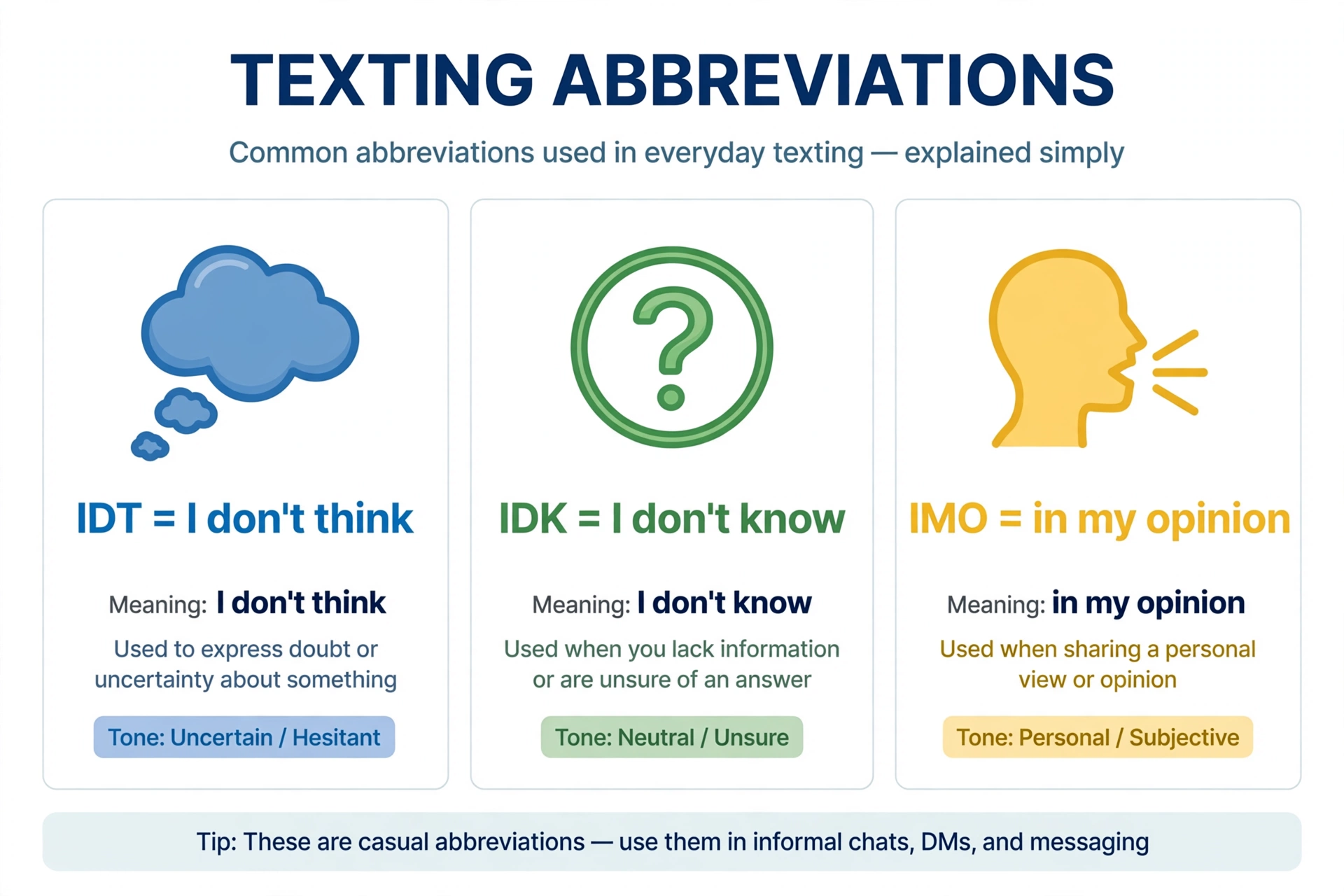
IDT is often confused with its neighbors in the abbreviation family. They look alike, but each carries a different shade of meaning. Using the wrong one can accidentally change your whole message.
| Abbreviation | Stands For | What It Really Signals | Example |
|---|---|---|---|
| IDT | I Don’t Think | Doubt or gentle disagreement — you have an opinion, leaning “no” | “IDT he’ll show up.” |
| IDK | I Don’t Know | No knowledge at all — neutral, not an opinion | “IDK where he is.” |
| IMO / IMHO | In My (Humble) Opinion | A stated opinion, more confident than IDT | “IMO it’s the best season.” |
| TBH | To Be Honest | Brutal honesty incoming | “TBH, IDT that’s a good idea.” |
| NGL | Not Gonna Lie | Honest admission, often surprising | “NGL, IDT I understood the ending.” |
| IKR | I Know, Right? | Enthusiastic agreement — the opposite energy of IDT | “IKR! It’s amazing!” |
The key distinction: IDK means your brain is empty on the topic; IDT means your brain has formed a skeptical opinion. Saying “IDK” when you mean “IDT” makes you sound uninformed, while saying “IDT” when you mean “IDK” makes you sound like you’re doubting someone for no reason. And IKR is IDT’s mirror image — one agrees loudly, the other disagrees softly.
Fun fact: IDT pairs naturally with its cousins. Native texters combine them all the time — “TBH IDT that’s true” and “NGL, IDT he’ll come” are completely normal sentences in casual chat.
Alternate Meanings
In texting, IDT means “I Don’t Think” about 95% of the time. But abbreviations live double lives, and IDT has a few rare alternate meanings worth knowing so you are never caught off guard.
| Alternate Meaning | Where You’d See It | How Common |
|---|---|---|
| I Did That | Social media captions celebrating an achievement (“Finished the marathon — IDT!”) | Rare, playful |
| In Due Time | Conversations about future plans (“You’ll get your chance, IDT”) | Rare, context-dependent |
| Identity Theft | Cybersecurity discussions, news articles | Formal contexts only — never in casual texting |
How to tell which meaning applies: context does all the work. If someone replies “IDT” to your question, it’s “I Don’t Think.” If a cybersecurity article mentions “IDT protection,” it’s “Identity Theft.” When in doubt, assume the texting meaning — it’s overwhelmingly the most common.
Professional or Polite Alternatives
Since IDT is strictly casual, you need grown-up replacements for work, school, and formal messages. Here is a quick swap table:
| Instead of texting… | Say or write… | Best for |
|---|---|---|
| “IDT that’s correct.” | “I don’t believe that’s correct.” | Work emails, discussions |
| “IDT we can finish by Friday.” | “I doubt we can finish by Friday.” | Project updates |
| “IDT so.” | “I don’t think so, unfortunately.” | Polite declines |
| “IDT he’ll agree.” | “I’m not confident he’ll agree.” | Meetings, reports |
| “IDT it’s worth it.” | “I’m skeptical about the value.” | Reviews, feedback |
The pattern is simple: expand the abbreviation and soften the edges. “I don’t think,” “I doubt,” “I’m not sure,” and “I have reservations about” all do IDT’s job without the slang.
Common Mistakes
IDT is simple, but texters still trip over it. Avoid these common mistakes:
- Using it in formal messages. Dropping “IDT” in a job application email or a message to a professor instantly looks unprofessional. Spell it out.
- Confusing it with IDK. “IDT” expresses an opinion; “IDK” admits ignorance. Replying “IDT” when someone asks for a fact you simply don’t know sounds oddly dismissive.
- Using it with strangers in serious contexts. Telling a customer “IDT that’s possible” reads as rude. Strangers deserve full sentences.
- Overusing it in one conversation. Three “IDT”s in five messages makes you sound negative about everything. Vary your language.
- Forgetting tone doesn’t travel. Without emojis or context, “IDT.” with a period can read cold or annoyed. In sensitive chats, add a softener: “IDT 😅” or “IDT, sorry!”
- Typing IDK when you mean IDT (and vice versa). One letter changes “I have no idea” into “I disagree with you” — double-check before sending.
Quick Tips
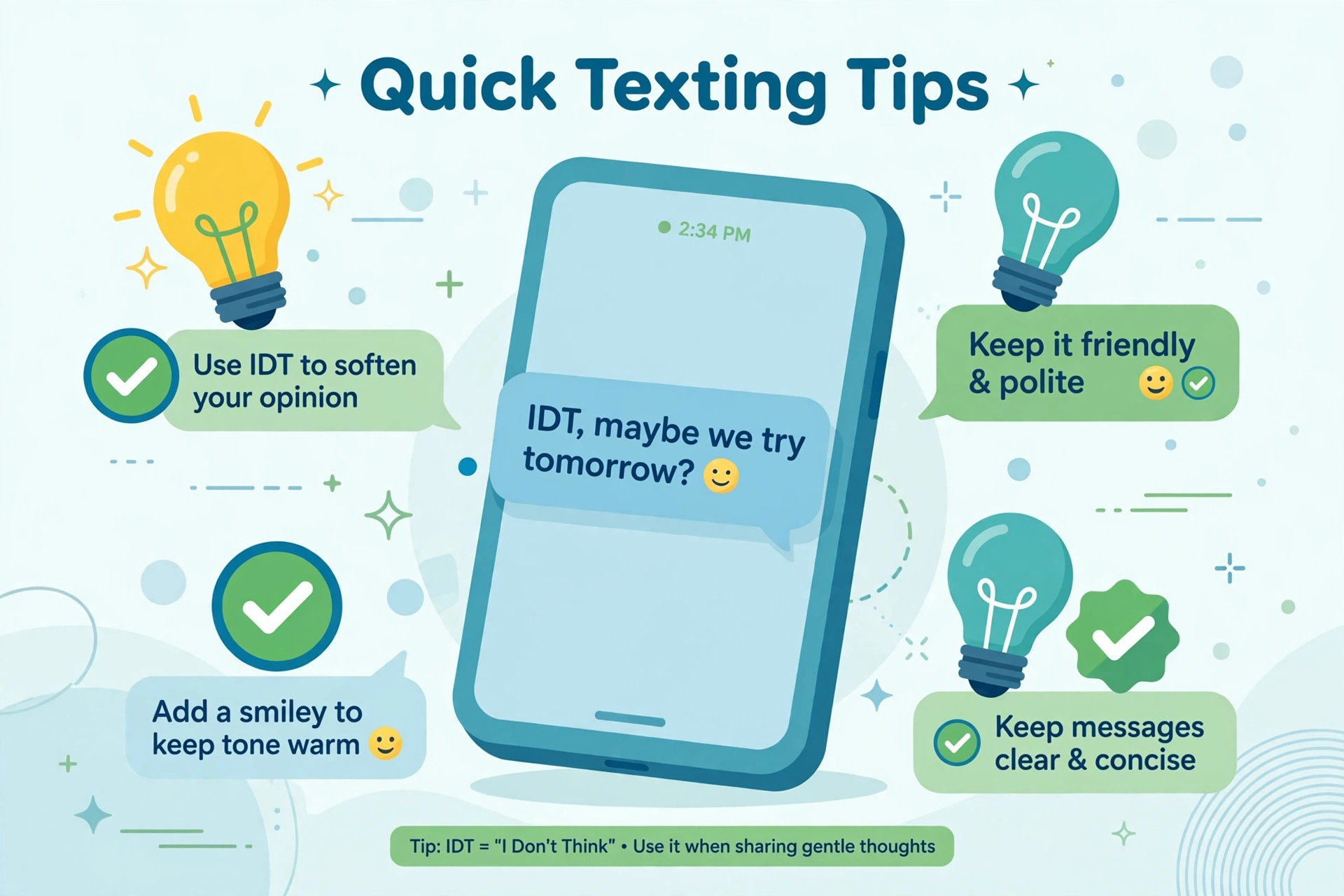
- Default to the texting meaning. In any chat, IDT = “I Don’t Think.” Don’t overthink it.
- Pair it with a reason. “IDT it’ll work because the timing is bad” lands better than a bare “IDT.”
- Soften with emojis when declining. “IDT I can come 😅” feels friendly; “IDT I can come.” feels blunt.
- Read the room. Great with friends; terrible with your boss, clients, or teachers.
- Use it to disagree without fighting. In heated group chats, IDT is a de-escalation tool — firm but not aggressive.
- Don’t stack it with other doubt words. “IDT, IDK, maybe not” in one message sounds confused. Pick one.
- Teach it forward. If an older relative asks what IDT means, this article is the perfect link to share.
FAQ
1. What does IDT mean in text?
IDT means “I Don’t Think.” It’s a casual abbreviation used to express doubt, uncertainty, or gentle disagreement in text messages and online chats — for example, “IDT that’s true.”
2. What does IDT mean from a girl or guy in texting?
It means the same regardless of who sends it: “I Don’t Think.” If a girl texts “IDT he’s cute,” she’s softly disagreeing. If a guy texts “IDT we should go,” he’s expressing doubt about the plan. The meaning doesn’t change with gender — only the context matters.
3. Is IDT rude?
Not usually. IDT is actually one of the gentler ways to disagree in text — much softer than “No” or “You’re wrong.” It only feels rude if the conversation is serious, the relationship is formal, or it’s delivered with a cold tone (like “IDT.” with a hard period).
4. How do you reply when someone says IDT?
It depends on context. If they doubted your plan, you can explain more (“Here’s why I think it’ll work…”), ask what concerns them (“What part worries you?”), or simply accept it (“Fair enough 😄”). Don’t take it personally — it’s a soft disagreement, not an attack.
5. What’s the difference between IDT and IDK?
IDK (“I Don’t Know”) means you lack information — your mind is blank on the topic. IDT (“I Don’t Think”) means you’ve formed a skeptical opinion — your mind is made up, leaning “no.” Mixing them up changes your message completely.
6. Can I use IDT at work or in professional emails?
No — keep IDT out of professional communication. In emails, reports, or messages to clients and managers, write the full phrase: “I don’t think,” “I doubt,” or “I’m not confident.” IDT is fine only in very casual chats with close coworkers.
7. What does IDT mean on Snapchat, TikTok, or Instagram?
The same as in texting: “I Don’t Think.” On these platforms it usually appears in comments reacting skeptically to a video or claim — e.g., “IDT that’s real 😂” under a surprising clip. The platform doesn’t change the meaning.
8. Are there other meanings of IDT?
Rarely. Outside texting, IDT can mean “I Did That” (celebrating an achievement), “In Due Time” (something will happen eventually), or “Identity Theft” (in cybersecurity contexts). In everyday chats, though, it virtually always means “I Don’t Think.”
Conclusion
IDT is small but mighty: three letters that let you express doubt, disagree gently, and keep conversations moving — all without sounding harsh. Now you know it stands for “I Don’t Think,” where it came from, how to use it across tones and platforms, and when to leave it out of your messages entirely.
The takeaway is simple: use IDT freely with friends, pair it with emojis when you want to stay friendly, and swap it for full sentences the moment things turn professional. Master that balance, and you’ll never misread — or misuse — those three letters again.
Want to decode more texting shortcuts? Check out IMK meaning in text, WYFD meaning in text, and TMP meaning in text — and explore the full collection of guides on Merriam-Webster’s dictionary whenever you want to verify a word’s formal meaning.

6 thoughts on “IDT Meaning in Text: What It Really Means and When to Use It”