
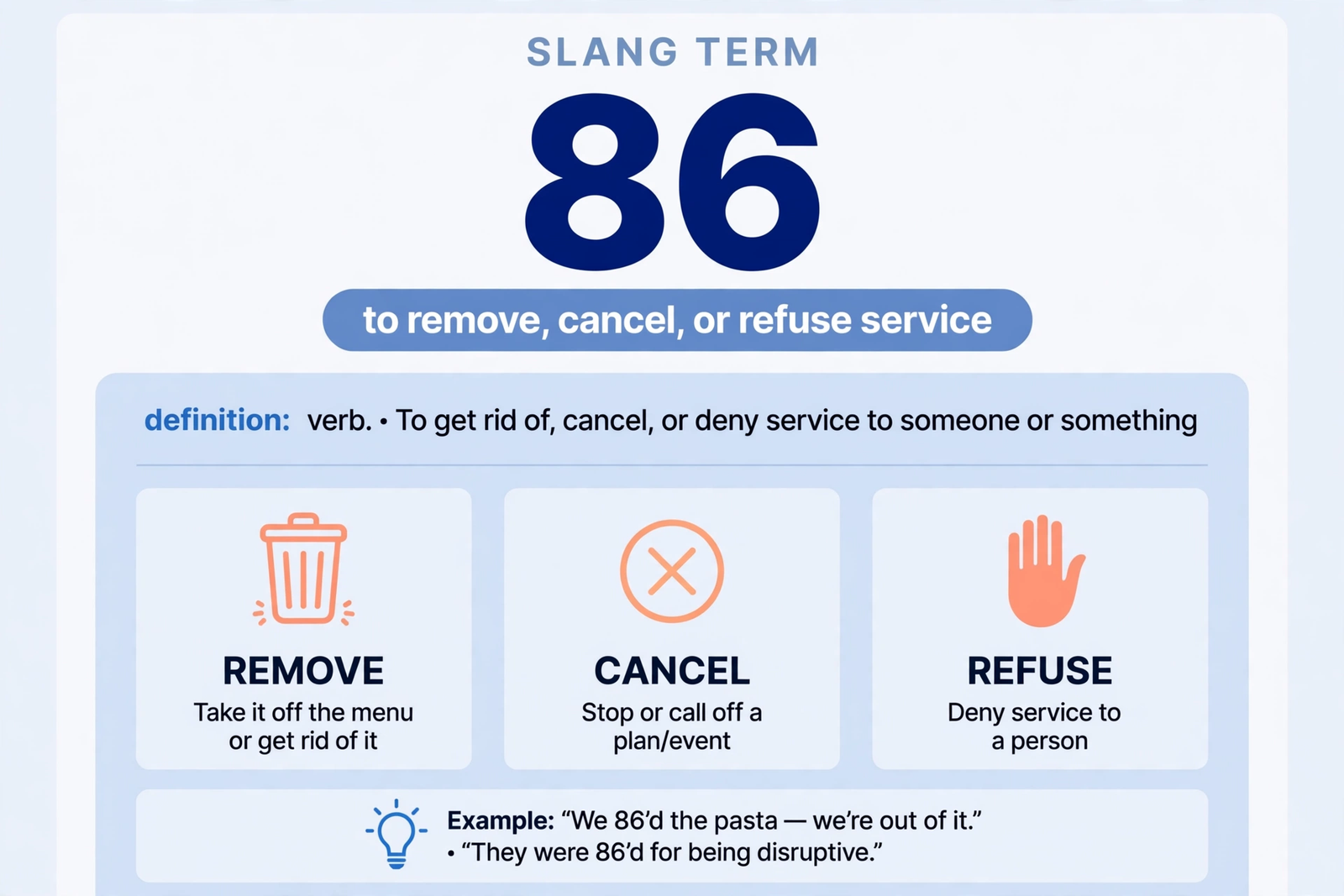
Quick definition: In slang, 86 meaning slang is simple: to 86 something means to remove it, cancel it, or get rid of it. When a restaurant says a dish is “86’d,” it is sold out and off the menu. When someone says a person got “86’d” from a bar, that person was kicked out and refused service. In everyday texts and conversations, 86 (pronounced “eighty-six”) means to ditch, drop, cancel, or reject something completely.
86 Meaning Slang Meaning & Definition
The phrase 86 meaning slang covers one of the oldest pieces of American slang still in daily use. At its core, 86 is a verb and a code word that means “no longer available,” “cancelled,” or “removed.” It started in restaurants and bars nearly a hundred years ago, and it has since spread into texting, social media, music, movies, and everyday conversation.
Here is the easiest way to understand it: if something is 86’d, it is gone. A dish is 86’d when the kitchen runs out of it. An order is 86’d when it is cancelled. A person is 86’d when they are thrown out of a place and told not to come back. A plan is 86’d when it is scrapped entirely. The word always carries the same energy — a firm, final “no.”
Unlike many slang terms that fade in a year or two, 86 has survived since the 1930s. Chefs still shout it across kitchens, bartenders still use it to refuse service, and young people still drop it into texts and TikTok captions. That staying power is exactly why so many people search for what 86 means in slang today.
| Form | What It Means | Example |
|---|---|---|
| 86 (verb) | To remove, cancel, or get rid of | “86 the fries, we are out of potatoes.” |
| 86’d / eighty-sixed | Removed or kicked out | “He got 86’d from the bar last night.” |
| 86 it | Stop it / drop it / forget it | “86 it, we are not doing that plan.” |
| On the 86 list | Banned from a place | “He is on the 86 list at that club.” |
Introduction
You are scrolling through comments, watching a cooking show, or texting a friend about weekend plans — and suddenly someone drops a number into the conversation: “86.” No context, no explanation, just two digits. If you have ever paused and wondered what on earth that means, you are not alone. The 86 meaning slang question is one of the most searched slang questions online, because the term looks like a random number but works like a full sentence.
The beauty of 86 is its efficiency. In a busy kitchen, a chef does not have time to explain that the salmon is finished, the order cannot be made, and the waitstaff should stop promising it to guests. One shout — “86 the salmon!” — does the whole job. That same short, sharp energy is why the word escaped the kitchen and entered everyday language. To 86 something is to end it, fast and without debate.
In this guide, we will break down the full 86 meaning slang story: where the term came from, how it is used in restaurants, bars, texts, and social media, how it compares with similar slang, the mistakes people make with it, and the polite alternatives you can use when 86 sounds too harsh. By the end, you will know exactly when to use it — and when to leave it on the shelf.
Origin
The honest truth is that nobody knows for certain where 86 came from. The origin of 86 meaning slang is one of American English’s most argued-over mysteries, with more than a dozen competing theories. What historians do agree on is the timeline: the term was already in use in American restaurants, diners, and soda fountains by the early 1930s, and its first printed appearances date to 1933.
The strongest evidence points to soda jerks — the young workers behind soda fountains during Prohibition. When a flavor or ingredient ran out, they would call out “86” to mean “all out of it.” Newspaper columnist Walter Winchell printed a glossary of soda-fountain slang in 1933 that included 86, and the American Speech journal documented it in February 1936. From the soda fountain, the code spread to diners, restaurants, and bars, where it became standard kitchen language.
As for why the number 86 specifically, here are the most popular theories:
- Rhyming slang for “nix.” Merriam-Webster notes this as the most likely explanation: 86 rhymes with “nix,” an old slang word meaning “nothing” or “no.” Soda jerks loved rhyming codes.
- Chumley’s speakeasy, 86 Bedford Street. The famous Prohibition-era bar in New York’s Greenwich Village had a back exit at 86 Bedford Street. The story goes that when police raided the front, staff yelled “86!” to send patrons out the back door.
- Article 86 of the New York liquor code. Some say this was the section covering refusal of service to drunk patrons, so bartenders adopted the number as shorthand.
- The Delmonico’s steak theory. Item number 86 on the menu at Delmonico’s restaurant in New York was supposedly the steak, which ran out often — so “86” became code for “we are out.”
- The grave theory. A standard grave is 8 feet long by 6 feet deep, and some slang dictionaries claim 86 came to mean “bury it” or “get rid of it for good.”
- The soup kitchen story. One tale claims Depression-era soup kitchens held exactly 85 cups of soup, so the 86th person in line got nothing.
None of these stories has ever been proven. The rhyming-slang explanation has the most support from dictionaries, but the Chumley’s story is the one people love to repeat. What matters for everyday use is not which theory is true, but how the word works now: 86 means something is gone, cancelled, or refused.
Popularity
The 86 meaning slang story is also a story about staying power. Most slang burns bright and fades fast, but 86 has been in continuous use for about ninety years, which is almost unheard of for a slang term. Its secret is usefulness: every industry that deals with stock, orders, or customers needs a fast way to say “we don’t have it anymore.”
Chef Anthony Bourdain’s bestselling book Kitchen Confidential (2000) introduced restaurant kitchen slang to millions of readers, and 86 was one of its star words. Cooking shows, food YouTube, and TikTok kitchen creators keep the term in front of new audiences every day. When a line cook films a busy service and yells “86 the special,” millions of viewers learn the word in context without ever opening a dictionary.
Outside the kitchen, 86 picked up a second life in the 1950s as a verb for refusing service — and, in rougher circles, as slang for getting rid of someone permanently. Movies and crime shows used it that way for decades, which gave the word an edgy, streetwise flavor. Today, that edge has softened: most people who say “86 it” simply mean “cancel it” or “drop it.”
On social media, 86 shows up in comments, captions, and memes whenever someone wants to reject something decisively. “86 that idea,” “86 him,” “86 the whole plan” — the word works as a punchline because it sounds final. Gen Z slang lists and TikTok explainers regularly feature it, which keeps it circulating among younger users who have never set foot in a professional kitchen.
How It Is Used
Understanding the 86 meaning slang in real life comes down to context. The same two digits can mean a sold-out dish, a cancelled plan, a kicked-out customer, or a rejected idea — and the situation tells you which one it is. Here are the main ways people use 86 today.
In restaurants and bars
This is the original home of the term. A chef calls “86 the soup” when the soup is finished. A bartender says a customer has been 86’d when that customer is cut off and told to leave. Many bars keep an actual “86 list” of people who are not allowed back in, sometimes for a set period like a year. If you work in hospitality, 86 is not slang at all — it is a standard work instruction.
As a verb in everyday speech
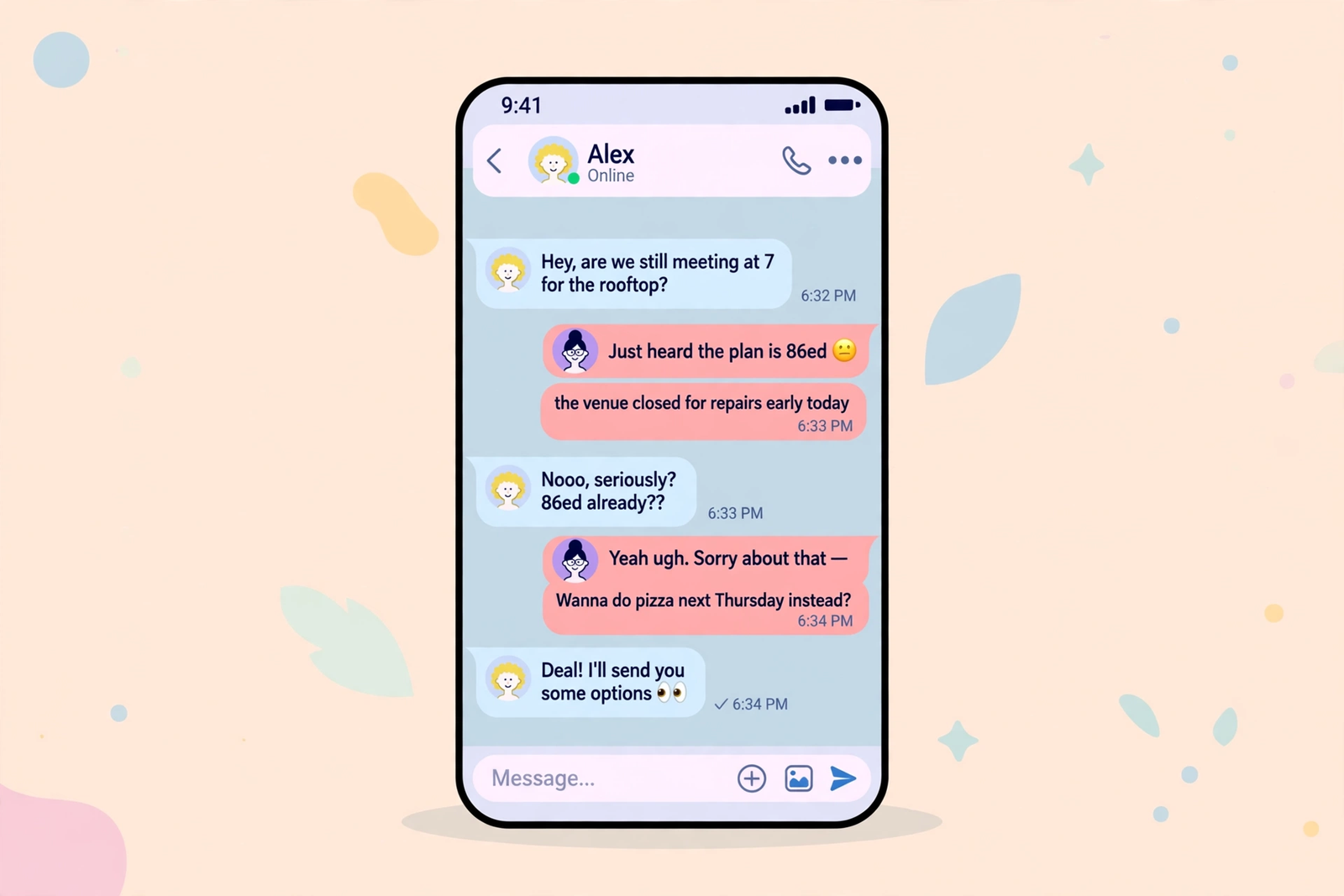
Outside the kitchen, 86 works as a regular verb: “Let’s 86 that idea,” “She 86’d the whole trip,” “We need to 86 the second venue.” It sounds more decisive than “cancel” and more casual than “terminate.” People reach for it when they want to sound firm without writing a paragraph about why something is over.
In texts and social media
In chats, 86 is short, punchy, and dramatic, which is why it fits texting so well. “86 him, he’s toxic” or “86 that plan, I’m broke” reads like a decision already made. On TikTok and X, creators use it in captions and comments to dismiss trends, exes, or bad ideas with one word. Like other slang terms such as cap meaning slang, it travels fast because it is short and expressive.
In business and projects
86 also appears in offices and creative work, usually as a joke with a sharp edge: “86 the third slide, it’s not working.” Managers and teams use it to kill a feature, a design, or a plan quickly. It is informal, so it fits brainstorming sessions and group chats better than formal emails.
Examples
Real examples make the 86 meaning slang click instantly. Notice how the meaning stays the same — remove, cancel, reject — while the tone changes with the situation.
Friendly Examples
- “86 the scary movie, let’s watch a comedy instead.”
- “We’re 86ing the beach plan — it’s going to rain all day.”
- “86 that song from the playlist, nobody likes it.”
- “My mom 86’d my idea of a midnight snack run. 😂”
- “86 the extra toppings, I’m keeping it simple tonight.”
Professional Examples
- “Chef, 86 the salmon special — we just sold the last one.”
- “Please 86 table twelve’s appetizer, they changed their order.”
- “We had to 86 the old pricing page after the update went live.”
- “The client asked us to 86 the second concept and focus on the first.”
- “86 the draft email — I’ll rewrite it from scratch.”
Funny Examples
- “My brain 86’d my alarm this morning. I woke up at noon.”
- “He got 86’d from the group chat for sending 40 memes at 3 a.m.”
- “86 my diet for today. The pizza already won.”
- “That outfit? 86 it immediately. 😅”
- “I 86’d my ex’s number, my playlist, and my bad decisions — new era.”
Comparison with Similar Terms
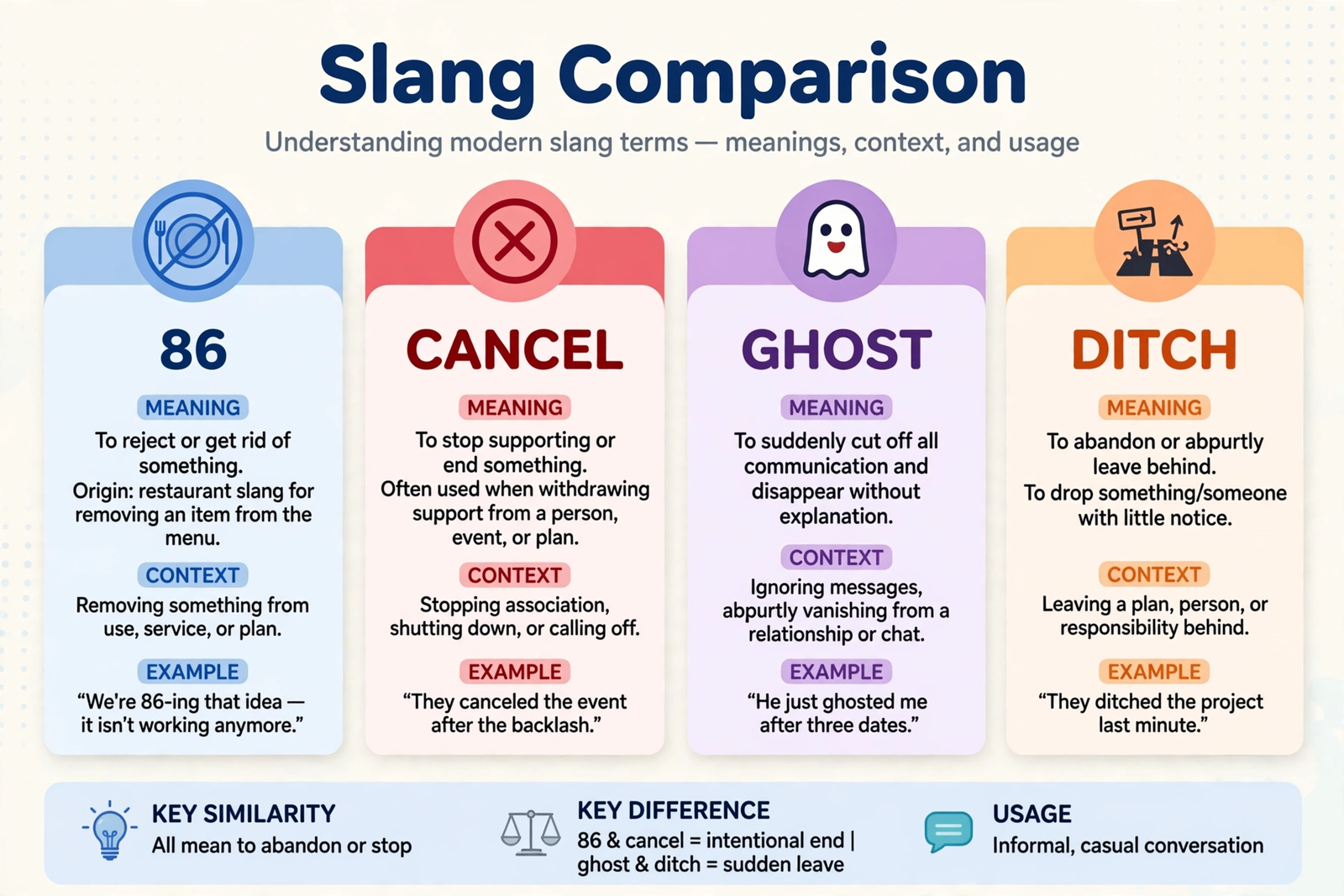
The 86 meaning slang overlaps with several other slang words, but each one has its own flavor. This table shows how 86 compares with the terms people confuse it with most often.
| Term | Meaning | How It Differs from 86 |
|---|---|---|
| 86 | Remove, cancel, refuse, get rid of | The original — firm, final, often about stock or service |
| Cancel | Call something off | Neutral and formal; 86 sounds sharper and more casual |
| Ghost | Cut off contact silently | About people and communication, not items or orders |
| Yeet | Throw away forcefully | Playful and physical; 86 is colder and more businesslike |
| Nix | Say no to something | Closest cousin — 86 may come from rhyming slang for nix |
| Axe / cut | Remove from a plan or team | Similar, but axe sounds harsher; 86 sounds like kitchen code |
| Ditch | Abandon someone or something | More personal and sneaky; 86 is direct and official |
| Scrap | Throw away a plan or idea | About ideas and projects; 86 also covers people and service |
Think of it this way: if you cancel a meeting, you 86 the meeting. If you ghost a date, you disappear quietly. If you yeet your old phone, you toss it dramatically. The words overlap, but 86 is the one that sounds like an official decision — the kitchen has spoken, and the item is gone. That official, no-arguments tone is what makes 86 different from softer words like “skip” or “pass.”
It is also worth noting how 86 sits next to other popular slang words. Saying something is mid meaning slang is a judgment about quality; saying 86 it is a decision about existence. And where cooked meaning slang describes being finished or done for, 86 is the action that finishes something.
Alternate Meanings
Like many old slang words, 86 has collected a few extra meanings over the decades. Context decides which one applies.
- Sold out / out of stock (restaurants). The original and most common meaning: the item is gone. “86 the ribs” means no more ribs tonight.
- Refuse service / kick out. A person who is 86’d from a bar or restaurant is banned, often for bad behavior. This use dates to the 1940s and is still standard in hospitality.
- Cancel or remove (general). In everyday speech, 86 means to drop a plan, an idea, or an item. “86 the meeting” simply means the meeting is off.
- Kill or murder (old crime slang). In mid-20th-century crime fiction and mob movies, “86” was sometimes used as a euphemism for killing someone. This meaning is outdated and rarely used seriously today, but it explains why the word can sound intense.
- The number itself. Outside slang, 86 is simply the number eighty-six — the year 1986, the 86th floor, or a sports jersey number. If there is no kitchen, bar, or cancellation context, it is probably just a number.
- 86 as a name or code. The anime 86: Eighty-Six uses the number as a title, and car fans know the Toyota 86 sports car. These are references to the number, not the slang meaning.
The golden rule: if someone says 86 in a restaurant, it means out of stock. If they say it about a person at a bar, it means kicked out. If they say it about a plan, it means cancelled. The core idea — something is removed — never changes.
Professional or Polite Alternatives
86 is casual and blunt, which is fine with friends but can sound rude at work or with strangers. If you need the same meaning in a softer or more formal way, try these alternatives:
- “We’ve run out” — the polite restaurant version of 86. “I’m afraid we’ve run out of the salmon tonight.”
- “That item is no longer available” — the formal, customer-friendly version for menus, websites, and emails.
- “Let’s cancel that” — the neutral everyday replacement for “86 it” in plans and meetings.
- “We’ll have to remove that” — the professional way to cut a slide, a feature, or an agenda item.
- “Please leave / we’re closing your tab” — the polite bar version of 86ing a customer, used before things escalate.
- “Let’s drop that idea” — a friendly way to reject a suggestion without sounding harsh.
- “That won’t be possible” — the formal refusal that works in emails, customer service, and official settings.
In short: use 86 with friends, coworkers you know well, and anyone in the hospitality world. Switch to “cancel,” “remove,” or “no longer available” when you are writing formally or talking to customers, clients, or people you do not know.
Common Mistakes
People usually get the 86 meaning slang right, but a few mistakes keep showing up. Avoid these and you will always use the word correctly.
- Using it to mean “add” or “include.” 86 always means remove, never add. Saying “86 the dessert” means take dessert away, not bring more of it.
- Confusing it with the year 1986. In some contexts, “’86” refers to the year. The slang meaning needs a removal or cancellation context to make sense.
- Using it in formal writing. 86 is slang. It does not belong in contracts, formal emails, academic essays, or official announcements.
- Thinking it always means “kicked out.” Getting 86’d from a bar is only one use. In a kitchen, 86 usually just means the dish is sold out — nobody is in trouble.
- Using the crime-movie meaning casually. The old “86 someone” as a euphemism for murder comes from films and pulp fiction. Using it that way in real life sounds threatening, not funny.
- Pronouncing it wrong. It is pronounced “eighty-six,” not “eight-six.” Saying the digits separately marks you as someone who learned the word from text alone.
- Spelling it “atey-six” or “86ed” with confusion. The standard written forms are 86, 86’d, 86ed, and eighty-sixed. All four appear in dictionaries, with 86’d the most common in casual writing.

Quick Tips
Want to use 86 like someone who has known the word for years? These quick tips will help:
- Match the tone to the room. In a kitchen or with close friends, 86 is perfect. In a client meeting, say “cancel” instead.
- Use it for final decisions. 86 works best when the decision is made. If you are still unsure, say “maybe skip it” rather than 86ing it.
- Pair it with the thing being removed. “86 the fries” is clear; a bare “86!” leaves people guessing what you mean.
- Try it as a verb. “We 86’d the whole plan” sounds natural and confident, and it is the form most people use today.
- Do not overuse it. Like any strong word, 86 loses its punch if you say it ten times a day. Save it for real removals and cancellations.
- Learn the kitchen context. If you work in or love food culture, knowing 86 (and its partner codes) instantly marks you as an insider.
- Read the room before 86ing a person. Saying someone got 86’d is gossip-friendly, but saying it to their face is a confrontation.
And if you enjoy decoding slang like this, you will also like our guide to based meaning slang, another word that traveled from a small subculture into everyday speech.

FAQ
What does 86 mean in slang?
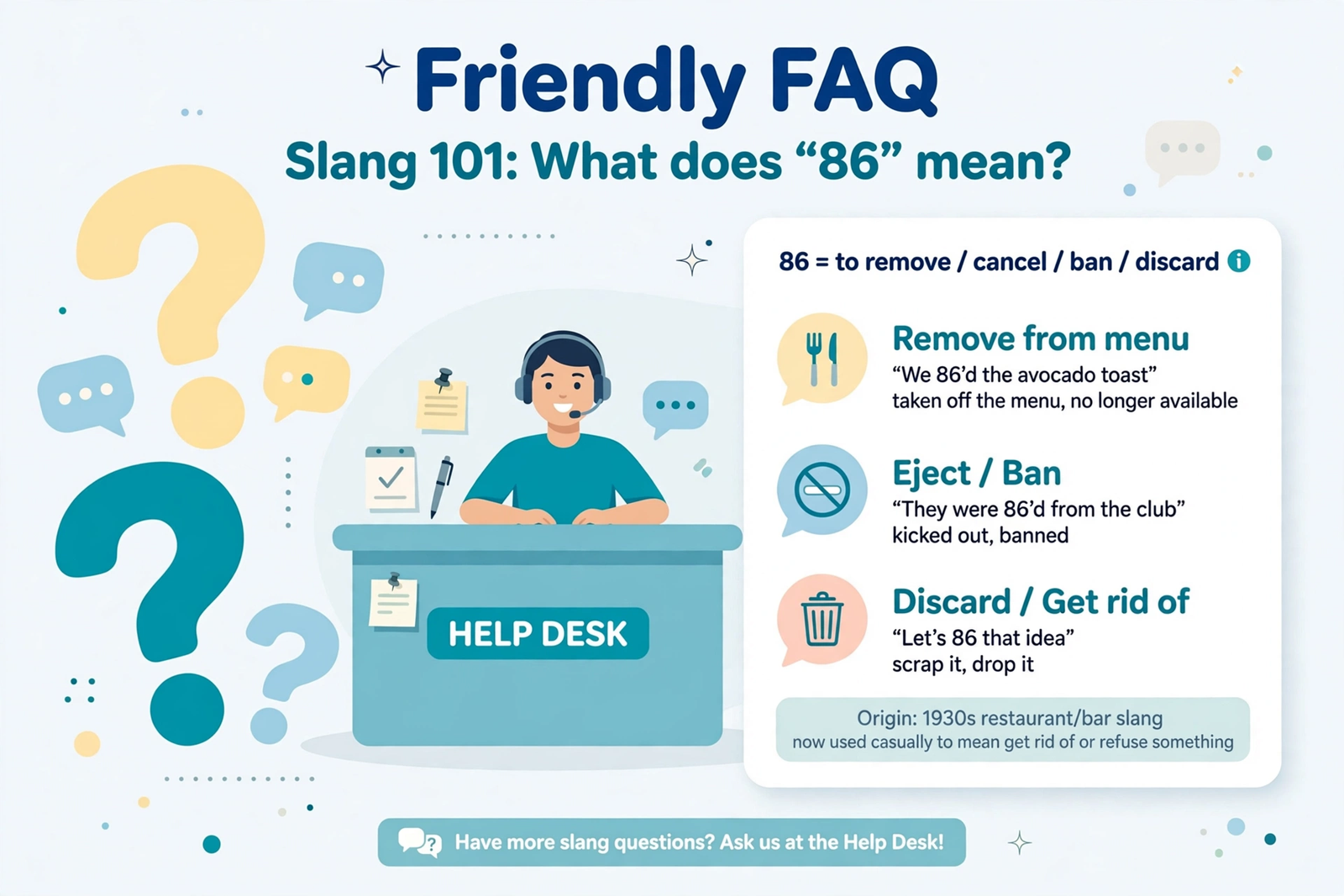
In slang, 86 means to remove, cancel, or get rid of something. A dish is 86’d when it sells out, a plan is 86’d when it is cancelled, and a person is 86’d when they are kicked out of a bar or restaurant and refused service.
Where did 86 come from?
86 comes from American restaurant and soda-fountain slang of the early 1930s. The exact origin is unknown, but the most supported theory is that it is rhyming slang for “nix” (meaning “no” or “nothing”). Other popular stories link it to Chumley’s speakeasy at 86 Bedford Street in New York, or to Article 86 of the New York liquor code.
What does it mean to be 86’d from a bar?
To be 86’d from a bar means you have been kicked out and banned from coming back, usually for bad behavior such as fighting, harassing staff, or being dangerously drunk. Many bars keep an 86 list, and a ban can last months or even a year.
What does 86 mean in a restaurant?
In a restaurant, 86 means an item is no longer available. When the kitchen runs out of a dish or an ingredient, the chef calls “86” so the waitstaff stops taking orders for it. It is standard kitchen language, not an insult.
Is 86 rude to say?
86 is blunt but not usually rude among friends or coworkers in casual settings. It can sound harsh if you say it about a person, especially to their face. In formal or customer-facing situations, use “cancel,” “remove,” or “no longer available” instead.
What is the difference between 86 and cancel?
Cancel is neutral and formal; 86 is casual, sharp, and final. You cancel a meeting in an email, but you 86 a plan in a group chat. Both mean the thing is off, but 86 carries more attitude and sounds like a decision that will not be revisited.
Do people still use 86 today?
Yes. 86 is still used daily in restaurants and bars, and it has spread into texting, TikTok, memes, and everyday speech. Its age — about ninety years — makes it one of the longest-surviving slang terms in American English.
What does 86’d mean on TikTok?
On TikTok, 86’d usually means cancelled, rejected, or removed. Creators say things like “86 that trend” or “he got 86’d” to mean an idea was dropped or a person was cut off. The meaning is the same as the restaurant original, just applied to online life.
Conclusion
The 86 meaning slang is one of those rare slang terms that has earned its place in the language. Born in the soda fountains and kitchens of 1930s America, it gave busy workers a one-word way to say “it’s gone.” Ninety years later, it still does the same job — in restaurants, in group chats, on TikTok, and in everyday conversation.
Remember the core idea and you will never misuse it: 86 means remove, cancel, or refuse. A dish is 86’d when it sells out. A plan is 86’d when it is dropped. A person is 86’d when they are shown the door. Use it with friends and in casual settings, switch to “cancel” or “no longer available” when things get formal, and never confuse it with adding or including something.
Next time you hear a chef shout “86 the special” or a friend text “86 that idea,” you will know exactly what is happening: something is being removed, decisively and without debate. And if you want to keep building your slang vocabulary, our guides to cap, mid, and based are a great place to continue. For the full dictionary history of the term, see the Wikipedia entry on 86.
