
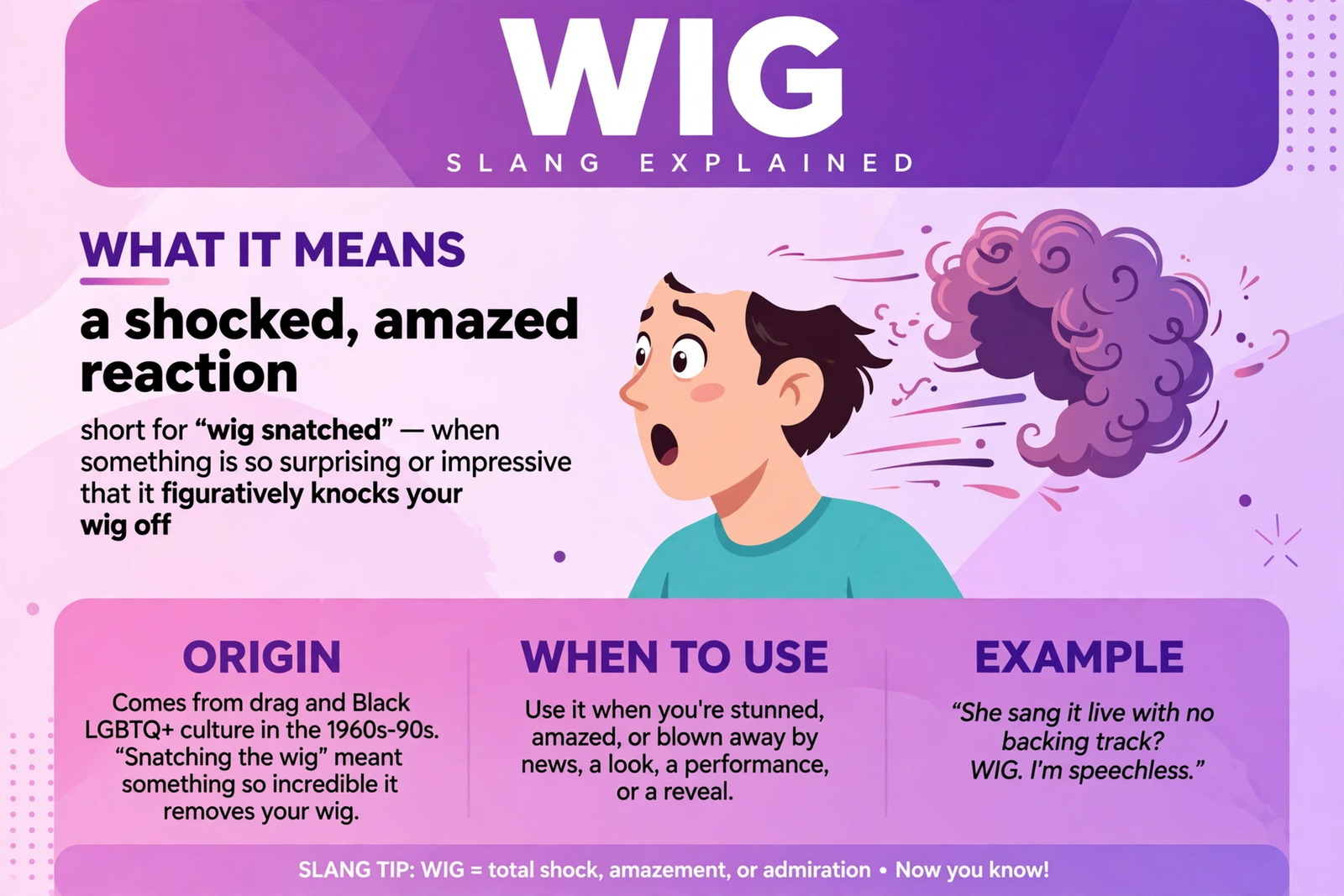
Quick Definition: In slang, “wig” is a one-word exclamation of shock, amazement, or pure admiration. When someone says “Wig!” they mean something was so impressive, surprising, or unbelievable that it figuratively blew their wig clean off their head. It is short for “wig snatched,” and it is the internet’s favourite way of saying “I am shook” in a single syllable.
What Does Wig Mean Slang? Meaning & Definition
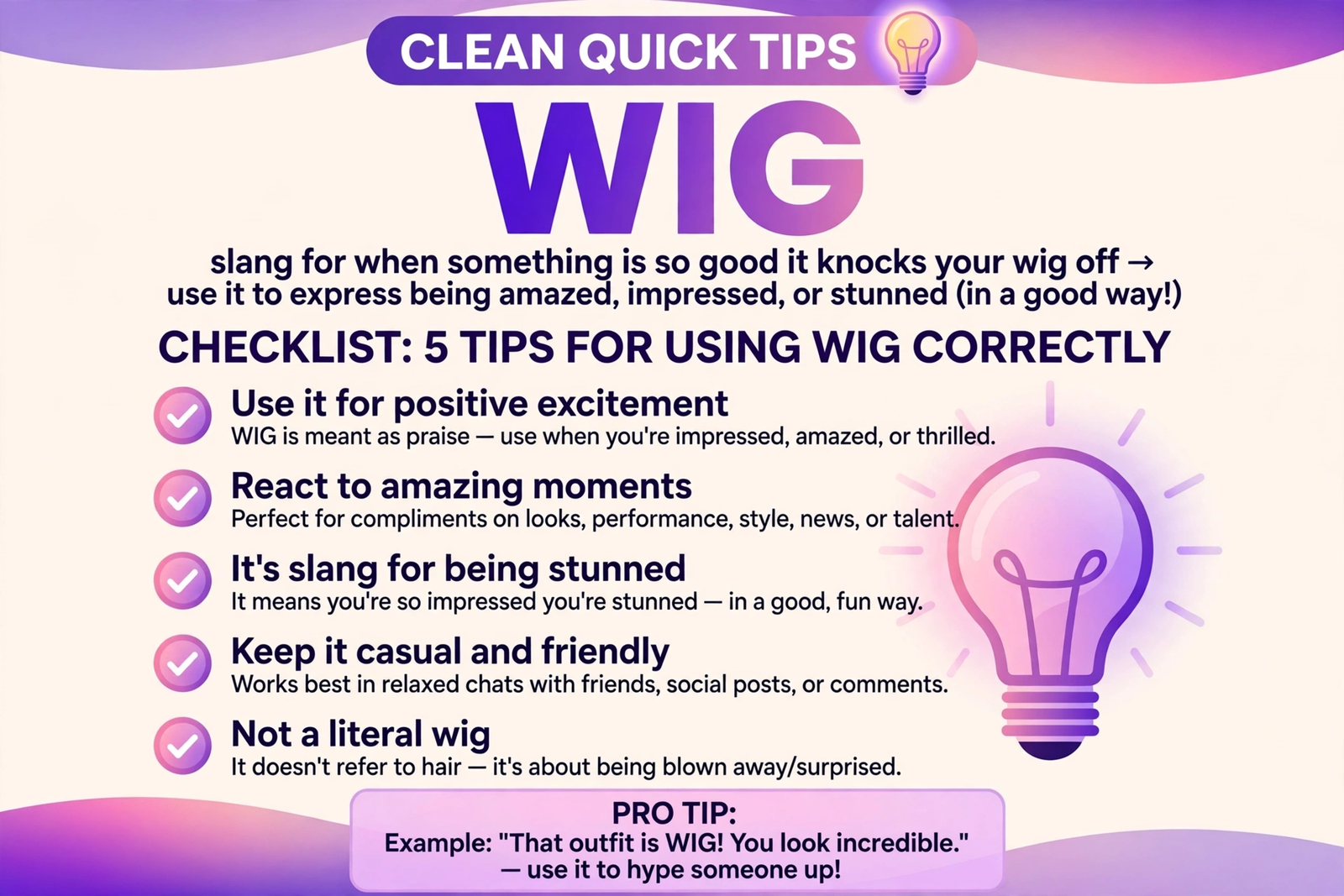
So, what does wig mean slang exactly? At its core, “wig” means “mind-blown.” It is what you say when a performance, a look, a plot twist, or a piece of news is so good that your normal words cannot keep up. The image behind it is simple and funny: imagine being so stunned that the hairpiece on your head flies off. That is the feeling “wig” captures in three letters.
Unlike most slang, “wig” is almost always positive. You would not say “wig” about something boring or disappointing. You say it when someone’s talent, outfit, comeback, or reveal leaves you speechless in the best possible way. A singer hitting an impossible note? Wig. Your friend’s glow-up photos? Wig. A plot twist you never saw coming? Wig.
Grammatically, “wig” is flexible. It works as a standalone exclamation (“Wig!”), as part of the phrase “wig snatched” (“That performance snatched my wig”), or as a verb phrase like “wig flew” (“My wig flew across the room”). In every form, the meaning stays the same: shock, awe, and admiration, turned up to the maximum.
It is also worth knowing what “wig” does not mean. It is not an acronym, it is not a secret code, and it has nothing to do with actual hair products when used as slang. People sometimes guess it stands for something like “With Incredible Grace,” but that is a backronym invented after the fact. The real story is much more interesting — and it starts in the ballroom.
Introduction
Scroll through TikTok comments for five minutes and you will find it: a single word, standing alone, carrying a whole paragraph of emotion. “Wig.” No explanation, no emoji, no follow-up needed. Everyone in the comments understands exactly what it means — that whatever just happened was so incredible it broke the scale.
That is the power of “wig” in modern slang. It travelled from the drag balls of the 1980s and 1990s to Black queer culture, then to stan Twitter, then to TikTok, and finally into everyday group chats around the world. Along the way it picked up millions of users, a shout-out from Katy Perry on American Idol, and a permanent place in the Gen Z vocabulary.
This guide explains what does wig mean slang in full: the exact definition, where it came from, how it exploded online, and how to use it yourself without sounding forced. You will get real examples for friendly, professional, and funny situations, a comparison with similar words like slay and “shook,” the alternate meanings people confuse it with, the mistakes to avoid, and answers to the eight questions people search for most. Whether you saw “WIG!” under a celebrity post or heard a friend say their wig was snatched, you will leave knowing exactly what it means.
Origin
The slang use of “wig” was born in Black queer ballroom culture in the 1980s and 1990s. In ballroom, drag performers competed in categories like vogue, face, and realness, wearing elaborate wigs as part of show-stopping looks. When a performer was so fierce, so flawless, or so unexpected that the audience lost control, people said their “wig was snatched” — as if the sheer force of the performance had ripped the wig right off someone’s head.
The phrase “wig snatched” became the ultimate compliment in ballroom. It meant the performer had done something unforgettable. Over time, the community shortened it. First to “snatched my wig,” then to “my wig,” and eventually to just “wig” — a single word that still carried the whole compliment.
The term spread through LGBTQ+ nightlife, then onto early YouTube and Tumblr, where drag and ballroom clips reached wider audiences. A famous 2009 moment helped: a Brazilian drag queen had her wig pulled off on live television after losing a competition, and the clip became one of the early viral “wig snatched” moments online. From there, the phrase kept travelling.
The literal word “wig” is much older. It is a clipping of “periwig,” which came from the French “perruque,” and it entered English around 1675. For centuries it meant only one thing: a head of real or synthetic hair worn for fashion, disguise, or performance. The slang meaning flipped that on its head — the wig stopped being a hairpiece and became a measure of how hard something hit you.
Popularity
“Wig” went mainstream in stages. Stan culture on Twitter adopted it first: fans of pop stars like Beyoncé, Lady Gaga, and Nicki Minaj started replying “wig” to every iconic photo, performance, or announcement. If your favourite artist did something legendary, the correct response was not a paragraph — it was “wig.”
The first Urban Dictionary definition of “wig” with this slang meaning was submitted on November 28, 2017, and it framed the term as shorthand for something so incredible it makes another person’s wig fly off. That definition captured the moment the word moved from a niche community phrase to a general internet reaction. Know Your Meme traces the full journey of the term, from its roots in African American Vernacular English and ballroom culture to its explosion in stan culture and mainstream media.
Then came the celebrity boost. In 2018, Katy Perry told an American Idol contestant, “Wig, I feel that,” on live television. Millions of viewers heard a pop superstar use a piece of ballroom slang on a family show, and searches for the term spiked. After that, “wig” was no longer insider language — it was pop culture.
TikTok finished the job. From 2019 onward, “wig” became a standard comment under dance videos, glow-ups, makeup transformations, and celebrity moments. Gen Z users loved it because it was short, dramatic, and funny — the perfect reaction word for a platform built on quick, emotional responses. Today it sits comfortably alongside words like “slay,” “ate,” and “no cap” in the everyday slang toolkit, and it shows no signs of fading, because the feeling it describes — being genuinely blown away — never goes out of style.
How It Is Used
“Wig” is used as a reaction, not a description. You do not use it to describe an ordinary thing; you use it in the moment something impresses you. The most common form is the standalone exclamation, usually typed in all caps for extra drama: “WIG!”
The second most common form is the “snatched” construction. “That outfit snatched my wig” means the outfit was so good it overwhelmed you. Variations include “my wig flew,” “wig gone,” and “wig is in orbit,” each one raising the drama a level — if your wig is in orbit, you are not just impressed, you are beyond impressed.
You will also see “wig” used as an adjective-like burst in longer sentences: “Wig, that performance was unreal,” or “The finale? Wig. That’s all I have to say.” In group chats, it often appears as the entire reply to a photo or video. No further explanation is needed because everyone knows what it means.
Context matters. “Wig” belongs in casual, fun, online, and friendly settings — TikTok comments, Twitter replies, Instagram captions, and group chats with people your own age. It is a celebration word, so it fits moments of praise, surprise, and delight. It does not fit serious, sad, or formal situations, and it sounds strange in professional emails or messages to people who do not use internet slang.
Examples
The best way to understand “wig” is to see it in real conversations. Here are examples grouped by tone, so you can see how the same word flexes across different situations.
Friendly Examples
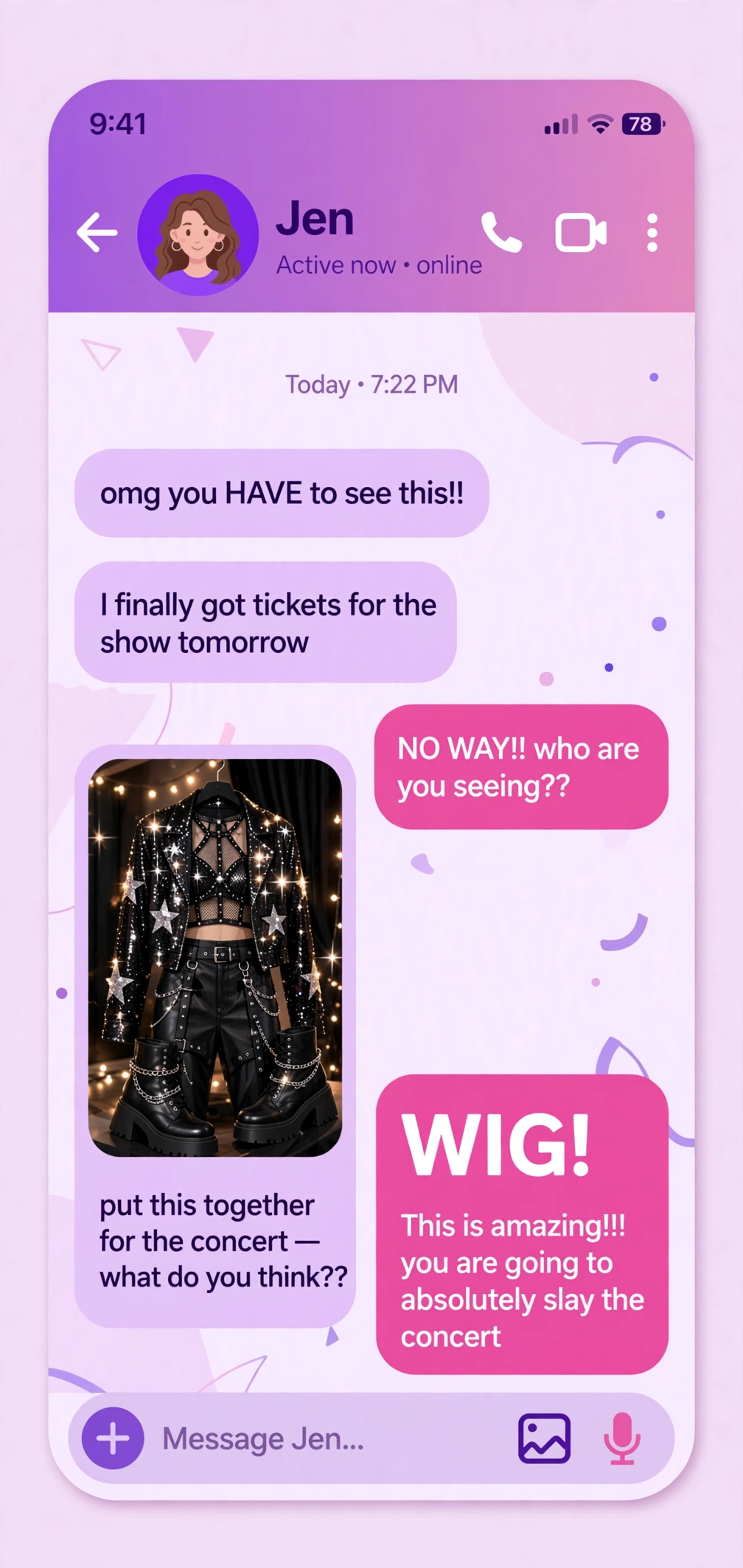
- Friend: “I just got tickets to the Billie Eilish concert.” You: “Omg, wig!”
- Friend: “Look at my new haircut, what do you think?” You: “Wig. You look unreal.”
- Group chat: “She just announced her album drops Friday.” Everyone: “WIG!!!”
- Friend: “I passed my driving test on the first try!” You: “Wig, I knew you had it in you.”
Professional Examples
Slang rarely belongs at work, but creative and social-media jobs are the exception. A social media manager might comment “Wig” on a creator’s post, or a colleague in a casual team chat might use it after a great presentation. Still, keep it out of formal emails, client messages, and meetings with senior managers. If you would not say “that was fire” in the same room, do not say “wig” there either.
- Team chat: “The launch video just hit a million views.” Colleague: “Wig, that edit was unreal.”
- Creator comment: “This campaign is the best thing your brand has ever done. Wig.”
Funny Examples
- “My wig flew clean off when I saw the plot twist. I need a minute.”
- “He walked in with that outfit and my wig is currently in orbit. NASA, please return it.”
- “Wig. I have watched this performance twelve times and I am still not okay.”
- “That comeback was so good my wig filed for divorce and left.”
| Situation | What you say | What it means |
|---|---|---|
| A friend shows a stunning photo | “Wig!” | You look amazing, I am shook |
| A singer hits an impossible note | “My wig flew” | That was unbelievably good |
| A plot twist shocks everyone | “Wig snatched” | I did not see that coming at all |
| A celebrity posts a surprise album | “WIG!!!” | I am losing my mind with excitement |
| Someone’s comeback is perfect | “Wig, that was iconic” | That was flawless and unforgettable |
Comparison with Similar Terms
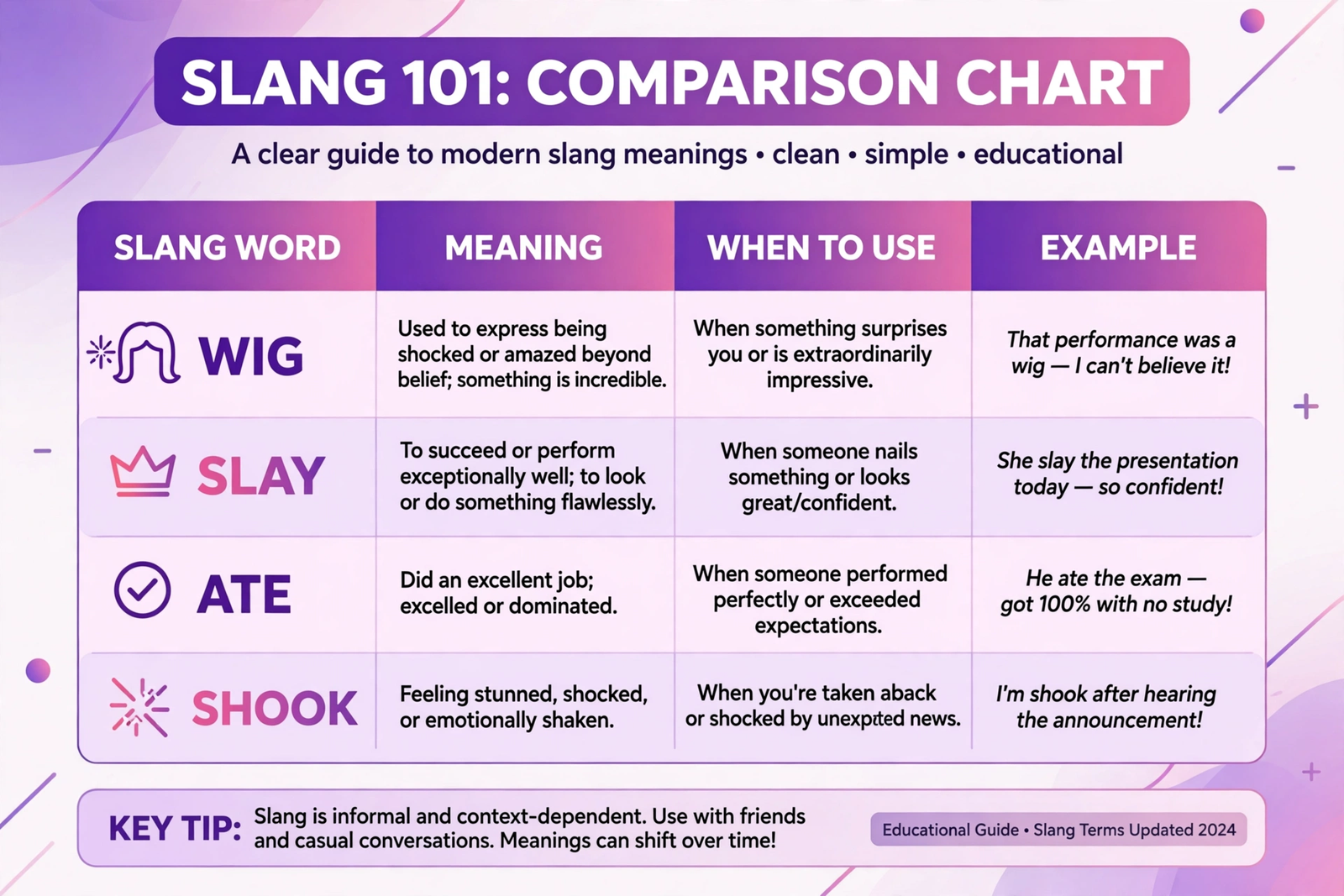
“Wig” overlaps with several other slang words, but each one has its own flavour. Knowing the difference helps you pick the right word for the moment — and stops you from using them all as if they were the same.
| Term | Core meaning | When to use it | How it differs from “wig” |
|---|---|---|---|
| Wig | Shock and amazement | Something blows your mind | The reaction itself; pure shock |
| Slay | To do something flawlessly | Someone performs or looks perfect | Praises the person’s skill, not your shock |
| Ate | To perform extremely well | Someone “ate that” performance | Focuses on the performance, not the reaction |
| Shook | Shocked or stunned | Any surprising news, good or bad | Works for bad surprises too; “wig” is positive |
| No cap | Honestly, no lie | Emphasising that you mean it | About truth, not amazement |
| Periodt | End of discussion | Closing a statement with finality | About confidence, not surprise |
| GOAT | Greatest of all time | Calling someone the best ever | A title for a person, not a reaction |
The closest cousins are “slay” and “ate.” If your friend nails a dance routine, you might say they “ate” it, they “slayed” it, or simply “wig” — all three work, but “wig” says the most about how you felt watching it. It is the audience’s reaction, while “slay” and “ate” describe the performer’s achievement. That is why comments often stack them: “She ate, she slayed, wig!” — a triple compliment that covers every angle.
“Shook” is the other word people confuse with “wig.” The difference is direction: “shook” can describe a bad shock (a scary plot twist, bad news), while “wig” is almost always a happy shock. If the news is terrible, say you are shook. If it is incredible, say wig.
Alternate Meanings
“Wig” has several other meanings, and context is everything. Here are the main ones you might run into.
The literal hairpiece
The original meaning is still the most common one in everyday life: a wig is a head of real or synthetic hair worn for fashion, disguise, medical reasons, religious observance, or performance. Actors, cancer patients, cosplayers, and drag performers all wear wigs. If someone says “I bought a new wig,” they almost certainly mean the hairpiece, not the slang.
“Wig out” — to freak out
“Wig out” is older American slang meaning to lose control, panic, or behave erratically. “Don’t wig out, we still have time,” means “don’t freak out.” This use comes from 1960s counterculture slang and is related to the same image — losing your head, or your hair, over something. It can describe excitement, anger, or anxiety, so the tone depends entirely on context.
WIG — Wildly Important Goal
In business, WIG stands for “Wildly Important Goal,” a concept from the book The 4 Disciplines of Execution by Chris McChesney, Sean Covey, and Jim Huling. A WIG is the one goal a team must achieve above all others. If you see “WIG” in all caps in a corporate document, it means this — not the slang.
To “wig” someone — an old insult
In old British slang, “to wig” someone meant to scold or reprimand them sharply. This use is rare today and mostly appears in historical novels. If you hear it in a period drama, that is what it means — not a compliment.
Regional and niche uses
In some UK street slang, “wigging” has been used to mean acting crazy or losing your temper, close to “wig out.” In gaming and stan communities, “wig” occasionally appears as a verb — “she wigged the whole arena” — meaning she stunned everyone. These uses are uncommon, but they all trace back to the same idea: something so intense it knocks your hair off.
Professional or Polite Alternatives
“Wig” is fun, but it is not for every room. Here are polished ways to express the same feeling when the situation calls for it.
| Instead of “wig” | Say this | Best for |
|---|---|---|
| “Wig!” | “That was absolutely incredible.” | Work messages, formal chats |
| “My wig flew” | “I was completely blown away.” | Emails, presentations |
| “Wig snatched” | “That exceeded every expectation.” | Reviews, professional feedback |
| “WIG!!!” | “I am genuinely speechless — in the best way.” | Client messages, public comments |
| “Wig, that was iconic” | “That was truly outstanding.” | Speeches, congratulations |
The rule is simple: use “wig” with friends and online, and use the alternatives with colleagues, clients, teachers, and anyone older who might not know the slang. The feeling is the same; only the packaging changes. And if you are ever unsure whether “wig” fits the room, it probably does not — save it for the group chat.
Common Mistakes
“Wig” is easy to use, but people still get it wrong. Here are the mistakes to avoid.
Using it for bad news
“Wig” is a positive reaction. Saying “wig” when someone shares sad or shocking bad news sounds tone-deaf, because it reads as excitement. For bad surprises, use “shook,” “no way,” or “I can’t believe that” instead.
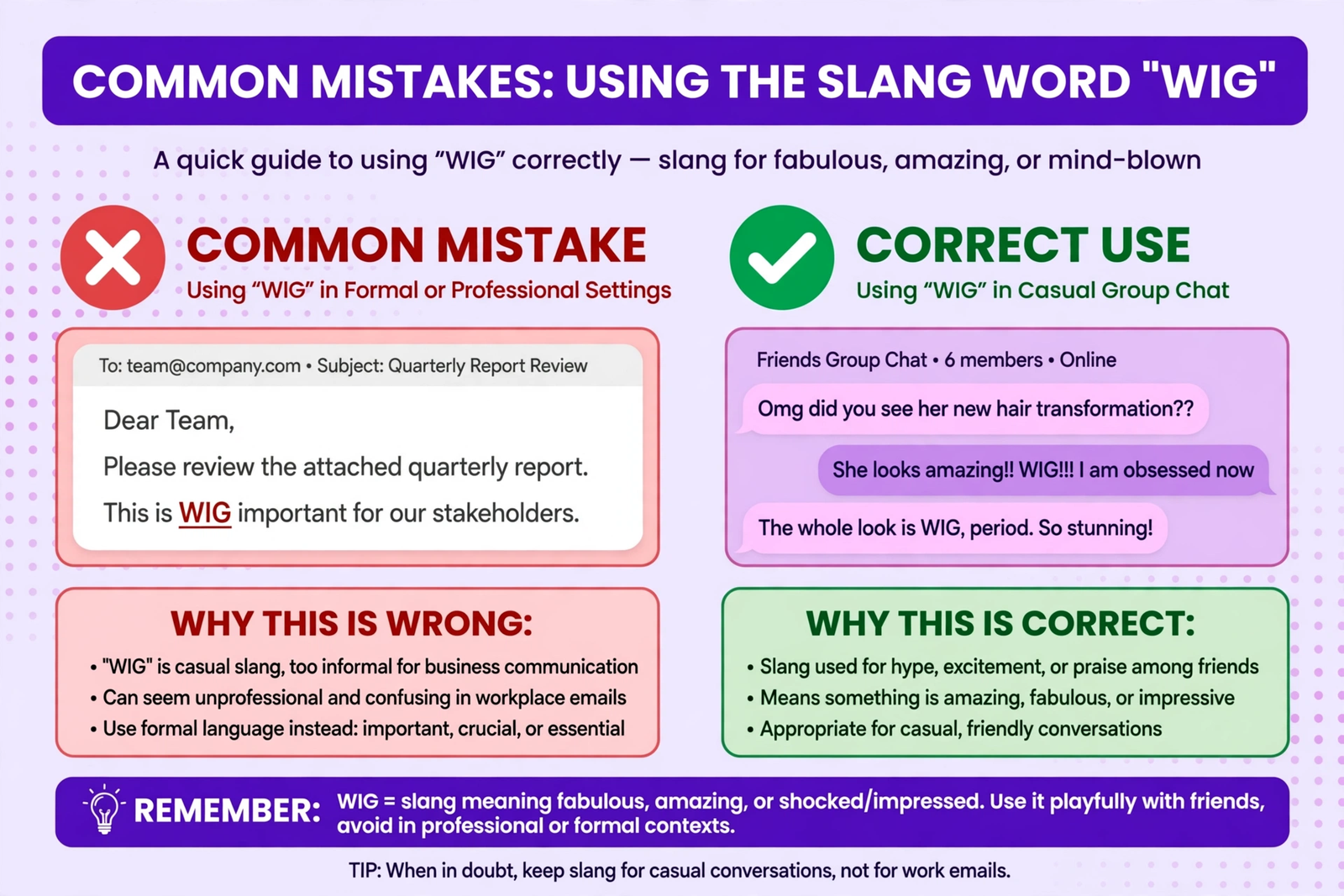
Forcing it into formal settings
Dropping “wig” into a work email, a job interview, or a message to your grandmother will confuse people at best and look unprofessional at worst. Slang works when the audience shares it. If they do not, plain language wins.
Overusing it until it means nothing
If every photo, every song, and every sandwich gets a “wig,” the word loses its power. “Wig” works because it signals something exceptional. Save it for the moments that genuinely impress you, and it will hit much harder.
Confusing it with the hairpiece
In mixed company, “wig” without context can be misunderstood. “I lost my wig over that show” is clearly slang to a Gen Z listener, but an older relative might think you literally lost a hairpiece. A little context — “my wig flew, that performance was insane” — removes all doubt.
Claiming it stands for something
“Wig” is not an acronym. Guessing that it stands for “With Incredible Grace” or something similar is a common mistake, and it will get corrected fast in any comments section. The word comes from ballroom culture and the image of a wig flying off — that is the whole story, and it is a better one than any backronym.
Using it without crediting where it came from
“Wig” comes from Black queer ballroom culture. Using the word is fine — slang is meant to be shared — but using it while mocking or dismissing the community that created it is not. Respect the roots, and the word keeps its meaning.
Quick Tips
- Use it as a reaction, not a description. “Wig” answers something impressive; it does not describe an ordinary object or event.
- All caps means more feeling. “Wig” is impressed. “WIG!!!” is losing your mind. Match the caps to the moment.
- Pair it with the reason. “Wig, that high note!” is clearer and funnier than “wig” alone.
- Stack it with slay and ate for a full compliment. “She ate, she slayed, wig” is the internet’s version of a standing ovation.
- Keep it casual. Group chats, TikTok comments, and stan Twitter are its natural home. Formal settings are not.
- Save it for the exceptional. The rarer you use it, the more it means when you do.
- Know the phrase behind it. Saying “wig snatched” or “my wig flew” shows you understand the slang, not just the word.
- Watch the tone. “Wig” is celebration. If the moment is sad, serious, or bad news, pick a different word.
FAQ
What does wig mean in slang?
In slang, “wig” means shock, amazement, or admiration. It is short for “wig snatched” — the idea that something was so impressive it figuratively blew your wig off your head. People say “Wig!” as a one-word reaction to something incredible, like a great performance, a stunning outfit, or a shocking plot twist.
What does “wig snatched” mean?
“Wig snatched” means something was so good or so shocking that it overwhelmed you completely. It comes from ballroom culture, where a “snatched wig” was the highest compliment a performer could receive. Today it means the same thing online: “that was unforgettable.”
Where did wig slang come from?
Wig slang originated in Black queer ballroom culture in the 1980s and 1990s, where drag performers’ wigs were part of show-stopping looks. It spread through LGBTQ+ nightlife, then to stan Twitter and TikTok, and went fully mainstream after Katy Perry used it on American Idol in 2018.
Is wig slang offensive?
No, “wig” itself is not offensive. It is a positive, celebratory word. The only sensitivity is about its roots: it comes from Black queer ballroom culture, so use it with respect for that community and do not use it to mock the culture that created it.
What does “wig” mean on TikTok?
On TikTok, “wig” is a comment people leave under videos that amaze them — dance routines, glow-ups, makeup transformations, and celebrity moments. A single “WIG!” in the comments means the video blew the viewer’s mind, and it is one of the most common reaction words on the platform.
What is the difference between wig and slay?
“Slay” praises the person’s skill or look — they did something flawlessly. “Wig” describes your reaction — you were so impressed your metaphorical wig flew off. They often appear together (“she slayed, wig!”) because one celebrates the performance and the other celebrates the feeling it caused.
What does “wig out” mean?
“Wig out” means to freak out, panic, or lose control — for example, “Don’t wig out, we still have time.” It is older American slang from the 1960s and can describe excitement, anger, or anxiety depending on context. It is different from the one-word exclamation “wig,” which is always positive amazement.
Does WIG stand for anything?
As slang, no — “wig” is not an acronym. It comes from the literal hairpiece and the ballroom phrase “wig snatched.” The only common acronym is in business, where WIG stands for “Wildly Important Goal” from the book The 4 Disciplines of Execution. That meaning has nothing to do with the slang.
Conclusion
So, what does wig mean slang? It is the internet’s shortest standing ovation: one word that says “that was so incredible I am still processing it.” Born in the ballrooms of the 1980s and 1990s, carried by stan culture and TikTok, and sealed into pop culture by a Katy Perry shout-out, “wig” turned a hairpiece into a universal reaction.
The key takeaways are simple. Use “wig” when something genuinely amazes you, and save it for moments that deserve it. Remember it is short for “wig snatched,” so phrases like “my wig flew” and “wig is in orbit” are all part of the same family. Keep it casual and positive, avoid it for bad news or formal settings, and respect the Black queer ballroom culture that created it.
Slang moves fast, but “wig” has already survived four decades, three platforms, and a trip to mainstream television — because the feeling it names never gets old. Next time something leaves you speechless in the best way, you know the word. And if you want to keep decoding the comments section, explore related guides like snatched meaning slang, ate slang meaning, and GOAT slang — your group chat will never confuse you again.

1 thought on “What Does Wig Mean Slang? 7 Shocking Uses, Origin & Real Examples”